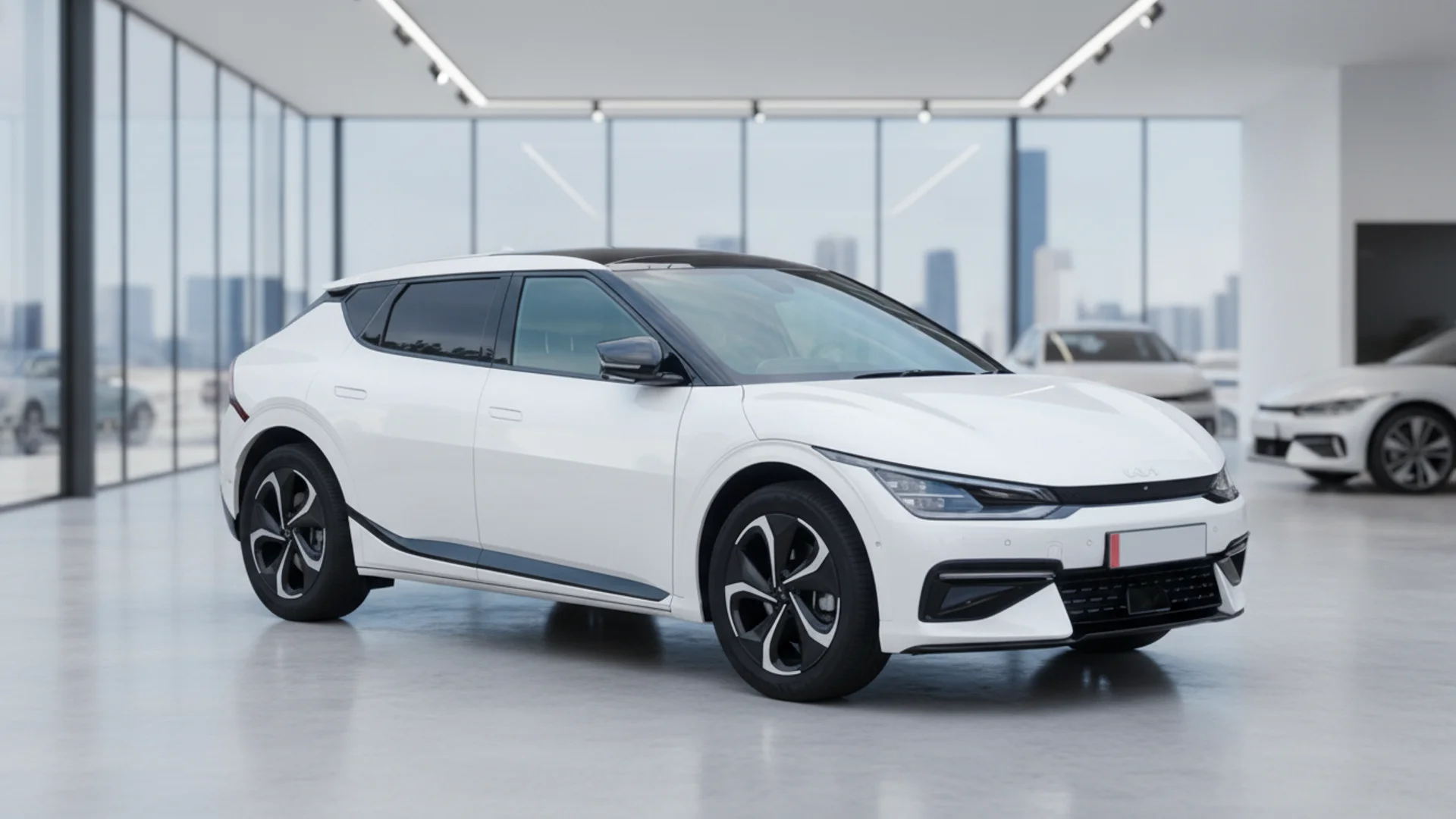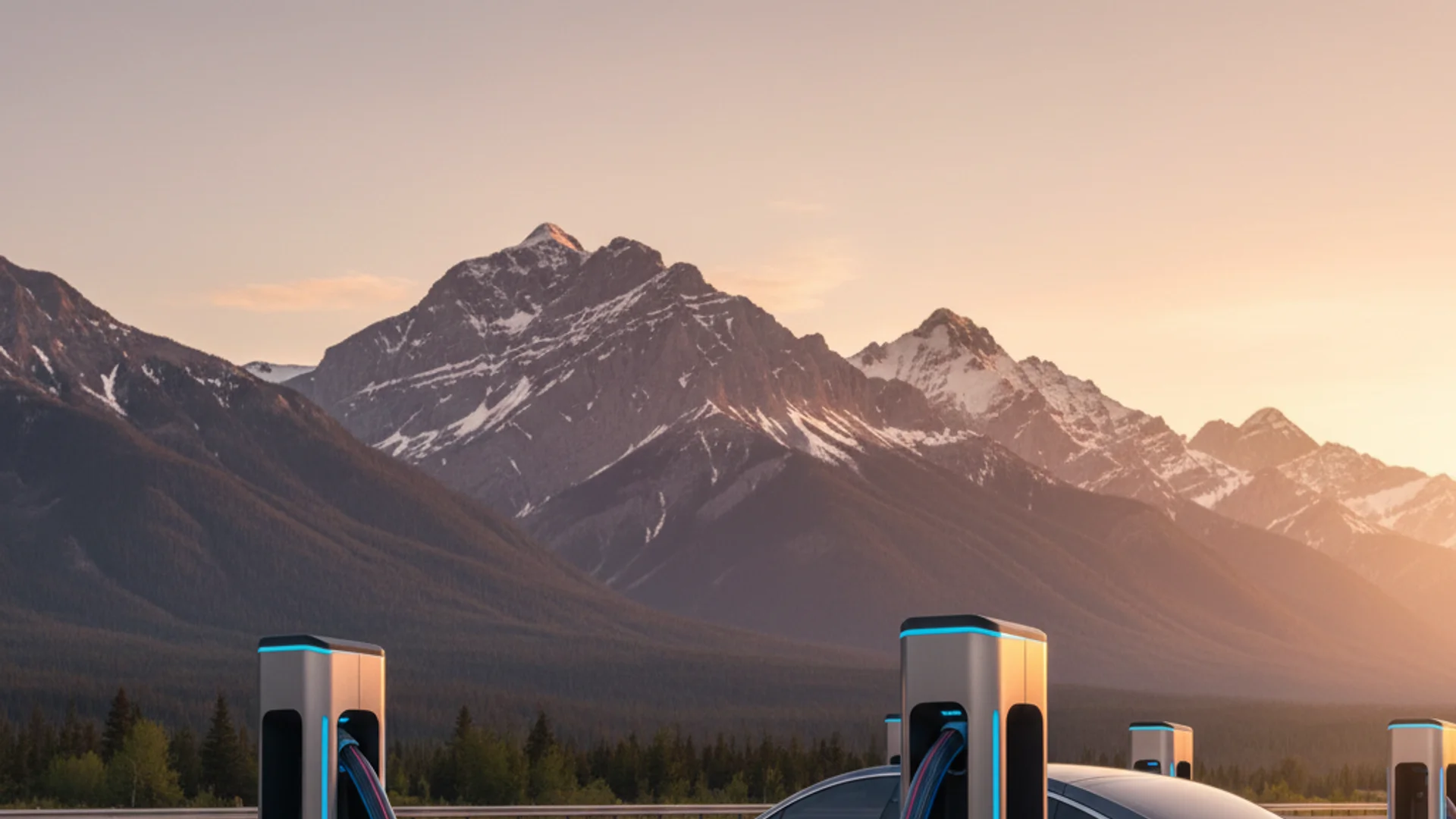
A 350 kW charger and a 50 kW charger can sit under the same parking-lot sign, share the same logo, accept the same payment card, and deliver wildly different outcomes to the driver pulling in. The architectural gap between those two numbers, not the marketing tier they share, is what determines whether a Trans-Canada drive actually works in February.
The way Tesla solved the corridor problem, and the way the rest of the industry didn't until roughly 2021, is by reading DC fast charging as a network design question first and a hardware question second. Most of the Canadian public-charging buildout did the opposite. It treated Level 3 as the next rung on a marketing ladder above Level 2, picked a power rating that looked respectable on a press release, and bolted the unit to a parking lot.
That sequencing is why a Hyundai IONIQ 5 capable of accepting 230 kW routinely sips at 50 kW somewhere west of Thunder Bay. The vehicle was engineered for a corridor that doesn't quite exist yet. The corridor was engineered for a vehicle that doesn't quite exist anymore.
This is a piece about what the engineering choices behind Level 3 charging actually mean, why "Level 3" is a confusingly broad category that hides a 7× spread in real throughput, and how the Canadian network's installation history shapes the experience a 2026 buyer is going to have on the highway tomorrow. Natural Resources Canada frames the technology cleanly: there are two main types of EV chargers, AC and DC, and DC chargers, also called fast chargers, are Level 3 chargers that provide direct current electricity to the vehicle. That definition is correct and useless in equal measure. The interesting layer is underneath.
Key takeaways
- A 350 kW and 50 kW charger can share the same logo yet deliver a 7× difference in real throughput.
- DC fast chargers convert AC power in the parking-lot cabinet, bypassing your car's onboard charger entirely.
- Canada's 2018–2022 buildout installed 50 kW highway units that will underserve 800 V vehicles for the next 15 years.
- CHAdeMO is being retired by FLO, Petro-Canada, and Electrify Canada, effectively dead by 2028.
- NACS adoption by Ford, GM, Hyundai-Kia, and others means CCS1 owners need adapters to access Superchargers today.
Why DC Fast Charging Is a Different Technology Category
The conventional framing treats Level 1, Level 2, and Level 3 as a single ladder of "speed." That framing is wrong, and it produces wrong expectations.
Level 1 and Level 2 charging hand the conversion job to the vehicle. AC power flows from the wall through the cord, into the onboard charger inside the car, and only then becomes the DC current the battery pack can actually store. The onboard charger's capacity, typically 7.2 kW, 11 kW, or in a few cases 19.2 kW, is the real ceiling. A Level 2 wall unit rated at 48 amps is delivering exactly what an 11 kW onboard charger can ingest, and not a watt more.
DC fast charging skips that handoff entirely. The conversion happens in the cabinet on the parking lot, not in the car. Current arrives at the battery pack already in DC form, bypassing the onboard charger's bottleneck and answering directly to the battery management system. This is why Level 3 stations are physically larger, demand three-phase 480 V commercial service, and carry installation costs in the $50,000 to $200,000 range. They're substations dressed as parking signage.
Car and Driver's primer on charging levels covers the same hierarchy from Level 1 home charging up through Level 3 fast charging, but the more useful read is on the architectural break, not the speed jump. Once you understand that DC chargers are talking directly to the pack, the rest of the strangeness, why a 350 kW station gives an older Nissan Leaf only 50 kW, why a Chevrolet Bolt seems to "ignore" most of the cabinet's capacity, stops being strange.
The case against treating DC fast charging as a categorically separate technology is reasonable on its face: a driver doesn't care which side of the cord the AC-to-DC inverter sits on, only how many minutes they spend at the cabinet. The reason that argument fails in practice is that the location of the inverter dictates everything else, the cost curve, the siting requirements, the rate of capability improvement, and the upper bound on what a vehicle can ever accept. Pretending the categories are continuous is how Canadian procurement teams ended up specifying 50 kW units for highway corridors that will be servicing 800 V vehicles for the next fifteen years.
The original Chevrolet Bolt shipped with standard SAE J1772 plugs for Level 1 and Level 2 AC charging, with DC fast charging via the CCS1 connector offered only as a factory option. That's the inversion move embedded in the spec sheet. GM treated DC fast charging as an upsell on a car designed primarily for urban commuting. Hyundai and Kia, three years later, treated it as the core engineering brief and built the E-GMP platform around 800 V architecture. Those are two genuinely different worldviews about what an EV is for, expressed through which charging port is standard versus optional.
The DC-fast-as-corridor philosophy is the one Canada needs. The DC-fast-as-upsell philosophy is what got installed across most of the country between 2018 and 2022.
The Connector Landscape: CCS1, CHAdeMO, and the NACS Shift
A connector is a piece of plastic and metal. It is also a thesis about how an industry should organize itself.
CCS1, Combined Charging System, North American variant, is the de facto Canadian standard. Virtually every non-Tesla EV sold in Canada since 2020 uses it: the Hyundai IONIQ 5 and 6, Kia EV6 and EV9, Ford Mustang Mach-E and F-150 Lightning, Chevrolet Bolt and Equinox EV, Volkswagen ID.4, Polestar 2, Mercedes EQS, and the entire BMW i-series lineup. CCS1 is a cross-industry compromise, the SAE J1772 AC port with two additional DC pins bolted underneath. It's not elegant. It is open, standardized, and the result of carmakers agreeing on a baseline.
CHAdeMO is the other story. Developed by a Japanese consortium that included Nissan, Mitsubishi, and Toyota in the early 2010s, CHAdeMO was technically capable and culturally isolated. North America never adopted it broadly. Today it survives almost exclusively on older Nissan Leafs and a small number of Mitsubishi i-MiEV and Outlander PHEV variants. Network operators across Canada, FLO, Petro-Canada, Electrify Canada, are progressively retiring CHAdeMO hardware as those vehicle populations age out. By 2028 it will be a footnote.
Tesla's NACS connector, now formally SAE J3400, is the third entrant, and it's the connector with the most narrative momentum. Ford, GM, Rivian, Volvo, Polestar, Honda, and Hyundai-Kia have all announced NACS adoption on future model years. The Supercharger network's reliability advantage was the lever. The adapter ecosystem is the friction. A 2025 IONIQ 5 with a CCS1 port can plug into a Supercharger today only with a Hyundai-supplied NACS adapter, and the handshake protocol has to negotiate cleanly for the session to start.
The contrarian read on NACS is that the industry has talked itself into a connector swap that solves a problem the open standard had already begun resolving, Electrify Canada's reliability numbers have climbed steadily since 2023, plug-and-charge protocols are spreading across CCS1 hardware, and the second-mover networks have largely closed the user-experience gap that made the Supercharger network the obvious benchmark in the first place. The counter-reading, which is the one I'd bet on, is that single-vendor accountability for the entire stack, connector, cabinet, software, billing, produces a maintenance discipline that committee-driven standards struggle to replicate. The proof point will be how the converted networks behave in 2027, after the first full winter of mixed-fleet sessions at scale.
The spec-as-philosophy move here is unavoidable. CCS1 reflects open standards, cross-industry committees, and the assumption that a charging network is shared infrastructure. NACS reflects vertical integration, single-vendor reliability, and the assumption that the network is part of the product. Both views have merit. Canada's installed base committed to the first view a decade ago and is now retrofitting toward the second.
For a 2026 Canadian buyer, the practical answer is: the car you buy will have CCS1 or NACS, both standards are being supported at major Canadian networks via adapters and dual-port hardware, and the connector itself is no longer the variable to worry about. The variable is the cabinet behind it. The way Tesla and EVgo's 1,000 new fast chargers are reshaping the network is more about cabinet density than connector politics.
Gear worth having
As an Amazon Associate, ThinkEV earns a small commission from qualifying purchases — at no extra cost to you.

Lectron Level 2 J1772 Charger (40A, WiFi)
Smart WiFi charger with real-time energy monitoring. 40A / 9.6 kW, J1772 with a NEMA 14-50 plug, schedule charging right from your phone.
As an Amazon Associate, ThinkEV earns from qualifying purchases — at no extra cost to you.
Power Curves, Thermal Management, and What 'Peak kW' Actually Means
Peak kW is the number on the press release. It is almost never the number a driver experiences for more than a few minutes.
Every modern EV charges along a curve, not a flat line. The pack accepts the highest power rate in a narrow state-of-charge window, typically 10% to 35% SOC, and then tapers as the cells fill. Above 50% SOC, the curve has already begun its descent. By 80% it is a fraction of its peak. By 95% the vehicle is sipping at AC-charging speeds, which is precisely why every road-trip planner recommends stopping at 80%.
A Hyundai IONIQ 6 with the right pack temperature, on a 350 kW Electrify Canada cabinet, at 12% SOC, will pull close to its 240 kW peak, for about eight minutes. The same vehicle at 65% SOC on the same cabinet is accepting 70 kW, and not because the cabinet is failing. The battery management system is protecting the cells. That tradeoff is the engineering reality the marketing number obscures.
Thermal management is the variable that separates the vehicles that hold peak rates from the ones that hit them and immediately taper. Active liquid cooling, found in Tesla, Porsche, Audi, Hyundai-Kia E-GMP, GM Ultium, and Ford Mach-E architectures, circulates coolant through the pack and dumps heat into the cabin or ambient air. Passive air-cooled packs, older Leafs, the first-generation Bolt, several Chinese-market entries that haven't been re-engineered for export, heat up faster under load and throttle the charge rate to compensate. The IONIQ 5's celebrated 18-minute 10–80% time is partly a battery achievement and almost equally a thermal-system achievement.
Battery chemistry sits underneath all of this. LFP, lithium iron phosphate, chemistry, used in the Tesla Model 3 Standard Range, the BYD Atto 3, and an increasing share of the BYD lineup, has a flatter charging curve. The peak is lower, the taper is gentler, the cycle life is longer, and the cold-weather performance is worse. NMC, nickel-manganese-cobalt, chemistry, used in most premium EVs and the long-range trims, sprints harder, tapers sooner, and degrades faster under repeated fast-charge sessions. Neither chemistry is universally superior. They optimize for different lives. The chemistry choice shows up cleanly in the cross-shop comparison between the BYD Atto 3 and the Hyundai Kona EV, and the answer to "which charges faster on a road trip" is not the answer most buyers expect.
A worked comparison makes the abstraction concrete. The Tesla Model 3 Long Range, retailing in Canada at approximately $54,990, runs an NMC pack with a peak DC acceptance rate north of 250 kW and a sharply tapered curve that hands back most of that capability before 40% SOC. The BYD Atto 3, projected at roughly $34,500 in Canada once the tariff window clears, runs LFP and peaks closer to 88 kW with a curve that holds nearly flat until 70%. A naive read of the peak numbers says the Tesla is three times faster. The read of the 10–80% times, which is what actually governs a road trip, narrows that gap considerably, particularly on a warm-weather corridor stop where the LFP pack doesn't pay the cold-acceptance tax it would in Saskatoon in January. Spec-sheet shopping at the peak number penalizes a chemistry that, on a flatter curve, is doing exactly what the engineers designed it to do.
The number that actually predicts a road-trip experience is the 10–80% time. Peak kW is the press release. 10–80% is the bathroom-and-coffee window.
Canadian Infrastructure: Where 50 kW Ends and 150–350 kW Begins
Most of Canada's installed Level 3 charging hardware was specced for a vehicle fleet that no longer exists.
Between 2018 and 2022, a wave of public-funded charging buildouts, Ontario's MOECC programme, BC Hydro's corridor expansion, Quebec's Electric Circuit, several Atlantic-province initiatives, installed predominantly 50 kW dual-standard cabinets along major highways. CCS1 on one side, CHAdeMO on the other, two stalls per site, often a single cabinet shared between the two ports. At the time, 50 kW was a reasonable match for the vehicles on Canadian roads: the original Nissan Leaf, the Chevrolet Bolt, the Hyundai Kona EV first generation, the Kia Soul EV. Their pack sizes and onboard acceptance rates topped out around 50–70 kW. The infrastructure matched the fleet.
That match ended in 2021 when the IONIQ 5 launched, and again in 2023 when the EV6 GT, the Mustang Mach-E Extended Range, and the Lucid Air arrived in volume. The current fleet of premium EVs is engineered for 150–350 kW charging. The installed base of stations remains heavily 50 kW. The mismatch is the lived experience of every Canadian EV owner who has driven from Toronto to Ottawa, from Calgary to Edmonton, or anywhere along the Trans-Canada west of Sudbury.
Electrify Canada, funded by Volkswagen Group as part of the Dieselgate consent decree, is the primary builder of 150–350 kW corridors. Its station map skews to the busiest highway corridors and major-city outskirts, and the cabinets are genuinely capable. FLO's Trans-Canada buildout, supported by federal NRCan funding and provincial co-investments, is filling the gaps with 150 kW units. Petro-Canada's EV Fast Charge Network, built into existing fuel-station footprints, runs 200 kW cabinets on its corridor stops.
Gear worth having
As an Amazon Associate, ThinkEV earns a small commission from qualifying purchases — at no extra cost to you.

TP-Link Kasa Smart Plug with Energy Monitoring
Track exactly how much electricity your Level 1 charger uses and schedule it for off-peak hours. Know your real cost per kWh.
As an Amazon Associate, ThinkEV earns from qualifying purchases — at no extra cost to you.
BC Hydro's network, by contrast, remains heavily 25–50 kW outside major urban centres. The Province of British Columbia's Ministry of Transportation catalogues its ministry-installed corridor sites as two-stall locations running 25 kW or 50 kW DCFC hardware, which tells you exactly what era the procurement decisions belong to. Ontario's older OnRoute-mounted stations are similar. These aren't failures of design, they're artifacts of when the procurement happened and what was commercially mature at the time. They will be retrofitted. The retrofit cycle is on a decade timeline, not a quarter.
The case for defending the 50 kW legacy install is real and rarely stated out loud: those cabinets are paid for, mostly working, and serve the substantial Canadian fleet of first-generation Leafs, Bolts, and Kona EVs that can't accept more than 50 kW anyway. Ripping them out to install 350 kW units that the older fleet can't use is a transfer of capital expenditure from one cohort of drivers to another. The rebuttal is that the older fleet is in terminal demographic decline, those vehicles age out faster than infrastructure depreciates, and a corridor with 50 kW as its ceiling is a corridor that quietly suppresses EV adoption in the next purchase cycle. Both things are true. The retrofit math has to weigh them.
The implication for current buyers: choose your highway based on the cabinet behind the connector, not the connector itself. A 250 kW-capable car on a 50 kW station is a 50 kW car for that stop. The way Canadian fleets are quietly going electric faster than the consumer market reveals which networks operators trust enough to bet on, and the answer is informative.
Gear worth having
As an Amazon Associate, ThinkEV earns a small commission from qualifying purchases — at no extra cost to you.
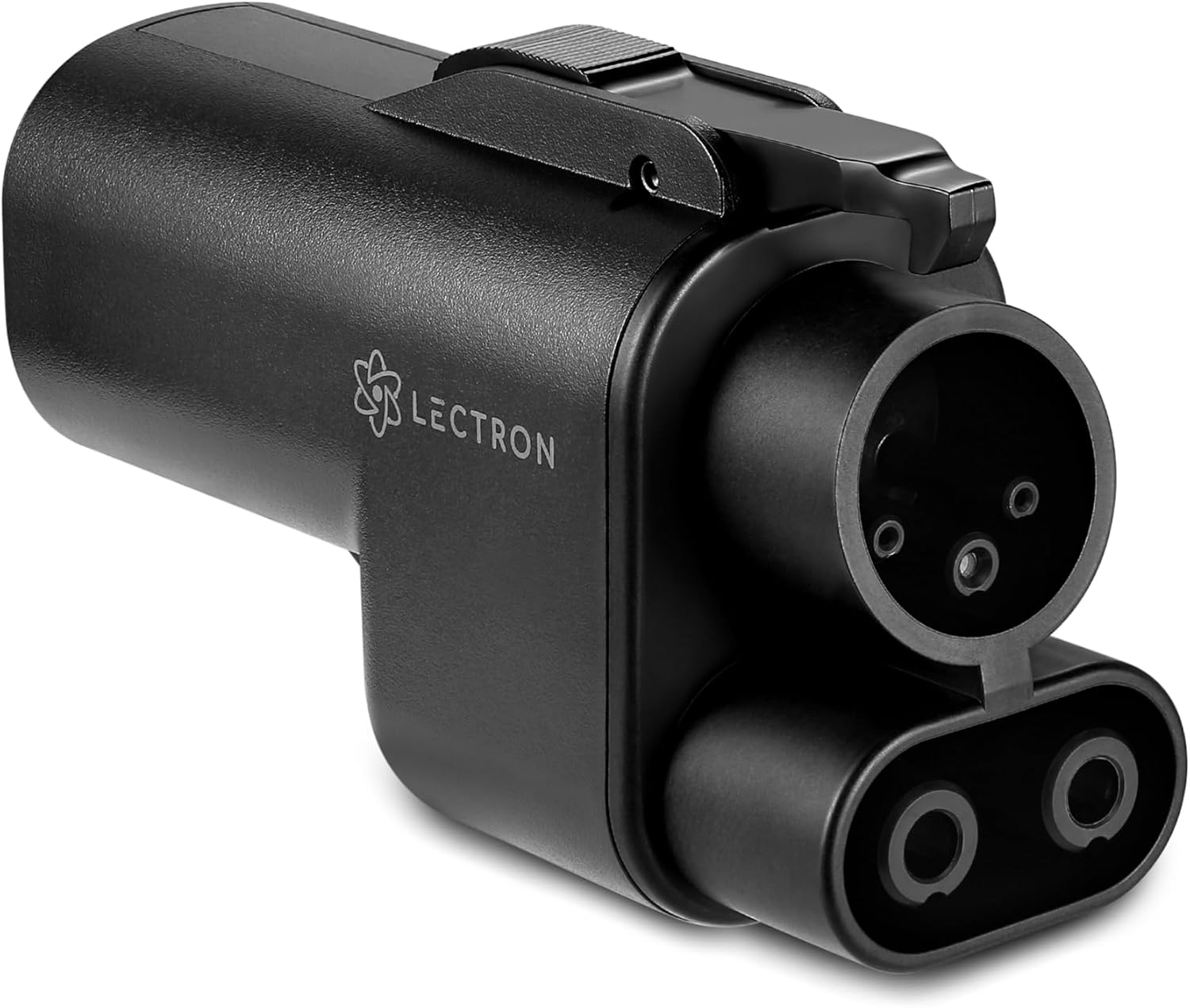
Lectron NACS to CCS Fast-Charge Adapter
Unlock every CCS fast charger for your Tesla, up to 500A DC. Never get stranded at a non-Tesla DC station again.
As an Amazon Associate, ThinkEV earns from qualifying purchases — at no extra cost to you.
Cold Weather, Battery Preconditioning, and Why January Changes the Math
The Canadian fast-charging story is incomplete without the temperature variable, and the temperature variable is more an engineering choice than a weather problem.
Lithium-ion cells resist fast ion movement below approximately 15°C. The chemistry doesn't fail, it slows. A pack at –10°C asked to accept 150 kW will accept perhaps 40 to 60 kW, because the battery management system is protecting the cells from lithium plating, a degradation mode that causes irreversible capacity loss and dendrite formation. The BMS is doing exactly what it should. The driver is staring at a screen wondering why a 350 kW cabinet is delivering 40.
Battery preconditioning is the engineering answer. When a vehicle's navigation system is routed to a DC fast charger, modern EVs, Tesla across its lineup, the Hyundai-Kia E-GMP platform, Polestar 2, Mercedes EQS, BMW iX, Ford F-150 Lightning, the Lucid Air, actively heat the pack during the drive so that arrival temperature is in the 20–30°C window the chemistry wants. Vehicles without nav-linked preconditioning, older Bolts, the base Nissan Leaf, several first-generation entries from European brands that delayed the feature, cannot prepare the pack and will accept whatever the cells can take at ambient temperature.
A Calgary January road trip illustrates the gap. A 2026 IONIQ 5 routed via the Hyundai nav system to an Electrify Canada 350 kW stall in Banff will arrive with a pack at roughly 25°C, accept 200+ kW for the first ten minutes, and complete a 10–80% session in close to its rated time. A 2020 Chevy Bolt on the same trip, with no preconditioning capability, will arrive with a pack at –15°C and accept 22 kW until the pack warms through the act of charging itself, by which point the session is over. Same weather. Same station. Different engineering era.
Hardware vendors have started designing around the Canadian variable rather than ignoring it. The cabinet itself can be specified for the climate it sits in, Metro EV's reference on Level 3 hardware calls out the NEMA 3R enclosure standard for outdoor installs and the load-management features that let a site operator distribute available power intelligently across stalls in cold weather. A station designed to a Toronto specification isn't the same product as one designed to a Whitehorse specification, and the difference is not cosmetic. Stations that derate gracefully under thermal load, pushing 80 kW per stall across four stalls instead of going offline trying to sustain 150 kW on one, keep a winter corridor functional. The networks that have internalized this design choice are the ones whose uptime numbers hold through February.
This is why "winter range" comparison videos that ignore preconditioning are misleading. The vehicle's behavior is mostly a function of whether its software was designed for cold-weather charging from the start. Which EVs actually work through a Canadian winter is a software question as much as a battery question, and the chemistry-philosophy split between LFP and NMC interacts with cold weather in counter-intuitive ways the spec sheets don't surface.
The fix for older vehicles is operational rather than mechanical: take a Level 2 top-up at the start of the day, drive long enough to warm the pack through use, and time the fast-charge stop for after at least 45 minutes of highway driving. It's a workaround, not a solution. The solution is in the next vehicle.
Network Reliability and the Station Uptime Problem
A 350 kW cabinet that's offline is a 0 kW cabinet, and the second-order experience of Canadian fast charging is shaped more by uptime than by peak power.
A 2023 University of California Berkeley study of San Francisco Bay Area public fast chargers found that approximately 27% were non-functional on a given inspection day. The Canadian dataset is thinner, the country doesn't yet have a published, methodologically comparable study at scale, but field reports from Plug Share, A Better Routeplanner, and the Canadian EV owner community track in the same neighbourhood. The failure modes cluster in three places, and they're worth knowing because they predict which stations are likely to be down when you arrive.
Payment terminal hardware is the first. Touchscreen card readers exposed to Canadian winters fail. The Bluetooth and NFC chipsets in older units degrade. RFID readers misalign. When a payment terminal fails, the entire stall is offline even if the power electronics behind it are perfectly healthy. Networks that have moved to plug-and-charge protocols, where the vehicle's VIN handshakes with the station and the billing happens via a pre-registered account, are systematically more reliable, because the failure-prone component has been removed from the critical path. Tesla's Supercharger network has run this model for a decade.
Cellular modem connectivity is the second. Stations need to phone home to authenticate payment, publish status to network apps, and accept remote management commands. Stations on the edge of cellular coverage, a real condition along long stretches of the Trans-Canada, lose backhaul, which kicks them into a fault state. The cabinet is fine. The cellular tower three kilometres away has a snowed-over antenna. The result for the driver is identical.
Thermal management of the cabinet itself is the third, and the most Canadian. The power electronics inside a 350 kW cabinet generate substantial heat under load. The cabinet has its own cooling system. At –30°C, those cooling systems sometimes shut down preemptively or fail to start, and the cabinet derates or trips offline as a protective measure. This is rarer than the first two failure modes but disproportionately disruptive when it happens, because it tends to hit during the exact weather conditions when the driver needs the charge most.
Electrify Canada and Tesla Supercharger networks post the highest reliability scores in Canadian owner-community reporting. Petro-Canada's EV Fast Charge Network is similar. Smaller third-party operators, the ones that bid into provincial RFPs and won contracts on price, vary widely, and the variance is concentrated in single-cabinet sites where a unit going offline takes the entire location with it.
The counter-position from network operators is that uptime numbers are improving sharply year over year, that the worst stations in the 2022 owner reports have been retrofitted, and that pointing at three-year-old failure rates is a form of motivated pessimism. The numbers do appear to be moving. The reason I'd still bet on the operational gap persisting through 2027 is that uptime is a culture problem more than a hardware problem, it requires a field-service organization with measurable response-time SLAs, real-time monitoring dashboards that staff actually watch, and a willingness to refund failed sessions without making the driver call a support line. The networks that have that culture run reliable stations. The ones that don't can swap every component in the cabinet and still post 73% uptime.
Redundancy is the design principle that matters more than speed. A site with four 100 kW stalls beats a site with one 350 kW stall and no backup, every time, on a road trip that depends on the next charge being available. The corridor map worth studying is the one that shows stall count per site, not peak power per cabinet.
Gear worth having
As an Amazon Associate, ThinkEV earns a small commission from qualifying purchases — at no extra cost to you.

Grizzl-E Classic Level 2 EV Charger (40A)
Canadian-made and rated for minus 40C winters. 40A / 9.6 kW, NEMA 14-50, indoor/outdoor, 24-ft cable. The charger built for Canadian weather.
As an Amazon Associate, ThinkEV earns from qualifying purchases — at no extra cost to you.
"Level 3" Is Barely A Useful Category Anymore
The Level 3 category contains so much engineering variance that the term itself is barely useful. A 50 kW corridor station from 2019 and a 350 kW Electrify Canada cabinet from 2024 occupy the same regulatory definition and produce different experiences in the same vehicle. The variables that matter, connector standard, cabinet power rating, stall redundancy, network reliability, vehicle-side acceptance rate, battery chemistry, preconditioning capability, ambient temperature, interact in ways the marketing tier never captures.
What's worth watching from here: the NACS transition will resolve over 2026 and 2027 as adapter ecosystems mature and dual-port hardware proliferates. The Electrify Canada and FLO 150–350 kW corridor buildout will continue closing the gap between vehicle capability and installed infrastructure, with the Trans-Canada and Highway 401 finishing first and the secondary highway network catching up by roughly 2028. The retirement of CHAdeMO hardware will accelerate as the Leaf fleet ages out. The reliability gap between networks will narrow as plug-and-charge becomes table stakes.
The signals I'd watch for confirmation or refutation: a published Canadian uptime study with Berkeley-equivalent methodology landing before the end of 2027, because the absence of one is the single biggest gap in this analysis; the rate at which BC Hydro and Ontario's legacy 50 kW sites get scheduled for retrofit rather than refurbishment, because retrofit-versus-refurbish is the leading indicator of whether networks are committing to the post-2025 vehicle fleet; and the cabinet-level uptime numbers Electrify Canada reports for its first full winter on the converted NACS hardware, because that's the operational test the connector-swap thesis has been promising for two years.
The bet worth making: the right car for a Canadian buyer in 2026 isn't the one with the highest peak charge rate on the spec sheet. It's the one with active thermal management, nav-linked preconditioning, an 800 V architecture or near-equivalent acceptance curve, and a connector that's supported on the networks you'll actually use. That set of features describes a different vehicle list than "fastest charging EV" search results would suggest, and the difference between the two lists is exactly the gap between marketing and engineering this piece has been about.
The corridor is being built. The vehicles are being engineered. They're converging. Until they fully converge, somewhere around 2028, on the timelines current network operators are quoting, the Canadian driver's job is to read past the tier label and into the cabinet behind it. The reward for doing that reading is the difference between a coffee-break stop and a meal-break stop on a six-hour drive.
Gear worth having
As an Amazon Associate, ThinkEV earns a small commission from qualifying purchases — at no extra cost to you.

Tesla Key Card Holder with AirTag Slot
Stop fishing the keycard out of your wallet, and slot an AirTag in case the car wanders off in a lot.
As an Amazon Associate, ThinkEV earns from qualifying purchases — at no extra cost to you.

Founder & Chief Editor
Vlad Pereira is the founder and chief editor of ThinkEV.ca, the Canadian electric-vehicle publication he writes and edits from Courtenay, British Columbia. He covers EV pricing, federal and provincial rebates, charging costs, and the Chinese manufacturers now entering Canada, from the buyer's side rather than the press-fleet side. ThinkEV is a venture of Vlad Pereira Online; his writing on health, income and the long game lives at vladpereira.com.
Frequently asked questions
Why does a 350 kW station give my older EV so little power?
Can a CCS1 car actually use a Tesla Supercharger in Canada today?
What makes a Level 3 charger so much more expensive to install?
Will CHAdeMO charging still be available at Canadian stations in a few years?
Does the connector type on my EV affect charging speed?
More EV & road-trip finds
Affordable upgrades worth a look — tap any to check the price on Amazon.
 ★ 2,941
Microfiber Cleaning Cloths (Multi-Pack)
View on Amazon ★ 537
★ 537USB Star Projector Roof Light
View on Amazon ★ 546
★ 546Funny Headrest Face Covers (2-Pack)
View on Amazon ★ 27,769
Car Cup Holder Coasters (4-Pack)
View on Amazon ★ 55,938
WixGear Magnetic Air Vent Phone Mount (2-Pack)
View on Amazon ★ 119
★ 119Foldable Waterproof Trunk Organizer
View on Amazon ★ 392
★ 392Large Cup Holder Adapter (32-40oz)
View on Amazon ★ 96,686
PULIDIKI Car Cleaning Gel (Detailing Putty)
View on AmazonRead, Plan, Then Stay Current
Explore our expert articles to understand incentives and ownership costs, use the map to pressure-test charging reality, then subscribe so new EV coverage comes straight to you.
Continue Reading
Public EV Charging in Canada: Networks and Payment
Rivian's Charging Network Hits 1,007 Stalls in 2026
Walmart's EV Charging Network Is Getting Cheaper
EV Battery Degradation: What's Normal and How to Slow It
Why Cold Weather Cuts EV Range, the Real Reasons