
Key takeaways
- A consumer putting 20,000 km a year on a vehicle needs years to recoup an EV premium over a comparable ICE vehicle.
- A fleet operator putting 80,000 to 120,000 km a year on the same vehicle closes that gap at three to four times the rate.
- A corporate fleet operator who replaces vehicles at 200,000 to 300,000 km is running a full-lifecycle TCO calculation, not a three-year resale game.
The fleet market, not the consumer market, is where the economics of electric vehicles make the clearest, most undeniable sense for a huge swath of businesses operating in this country. Most of the general EV coverage you see doesn't pay nearly enough attention to it.
The fleet sector isn't electrifying because of attitude shifts or cultural momentum. It's electrifying because finance departments at logistics companies, municipalities, transit agencies, and corporate service operators ran actual numbers and the numbers made a case. That's a more durable driver than enthusiasm.
A delivery van running 100,000 kilometres a year saves over $10,000 in fuel costs compared to a comparable gas-powered unit, and that's before you touch the maintenance savings, which run 30 to 50 percent lower for electric drivetrains because there are no oil changes, no spark plugs, no exhaust systems, no transmission fluid. Stack fuel and maintenance together, and for a high-mileage urban fleet, the total cost of ownership calculation starts shifting hard in favour of electric within four to five years of deployment. For some applications, it's already shifted past the tipping point. For others, it's getting close enough that procurement teams are actively planning transitions rather than watching from the sideline.
This is a commercial operations story, not a consumer adoption story. And commercial logic is different in ways that matter enormously for how fast and how durably this transition happens.
Why Fleets Are Different From Consumer EVs
The objections that dominate consumer EV conversations, range anxiety, charging infrastructure, upfront cost, resale uncertainty, don't map cleanly onto commercial fleet operations. Understanding why is key to understanding why fleet adoption is running ahead of consumer adoption in specific segments.
Range anxiety is essentially irrelevant for depot-based fleets. A delivery van that leaves a warehouse at 7am, runs a defined urban route, and returns to the depot by 6pm knows exactly how many kilometres it's covering every single day. You charge it overnight. The range requirement is fixed and predictable. There's no scenario where a fleet dispatcher is left wondering if a van will make it back because the driver took an unexpected detour. In fact, fleet operators who've seriously evaluated EV adoption typically cross range anxiety off their concern list within the first week of mapping their actual routes against available vehicle range. It's almost always a non-issue.
Charging infrastructure for a fleet isn't a public charging problem. It's a depot electrical upgrade problem. You run Level 2 chargers at your facility, potentially with smart charging management to stagger load across the overnight window, and your drivers plug in when they park. This is a one-time capital cost. The federal Zero Emission Vehicle Infrastructure Program (ZEVIP), administered by Natural Resources Canada, is specifically designed to help businesses offset exactly this cost. The sprawling public charging network that dominates consumer EV coverage is almost entirely irrelevant to a depot-based commercial fleet. Your charger is in your building. You control it. It's there when you need it.
Upfront cost premium is a real concern, but it gets absorbed dramatically faster at commercial mileage levels. A consumer putting 20,000 km a year on a vehicle needs years to recoup an EV premium over a comparable ICE vehicle. A fleet operator putting 80,000 to 120,000 km a year on the same vehicle closes that gap at three to four times the rate. The per-kilometre economics are simply more favourable at commercial duty cycles. This is the core insight that explains why fleet electrification economics work when the personal vehicle math still doesn't fully pencil out for lower-mileage buyers.
Resale value uncertainty is less relevant for fleets that run vehicles to end-of-life rather than cycling them every few years the way consumers often do. A corporate fleet operator who replaces vehicles at 200,000 to 300,000 km is running a full-lifecycle TCO calculation, not a three-year resale game. Over that full commercial service life, fuel and maintenance advantages compound significantly, and the worry that EV residual values are hard to predict stops mattering as much when you're not planning to sell the vehicle early.
Commercial operators are also less susceptible to the emotional resistance that slows consumer adoption. They're running businesses, not making identity statements. When a fleet procurement team does a TCO analysis that says electric wins on a five-year horizon, they act on it. That's a fundamentally different adoption mechanic, and it's why fleet electrification is outpacing consumer electrification in specific segments.
The Government Programs Actually Aimed at Fleets
A common misconception trips up business owners early: the federal EVAP rebate, the $5,000 incentive most Canadians know about, does not apply to corporate fleet acquisitions. It's structured for personal vehicle purchases. Businesses need different channels entirely, and those channels exist and are accessible.
The main federal program for fleet and commercial operators is ZEVIP, the Zero Emission Vehicle Infrastructure Program. ZEVIP is specifically designed to fund charging infrastructure for businesses, workplaces, and fleet depots. If you're a logistics company that needs to install 20 Level 2 chargers at your distribution centre, ZEVIP is what you're applying for. It covers up to 50 percent of eligible costs for Level 2 charging hardware and installation, which is often the biggest practical barrier to fleet electrification beyond the vehicle acquisition cost itself. Getting your first cohort of vehicles onto overnight depot charging is the critical step, once that infrastructure exists, adding more electric vehicles to the operation becomes incrementally easier and cheaper.
ZEVIP has gone through multiple funding rounds as business demand has grown, and the program has been one of the federal government's consistently funded clean transportation commitments across recent budget cycles. Applications are processed on a rolling basis, which means there's no cliff-edge deadline to stress about. You apply when your project is ready.
The federal iZEV program, distinct from EVAP, covers a broader range of zero-emission vehicle purchases including certain commercial vehicles and vans. Fleet operators should review the current eligible vehicle list with their procurement team, the qualifying criteria include base price caps and vehicle category definitions that determine what makes the cut. Worth the hour of homework before finalizing any acquisition plan.
The Canada Infrastructure Bank's Zero Emission Bus Fund is a separate stream targeting transit agencies specifically. This is how cities like Brampton, Montreal, and Vancouver are financing electric bus procurement. Transit agencies operate on multi-decade planning horizons, and an electric bus that costs more upfront but saves substantially on fuel and maintenance across a 12 to 15 year service life looks very different in a capital plan than it does on a quarterly budget. The CIB structure recognizes this, it provides the long-term patient capital that transit electrification requires, rather than a one-time grant that doesn't match the actual investment horizon of a transit agency.
Provincial programs vary considerably, and this is where things get complicated for fleet operators with locations in multiple provinces. Quebec and British Columbia have historically been the most aggressive with commercial EV incentives layered on top of federal programs. Quebec's Roulez Vert program has included commercial vehicle incentives at various points. BC's CleanBC program has commercial components that reduce effective acquisition costs for fleet EVs. Ontario's provincial picture has shifted over the years, provincial EV incentives that existed under previous governments were cancelled, but municipal programs and fleet-specific grants continue to exist through various channels.
Alberta has been slower on the provincial incentive front, but that hasn't stopped real adoption driven by pure operational economics, particularly in urban distribution and short-haul routes where the numbers work regardless of what the provincial government does or doesn't support.
The key takeaway for any business operator: talk to your province's clean energy or transportation ministry and to your fleet procurement advisor before finalizing your electrification business case. The federal baseline exists and is accessible nationally. The provincial top-up can change the acquisition math significantly depending on where you operate. A fleet operator in Quebec may be able to layer incentive streams that an Alberta counterpart can't access, but the underlying economics still work in Alberta, the payback timeline is just somewhat longer.
Who's Actually Moving Right Now
Let me walk you through what's actually happening on the ground, because the picture is more developed than the general coverage suggests, and also more honestly complicated than the optimistic press releases make it sound.
Purolator has been running electric vehicle pilots on urban delivery routes for several years now, accumulating real operational data on how EVs perform in the specific conditions of Canadian urban last-mile delivery. Canada Post has made public commitments to electrifying portions of its delivery fleet and has been working through the genuinely hard challenge of transitioning a national network with enormous geographic diversity.
What looks like a single problem, "electrify our delivery fleet", is actually a dozen different problems simultaneously, because a dense Toronto urban route and a rural northern route that spans hundreds of kilometres between stops require completely different solutions. Canada Post deserves credit for being honest about this complexity rather than pretending the whole fleet can flip on a single timeline.
Amazon, operating through its Delivery Service Partner network, has been rolling out electric delivery vans in major Canadian urban centres as part of its broader global electrification commitment. What's notable about the Amazon approach is that it's structured procurement, not just a pilot, it creates meaningful volume commitments for vehicle manufacturers and puts working capital behind charger installations at partner depots. When Amazon commits to EV delivery vans in a city, they're not hedging with a few test units. They're wiring buildings and ordering vehicles in quantities that shape what the commercial EV supply chain produces.
What Purolator, Canada Post, and Amazon have in common: dense urban routes, high daily mileage, return-to-depot operations, and enough organizational scale to make infrastructure investment worthwhile. These are exactly the conditions where the economic case for fleet electrification is strongest. The fact that they're running pilots rather than complete fleet transitions is a reflection of where the commercial EV supply chain and charging ecosystem actually are right now, capable enough to prove the concept at meaningful scale, not yet mature enough to flip an entire national fleet overnight.
The commercial vehicle market hasn't seen the same pace of new model introductions that the consumer side has, and total available EV inventory for commercial purchasers is still constrained relative to demand.
On the transit side, electric buses are already in active service across multiple Canadian cities, carrying passengers on regular routes every day and accumulating real operational data. Brampton Transit has been expanding its electric bus program as part of a longer-term commitment. Vancouver's transit system is working toward electrification on a defined timeline backed by capital commitments through the Canada Infrastructure Bank. Montreal has electric buses in active service as part of its broader transit modernization effort. These are meaningful deployments, not proof-of-concept pilots, not press releases, actual buses on actual routes.
The private logistics sector beyond the major carriers is a patchwork. Smaller regional carriers and owner-operators are watching closely but haven't broadly crossed the adoption threshold yet. Part of the reason is vehicle supply, the range of electric options across different tonnage ratings and body configurations that a diverse regional logistics fleet needs hasn't fully arrived. A plumbing supply distributor running 3/4-ton cargo vans in a medium-sized Canadian city has different vehicle requirements than a national courier, and purpose-built commercial EV options for those specific requirements are still arriving.
Municipal fleet electrification deserves more attention than it typically gets. Cities across Canada run large fleets, maintenance trucks, parks equipment, bylaw enforcement vehicles, utility response units, that operate predominantly within city limits on predictable routes and return to municipal yards or stations each night. Several major Canadian municipalities have adopted fleet electrification targets and are actively acquiring EVs for appropriate service categories. Municipal procurement moves slowly relative to private sector, but when a large Canadian city puts EV requirements into its fleet procurement standards, that creates durable, recurring demand that shapes what manufacturers bring to market over the coming years.
Gear worth having
As an Amazon Associate, ThinkEV earns a small commission from qualifying purchases — at no extra cost to you.

NOCO Boost Plus GB40 Jump Starter
A 1000A lithium jump starter that fits in your glovebox and works on any 12V battery. Your insurance against a dead 12V in a parking lot.
As an Amazon Associate, ThinkEV earns from qualifying purchases — at no extra cost to you.
The Real Cost Breakdown
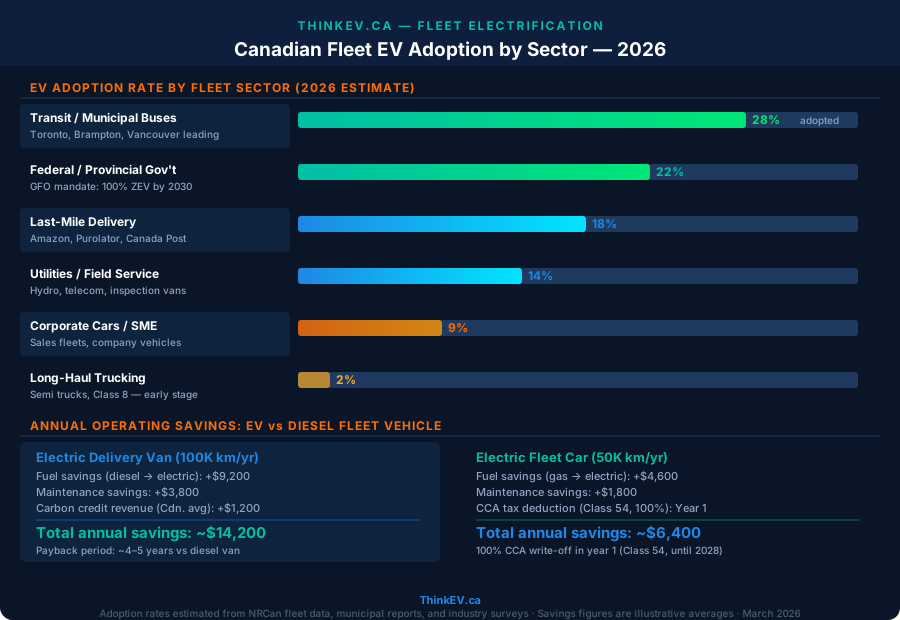
Let me put actual numbers around this, because the abstraction version, "EVs save money on fuel and maintenance", has been repeated so many times it's started to sound like a slogan rather than a calculation. And fleet operators making real capital decisions need more than a slogan.
On the fuel side: electricity in most Canadian markets, even at commercial rates, is significantly cheaper per kilometre than gasoline or diesel at current pump prices. In urban Ontario or BC, electric propulsion runs somewhere in the range of two to four cents per kilometre versus eight to twelve cents per kilometre for a comparable diesel or gasoline van. That's a ratio of roughly three to one or four to one in favour of electric, not a marginal advantage, a substantial one. Run that ratio across 100,000 km of annual fleet mileage and you're looking at $4,000 to $10,000 in per-vehicle fuel savings annually, depending on the specific vehicle, the route, and the province.
Commercial electricity rates complicate this somewhat. Businesses pay commercial rates that can be higher than residential rates in some provinces, and demand charges, fees for peak power draw, mean that an unsophisticated "plug everything in at 5pm" charging strategy can produce unexpectedly high electricity bills. This is why smart charging management systems that stagger charging across the overnight window are essentially mandatory for any fleet installation beyond a handful of vehicles. Get the charging right and the per-kilometre fuel cost advantage is substantial and predictable. Get it wrong and demand charges eat into your savings in ways that make the economics look worse than they actually are once properly managed.
On the maintenance side: no oil changes. For a commercial diesel unit running 100,000+ km per year, that means multiple services annually at commercial oil change intervals, costs that add up fast. No transmission fluid changes. No exhaust system repairs, an exhaust on a diesel van doing that kind of stop-and-go urban mileage sees significant stress. And significantly reduced brake wear, because regenerative braking handles most deceleration and captures that energy rather than turning it into heat and brake dust. The brake rotors and pads on a fleet EV running the same route as its diesel equivalent will last considerably longer.
The simplified drivetrain of an EV has fewer scheduled service items and fewer failure modes. Fleet maintenance cost reductions in the 30 to 50 percent range are consistently reported by operators running EV and ICE vehicles side by side on comparable routes. This isn't theoretical modelling, it's the outcome of real fleet operations comparing actual bills at the end of each quarter.
In concrete terms: a medium-duty commercial van with a typical diesel-era maintenance schedule might run $4,000 to $8,000 per year in scheduled and unscheduled maintenance at high fleet mileage. An equivalent EV running the same mileage and route might come in at $2,000 to $4,000. Across a 50-vehicle fleet over five years, that gap is a number with six figures in it. That's not an abstraction. That's a real budget line.
The upfront cost premium is real and has to go into the calculation honestly. Commercial electric vehicles still carry a price premium over comparable ICE vehicles. For high-mileage fleet applications, delivery vans covering 100,000 km per year, transit buses, municipal service vehicles, that premium gets recovered through operational savings within a manageable period. For lower-mileage commercial applications where a vehicle covers 30,000 km a year, the math is harder. Honest operators in lower-mileage segments are still waiting for the price gap to close further before the numbers fully work. That's the right call, I'd rather see someone wait until the economics are clear than stretch an optimistic business case.
The depot infrastructure cost also has to go into the calculation. Installing Level 2 charging at a depot isn't free. Electrical panel upgrades, charging hardware, installation labour, permits, depending on facility size, existing electrical infrastructure, and grid connection situation, you could be looking at anywhere from a few thousand dollars per charging position to significantly more for facilities that need substantial electrical upgrades.
For a 50-van fleet, that's a non-trivial upfront capital commitment. ZEVIP exists precisely to take the edge off this cost. But even with ZEVIP support, the infrastructure capital requirement is real and needs to be modelled accurately in any fleet electrification business case. Underestimating infrastructure costs is one of the most common errors in early fleet EV planning.

ESG as a Real Driver, Not Just PR
The "we care about the planet" explanation for fleet electrification doesn't hold up to scrutiny. Companies exist to generate returns. When ESG shows up as the stated motivation, the real driver is usually structural, not philosophical.
What I find when I look: ESG targets are creating real, structural changes in how corporations buy services from each other. Major corporate procurement processes at large Canadian companies increasingly include supplier sustainability criteria. If you run a logistics provider or courier business and your largest clients are corporations with net-zero Scope 3 commitments, your operational emissions profile increasingly affects your ability to hold those contracts. The emissions from your fleet show up in your client's Scope 3 supply chain reporting. When that client is under investor pressure to reduce its reported Scope 3 footprint, they will eventually, and are already beginning to, require their logistics vendors to reduce theirs.
This is not hypothetical anymore. It's showing up in RFP criteria and contract renewal discussions in Canadian commercial logistics. The companies responding earliest and most aggressively to fleet electrification tend to be those with institutional clients who are under genuine ESG reporting pressure. The dynamic is: institutional investors pressure large corporations on ESG commitments, large corporations push requirements down through their supply chains, logistics providers and fleet operators electrify to hold their major accounts.
Over 60 percent of Canadian companies with more than 100 employees had set net-zero targets by 2026 according to industry surveys. Whether every one of those commitments represents a serious operational plan or an aspirational statement that will get revised under future business pressure varies company to company. But the target-setting process means these businesses are now tracking fleet emissions and building electrification into their forward capital plans in ways they weren't five years ago. Fleet electrification decisions that might otherwise have been pushed to 2028 or 2030 are getting pulled forward to 2026 and 2027 because external pressure has arrived ahead of schedule.
The mid-market operator, the regional carrier, the HVAC service fleet, the food distribution company, without those large institutional clients isn't responding to this same ESG pressure. They're making the decision on operational economics, and that's fine. The economics are increasingly supporting it on their own merits without any external push. But understanding the ESG-driven dynamic helps explain why the largest fleet operators are moving first and fastest. They're responding to their own clients' requirements, not just internal financial calculations.
Fleet Management Software and Telematics: The Operational Layer
One thing that consistently gets overlooked in fleet electrification conversations is how much the day-to-day management of an electric fleet differs from managing a diesel fleet, and how much purpose-built technology has emerged to handle that difference well.
Traditional fleet telematics tracks mileage, location, speed, and basic vehicle diagnostics. Useful for any fleet, but an electric fleet has a whole additional layer of data that matters operationally: state of charge for every vehicle at every point during the day, projected range given current battery level and upcoming route profile, charging session history and cost, battery health trends over time, and alerts when a vehicle is at risk of running short before completing its route.
Fleet management platforms have evolved significantly to handle EV data. Geotab, a Canadian company based in Oakville, Ontario, which is worth highlighting because it tends to get overlooked in coverage that focuses on Silicon Valley companies, has built substantial EV fleet management capabilities into its platform. Geotab's systems can monitor battery state across a fleet in real time, project when individual vehicles need to charge, optimize charging schedules to minimize demand charges on commercial electricity rates, and provide the operational visibility that fleet managers need to run a mixed EV and ICE fleet confidently.
The fact that Geotab is a Canadian company with deep roots in the commercial fleet market means Canadian fleet operators have access to world-class EV fleet software built locally, by people who understand how Canadian operations actually work.
Route optimization also becomes more nuanced with EVs. The same logic that minimized diesel costs, distance, time, stop sequencing, now has to account for battery state along the route, the location of potential emergency charging stops if needed, and how temperature at the current time of year affects range projections. In February in Winnipeg, a van's effective range is materially different from what it is in July. The best fleet EV management platforms handle this automatically, adjusting route plans and charging schedules dynamically based on real-time battery data and weather conditions.
Charging management software handles the depot infrastructure side as a separate function. When you have 30 vehicles all trying to charge overnight, you don't want them all drawing peak power simultaneously, that creates a demand spike that drives up your commercial electricity bill substantially. Smart charging management staggers the charging across the available window, prioritizes vehicles with lower state of charge, and flattens the load curve to minimize demand charges. Some systems go further, integrating with utility demand response programs that allow the fleet operator to earn credits by reducing their charging load during peak grid demand events. That's money flowing back to the operator from a behaviour that's also beneficial to the grid, a genuinely good outcome.
The operational data flywheel is one of the underappreciated long-term advantages of running an electric fleet. Every trip, every charge session, every kWh consumed generates data. Over time, fleet operators build detailed models of exactly what their routes cost to operate, which vehicles are performing above or below expectations, where battery degradation is accelerating, and how seasonal factors affect operations. This data quality is often significantly better than what operators had with diesel fleets, where actual operating costs could be obscured by variable fuel prices, inconsistent maintenance records, and less granular telematics. The EV fleet is transparent in a way that a diesel fleet never quite was.
Where Provincial Adoption Is Actually Happening
Ontario and Quebec are the obvious leaders in fleet electrification, and not just because they have the most commercial vehicle registrations in the country. Both provinces have dense urban corridors, the Greater Toronto Area and the broader Golden Horseshoe, the Greater Montreal Area, where short predictable routes, depot-based operations, and higher urban fuel costs create ideal conditions for fleet electrification economics.
Ontario's commercial fleet market is the largest in the country, which means absolute numbers of electric commercial vehicles are highest here even if penetration rates don't necessarily lead nationally. The GTA's logistics economy, driven by e-commerce growth, intermodal freight, and dense urban delivery demand, creates exactly the volume of high-mileage urban delivery operations where electric drivetrains perform best. The combination of scale, urban density, and the concentration of major logistics operations makes southern Ontario the most natural early market for Canadian commercial EV adoption.
Quebec benefits from two structural advantages that make it a particularly strong fleet electrification market. First, its electricity rates are among the lowest in North America, Hydro-Québec's commercial and industrial rates are substantially below what Ontario or BC businesses pay, which makes the per-kilometre fuel cost advantage of electric even more pronounced. Second, Quebec has maintained provincial incentive programs for commercial EVs more consistently than other provinces, giving fleet operators there access to provincial funding on top of federal programs. The combination produces a strong economic case even before ESG considerations enter the picture.
Interest in commercial EV adoption has roughly doubled since 2024 according to Electric Mobility Canada's industry surveys, and that momentum is showing up across all fleet categories in both provinces. Urban delivery and transit are leading, but corporate service fleets, utilities, telecom, healthcare, government, are increasingly evaluating EV transitions for vehicles that operate on predictable local routes and return to a base facility each night.
Alberta is more interesting than people expect. The provincial policy environment has been less supportive of EVs than Ontario or BC. But the economics-driven adoption in the commercial sector doesn't particularly care about that. An Alberta logistics operator running urban routes in Calgary or Edmonton is looking at the same fuel and maintenance math as their Ontario counterpart.
The federal ZEVIP program is available nationally regardless of provincial politics. And the operational case doesn't change based on what the provincial government does or doesn't incentivise. Short-haul urban distribution in Alberta is seeing real fleet electrification driven almost entirely by TCO analysis, operators who've done the numbers and found they work.
Alberta also has an interesting angle in the oilfield services sector. Mobile equipment and service trucks operating in resource extraction don't map neatly onto the urban delivery use case, but there's growing interest in electrifying the lighter end of the oilfield service fleet, the pickup trucks running around producing sites, the light service vehicles covering short distances between facilities. These applications have different duty cycles than urban delivery, but the depot-based logic often still applies in camp or facility-based operations. It's early, but it's real.
British Columbia benefits from some of the best commercial EV conditions in the country: competitive electricity rates at BC Hydro's commercial tiers, a developed public charging network that reinforces the general EV ecosystem even if it's less directly relevant for depot-based fleets, CleanBC provincial programs that stack with federal support, and Metro Vancouver's urban density creating strong last-mile delivery economics. Transit electrification in BC is well advanced, with BC Transit and TransLink both operating electric buses in active service and expanding procurement through the Canada Infrastructure Bank's transit programs.
Manitoba deserves a specific mention because it's home to New Flyer Industries, one of North America's most significant electric bus manufacturers. The Xcelsior CHARGE electric buses that New Flyer builds in Winnipeg are in service with Canadian and American transit agencies across the continent. Manitoba has a real stake in the success of electric transit procurement nationally, and the domestic manufacturing capability that New Flyer represents is part of the Canadian commercial EV story that doesn't get nearly enough recognition.
Atlantic Canada is earlier in the journey. The commercial fleets are smaller, population density is lower, and charging infrastructure outside Halifax and a few other urban centres is less developed. But the economics still apply, a carrier running urban routes in Halifax or Moncton is looking at the same fuel and maintenance calculus as a Toronto counterpart. The question in smaller markets is more about vehicle availability, local EV servicing expertise, and upfront financing access than whether the fundamental economic case exists. It does.
The Vehicle Supply Side
The fleet electrification story is meaningfully constrained right now by what you can actually buy. Consumer EV options have expanded considerably over the past two years, but the commercial vehicle side is still catching up to where fleet demand is pointing.
The Ford E-Transit has been the most accessible and most widely deployed option for cargo van fleets in the North American market, a familiar manufacturer, established dealer network, reasonable payload capacity, and the service infrastructure that comes with being a Ford product in a country where Ford dealers are everywhere. Its limitations are real: the range on the base configuration is modest compared to what some high-mileage operators want, and the maximum charge rate is limited compared to newer commercial EV platforms.
But it exists, it's available now, Canadian dealers can support it, and it's what many early Canadian fleet adopters have been piloting. The E-Transit Custom, which offers a somewhat larger capacity, has also entered the market as Ford has expanded its commercial electric lineup.
The BrightDrop story is worth understanding as an honest cautionary note about the volatility of the commercial EV supply side. BrightDrop was a GM venture built specifically to develop purpose-built electric delivery vehicles, the Zevo 400 and Zevo 600 cargo vans were designed from the ground up for the delivery use case rather than adapted from a consumer platform.
FedEx was an early customer. The vehicles were well-regarded by operators who deployed them. Then GM, facing financial pressures across its EV product lineup, restructured and wound down BrightDrop as a brand. Fleet operators who had been building procurement plans around BrightDrop vehicles as a Ford E-Transit alternative had to reassess. The physical vehicles already delivered kept operating, but the pipeline of new vehicles and the brand support infrastructure disappeared.
This is a real risk in the commercial EV space right now: the supply side is still volatile enough that manufacturers can exit specific vehicle categories in ways that disrupt fleet planning. It's not a reason to avoid fleet electrification, but it's a reason to plan with realistic awareness of where the market is.
Rivian's commercial van, the Electric Delivery Van, developed originally in partnership with Amazon, has been deployed extensively in Amazon's US delivery operations. Canadian availability through Amazon's DSP network has expanded, meaning the vehicles are appearing on Canadian streets even if they're not yet broadly available for general fleet purchase. Rivian's EDV was purpose-built for last-mile delivery in ways the E-Transit wasn't, and its performance in Amazon's deployment has been generally positive. Whether and when Rivian makes the EDV broadly available to non-Amazon fleet buyers in Canada is a meaningful open question for the market.
Gear worth having
As an Amazon Associate, ThinkEV earns a small commission from qualifying purchases — at no extra cost to you.

Grizzl-E Classic Level 2 EV Charger (40A)
Canadian-made and rated for minus 40C winters. 40A / 9.6 kW, NEMA 14-50, indoor/outdoor, 24-ft cable. The charger built for Canadian weather.
As an Amazon Associate, ThinkEV earns from qualifying purchases — at no extra cost to you.
For heavier commercial applications, medium-duty delivery trucks in the Class 4 to 6 range, North American options are more limited and more expensive. International eMV, Freightliner eM2, and similar platforms exist but supply chain volumes are lower, prices are higher, and the dealer service infrastructure for commercial EV repair at this weight class is thinner than for consumer vehicles or light commercial vans. This is where fleet operators with heavier-duty requirements find themselves genuinely waiting for the market to mature.
Class 8 heavy-duty long-haul is a different category entirely. Tesla's Semi has been in limited production with major US customers, and some range capability has expanded, but Class 8 EV commercial deployment in Canada at any meaningful scale is still years away from being mainstream. The charging requirements, range limitations over long distances, and vehicle cost premium all remain substantial challenges for long-haul applications, even if urban and regional short-haul Class 8 operations are more tractable.
New Flyer, based in Winnipeg, is the standout Canadian commercial EV manufacturer success story. Their Xcelsior CHARGE electric bus platform has significant market presence with North American transit agencies, and New Flyer has continued investing in both battery-electric and hydrogen fuel cell bus development. When Canadian transit agencies procure electric buses, many of those buses are built in Manitoba. That's a meaningful part of the commercial EV supply story that consistently gets underplayed, Canada has real domestic manufacturing capability in the commercial EV space. It just happens to be in transit buses rather than delivery vans. That matters.
Gear worth having
As an Amazon Associate, ThinkEV earns a small commission from qualifying purchases — at no extra cost to you.

PULIDIKI Car Cleaning Gel (Detailing Putty)
Press it into vents, buttons, and seams and it lifts out dust you did not know was there. Weirdly satisfying, genuinely useful.
As an Amazon Associate, ThinkEV earns from qualifying purchases — at no extra cost to you.
Charging Infrastructure at Scale
The charging situation for fleet operators is fundamentally different from the consumer charging discussion, and it's worth being precise about why that matters practically for anyone making fleet decisions.
You're not building a strategy around public fast charger networks. You're building a private charging facility at your depot. The engineering questions are about electrical service capacity, load management, cost optimisation, and reliability. The public charging network, which rightly gets constant coverage in consumer EV discussions, is essentially a backup option for fleet operations, not the primary infrastructure.
For a modest urban delivery fleet of 20 to 30 vans, a depot charging installation is a meaningful but manageable capital project. You need enough charging circuits to get all vehicles adequately charged during the available overnight window, typically eight to twelve hours, with smart charging controls to avoid commercial electricity demand charge spikes, and the upfront electrical infrastructure work to support that load. ZEVIP funding helps offset hardware and installation costs, and the program has been actively approving business applications.
The typical Level 2 charging setup for a commercial fleet uses J1772 or CCS equipment running at 7.2 kW to 19.2 kW per station depending on the vehicle's onboard charger capacity. A delivery van with a roughly 70 kWh battery covering 80 to 120 km per day typically uses 25 to 45 kWh on a normal route. Overnight at 7.2 kW, that's fully recharged in three to six hours, well within a twelve-hour overnight window. This means you don't need to rush charging or rely on DC fast charging for routine daily operations, which keeps infrastructure costs lower and avoids accelerated battery degradation from frequent high-rate charging.
For a larger operation, 100 vans or more, the electrical infrastructure becomes a materially larger planning effort. You're looking at potentially 500 to 1,000 kW of total installed charging capacity for a 100-vehicle fleet, which affects your electrical service connection size and potentially requires negotiations with your local utility about service upgrades. Some large fleet operators are exploring vehicle-to-grid (V2G) and managed demand response setups that interact with the grid intelligently, charging preferentially during off-peak rate periods and, in programs that support it, dispatching stored battery capacity back to the grid during peak demand events to generate credits or revenue.
V2G is still early-stage for most commercial applications, but it's worth watching because the energy storage capacity of a large electric fleet is genuinely substantial. A 100-van fleet with 70 kWh batteries each has 7,000 kWh of total potential storage, comparable to a meaningful community battery installation. Utilities are increasingly interested in managed demand programs that compensate large commercial customers for flexible charging behaviour, and some fleet operators are starting to monetise this flexibility. That's a second revenue stream from an asset you already own.
The ZEVIP program has supported over 5,000 Level 2 charging installations at Canadian businesses and workplaces in recent years, with concentration in urban areas where fleet operations are densest. This is real infrastructure investment, but it's early in what will ultimately need to be a much larger commercial charging ecosystem. The number of commercial EV charging positions in Canada is still a fraction of what a fully electrified commercial fleet market would require, the infrastructure build-out is a multi-decade capital story running in parallel with fleet adoption itself.
Last-Mile Delivery: The Near-Term Opportunity
If I had to pick the single use case where fleet electrification makes the most compelling sense in Canada right now, it's last-mile urban delivery. Everything lines up simultaneously in a way that just doesn't happen for most commercial EV applications.
Short predictable routes. Return-to-depot overnight charging. High enough daily mileage to make fuel savings substantial. Urban fuel prices that are elevated. A vehicle category, the cargo van in the two to four tonne range, where electric options actually exist and are available to purchase in Canada today. Stop-and-go urban driving patterns that happen to be exactly where regenerative braking is most effective, meaning you're recovering energy at every deceleration rather than burning brake pads. The whole picture adds up in a way that's genuinely exciting.
E-commerce volumes have been climbing steadily and show no sign of flattening, and urban delivery is absorbing most of that growth. The pattern of a delivery van making 50 to 100 stops per day in a city grid, covering 80 to 120 km total, is almost perfectly matched to the operational profile of a current electric cargo van. You have enough time at each stop for any thermal management the battery system needs. Regenerative braking actively extends effective range in city stop-and-go. The total daily distance is well within what any current commercial EV can handle on a single charge. And because you're depot-based, you never need to find a public charger or plan a charging stop into the middle of a route.
The major carriers, Purolator, Canada Post, Amazon, UPS, FedEx, are all running EV pilots in exactly this use case across their Canadian urban operations. The early results from these pilots are what will determine the pace of the next phase of transition. When pilot operations validate the fuel and maintenance savings that the models predicted, those pilots become programs. Programs become standard acquisition policy for new vehicle procurement. And within a fleet replacement cycle of three to seven years, you're looking at meaningful electrification of last-mile delivery across Canada's major urban centres.
That transition won't complete in one year or two years. Fleet replacement cycles are the pacing mechanism, and they can't be compressed indefinitely without stranding still-serviceable ICE vehicles. But directionally, last-mile urban delivery going electric is not a question of whether, it's a question of pace.
The business case is there, the technology is proven enough, the vehicles are available, and the early movers are generating data that will pull the rest of the market forward. This is already happening and accelerating.

Municipal Fleets: The Quiet Electrification
Municipal government fleets don't generate the same media coverage as Canada Post or Amazon, but they're a significant and genuinely underappreciated part of the fleet electrification story.
Canadian municipalities operate enormous quantities of vehicles. A major Canadian city might run hundreds of police cruisers, dozens of fire suppression vehicles, large parks and recreation fleets, public works trucks, bylaw enforcement vehicles, building inspection vehicles, and the full range of municipal service operations. The majority of these operate within city limits, return to municipal yards or stations each night, and run predictable route patterns, exactly the conditions where fleet electrification economics work best.
Several major Canadian municipalities have adopted fleet electrification targets and are actively acquiring EVs for appropriate service categories. The light-duty segment, the sedans and small SUVs used by inspectors, bylaw officers, and administrative staff, has been the easiest to electrify because the consumer EV market provides abundant options. Municipal fleet managers can order a Chevrolet Equinox EV or a Hyundai Ioniq 5 through government procurement the same way they order ICE equivalents, with the same dealer relationships and service access. No exotic procurement process required.
The medium-duty municipal segment, utility trucks, parks maintenance equipment, light public works vehicles, is where municipal electrification is in earlier stages, because purpose-built electric options in these configurations are less available. But this is where adoption is accelerating as manufacturers bring more commercial EV options to market for specific work configurations.
Municipal procurement is slow by private sector standards, RFP processes, council approval cycles, multi-year budget commitments, but it creates durable, long-horizon demand that manufacturers can actually plan around. When a Canadian city puts zero-emission vehicle requirements into its next ten-year fleet procurement plan, that's committed purchasing volume on a known timeline. The aggregate procurement power of Canadian municipalities is substantial, and as more cities formalise fleet electrification targets, the cumulative signal to the commercial vehicle market grows more and more significant.
What I find particularly interesting about municipal fleets is the visibility effect. When a city electrifies its bylaw enforcement vehicles or building inspection fleet, residents see those vehicles, with city logos on them, driving around the community as electric. That normalises EVs in a way that advertising campaigns can't quite replicate. The city becomes a visible demonstration of electrification working in real-world conditions, every day.
Drivers and Operations: The Human Side
Fleet management technology can optimise charging schedules and track battery health in real time, but there's a human element to fleet electrification that doesn't always get discussed: your drivers have to operate these vehicles differently, and that transition requires real investment in training and change management.
For most commercial driving applications, the actual driving experience in an EV is straightforwardly better than diesel. Quieter cabin. Smoother acceleration with no gear changes in many configurations. Better low-speed torque for urban stop-and-go. No diesel exhaust exposure in loading dock and warehouse environments. Drivers who've made the transition generally report positive experiences with the vehicles themselves once they're past the initial learning curve.
But the learning curve is real. Drivers need to understand how range changes with temperature and load, how to maximise regenerative braking to extend effective range, what the charging procedure is at the depot, and how to interpret the state-of-charge information on the vehicle's displays. None of this is technically demanding. But it's different from what drivers have been doing for years, and a fleet electrification rollout that doesn't include proper driver orientation will produce range anxiety and operational friction that could have been avoided with a half-day of training.
Fleet managers face their own adjustment curve. Maintenance scheduling changes when most of the oil-and-filter-type services disappear. The metrics that matter shift, you're now watching battery state-of-health trends, charging efficiency, and energy consumption per kilometre rather than fuel receipts and oil change intervals. Integrating EV data into existing fleet management reporting infrastructure is something the software platforms handle increasingly well, but it requires a transition period and potentially new reporting workflows.
The technician side is also genuinely important. High-voltage electric vehicle systems require specific training and certification for safe service. This is an area where the workforce development side of fleet electrification is still catching up to the pace of adoption. Fleet operators running larger EV deployments are increasingly investing in training their own technicians to Level 2 EV service qualification, because the commercial EV service network at dealerships is less comprehensive than what exists for consumer EVs, and depot-level preventive maintenance capability is a real operational advantage. Building that internal expertise takes time. It's worth starting earlier rather than later.
Transit: The Long Game
Transit agency electrification operates on a completely different timeline and capital structure than private fleet electrification, but it represents a huge share of the commercial electric vehicle market and it's where some of the most durable, long-term electrification commitments in Canada are being made, commitments that will hold regardless of short-term political or economic shifts because they're embedded in capital plans and infrastructure investments that span multiple budget cycles.
A transit bus costs significantly more than a delivery van, electric bus acquisition costs run well into the six-figure range per vehicle, and operates for 12 to 15 years or longer in active service before replacement. The Canada Infrastructure Bank's Zero Emission Bus Fund is specifically designed to make this financing structure work for agencies that couldn't absorb the full capital cost of transitioning their fleets in a single budget cycle. It's long-term lending at favourable rates, not a one-time grant, which is the right capital structure for an investment with a 12 to 15 year service horizon.
New Flyer, based in Winnipeg, is a major manufacturer of electric buses for the North American transit market and holds significant contracts with Canadian transit agencies. This matters beyond just the transit electrification story. New Flyer's continued investment in electric bus technology, its manufacturing presence in Manitoba, and its contracts with agencies like Vancouver's TransLink and numerous other Canadian systems mean that Canadian transit electrification is actively supporting a domestic manufacturing ecosystem. The electric buses going into service in Canadian cities include substantial Canadian content through New Flyer's production. We're not just buying foreign technology, we're building it here.
The fuel savings for transit agencies over the service life of an electric bus are substantial. A diesel bus in high-frequency city service burns significant fuel, and transit agencies operating large fleets in major Canadian cities spend substantial sums annually on diesel procurement. Even a partial fleet transition to electric produces measurable operating cost relief. As more buses flip over the course of a normal replacement cycle, the savings compound across the operating budget in ways that improve the long-term financial picture for transit agencies that are typically under constant cost pressure.
Transit agencies have also been dealing for years with the skilled trades challenge of maintaining sophisticated diesel drivetrains in an environment where experienced diesel mechanics are increasingly scarce and expensive. Electric bus drivetrains genuinely simplify the mechanical picture, fewer moving parts, different failure modes, more diagnostic capability built into the vehicle systems. The transition requires retraining and some new tooling, but the ongoing maintenance complexity per vehicle is lower than diesel. That matters for agencies trying to manage operations with constrained workforce capacity.
The operational data coming back from transit agencies that have been running electric buses for multiple years, in Vancouver, Brampton, and others, is now informing second and third generation procurement decisions with real performance evidence. Battery degradation patterns, winter range impacts, charging cycle efficiency, grid integration challenges: transit agencies are building institutional knowledge about electric bus operations that will make subsequent procurement and operations progressively more effective. This is the learning curve compounding in a productive direction.
Cold Weather Operations: The Canadian Reality
I can't write a Canadian fleet electrification piece and gloss over cold weather performance. It would be dishonest, and frankly, it's one of the most important operational considerations for most Canadian fleet operators.
Battery electrochemistry is temperature-dependent. In cold conditions, which in Canada means not just Winnipeg in January but Ontario and Quebec in the depths of a hard winter, and even Metro Vancouver in a cold snap, range can degrade meaningfully from rated specifications. Operators in cold climates should plan routes and charging cycles against realistic winter range figures, which for many current commercial EVs might be 15 to 25 percent below warm-weather rated range in extreme cold.
For most urban last-mile delivery applications, even winter-derated range is sufficient for a full daily urban route of 80 to 120 km. But the planning has to account for it. Operators who size their charging infrastructure or route plans against summer range figures will find themselves with operational problems in February. That's not a knock on the technology, it's a feature of the physics, and it's entirely manageable with appropriate planning.
Pre-conditioning, warming the battery while the vehicle is still plugged into depot charging, before it leaves for its route, is the main tool for managing cold weather range loss. Most modern commercial EVs support pre-conditioning, and fleet management software can automate it based on departure schedules and outdoor temperature forecasts. A vehicle that leaves the depot with a pre-warmed battery in January performs considerably better than one that sits cold overnight and drives away cold.
Charging behaviour in cold weather also matters. Cold batteries charge more slowly and less efficiently than warm ones, which means your overnight charging window needs to account for longer charge times in winter months. Again, this is manageable with smart charging management software that adjusts schedules based on ambient temperature. But it needs to be in your planning model from the start, not discovered the first time you find half your fleet at 60 percent charge when it should be full.
And: cabin heating draws meaningfully more energy in winter than air conditioning does in summer for most EV platforms. In a diesel vehicle, waste heat from the engine provides cabin warming essentially for free. In an EV, cabin heating comes straight out of the battery. Fleet operators should factor this into winter range projections alongside the raw battery temperature effect.
None of this makes fleet electrification unworkable in Canada. The country has had electric transit buses running in Calgary, Winnipeg, and Ottawa winters for years. The technology handles Canadian cold. But it handles Canadian cold when the operator plans for it properly, not when they assume performance specs from a California test track.
What Barriers Still Exist
I don't want to oversell this. Fleet electrification is accelerating in Canada, but there are real constraints on how fast it can go. Pretending they don't exist doesn't help anyone make good decisions.
Vehicle availability in specific configurations remains a genuine issue for large segments of the commercial fleet market. If you operate a refrigerated delivery fleet, a specialised utility truck application, or any of the dozens of specific commercial vehicle body configurations that exist beyond standard cargo vans, your electric options are much more limited than if you're running standard vans on urban routes.
The commercial EV market is still in early development, and manufacturers are prioritising the highest-volume applications first. Operators with specialised requirements are often genuinely waiting for the market to develop the specific vehicle they need. And that's okay, the answer is "wait until the right product exists" rather than "force a vehicle that doesn't fit your operation. "
Electrical infrastructure at older facilities is a real and sometimes significant cost driver. A warehouse or distribution centre built 30 or 40 years ago with electrical service sized for lighting and basic equipment may need substantial upgrades before it can support meaningful fleet charging capacity. These upstream electrical costs, utility service connection work, transformers, main distribution panels, feeder circuits, aren't covered by ZEVIP, which covers the charging hardware and installation on the facility side of the meter. They can add substantially to the total project cost in ways that fleet electrification business cases sometimes underestimate, especially in preliminary financial modelling before a proper electrical assessment has been done.
Range constraints in cold weather deserve serious treatment rather than dismissal, as covered above. Canadian operators planning fleet electrification need winter-realistic range figures in their models from day one.
Fleet acquisition financing is a practical barrier that affects smaller operators more than large ones. Commercial EVs carry a price premium over ICE equivalents, and while the TCO calculation may favour electric over the vehicle's service life, the upfront capital requirement is higher. A regional logistics company without strong balance sheet access or established commercial lending relationships for EV-specific financing may find itself unable to make the switch even when the numbers argue for it.
This is an area where government programs, whether loan guarantees, green financing programs, or equipment leasing structures that let operators get into electric vehicles without the full upfront capital commitment, could meaningfully accelerate adoption beyond what simple capital grants achieve.
Service network depth is another legitimate concern. The consumer EV service infrastructure at dealerships, while still developing, is substantially more mature than what exists for commercial EV fleets. A fleet operator running 30 E-Transit vans who needs a complex drivetrain repair faces a more uncertain service experience than a consumer who bought a personal EV. Manufacturers are developing commercial EV service capability, but it's not yet at the depth that experienced fleet managers expect from the ICE commercial vehicle service ecosystem they've operated within for decades.
The Direction Is Clear
None of these barriers are reasons fleet electrification won't happen. They're reasons it's happening at the pace it is rather than faster. The economic fundamentals, fuel savings, maintenance cost reduction, TCO advantage at high mileage, aren't going away. They get more compelling every year as electric vehicle acquisition costs continue to decline and the technology matures through larger production volumes.
The federal government has signalled sustained investment in ZEVIP and transit electrification funding through the Canada Infrastructure Bank. Vehicle manufacturers are bringing more purpose-built commercial electric vehicles to market as they develop commercial EV product lines beyond light consumer vehicles. The commercial EV service infrastructure, trained technicians, parts availability, fleet management software that handles mixed EV and ICE operations, is developing in parallel with adoption, creating a reinforcing cycle where greater fleet EV deployment builds the service ecosystem that makes deployment even more practical.
The fleet market is where the most rational, evidence-based EV adoption is happening in Canada right now, driven by finance teams running numbers, operations teams analysing routes, and procurement managers finding that for the right applications, electric already wins on the merits. That kind of adoption is durable. It doesn't reverse when subsidies change or when media attention shifts elsewhere.
For any fleet operator who's been watching and waiting: the highest-mileage, most predictable route applications, urban last-mile delivery, transit, and predictable municipal service routes, already have a compelling economic case today, with federal programs available to offset the infrastructure cost. The question isn't whether fleet electrification makes sense in the abstract. For the right applications, it demonstrably does. The question is when your specific fleet profile crosses the threshold where the economics clearly support the switch, and for many Canadian operators, that moment is either already here or arriving within the current fleet replacement cycle.
The last-mile delivery sector will look materially different by 2028 than it does today. Transit agencies will keep advancing through their electrification timelines as replacement cycles turn over and the Canada Infrastructure Bank's funding does its work. Corporate service fleets, utilities, telecom, healthcare, government, are being evaluated for EV transitions across the country, and many of those evaluations are going to produce positive outcomes as the vehicle supply continues to improve.
The commercial electrification wave is slower than the consumer wave in some ways, fleet procurement cycles are long, infrastructure investment is large, and the stakes of getting it wrong in a commercial operation are higher than for a consumer making a personal vehicle purchase. But it's also more durable. When a logistics company makes the decision to electrify a fleet category, that's a capital plan, not an impulse purchase. It drives procurement volume, infrastructure investment, and operational learning that compounds over years.
This isn't a "maybe someday" story. It's already happening, and the momentum is real.
Gear worth having
As an Amazon Associate, ThinkEV earns a small commission from qualifying purchases — at no extra cost to you.

WixGear Magnetic Air Vent Phone Mount (2-Pack)
A magnet strong enough that your phone never flinches over potholes or rail crossings. Two in the box, one for each car.
As an Amazon Associate, ThinkEV earns from qualifying purchases — at no extra cost to you.
Related Reading
- EV Market Share by Brand Canada 2026, Which brands are winning the Canadian EV market.
- Every New EV Coming to Canada in 2026, The complete list of electric vehicles arriving this year.
- Federal EVAP Rebate Guide, How to claim your $5,000 federal EV incentive.
Gear worth having
As an Amazon Associate, ThinkEV earns a small commission from qualifying purchases — at no extra cost to you.

Car Cup Holder Coasters (4-Pack)
Drop-in coasters that catch spills and crumbs so your cup holders stay clean. Rinse and reuse forever.
As an Amazon Associate, ThinkEV earns from qualifying purchases — at no extra cost to you.

Founder & Chief Editor
Vlad Pereira is the founder and chief editor of ThinkEV.ca, the Canadian electric-vehicle publication he writes and edits from Courtenay, British Columbia. He covers EV pricing, federal and provincial rebates, charging costs, and the Chinese manufacturers now entering Canada, from the buyer's side rather than the press-fleet side. ThinkEV is a venture of Vlad Pereira Online; his writing on health, income and the long game lives at vladpereira.com.
Frequently asked questions
Does the EVAP rebate apply to fleet vehicles?
Which companies are electrifying their fleets in Canada?
What is the cost advantage of fleet electrification?
Why is last-mile delivery the best use case for fleet electrification?
What charging infrastructure do fleet operators need?
How does cold weather affect fleet EV operations in Canada?
What fleet management software is available for electric fleets in Canada?
More EV & road-trip finds
Affordable upgrades worth a look — tap any to check the price on Amazon.
 ★ 4,055
6-Speed Manual Shift Knob Display
View on Amazon ★ 979
★ 979Leather Headrest Purse Hook
View on Amazon ★ 297
★ 297360-Degree One-Hand Dashboard Phone Mount
View on Amazon ★ 61
★ 61Toddler Car Seat Snack and Cup Tray
View on Amazon ★ 17,839
Qifutan Vent Phone Mount (Military-Grade Clip)
View on Amazon ★ 12,051
Windex Electronics Screen Wipes
View on Amazon ★ 419
★ 419RGB Car Interior LED Strip Light
View on Amazon ★ 4,626
HoogaLife Hanging Car Diffuser (2-Pack)
View on AmazonRead, Plan, Then Stay Current
Explore our expert articles to understand incentives and ownership costs, use the map to pressure-test charging reality, then subscribe so new EV coverage comes straight to you.
Continue Reading

BYD Canada Lineup: The Four Models Coming First
Chery EVs Coming to Canada: Models and Prices

Who Got Canada's First Chinese EV Import Permits

Solid-State Batteries Are No Longer Coming Soon

EV Rentals in Canada 2026: Where to Try One First