Key takeaways
- At 1,500 kW, BYD claims 400 km of range in 5 minutes under optimal conditions.
- For comparison, today's fastest 350 kW chargers deliver roughly 150-175 km in the same timeframe.
- For a typical top-up scenario where you arrive at 20% and want to leave at 80%, you're talking about less than three minutes.
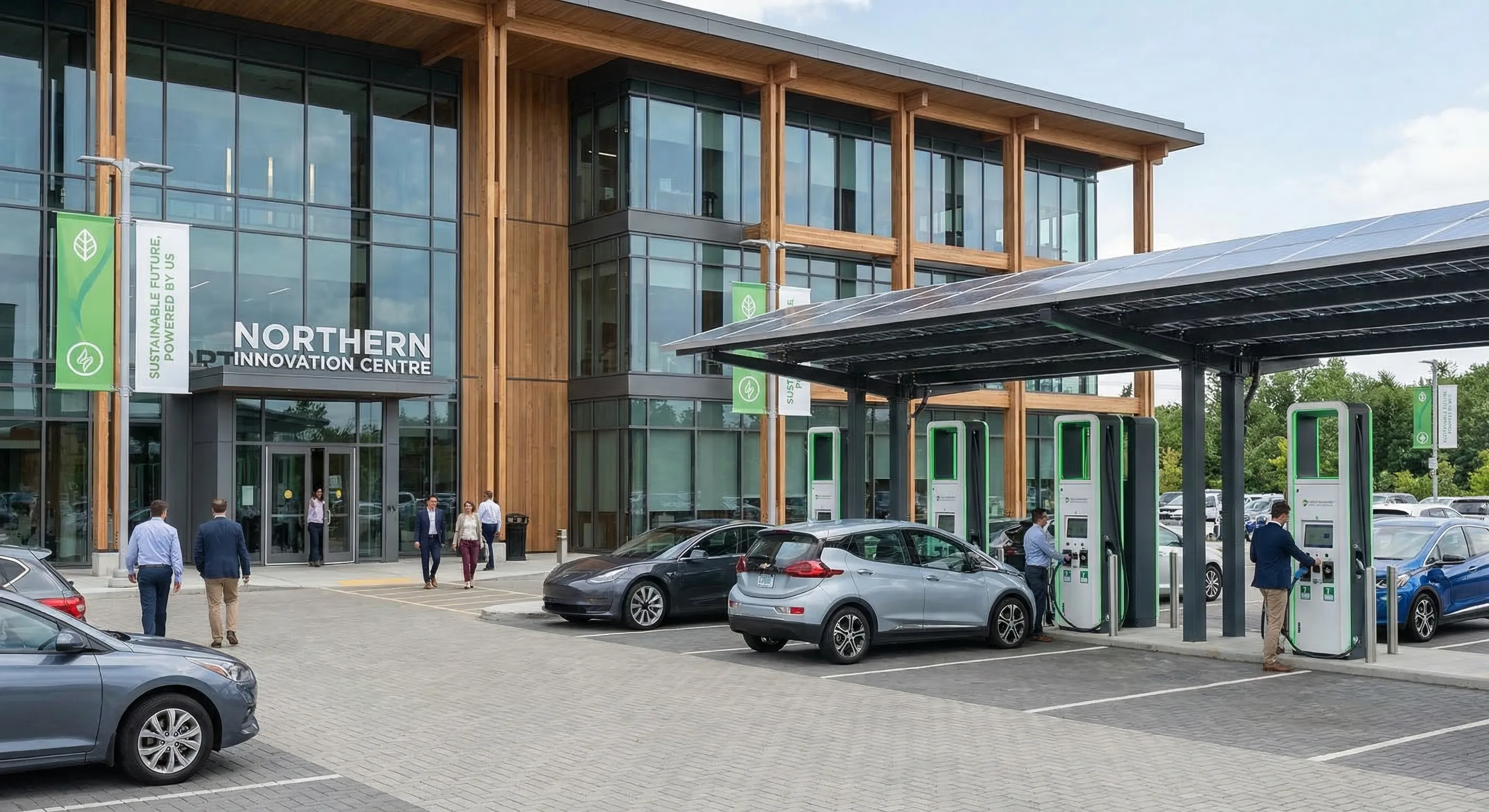
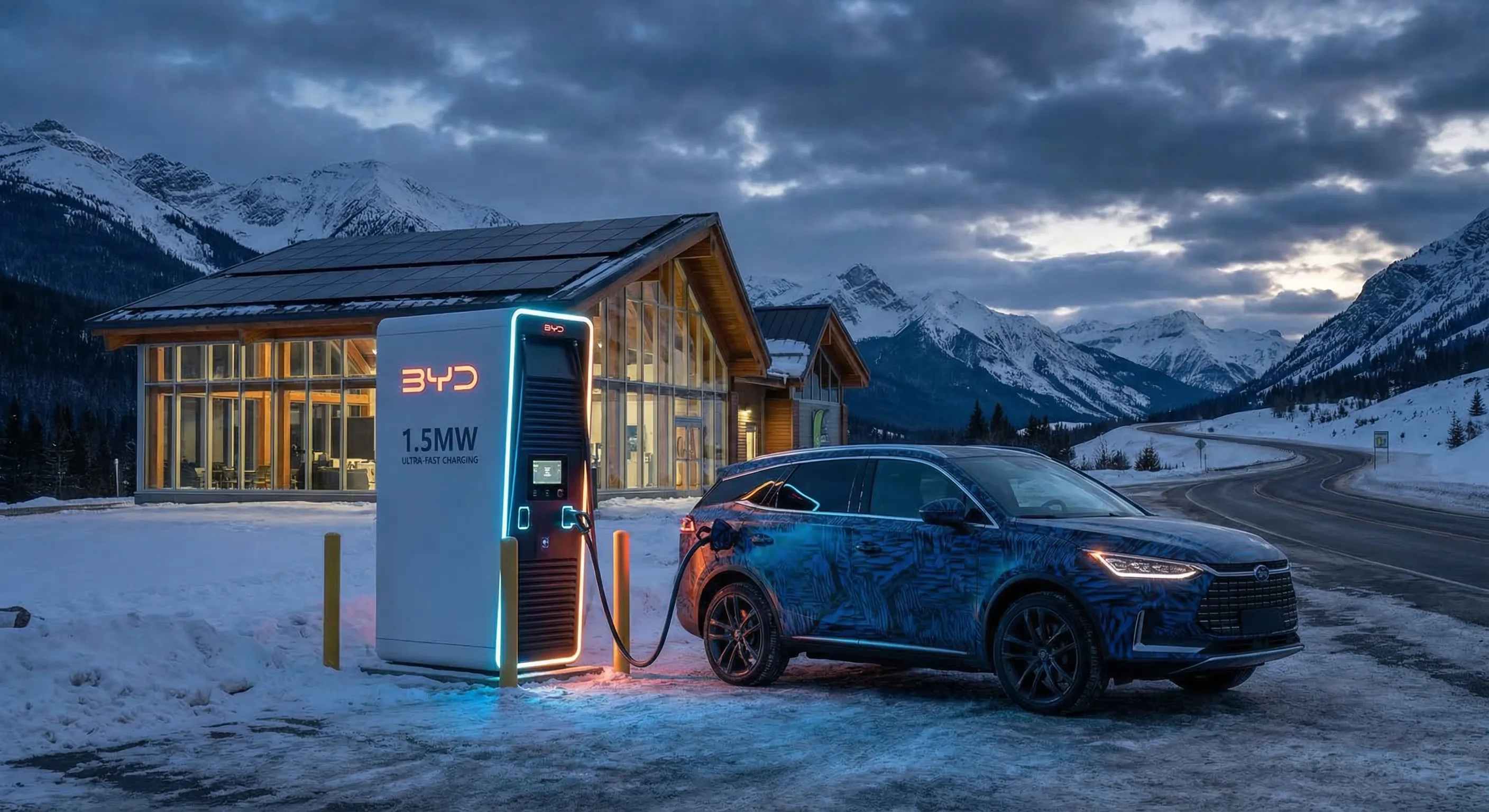
BYD's 1.5-megawatt flash charger delivers 400 kilometres of range in five minutes, roughly the same window it takes to use the washroom and fill a water bottle at a highway rest stop. Today's fastest 350 kW chargers cover 150 to 175 kilometres in that same timeframe. BYD says these stations cost about the same to build and install. Same cost, four times the speed.
That's not me writing fiction about some far-off EV future. That's what BYD's 1.5-megawatt flash charging system is doing right now, in China, today. And here's the part that should make every Canadian EV driver sit up straight: BYD says these chargers cost roughly the same to manufacture and install as the 350 kW chargers that Electrify Canada is currently rolling out across the country.
Same cost. Four times the speed.
I've been following EV technology for years, and I don't say this lightly. This isn't just a spec on a press release. This is a fundamental shift in what "EV road trip" means, and if it arrives in Canada anywhere near the timeline BYD is suggesting, the last real objection to driving electric just evaporates.
Let me break down exactly what's happening, what it takes to make it work, what the honest timeline looks like for Canada, and what you should actually do about it right now.
The Number That Matters: 1,500 kW
First, let's put 1,500 kW into context, because a lot of coverage of this technology just throws the number out there without helping you understand what it actually means.
The current charging situation in Canada looks roughly like this:
- Level 2 home charging (what most EV owners use overnight): 7.2 to 19.2 kW depending on your equipment and electrical panel
- Standard DC fast charger (what you'll find at older highway stations and many urban locations): 50 kW
- Electrify Canada CCS stations at major highway corridors: 150 to 350 kW
- Tesla Supercharger V4 (the fastest widely-available charger in North America right now): up to 350 kW
- Hyundai and Kia's 800V E-GMP platform vehicles accepting up to 350 kW
- BYD's flash charging system: 1,500 kW
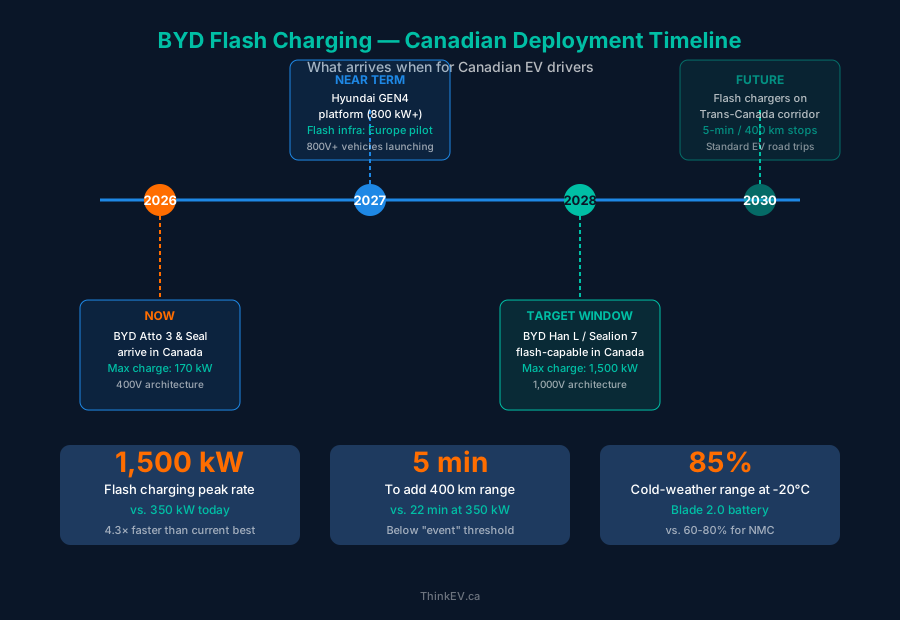
The gap between "best available today" and "what BYD just announced" is 4.3x. At 1,500 kW, BYD claims 400 km of range in 5 minutes under optimal conditions. For comparison, today's fastest 350 kW chargers deliver roughly 150-175 km in the same timeframe. For a typical top-up scenario where you arrive at 20% and want to leave at 80%, you're talking about less than three minutes.
For comparison, consider what that same 400 km of range costs you in time at different charger speeds:
- At a 50 kW station (still common in Canada outside major corridors): roughly 90 minutes. That's enough time to eat a full meal, do some work, and maybe take a nap.
- At a 350 kW Electrify Canada station (the current top of the network): about 22 to 25 minutes. A proper coffee stop, which is fine but still noticeable.
- At BYD's 1.5 MW flash charger: 5 minutes. A bathroom break. The time it takes to walk in, wash your hands, and walk back.
The psychological difference between 22 minutes and 5 minutes is enormous, not because 22 minutes is actually that long, but because 5 minutes is below the threshold where "charging the car" registers as an event. It just becomes something you do while you do other things, the same way you don't really "spend time" getting a glass of water.
How It's Possible: The Blade 2.0 Battery
The technology is not magic, it's very clever chemistry combined with a completely rethought thermal management system.
The biggest obstacle to ultra-fast charging isn't the charger itself. The bottleneck has always been the battery. When you push massive amounts of electricity into a battery quickly, you generate heat. A lot of heat. Lithium-ion cells don't like heat, it degrades them, stresses them, and in extreme cases causes thermal runaway, which is the technical term for "battery fire."
The reason today's 800V EVs (Ioniq 5, Ioniq 6, Kia EV6, EV9, Porsche Taycan, Audi e-tron GT) can charge faster than their competitors is precisely because higher voltage means you can deliver the same amount of power with less current, and less current means less heat. It's like the difference between running a lot of water through a narrow pipe (high current, lots of resistance, lots of heat) versus running a smaller amount of water through a wider pipe at higher pressure (high voltage, lower current, less heat).
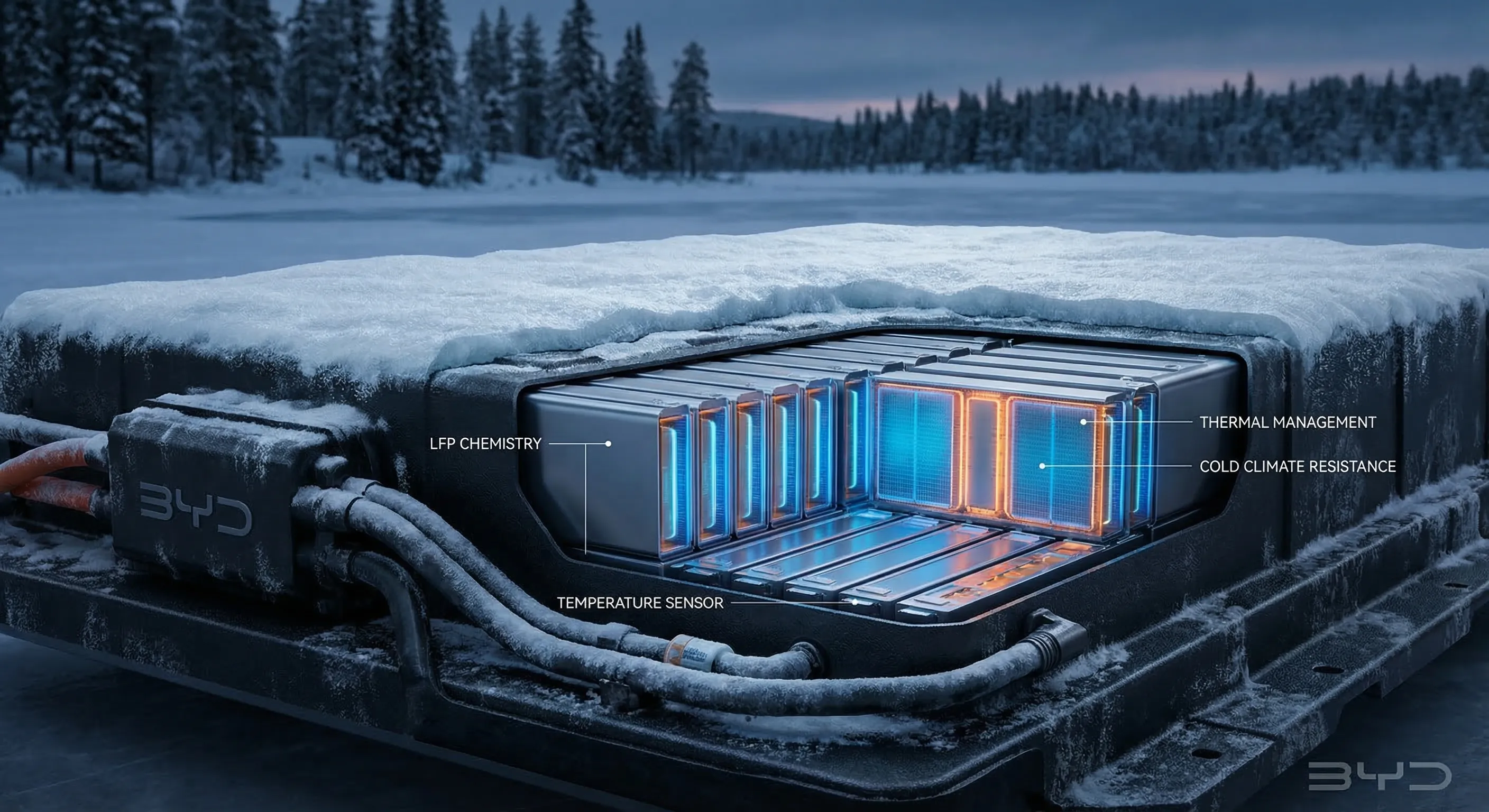
BYD's Blade 2.0 takes this further by redesigning the cell geometry from the ground up. The original Blade Battery, the flat, sword-like LFP cells that made BYD famous for thermal stability, was already best-in-class for safety. The Blade 2.0 takes those cells and addresses the two remaining limitations: charge acceptance speed and low-temperature performance.
On charge acceptance, the key innovation is in the electrolyte and electrode coating. BYD has developed what they're calling a "nano-network" structure on the anode surface that massively increases the number of sites where lithium ions can enter and exit the cell during charging and discharging. More entry points means less congestion, less localized heat, and faster charge acceptance without degradation. The cells are also engineered to sustain peak charge rates for much longer than typical cells, which fade quickly from their peak rate. This is how you get 80 km/min for a sustained multi-minute charge rather than just a brief flash.
On low-temperature performance, which is the part that matters most for Canadian drivers, the Blade 2.0 retains 85% of its rated capacity at -20°C. To understand how remarkable that number is, consider what we're used to: most current lithium-ion NMC batteries lose 20 to 40% of their range at -20°C. Some lose more. The LFP chemistry in original Blade Batteries was already somewhat better than NMC at cold temperatures, but the Blade 2.0's improvements to electrolyte formulation and the addition of an integrated liquid heating layer inside the cell structure push cold-weather retention to a level that changes the calculation for Canadian winters fundamentally.
Let's run those numbers. If you have an EV with a rated range of 500 km, and you're driving in January in Edmonton at -20°C:
- With typical NMC chemistry: you might see 300 to 350 km actual range. That's a 30 to 40% reduction.
- With Blade 2.0: you'd see roughly 425 km. A 15% reduction.
On a long drive, say, Edmonton to Calgary and back, which is about 600 km round trip, that difference determines whether you can make it without charging at all, or whether you need a stop. That's not abstract. That's whether you can make the trip comfortably or you're managing anxiety every 200 km.
The thermal management integration is equally important. The Blade 2.0 cells are designed with micro-channels for liquid coolant integrated directly into the cell stack, not wrapped around the outside of the pack, but literally threaded through the battery at the cell level. This allows for preconditioning (warming the battery before you arrive at a charger) to happen far more quickly and efficiently than current systems. When your navigation routes you through a flash charging station, the car begins warming the battery 15 minutes out, and by the time you arrive, the cells are already at optimal temperature for maximum charge acceptance. You plug in and it's immediate, no ramp-up period, no waiting for the battery to reach temperature before the charge rate climbs.
The Infrastructure Reality: What It Takes to Deliver 1.5 MW
A 1.5 MW charger is not a bigger version of the 350 kW charger in the Petro-Canada parking lot in Red Deer. It's a fundamentally different piece of infrastructure, and the grid requirements are substantial.
For comparison:
- A typical house in Canada draws a maximum of about 20 kW (200-amp service at 240V, which is 48 kW theoretical maximum, but average household peak draw is typically 15–25 kW).
- A 350 kW charger draws about as much power as 17 of those houses simultaneously.
- A 1.5 MW charger draws about as much power as 75 houses simultaneously.
At a charging station with, say, four 1.5 MW chargers, you're looking at 6 MW of peak demand. That's not something you pull from a standard utility connection. You need a transformer, a dedicated grid feed, and in many cases, on-site energy storage to buffer demand spikes and reduce infrastructure costs.
The good news is that BYD has already thought through this. Their commercial rollout in China uses integrated battery buffer systems, essentially large stationary battery packs located at the charging station that charge slowly from the grid and deliver power quickly to vehicles. This means the grid connection only needs to supply the average power consumption, not the peak demand. A four-stall flash charging station with a 2 MWh buffer battery might only need a 500 kW grid connection, something that's manageable for utilities.
This is actually similar to what some DC fast chargers already do in Canada. ChargePoint and Electrify Canada have both deployed sites with on-site storage to manage peak demand costs. BYD's system is just scaling that approach to a much higher power level.
The cost claim, that these chargers are comparable in cost to 350 kW chargers, is specifically about the charger unit cost, not the total installed cost including grid upgrades and buffer storage. A 1.5 MW charger dispenser is reportedly similar in price to a 350 kW unit because the power electronics scale relatively efficiently. The buffer battery adds cost, but it also eliminates expensive grid upgrade requirements at many locations, and can potentially earn revenue through grid services programs. On a total system cost basis, the numbers reportedly come out similar.
I find this plausible, and here's why: BYD makes everything in-house. They're the world's largest battery manufacturer, not just for EVs, but for grid storage. Building a 2 MWh buffer battery for a charging station is, for BYD, what Toyota making a car seat is for Toyota. It's not a specialised external purchase; it's a product line. Vertical integration matters enormously for cost, and BYD's integration is deeper than anyone else's.
What the Canadian Charging Network Looks Like Today
To understand where flash charging fits into Canada's infrastructure story, you need to know what we're actually working with, and it's more developed than most people think, but still has significant gaps on the routes that matter most for road trips.
The two major fast-charging networks in Canada right now are Electrify Canada and the Tesla Supercharger network (which is now open to non-Tesla vehicles through CCS adapters). Both are actively expanding.
Electrify Canada's Trans-Canada coverage currently includes:
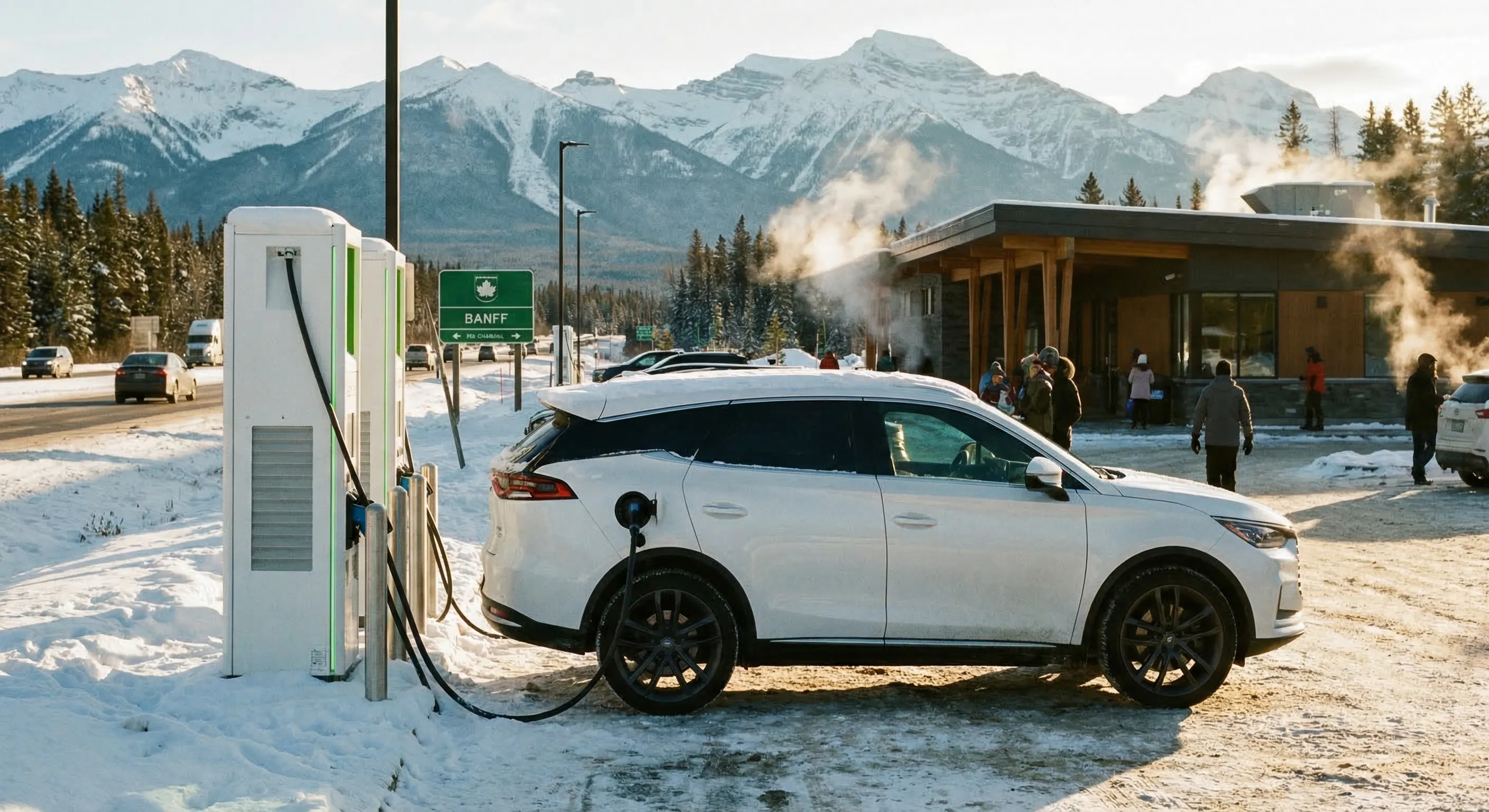
- Vancouver to Calgary: reasonably covered, with stations in Hope, Revelstoke, Golden, Banff, and Calgary itself
- Calgary to Edmonton: multiple stations along the QEII Highway
- Edmonton east across the Prairies: coverage drops significantly. Long gaps through Saskatchewan and Manitoba.
- Ontario: improving rapidly, especially on the 400-series highways and the Trans-Canada between Sault Ste. Marie and Sudbury
- Quebec and the Maritimes: patchy but improving
The gaps matter. A 350 kW charger helps enormously when it's there, but if the next station is 400 km away and you're in a Saskatchewan blizzard with a loaded car, you're not doing math about charge speed, you're doing math about whether you make it.
Current best practices for Canadian EV road trips at the 350 kW tier involve:
- Leaving with a full charge (easy with overnight Level 2 at home)
- Targeting 20% arrival at each charging stop
- Planning 20-25 minute stops to get to 80%
- Having a backup plan for the gaps (Petro-Canada DCFC at 50 kW is better than nothing)
- Using A Better Routeplanner or PlugShare to find stations and check real-time availability
The 22-minute stops are honestly fine. Most long-haul drivers don't object to stopping for 22 minutes, you'd stop for gas anyway, and it takes longer than that to fill up, pay, and get coffee at a Canadian highway stop. The objection isn't really about charging time at this tier. The objection is about charging availability, what if all three stalls are occupied? What if one is out of service? What if I'm in a place where the nearest fast charger is a 50 kW unit with a 40-minute queue?
Flash charging at 1.5 MW changes the availability problem as much as it changes the speed problem. If a charge session takes 5 minutes instead of 22 minutes, you need far fewer stalls to serve the same number of drivers. A four-stall 1.5 MW station handles the same throughput as roughly 18 stalls at the current 350 kW tier. For a given infrastructure investment, you can either build 18 slow stalls in one location or distribute 4 ultra-fast stalls across 4 different locations. The second option is dramatically better for coverage.
The BYD Han L and Sealion 7: The First Flash-Compatible Vehicles
The 1.5 MW flash charging system isn't coming in isolation. BYD is launching it as an integrated ecosystem alongside new vehicles designed to accept that charge rate.
The first production vehicles with Blade 2.0 flash charging compatibility are the BYD Han L sedan and the BYD Sealion 7 SUV, both announced in early 2026.
The Han L is a flagship luxury sedan, not the vehicle that most Canadians will be shopping in. But it matters because it validates the technology at production scale and serves as proof-of-concept for what the platform can do. Range is rated at 700 km (CLTC, China's test cycle, probably 550 to 600 km in real-world Canadian conditions). 0 to 100 km/h in 2.9 seconds. Nappa leather interior. Price in China is roughly $50,000 CAD equivalent, which will be higher in Canada once tariffs and shipping are factored in.
The Sealion 7 is more interesting for the Canadian market. It's a mid-size electric SUV competing in the Tesla Model Y segment. An earlier version of the Sealion 7 (without flash charging) has been on sale in Australia and some European markets. If BYD brings a Sealion 7 with Blade 2.0 flash charging to Canada, and given BYD's stated expansion plans, this is not far-fetched for 2027 or 2028, you're looking at a vehicle that would be a genuinely compelling alternative to the Model Y and Ioniq 5.
For those tracking BYD's Canadian rollout: the Atto 3 and Seal are expected as first arrivals (we covered this in detail in our piece on BYD coming to Canada). Neither of those models supports flash charging, they use BYD's earlier generation battery and charging tech. Flash charging is a second wave, coming after BYD has established its presence in the Canadian market.
The 800V Architecture Question
There's a point of confusion I want to clear up because You can see it in forums and comment sections constantly.
A lot of people assume that flash charging requires 800V architecture, and that therefore current BYD vehicles (which use 400V architecture) can't benefit from it. This isn't quite right.
The BYD Han L and the Sealion 7 with flash charging capability both operate on a new 1,000V architecture, higher than most 800V competitors. This is specifically designed to support the 1,500 kW charge rate. The higher voltage allows the same power delivery with proportionally lower current, which is how you avoid cooking the wiring.
This does mean that current-generation BYD vehicles, the Seal, Atto 3, and Dolphin, cannot use flash charging. They're 400V vehicles with maximum charge rates of 150 to 170 kW. These aren't bad numbers, but they're in a different league from 1,500 kW.
For Canadian buyers looking at BYD right now: the vehicles arriving in late 2026 (Atto 3, Seal) will charge at 150 to 170 kW, which puts them roughly in the same tier as a Volkswagen ID.4 or Chevrolet Equinox EV. Not slow, not the fastest, good enough for highway trips with a 20-25 minute stop. Flash charging is a later-generation story, likely 2027 to 2028 for Canadian-market vehicles.
This matters for purchasing decisions. If you're deciding between waiting for BYD flash charging and buying something today, understand that you're probably talking about a 2-to-3-year horizon for flash-capable vehicles at Canadian dealers. Not 2026.
What Needs to Happen for Flash Charging to Work in Canada
Let's get practical. For a Canadian driver to stop for 5 minutes and add 400 km of range, five things need to be true simultaneously:
First, you need a vehicle with a 1,000V+ architecture that accepts 1,500 kW. As discussed, no vehicle currently sold or announced for Canada meets this requirement. This is a 2027 to 2028 story for Canadian buyers.
Second, you need charger hardware at the station. This is the infrastructure build-out question. BYD has deployed flash charging stations in China and has announced partnerships for Europe. Canadian deployment would likely require either BYD building its own charging network (possible, they have the battery manufacturing capability for the buffer storage) or partnering with Electrify Canada or another operator. Neither has been announced for Canada as of March 2026.
Third, you need grid capacity at the station location, OR on-site energy storage. As I explained earlier, this is solvable with battery buffers. The costs add up, but BYD's battery manufacturing scale makes this more economical for them than for any other company.
Fourth, you need the battery to be preconditioned to optimal temperature. This is a software and hardware issue that gets handled automatically in properly designed systems. It works, just requires the navigation system to be integrated with the charging network, which is standard on new EVs.
Fifth, your battery state of charge and health needs to be appropriate. Flash charging at the full 1,500 kW rate only works when the battery can accept it, which means it needs to be warm, not fully charged, and in good health. In practice, this means the real-world 5-minute stop happens in the mid-range of the battery's state of charge. Arriving at 5% and leaving at 95% in 5 minutes is not realistic even with flash charging, that would be closer to 8 to 10 minutes. The 5-minute figure refers to a substantial mid-trip top-up scenario.
None of these requirements are technically impossible. Several of them are already being solved. But the convergence of all five at Canadian highway rest stops is a 2027 to 2029 horizon, not 2026.
Why This Matters Even Before It Arrives in Canada
Here's the part of this story that most people miss when they read "not available in Canada yet" and tune out.
The fact that 1.5 MW charging is real and deployable, not conceptual, not a prototype, but a shipping product, changes the entire EV infrastructure investment calculus today.
Every decision being made right now about what chargers to install at a Canadian highway rest stop is being made with the knowledge that 350 kW might not be the endpoint. If you're a municipality building an EV corridor along Highway 16 between Prince George and Edmonton, do you spec your conduit and transformer capacity for 350 kW and potentially need to redo it in five years? Or do you run heavier conduit now, overbuild the grid connection slightly, and be ready to install 1.5 MW equipment when it's available?
The smart money is on building for the future. This is what happened with internet infrastructure, early fibre installations were overbuilt relative to what was needed at the time, and that excess capacity became the backbone of the modern internet. EV charging infrastructure built today is either going to look forward or need to be replaced.
For Electrify Canada and other charging operators, the business model question is also changing. At 350 kW, a charging session for 80 km of range takes about 5 minutes and costs (at current rates) somewhere in the range of $3 to $5. At 1.5 MW, a session for 400 km of range also takes 5 minutes. But revenue per minute at the flash charger is 4x higher than at the current fast charger. Higher throughput AND higher revenue per stall is a compelling business case, if the vehicles exist to use it.
Gear worth having
As an Amazon Associate, ThinkEV earns a small commission from qualifying purchases — at no extra cost to you.

Grizzl-E Classic Level 2 EV Charger (40A)
Canadian-made and rated for minus 40C winters. 40A / 9.6 kW, NEMA 14-50, indoor/outdoor, 24-ft cable. The charger built for Canadian weather.
As an Amazon Associate, ThinkEV earns from qualifying purchases — at no extra cost to you.
BYD is not building this technology in isolation. Every major automaker knows it exists. Hyundai's next-generation E-GMP platform (codenamed GEN4) is targeting 800 kW charge rates. Porsche and Audi are exploring 1 MW+ charging for future models. The competitive pressure of BYD's announcement is pushing the entire industry to accelerate, which means Canada's charging infrastructure operators are building for a world where 1 MW+ charging is normal, not exotic.
This is how technology diffusion works. The frontier moves, and the ecosystem follows.
The Practical Takeaway for Canadian Road Trips Right Now
Most coverage of this announcement falls into one of two failure modes: either breathlessly saying "it's here!" when it's not, or dismissively saying "not relevant for Canadians" when it very much is.
The position is this: flash charging changes the long-term trajectory of EV road trips in Canada profoundly. It does not change what you're doing this summer on the Trans-Canada. Those are both true simultaneously.
If you're planning a road trip from Vancouver to Banff this summer, here's what's actually relevant to you right now:
- Electrify Canada has stations in Hope (two locations), Merritt, Kamloops (multiple), Sicamous, Revelstoke, Golden, and Lake Louise, all capable of 150 to 350 kW depending on your vehicle
- Tesla Superchargers along the same corridor are now accessible for most non-Tesla EVs with a CCS adapter
- The Petro-Canada DCFC network (50 kW) fills in gaps where Electrify Canada and Supercharger don't have coverage
- With a vehicle capable of 200+ kW charging (Ioniq 5, EV6, any Tesla, Chevy Equinox EV), you're looking at 20-minute stops every 300 km or so
- Plan your stops ahead of time using A Better Routeplanner, it integrates with most EV navigation systems and shows real-time charger status
That's a road trip that works today. It requires more planning than a gas vehicle trip, but less than it did three years ago, and far less than it will require once flash charging stations exist on the Trans-Canada.
For EV owners considering an upgrade in 2025 or 2026: the vehicles arriving in Canada this year (BYD Atto 3, Seal, the next Ioniq 6, new Chevy Equinox EV variants) will charge at 150 to 350 kW and work fine with current Canadian infrastructure. You don't need to wait for flash charging to have a great EV experience.
For the future-focused buyer who wants to be flash-charging-ready: you're looking at a 2027 to 2028 purchase window, and the vehicles involved will likely be BYD's second-generation Canadian lineup, Hyundai's GEN4 platform vehicles, or next-gen Tesla models. None of those are confirmed for Canada yet.
The Infrastructure Investment Question: Is Canada Ready?
Natural Resources Canada's Zero Emission Vehicle Infrastructure Program (ZEVIP) has committed $680 million over ten years to charging infrastructure. That sounds like a lot, but spread across a country the size of Canada with charging gaps that span hundreds of kilometres in rural areas, it goes quickly.
The challenge with Canada is the geography. We have enormous distances between population centres, particularly across the Prairies and northern Ontario. Installing a charging station at a Prairie rest stop that serves 50 vehicles per day is a different economic proposition than installing one at an Ontario highway plaza that serves 500 vehicles per day. Revenue per charger per day varies enormously, which means some locations need public subsidy to make the business case work.
Flash charging actually helps here in a counterintuitive way. A flash charging station with buffer storage serves the same number of vehicles as a much larger traditional DCFC station with fewer stalls. Lower stall count means lower real estate requirements, which matters in places where highway commercial land is expensive. And on routes that are currently being avoided by EV owners due to charging gaps, flash charging stations can provide the range assurance needed to open up those routes, which increases utilization and improves the business case.
The federal government has committed to ZEV mandates requiring 20% of new light vehicle sales to be zero-emission by 2026, scaling to 60% by 2030 and 100% by 2035. These mandates create the demand side of the equation. Flash charging infrastructure, deployed smartly over the next three to five years, creates the supply side. They need to meet in the middle.
My read: the federal targets are aggressive and will likely face compliance pressure, but they do create real incentive for charging investment. And the provinces are increasingly filling in gaps, BC's Clean BC charging investment, Quebec's network of Level 2 and DCFC stations along all major highways, even Alberta's recent expansion of its charging corridor. Canada is not as far behind as critics suggest. But getting to flash-charging-ready infrastructure on the Trans-Canada before flash-capable vehicles arrive requires coordination between government, charging operators, and automakers that doesn't yet exist.
It will exist. But it takes time.
BYD's Broader Play: Why They're Building This
I want to zoom out for a moment and think about why BYD is doing this, because understanding the business strategy helps you understand how quickly this technology will actually arrive.
BYD is the world's largest EV manufacturer. They sell more electric vehicles than Tesla, actually, they sell more EVs than the next five manufacturers combined. They make their own batteries, their own motors, their own chips, their own software. They are vertically integrated in a way that no Western automaker can match.
The 1.5 MW flash charging system is not just a product. It's a strategic move designed to accomplish several things simultaneously:
It removes the last credible objection to EV adoption. You can argue about range, but most people accept that 500+ km is enough. You can argue about cold weather performance, but the Blade 2.0's -20°C numbers address that. The one thing you could still legitimately argue was "charging time." Flash charging eliminates that argument.
It creates a moat. BYD owns the battery technology, the charging hardware, and increasingly the vehicle platform. A competitor who wants to offer flash charging needs to develop or license all three. BYD already has them.
It signals to the global market that BYD is not just a cheap Chinese EV brand, it's the most technically sophisticated EV company in the world. For markets like Canada, where brand perception is a barrier to purchase, "the company that makes the only 5-minute charging system" is a very different positioning than "the Chinese alternative to Tesla."
It creates infrastructure lock-in in markets where BYD builds its own charging network. If BYD flash chargers are built to BYD specifications and work optimally with BYD vehicles (while accepting standard CCS for other brands at lower rates), BYD effectively builds a premium charging tier that its own vehicles can use most efficiently.
This is a long-term play, not a product announcement. BYD is betting that within five years, ultra-fast charging will be the expected standard, and they want to be the company that defined what that standard looks like.
The Cold Weather Factor: Canada as a Test Market
Here's something I think about a lot when I read about BYD's technology announcements: Canada is actually an ideal market for demonstrating that the Blade 2.0's cold-weather performance claims are real.
The Chinese CLTC test cycle is conducted at moderate temperatures, and even the industry-standard WLTP cycle doesn't fully capture what happens in a Canadian January. The 85% capacity retention at -20°C is BYD's claim, and it's based on their testing, but Canadian drivers will put this through a real-world stress test that no lab can replicate.
If the Blade 2.0 actually delivers 85% range retention at -20°C in a Saskatoon winter, that's a story that will spread through the EV community faster than any advertising campaign. EV owners talk to each other constantly, on Reddit's r/electricvehicles, on PlugShare, on forums specific to each vehicle model. If someone in Regina drives their BYD Sealion 7 in January and consistently sees 440 km of range when the temperature is -22°C, the comment section of every EV review site in Canada will know about it within a week.
Conversely, if the real-world numbers significantly underperform the claims, that will also spread immediately. BYD knows this. The cold-weather performance of the Blade 2.0 is not a selling point they can fake, the Canadian winter will provide an objective test that millions of people will be watching.
This is why I'm cautiously optimistic rather than dismissive about BYD's technology claims. They're announcing a product that will face the most rigorous real-world testing anywhere in the world within a few years of launch. That's not the announcement you make if your numbers are soft.
How to Think About This If You're Shopping for an EV Today
I get questions about this constantly: "Should I wait for flash charging before buying an EV?" My honest answer is no, and here's why.
The improvement in your daily life from switching from a gas car to a current-generation EV is enormous and immediate. You charge at home overnight, your car is full every morning, you never stop at a gas station, and your per-kilometre fuel cost drops by 60 to 80% depending on your province's electricity rates. That improvement exists today, with current charging technology.
The specific improvement that flash charging provides, reducing highway road trip charging stops from 20 minutes to 5 minutes, is real but much more limited in its impact on daily life. Most EV owners never do long highway road trips. And for those who do, 20-minute stops are already perfectly manageable.
If you're buying a vehicle today and plan to keep it for 5 to 7 years, here's the realistic picture:
An Ioniq 5 or EV6 bought today will charge at up to 350 kW and handle every current Canadian highway corridor with minimal friction. In 2027 to 2028, when flash charging stations start appearing on the Trans-Canada (assuming the technology and infrastructure alignment happens on schedule), your 350 kW vehicle will still charge at 350 kW. Flash charging helps people driving flash-capable vehicles. Your Ioniq 5 experience doesn't get worse, the infrastructure just becomes more capable for people with newer vehicles.
The depreciation curve on today's EVs is uncertain, and flash charging is a factor. A vehicle that can use 1.5 MW flash charging will be more valuable than one that can't, in a world where flash chargers are common. But "a world where flash chargers are common" is 2028 to 2030 for Canada, and trying to time your vehicle purchase around a 4-year infrastructure deployment timeline is likely to leave you driving your gas car longer than you need to.
Buy the car that works for you today. If you specifically want flash charging capability, wait for the BYD second-generation Canadian lineup or the Hyundai GEN4 platform, both expected in the 2027 to 2028 timeframe. If you want a great EV now, there's plenty to choose from.
Gear worth having
As an Amazon Associate, ThinkEV earns a small commission from qualifying purchases — at no extra cost to you.
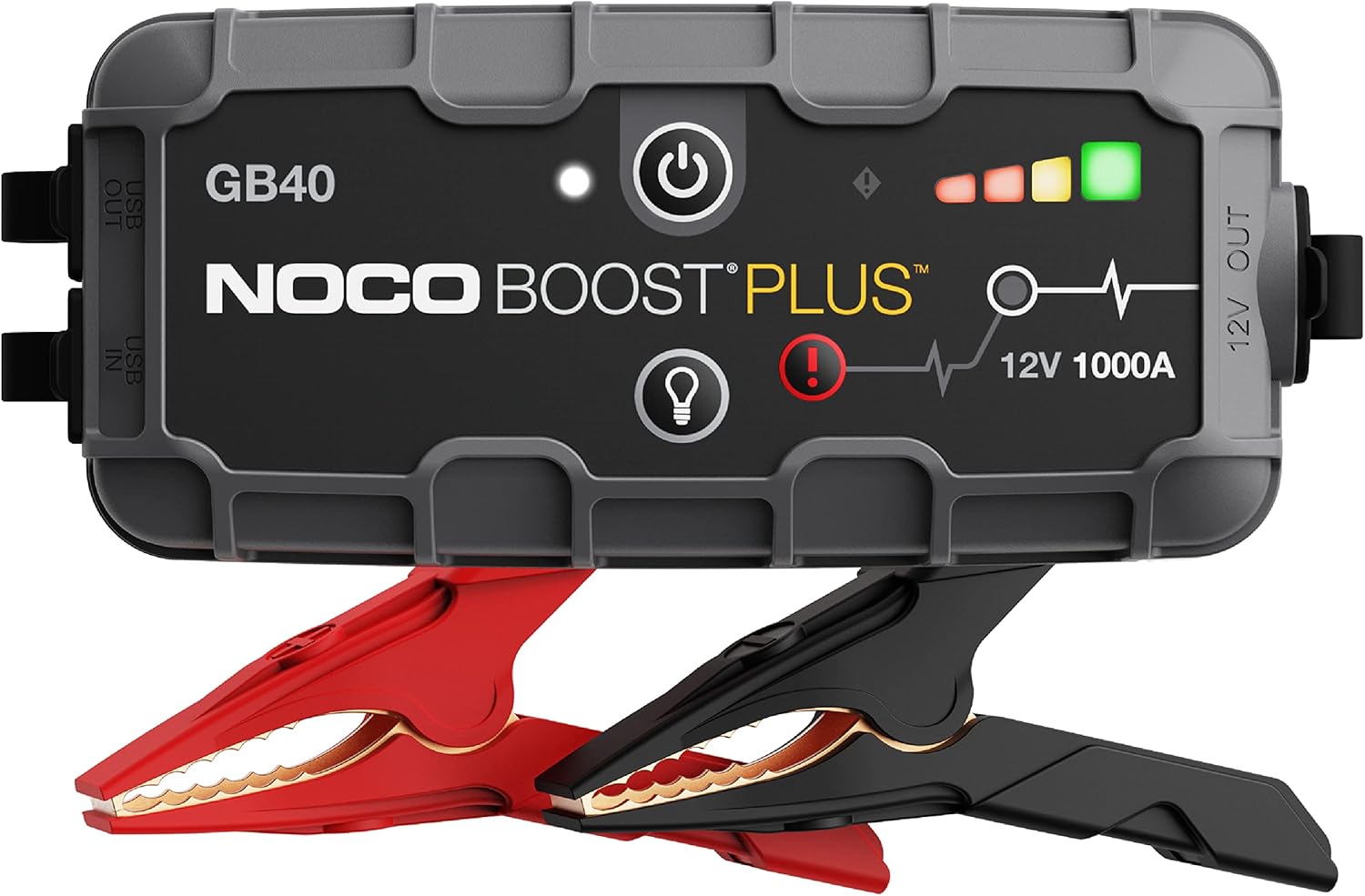
NOCO Boost Plus GB40 Jump Starter
A 1000A lithium jump starter that fits in your glovebox and works on any 12V battery. Your insurance against a dead 12V in a parking lot.
As an Amazon Associate, ThinkEV earns from qualifying purchases — at no extra cost to you.
The Safety Question
Any time you're talking about 1.5 MW of power flowing through a connector, safety is not an optional topic. Let me address it head-on.
The BYD flash charging connector is a new physical standard, not backward compatible with the CCS1 connector used by most non-Tesla EVs in Canada today. It's designed to handle the current loads involved safely. The connector geometry ensures proper alignment before any power flows, the cable is liquid-cooled (the heat generated in the cable itself at 1.5 MW is substantial), and the communication between vehicle and charger is continuous throughout the session.
The Blade 2.0 battery's thermal stability is critical to flash charging safety. The original Blade Battery was famous for passing the "nail test", a test where you drive a nail through a fully charged battery cell to induce a short circuit, and the LFP chemistry means nothing catches fire. Blade 2.0 inherits this chemistry with improvements. LFP cells literally cannot undergo thermal runaway the way NMC cells can, the chemical reactions involved are not capable of sustaining the runaway feedback loop that causes battery fires.
The cable cooling system is something most people don't think about. At 1.5 MW, a cable that would be fine at 150 kW would be red-hot and dangerous. BYD's flash charging cables circulate coolant through the cable itself, keeping the temperature within safe limits throughout the session. This is the same approach used by some high-power industrial charging systems and is a solved engineering problem.
From a grid perspective, the buffer storage system at the station is the safety critical component, specifically, the protection systems that prevent the buffer battery from discharging faster than intended, and the protections between the grid and the buffer. These are standard power electronics challenges with known solutions. Nothing here is novel safety territory; it's scaling existing approaches.
Looking Five Years Out: What Canadian EV Infrastructure Could Look Like
Let me paint a full picture of where this goes if the technology and policy alignment happens on schedule.
By 2029 to 2030, a realistic Canadian EV road trip scenario looks like this:
You're leaving Vancouver for Banff. Your vehicle, let's say a BYD Sealion 7 with flash charging, or a Hyundai equivalent, has 600 km of rated range. You leave with a full charge. The first flash charging stop is somewhere around Kamloops or Revelstoke, depending on your pace. You pull off, plug in, use the restroom, and you've added 400 km. You never stop again until Banff.
Banff to Calgary: a single stop somewhere near Canmore or at the Calgary city limits. Five minutes.
Calgary to Saskatoon: the Prairies are harder. You'd need two stops, one near Brooks (AB) or Swift Current (SK), one near Moose Jaw or Regina. Even then, five minutes each. The total added travel time compared to a gas vehicle is under 15 minutes.
The key number is not the 5 minutes per stop, it's that each stop adds 400 km. A vehicle with 600 km of rated range that stops for 5 minutes and gets 400 km means you can effectively drive indefinitely with brief pauses. The limiting factor becomes the driver, not the car.
That's the world flash charging enables. It's not here yet for Canadian drivers. But it's coming, and understanding it now helps you make better decisions about what to buy, when to buy it, and where the charging infrastructure investment is heading.
The Numbers Are Not Vaporware
BYD's 1.5 MW flash charging system is real technology, deployed in production, and it works. The numbers are not vaporware: 400 km in 5 minutes, 85% cold-weather range retention, comparable installation cost to 350 kW equipment. These are verifiable claims backed by physical products, not concept renders.
For Canadian road trips in 2026: flash charging is not relevant to your planning. You're working with today's infrastructure, Electrify Canada, Tesla Superchargers, Petro-Canada DCFC, and that infrastructure is good enough for most routes if you plan properly.
For Canadian road trips in 2028 to 2030: this becomes the defining technology of the category. The combination of flash-capable vehicles and flash charging stations on major Canadian corridors will make EV road trips genuinely more convenient than gas vehicle road trips, not just comparable.
For your next car purchase: don't wait for flash charging if you need a car now. If you're specifically planning for a 2027 to 2028 purchase, and highway road trips matter to you, look for vehicles with 800V or higher architecture that can potentially be upgraded through software for higher charge rates as infrastructure deploys. BYD's Blade 2.0 vehicles, when they arrive in Canada, will be specifically designed for this.
The last objection to EVs is falling. It's not gone yet in Canada, but the engineering is done and the manufacturing scale is real. Five-minute charges on the Trans-Canada are coming. Plan accordingly.
Gear worth having
As an Amazon Associate, ThinkEV earns a small commission from qualifying purchases — at no extra cost to you.

Lectron Level 2 J1772 Charger (40A, WiFi)
Smart WiFi charger with real-time energy monitoring. 40A / 9.6 kW, J1772 with a NEMA 14-50 plug, schedule charging right from your phone.
As an Amazon Associate, ThinkEV earns from qualifying purchases — at no extra cost to you.
Gear worth having
As an Amazon Associate, ThinkEV earns a small commission from qualifying purchases — at no extra cost to you.

ChargePoint Home Flex Level 2 Charger (50A)
Premium 50A / 12 kW charger with the best app ecosystem. Hardwired or NEMA 14-50, with real-time energy tracking and smart scheduling.
As an Amazon Associate, ThinkEV earns from qualifying purchases — at no extra cost to you.
Related Reading
- BYD Is Coming to Canada, What the Tariff Deal Really Means for Buyers, The complete breakdown of BYD's Canadian market entry, pricing, and timeline
- BYD Seal Review: $45K Gets You This?, In-depth review of BYD's best vehicle currently accessible to Canadian buyers
- Canada's New $5,000 EV Rebate (EVAP), The Complete 2026 Guide, How to claim your federal rebate before you buy
- Best Level 2 EV Chargers Ranked Canada 2026, What to install at home while you wait for the public network to catch up
- Are Chinese EVs Safe? Complete Safety Analysis, Crash testing, battery safety, and what the data shows on BYD and other Chinese brands
Gear worth having
As an Amazon Associate, ThinkEV earns a small commission from qualifying purchases — at no extra cost to you.

Magnetic EV Charger Plug Cover
A magnetic cap that keeps rain, road salt, and grit out of your home charger handle between sessions.
As an Amazon Associate, ThinkEV earns from qualifying purchases — at no extra cost to you.

Founder & Chief Editor
Vlad Pereira is the founder and chief editor of ThinkEV.ca, the Canadian electric-vehicle publication he writes and edits from Courtenay, British Columbia. He covers EV pricing, federal and provincial rebates, charging costs, and the Chinese manufacturers now entering Canada, from the buyer's side rather than the press-fleet side. ThinkEV is a venture of Vlad Pereira Online; his writing on health, income and the long game lives at vladpereira.com.
Frequently asked questions
Can I use BYD's 1.5MW flash chargers with my current EV in Canada?
When will BYD flash charging stations arrive in Canada?
Does the BYD Blade 2.0 battery really retain 85% capacity at -20°C?
Is a 1.5MW charger safe for the battery and the driver?
What about the electrical grid, can Canada handle 1.5MW chargers?
Should I wait for flash charging before buying an EV?
Which BYD vehicles coming to Canada will support flash charging?
How does BYD's flash charging compare to Tesla's Supercharger V4?
More EV & road-trip finds
Affordable upgrades worth a look — tap any to check the price on Amazon.
 ★ 164
★ 164Solar-Powered LED Ambient Light
View on Amazon ★ 900
★ 900Personalized Photo Car Air Freshener
View on Amazon ★ 21,304
Car Headrest Hooks (4-Pack)
View on Amazon ★ 55,938
WixGear Magnetic Air Vent Phone Mount (2-Pack)
View on Amazon ★ 87
★ 87Car Window Sun Shades for Kids (4-Pack)
View on Amazon ★ 68
★ 68WeatherTech FloorLiner for Tesla Model 3
View on Amazon ★ 96,686
PULIDIKI Car Cleaning Gel (Detailing Putty)
View on Amazon ★ 419
★ 419RGB Car Interior LED Strip Light
View on AmazonRead, Plan, Then Stay Current
Explore our expert articles to understand incentives and ownership costs, use the map to pressure-test charging reality, then subscribe so new EV coverage comes straight to you.
Continue Reading
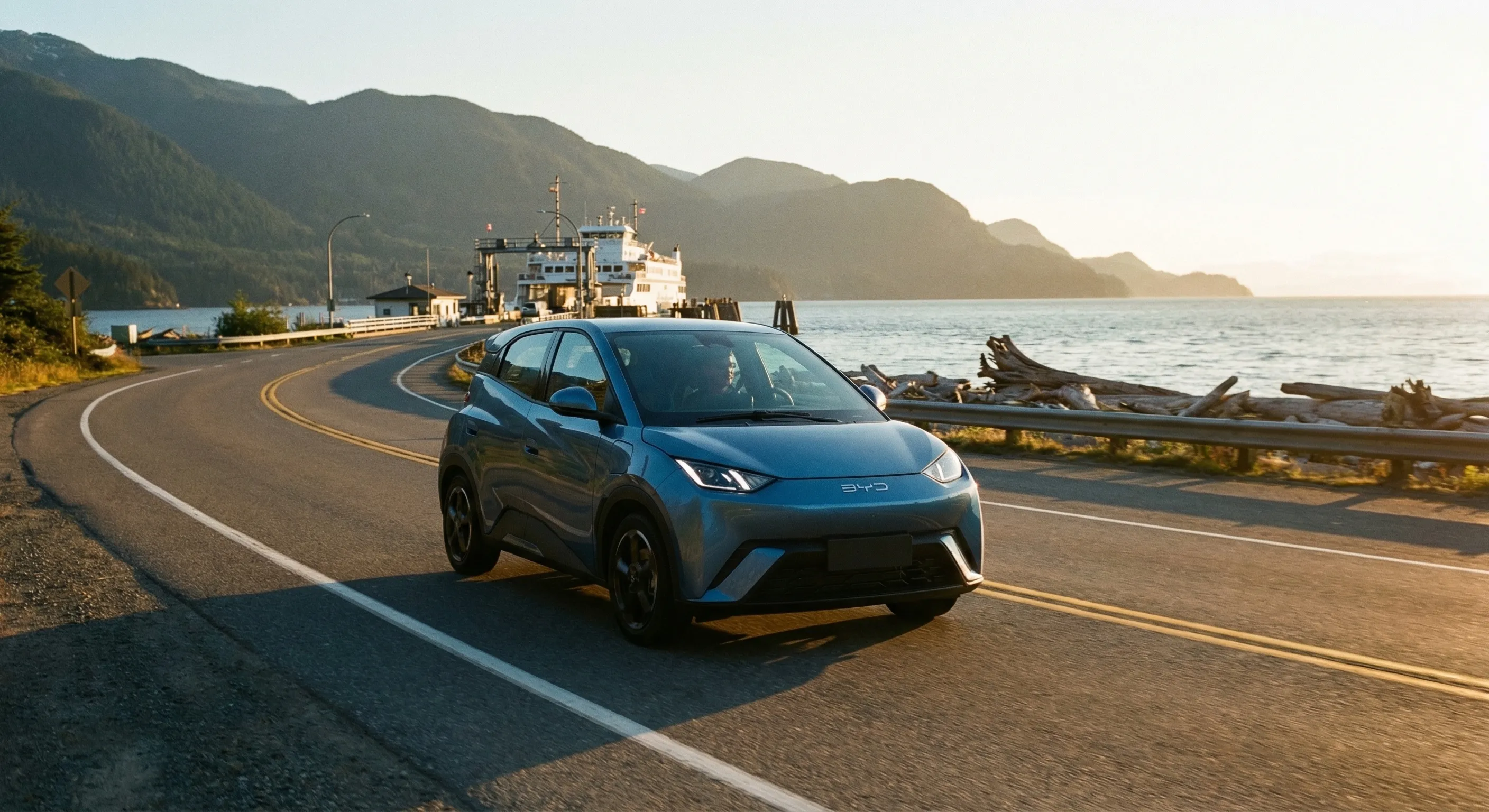
BYD Seagull Canada Price: The $15K-$20K EV in 2026

Chinese EVs in Canada: Security Politics vs Value
EV Charging on Road Trips Across Canada, Is It Viable Yet?

Should I Wait for BYD to Come to Canada?
Chinese EV Resale Value in Canada: What to Expect