Key takeaways
- Ford sold over 150,000 F-150s in Canada in 2025.
- For reference, the average Canadian drives about 17,000 km per year.
- Even on a -5°C November morning with the heat running full blast, the standard-range Lightning's 370 km covers more than a week of average Canadian driving on a single charge.
- The extended-range model reaches 100 km/h in approximately 4.5 seconds.
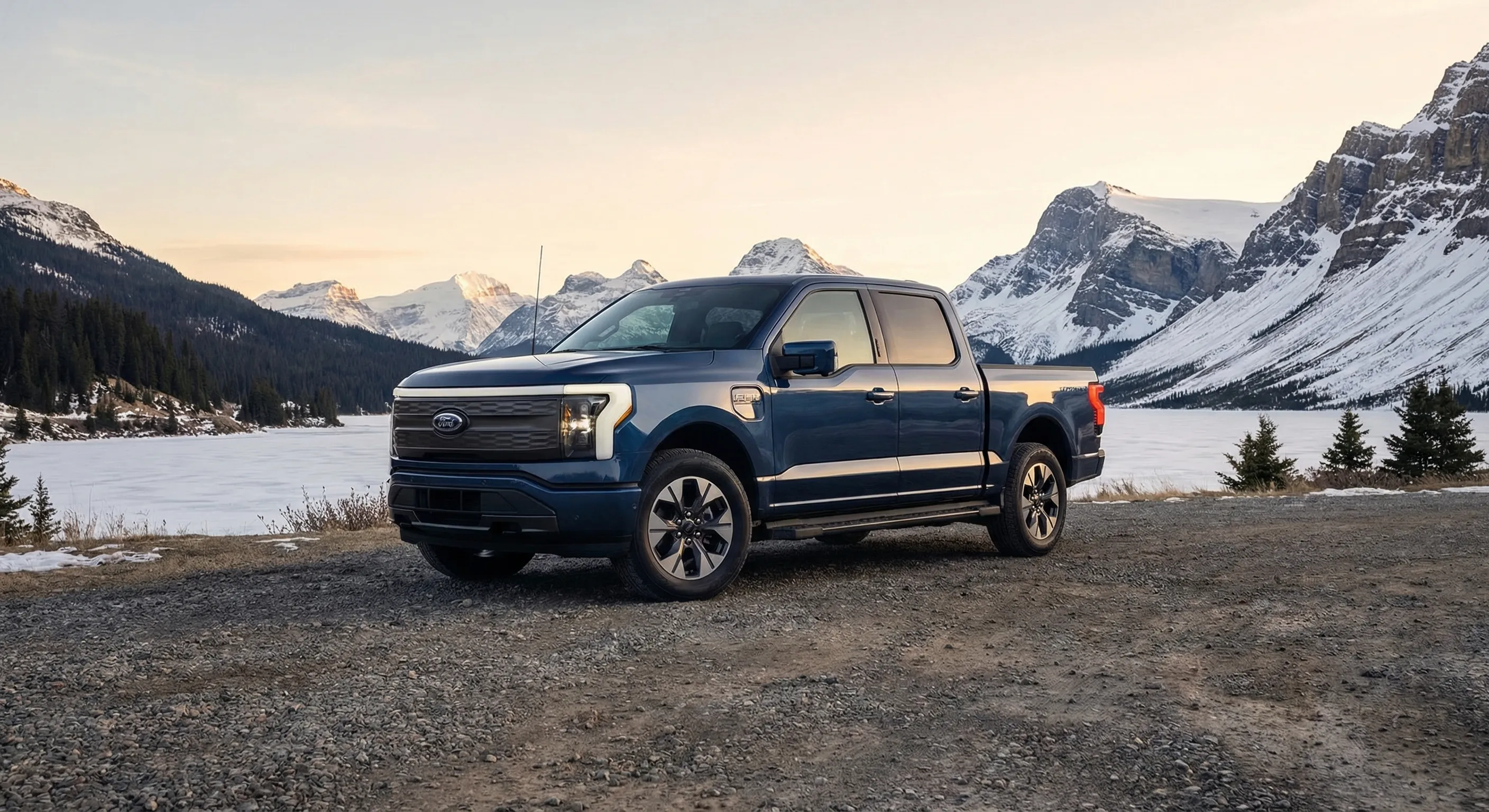
Ford sold over 150,000 F-150s in Canada in 2025. Not trucks, F-150s specifically. The F-Series has been Canada's top-selling vehicle for more than two decades, not just in the truck segment but across every car, crossover, and SUV in the country combined. When Ford decided to electrify it, they weren't launching a curiosity for EV enthusiasts. They were trying to electrify the one vehicle that Canada actually depends on. That is an entirely different project than building a Mustang Mach-E, and the stakes of getting it wrong are much higher.
Consider this: F-150 buyers are not Ioniq 6 buyers. They haul. They tow. They work on job sites in Fort McMurray and Chilliwack and Brantford. They drive gravel roads to remote properties in northern BC and rural Manitoba. They're not deciding between a Tesla and a Volvo, they're deciding whether electricity can do what diesel and gasoline have done reliably for forty years. That's a harder question than it looks, and it deserves a harder answer than most electric truck reviews are willing to give.
So here's mine. The Lightning is genuinely good. It's also genuinely limited. And whether those limitations matter to you depends on facts about your actual life, not your feelings about EVs, not whether you consider yourself an environmentalist, not whether you find the frunk amusing. Just facts: how far do you drive, what do you tow, where do you park overnight, and how far from a charger are you when you're in the places that matter? Answer those questions honestly and the Lightning's case for or against becomes obvious quickly.
The Battery, the Power, and Why the Rated Range Is Actually Honest
The Lightning comes in two configurations: a standard-range model with 370 km of rated range, and an extended-range model that pushes 515 km. Those are Natural Resources Canada figures, NRCan uses a combined city/highway methodology that's more conservative than the American EPA test cycle. These aren't marketing numbers. They're closer to what you'll actually see.
For reference, the average Canadian drives about 17,000 km per year. That's roughly 47 km per day. Even on a -5°C November morning with the heat running full blast, the standard-range Lightning's 370 km covers more than a week of average Canadian driving on a single charge. If you're plugging in at home each night, which is the only way to sensibly own any EV, not just this one, you wake up every morning with a full "tank." The range anxiety people talk about is essentially absent in that daily use scenario.
The power numbers deserve the same honest treatment. The dual-motor extended-range model produces 580 horsepower and 775 lb-ft of torque. The standard-range sits at 452 hp and, interestingly, the same 775 lb-ft of torque, same pulling power, just less total output. Both deliver all of that torque from zero RPM, which is what electric motors do and what internal combustion engines structurally cannot replicate. The extended-range model reaches 100 km/h in approximately 4.5 seconds. Anyone who suggests the Lightning might feel underpowered hasn't driven one. At over 3,000 kg fully loaded, it reaches 100 km/h faster than most sports cars built in the 1990s. Underpowered is not the critique.
Payload is rated at 900 kg, roughly 2,000 lbs, for the extended-range model. Some gas F-150 configurations can carry more, and if you routinely load the bed to absolute maximum, that gap matters. For most buyers, 900 kg covers tools, materials, and equipment for typical job site work with room to spare. The tow rating is 10,000 lbs, which is where the interesting discussion actually lives.
Towing: Let's Not Pretend Physics Is a Marketing Problem
When you hook a trailer to the Lightning, the range drops by roughly half. This is not a software issue. It's not something Ford can fix in a future OTA update. It's physics, and it's worth understanding rather than pretending it doesn't exist.
Aerodynamic drag scales with the square of velocity. At 100 km/h on a Canadian highway, a 24-foot travel trailer creates approximately four times the aerodynamic load of the truck itself. The electric drivetrain is extraordinarily efficient in stop-and-go driving where regenerative braking recovers energy that gas engines just vent as heat. But at sustained highway speed with a large trailer attached, that efficiency advantage shrinks dramatically. The motor is still more efficient than a V8, but the baseline load is so high that the range impact is severe regardless.
Natural Resources Canada data puts the practical tow-range penalty for a 1,000 kg trailer at 150 km or more depending on conditions, temperature, and driving speed. Ford's own real-world data for the extended-range model near maximum tow capacity puts you in the 200 to 240 km window. Standard-range under similar conditions: 160 to 180 km. These are the numbers you're actually working with when you load the trailer.
The Alberta scenario gets specific quickly. Calgary to Edmonton is 299 km. If you're towing a horse trailer from a property south of Calgary to an event north of Edmonton, you're stopping to charge somewhere around Ponoka or Red Deer, adding 30 to 40 minutes to your trip. On BC's major corridors or Ontario's 400-series highways, places with reasonable DCFC density, that stop is manageable. You stop, you have coffee, you use the washroom, and you leave. But you're planning around it in a way you would not plan around a gas truck, and that planning has a real cost in flexibility.
Here's what the Lightning does better than any gas truck when towing uphill: the instant torque delivery is genuinely superior. A gas engine needs to build RPM before it produces peak torque, press the throttle, wait for the transmission to downshift, wait for RPMs to climb, wait for the power to arrive. The Lightning is already at peak torque the instant the accelerator moves. On Kicking Horse Pass, on the climb into Northern Ontario granite country, on any sustained grade with 8,000 lbs behind you, that difference is not subtle. Better control, more confidence, and on long descents, regenerative braking doing the work that overheated brakes would otherwise struggle with.
The practical breakdown for Canadian towing patterns looks like this. For contractors doing daily work within a 100 km service radius, the operating pattern that describes the majority of Canadian trades workers, the Lightning is excellent. The trailer never goes far enough to threaten the range. The job site power comes from the truck bed. The truck goes home every night and wakes up full. For the family in Sault Ste. Marie doing an annual Algonquin trip with a travel trailer, you make the trip with one or two planned stops and the inconvenience is modest. The routes are serviced, the stops are brief, and the experience is honestly fine.
For someone who regularly hauls 8,000 lbs for 400 km stretches across rural Saskatchewan or northern Alberta, where the nearest DC fast charger might be 150 km off your intended route, the Lightning asks you to restructure your operating pattern. Not impossible. But genuinely inconvenient in ways that matter when your time is your money. The charging network will make this less true over the next three to five years. In 2026, it's still true enough to mention clearly.
What makes the trade-off worth more careful examination is the fuel cost of towing with gasoline. Towing 8,000 lbs in a gas F-150 with the 3.5L EcoBoost at highway speed consumes about 22 to 26 litres per 100 km depending on conditions. At current Canadian gas prices around $1.65 per litre, that's $36 to $43 per 100 km just in fuel. The Lightning's electricity cost for equivalent towing distance, drawing harder from the battery, yes, but at roughly $0.15 per kWh average across Canadian provinces, comes to about $8 to $12 per 100 km.
If you're making 40 towing trips a year at 150 km each, the Lightning saves you somewhere around $2,500 to $3,500 annually in fuel costs alone, before you even calculate the charging stops. The economics improve materially when you're doing serious towing volume, even if the range limitation requires more planning.
The Mega Power Frunk, More Than a Talking Point
Ford calls it the Mega Power Frunk. That's objectively a silly name. But the space itself, 14.1 cubic feet of lockable, drainable storage where the engine used to live, is legitimately useful in ways reviewers routinely undervalue. It's approximately the luggage space of a large sedan's boot. It has a 12V outlet and drain plugs for washing it out. The floor is flat and the latch is a proper lock. You leave tools in it on a job site without worrying about someone reaching over the tailgate. You put groceries in it on the way home without them rolling around the bed. On a gas F-150, that space is occupied entirely by an engine. The Lightning has the engine somewhere else (in the wheel hubs and floor, effectively) and the space becomes yours.
The frunk will get exactly one mention in most test drives and then everyone moves on. It's worth more than that as an indicator of how thoughtfully Ford actually designed this truck. They didn't just bolt an electric drivetrain under an existing F-150 body and call it a day. They thought about what the lack of a combustion engine actually enables, and they used the space purposefully. That design thinking shows up elsewhere too.
Pro Power Onboard: The Feature That Changes the Entire Value Equation
Most Lightning reviews mention the 9.6 kW Pro Power Onboard system in passing and immediately move on. It is not a neat trick. It's a full-sized commercial generator's worth of 120V and 240V electrical output, delivered from outlets in the truck bed, the cabin, and the frunk, without exhaust, without noise, without fuel, and without the 45-second ritual of pulling a start cord in the rain on a cold Tuesday morning.
Let's talk about what 9.6 kW actually runs, because the number means nothing in the abstract. A 7.25-inch circular saw draws about 1,200 watts at full load. A 10-inch contractor table saw draws 1,800 watts. A 30-gallon air compressor for a pneumatic tool setup draws about 1,500 watts while running. An angle grinder pulls 900 watts. A full job site lighting setup for an evening pour might use 600 watts. Run all of those simultaneously and you're at roughly 6,000 watts, well under the 9,600-watt system ceiling. An electrician, a framer, a plumber, or a general contractor can run their entire tool complement off the truck bed without a dedicated generator present.
The economics of eliminating a generator are straightforward. A commercial-grade 9 kW gas generator costs $1,500 to $3,000 to purchase outright. It requires oil changes every 100 hours of runtime, typically $25 to $40 per service including parts. Under load it burns roughly 1.5 to 2 litres of fuel per hour, which at $1.65 per litre is $2.50 to $3.30 per hour continuously. It runs at 70 to 80 decibels, which exceeds most municipal daytime construction noise bylaws and makes it genuinely difficult to communicate on a site. And it breaks down at 7 AM on a cold January morning in Lethbridge precisely when you need it most, because that's what gas equipment does.
The Lightning's Pro Power system costs $0 per hour to run. It produces no exhaust. It's quiet enough to hold a normal conversation while it powers your tools. For a small electrical contractor in Saskatoon, a landscaping crew in Oakville, or a two-person renovation company in Halifax who currently owns or rents a generator, the math is straightforward. Eliminate the purchase or rental cost, eliminate the fuel cost, eliminate the maintenance. The system isn't replacing a generator as a secondary feature. For many trades buyers, eliminating the generator is the primary case for the Lightning over every other work truck on the market, including the gas F-150.
Gear worth having
As an Amazon Associate, ThinkEV earns a small commission from qualifying purchases — at no extra cost to you.

Portable Level 2 EV Charger (40A, NEMA 14-50)
Throw it in the trunk and charge anywhere with a 240V outlet. 40A portable with NEMA 14-50 plug. Your road-trip insurance policy.
As an Amazon Associate, ThinkEV earns from qualifying purchases — at no extra cost to you.
Vehicle-to-Home Power in a Canadian Winter: The Case Nobody's Making Loudly Enough
The Lightning's V2H system, vehicle-to-home, is a different use case from the job site power, and it deserves its own section because it's the one Lightning capability that could legitimately tip a buying decision for a specific category of Canadian buyer that almost nobody's writing for.
The setup requires a properly installed Ford Charge Station Pro paired with the Home Integration System, a combined cost of $5,000 to $7,000 installed on top of the truck price. Not trivial. But consider what it actually delivers.
A standard Canadian home during a winter power outage in survival mode, keeping the gas furnace blower motor running (400 to 600 watts), the refrigerator cycling (150 watts), lights at reasonable coverage (300 to 500 watts), phones and devices charging (200 watts), draws about 1,000 to 1,200 watts steady-state. At that consumption rate, the Lightning's extended-range 131 kWh battery pack provides approximately 90 to 110 hours of power before you'd need to think about your driving range. That's nearly five full days. In a Canadian ice storm, most outages are measured in hours, not days. For the vast majority of outage scenarios, the Lightning is an inexhaustible backup for survival-mode consumption.
Run the house more normally, television on, microwave being used for actual meals, electric kettle, some extra lighting, and you're averaging 2,000 to 3,000 watts steady-state with spikes from the microwave and kettle. That gives you 40 to 60 hours of runtime. Still covers essentially every realistic Canadian power outage with comfortable margin.
Natural Resources Canada has documented that more than 100,000 Canadians live in areas with persistent grid reliability problems, rural Newfoundland and Labrador, parts of Northern BC, pockets of rural Nova Scotia and New Brunswick, northern Ontario communities where the grid infrastructure is thin and ice storms are seasonal. These are not people for whom backup power is a luxury option. It's a functional necessity they're currently spending real money to maintain.
A comparable whole-home natural gas standby generator, the kind installed beside the house that kicks on automatically during an outage, costs $8,000 to $15,000 installed. It requires annual servicing at $150 to $300 per visit. It depends on natural gas availability, which isn't universal in rural areas. And it burns fuel continuously during an outage, which is both expensive and dependent on continued gas supply. The Lightning's V2H eliminates all ongoing fuel costs, eliminates annual servicing requirements for the generator, and draws from a battery you're charging for driving anyway. The generator is already there, it just needs a wall outlet to export power.
The Ram 1500 REV doesn't have this functionality yet in Canada. The Silverado EV's home integration is still in limited rollout. Ford got here first, got the implementation complete, and built a charging ecosystem, the Ford Charge Station Pro, that makes the V2H installation straightforward for any licensed electrician. For rural and semi-rural buyers in provinces with unreliable winter power delivery, this is not a secondary consideration. It might be the primary one.

Canadian Winter Range: An Answer for People Who Don't Have Time for Vague Answers
Every Canadian EV question eventually becomes a winter range question, so let's answer it properly rather than with the usual "cold weather affects batteries" non-answer that tells you nothing useful.
Lithium-ion batteries lose effective capacity in cold temperatures because the electrochemical reactions that store and release energy slow down as temperature drops. The relationship is non-linear, modest cold (around -5°C to -10°C) has a modest effect, but below -15°C the impact becomes more pronounced, and below -25°C it's genuinely significant. The standard real-world range reduction figure for severe cold is 20 to 40% depending on the vehicle's battery management system, chemistry, and whether the driver uses cabin heating efficiently.
For the Lightning specifically: at -10°C, expect roughly 10 to 15% range reduction. At -20°C, plan for 25 to 35%. At -30°C and below, the temperatures that are routine in Winnipeg, Saskatoon, and much of rural Alberta from January through February, you may see 35 to 40% reduction without preconditioning. Ford's thermal management system is genuinely well-engineered and keeps the Lightning toward the better end of these ranges, but the physics doesn't care about your feelings.
The practical numbers for the extended-range model (515 km rated): at -20°C with a 30% reduction, you're working with approximately 360 km of real-world range. That's still substantial. That's Edmonton to Calgary with 60 km to spare. That's Ottawa to Kingston and halfway back. The standard-range model at 370 km rated gives you approximately 260 km at -20°C, workable for most daily driving patterns but requiring more deliberate planning on longer winter days.
Two Lightning features specifically address Canadian winter performance, and both are worth understanding properly.
The heat pump, standard on XLT trim and above, is not a fancy version of the resistance heater you'd find in base-model EVs. It works on a fundamentally different principle: rather than converting electricity to heat at 1-to-1 efficiency (one kilowatt in, one kilowatt of heat out), a heat pump moves heat from outside air into the cabin, achieving 2.5 to 3.5 units of heat output per unit of electricity consumed.
On a -10°C morning, the resistance heater a base-trim EV uses draws 5 to 6 kW to warm the cabin. The Lightning's heat pump does the same job for 1.5 to 2 kW. That difference, 3.5 to 4 kW of continuous savings, translates directly into more range. On a four-hour winter highway drive, the heat pump is recovering 14 to 16 kWh that would otherwise be wasted.
At 27 kWh per 100 km combined consumption, that's 50 km or more of range saved from a single winter trip. The heat pump is worth real money in Canadian winter conditions. Skipping the Pro trim's lack of it is not a mistake you'll enjoy making.
Battery preconditioning is the other piece. When the Lightning is still plugged in at home, the Battery Management System can warm the battery pack to optimal operating temperature before you leave. This matters in two ways: a warm battery starts the day with its full rated capacity rather than cold-reduced capacity, and it accepts DC fast charging dramatically faster. A cold-soaked battery at -20°C might accept only 40 to 50 kW of DC charging peak. A preconditioned warm battery accepts the full 150 kW. On a long winter road trip with charging stops, that difference is 20 minutes per stop. Set your departure time in the FordPass app the night before, and the truck does this automatically while it's still on grid power, so it doesn't cost you battery range to do it.
The comparison that matters most here isn't the Lightning's winter range against its own summer range. It's the Lightning against a gas F-150 doing equivalent work in equivalent cold. A gas F-150 with the 3.5L EcoBoost loses 8 to 12% fuel economy in genuine Canadian winter, longer warm-up cycles burn fuel at idle, winter fuel blends have 3 to 4% lower energy density than summer blends, and cold tires have more rolling resistance. That's real money over a winter of driving. But it doesn't affect how far you can go before you need fuel, because you can refuel anywhere. The Lightning's winter range loss is a larger percentage, but the per-kilometre cost even at -20°C still favours electricity by a wide margin over gasoline at current Canadian pump prices.
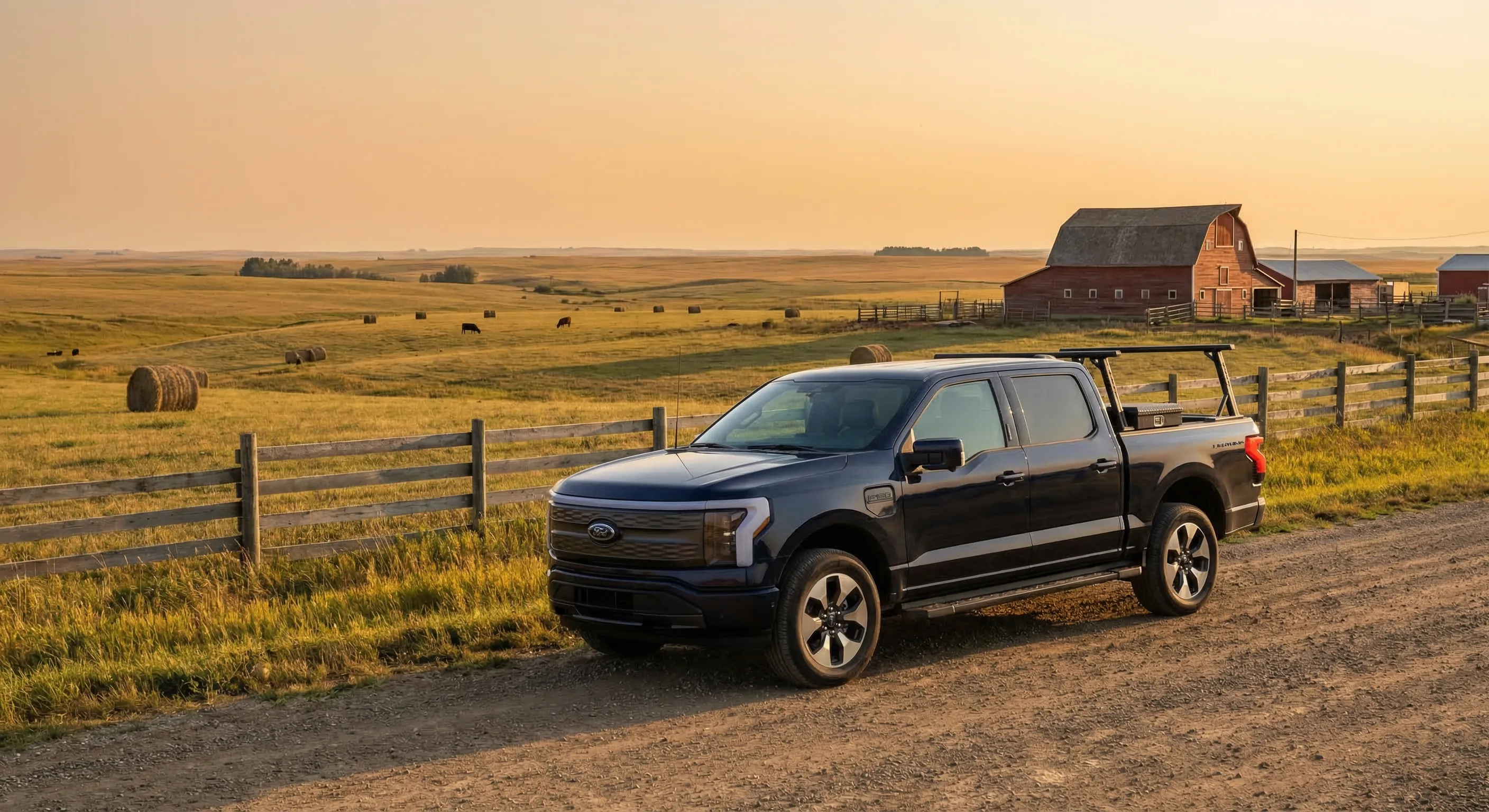
One more winter consideration that almost never appears in EV reviews because it requires actually thinking about how Canadian truck owners live: the block heater analogy. Canadian F-150 owners in serious cold already plug their trucks in overnight, into block heaters that keep the engine warm to aid cold starts and reduce wear. If you own an F-150 in Winnipeg or Prince Albert, you have a plug by your parking spot. The Lightning uses that same plug, or ideally a Level 2 charger on the same circuit, for overnight charging and battery preconditioning. It's the same behaviour, with a better result: a warm cabin and a fully charged battery instead of just a warm engine block. The infrastructure habit is already there. The Lightning just uses it for more things.
Charging: The Full Canadian Picture
The Lightning accepts up to 19.2 kW on Level 2 AC charging. At that rate, you're adding approximately 50 km of range per hour. Overnight on a 240V home circuit with a proper Level 2 charger, you can recover 100 to 150 km depending on your charger's output, meaning a truck that comes home at 30% charge is back to full by morning. For the daily use case, this is the only charging that actually matters. Everything else is for road trips.
DC fast charging is where the extended-range model accepts up to 150 kW peak. At 150 kW with a warm battery, you're adding approximately 100 km of range in about 10 minutes. The 15% to 80% charge window, the range most drivers use for road trip stops, takes approximately 41 minutes under ideal conditions. That aligns with a coffee and a washroom break at a travel centre, which is the target experience.
And here's the number that makes the Silverado EV comparison awkward for Lightning advocates: the Silverado EV is rated for 350 kW DC charging peak. In practice, it rarely sustains that rate for long, battery thermal limits cause it to throttle back, but the Silverado EV's real-world 15% to 80% charge still completes in roughly 35 to 38 minutes versus the Lightning's 41 minutes. The difference is not dramatic. But it's honest to mention it, and it's the kind of thing that compounds on a long road trip with three charging stops. Six minutes per stop sounds small until you're making three of them through a winter drive from Kelowna to Edmonton.
NACS compatibility is now standard on all 2026 Lightning trims. This is genuinely significant. Tesla's Supercharger network has over 200 locations in Canada, and they're consistently the most reliable and most available DC fast charging option outside of major urban centres, better maintained than most third-party networks, with better uptime and more predictable speeds. A Lightning owner with NACS access has a meaningfully larger reliable charging network than one who depends on CCS-only third-party stations. For long-distance driving, this is not a minor checkbox item.
Outside of Tesla Superchargers and major urban DCFC corridors, the Canadian fast charging network has real gaps in 2026. Rural Saskatchewan, interior BC outside Highway 1 and Highway 97, northern communities, and most of Atlantic Canada outside Halifax, if your regular driving pattern includes these areas, you need to plan your charging before you leave. Apps like PlugShare, ChargePoint, and the FordPass native routing help. But they can only route around infrastructure that exists. The Lightning is genuinely limited in areas where infrastructure doesn't.
Gear worth having
As an Amazon Associate, ThinkEV earns a small commission from qualifying purchases — at no extra cost to you.
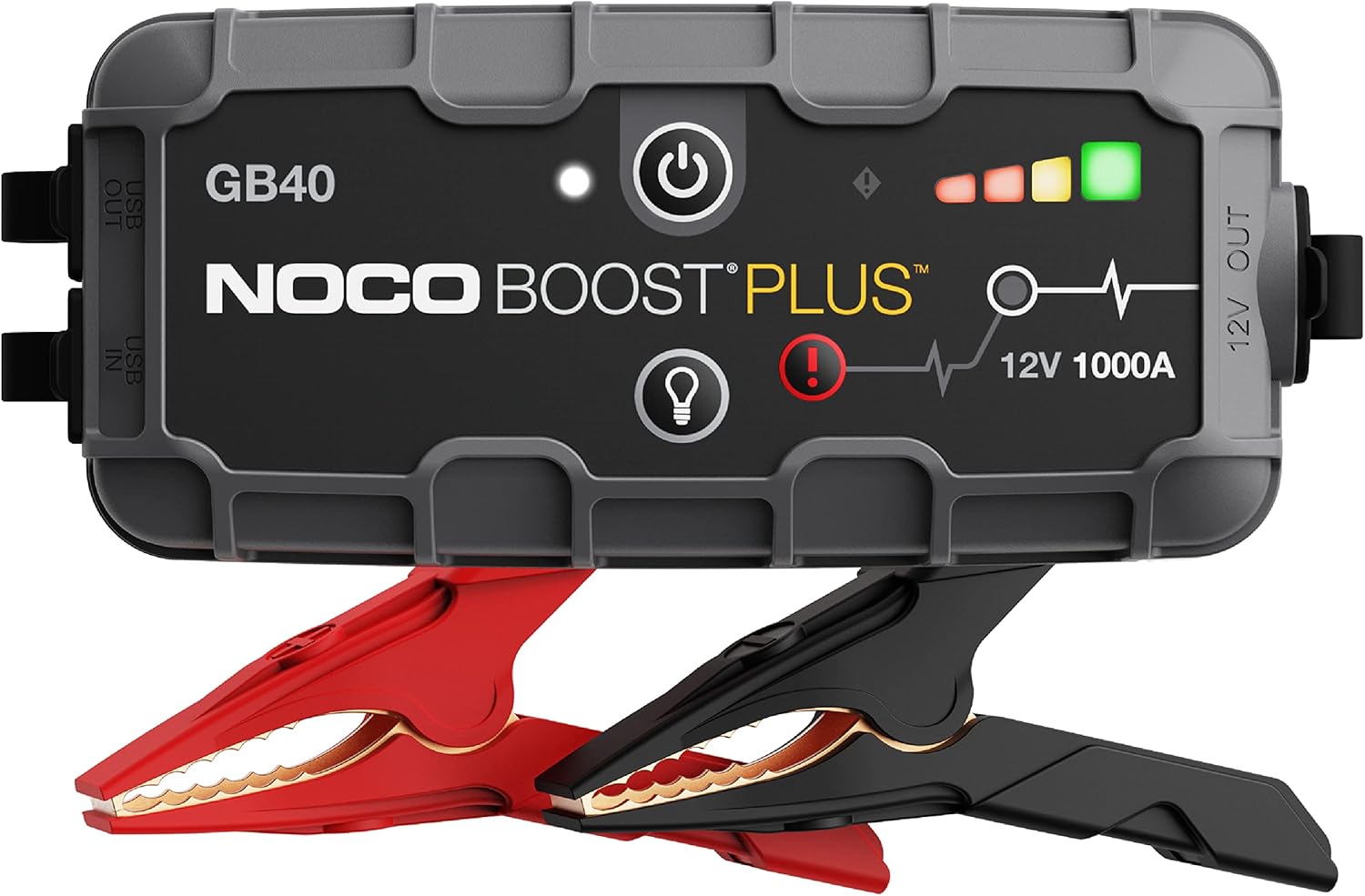
NOCO Boost Plus GB40 Jump Starter
A 1000A lithium jump starter that fits in your glovebox and works on any 12V battery. Your insurance against a dead 12V in a parking lot.
As an Amazon Associate, ThinkEV earns from qualifying purchases — at no extra cost to you.
Home charging is the foundation of all the economics, the winter arguments, and the convenience. If you have a driveway or garage where you can install a Level 2 charger, typically $700 to $1,500 installed depending on your electrical panel situation, the Lightning's daily ownership experience is excellent. If you rely on public or workplace charging for 100% of your needs because you live in a condo or apartment without charging access, the math is harder. Not impossible, but deliberately inconvenient in ways that erode the experience. No current electric truck is designed to work optimally without home charging as the foundation. Before you buy any EV, and the Lightning in particular, confirm your home charging situation. That answer shapes every other calculation.
The Price, the Rebates, and the Five-Year Math
The Lightning's base price in Canada starts at $79,995. The extended-range model in higher trims, which is where most buyers will end up once they understand what they're giving up in the Pro and base XLT, pushes into the $90,000 to $105,000 range. This is not cheap. Ford isn't pretending it's cheap.
It also doesn't qualify for the federal iZEV (formerly EVAP) rebate, which caps final transaction price at $50,000. The Lightning exceeds that by somewhere between $30,000 and $55,000 depending on trim. Some provincial programs exist, BC's SCRAP-IT, some Quebec programs, but most are similarly price-capped in ways that exclude the Lightning. Check your specific province's current rules before you get your hopes up, because they change frequently and the details genuinely matter.
For comparison: a gas-powered F-150 in Lariat trim with the 3.5L EcoBoost and a reasonable option package runs $70,000 to $82,000 in Canada. The Lightning is at or slightly above parity with equivalent-trim gas models. It's not the dramatic premium over an equivalent gas truck that people often assume. The absence of a rebate is real, but the base price gap to the gas equivalent is smaller than it appears at first glance.
Now the five-year arithmetic. A gas F-150 with the 3.5L EcoBoost in real-world Canadian mixed use averages about 13.5 litres per 100 km, this is what owners actually report in Canadian driving conditions, not the NRCan optimistic combined figure. At $1.65 per litre, that's $22.28 per 100 km in fuel. The Lightning at approximately 27 kWh per 100 km combined consumption costs about $4.05 per 100 km at a Canadian average electricity rate of $0.15 per kWh. The per-kilometre cost difference is $18.23. At 17,000 km per year, you're saving roughly $3,100 annually in fuel alone.
Maintenance savings compound on that. No oil changes (a 3.5L EcoBoost gets serviced every 7,500 to 10,000 km, call it two to three times per year at $80 to $120 each). No transmission fluid services. No spark plugs. No exhaust system maintenance. No belt replacements. No coolant flushes. Electric motors have dramatically fewer wear components than internal combustion engines with their hundreds of moving parts subject to combustion heat and friction.
The main Lightning maintenance items are tires (which you'd buy for any truck), brakes (which last substantially longer because regenerative braking does most of the deceleration), and battery health monitoring that happens during routine software updates. Conservative industry estimates put the five-year maintenance cost of an electric truck at 30 to 40% lower than an equivalent gas truck.
On a $2,000 to $3,000 annual gas truck maintenance budget, that's another $600 to $1,200 per year in real savings.
Add it up over five years: somewhere in the range of $18,000 to $22,000 in combined fuel and maintenance savings compared to the gas equivalent, assuming current fuel prices hold (which, in Canada, they historically have or have risen). That closes the price premium significantly. The Lightning's economics work. They're just not obvious from the sticker price, which is exactly why the sticker price dominates the conversation and the lifetime cost mostly doesn't.
The Interior, the Technology, and What It's Actually Like to Use
The Lightning's interior at XLT and above doesn't feel like a compromise. That matters, because electrified versions of existing vehicles sometimes do, they borrow the nameplate and forget the character. The Lightning XLT is a proper truck interior with proper materials for the price point. The 12-inch SYNC 4A screen is responsive and well-organized without being overwhelming. The physical controls for climate and off-road modes exist alongside the touchscreen rather than hiding everything inside menus that require navigation during driving. Ford understood that truck buyers are not interested in hunting through software menus to turn on their heated seats.
The Lariat trim adds leather seating, heated front and rear seats, ventilated fronts for summer, and a 360-degree camera system. For buyers using the Lightning as their primary daily vehicle, not just a work tool, the Lariat quality jump is worth the price step. The Platinum is genuinely luxurious: top-quality interior materials, advanced technology features, the most capable BlueCruise implementation. At $105,000 and up, it competes on interior quality with loaded Ram 1500 Limiteds and F-150 King Ranches. Whether the Platinum premium over the Lariat is worth it depends entirely on how much the materials quality and top-trim tech features matter to you personally. Most buyers will be better served by the Lariat.
The SYNC 4A navigation is worth calling out specifically for Canadian road trip use. It integrates charging stop planning into native routing, showing you where to charge based on your current state of charge, your destination, and the optimal charge level to arrive with. For owners new to EV trip planning who haven't yet built the mental model of managing energy on a route, this native integration does the work for you. You put in your destination and the truck tells you whether you need to stop and where. On longer Canadian drives, this removes what would otherwise be a planning burden from every trip.
Over-the-air updates mean the Lightning you buy today will be meaningfully better software-wise in two years without a dealer visit. Ford has pushed substantial improvements since the 2022 launch, better cold-weather charging management, improved range estimation accuracy, enhanced NACS station data, navigation upgrades, SYNC feature additions. The 2026 model already includes multiple improvements that 2022 buyers received through software updates. This is how modern vehicles work, and the Lightning does it well. Your truck getting better overnight while parked in the driveway is a thing that's hard to value until you experience it regularly.
The BlueCruise hands-free highway driving system deserves a direct description rather than the vague "driver assistance technology" framing most reviews use. BlueCruise works on pre-mapped divided highways and uses a driver-facing camera to monitor your eye gaze. You can take your hands off the wheel on mapped highway sections while the system handles lane-keeping and following distance, but only while you're actively watching the road.
It's not autonomous. It's attentive cruise control that handles the physical inputs while you remain mentally present. On a long Trans-Canada Saskatchewan stretch, or the stretch of Ontario highway between Sudbury and North Bay, or commuting through congested GTA highway traffic, the fatigue reduction is real. Hands-free, eyes-on is more relaxing than hands-on, eyes-on for hours at a time.
The FordPass app is the daily-use interface that matters more than most buyers think before they own an EV. Preconditioning the cabin and battery before departure is the one habit that most improves winter ownership, and FordPass makes it automatic: you set a departure time, the truck conditions itself, and you get in a warm cab with a thermally optimal battery. The 2026 model's FordPass integration also shows your estimated range at departure after preconditioning, so you can plan accordingly before you leave the driveway rather than discovering on the road that cold-soaking overnight cost you 40 km you were counting on.
The range estimation algorithm in the 2026 Lightning deserves specific credit: Ford updated it to use your actual recent driving data rather than generic NRCan figures. If you've been doing mixed city and highway driving at -12°C for the past week, the truck knows your real consumption pattern and shows you that honest range estimate. An EV that's accurate about range builds trust. An EV that shows you optimistic numbers and then falls short of them trains you to distrust the gauge at the worst moments. The Lightning's updated estimation is trustworthy in a way that makes a real difference to the ownership experience.
Trim Levels: The Right Answer for Most Canadian Buyers Is XLT or Lariat With Extended Range
The Lightning comes in Pro, XLT, Lariat, and Platinum trims in Canada, with a Black Ops package on XLT and Lariat.
The Pro trim is the fleet and commercial buyer entry point. It's deliberately stripped: basic cloth seats, no heat pump (this is genuinely punishing in a Canadian winter, do not skip the heat pump), no BlueCruise, standard-range battery only. For fleet buyers who need the Pro Power Onboard system and will run the truck in mild-weather regions or urban environments, it's an entry point. For individual buyers planning to own this truck through five Canadian winters, no.
The XLT is where the Lightning becomes a complete vehicle. It adds the heat pump (essential, not optional, in Canada), the 12-inch SYNC 4A infotainment, proper interior comfort, and the option to spec the extended-range battery. XLT with extended range comes in around $89,000 to $92,000 depending on option packages. This is the value configuration: everything that matters for Canadian ownership, nothing you're paying for just because you can. If you're a contractor or a buyer who prioritizes capability over luxury features, this is your truck.
The Lariat step-up adds interior refinement that matters if you're spending significant time in the cab beyond just driving to job sites. Leather, heated and ventilated seats, the 360-degree camera, better audio, more tech standard. Lariat with extended range runs approximately $95,000 to $100,000. For buyers using the Lightning as their primary daily vehicle for years, the Lariat quality gap from XLT is noticeable and worth the premium.
The Platinum at $105,000 and above is a luxury truck competing with luxury alternatives. If that's your comparison set, if you'd otherwise be looking at a Ram 1500 Limited TRX or an F-150 King Ranch, the Platinum holds its own on interior quality. If you're a trades buyer or a rural buyer who wants the capability without the luxury premium, the Lariat ceiling is the right stop.
The Competitive Picture: What the Silverado EV and Ram REV Actually Mean for Your Decision
The Canadian electric truck market in 2026 has real options, and the Lightning doesn't dominate every comparison cleanly. Being direct about this is more useful than pretending the category doesn't exist.
The Chevrolet Silverado EV RST has a longer NRCan-rated range, 590 km for the extended-range versus the Lightning's 515 km. It has faster peak DC charging at 350 kW, though real-world sustained rates are lower due to thermal throttling and the practical 15% to 80% completion time is 35 to 38 minutes versus the Lightning's 41. The Silverado EV starting price for some configurations is closer to $73,995, which is meaningfully less than the base Lightning. On paper, these are competitive specs.
What the Silverado EV doesn't have at scale: the V2H home integration system, the depth of Ford's truck dealer network across smaller Canadian markets, and the matured NACS charging ecosystem that Ford has built. The Silverado EV has also had more constrained Canadian inventory than the Lightning through early 2026. For a work truck where downtime has direct cost implications, service infrastructure is not a secondary consideration. If your Lightning needs warranty work in Fort St. John, Timmins, Rimouski, or Lethbridge, there's a Ford dealer there. Chevrolet has dealers too, but Ford's truck-specific service depth and technician familiarity with the Lightning is more established.
The Ram 1500 REV is not widely available in Canada as of early 2026. Its claimed specs, a 221 kWh extended-range pack, a range of 725+ km, and strong V2H and V2G capabilities, are impressive on paper and will be meaningful when inventory is available. But specs on trucks you cannot actually buy do not haul your trailer or power your tools. When the Ram 1500 REV arrives at Canadian dealers in meaningful volume, it will genuinely complicate the Lightning's value proposition at the top end. In 2026, you can walk into a Ford dealer today.
The competitive argument for the Lightning is: availability now, V2H that works now, dealer service infrastructure now, and a truck that's had four model years to have its software and reliability kinks worked out. The competitive argument against it is: slower DC charging peak, lower rated range than the Silverado EV, and a price ceiling that doesn't attract any rebates. Both of those are true. Weight them for your situation.
What Actually Changed for 2026
The 2026 model year Lightning is iterative improvement rather than generational redesign. But the specific changes have real impact for Canadian buyers.
NACS compatibility is now standard across all trims. No adapter required for Tesla Superchargers, which in Canada's charging infrastructure picture is the difference between accessing roughly 200 reliable Supercharger stations across the country and relying on the patchier third-party DCFC network. This was previously an adapter situation or a higher-trim package feature. Making it standard is the right call and meaningfully expands the real-world charging network available to every Lightning owner regardless of which trim they buy.
The Pro Power Onboard 240V capability is now standard on XLT and above rather than a package add-on. The previous model required option navigation to get the full 9.6 kW output. Standardising it simplifies the buying decision and ensures that commercial buyers who choose the XLT get the full tool-powering capability without hunting through option sheets.
The OTA software for 2026 includes improved Canadian DCFC station data, better coverage of the expanding NACS network and real-time charger status rather than just showing stations on a map regardless of their operational state. An out-of-service charger that appears available on the navigation screen is a genuinely bad experience on a road trip when you're depending on that stop. Better station status data makes charging stop planning meaningfully more reliable.
FordPass integration with departure planning has been improved such that setting a departure time more reliably activates both cabin preconditioning and battery thermal management. The app now also shows the expected range at departure post-preconditioning, which is genuinely useful information for planning a cold morning trip in January in Saskatoon rather than discovering your real range after you've already left.
Who Should Buy This Truck and Who Shouldn't
The thing that gets lost in most reviews is that they'd rather give you a number out of ten than tell you who the truck is actually right for.
Buy the Lightning if you're a contractor working within a 200 km service radius with home charging access. The Pro Power Onboard eliminates your generator cost, the fuel savings over five years are concrete, the instant torque with a loaded bed is genuinely better than a gas truck, and the V2H adds emergency backup power value that has nothing to do with being an EV enthusiast. This is the case where the Lightning wins on pure economics, not ideology.
Buy the Lightning if you're a rural homeowner dealing with extended winter power outages and have a place to charge at home. Run the five-year numbers on what you've spent on generator fuel, generator maintenance, and the aggravation of a gas generator that needs maintenance right when you need it most. Add the V2H installation cost of $5,000 to $7,000. See if the math closes. For many rural buyers in BC, Nova Scotia, or northern Ontario, it does.
Buy the Lightning if you're an urban or suburban F-150 owner whose actual use pattern is commuting, hauling materials within the city, and occasional towing within 150 km. You'll spend less on fuel and maintenance, you'll have better performance, you'll have a full "tank" every morning, and you'll never think about range. This is the majority of actual F-150 buyers, the truck that lives in the driveway and occasionally goes to the hardware store and the lake, not the truck that hauls cattle across three provinces.
Don't buy the Lightning if you routinely tow heavy loads for 400+ km stretches through western or northern Canada where DC fast charging is genuinely sparse. Not because the Lightning is a bad truck, it isn't, but because the mismatch between what it can currently do and what your work requires is real. The gas F-150 or a diesel alternative remains the right answer for that specific use case in 2026. By 2028 or 2029, when the charging network has filled more of those gaps and range has improved with the next battery generation, this calculation will look different. But in 2026, it's honest to say that one.
Don't buy any EV, the Lightning or otherwise, if you have no home charging access and will be entirely dependent on public or workplace charging. The economics, the convenience, and the winter performance arguments all depend on home charging as the foundation. Without it, the experience is workable but deliberately inconvenient in ways that erode enthusiasm quickly.
The Verdict
The F-150 Lightning is not a truck for everyone who currently drives an F-150. Ford knows this. The buyers who should be looking at it seriously, contractors within daily driving range, rural homeowners who need backup power, suburban and urban F-150 users who drive more than they haul, represent a large portion of the actual F-150 market. Not all of it. A meaningful portion.
The Lightning does things a gas F-150 structurally cannot do. It powers your tools all day at no fuel cost and in near silence. It runs your house through a four-day winter outage. It hits 100 km/h in 4.5 seconds with three tonnes of truck and trailer behind it. And it wakes up every morning with a full tank that cost you $0.85 in overnight electricity. These are not incremental improvements on the gas version. They are genuinely new capabilities that the Lightning adds to the F-150 formula.
The counterpoints are equally real: 200 to 240 km while towing, no federal rebate, 150 kW DC charging ceiling in a world where competitors are pushing 350 kW, and a charging network outside major urban corridors that still has real gaps. Anyone who tells you these things don't matter is trying to sell you something. They matter. They matter differently depending on what you actually do with a truck.
Here's the case in one paragraph: if you have home charging access, a daily driving pattern within 300 km, any amount of job site tool use or winter power outage exposure, and you're in the market for a new full-size truck in Canada, the Lightning is worth serious evaluation against the gas equivalent. The five-year savings are real. The unique capabilities are real.
The experience is genuinely good, not "good for an EV," not "impressive given the limitations," just good. Ford built a truck that takes the F-150's core value proposition and adds dimensions of usefulness that gasoline physically cannot provide. Whether that's worth $79,995 to start is a question only your specific situation can answer. But there are 150,000 F-150 buyers in Canada every year, and for a significant number of them, the answer is yes.
Gear worth having
As an Amazon Associate, ThinkEV earns a small commission from qualifying purchases — at no extra cost to you.

Grizzl-E Classic Level 2 EV Charger (40A)
Canadian-made and rated for minus 40C winters. 40A / 9.6 kW, NEMA 14-50, indoor/outdoor, 24-ft cable. The charger built for Canadian weather.
As an Amazon Associate, ThinkEV earns from qualifying purchases — at no extra cost to you.
Gear worth having
As an Amazon Associate, ThinkEV earns a small commission from qualifying purchases — at no extra cost to you.

Coiled Lightning Car Cable for iPhone (2-Pack)
Retractable Lightning cables built for the car: fast, tidy, and long enough to reach the back seat.
As an Amazon Associate, ThinkEV earns from qualifying purchases — at no extra cost to you.
Related Reading
- Every New EV Coming to Canada in 2026-2027, The complete list of electric vehicles arriving on Canadian roads.
- Most Affordable EVs in Canada 2026, Our top picks for affordable electric vehicles available now.
- EV Winter Range Test Canada 2026, How far can you really go in a Canadian winter?
Gear worth having
As an Amazon Associate, ThinkEV earns a small commission from qualifying purchases — at no extra cost to you.

PULIDIKI Car Cleaning Gel (Detailing Putty)
Press it into vents, buttons, and seams and it lifts out dust you did not know was there. Weirdly satisfying, genuinely useful.
As an Amazon Associate, ThinkEV earns from qualifying purchases — at no extra cost to you.

Founder & Chief Editor
Vlad Pereira is the founder and chief editor of ThinkEV.ca, the Canadian electric-vehicle publication he writes and edits from Courtenay, British Columbia. He covers EV pricing, federal and provincial rebates, charging costs, and the Chinese manufacturers now entering Canada, from the buyer's side rather than the press-fleet side. ThinkEV is a venture of Vlad Pereira Online; his writing on health, income and the long game lives at vladpereira.com.
Frequently asked questions
Can the Lightning tow a boat from Prince Edward Island to Ottawa?
How much does the Lightning cost in Canada and does it qualify for rebates?
Is the Lightning suitable for rural areas and off-grid use in Canada?
How does Canadian winter affect the Lightning's real-world range?
What is the Lightning's maximum towing capacity and how does it compare to gas F-150s?
How does the Lightning's Pro Power Onboard compare to a portable generator?
More EV & road-trip finds
Affordable upgrades worth a look — tap any to check the price on Amazon.
 ★ 268
★ 268Anti-Slip Leather Steering Wheel Cover
View on Amazon ★ 12,051
Windex Electronics Screen Wipes
View on Amazon ★ 314
★ 314Mini USB LED Ambient Lamps (4-Pack)
View on Amazon ★ 1,349
Cool Swinging Duck Dashboard Ornament
View on Amazon ★ 865
★ 865Collapsible Trunk Organizer
View on Amazon ★ 21,310
Magnetic Car Phone Mount
View on Amazon ★ 121
★ 121Foldable Windshield Sun Umbrella
View on Amazon ★ 392
★ 392Large Cup Holder Adapter (32-40oz)
View on AmazonRead, Plan, Then Stay Current
Explore our expert articles to understand incentives and ownership costs, use the map to pressure-test charging reality, then subscribe so new EV coverage comes straight to you.
Continue Reading
Rivian R1T Canada Review 2026: 515 km Quad-Motor
Chevy Silverado EV Canada Review: 640 km Range
Ford Mustang Mach-E Review 2026: Still Worth It?
Kia EV3 Canada Price 2026: The $38K Electric SUV
Volvo EX30 Canada Review: The Small One to Want