Key takeaways
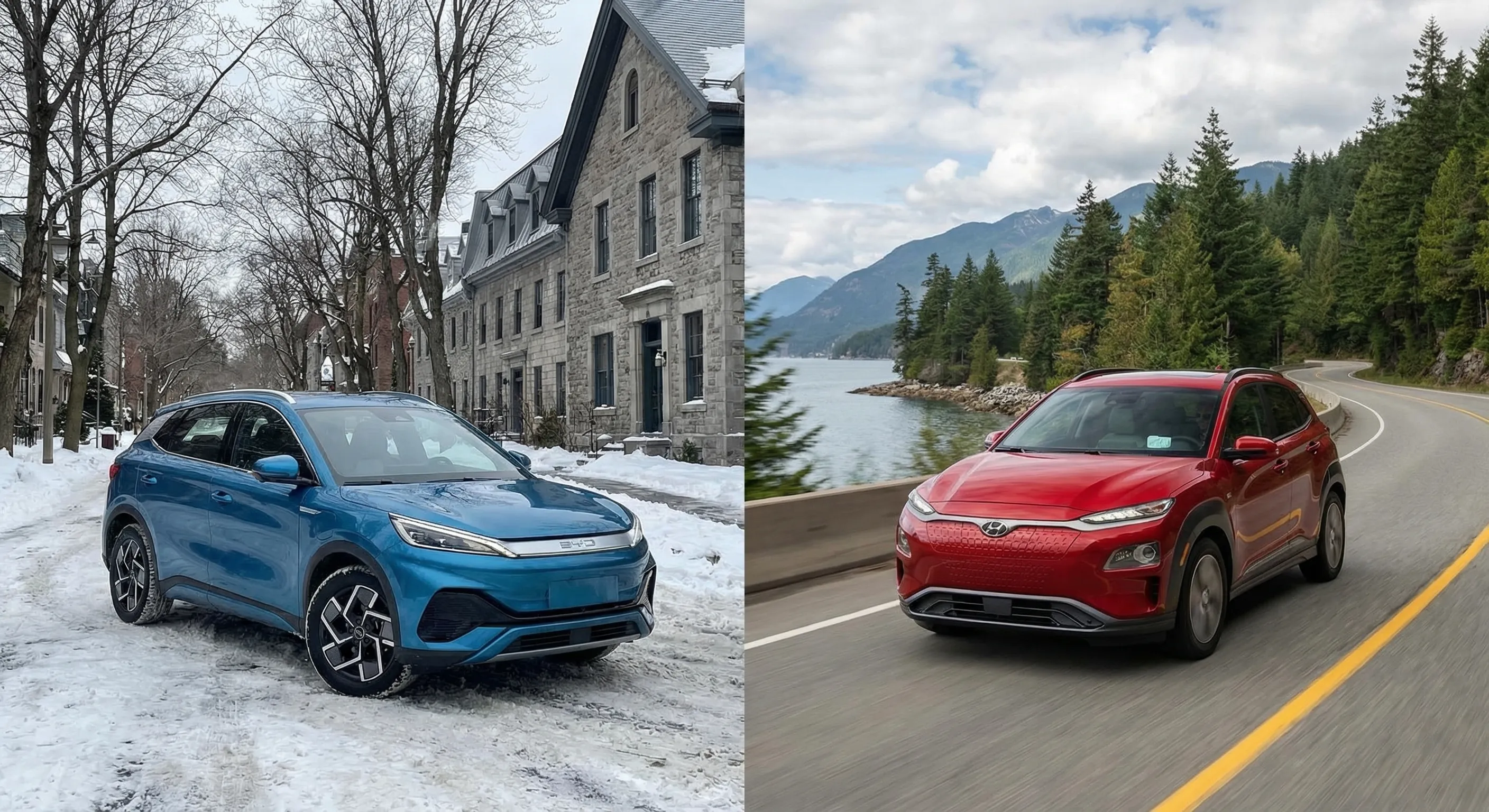
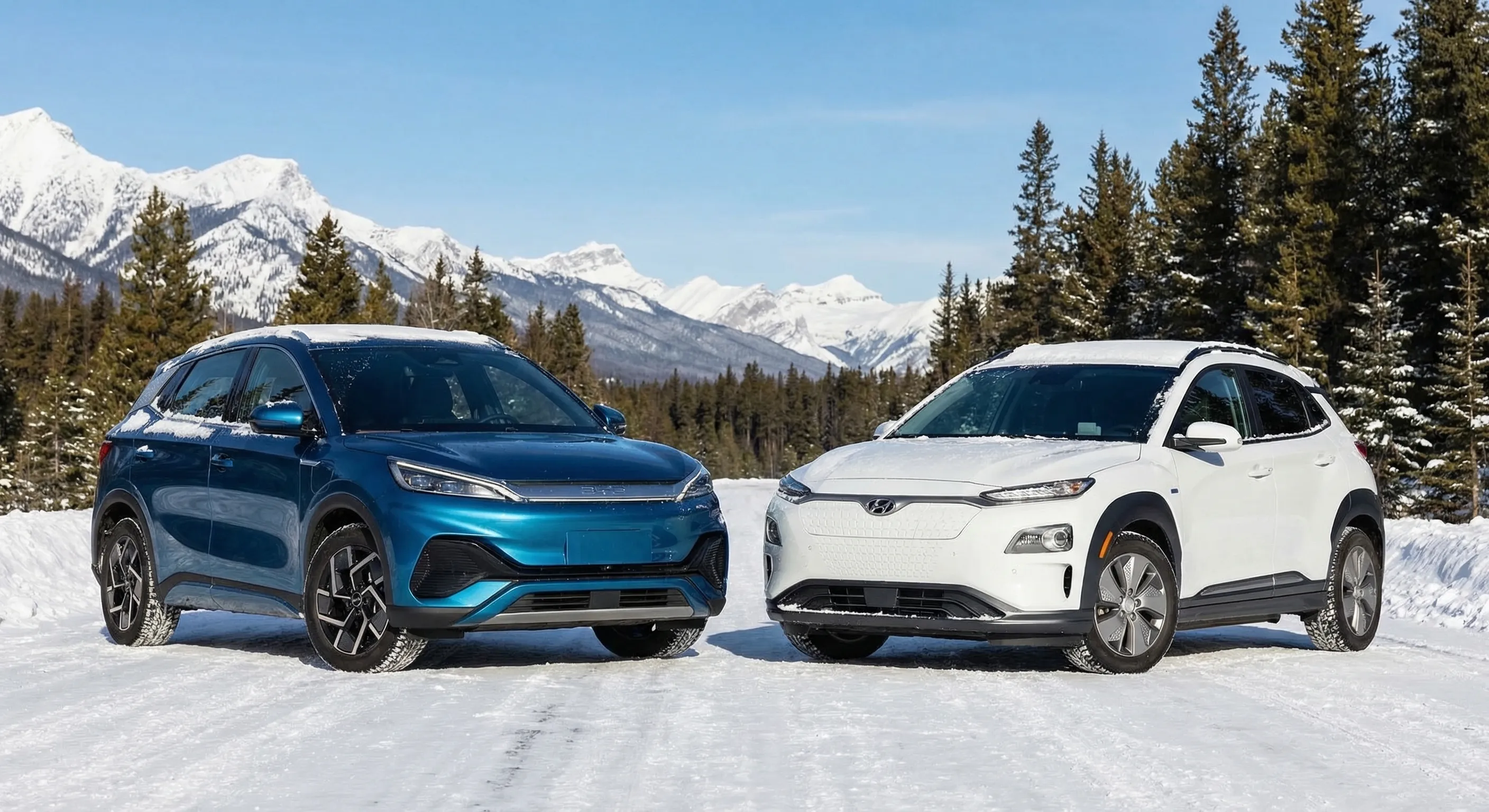
- The Hyundai Kona EV qualifies for the $5,000 federal EVAP rebate; the BYD Atto 3 doesn't, because EVAP excludes China-built vehicles regardless of tariff.
- After that rebate, the Kona's effective start drops to $37,999, narrowing the Atto 3's price edge.
- The two are a near-tie on range, the Atto 3's 60.5 kWh LFP Blade at 420 km WLTP versus the Kona's 64.8 kWh NMC at 418 km.
- The Kona fast-charges to 80% in about 41 minutes (100 kW) versus roughly 50 for the Atto 3 (80 kW), about 30 extra minutes on a three-stop trip.
- LFP cells like the Atto 3's lose only 1–1.5% capacity a year versus 2–3% for the Kona's NMC, a gap that compounds to 85–90% versus 75–80% retention after a decade.
DECISION FRAME
For most Canadian buyers in 2026, the Hyundai Kona EV is the better buy. Here is the short version: you can walk into a Hyundai dealership today, drive one home, and collect a $5,000 federal EVAP rebate. The BYD Atto 3 is not even on Canadian roads yet, it is expected to arrive later in 2026, carries no EVAP eligibility under the current federal rules due to Chinese manufacturing, and still has an unproven Canadian service story. That is a lot of unknowns for a vehicle you are financing for six years.
The Atto 3 is genuinely impressive hardware. But "impressive hardware that is not yet a live Canadian retail reality" usually loses to "proven car you can buy today." That is the core tension running through this entire comparison, and it touches every section below, from charging speed to winter performance to total cost of ownership.
This comparison is built for Canadian buyers working through a specific decision in a specific market. If you are reading from Australia, where the Atto 3 has been selling since 2022, or from the UK, where BYD has an established dealer network, your calculus is different. Canada is a unique case: the tariff history matters, the EVAP rules matter, the winter conditions matter, and the dealership reality matters. Everything here is framed through that lens.
The one scenario where the Atto 3 wins is if you are deliberately shopping ahead, you are not buying until late 2026, you want the boldest interior in this price class, and you are comfortable being an early adopter. That is a real buyer. It is just not most buyers. If you already know which camp you fall into, the verdict section at the bottom gives you the answer. If you want to understand why, the next 7,000 words break down every dimension that matters.
For deeper dives on each vehicle individually, see our BYD Atto 3 full review and our Hyundai Kona EV Canadian review.
RANGE
Winner: Draw, practically irrelevant
The Atto 3 is rated at 420 km (WLTP). The Kona EV delivers 418 km. That 2 km gap is not a factor in any real-world decision. Both vehicles handle the average Canadian daily commute, roughly 50 km, with enormous buffer. Both leave you with enough range to run errands, pick up the kids, and charge overnight at home without thinking about it.
What matters more than the headline number is how each vehicle achieves its range. The Atto 3 uses a 60.5 kWh LFP (lithium-iron-phosphate) Blade Battery pack. The Kona EV uses a 64.8 kWh NMC (nickel-manganese-cobalt) chemistry. The Kona extracts slightly more range from slightly more capacity, a function of NMC's higher energy density per kilogram. The Atto 3 extracts comparable range from a slightly smaller pack, a function of BYD's Blade Battery architecture and the Atto 3's efficient powertrain calibration. The net result is the same: both cars go about the same distance on a full charge.
Real-world range depends on speed, temperature, terrain, and driving style more than it depends on which car you pick. Highway driving at 110 km/h with climate control running will shave both vehicles down to the 320–350 km range. City driving in moderate weather will exceed the rated range on both. The gap between these two cars is noise, it is within the margin you would see from tyre pressure differences or whether you are running the seat heaters.
If you are driving to a remote cabin in northern Manitoba, you are planning charging stops regardless of which car you own. If you are commuting in the GTA, both cars will go a full week between charges for most households. The range numbers here are a wash. Do not let anyone use them to tip your decision.
For context on how both of these stack up against the broader market, see our breakdown of the most affordable EVs in Canada for 2026.
INTERIOR
Winner: BYD Atto 3
This is the one category where the Atto 3 wins cleanly and it is not close. BYD's designers built something genuinely interesting, a 12.8-inch rotating touchscreen that pivots between portrait and horizontal, a digital gauge cluster, and materials that feel premium well above the price point. The cabin has character. You notice it.
The rotating screen is not a gimmick. In portrait mode, it works well for navigation, the vertical orientation shows more road ahead and more of your route context. In horizontal mode, it is better for media, settings menus, and the reversing camera view. The system runs BYD's own software, which is competent if not remarkable, and supports wireless Android Auto and Apple CarPlay. The learning curve is minimal. The screen's rotation motor has proven reliable across hundreds of thousands of Atto 3 units sold globally since 2022, early concerns about mechanical failure have not materialized in any statistically meaningful way.
The Atto 3's interior trim uses what BYD calls a "gym and music" design language. The air vents are designed to resemble guitar strings, the door handles look like dumbbells, and the ambient lighting system runs across the dash. It is playful without being juvenile. The front seats are comfortable for long drives, with enough bolstering to hold you in corners without feeling restrictive. Rear seat space is adequate for adults, not cavernous, but competitive for the segment. The boot offers 440 litres with the rear seats up, expanding to 1,338 litres with them folded.
The Kona EV's interior is functional, comfortable for long drives, and utterly forgettable. The seats are good, Hyundai has been building comfortable seats for decades, and the Kona benefits from that institutional knowledge. The layout is logical, the 12.3-inch dual-screen setup (instrument cluster and infotainment) is clean and responsive, and the materials are conventional plastics and fabric, exactly what you would expect from a Korean economy EV in this price range. That is not a knock. It does the job. The Kona's infotainment runs on Hyundai's latest-generation software with Bluelink connected services, which offers remote climate pre-conditioning, charge scheduling, and vehicle health monitoring. It is a well-executed, thoroughly conventional cabin.
The gap between these two is not about functionality, both cars have everything you need. It is about whether the interior makes you feel anything. The Atto 3's cabin makes you look around and appreciate the design choices. The Kona's cabin makes you forget you are in a car, which is its own kind of achievement, but not the kind that wins a comparison.
If interior design matters to you, if you want to sit in your car and feel like the designers were having fun, the Atto 3 is in a different league. If you want a cabin that simply works and never calls attention to itself, the Kona is the safer choice.
Gear worth having
As an Amazon Associate, ThinkEV earns a small commission from qualifying purchases — at no extra cost to you.
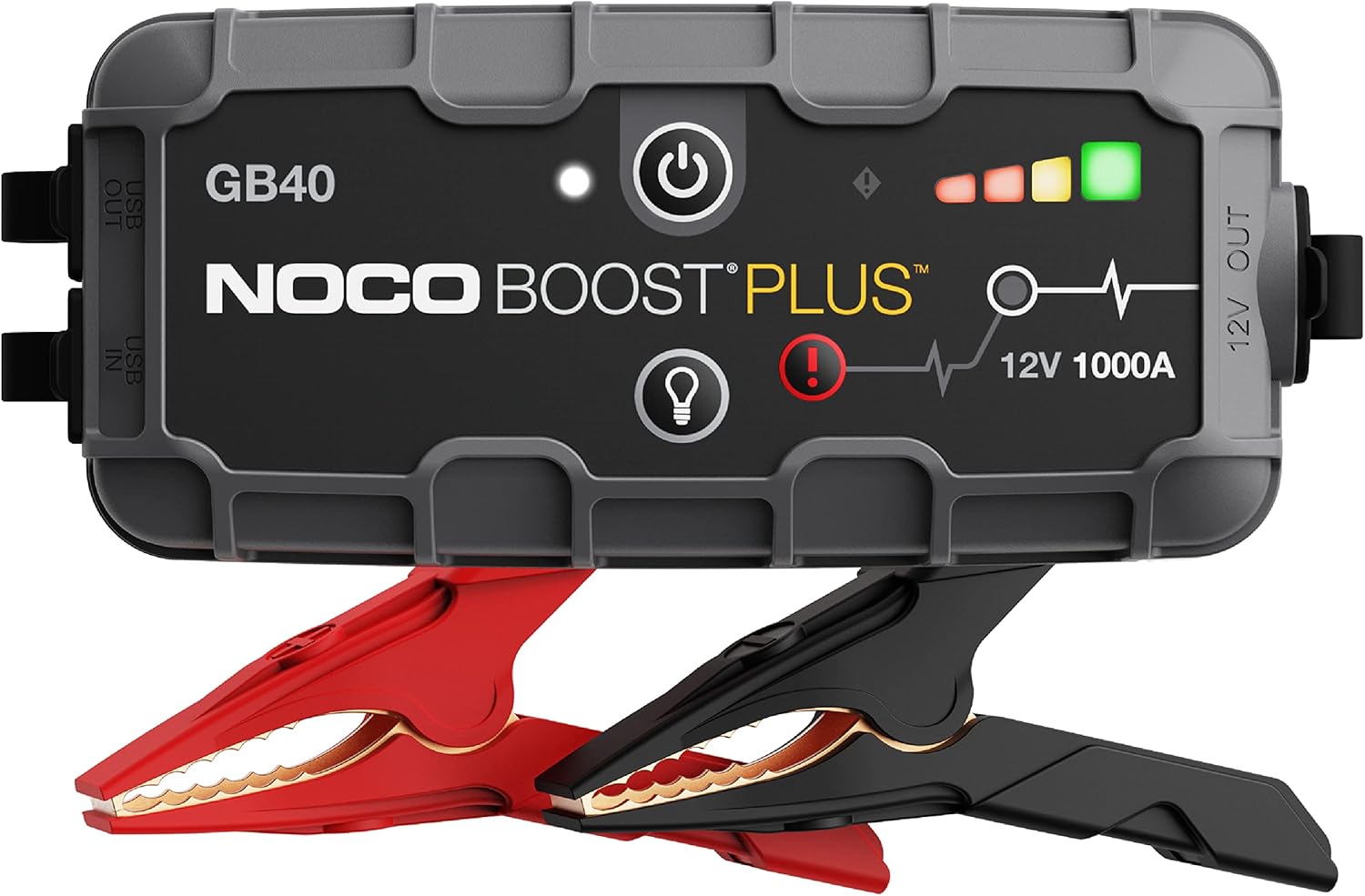
NOCO Boost Plus GB40 Jump Starter
A 1000A lithium jump starter that fits in your glovebox and works on any 12V battery. Your insurance against a dead 12V in a parking lot.
As an Amazon Associate, ThinkEV earns from qualifying purchases — at no extra cost to you.
DRIVING
Winner: Hyundai Kona EV
Both of these are front-wheel-drive compact SUVs with single electric motors. Neither is a performance car. But the way they drive is meaningfully different, and the Kona EV has the edge for the kind of driving most Canadians actually do.
The Kona EV produces 218 hp and 255 lb-ft of torque. The Atto 3 makes 204 hp and 310 lb-ft. On paper, the Atto 3's torque advantage looks significant, and you feel it off the line, the Atto 3 launches harder from a standstill and feels more urgent in the first few metres. But the Kona EV's power delivery is smoother and more linear through the mid-range, which makes it a more relaxed highway cruiser and a more predictable car in daily driving.
Acceleration numbers are close. The Kona EV reaches 100 km/h in about 7.6 seconds. The Atto 3 gets there in roughly 7.3 seconds. That 0.3-second gap is imperceptible in real-world driving, you will never notice it unless you are running them side by side on a drag strip, which you are not.
Where the Kona EV pulls ahead is handling and steering feel. Hyundai has decades of experience tuning suspensions for the North American market, and it shows. The Kona's steering is well-weighted, communicates road texture without being harsh, and tracks straight on the highway without constant correction. The chassis is composed in corners, it leans, as all tall vehicles do, but progressively and predictably. Hyundai's damping calibration absorbs potholes and frost heaves (a key Canadian consideration) without the kind of secondary bounce that makes passengers uncomfortable.
The Atto 3's ride is softer, BYD tuned the suspension for comfort rather than precision. This makes it pleasant over smooth roads and around town, but it feels floaty at highway speed and less controlled when you need to change lanes quickly. The steering is light and slightly vague around centre, which some drivers will appreciate for parking-lot manoeuvrability and others will find unsettling on the 401 at 120 km/h. The Atto 3 is not unsafe, it is simply tuned for a different driving philosophy, one that prioritizes comfort over engagement.
Regenerative braking is configurable on both vehicles. The Kona EV offers paddle-controlled regen levels, including an aggressive one-pedal driving mode that brings the car to a complete stop. The Atto 3 offers two regen settings. The Kona's system is more refined, the transition between regen and friction brakes is smoother, and the paddle controls mean you can adjust on the fly without entering a menu. For drivers who embrace one-pedal driving (and most EV drivers do, eventually), the Kona's implementation is best-in-class for this price range.
Noise, vibration, and harshness (NVH) is good on both vehicles. The Kona EV is slightly quieter at highway speed, Hyundai uses better sound insulation around the wheel wells and A-pillars. The Atto 3 lets in a bit more road noise on coarse Canadian pavement, though it is still dramatically quieter than any comparable gas vehicle.
Ground clearance is worth mentioning for Canadian buyers. Both vehicles ride high enough for unploughed residential streets and parking lot snow banks, but neither is an off-roader. The Atto 3 sits at 175 mm of ground clearance; the Kona EV at 178 mm. Both clear speed bumps, both handle the curb cuts at Canadian charging stations, and both will occasionally scrape the front lip on a particularly aggressive parking lot entrance. If you need serious ground clearance, you are shopping in the wrong segment.
Visibility is better in the Kona EV. The greenhouse is more upright, the sightlines are cleaner, and the thin A-pillars create less of a blind spot. The Atto 3's sloping roofline looks better in photos but creates a slightly more cramped rear-window view. Both vehicles have competent 360-degree camera systems that compensate, but there is no substitute for good natural sightlines when you are merging on the Deerfoot or working through a snowbound Montreal side street.
The Kona is the better driver's car. The Atto 3 is the more comfortable passenger car. For a primary vehicle that will see highway commuting, winter driving, and the full spectrum of Canadian road conditions, the Kona's chassis tuning gives it the advantage.
BATTERY
Winner: BYD Atto 3
Battery chemistry is where the Atto 3 makes its strongest technical argument. BYD uses lithium-iron-phosphate (LFP) in its proprietary Blade Battery design. The Kona EV uses lithium-nickel-manganese-cobalt (NMC). For Canadian buyers planning to keep their vehicle for a decade or longer, this distinction matters more than any other spec on the sheet.
LFP is more thermally stable, less prone to capacity degradation in sustained cold, and according to Transport Canada data, less susceptible to thermal runaway. The Blade Battery's cell-to-pack architecture eliminates modules entirely, packing flat prismatic cells directly into the structural pack. This design improves energy density relative to older LFP approaches and creates a thinner, more rigid battery pack that doubles as a structural element of the chassis. BYD has famously demonstrated the Blade Battery's safety by driving a nail through a cell without triggering thermal runaway, a test that NMC cells reliably fail.
NMC delivers higher gravimetric energy density, which is why the Kona EV achieves 418 km of range from a 64.8 kWh pack while the Atto 3 needs only 60.5 kWh for 420 km. The chemistry is mature and well-understood, and the Kona's battery management system is refined. But NMC batteries degrade faster over time, typical NMC packs lose 2–3% capacity per year under normal use, while LFP packs lose closer to 1–1.5%. Over a 10-year ownership period, that compounds. An NMC pack might retain 75–80% of original capacity after a decade. An LFP pack, charged and managed properly, can retain 85–90%.
LFP batteries also tolerate charging to 100% regularly without significant degradation. With NMC, most manufacturers and owners target 80% daily charging to preserve longevity. That means the Kona EV's usable daily range is effectively 334 km (80% of 418), while the Atto 3's full 420 km is available every day without guilt. Over time, this convenience gap adds up.
The Blade Battery's thermal stability also reduces the risk of battery fires, a concern that remains top-of-mind for many Canadians considering EVs. BYD's fire safety record across millions of vehicles sold globally is excellent. Hyundai, by contrast, dealt with a costly battery recall in 2020–2021 affecting the Kona EV (a previous generation with a different battery supplier). The current-generation Kona EV uses an updated pack with improved cell quality and battery management, and Hyundai has not had a repeat of those issues. But the history is relevant context.
For a detailed look at how Chinese EVs perform in safety testing, including battery safety, see our analysis of Chinese EV safety and Euro NCAP ratings.
The Atto 3's battery advantage is real and durable. It is the single strongest technical argument for the car, and for buyers who prioritize longevity, safety, and the freedom to charge to 100% daily, it is a genuine differentiator.
CHARGING
Winner: Hyundai Kona EV
Charging speed and charging infrastructure access are separate questions, and the Kona EV wins on both.
DC fast charging is the metric that matters for road trips. The Kona EV supports up to 100 kW DC fast charging, taking the battery from 10% to 80% in approximately 41 minutes. The Atto 3 maxes out at approximately 80 kW DC, achieving the same 10–80% charge in roughly 50 minutes. That 9-minute difference does not sound dramatic, but it compounds over a multi-stop road trip. On a Calgary-to-Vancouver drive with three charging stops, you are looking at roughly 30 extra minutes in the Atto 3. Not a dealbreaker, but not nothing.
The charging curve matters as much as the peak rate. The Kona EV maintains higher power levels deeper into the charge cycle, it holds close to its peak rate until roughly 60% state of charge before tapering. The Atto 3's LFP chemistry charges more linearly but starts tapering earlier. In practice, the Kona is faster at the charger for most real-world scenarios.
Level 2 home charging is essentially identical for both vehicles. Both accept up to 7.2 kW from a standard 240V/32A Level 2 home charger, which is the most common home setup in Canada. A full overnight charge, 10 hours, give or take, refills either battery completely. If you install a higher-amperage circuit (48A), both vehicles can charge slightly faster, but the standard 32A setup is sufficient for daily use. Most Canadian EV owners charge at home overnight and rarely think about charging infrastructure at all.
Where the Kona EV has a structural advantage is network access. The Kona EV uses CCS1 (Combined Charging System), which is the dominant DC fast charging standard across Canada's major networks: Petro-Canada Electric Highway, FLO, ChargePoint, Electrify Canada, and Tesla Superchargers (which now support CCS1 via the NACS adapter or Magic Dock). The Atto 3 also uses CCS1 for the Canadian market, so hardware compatibility is not the issue. The issue is that the Kona EV has been tested on these networks for years, drivers report reliable handshakes, consistent charging speeds, and no compatibility quirks. The Atto 3 is an unknown quantity on Canadian charging networks because it has not been here yet.
International data from Australia, the UK, and Europe suggests the Atto 3 charges reliably on CCS networks, with occasional reports of slow handshake times on certain charger brands (primarily older Tritium units). These are firmware-level issues that BYD and charger manufacturers typically resolve, but for a Canadian buyer plugging into a Petro-Canada station on the Trans-Canada Highway in February, "typically resolves" is not as reassuring as "always works."
Home charging infrastructure is identical in terms of hardware requirements. Both vehicles work with any CCS-compatible Level 2 charger. If you are buying a home charger, our Grizzl-E recommendation applies equally to both vehicles, it is the best value Level 2 charger for Canadian conditions (weather-rated, no subscription fees, made in Ontario).
A note on charging costs: public DC fast charging in Canada typically costs $0.30–$0.50 per kWh, depending on the network and province. A 10–80% fast charge on the Kona EV (roughly 45 kWh delivered) costs approximately $13–$22. The same charge on the Atto 3 (roughly 42 kWh delivered) costs approximately $12–$21. The difference is negligible. Home charging at overnight rates is dramatically cheaper, roughly $5–$7 for a full charge on either vehicle in most provinces. The economic case for home charging is identical for both cars, and it is overwhelming. If you can charge at home, you should. If you cannot, public charging costs are comparable between the two.
The Kona EV charges faster, and it charges on a network that already knows it. That is the advantage.
WINTER PERFORMANCE
Winner: Conditional, depends on your priorities
Winter performance is the question that matters most to Canadian EV buyers, and neither vehicle has a clean win here. Each has advantages that align with different aspects of cold-weather driving.
Both vehicles are rated for Canadian winters and both have been tested (the Kona in Canada directly, the Atto 3 in comparable climates in northern Europe and northern China). Both handle well on winter tyres, mandatory in Quebec and strongly recommended everywhere else in Canada. Neither offers AWD, which is a limitation for both in heavy snow, but front-wheel-drive EVs with proper winter tyres are more capable than most drivers expect. The instant torque and low centre of gravity (thanks to the floor-mounted battery pack) give both vehicles confident traction in moderate winter conditions.
Range loss in cold weather is the primary concern. At -20C, expect to lose roughly 20–30% of rated range on both vehicles. At -30C, that loss can climb to 35–40%. The Atto 3's rated 420 km becomes roughly 250–335 km in deep cold. The Kona EV's 418 km becomes roughly 250–335 km. The numbers are close enough to be interchangeable. For a thorough look at what real Canadian winters do to EV range, see our EV winter range test results.
Where the vehicles diverge is in how their battery chemistries handle cold.
LFP batteries (Atto 3) have a known limitation: they charge more slowly in extreme cold. Below -10C, LFP cells resist accepting charge until they are warmed, and the Atto 3's battery management system must heat the pack before DC fast charging can begin at full speed. This pre-conditioning adds time, potentially 10–15 minutes at a fast charger in deep winter. BYD's thermal management system handles this automatically, but you are still waiting. On the positive side, LFP's calendar degradation is minimal, the pack does not lose significant capacity from sitting in the cold, and it rebounds fully when warmed. Over the life of the vehicle, LFP's resilience to thermal cycling is a genuine advantage for Canadian owners.
NMC batteries (Kona EV) accept charge more readily in cold conditions than LFP, though they still benefit from pre-conditioning. The Kona EV's battery thermal management system (liquid-cooled, with a heat pump) is more sophisticated than the Atto 3's, Hyundai has refined it over multiple generations and multiple Canadian winters. The heat pump is particularly valuable: it recovers waste heat from the motor and power electronics to warm the cabin and the battery, reducing the energy penalty of winter heating. The Kona EV's heat pump is one of the most effective in the segment, maintaining cabin comfort while minimizing range loss. Hyundai quotes a 10–15% efficiency improvement from the heat pump compared to resistive heating alone.
The Atto 3 also has a heat pump system, which BYD introduced in later production runs. Early Atto 3 units in Australia and the UK used resistive heating only, so pay attention to the model year and specification if buying. For the Canadian-market Atto 3 (expected late 2026), BYD has confirmed heat pump inclusion across all trims. However, the system has not been tested through a full Canadian winter, it is an unknown.
The Kona EV also offers features that Canadian winter drivers have come to rely on: heated steering wheel, heated front and rear seats, a pre-conditioning function that warms the cabin while plugged in (preserving battery range for driving), and windshield defroster that works quickly and effectively. The Atto 3 offers heated front seats and a pre-conditioning function, but does not offer a heated steering wheel in the base configuration, a notable omission for a vehicle entering the Canadian market.
Traction control systems on both vehicles are competent but not remarkable. Neither offers winter-specific driving modes. Both benefit enormously from good winter tyres, this is the single most impactful upgrade any Canadian EV owner can make, more important than AWD, more important than battery chemistry, more important than anything else on this list.
Gear worth having
As an Amazon Associate, ThinkEV earns a small commission from qualifying purchases — at no extra cost to you.

Grizzl-E Classic Level 2 EV Charger (40A)
Canadian-made and rated for minus 40C winters. 40A / 9.6 kW, NEMA 14-50, indoor/outdoor, 24-ft cable. The charger built for Canadian weather.
As an Amazon Associate, ThinkEV earns from qualifying purchases — at no extra cost to you.
One practical winter consideration that gets overlooked: garage versus street parking. If you park in a heated garage, both vehicles perform well in winter because the battery starts warm. If you park on the street, as many Canadians in Montreal, Toronto, and Vancouver do, the overnight cold soak hits harder. The Kona EV's pre-conditioning system (activated via the Bluelink app) can warm the cabin and battery while still plugged in, using grid power rather than battery power. This is the single most effective cold-weather strategy for any EV, and both vehicles support it, but only if you have access to a plug where you park. For condo and apartment dwellers without dedicated charging, winter range loss is more impactful because you cannot pre-condition on grid power.
Bottom line on winter: the Kona EV has a more proven, more refined cold-weather package. Its heat pump is more effective, its charging accepts cold-weather conditions more gracefully, and its creature comforts (heated steering wheel) are more complete. The Atto 3's LFP battery ages better through years of thermal cycling, which matters for long-term ownership. If you are focused on the next five winters, the Kona is the safer choice. If you are focused on the next fifteen, the Atto 3's battery chemistry tells a better story.
DEALER NETWORK
Winner: Hyundai Kona EV, and it is not close
This is the category that settles the comparison for most buyers in 2026.
Hyundai has operated in Canada for decades. Their dealer network spans every major city, Toronto, Vancouver, Calgary, Montreal, Halifax, Ottawa, Winnipeg, Edmonton, Victoria, Saskatoon, and dozens of smaller markets. Service technicians are trained on EV-specific systems including high-voltage battery diagnostics, electric motor service, and thermal management maintenance. Parts are stocked domestically. Warranty work gets done at any Hyundai dealer, with no appointment wait times exceeding what you would expect from any mainstream brand. You can walk in today and take a test drive.
The value of an established dealer network is not just convenience, it is financial protection. If your Kona EV develops a battery fault under warranty, Hyundai replaces or repairs it at a Canadian dealership using Canadian-stocked parts, covered under a warranty administered by a company with decades of Canadian regulatory compliance. That process is well-understood. Lemon law protections, provincial consumer protection statutes, and Hyundai's own customer service infrastructure all work together. You are not guessing about how warranty claims get resolved.
BYD is not yet selling vehicles in Canada as of March 2026. The Atto 3 is expected to arrive later this year following the tariff reduction (from 100% to 6.1% on Chinese EVs, effective January 16, 2026), but the dealer and service infrastructure is being built from scratch. That means limited test drive access, uncertain delivery timelines, and, critically, unknown wait times if something goes wrong under warranty.
BYD has announced partnerships with existing dealer groups in several Canadian markets, which is the right strategy. Partnering with established dealers who already have showroom space, service bays, and trained staff accelerates the rollout. But "announced partnerships" and "functioning service network" are different things. As of this writing, buyers should still treat the Canadian BYD service footprint as early-stage rather than fully operational nationwide.
This matters practically. Consider a scenario where your Atto 3 develops a thermal management fault in January. With Hyundai, you book a service appointment, drop the car off, and get a loaner or rental. The dealer diagnoses the issue using Hyundai's diagnostic tools, orders parts from a Canadian warehouse, and completes the repair. Total downtime: days to a week, typically. With BYD in its first year of Canadian operations? The dealer may need to order parts from China. The diagnostic tools may be unfamiliar. The technician may be consulting BYD's international support line for guidance. Total downtime: unknown. For a primary vehicle in a Canadian winter, "unknown" is not acceptable.
Early adopters always pay a premium in inconvenience even when they save on sticker price. For a primary vehicle, that is a serious consideration. For a second car or a household with flexibility, the calculus changes, you can tolerate longer service timelines when you have another vehicle to drive.
BYD will build a competent Canadian dealer network. They are the world's largest EV manufacturer, they have done it successfully in Australia and Europe, and they have the resources and the product lineup to make it work here. But that network does not exist yet. The Kona EV's does.
PRICE & REBATES
Winner: Hyundai Kona EV (after rebates)
On paper, the Atto 3 looks cheaper: low-to-mid $30,000s CAD is the expected Canadian pricing range most often discussed, versus the Kona EV starting at $42,999. That is a meaningful sticker gap. If you stop the analysis at projected sticker price, the Atto 3 wins.
But Canadian EV pricing does not stop at the sticker.
The Kona EV qualifies for the $5,000 federal EVAP (Electric Vehicle Availability Program) rebate. The Atto 3 does not. EVAP requires manufacturing in Canada or an FTA (Free Trade Agreement) partner country. BYD manufactures the Atto 3 in China. Chinese-manufactured EVs are explicitly excluded from EVAP, even after the tariff reduction. This is not a tariff issue, it is a separate eligibility criterion under the EVAP program rules.
After the federal rebate, the Kona EV's effective starting price drops to $37,999. The Atto 3 at $30,000–$34,500 is still cheaper, by $3,500 to $8,000 depending on trim comparison. That is a real savings, but it is far less dramatic than the sticker price suggested.
Provincial rebates complicate the picture further. Quebec's Roulez vert program offers meaningful provincial support and does not apply the same country-of-manufacture restriction as federal EVAP. But the exact Atto 3 net price in Quebec still depends on final Canadian MSRP and eligible trim structure. Quebec buyers may still get the most dramatic Atto 3 math, but it should be framed as scenario pricing, not a finished retail sheet.
British Columbia's CleanBC Go Electric program offers up to $4,000, applicable to both vehicles. After rebates, the Kona EV drops to roughly $33,999 in BC. The Atto 3 drops to $26,000–$30,500. Again, the Atto 3 maintains a price advantage, but the gap narrows once federal EVAP is factored in.
In provinces without provincial EV rebates, Ontario, Alberta, Saskatchewan, Manitoba, the comparison is straightforward. The Kona EV at $37,999 (after EVAP) versus the Atto 3 at $30,000–$34,500 (no rebates available). The Atto 3 is $3,500–$8,000 cheaper.
Here is what the sticker analysis misses: financing costs, insurance premiums, and the resale value question. Financing rates for BYD in Canada are unknown, the company has no established Canadian financing arm. Hyundai Motor Finance Canada offers competitive rates, loyalty incentives, and lease programs that are well-understood by Canadian buyers and their accountants. BYD buyers may need to finance through banks or credit unions, potentially at higher rates, which erodes the price advantage.
Insurance is another unknown. Canadian insurers base premiums on claims history, repair costs, and parts availability. The Kona EV has years of Canadian claims data, insurers know what it costs to repair. The Atto 3 has none. Initial premiums for a new, unfamiliar vehicle from a brand without an established Canadian parts supply chain will likely be higher. How much higher is speculative, but the direction is clear.
Resale value is the largest financial unknown. Hyundai vehicles hold their value reasonably well in Canada, the Kona EV's resale trajectory is predictable based on comparable Hyundai models. BYD's Canadian resale value is a complete unknown. Will the Atto 3 depreciate like a proven commodity or like an unknown brand? Nobody knows, because no BYD has ever been resold in Canada. For buyers who plan to sell or trade in within 3–5 years, this uncertainty carries real financial risk.
For a comprehensive look at the full financial picture of EV ownership versus gas, including fuel savings, maintenance costs, and depreciation, see our EV vs gas total cost of ownership analysis.
Run the full numbers for your province before assuming the Atto 3 is the cheaper car. It might be. But the gap is narrower than the sticker suggests, and the unknowns (financing, insurance, resale) all cut against the Atto 3.
WARRANTY AND SERVICE
Winner: Hyundai Kona EV
Warranty coverage is one of the most tangible advantages the Kona EV holds in this comparison, and it is not just about the terms on paper, it is about the infrastructure behind those terms.
Hyundai offers one of the most comprehensive warranty packages in the Canadian market. The Kona EV is covered by a 5-year/100,000 km comprehensive warranty (bumper to bumper, excluding wear items) and an 8-year/160,000 km battery and electric powertrain warranty. The battery warranty guarantees a minimum of 70% capacity retention, if your Kona EV's battery drops below 70% of original capacity within 8 years or 160,000 km, Hyundai replaces or repairs it at no cost.
These are not just numbers on a brochure. Hyundai has honoured battery warranty claims in Canada. The process is established. Dealers know how to file claims, Hyundai Canada processes them, and parts are available domestically. The warranty is backed by a company that has operated in Canada for decades and has every intention of operating here for decades more.
BYD's Canadian warranty terms have not been officially announced as of March 2026. In other markets, BYD offers competitive warranty coverage, 6 years/150,000 km comprehensive and 8 years/200,000 km battery in Australia, for example. It is reasonable to expect competitive Canadian terms, given the pressure from Hyundai and the need to reassure first-time BYD buyers, but that expectation is still not a published Canadian warranty card.
But warranty terms are only as good as the service network that backs them. A 10-year warranty from a company with no Canadian service infrastructure is worth less, practically speaking, than a 5-year warranty from a company with service bays in every major city. The warranty exists on paper; the service exists in the real world. This is not a criticism of BYD's intentions, it is a statement about the current state of their Canadian operations.
There is also the question of service costs outside of warranty. Hyundai's parts pricing is transparent and competitive. Independent mechanics can work on non-warranty Hyundai EVs using widely available parts. BYD parts will need to be sourced from BYD's supply chain, and until that supply chain is established in Canada, out-of-warranty repairs may involve longer wait times and higher costs. This gap will close over time, but it exists today.
For Canadian buyers making a 6-year financing commitment, the warranty question is not abstract. It is: "If something goes wrong in year 3, how quickly and painlessly does it get fixed?" For the Kona EV, the answer is clear. For the Atto 3, it is not.
TOTAL COST OF OWNERSHIP
Winner: Depends on your timeline, Kona EV for 5 years, Atto 3 for 10+
Total cost of ownership (TCO) is the number that actually matters, and it tells a more nuanced story than either sticker price or rebate analysis alone. Here is a 5-year TCO breakdown for a buyer in Ontario (no provincial rebate, to keep it clean).
Kona EV, 5-year TCO estimate:
- Purchase price after EVAP: $37,999
- Financing cost (5 years, 6.5% through Hyundai Finance): ~$5,950
- Insurance (5 years, estimated $1,800/year based on Canadian EV averages): ~$9,000
- Electricity (20,000 km/year, 16 kWh/100 km, $0.13/kWh Ontario average): ~$2,080
- Maintenance (tire rotations, cabin filters, brake fluid, windshield washer, EVs have minimal maintenance): ~$1,500
- Total 5-year TCO: ~$56,529
- Estimated resale value (45% of MSRP after 5 years, based on comparable Hyundai EVs): ~$19,350
- Net 5-year cost: ~$37,179
Atto 3-5-year TCO estimate (using $32,000 mid-range price):
- Purchase price (no EVAP): $32,000
- Financing cost (5 years, 7.5% through bank, higher rate assumed for unknown brand): ~$5,850
- Insurance (5 years, estimated $2,100/year, higher for new brand, unknown repair costs): ~$10,500
- Electricity (20,000 km/year, 15.5 kWh/100 km, $0.13/kWh): ~$2,015
- Maintenance (similar to Kona, EVs are EVs): ~$1,500
- Total 5-year TCO: ~$51,865
- Estimated resale value (unknown, estimated 35% of sticker, reflecting brand uncertainty): ~$11,200
- Net 5-year cost: ~$40,665
The Atto 3 costs less up front but more over five years in this scenario. The drivers are higher insurance premiums (new brand, unknown repair costs), higher financing costs (no captive finance arm), and weaker resale value (brand uncertainty). These are estimates, not guarantees, BYD could surprise with competitive financing, insurance costs could be lower than projected, and resale value could hold up better than expected. But the directional risk is clear: the unknowns all add cost to the Atto 3 side.
Over 10 years, the math shifts. The Atto 3's LFP battery will retain more capacity than the Kona EV's NMC pack, meaning the Atto 3 remains a more capable vehicle in years 7–10. The Atto 3's lower purchase price compounds over a longer holding period. And by year 5–6, BYD's Canadian infrastructure will presumably be mature, reducing the insurance and service cost premiums. For a buyer who keeps their car a decade or longer, the Atto 3's lower sticker and superior battery longevity could result in a meaningfully lower TCO.
The tipping point is somewhere around year 6–7. Before that, the Kona EV's rebate eligibility, predictable costs, and stronger resale value make it cheaper to own. After that, the Atto 3's fundamental cost advantages and battery durability take over.
One factor often overlooked in TCO analysis is maintenance scheduling. EVs in general have dramatically lower maintenance costs than gas vehicles, no oil changes, no transmission servicing, no exhaust system repairs. But they are not zero-maintenance. Both the Kona EV and the Atto 3 require periodic tyre rotations (every 10,000–12,000 km), cabin air filter replacements (annually), brake fluid changes (every 2–3 years), and coolant top-ups for the battery thermal management system.
The Kona EV uses Hyundai's standard service intervals, which are well-documented and priced transparently at any Hyundai dealer. The Atto 3's Canadian service intervals have not been published. In other markets, BYD recommends annual inspections with similar maintenance items, the costs should be comparable once BYD's Canadian service operations are running.
Winter tyres are a mandatory expense for both vehicles in Quebec and a strongly recommended one everywhere else. Budget $800–$1,200 for a set of dedicated winter tyres on rims for either vehicle. Tyre wear is slightly higher on EVs than gas vehicles due to the instant torque, expect to replace tyres every 40,000–50,000 km rather than every 60,000–80,000 km. This cost is identical for both vehicles.
For most Canadian buyers, who finance for 5–6 years and trade in around the same time, the Kona EV is the lower-cost choice when all factors are included.
VERDICT
For most Canadian buyers: Hyundai Kona EV.
It is available now. It qualifies for $5,000 in federal rebates. Hyundai's dealer network means you are covered when something needs attention. The range is equivalent, the reliability record is established, the driving dynamics are better, the charging is faster, and the effective after-rebate price is competitive. The warranty is backed by decades of Canadian operations. The winter package is proven through multiple Canadian seasons. The 5-year TCO favours the Kona once you account for insurance, financing, and resale value. That is a straightforward case.
The Kona EV is not the most exciting car in this comparison. It is the more responsible one. For a primary vehicle that you are financing for half a decade and driving through Canadian winters, responsible wins.
Buy the Atto 3 if: you are not purchasing until late 2026 at the earliest, you want the most interesting interior in this price class, you value LFP battery longevity over the next decade-plus, and you are prepared for early-adopter friction with a brand building its Canadian presence. The Atto 3 is genuinely good hardware, BYD is the world's largest EV manufacturer for a reason. The Blade Battery is a technical achievement that gives the Atto 3 a real long-term durability advantage. The interior design is in a class above the Kona. And the base price, even without EVAP, is the lowest in the segment.
The Atto 3 is the right car for patient, informed buyers who are comfortable with uncertainty and who plan to keep their vehicle long enough for the LFP battery advantage and the lower sticker price to outweigh the early-adopter costs. That is a legitimate buying thesis. It just requires a higher tolerance for the unknown than most Canadian families have when spending $30,000 or more.
If you are shopping now, the Kona wins. If you are shopping in twelve months and BYD has established service presence in your city, revisit this comparison, the answer may change. BYD is building something real. It is just not finished yet.
For the latest on Canada's EV rebate programs and eligibility, check our regularly updated guide.
Gear worth having
As an Amazon Associate, ThinkEV earns a small commission from qualifying purchases — at no extra cost to you.

PULIDIKI Car Cleaning Gel (Detailing Putty)
Press it into vents, buttons, and seams and it lifts out dust you did not know was there. Weirdly satisfying, genuinely useful.
As an Amazon Associate, ThinkEV earns from qualifying purchases — at no extra cost to you.
Gear worth having
As an Amazon Associate, ThinkEV earns a small commission from qualifying purchases — at no extra cost to you.

WixGear Magnetic Air Vent Phone Mount (2-Pack)
A magnet strong enough that your phone never flinches over potholes or rail crossings. Two in the box, one for each car.
As an Amazon Associate, ThinkEV earns from qualifying purchases — at no extra cost to you.
Related Reading
- BYD Atto 3 Full Review for Canada, Everything you need to know about BYD's first Canadian offering.
- Hyundai Kona EV Canadian Review 2026, The full breakdown on Canada's best-selling affordable EV.
- Best EVs Under $50,000 in Canada, Budget-friendly EVs compared head to head.
- EV vs Gas: Total Cost of Ownership in Canada, The numbers that settle the debate once and for all.
- Canada EV Rebate and EVAP Guide 2026, Every federal and provincial rebate, eligibility rules, and how to apply.
- EV Winter Range Test Results in Canada, What Canadian cold actually does to your EV range.
Gear worth having
As an Amazon Associate, ThinkEV earns a small commission from qualifying purchases — at no extra cost to you.

Car Cup Holder Coasters (4-Pack)
Drop-in coasters that catch spills and crumbs so your cup holders stay clean. Rinse and reuse forever.
As an Amazon Associate, ThinkEV earns from qualifying purchases — at no extra cost to you.

Founder & Chief Editor
Vlad Pereira is the founder and chief editor of ThinkEV.ca, the Canadian electric-vehicle publication he writes and edits from Courtenay, British Columbia. He covers EV pricing, federal and provincial rebates, charging costs, and the Chinese manufacturers now entering Canada, from the buyer's side rather than the press-fleet side. ThinkEV is a venture of Vlad Pereira Online; his writing on health, income and the long game lives at vladpereira.com.
Frequently asked questions
Is the BYD Atto 3 reliable?
How much does the federal EVAP rebate cover?
Can I charge the Atto 3 at home in Canada?
Which car handles Canadian winters better?
Is the BYD Atto 3 safe?
What is the BYD Atto 3 warranty in Canada?
How does the Atto 3 compare to other affordable EVs in Canada?
Should I wait for the BYD Atto 3 to arrive in Canada?
More EV & road-trip finds
Affordable upgrades worth a look — tap any to check the price on Amazon.
 ★ 392
★ 392Large Cup Holder Adapter (32-40oz)
View on Amazon ★ 47,507
HOMEXCEL Microfiber Cloths (12-Pack)
View on Amazon ★ 537
★ 537USB Star Projector Roof Light
View on Amazon ★ 546
★ 546Funny Headrest Face Covers (2-Pack)
View on Amazon ★ 12,396
K KNODEL Car Trash Can with Lid
View on Amazon ★ 15,014
Spigen Tempered Glass for Tesla Model 3/Y
View on Amazon ★ 119
★ 119Foldable Waterproof Trunk Organizer
View on Amazon ★ 17,839
Qifutan Vent Phone Mount (Military-Grade Clip)
View on AmazonRead, Plan, Then Stay Current
Explore our expert articles to understand incentives and ownership costs, use the map to pressure-test charging reality, then subscribe so new EV coverage comes straight to you.
Continue Reading
Rivian R1T vs F-150 Lightning: Canada 2026 Test
EV vs Gas: 5-Year Cost of Ownership in Canada
BMW i4 vs Tesla Model 3: Is the $11K Premium Worth It?
BYD Dolphin vs Chevy Bolt 2027: Cheapest EVs
BYD Seagull vs Nissan Leaf: Canada's Cheapest EVs