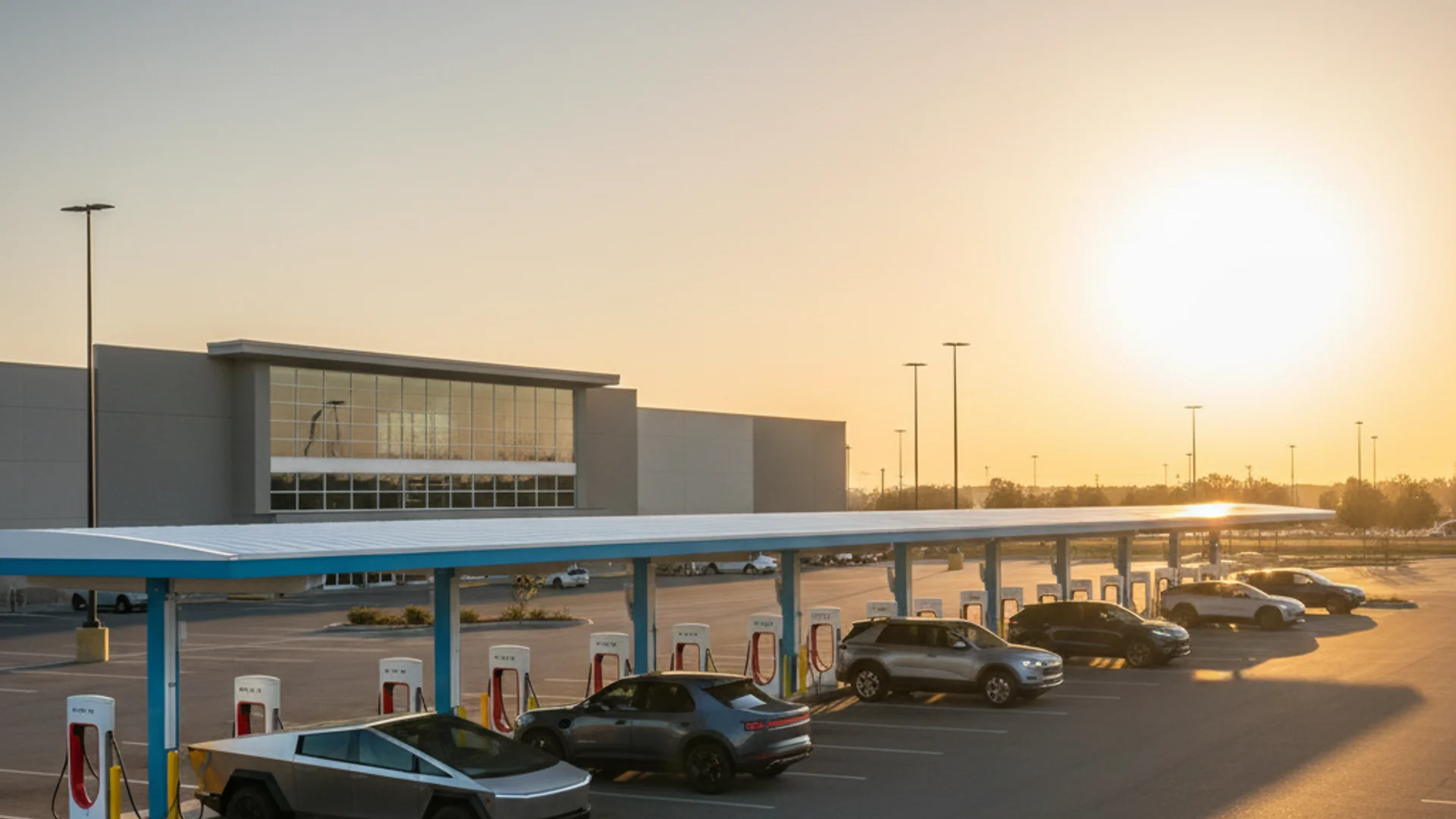
300 fast-charging ports. Thousands more by 2030. Walmart didn't ask permission to become America's biggest retail charging network. It just did it.
Key takeaways
- Walmart passed 300 DC fast-charging ports in the US within three years of starting from zero, using ABB A400 units rated at 400 kW, enough for 200-plus km of range during a typical shopping trip.
- The chargers carry both NACS and CCS1 connectors on the same unit, so Tesla and non-Tesla drivers plug in natively, and payment is just a QR scan in the existing Walmart app with no separate charging account.
- Walmart's roughly 4,600 US stores already have the parking and industrial-grade electrical service, giving it a site-acquisition cost of zero for charging.
- Walmart Canada hasn't announced any parallel rollout; Canadian public charging stays dominated by FLO, Petro-Canada, Circle K's Recharge, and ZEVIP-funded networks.
Three years ago Walmart had zero proprietary fast chargers. Today the network has crossed the 300-port mark and the buildout cadence is tightening, not slowing. The retail giant's EV charging blitz just surpassed 300 ports, with thousands more in the pipeline, and the people who should be sweating about this are the legacy charging operators who spent a decade building networks the hard way.
Walmart skipped the hard way. It already owned the parking lots.
That is the part nobody framing this story has stated plainly. This is not a CSR press release dressed up as infrastructure. This is a land-grab against EVgo, ChargePoint, Electrify America, and yes, Tesla. The press release calls it convenience for customers. The math calls it competitive moat.
300 Ports In and Walmart Is Just Warming Up
Three years from zero to 300 fast-charging ports is not a pilot. It is a deployment curve. And the curve is bending up, not flattening.
The hardware tells you Walmart is not playing for participation trophies. The chargers are ABB A400 units, the same 400 kW DC fast-charging platform ABB is selling to commercial fleet operators and highway corridor networks. These are not Level 2 trickle chargers tacked onto a lamppost. They are top-shelf, liquid-cooled, NACS-and-CCS1 dual-connector hardware capable of delivering meaningful range in a typical Walmart shopping trip.
ABB and Walmart announced the deployment partnership in 2026 with seven flagship installs in metropolitan Phoenix, then opened the floodgates. The chargers are not scattered randomly. They are placed at stores with the parking footprint, the electrical service, and the customer density to justify the capex. Walmart picked its spots like a retailer, not like a charging operator with a NEVI grant deadline and a map of empty highway exits.
The case against this read is that 300 ports is rounding error against the roughly 10,000 public DC fast-charging ports already operating in the US, and that Walmart is a latecomer to a market Tesla, EVgo, and Electrify America have been building since 2012. Fair on the surface. The rebuttal is that port count today is a lagging indicator and deployment velocity is the leading one. Walmart went from zero to 300 in three years on a hardware platform, ABB A400 at 400 kW, that most legacy networks are still only deploying in flagship corridor sites. The base is small. The trajectory is not.
The 300-port milestone matters for one reason: it is the threshold where a charging network stops being a curiosity and starts being routed. Drivers begin trip-planning through it. Apps begin auto-suggesting it. The compounding starts.
By 2030 Walmart is targeting thousands of additional ports. That timeline is six years from a 300-port base. Apply any reasonable growth curve and Walmart ends the decade as a top-five US charging network by port count, and a top-two by retail-attached convenience.
The other networks built corridors. Walmart is building destinations, and the business logic behind that distinction is entirely different.
For Canadian readers wondering whether any of this lands north of the border: Walmart Canada has not announced parallel deployments, and the Canadian charging conversation is dominated by FLO, Petro-Canada, Circle K's Recharge build-out, and the federal ZEVIP-funded networks. The complete map of Canadian charging networks and how each one actually bills you reads very differently from the US picture, but the structural lesson Walmart is teaching applies everywhere. Whoever attaches charging to existing retail dwell time wins the daily-driver charging vote.
The Payment Friction Problem Is Actually Getting Solved
Ask any EV driver what frustrates them about public charging and "range" will not be the top answer. The top answer will be some version of: I had to download a third app, create a fourth account, and tap a fifth RFID card to start the session.
Walmart skipped that entire mess.
The flow is documented and it is brutal in its simplicity. Open the Walmart app you already have. Scan the QR code on the charger. Pick your connector. Pay. Charge. The Walmart app is on more US phones than ChargePoint, EVgo, and Electrify America combined. Walmart did not have to convince anyone to install software. The software was already there.
This is the kind of thing a legacy charging network cannot copy by Tuesday. ChargePoint cannot ship an app with 100 million MAU. EVgo cannot become a top-five retailer overnight. Walmart's payment advantage is structural, it is the consequence of being Walmart, not the consequence of being a charging company.
The pricing layer is where it gets interesting. Walmart is currently piloting a 10% discount for Walmart+ members on charging sessions. That is not a marketing flourish. That is a Walmart+ retention play with energy as the lever. The subscription costs $98 a year in the US. A regular EV-driving Walmart shopper who charges twice a week recovers the membership fee in energy savings alone, never mind the free shipping and grocery delivery the subscription already bundles.
Compare that with the OEM-gated discount model. BMW is currently offering 20% off at IONNA chargers, but only to BMW drivers, and only through a defined promotional window. The Walmart discount is smaller per session but lives inside a $98-a-year subscription that already pays for itself on groceries, and it is brand-agnostic across every EV on the road. The OEM-gated promo buys a few weeks of brand loyalty. The retailer-gated discount buys a multi-year habit. Different mechanics, different time horizons, different winners.
The 10% number will move. It is a pilot. But the direction of travel is obvious: charging will become a Walmart+ retention hook, not a standalone profit centre. The energy margin is the bait. The shopping basket is the catch.
For context on how Canadian charging networks bill, including the ones still charging by both kWh and time, there is a breakdown of ChargePoint's dual-meter pricing and which Canadian networks are cleaner. The Walmart model collapses that complexity into one tap. That is the bar legacy networks now have to clear.
The Real Disruption: 4,600+ Locations Already Have Parking Lots
This is the part the charging incumbents should be losing sleep over.
Walmart operates roughly 4,600 stores in the United States. Every one of them has a parking lot with hundreds of stalls. Every one of them has electrical service sized for industrial refrigeration loads. Every one of them already has dwell time built into the customer behaviour, the median Walmart trip is 30 to 45 minutes inside the store, which happens to be roughly the time required to add 200+ kilometres of range on an ABB A400.
The site acquisition cost is zero. Walmart already owns the land. The permitting battle is minimal, these are existing commercial sites with established traffic studies and approved parking layouts. The customer is already there. The marketing channel is the Walmart circular, the Walmart app push notification, the receipt at the register.
Now look at what greenfield charging deployment actually costs an operator like EVgo or Electrify America. Walmart will add thousands of EV charging stations to stores by 2030 at a unit economics legacy networks cannot match because legacy networks have to find the site, negotiate the lease, run new utility service, fight the local zoning board, build the canopy, and then hope drivers route through.
Walmart skips every one of those steps. The land is paid for. The utility service exists. The customer is already shopping. The chargers go in next to the cart corral.
The most credible counter is that Walmart's site portfolio is suburban-and-exurban biased, which is exactly the geography where home charging is most prevalent and public DC demand is structurally lowest. Urban Walmart-less neighbourhoods, apartment-dweller territory, where the real public-charging hunger lives, get nothing from this build-out. That is a real limit. It also happens to be the limit Tesla ran into with Supercharger placement and solved by ignoring the urban core entirely until volume justified the build. Walmart can run the same sequence. Suburban first, urban Neighborhood Market formats later, and let the apartment-charging problem be somebody else's segmentation play.
This is not a fair fight. It is a structural advantage that compounds every year as Walmart bolts more ports onto more stores. By the time Walmart has 1,500 sites live, the company will have a denser US fast-charging footprint than any legacy network outside of Tesla. And it will have built that footprint without competing for a single greenfield site.
The lesson for how charging networks like Electrify America decide stall count per location reads like a manual for the constraints Walmart simply does not face. Capital ROI thresholds, utility transformer caps, ADA mandates, grant program timelines. Walmart's constraints are different, and lighter.
Tesla figured this out a decade ago with Superchargers, but Tesla had to build its own destinations because the destinations did not exist yet. Walmart is running a similar playbook with the destinations already constructed, paid for, and full of customers.
Community Reaction: EV Drivers Are Cautiously Stoked
The discourse around Walmart's network has been notably positive, and notably wary at the same time.
The positive: drivers genuinely like the idea of charging during a grocery run. The complaint that owned EV-charging conversation for five years was "there is nowhere to charge near anywhere I actually go." Walmart is, by definition, somewhere people actually go. The reaction across X and the EV subreddits has been some version of "finally" rather than "another network nobody asked for."
Gear worth having
As an Amazon Associate, ThinkEV earns a small commission from qualifying purchases — at no extra cost to you.
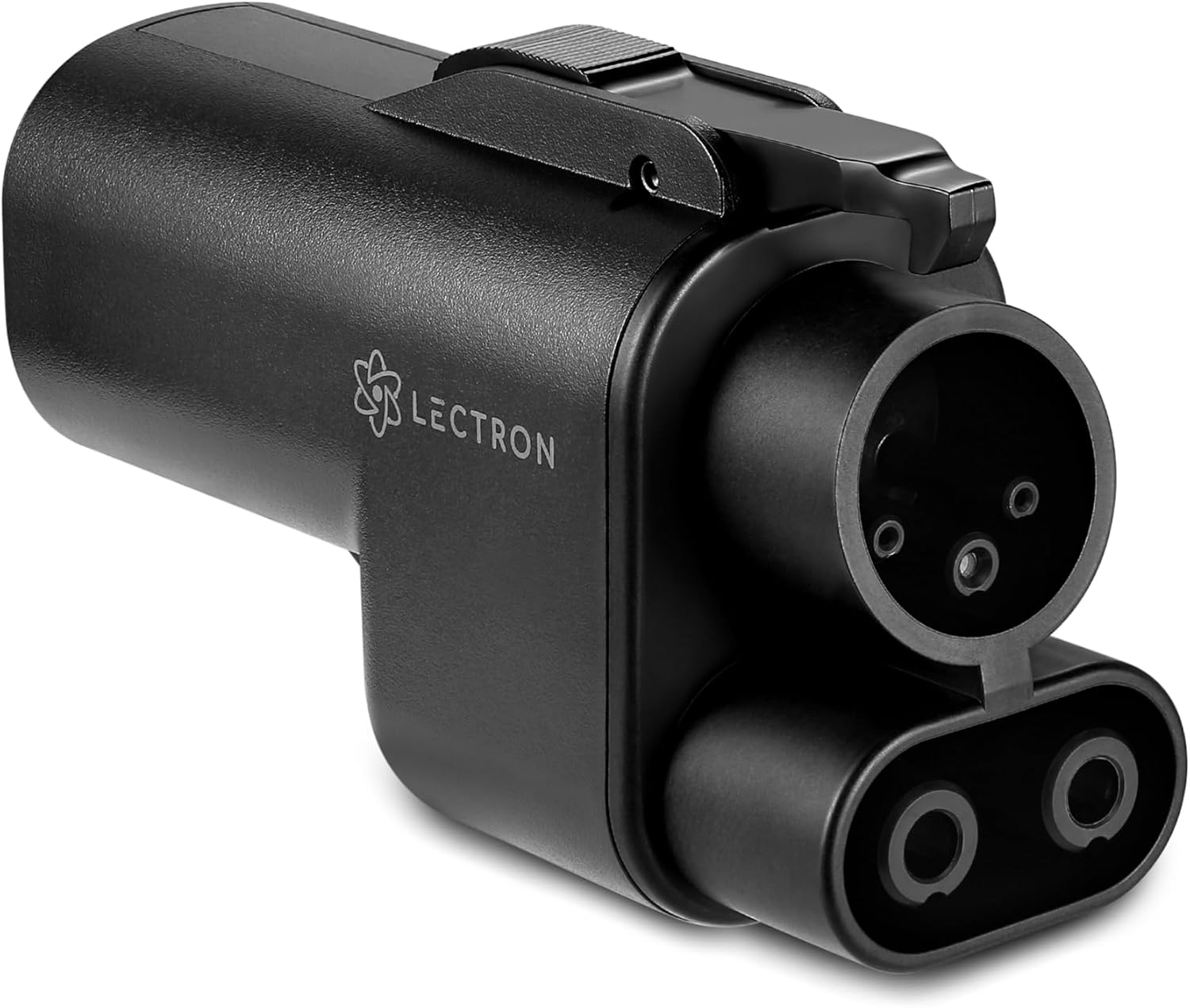
Lectron NACS to CCS Fast-Charge Adapter
Unlock every CCS fast charger for your Tesla, up to 500A DC. Never get stranded at a non-Tesla DC station again.
As an Amazon Associate, ThinkEV earns from qualifying purchases — at no extra cost to you.
The cautious: nobody trusts a new fast-charging network until they have personally watched it not break for six months. Tesla's Supercharger reliability, historically in the 96-99% uptime range, set the bar. Electrify America's well-documented reliability struggles set the floor. Walmart is unproven on this metric and the EV community is correctly waiting on real-world uptime data before declaring victory.
Two early-signal data points are working in Walmart's favour. First, the ABB A400 is a known-quantity industrial-grade charger with a real service network behind it, not a no-name OEM moonshot. Second, Walmart's existing store operations teams already handle equipment maintenance at scale, refrigeration, HVAC, point-of-sale terminals, automotive service bays. The institutional muscle for "things have to keep working" exists. Whether it transfers to charger uptime is the question of the next 18 months.
The connector question is largely resolved. Walmart's chargers ship with both NACS and CCS1 connectors on the unit. Between May 2023 and February 2024, almost all major North America EV manufacturers announced plans to switch to Tesla's North American Charging Standard, and Walmart's hardware choice reflects that reality. Tesla drivers plug in natively. Non-Tesla drivers plug in natively. Nobody has to think about adapters.
The early-install reports, clean canopies, well-lit stalls, accessible spacing, not jammed against the dumpsters, suggest Walmart is treating the charging deployment as customer-facing infrastructure rather than back-of-lot afterthought. That matters more than people realize. A charging stall in the back row next to the cart return is a different product than a charging stall in a covered canopy ten metres from the store entrance.
The Canadian read-across is notable: for ThinkEV readers: insurers are starting to price EV-specific risk more accurately as the data set matures, which is part of why EV insurance premiums are finally beginning to drop. Reliable, well-built public charging infrastructure is part of that maturation curve. Networks that earn the reliability reputation get rewarded, not just by drivers, but by the entire actuarial ecosystem behind EV ownership.
What Walmart Gets Out of This (It's Not Altruism)
Strip the press release language and the business case writes itself.
Dwell time equals basket size. The single most studied variable in big-box retail is how long a customer stays in the store. The longer the dwell, the bigger the basket. An EV charging session is a 30-to-45-minute commitment to being on Walmart's property. That is not a coincidence, it is a strategy.
Walmart is not running these chargers as a public service. Walmart will add thousands of EV charging stations to stores by 2030 because every charging session is a customer parked in the lot with nothing to do but go inside. The energy margin pays for the equipment. The basket margin is the actual prize.
The Walmart+ angle is the second pillar. Walmart+ is in a multi-year battle with Amazon Prime for subscriber loyalty. The membership benefits to date have been fuel discounts, free shipping, grocery delivery, and Paramount+ bundling. EV charging is the next slot. A 10% pilot discount looks modest in isolation; viewed as a Walmart+ retention lever for the EV-owning demographic, it is precision-targeted at a customer cohort with above-average household income and above-average lifetime value.
That demographic point is the third pillar. EV owners in the US skew higher income than the overall vehicle-owning population. Walmart spent the last decade in an explicit "trading-up" strategy aimed at exactly that household, better grocery selection, expanded fresh produce, beauty brand partnerships, premium private label. EV charging is consistent with that trajectory. It is an amenity that signals "this Walmart is for you" to the customer Walmart has been chasing.
And the energy revenue is real. At 400 kW peak, a single ABB A400 dispensing energy for 60% of a 12-hour day at typical retail margins generates meaningful per-port revenue annually. Multiply by 300 ports today and thousands tomorrow and the charging business line becomes its own segment, not an experiment.
The customer demographic overlap with EV ownership is also why Walmart is moving faster than Target, Costco, or Home Depot on this, though all three are watching closely. First-mover advantage in retail-attached charging is real because the customer who learns to charge at Walmart while shopping does not unlearn that habit easily.
The skeptical reading is that retailer-run charging networks have failed before, Kroger backed away from EVgo-branded co-locations, Macy's never expanded past its pilot, and the early IKEA chargers were Level 2 amenities, not strategic infrastructure. None of those efforts moved a needle. The difference this time is that Walmart is the only retailer with the parking-lot scale, the app penetration, and the maintenance org to do this as a core operating line rather than a marketing experiment. The previous attempts proved a retailer can install a charger. Walmart is testing whether a retailer can run a network. That is a different question with a different answer.
The Press Release Got One Thing Wrong
Every story about this rollout has framed it as Walmart helping customers go electric. That framing is not wrong, exactly. It is just incomplete enough to miss the point.
This is a competitive infrastructure land-grab. It is being executed at a pace and scale that no legacy charging operator can match, by a company that owns the one input every charging network desperately needs: parking lots where customers already spend money. The "helping customers" framing flatters Walmart and pacifies the rest of the industry. The "running the Tesla Supercharger playbook at retail scale" framing is the one that explains why this is actually happening.
Tesla figured out a decade ago that whoever owns the convenient charging owns the EV driver's brand allegiance. The Supercharger network was never about the chargers, it was about making Tesla ownership friction-free at exactly the moment a new EV driver was most likely to second-guess the purchase. The network sold cars. The chargers were the delivery mechanism.
Walmart is running the same logic at a different layer. Whoever owns the convenient charging owns the EV driver's shopping habit. The Walmart charging network is not about the chargers. It is about ensuring that the rapidly growing EV-owning household defaults to Walmart for the weekly grocery run because Walmart is where the car gets juiced. The network sells groceries; the chargers get people in the door.
The winning network in the end will not be the fastest, the cheapest, or the most extensive. It will be the one attached to somewhere the driver was going anyway. Walmart already is that somewhere for tens of millions of US households. The chargers are just making the attachment explicit.
This pattern is going to repeat. Costco will follow. Target will follow. The European hypermarket chains will copy the model. The Canadian equivalent, Loblaws, Sobeys, Canadian Tire, will face the same strategic question within 24 months and the smart ones will move first. The retail dwell-time charging vertical is a real market category now, not a nice-to-have.
There is precedent in the broader EV charging policy conversation for thinking carefully about who controls charging pricing and access, the dynamics behind BMW's 20% IONNA charging discount and OEM-gated pricing raise the same structural questions about who owns the customer relationship at the plug. Walmart's answer is unambiguous. Walmart owns it. The driver is a Walmart customer first and an EV driver second.
That is the framing the press release missed.
Gear worth having
As an Amazon Associate, ThinkEV earns a small commission from qualifying purchases — at no extra cost to you.

Grizzl-E Classic Level 2 EV Charger (40A)
Canadian-made and rated for minus 40C winters. 40A / 9.6 kW, NEMA 14-50, indoor/outdoor, 24-ft cable. The charger built for Canadian weather.
As an Amazon Associate, ThinkEV earns from qualifying purchases — at no extra cost to you.
This Is Not The Side Project It Looked Like
Walmart's EV charging network is not the cute side project the early coverage suggested. It is a structural reshaping of who controls retail-attached fast charging in North America, executed by a company with parking lots in every zip code and a payment app on every phone. The 300-port milestone is the warning shot. The 2030 buildout is the actual play.
The things to watch over the next 18 months: uptime data versus Tesla and EVgo, the Walmart+ discount evolution beyond the 10% pilot, and the first response from a major competing retailer, Costco being the most likely candidate. If Walmart hits 1,500 ports by end-of-2027 with 98%+ uptime, the legacy charging operators have a serious strategic problem on their hands. If reliability slips or the Walmart+ tie-in stays flat, the threat is real but slower.
What would change my mind: a second-consecutive quarter of port-count growth below 25%, or a credible J.D. Power-style reliability survey putting Walmart below Electrify America's current floor. Either signal flips this from "structural land-grab" to "ambitious pilot that overpromised." Absent those, the bet stands.
The bet here: Walmart hits the milestones, the retail-attached charging category becomes a defined segment, and by 2028 the question is not whether Walmart is a top-three US charging network. The question is which retailer ends up second.
Gear worth having
As an Amazon Associate, ThinkEV earns a small commission from qualifying purchases — at no extra cost to you.

Lectron Level 2 J1772 Charger (40A, WiFi)
Smart WiFi charger with real-time energy monitoring. 40A / 9.6 kW, J1772 with a NEMA 14-50 plug, schedule charging right from your phone.
As an Amazon Associate, ThinkEV earns from qualifying purchases — at no extra cost to you.

Founder & Chief Editor
Vlad Pereira is the founder and chief editor of ThinkEV.ca, the Canadian electric-vehicle publication he writes and edits from Courtenay, British Columbia. He covers EV pricing, federal and provincial rebates, charging costs, and the Chinese manufacturers now entering Canada, from the buyer's side rather than the press-fleet side. ThinkEV is a venture of Vlad Pereira Online; his writing on health, income and the long game lives at vladpereira.com.
Frequently asked questions
Is Walmart Canada building EV chargers too?
Will a non-Tesla EV plug in without an adapter?
Do you need a separate charging account to pay?
Which Canadian retailers might copy this?
More EV & road-trip finds
Affordable upgrades worth a look — tap any to check the price on Amazon.
 ★ 87
★ 87Car Window Sun Shades for Kids (4-Pack)
View on Amazon ★ 68
★ 68WeatherTech FloorLiner for Tesla Model 3
View on Amazon ★ 12,051
Windex Electronics Screen Wipes
View on Amazon ★ 164
★ 164Solar-Powered LED Ambient Light
View on Amazon ★ 4,626
HoogaLife Hanging Car Diffuser (2-Pack)
View on Amazon ★ 979
★ 979Leather Headrest Purse Hook
View on Amazon ★ 12,834
P3 Kill A Watt Electricity Usage Monitor
View on Amazon ★ 121
★ 121Foldable Windshield Sun Umbrella
View on AmazonRead, Plan, Then Stay Current
Explore our expert articles to understand incentives and ownership costs, use the map to pressure-test charging reality, then subscribe so new EV coverage comes straight to you.
Continue Reading
Rivian's Charging Network Hits 1,007 Stalls in 2026
Public EV Charging in Canada: Networks and Payment
Level 3 DC Fast Chargers Explained for Canadian EV Owners
BYD's 1,500 kW Flash Charger Lands in Germany

GM Energy Pass: One Universal Interface For Public Charging