Key takeaways
- The numbers help: 601 hp from dual motors, 0-100 km/h in 3.4 seconds, and a chassis tuned by the same team that developed the Elantra N and Veloster N.
- no, it doesn't qualify for the $5,000 EVAP rebate, EVAP uses a $50,000 final transaction value cap, and the Ioniq 5 N blows past that.
- The 601 hp figure comes from two electric motors, one on each axle, fed by an 84 kWh battery.
- The cargo area is identical, 527 litres with the rear seats up, expandable to 1,587 litres with the rear bench folded.
Every EV on the market makes the same promise: silent, smooth, effortless. The Ioniq 5 N does the opposite. It growls, it lurches between simulated gear shifts, it fights you through corners. It is, without qualification, the most entertaining electric car ever sold in Canada. And it does all of this while wearing the body of a family crossover that could pass for your neighbour's grocery-getter.
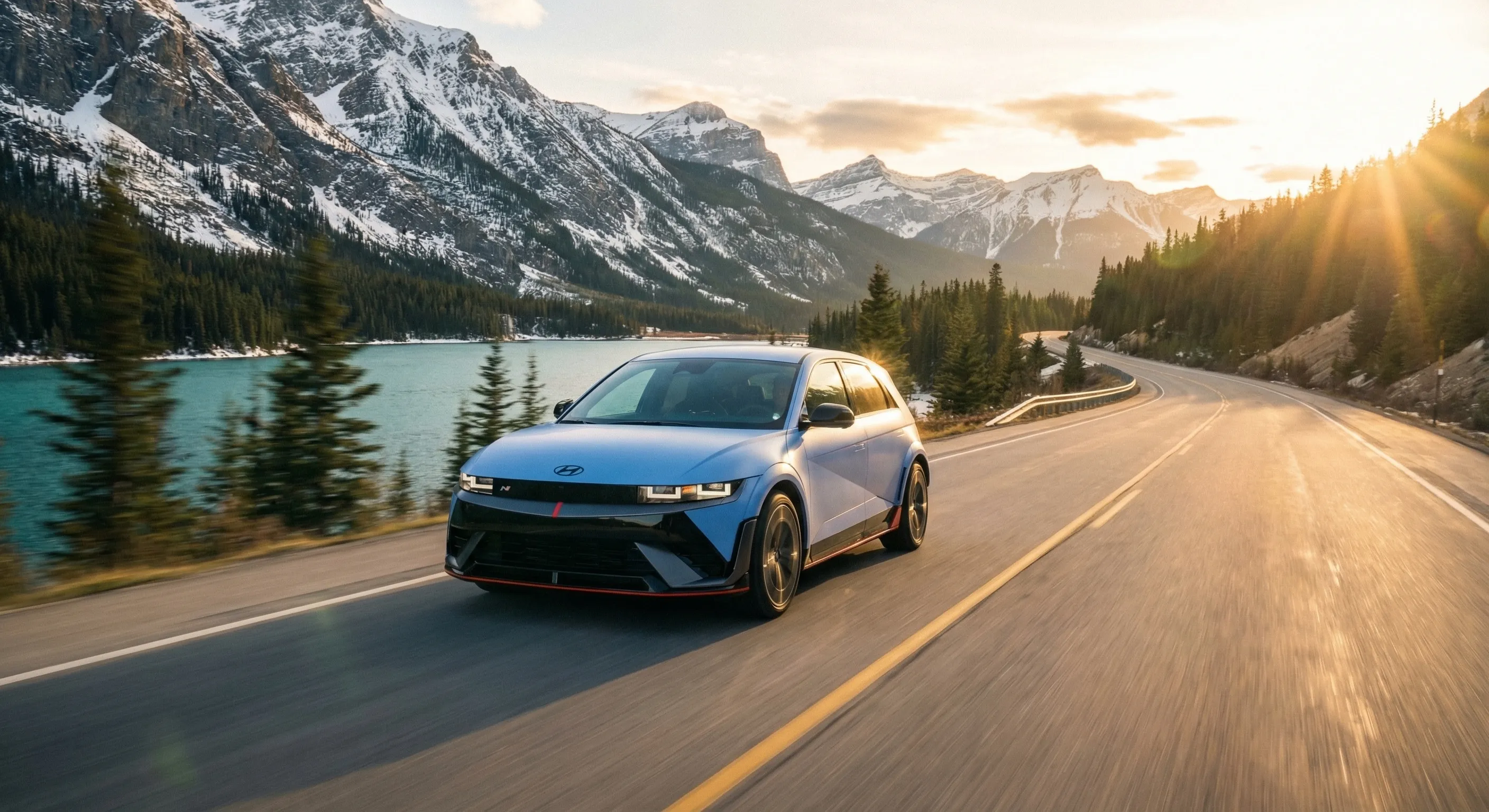
Hyundai's N division took the standard Ioniq 5, a competent, comfortable, somewhat boring crossover, and turned it into something that would make a BMW M3 owner nervous. The numbers help: 601 hp from dual motors, 0-100 km/h in 3.4 seconds, and a chassis tuned by the same team that developed the Elantra N and Veloster N. But the numbers only tell half the story. What makes the Ioniq 5 N special is how it makes you feel on the road.
At $72,999 CAD, it's not cheap. And no, it doesn't qualify for the $5,000 EVAP rebate, EVAP uses a $50,000 final transaction value cap, and the Ioniq 5 N blows past that. This is a car you buy because you want it, not because the math works out.
The spec sheet captures the numbers but misses the argument the Ioniq 5 N is making. Most EV manufacturers believe the future of driving is autonomous, passive, and frictionless. Hyundai's N division believes the future of driving should still include joy. Not speed, joy. The distinction matters because plenty of EVs are fast. A base Tesla Model 3 will pin you to the seat. A Kia EV6 GT will embarrass supercars at stoplights. Speed alone is table stakes in the electric era. What the Ioniq 5 N delivers, and what no other production EV in Canada can match, is the sensation that the car was designed by people who genuinely love driving and refuse to let electrification erase that experience.
That philosophy permeates every aspect of this vehicle, from the way the steering weights up in corners to the artificial exhaust note that crackles on overrun. Some of these features are engineering marvels. Some are technically gimmicks. All of them combine into a driving experience that is genuinely unique in the Canadian EV market, and worth every dollar of the $18,000 premium over the standard Ioniq 5, if you're the kind of person who drives for the experience, not just the destination.
DESIGN AND EXTERIOR
The Ioniq 5 N is not a standard Ioniq 5 with a badge swap and a power bump. Hyundai's N division made meaningful visual changes that communicate the car's performance intent without resorting to the boy-racer aesthetics that plague some sport-tuned crossovers. The differences are subtle enough to pass unnoticed at a distance, but distinctive enough that anyone familiar with the Ioniq 5 lineup will recognize the N immediately.
Starting at the front, the N gets a unique lower bumper with larger air intakes, functional, not decorative, that feed cooling air to the battery and motors during hard driving. The front lip sits lower than the standard Ioniq 5, reducing the ground clearance slightly but improving aerodynamic stability at higher speeds. The pixel-pattern LED headlights are carried over from the standard car, but the N adds a body-colour surround that integrates them more aggressively into the front fascia. The overall effect is a face that looks focused and intentional, like the car is concentrating on the road ahead.
Along the sides, the N's wider fender flares are the most obvious visual tell. They're not dramatic, maybe 10 mm wider per side, but they accommodate the N-specific 21-inch forged aluminium wheels wrapped in 275/35R21 Pirelli P Zero tyres. Those are serious performance tyres on serious wheels, and they fill the arches in a way that gives the Ioniq 5 N a planted, muscular stance the standard car lacks. The side skirts are subtly extended, running the length of the rocker panels in a body-colour treatment that lowers the visual centre of gravity. When you see the standard Ioniq 5 and the N parked side by side, the N looks like it's crouching, ready to launch.
The rear is where the N makes its boldest statement. A fixed rear wing, not a subtle lip spoiler, an actual wing, sits atop the liftgate, adding real downforce at speed. Below it, the rear bumper incorporates a functional diffuser and the signature N red accent bar that ties into the triangular reflectors. There's no exhaust pipe, obviously, but the diffuser treatment gives the rear end a purposeful, aerodynamic look that hints at the car's performance capability. The N-specific rear light bar, spanning the full width of the tailgate, creates a distinctive nighttime signature that's visible in the rear-view mirror from blocks away.
Hyundai offers the Ioniq 5 N in a curated palette of colours for the Canadian market. Performance Blue, the signature N colour that debuted on the Veloster N, is the enthusiast's choice and the one you'll see in most marketing material. It's a deep, saturated blue that photographs beautifully and looks stunning under Canadian skies. Other options include Abyss Black Pearl, Gravity Gold Matte (a unique matte finish that's particularly striking), Sombre Grey, and Serenity White Pearl. The Performance Blue and Gravity Gold Matte are exclusive to the N, you can't get them on the standard Ioniq 5.
The overall design language communicates a message that's increasingly rare in the EV world: this car is here to be driven, not just admired. Compared to the standard Ioniq 5's clean, retro-futuristic design, which is lovely in its own right, the N adds just enough aggression to signal its intent without crossing into the juvenile territory that makes some sport-tuned vehicles embarrassing to drive to a work meeting. The Ioniq 5 N looks serious. It looks competent. And on a Canadian highway, it looks fast standing still.
INTERIOR AND TECHNOLOGY
Step inside the Ioniq 5 N and you immediately understand that Hyundai didn't treat this as a cosmetic exercise. The interior has been reworked to create a cockpit that prioritizes driver engagement while retaining the standard Ioniq 5's excellent ergonomics and build quality.
The N-specific bucket seats are the centrepiece. They're deeply bolstered, firmly padded, and upholstered in a combination of Alcantara and synthetic leather with N-branded blue stitching running along the bolsters. The lateral support is exceptional, during hard cornering, these seats hold you firmly in place without the uncomfortable pinching that some sport seats inflict on larger drivers. The seating position is lower than the standard Ioniq 5, dropping the driver closer to the floor and creating a more sports-car-like relationship with the steering wheel and pedals. Heated seats and ventilated front seats are standard, because Hyundai understands that Canadian performance car owners still need to survive January mornings in Edmonton.
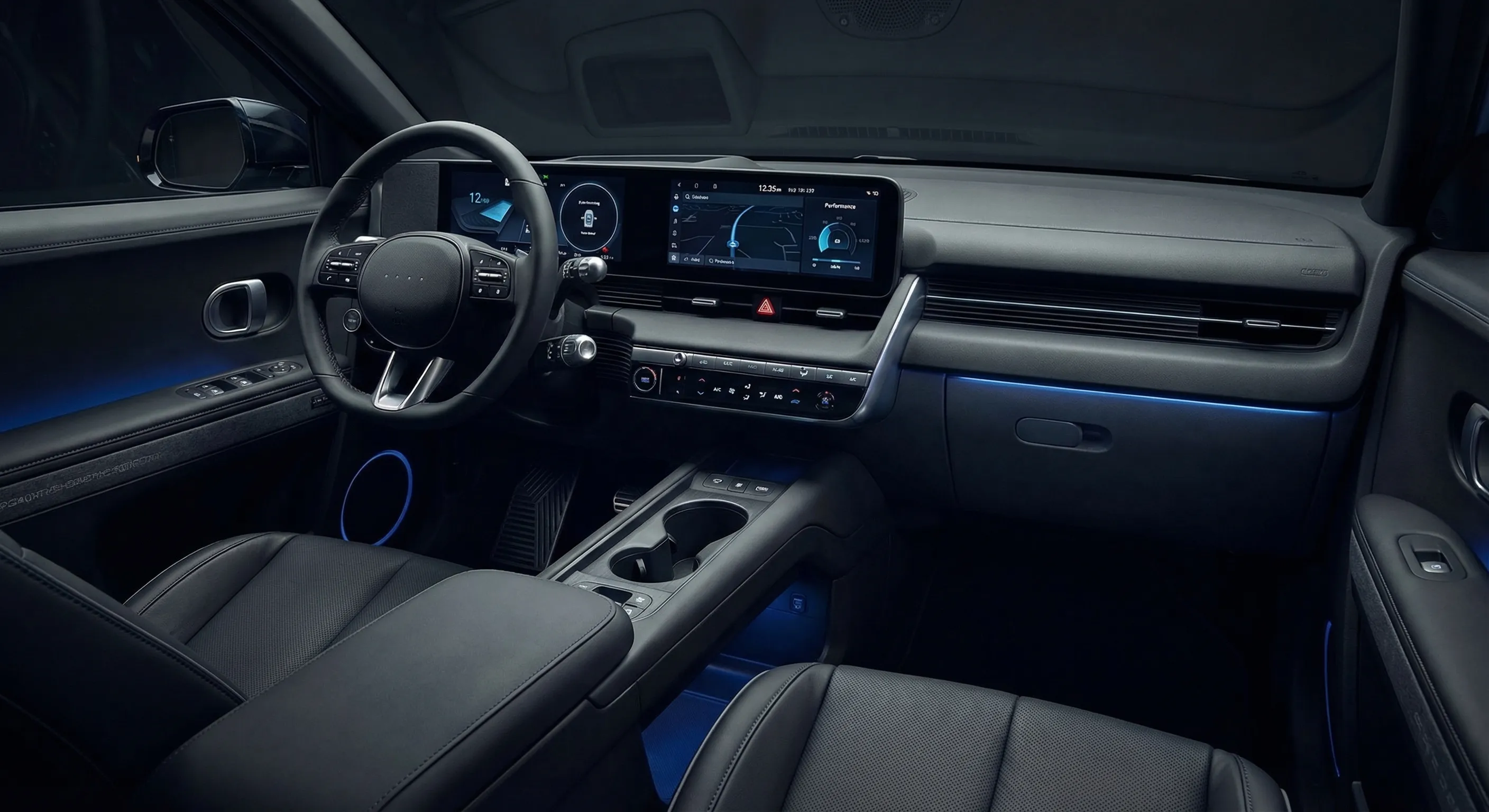
The steering wheel is a thick-rimmed, flat-bottomed unit wrapped in Alcantara with N-blue centre marker at the twelve o'clock position. It's smaller in diameter than the standard Ioniq 5's wheel, which quickens the steering ratio and improves the feeling of direct connection to the front axle. Two prominent blue paddles sit on the road, in most EVs, these would control regenerative braking levels, and they still do here. But in N e-Shift mode, they become gear-change paddles, letting you select your virtual gear with a satisfying metallic click. The N button on the right spoke provides instant access to your custom N drive mode, while the N Grin Boost button on the left spoke activates the temporary 641 hp overboost.
The dual 12.3-inch screens carry over from the standard Ioniq 5, but the N adds unique display modes. The digital instrument cluster can switch to an N-specific layout that shows boost pressure (simulated), motor temperature, battery temperature, lateral G-forces, and a lap timer. The information density is impressive, at a glance, you can see exactly how hard you're pushing the car and how much thermal headroom remains. A dedicated N Performance screen accessible from the centre display shows real-time power distribution between the front and rear motors, battery state of charge with temperature overlay, and the active status of all N systems (e-Shift, Active Sound+, ESC mode, and damper settings).
Drive mode selection is comprehensive. Normal mode softens everything, steering, dampers, throttle response, regenerative braking, creating a comfortable daily driver. N mode firms up the suspension, sharpens throttle response, and enables the N e-Shift and Active Sound+ systems. N Custom 1 and N Custom 2 allow individual adjustments to every parameter: you can run stiff dampers with soft steering if that's your preference, or pair aggressive throttle mapping with comfort-level regenerative braking. The level of customization rivals what BMW offers in its M cars, with the added advantage that the Ioniq 5 N's systems are controlled through a clean, intuitive interface rather than buried in obscure sub-menus.
Material quality throughout the cabin is a step above what you'd expect at this price point. The dashboard features soft-touch materials with the N-specific blue accent stitching that runs across the upper surfaces. The centre console is finished in a matte black material that resists fingerprints, a small detail that matters enormously in daily life. The rear seats are standard Ioniq 5 fare, comfortable, spacious, with the sliding rear bench that offers adjustable legroom and cargo balance. Rear passengers get USB-C charging ports and climate vents, making the back seat perfectly liveable for passengers who don't share the driver's enthusiasm for simulated gear changes.
The Bose premium sound system with eight speakers handles both music and N Active Sound+ duties. When the artificial engine note is active, the dedicated subwoofer adds a visceral low-frequency element to the simulated exhaust that you feel in your chest as much as you hear. Turn the fake engine off and the Bose system delivers clean, detailed audio for music, a dual-purpose audio setup that works surprisingly well for both applications.
THE N e-SHIFT SYSTEM
The headline feature is N e-Shift, Hyundai's simulated 8-speed gearbox. In a traditional EV, you press the accelerator and power arrives in one smooth, linear rush. In the Ioniq 5 N, the car simulates gear changes, you feel a slight pause between "shifts," and the power delivery has a rhythmic quality that mimics a dual-clutch automatic. It's entirely fake, and it's entirely brilliant.
Here's why it works: the linear power delivery of most EVs is impressive for about two weeks. After that, it becomes predictable and a bit boring. The N e-Shift gives acceleration a sense of drama and engagement that EVs typically lack. You're not just going fast, you're working through gears, anticipating the next shift, feeling the engine (or in this case, the motors) build toward a peak. It turns a mundane commute into something you actually look forward to.
The engineering behind N e-Shift is more sophisticated than it sounds. Hyundai's engineers didn't just program a simple power interruption between gears. Each "shift" involves a coordinated modulation of motor torque, regenerative braking pulse, and suspension response that together create the physical sensation of a gear change. Lower gears deliver shorter, more aggressive power bursts. Higher gears stretch out with a longer, more relaxed power curve. The rev-matching on downshifts, where the virtual engine blips to match the lower gear's speed, produces a convincing bark through the Active Sound+ system that genuinely tricks your inner ear into believing the drivetrain is mechanical.
You can use the paddle shifters in manual mode or let the system shift automatically. In automatic mode, the shift points vary based on driving intensity, calm driving produces early, smooth upshifts, while aggressive acceleration holds each gear closer to the simulated redline. In manual mode, the car will rev-limit rather than auto-upshift, adding another layer of engagement for enthusiasts who want complete control over the power delivery.
You can turn it off if you want the standard EV smoothness. Most owners won't. It's that good.
The N e-Shift system also integrates cleverly with the car's energy management. Because the momentary torque reductions during shifts reduce peak electrical demand on the battery, the system actually provides a small thermal benefit during sustained hard driving. It's a neat engineering side effect, the feature that makes the car more fun to drive also makes it slightly more capable of sustained performance. Hyundai won't market it that way, but the data bears it out.
PERFORMANCE
The 601 hp figure comes from two electric motors, one on each axle, fed by an 84 kWh battery. The N Grin Boost button adds another 40 hp for 10 seconds at a time, bringing the total to 641 hp. That's Porsche Taycan Turbo territory, in a car that costs half as much.
The 3.4-second sprint to 100 km/h is fast enough to rearrange your internal organs, but straight-line speed isn't where the Ioniq 5 N separates itself from other fast EVs. Tesla makes fast EVs. Kia makes fast EVs. What Hyundai's N division delivers is a car that feels alive through corners, on the brakes, and during weight transfer in a way that most EVs simply don't.
The suspension is stiffer than the standard Ioniq 5, with electronically controlled dampers that firm up in N mode and soften in Normal. The steering has genuine weight and feedback, not the numb, video-game feel that plagues most electric crossovers. And the brakes, which combine regenerative and friction braking, have a pedal feel that's among the best in any EV. Hyundai's engineers clearly spent time making sure the Ioniq 5 N communicates what's happening at the tires, which is something most EV manufacturers ignore entirely.
The chassis work is where the N division earned its reputation. The front suspension uses a MacPherson strut setup with stiffer springs, upgraded dampers, and a thicker anti-roll bar compared to the standard Ioniq 5. The rear gets a multi-link arrangement with similar upgrades. The result is a car that controls body roll aggressively without destroying ride compliance, a balance that's notoriously difficult to achieve and one that many dedicated sports cars get wrong.
The electronically controlled dampers are continuously variable, adjusting hundreds of times per second based on road surface, vehicle speed, steering angle, and lateral acceleration. In Normal mode, they're surprisingly pliant, not luxury-car soft, but comfortable enough for a daily commute on rough Canadian roads. Switch to N mode and they firm up considerably, reducing body motion and improving transient response. The difference between modes is dramatic and immediate, it genuinely feels like the car's personality changes with the press of a button.
Braking performance deserves special mention. The Ioniq 5 N uses 400 mm front brake discs with four-piston calipers, paired with the regenerative braking system. Hyundai developed a blended braking system that smoothly transitions between regenerative and friction braking, with a pedal feel that's linear and predictable. Most EVs have terrible brake feel, the handoff between regen and friction creates a mushy, inconsistent pedal. The Ioniq 5 N's brakes feel like a conventional performance car's, which is a remarkable engineering achievement. Under hard braking from speed, the car scrubs off velocity with confidence and composure, the front end diving predictably as weight transfers forward.
The torque vectoring system, which distributes power independently between the front and rear axles, is another layer of the performance equation. Under acceleration out of corners, the system sends more torque to the rear to promote a natural, rear-biased power delivery that experienced drivers will appreciate. Under deceleration into corners, it can apply selective braking to the inside wheels to tighten the car's line. The system operates transparently, you don't notice its interventions consciously, but you do notice that the car rotates more willingly and tracks more precisely than its 2,210 kg curb weight would suggest.
Gear worth having
As an Amazon Associate, ThinkEV earns a small commission from qualifying purchases — at no extra cost to you.
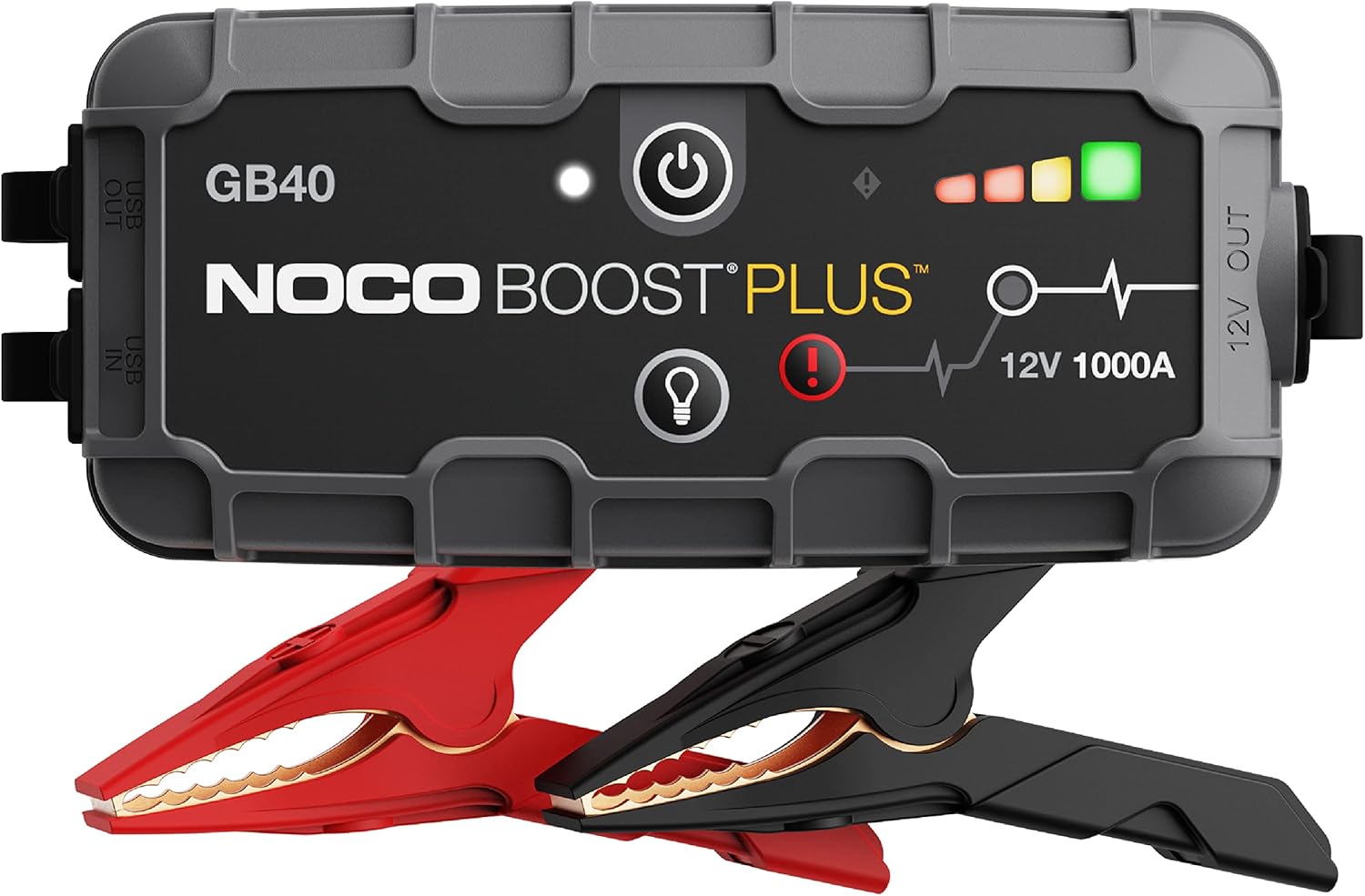
NOCO Boost Plus GB40 Jump Starter
A 1000A lithium jump starter that fits in your glovebox and works on any 12V battery. Your insurance against a dead 12V in a parking lot.
As an Amazon Associate, ThinkEV earns from qualifying purchases — at no extra cost to you.
N ACTIVE SOUND+
The other party trick is the sound system. Not the stereo, the simulated engine sound. N Active Sound+ pipes a synthesized exhaust note through the cabin speakers that responds to throttle position, rpm (simulated), and gear changes. It sounds like a flat-plane crank V8 mixed with a turbocharged four-cylinder, and it's surprisingly convincing.
This will be polarizing. Some drivers will love the drama. Others will turn it off immediately and enjoy the silence. Both are valid responses. The point is that Hyundai gave you the option, and the implementation is far better than anything BMW or Dodge has attempted with their EV sound generators.
What separates N Active Sound+ from the competition's attempts is the sophistication of the audio modelling. The system doesn't just play a recorded engine sound that rises and falls with the accelerator pedal, it's a real-time synthesized audio model that responds to dozens of input variables. Throttle position, motor speed, selected gear (via N e-Shift), vehicle speed, lateral acceleration, and even road surface all feed into the sound engine. The result is a dynamic, responsive audio experience that changes character depending on how you're driving.
At low speeds in city driving, the sound is a deep, purposeful burble, present enough to add character, quiet enough not to become annoying. Under hard acceleration, it builds into a snarling crescendo that peaks at each virtual gear change and drops in pitch during the shift transition before climbing again. On overrun, lifting off the throttle or downshifting, the system produces pops and crackles that mimic the anti-lag sounds of a turbocharged rally car. It's theatrical, it's unnecessary, and it brings an enormous grin to your face every single time.
Hyundai offers three sound themes: Ignition (a V8-inspired sound), Evolution (a more futuristic, sci-fi tone), and Supersonic (the most aggressive, combining combustion and electric elements). Each can be adjusted in volume from subtle background presence to full concert-hall intensity. Most N owners gravitate toward Ignition at medium volume, it provides the most convincing internal combustion simulation without overwhelming conversation or music.
The external speaker, a pedestrian warning system repurposed for entertainment, also produces a muted version of the sound outside the car. It's quieter than the cabin experience and designed primarily for the low-speed pedestrian safety requirement, but it adds a subtle announcement of the N's presence that bystanders notice. Standing outside while someone else drives the Ioniq 5 N past you in Ignition mode is a strange and delightful experience, your brain knows it's electric, but your ears insist otherwise.
ON THE ROAD, DAILY DRIVING
Here's the question that every enthusiast car review avoids: what's it actually like to live with every day? The Ioniq 5 N is a performance car, and performance cars are traditionally terrible at regular life. Stiff rides, cramped cabins, expensive maintenance, and fuel consumption that makes you wince at every gas station, that's the traditional price of driving excitement. The Ioniq 5 N breaks that pattern in ways that matter enormously for Canadian buyers who want a single car that does everything.
In Normal mode, the Ioniq 5 N is a genuinely comfortable daily driver. The electronically controlled dampers soften to a setting that absorbs potholes, frost heaves, and expansion joints without punishing your spine. The steering lightens up for parking-lot manoeuvres. The throttle response becomes gentle and progressive, no more lurching forward when you tap the pedal in stop-and-go traffic on the 401 or the Sea-to-Sky Highway. The N e-Shift disengages, delivering the smooth, linear power that makes EVs so pleasant in city driving. And the Active Sound+ system mutes itself, leaving you with the serene quiet that sold you on electric in the first place.
This dual personality is the Ioniq 5 N's secret weapon. You can commute to work in downtown Toronto in silence and comfort, pick up the kids from school without the car's stiff ride making them carsick, run errands to Costco with the same practicality as a standard Ioniq 5, and then, on a Saturday morning when the Muskokas are calling, press the N button and transform the car into a 601 hp weapon that carves through cottage-country roads with the precision and drama of a dedicated sports car.
The practicality carries over directly from the standard Ioniq 5. The cargo area is identical, 527 litres with the rear seats up, expandable to 1,587 litres with the rear bench folded. The sliding rear bench lets you prioritize either rear passenger legroom or cargo space depending on the situation. The flat floor, courtesy of the E-GMP skateboard platform, means no drivetrain tunnel eating into cabin space. The V2L (vehicle-to-load) capability is fully functional in the N, providing 3.6 kW of power through the charge port or the interior outlet, enough to run a portable fridge, camping gear, or power tools at a worksite.
Grocery runs, hockey-practice drop-offs, airport pickups, weekend road trips to Whistler or Tremblant, the Ioniq 5 N handles all of it without complaint. The ride height is standard-crossover appropriate, meaning you don't scrape the front lip on steep parking-garage ramps or gravel driveways. The visibility is good in all directions, with the flat hood and large windows providing confident sightlines in tight parking lots. Adaptive cruise control, lane-keeping assist, and Highway Driving Assist 2 (Hyundai's semi-autonomous highway system) make long highway drives effortless.
The one daily-driving concession is noise. Even in Normal mode with Active Sound+ disabled, the Ioniq 5 N's stiffer suspension and wider tyres generate more road noise than the standard Ioniq 5. The 275-width Pirelli P Zeros, phenomenal on dry pavement, transmit more surface texture through the cabin than the standard car's narrower, higher-profile tyres. It's not excessive, and the Bose sound system easily compensates, but if cabin silence is your top priority, the standard Ioniq 5 or the Ioniq 6 will serve you better.
WINTER PERFORMANCE
Canadian EV buyers want to know one thing above all others: how does it handle winter? The Ioniq 5 N answers that question with a combination of hardware capability and thoughtful engineering that makes it one of the most competent winter performers in the EV segment, with some important caveats.
The dual-motor AWD system distributes power between front and rear axles continuously, with the ability to send up to 100% of available torque to either axle depending on traction conditions. On snow and ice, the system reacts within milliseconds to wheelspin, redirecting power to whichever axle has the most grip. The response speed of electric motors, torque is available essentially instantaneously, gives the AWD system a reaction-time advantage over mechanical AWD systems in gas vehicles. When a rear wheel breaks traction on a patch of black ice, the system has already shifted power forward before a conventional transfer case would have registered the slip.
That said, the factory Pirelli P Zero tyres are summer-performance rubber. They're exceptional on dry and wet pavement, but they are genuinely dangerous on snow and ice. This is not an exaggeration, summer performance tyres have almost zero grip below 7 degrees Celsius. Any Canadian Ioniq 5 N owner must budget for a set of dedicated winter tyres. The 21-inch wheel size limits your winter tyre options and increases the cost, but several manufacturers now offer suitable compounds in 275/35R21.
Alternatively, many owners run a set of 19-inch wheels with a higher-profile winter tyre, which improves ride comfort in winter and reduces the risk of wheel damage on potholed winter roads. Budget $2,000 to $3,000 for a set of winter wheels and tyres, a non-negotiable expense for any Ioniq 5 N owner in Canada.
Gear worth having
As an Amazon Associate, ThinkEV earns a small commission from qualifying purchases — at no extra cost to you.

VIOFO A229 Pro 4K Dash Cam
4K front plus 2K rear with parking mode and GPS. Your silent witness for insurance claims, with always-on sentry recording while parked.
As an Amazon Associate, ThinkEV earns from qualifying purchases — at no extra cost to you.
With proper winter tyres, the Ioniq 5 N is remarkably confident in snow. The low centre of gravity from the floor-mounted battery pack, combined with the instant torque vectoring of the dual-motor AWD, creates a car that feels planted and predictable on snow-covered roads. The weight, 2,210 kg, actually works in your favour here, pressing the tyres into the snow surface for better traction. Hill starts on icy inclines are managed effortlessly by the AWD system and the precise torque control of the electric motors.
Range loss in winter is the unavoidable trade-off. Expect 260 to 300 km of real-world range in Canadian winter conditions, down from 350 to 380 km in summer, a reduction of roughly 25 to 30 percent depending on temperature, driving style, and how aggressively you use cabin heating. At minus 20 degrees Celsius, common across the Prairies, Ontario, and Quebec, range drops to the lower end of that band.
At minus 30 and below, which Calgary and Winnipeg see regularly, you may see range dip below 260 km. The battery's heat pump system helps mitigate this by scavenging waste heat from the motors and power electronics to warm the cabin, but physics ultimately wins: cold batteries hold less energy, cold air is denser, and cabin heating draws significant power.
For detailed numbers on what to expect, check our EV winter range test.
The 800V architecture provides a meaningful advantage in cold-weather charging. The Ioniq 5 N's battery preconditioning system automatically warms the battery when you set a DC fast charging station as your navigation destination. By the time you arrive at an Electrify Canada or Petro-Canada Electric Highway station, the battery is at optimal temperature for maximum charging speed, even if you started in minus 25 conditions. Without preconditioning, cold batteries accept charge much more slowly, potentially doubling or tripling the time for a 10-to-80-percent session. The preconditioning system eliminates this penalty in most conditions, making winter road trips practical even across long Canadian distances.
Cabin preconditioning while plugged in at home, scheduling the climate system to warm the car and defrost the windows before your morning departure, preserves range by using grid power rather than battery energy for the initial heating. Every Ioniq 5 N owner in Canada should use this feature religiously from November through March. It's the single most effective strategy for maximizing winter range and starting every morning with a warm, comfortable cabin and clear windows.
RANGE AND CHARGING
The 84 kWh battery delivers about 448 km on the WLTP cycle. Real-world Canadian driving knocks that down to 350-380 km in moderate weather. In winter, expect 260-300 km depending on temperature and driving style. Enthusiastic driving, which is the entire point of this car, drops range further. A hard afternoon on a back road will drain the battery noticeably faster than highway cruising.

The 800V architecture means charging is fast. 10% to 80% takes about 18 minutes on a 350 kW charger. In Canada, Electrify Canada stations offer 350 kW, and the Petro-Canada Electric Highway has expanded its high-power network. The Ioniq 5 N can also do vehicle-to-load (V2L) at 3.6 kW, which is handy for powering tools, appliances, or camping gear.
Let's put those numbers in practical Canadian context. A 350 km summer range covers Toronto to Ottawa with a comfortable margin. Toronto to Montreal requires one fast-charging stop, pull into an Electrify Canada station near Kingston, plug in for 18 minutes, grab a coffee, and you're back on the road with enough range to reach Montreal and then some. Vancouver to Kelowna is about 390 km, tight on a single charge but doable in moderate weather if you drive conservatively. In practice, a quick 10-minute top-up at a Merritt or Kamloops station eliminates any anxiety.
For daily commuting, the Ioniq 5 N's range is more than sufficient. The average Canadian commute is about 25 km each way, you could commute for an entire week on a single charge and still have range left for weekend errands. Home charging on a Level 2 setup (240V, 48A) replenishes the full 84 kWh battery in approximately 7 hours overnight. For most owners, this means plugging in when you get home, setting the charge limit to 80% for daily use (which extends battery longevity), and waking up to a full battery every morning. Our guide on the best Level 2 chargers for Canadian homes covers the hardware options in detail.
The 800V architecture also means the Ioniq 5 N is future-proofed for the next generation of ultra-fast chargers. As 350 kW stations become more prevalent across the Trans-Canada Highway and provincial charging networks, the N will be able to fully exploit their capability from day one. Many competing EVs with 400V architecture are limited to 150 to 200 kW maximum charging rates, meaning they'll take twice as long at the same station. Over the lifetime of the vehicle, the time savings from 800V charging are substantial, especially for road trips through Ontario, Quebec, or across the Prairies.
Gear worth having
As an Amazon Associate, ThinkEV earns a small commission from qualifying purchases — at no extra cost to you.

Grizzl-E Classic Level 2 EV Charger (40A)
Canadian-made and rated for minus 40C winters. 40A / 9.6 kW, NEMA 14-50, indoor/outdoor, 24-ft cable. The charger built for Canadian weather.
As an Amazon Associate, ThinkEV earns from qualifying purchases — at no extra cost to you.
TRACK AND SPIRITED DRIVING
The Ioniq 5 N is the first EV that was genuinely designed with track driving in mind, and Hyundai backed that claim with engineering, not marketing. The battery thermal management, the chassis tuning, the brake hardware, and the software modes all reflect a vehicle that's been developed and tested on racetracks, including the Nurburgring Nordschleife, where the N division does its final validation work.
N Drift Mode is the marquee track feature. Disengage the stability control (a deliberate, multi-step process that requires the driver to hold the ESC button), and the car unlocks a rear-biased torque split that allows controlled oversteer. The system doesn't just disable traction control, it actively manages the torque distribution to sustain a drift angle, feeding power to the rear motors to maintain the slide while the front axle provides directional control. For a 2,210 kg crossover, the Ioniq 5 N drifts with a composure and controllability that's genuinely surprising. It's not a lightweight sports car, you feel the mass, but the instant torque response of the electric motors means corrections happen faster than in any combustion-powered drift machine.
Launch Control is the drag-strip feature. Hold the brake and floor the accelerator simultaneously, and the car pre-loads the motors, battery pre-conditioning kicks in, and the system calibrates the optimal torque delivery for maximum traction. Release the brake and 601 hp (641 in Boost) hits all four wheels with precisely metered force. The launch is violent and repeatable, unlike combustion cars, which lose performance as the engine heats up and the transmission adapts, the Ioniq 5 N delivers consistent launch times lap after lap, provided the battery temperature stays within the optimal window.
Battery management during track use is where Hyundai's engineering depth shows. The 84 kWh battery pack uses a liquid cooling system that circulates refrigerant through channels integrated into the battery module structure. During sustained high-power output, the kind you'd see during a 20-minute track session, the system actively manages battery temperature to prevent power derating. Hyundai claims the Ioniq 5 N can sustain full power output for longer than any competing performance EV, and real-world track tests from European journalists support this: the car maintains consistent power output for 15 to 20 minutes of hard track driving before beginning gradual power reduction.
When the battery does reach its thermal limit, the power reduction is progressive and predictable, you feel the car becoming slightly less explosive rather than hitting a wall of sudden power loss. The instrument cluster shows battery temperature and remaining performance headroom in real time, so you can manage your session accordingly. A 10-minute cool-down with the climate system running (battery cooling is automatic) restores most of the performance headroom for another session.
For Canadian track enthusiasts, the options are growing. Calabogie Motorsports Park in Ontario, Canadian Tire Motorsport Park (formerly Mosport), Area 27 in the Okanagan, and Circuit Mont-Tremblant in Quebec all welcome EV track days. Some tracks have installed Level 2 chargers in the paddock area, and several now have DC fast chargers nearby. The logistics of tracking an EV are different from a combustion car, you're not hauling jerry cans of race fuel, but the Ioniq 5 N's fast-charging capability means you can top up between sessions in 15 to 20 minutes, roughly the same time you'd spend checking tire pressures and cooling down anyway.
One practical track note: the N's regenerative braking system supplements the friction brakes significantly, reducing brake wear. After a typical track day in a combustion performance car, you'd expect to see significant brake pad wear and potentially warped rotors. The Ioniq 5 N's regen system handles a meaningful portion of the deceleration, extending the life of the friction brake components considerably. It's a hidden cost advantage of the electric powertrain that track-day regulars will appreciate.
OWNERSHIP AND COSTS
The $72,999 MSRP is the starting point, but let's be honest about the full financial picture. The Ioniq 5 N does not qualify for the federal $5,000 EVAP rebate, the $50,000 final transaction value cap excludes it entirely. No provincial rebates apply either, as most provincial programs use similar price caps. For context on rebate eligibility across different models and provinces, see our comprehensive provincial rebate guide. You are paying full retail for this car, and the only financial incentive is the fuel savings over time.
Those fuel savings are real and substantial. Let's compare the Ioniq 5 N to the two combustion vehicles it most directly replaces in an enthusiast's garage, the BMW M3 Competition xDrive ($88,900 CAD) and the BMW M4 Competition ($86,400 CAD). The M3/M4 burns premium fuel at approximately 11 litres per 100 km in mixed driving. At current Canadian premium fuel prices averaging $1.85 per litre, that's roughly $3,700 per year in fuel costs for 20,000 km of driving.
The Ioniq 5 N consumes approximately 21 kWh per 100 km in mixed driving. At the Canadian average residential electricity rate of $0.13 per kWh, that's about $546 per year, a saving of over $3,100 annually. Over five years, that's $15,500 in fuel savings alone. For the full breakdown of EV versus gas economics, our total cost of ownership comparison covers every variable.
Insurance will be higher than a standard Ioniq 5, expect a 15 to 25 percent premium depending on your province, driving history, and insurer. The performance classification and higher replacement cost push insurance rates up. In Ontario, budget roughly $2,400 to $3,200 per year for comprehensive coverage, depending on your profile. In BC through ICBC, expect $2,000 to $2,800. Alberta tends to be slightly lower. Shopping around aggressively between insurers is essential, the spread between quotes for the same vehicle can be 30 percent or more.
Maintenance costs are where the Ioniq 5 N delivers a decisive advantage over combustion performance cars. No oil changes. No spark plugs. No timing belt. No transmission fluid. No exhaust system repairs. The Ioniq 5 N's maintenance schedule consists primarily of tyre rotation, brake fluid replacement every two years, cabin air filter replacement, and occasional coolant system inspection. Annual maintenance costs run approximately $300 to $500 per year, compared to $1,500 to $2,500 for a BMW M3 or M4 between oil changes, brake services, and the inevitable expensive surprises. For a detailed look at what EV maintenance actually costs in Canada, see our maintenance cost breakdown.
Tyre costs are the exception. The 275/35R21 Pirelli P Zeros are expensive performance tyres, expect $1,600 to $2,000 for a set, and they'll last 30,000 to 40,000 km depending on driving style. Add winter tyres at $2,000 to $3,000 for a set of wheels and rubber, and you're looking at $3,600 to $5,000 in tyre costs over two to three years. This is comparable to the tyre costs on an M3 or M4, which use similarly wide, performance-oriented rubber.
Hyundai's warranty coverage is competitive: 5 years or 100,000 km comprehensive, 5 years or 100,000 km powertrain, and 8 years or 160,000 km on the battery and electric motor components. The battery warranty guarantees at least 70% of original capacity over the warranty period. For a car that costs $73,000, eight years of battery peace of mind is meaningful.
Depreciation is the elephant in the room. Performance EVs are still new enough that long-term resale data is limited, but early indicators suggest that desirable, distinctive models like the Ioniq 5 N hold value better than mainstream EVs. The N's limited production numbers and enthusiast appeal create stronger demand in the used market than generic electric crossovers. After three years, expect roughly 50 to 55 percent residual value, better than a Tesla Model Y Performance (which suffers from frequent price cuts eroding used values) and roughly comparable to a BMW M3.
THE TRADE-OFFS
At $72,999, the Ioniq 5 N is competing with the Tesla Model Y Performance ($69,990), BMW iX xDrive40 ($73,990), and the standard Ioniq 5 Long Range AWD ($54,999). That last comparison matters most, you're paying an $18,000 premium over the standard Ioniq 5 for performance hardware and software. If you don't drive enthusiastically and often, the standard Ioniq 5 gives you more range and more comfort. Note that the Long Range AWD at $54,999 also exceeds the EVAP cap, you'd need to look at lower Ioniq 5 trims for rebate eligibility.
The ride quality is firmer than the standard car, which is noticeable on rough Canadian roads. Montreal's potholed streets and Ontario's frost-heaved highways will remind you that you bought a performance car, not a luxury cruiser. The N is tuned for engagement, not comfort, and that's a conscious trade-off.
Interior space and practicality are identical to the standard Ioniq 5, same cargo area, same rear seat space, same sliding rear bench. It's still a practical crossover that happens to be absurdly fast.
Let's expand on the competitive picture, because understanding what else $73,000 buys in Canada matters for making the right decision. The Tesla Model Y Performance is $3,000 cheaper and has access to the Supercharger network, the most reliable and widespread fast-charging network in Canada. The Tesla also has better range (approximately 480 km WLTP versus the N's 448 km) and a more advanced driver-assistance system. What it lacks is driving engagement. The Model Y Performance is fast, brutally fast, but it delivers that speed with the emotional engagement of a microwave oven. It's a point-and-squirt appliance, and if that's what you want, it's excellent. But it's not a driver's car.
The BMW iX xDrive40 at $73,990 offers a more luxurious experience, better interior materials, a quieter cabin, a more cosseting ride, but it's not a performance car. It's a luxury crossover that happens to be electric. The driving experience is competent but unremarkable, and the iX's unusual styling is polarizing in ways the Ioniq 5's retro-futurism is not. The iX is for people who want BMW badge prestige and luxury in an electric package. The Ioniq 5 N is for people who want to drive.
The Kia EV6 GT, built on the same E-GMP platform, is the Ioniq 5 N's closest mechanical relative, 585 hp, AWD, 800V, and a similar price point. The EV6 GT is slightly lighter and has a more traditional crossover profile, but it lacks the N e-Shift system, the Active Sound+ feature, and the depth of chassis tuning that the N division brings. If you want the performance without the theatrics, the EV6 GT is an excellent alternative. But the Ioniq 5 N's ability to simulate the engagement of a combustion sports car while delivering EV efficiency is something the EV6 GT doesn't attempt.
The standard Ioniq 5 Long Range AWD at $54,999 deserves careful consideration. It delivers 488 km of WLTP range (40 km more than the N), a more comfortable ride, quieter cabin, and the same practical interior. For $18,000 less, you get a car that handles 95% of daily driving needs with less compromise. The N's $18,000 premium buys you 601 hp, a track-capable chassis, and the most engaging driving experience in the EV world. Whether that's worth the premium depends entirely on how much you value driving excitement. If you're honest with yourself about how often you'll actually use the N's performance, and if the answer is "every single drive", then it's worth every penny.
VERDICT
The Ioniq 5 N is the best performance EV you can buy in Canada under $100,000. It's the only electric car that genuinely feels like a driver's car, not just fast in a straight line, but engaging, communicative, and rewarding through corners. The N e-Shift and Active Sound+ features are gimmicks, technically, but they're gimmicks that solve a real problem: EVs are boring to drive fast. The Ioniq 5 N is anything but boring.
The engineering depth here is what sets the Ioniq 5 N apart from every other attempt to make a "performance EV." Hyundai didn't just add power and stiffen the springs, they reimagined what driving engagement means in an electric context. The simulated gear changes, the artificial engine sound, the tuneable chassis, the drift mode, the battery management for sustained track performance, each feature represents a deliberate engineering decision to preserve the emotional connection between driver and machine that electrification threatens to sever.
Is it perfect? No. The range is shorter than the standard Ioniq 5. The ride is firmer. The tyres are expensive. It doesn't qualify for any government rebates. The road noise from those wide performance tyres is noticeable. And the $72,999 price tag is a lot of money for a vehicle based on a $54,999 platform.
But perfection isn't the point. On the metrics that matter when you're driving a mountain road at sunrise, the ones that make you take the long way home and look back at the car after you park, the Ioniq 5 N delivers like nothing else in the Canadian EV market.
Buy it if you want a car that makes you smile every time you drive it. Skip it if you want maximum range, maximum comfort, or the $5,000 EVAP rebate. This is a car for enthusiasts who happen to want an EV, not EV buyers who happen to want performance.
Gear worth having
As an Amazon Associate, ThinkEV earns a small commission from qualifying purchases — at no extra cost to you.

PULIDIKI Car Cleaning Gel (Detailing Putty)
Press it into vents, buttons, and seams and it lifts out dust you did not know was there. Weirdly satisfying, genuinely useful.
As an Amazon Associate, ThinkEV earns from qualifying purchases — at no extra cost to you.
Related Reading
- Hyundai Ioniq 5 vs Kia EV6 Canada 2026, How the standard Ioniq 5 compares to its Kia sibling, and what the EV6 GT offers as an alternative.
- Best Level 2 EV Chargers Canada 2026, Home charging setup for any EV, including the high-power units the Ioniq 5 N can use.
- EV Rebates by Province Canada 2026, Every provincial and federal rebate compared, including price cap details.
- EV Winter Range Test Canada 2026, Real-world range data across Canadian winter conditions for the Ioniq 5 and competitors.
- EV vs Gas Total Cost of Ownership Canada 2026, Full five-year cost comparison including fuel, maintenance, insurance, and depreciation.
- EV Maintenance Costs Canada: What You Actually Pay, Detailed breakdown of what EV maintenance really costs versus gas vehicles.
Gear worth having
As an Amazon Associate, ThinkEV earns a small commission from qualifying purchases — at no extra cost to you.

WixGear Magnetic Air Vent Phone Mount (2-Pack)
A magnet strong enough that your phone never flinches over potholes or rail crossings. Two in the box, one for each car.
As an Amazon Associate, ThinkEV earns from qualifying purchases — at no extra cost to you.

Founder & Chief Editor
Vlad Pereira is the founder and chief editor of ThinkEV.ca, the Canadian electric-vehicle publication he writes and edits from Courtenay, British Columbia. He covers EV pricing, federal and provincial rebates, charging costs, and the Chinese manufacturers now entering Canada, from the buyer's side rather than the press-fleet side. ThinkEV is a venture of Vlad Pereira Online; his writing on health, income and the long game lives at vladpereira.com.
Frequently asked questions
Does the Ioniq 5 N qualify for the EVAP rebate?
What is N e-Shift and can you turn it off?
How fast does the Ioniq 5 N charge?
How does it compare to the Tesla Model Y Performance?
What winter tyres should I use on the Ioniq 5 N?
Can the Ioniq 5 N be used on a racetrack?
What is the Ioniq 5 N's real-world winter range in Canada?
How much does it cost to maintain the Ioniq 5 N annually?
Is the Ioniq 5 N comfortable enough for daily driving?
More EV & road-trip finds
Affordable upgrades worth a look — tap any to check the price on Amazon.
 ★ 121
★ 121Foldable Windshield Sun Umbrella
View on Amazon ★ 268
★ 268Anti-Slip Leather Steering Wheel Cover
View on Amazon ★ 2,941
Microfiber Cleaning Cloths (Multi-Pack)
View on Amazon ★ 164
★ 164Solar-Powered LED Ambient Light
View on Amazon ★ 568
★ 568Personalized Photo and Text Keychain
View on Amazon ★ 979
★ 979Leather Headrest Purse Hook
View on Amazon ★ 308
★ 308Coiled Lightning Car Cable for iPhone (2-Pack)
View on Amazon ★ 119
★ 119Foldable Waterproof Trunk Organizer
View on AmazonRead, Plan, Then Stay Current
Explore our expert articles to understand incentives and ownership costs, use the map to pressure-test charging reality, then subscribe so new EV coverage comes straight to you.
Continue Reading
Hyundai Ioniq 6 Canada Review: Range and Price

Hyundai Kona Electric Canada Review: Under $45K
Volvo EX30 Canada Review: The Small One to Want

Rivian R1T Canada Review 2026: 515 km Quad-Motor

Rivian R2 Canada Price 2026: The $57K Electric SUV