Key takeaways
- Tesla and EVgo are partnering to build 1,000 new DC fast chargers across Canada between 2026 and 2028. Most will run on Tesla's NACS hardware and plug standard.
- Non-Tesla drivers can use these stations with a NACS adapter. Ford, GM, Rivian, Volvo, Mercedes, and Polestar already ship with NACS ports. Other brands are following.
- EVgo brings open-network experience and U.S. regulatory relationships. Tesla brings the fastest charger hardware in North America and the largest existing network.
- Planned locations include Trans-Canada highway corridors, underserved mid-size cities, and northern communities that currently have zero public fast chargers.
- This deal accelerates the NACS-vs-CCS transition in Canada by at least two years, putting pressure on Electrify Canada, Petro-Canada, FLO, and ChargePoint to align or lose ground.
- Canada lags behind the U.S. and most of Western Europe on fast-charger density. This partnership is the single largest private-sector commitment to close that gap.
Canada has a charging problem. Not a car problem. Not a battery problem. A charging problem.
You can buy a very good electric car in this country for under $45,000. The federal iZEV rebate still covers $5,000 of that. Several provinces stack on top of that. The vehicles themselves are better than they've ever been. But ask anyone who drives one from Vancouver to Calgary, or from Toronto to Montreal without pre-planning every stop, and you'll hear about the anxiety. The long pauses at Level 2 stations. The 45-minute top-ups at a CCS charger that was supposed to be 150 kW but delivered 65 because the station was throttling to manage heat. The Tesla drivers zipping past in the next lane, calm as anything, because they knew exactly where to stop and how long it would take.
Closing this gap is what the Tesla-EVgo partnership is trying to do. A thousand new fast chargers. A two-year build window. And, if it goes to plan, a meaningfully different experience for every EV driver in Canada by 2028.
I keep coming back to one number from this deal: 1,000 stations. Canada had approximately 7,400 public DC fast chargers total as of early 2026, spread across 10 provinces and 3 territories for a country that is, in case anyone needs reminding, the second-largest by land area on Earth. Adding 1,000 more in two years is a 13.5 percent jump in national fast-charge capacity. That's not trivial. And that figure assumes no other network adds a single unit during the same period, which obviously won't happen. The real impact compounds.
This post covers what each company brings to the table, where the chargers are going, how the deal affects Canada's existing networks, what happens to your CCS plug, and what a thousand new fast chargers actually means for a person driving an EV in Prince George or Sudbury or Moncton.
What Each Partner Brings to the Table
EVgo is the largest public fast-charging network in the United States that isn't Tesla. As of early 2026, it operates around 1,000 locations and more than 3,500 individual stalls across 35 U.S. states (EVgo, 2025). Every one of those stalls is open. You don't need a Tesla. You don't need a subscription. You tap your credit card, plug in, and charge.
Open access is central to what EVgo contributes here. Tesla's Supercharger network in Canada is large and reliable, but until the company opened it to non-Tesla vehicles in late 2023, it was effectively a private benefit for Tesla owners. EVgo has never had that restriction. Its entire business model depends on serving every EV driver, regardless of brand.
EVgo also brings U.S. regulatory experience. The company has worked through state and federal funding programs, utility interconnection processes, and permitting workflows in dozens of jurisdictions. Canada's regulatory environment is different, but many of the structural challenges are the same: utilities slow to upgrade transformer capacity, municipalities with no clear permitting process for charging equipment, and provinces with varying rules on cost recovery for electrical upgrades.
Beyond that, EVgo brings capital flexibility. The company has secured billions in U.S. federal funding through programs like the National Electric Vehicle Infrastructure (NEVI) formula, and it understands how to structure private-public partnerships. Canada's Zero Emission Vehicle Infrastructure Program (ZEVIP), administered by Natural Resources Canada, has allocated more than $700 million to charging infrastructure since 2019. EVgo's experience structuring deals around government co-investment makes them well-positioned to access ZEVIP funds for the Canadian build-out.
EVgo is not without problems. Its U.S. reliability record has been mixed. A 2023 J.D. Power study found that 25 percent of U.S. EV drivers reported a charging failure on their most recent public fast-charging session -- a number that's improved since, but still represents a real gap compared to Tesla's Supercharger uptime rates. EVgo has invested heavily in its Magic Dock CCS-to-NACS adapter technology, which allows CCS-standard vehicles to use NACS stations without a separate adapter. That technology is expected to carry over to the Canadian deployment.
EVgo's Canadian presence before this deal was minimal. The company had a handful of pilot installations in Ontario and British Columbia under earlier partnership arrangements, but it had no owned Canadian network. That's a disadvantage compared to FLO or Petro-Canada, which built their Canadian brand recognition over years of operational presence. EVgo will be a new name to most Canadian EV drivers outside of those who follow the U.S. market closely.
A new name is not necessarily a disadvantage when you enter a market with better technology and a stronger operational playbook than the incumbents. EVgo's U.S. network reliability improved significantly between 2022 and 2025. The company's shift to a real-time monitoring platform it calls EvStation, combined with mandatory 24-hour response windows for flagged equipment issues, brought its session-success rate from around 85 percent in 2022 to over 91 percent by end of 2024. That's still below Tesla's 94 percent, but it's meaningfully better than the 72 percent industry average for non-Tesla networks.
What EVgo doesn't bring is hardware. Tesla does.
Tesla's side of the deal is about hardware, scale, and standards.
Tesla's Supercharger network is the best charging network in the world, and the data isn't close. The company operates roughly 60,000 individual Supercharger stalls globally as of early 2026, with approximately 1,900 stalls at 155 Canadian locations (Tesla, 2025). Those stations consistently deliver the speeds they advertise. A V3 Supercharger peak-delivers at 250 kW. The new V4 Supercharger, which Tesla began deploying in Canada in 2024, peaks at 350 kW with a targeted 15-to-80 percent charge in under 20 minutes for compatible vehicles.
Hardware is the core of what Tesla contributes to this deal. EVgo will operate the stations under its open-network model, but the physical charging units -- the cables, the pedestals, the power electronics, the software stack -- will be Tesla Supercharger hardware. That matters because Tesla's hardware has a reliability track record that others don't yet match.
Plug In America's 2024 EV Driver Survey found that 94 percent of Tesla Supercharger sessions complete without error, versus 72 percent for non-Tesla DC fast-charging networks as a group (Plug In America, 2024). That gap is not about one incident or one bad site. It reflects systematic differences in station maintenance, power management, and software monitoring. Tesla has teams dedicated to remote monitoring every station in real time. A charger that goes down gets a service call within hours, not days.
Tesla also brings the NACS standard. The North American Charging Standard -- originally Tesla's proprietary connector format, submitted to SAE International in 2022 and ratified as SAE J3400 in 2023 -- is now the de facto standard for new North American EV charging infrastructure. General Motors, Ford, Rivian, Polestar, Volvo, Mercedes-Benz, Nissan, and Honda all announced NACS adoption between 2023 and 2025 (SAE International, 2023). That means the majority of new EVs sold in Canada from 2025 onward either come with a NACS port or include an adapter in the box.
Building 1,000 new fast chargers on Tesla's NACS hardware means building infrastructure that will serve the 2026-to-2030 vehicle fleet without compatibility issues. That's a design choice that extends the useful life of every station in this deal by at least five years compared to a CCS-only build.
And then there's the brand. Tesla's Supercharger network carries a level of consumer trust that no other charging brand in North America has built. When non-Tesla EV owners tell researchers why they're nervous about charging on road trips, they consistently cite reliability and predictability (J.D. Power, 2025). Tesla's name on a charging station changes that calculation for a lot of people. That intangible brand equity is worth something real in terms of EV adoption rates.
Tesla also brings its charging software platform. Every Supercharger station reports to Tesla's central monitoring system at five-second intervals. The system tracks voltage, current, cable temperatures, connector state, and dozens of other parameters. When something drifts outside normal range, an automated alert goes to a regional service team before any driver has experienced a failure.
The software also handles load balancing across stalls within a station, dynamically allocating power between vehicles to prioritise the one that can accept the most charge at any given moment. A Model Y at 10 percent battery gets priority over a Model 3 at 50 percent, which reduces total session times for everyone. This kind of real-time power management doesn't exist on most competing networks.
Bringing it to EVgo-branded stations means non-Tesla drivers will benefit from this system for the first time.
V4 hardware is also physically different from V3 in ways that matter for Canadian drivers specifically. V4 pedestals include a longer cable -- about 7.5 metres versus V3's 5 metres -- which means you can charge without perfectly aligning your vehicle to the stall. Anyone who has tried to get a full-size pickup truck into a charging stall designed for a sedan knows why that matters. The V4 also supports bidirectional charging as a firmware option, meaning future-compatible vehicles could push power back to the grid or to a structure. That's not a feature most people use today, but it's the infrastructure foundation for vehicle-to-grid programs that several Canadian utilities are actively developing.

Where the Chargers Are Going and When to Expect Them
Location data from the partnership announcement confirms three broad categories of placement: Trans-Canada highway corridors, underserved mid-size cities, and remote communities.
Highway corridor build-out is the most straightforward part. Canada's national highway network has gaps in fast-charging coverage that would surprise anyone who hasn't tried to drive them. The stretch of Highway 1 through northern Ontario between Thunder Bay and Sudbury has one functioning DC fast charger within 150 kilometres of the highway in either direction. That's a 300-kilometre dead zone for any EV driver not in a Tesla. The proposed build fills several of these gaps with stations spaced at 60-to-80 kilometre intervals, consistent with the effective range of most current EVs at highway speed in Canadian winter conditions.
Corridor coverage also addresses Highway 16 through northern British Columbia, the Trans-Canada through Saskatchewan's wide open spaces, and Highway 40 in Quebec north of Jonquiere. These are not glamorous locations. They don't get the foot traffic of a Toronto or Vancouver suburban location. But they're the routes that make cross-country EV travel possible for regular drivers, not just enthusiasts with 500-kilometre range vehicles and detailed spreadsheets.
Mid-size city coverage fills a different kind of gap. Canada's second and third-tier cities -- places like Kelowna, Lethbridge, Red Deer, Sault Ste. Marie, Peterborough, Fredericton, and Charlottetown -- often have slow Level 2 public charging but limited DC fast charging. A driver arriving in Lethbridge from Calgary at 15 percent battery today has two or three CCS options. After this build, they'll have six to eight NACS stations and the faster charge speeds to match. That changes the math on day trips and weekend travel significantly.
Northern and remote community placement is where the deal gets most interesting, and where the social equity argument for charging infrastructure becomes concrete. Whitehorse, Yukon, currently has two public DC fast chargers. Yellowknife has three. Iqaluit has zero. The partnership announcement specifically names northern corridors as a priority, citing grid connection challenges and the need for battery storage backup at remote locations to maintain reliability.
Cold-weather performance matters here too. Northern stations will be engineered for -40 Celsius operation, with enclosed equipment enclosures, battery thermal management systems at the station level, and cable heating to prevent connector lockup. That's not standard in most charging equipment specs. It's a sign that this build was designed with actual Canadian conditions in mind, not just a warm-climate deployment re-exported northward.
Gear worth having
As an Amazon Associate, ThinkEV earns a small commission from qualifying purchases — at no extra cost to you.

Grizzl-E Classic Level 2 EV Charger (40A)
Canadian-made and rated for minus 40C winters. 40A / 9.6 kW, NEMA 14-50, indoor/outdoor, 24-ft cable. The charger built for Canadian weather.
As an Amazon Associate, ThinkEV earns from qualifying purchases — at no extra cost to you.
On a province-by-province basis, Ontario and British Columbia receive the largest share of new stations, based on population, highway density, and existing charging gaps. Quebec, which already has the highest EV adoption rate in Canada at about 13 percent of new vehicle registrations, will see significant additions along Highway 20 and the 400-series corridors. Alberta, despite lower EV adoption rates, gets a disproportionately large share because of highway corridor gaps and the provincial government's recent commitment to ZEVIP matching funds.
Atlantic Canada is getting attention it has rarely received from charging infrastructure developers. New Brunswick, Nova Scotia, Prince Edward Island, and Newfoundland collectively have fewer public DC fast chargers than the city of Vancouver. The planned stations along the Trans-Canada through New Brunswick and the Cabot Trail corridor in Cape Breton would meaningfully change summer road-trip possibilities in a region where many people still view EVs as impractical.
The timeline for this build is ambitious, and worth treating with appropriate scepticism.
The 2026-to-2028 window sounds specific. It isn't.
Infrastructure timelines in Canada routinely stretch. The reasons are familiar to anyone who has watched a building project: utility connection delays, municipal permit backlogs, supply chain gaps for electrical equipment, and the sheer complexity of building across 10 provinces with different utility structures and building codes.
Realistically, roughly 300 stations will be operational by end of 2026. Those will be the easiest builds: locations with existing utility connections, straightforward permitting, and sites that Tesla and EVgo have already secured through lease agreements. The highway corridor fills are likely in this first tranche, given federal pressure to show progress on ZEVIP commitments.
Year two -- targeting an additional 400 stations -- is where the complexity grows. Northern builds require utility upgrades at remote transformer locations. Some of those upgrades require multi-year capital planning from the relevant provincial utilities. BC Hydro, Hydro-Quebec, and ATCO Electric all run their own upgrade timelines independent of what Tesla or EVgo want. Delays are likely in communities where grid capacity is actually constrained.
Final 300 stations, targeted for 2028, include the hardest-to-build locations. Iqaluit is a specific example. Getting equipment to Nunavut requires either shipping through Hudson Bay during a narrow seasonal window or flying freight at costs that make every charger there dramatically more expensive than its southern counterpart. This is not an engineering problem. It's a logistics and economics problem. The partnership will need to resolve it, likely with federal infrastructure support, before those stations break ground.
Progress tracking will matter for anyone who wants to follow this build in real time. EVgo publishes quarterly network updates on its investor relations page, and Tesla publishes Supercharger location updates through its app and website on a rolling basis. Both companies have also indicated they'll maintain a Canadian-specific deployment tracker as part of the partnership communications. The tracker will show planned, under-construction, and operational locations with estimated completion dates.
Supply chain conditions for charging equipment in 2026 are meaningfully better than in 2022 and 2023. During the pandemic recovery period, lead times for electrical switchgear, distribution transformers, and high-power power electronics ran 18 to 24 months. Tesla responded by vertically integrating more of its Supercharger hardware manufacturing. By 2025, Tesla was producing V4 Supercharger cabinets at a rate of roughly 10,000 units per year, with most components manufactured in-house or from domestic U.S. suppliers. That manufacturing capacity reduces supply chain risk for the Canadian build compared to what it would have faced three years earlier.
One practical note on site access: a significant share of the planned highway corridor stations will be on privately-owned land adjacent to fuel stations, restaurants, or retail locations. Tesla and EVgo negotiate with these property owners for ground leases, typically 10 to 20 years, with right-of-way for electrical conduits. In urban areas, these negotiations sometimes stall when property owners demand premium lease rates for high-traffic locations.
In rural areas, the more common problem is finding willing landowners at all. Highway commercial land adjacent to major fuel stops is often owned by petroleum companies that have no interest in enabling competitive EV charging. The partnership's site selection team will need to find independent landowners or develop relationships with hospitality chains along key corridors to secure the full site list.
What does all this mean practically? By end of 2026, the highway corridor experience for most Canadian EV drivers improves noticeably. By end of 2027, mid-size city coverage reaches the point where road-trip planning stops requiring a spreadsheet. By end of 2028, if the build proceeds on schedule, Canada will have a fast-charging network that rivals the U.S. network on a per-EV basis for the first time.
That's a meaningful shift. And it comes two to three years faster than ZEVIP funding alone would have delivered it.
Impact on Canada's Existing Charging Networks
Petro-Canada, FLO, ChargePoint, and Electrify Canada are going to feel this.
Petro-Canada's Electric Highway is Canada's most-used non-Tesla fast-charging network. It has around 60 locations on Trans-Canada and provincial highway corridors, with stations spaced roughly every 250 kilometres. Speed caps out at 50 kW on the older units, with newer locations at 150 kW. The network is reliable -- Petro-Canada gas station staff tend to be on-site and responsive to charging issues -- but the hardware is aging and the rollout pace has been slow.
Adding Tesla-standard 250 kW and 350 kW stations to the same corridors puts direct competitive pressure on the Electric Highway for the first time. A driver who can charge at 250 kW at a new EVgo station will stop doing 50 kW charges at older Petro-Canada units. Suncor, which owns Petro-Canada, will face a hardware refresh decision: upgrade the existing network or lose traffic to faster competition.
That price buys you a service change that affects a lot more than just station hardware. The Petro-Canada Electric Highway stations are often in locations that Tesla and EVgo won't directly target, like rural fuel stops in Saskatchewan or northern Quebec. So the competition isn't as direct as a map overlay might suggest. But where corridors overlap, the speed advantage of the new stations will be decisive.
FLO, the Montreal-based network that operates roughly 100,000 chargers across North America, mostly Level 2, has been slowly building its DC fast network. FLO's core business is residential and commercial Level 2, and it has partnerships with several municipal fleets and housing developers across Quebec and Ontario. It's less exposed to the highway corridor competition than Petro-Canada, but the shift toward NACS standards creates a real hardware challenge. FLO's DC fast chargers are CCS-based. Maintaining and expanding a CCS network as the industry tips toward NACS means either investing in dual-port hardware or watching your addressable market shrink as NACS-only vehicles become more common.
ChargePoint is primarily a Level 2 and commercial fleet player in Canada, with a smaller DC fast presence than in the U.S. The Tesla-EVgo build doesn't directly threaten ChargePoint's core business, but it does accelerate the NACS transition in a way that forces a hardware refresh cycle on every network simultaneously. ChargePoint's response in the U.S. has been to ship dual-port CCS/NACS hardware on new installations, a smart hedge that Canadian operators are increasingly copying.
Electrify Canada, a subsidiary of Electrify America (itself a Volkswagen-funded Dieselgate settlement entity), operates around 35 stations with 150 to 350 kW speeds. Their hardware is fast. Their reliability is not as strong as Tesla's but better than average. Electrify Canada's strategic vulnerability is that its business depends on CCS at a moment when the market is moving to NACS. The company has been retrofitting NACS adapters at existing stations, but a mass NACS build from Tesla and EVgo shifts the premium charging experience comparison against them at precisely the moment they need to win over non-Tesla drivers.
Over the next three years, the realistic outcome is consolidation. Networks that can't match the speed and reliability of the new stations will lose traffic and eventually be absorbed or wound down. Canada's charging market will likely look more like the U.S. post-NACS market: Tesla and EVgo on one side, a handful of well-capitalised regional networks on the other, and dozens of smaller CCS operators struggling to justify their hardware refresh costs.
NACS vs CCS, Adapters, and What Works for Non-Tesla Drivers
CCS (Combined Charging System) has been the official open-standard fast-charging connector for EVs in North America since about 2012. It was designed by a consortium of German automakers and adopted widely across the industry as a way to avoid Tesla's proprietary connector monopoly. For most of the 2010s, it worked fine. Most EVs used CCS2 in Europe and CCS1 (SAE J1772 Combo) in North America.
Then Tesla's network got big enough to matter, and the calculus changed.
CCS works. It's a standard. But it has real limitations. The connector is physically larger and more awkward than NACS. The communication protocol between vehicle and charger is more complex, which contributes to compatibility problems between specific car and charger combinations. And critically, the existing CCS fast-charging network in Canada has been slower to deploy and harder to keep reliable than Tesla's proprietary network.
NACS, ratified as SAE J3400 in 2023, is now the preferred connector for new charging infrastructure in North America. The switch happened faster than almost anyone in the industry predicted. By mid-2025, more than 60 percent of new EVs sold in Canada came with NACS ports as standard equipment. That number will be above 80 percent by end of 2026 as GM, Stellantis, and remaining hold-outs complete their platform transitions.
Building 1,000 NACS stations is what this deal does. That's 1,000 stations that will serve the 2026-onward fleet natively, without adapters. For CCS-standard vehicles still on the road, two paths exist: buy a NACS adapter (typically $200 to $400 CAD, available from Tesla directly or from third-party suppliers) or use the Magic Dock adapters that EVgo is building into its Canadian stations from the start.
EVgo designed Magic Dock as a built-in CCS adapter, physically attached to the station's NACS cable. You pull it out, attach it to your CCS port, and charge. You don't carry anything extra. You don't buy anything. It's there. This is a smarter approach than requiring every non-NACS driver to own their own adapter, and it addresses the main access concern for existing CCS vehicle owners during the transition period.
I keep coming back to the scale of this transition when I look at the numbers. Canada had approximately 4.5 million registered EVs and plug-in hybrids as of early 2026, roughly 12 percent of the active fleet. About 2.8 million of those were purchased before NACS standardisation. Every one of those drivers needs to either buy an adapter or rely on CCS infrastructure that's becoming comparatively less capable year over year. The Magic Dock built into EVgo's Canadian stations is the bridge that makes the transition workable for those drivers without stranding their investment.
What this means for CCS infrastructure already in the ground: it doesn't disappear overnight. The roughly 4,000 CCS-standard DC fast chargers in Canada will continue operating for the duration of their equipment life, typically 7 to 12 years. Operators will maintain them until traffic drops to the point where maintenance costs exceed revenue, then decommission them. The first generation of CCS chargers, installed around 2015 to 2018, will start hitting end of life in the 2025 to 2030 window. Many of those won't be replaced with CCS. They'll be replaced with dual-port or NACS-only hardware.
NACS transition in Canada is already past the point of no return. This deal accelerates it. But what does that actually mean if you're driving a CCS vehicle right now?
The options are more practical than most people assume.
First, the built-in Magic Dock at EVgo stations. EVgo designed Magic Dock specifically to address this problem. It's a CCS adapter physically attached to the NACS charging cable at the station. You don't carry anything. You don't buy anything. You pull out the Magic Dock tether, attach it to your CCS1 port, and charge. The interface is identical to any other EVgo session -- app or credit card. Magic Dock is already deployed across hundreds of U.S. EVgo stations and will be standard at every Canadian location in this build from day one.
One catch: Magic Dock limits charging speed to approximately 150 kW because CCS1 communication overhead caps the handshake speed regardless of the station's peak output. If you're driving a Hyundai Ioniq 6 that can accept up to 230 kW natively, you'll leave about 80 kW of charging capacity on the table using Magic Dock. For most drivers doing a typical highway rest stop, 150 kW is still fast. A 30-minute session at 150 kW will add roughly 300 kilometres of range to a mid-size EV. But enthusiasts who want maximum speed will want a NACS adapter in the car.
Second, the Tesla-branded NACS adapter for CCS vehicles. Tesla sells a cable adapter that lets CCS1-standard vehicles plug into NACS stations. The adapter retails for around $280 CAD. It supports full Supercharger speeds -- up to 250 kW on V3 hardware and 350 kW on V4, limited by your vehicle's onboard charger acceptance rate. Plug in, authenticate through the EVgo app, and charge. The adapter is small enough to store in your glove box and durable enough for regular use.
Third-party adapters have also entered the market. Brands like EVSE-Adapters.ca and TeslaTap sell CCS-to-NACS adapters at similar or slightly lower prices, with varying reliability records. The Tesla-branded adapter is the safest choice for compatibility, but third-party options give non-Tesla vehicle owners an alternative if Tesla's supply is constrained.
Gear worth having
As an Amazon Associate, ThinkEV earns a small commission from qualifying purchases — at no extra cost to you.
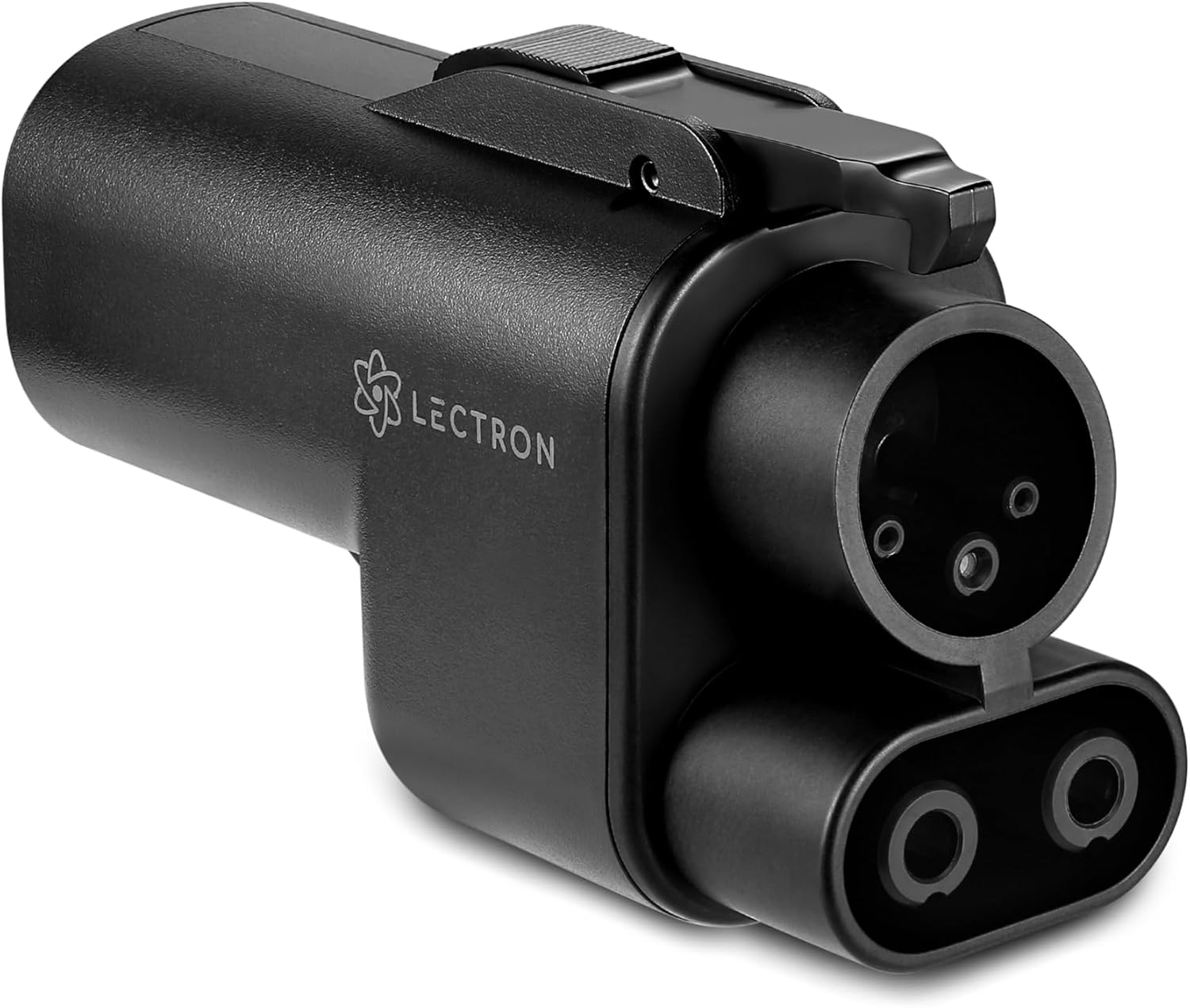
Lectron NACS to CCS Fast-Charge Adapter
Unlock every CCS fast charger for your Tesla, up to 500A DC. Never get stranded at a non-Tesla DC station again.
As an Amazon Associate, ThinkEV earns from qualifying purchases — at no extra cost to you.
Gear worth having
As an Amazon Associate, ThinkEV earns a small commission from qualifying purchases — at no extra cost to you.

Tesla Key Card Holder with AirTag Slot
Stop fishing the keycard out of your wallet, and slot an AirTag in case the car wanders off in a lot.
As an Amazon Associate, ThinkEV earns from qualifying purchases — at no extra cost to you.
Nissan Leaf owners face a more complicated situation. The Leaf uses a CHAdeMO connector for DC fast charging, not CCS1. CHAdeMO to NACS adapters exist but are rare, expensive (typically $600 to $900 CAD), and not supported by major charging networks. Leaf owners relying on the Chademo network -- which is already shrinking rapidly -- face the hardest transition. The practical answer for Leaf owners doing regular road trips is to plan around CHAdeMO locations that still exist, or accept that your current vehicle's public fast-charging options will narrow as the network transitions. This isn't a new problem -- CHAdeMO's trajectory has been clear since 2022 -- but the Tesla-EVgo build accelerates the timeline.
PHEV drivers need a separate note. Most plug-in hybrids sold in Canada use J1772 (Level 2) connectors and don't have DC fast-charging capability at all. The new EVgo stations are DC fast chargers only, not Level 2 units. A Ford Escape PHEV or a Toyota RAV4 Prime has no use for these stations. That's not a criticism of the build -- PHEVs charge at home or at Level 2 workplace stations, and that's fine. But if you're a PHEV driver looking for charging on a road trip, these new stations aren't for you.
For pure EV drivers with CCS ports, the bottom line is this: buy a NACS adapter before your first long road trip if you want the best possible speed. Rely on Magic Dock for occasional unplanned stops. Either way, you have access to the new stations. That's a significant change from the current reality, where NACS stations are usable for CCS vehicles only if you already own an adapter and remembered to bring it.
Pricing, Comparison to Other Networks, and What You'll Actually Pay
Fast-charging pricing in Canada is a mess. There's no standard. Rates vary by network, by province, by time of day, by membership tier, and sometimes by the specific location within a network. A 100 kWh charge at a Petro-Canada station costs something different than the same charge at an Electrify Canada location, at a FLO station, or at a Tesla Supercharger. Unless you have three different apps and three different pricing pages open, you're guessing.
Canadian pricing for EVgo-Tesla stations hasn't been finalised as of this writing, but the U.S. EVgo model gives a reasonable baseline. In the U.S., EVgo charges between US$0.34 and US$0.45 per kWh at most locations, with a membership plan (EVgo Plus, US$6.99/month) reducing that to US$0.26 to US$0.35/kWh. Peak and off-peak rates apply at busy urban stations.
Translating to Canadian pricing: apply a 1.35 to 1.40 exchange rate and add roughly 10 to 15 percent for electricity cost differences across Canadian provinces. Expect to see rates in the $0.45 to $0.65 CAD per kWh range at most locations, with membership pricing bringing that down to $0.35 to $0.50. For a 70 kWh battery (roughly a standard Model Y or F-150 Lightning), a full charge from 10 to 80 percent costs $22 to $32 CAD without membership, $17 to $24 with membership.
That price buys you about 450 to 500 kilometres of real-world highway range in those vehicles, assuming modest winter conditions. The equivalent fuel cost for a gas vehicle at 9L/100km and $1.70/L over the same distance is $68 to $76 CAD. Even at highway fast-charge rates, EVs are significantly cheaper to fuel than gas vehicles on road trips.
Compare that to European fast-charging pricing, where the picture is actually worse than Canada. Most Western European public fast chargers run at $0.60 to $0.90 EUR per kWh at peak times, translating to roughly $0.90 to $1.35 CAD. Some premium motorway locations in the UK and Germany exceed $1.50 CAD equivalent per kWh. Canadian EV drivers complaining about Canadian fast-charge pricing should spend a week road-tripping through France.
American EVgo prices are more relevant for comparison. They run roughly 25 to 30 percent lower than the Canadian projections above, after exchange rate adjustment, primarily because American electricity is cheaper on a wholesale basis. Alberta drivers using grid power during off-peak hours will see the closest pricing to U.S. norms. Quebec drivers, with Hydro-Quebec's low residential rates, benefit most from home charging but won't see those savings reflected at commercial fast-charging stations, which pay commercial electricity rates regardless of the provincial rate structure.
One real pricing question: what happens to Tesla Supercharger access for Tesla owners once EVgo takes over operation of these new stations. Tesla's current arrangement with non-Tesla vehicles on the Supercharger network charges a slight premium over Tesla-owner rates. The new stations are EVgo-operated, which means Tesla vehicles accessing them will likely pay EVgo rates rather than Tesla Supercharger rates. For Tesla owners accustomed to Supercharger pricing, this could mean a modest price increase at the new stations. Tesla's existing Supercharger network remains separate and under Tesla's pricing model.
For non-Tesla owners, the news is straightforwardly good. More stations, faster speeds, and pricing that at least has a consistent structure across the EVgo network are all improvements over the current fragmented experience.
Rural and Northern Canada: The Real Test
Canada's charging infrastructure problem is not primarily a city problem. Toronto, Vancouver, Calgary, and Montreal have reasonably dense fast-charging options today. An EV driver in any of those cities can run their daily life on home charging and occasionally top up at a commercial station. The problem is outside those cities.
Rural Ontario between Peterborough and North Bay has six public DC fast chargers covering roughly 250 kilometres of highway. Rural British Columbia along Highway 97 between Prince George and Dawson Creek has four. Northern Manitoba between Winnipeg and Thompson, a 700-kilometre drive, has one operational DC fast charger. One.
These gaps aren't just inconvenient. They're a market barrier. A farmer in Glendon, Alberta, won't buy an EV if a medical emergency in Edmonton means a two-hour detour to find a functioning charger. A First Nations community in northern Ontario that loses the ability to make a round trip to the nearest city without stopping to charge won't adopt EVs until the network reliably covers the route.
Highway corridor priority in this deal addresses the problem directly. The northern Ontario gap, the Highway 16 corridor through BC, the Trans-Canada through Saskatchewan -- these are named corridors in the partnership documents. They're getting stations.
Cold-weather engineering is worth spending a moment on because it's not a detail. Canadian winters are brutal for charging equipment. The industry standard for DC fast charger operating temperature is typically -30 Celsius. Parts of Northern Canada regularly reach -40 or colder. Liquid-cooled cables contract at low temperatures and can become stiff enough to damage connector seals. Power electronics in unheated equipment enclosures show dramatically higher failure rates below -35. Battery packs in parked EVs lose significant charge overnight at extreme cold, meaning drivers arrive at charging stations already stressed about their state of charge.
Northern station designs specify enclosed equipment in heated or insulated cabinet enclosures, cable heating to maintain connector flexibility, pre-conditioning compatibility with Tesla vehicles (and likely extended through software to other NACS-standard vehicles), and battery storage backup for remote locations with unreliable grid power. This is the first time a major fast-charging deployment in Canada has specified all of these features at the engineering stage rather than retrofitting them after stations fail their first winter.
It matters most for the Yukon, Northwest Territories, and Nunavut builds. Whitehorse's two existing fast chargers are unreliable in January. Yellowknife's three stations have reported cold-weather outages multiple times. Building stations engineered for actual northern conditions rather than rebadged southern designs is a meaningful change.
Grid impact in remote communities is also worth addressing. A single 150 kW fast charger draws as much power as a small apartment building at peak load. A cluster of four 250 kW V3 Supercharger stalls draws more than a mid-size grocery store. In a small northern community served by a diesel generator or a small hydroelectric plant with limited headroom, adding that load without grid upgrades causes real problems -- voltage sags, frequency instability, and outages.
Battery storage buffer units at remote locations are the partnership's answer. Each buffered station includes between 100 kWh and 500 kWh of on-site lithium battery storage, which charges slowly from the grid overnight and delivers fast bursts to vehicles during charging sessions. This approach reduces peak grid demand by up to 80 percent at remote locations, making fast charging viable in communities where direct grid connection would overload local infrastructure.
Ten remote communities in northern BC, the Territories, and northern Quebec are slated for buffered stations. That's not a big number. But it's the first engineering-sound approach to northern fast charging in Canada's public network history.
Grid Impact, Government Programs, and the Bigger Picture
A thousand new DC fast chargers sounds like a lot. On the Canadian electricity grid, the impact is more manageable than the number suggests.
Canada generates roughly 700 terawatt-hours of electricity annually, with hydro accounting for about 60 percent, nuclear for 15 percent, and other sources making up the rest. Total electricity consumption is roughly 500 TWh per year after transmission losses and exports.
A 250 kW Supercharger operating at 50 percent utilisation for 16 hours per day uses roughly 730 MWh per year. Scaled to 1,000 stations: 730 gigawatt-hours, or 0.73 terawatt-hours. That's about 0.15 percent of Canada's annual electricity generation. Even assuming the new stations run at 70 percent utilisation -- optimistic for the first few years -- total annual consumption stays under 1 TWh. That's a rounding error on Canada's grid.
Local grid impact is a different calculation. Transformers, distribution lines, and substations are sized for their service area. A new charging hub at a highway rest stop in rural Ontario might require a transformer upgrade that costs $200,000 to $800,000 and takes 18 months to complete. Multiplied across dozens of remote locations, these upgrades add significant cost and schedule risk to the build.
EVgo and Tesla have both worked through this problem in the U.S. Their approach in Canada will likely follow the same pattern: pre-negotiate utility agreements before site selection, select sites where grid capacity is available without major upgrades where possible, and use battery storage buffers to defer or eliminate upgrades where grid constraints are binding.
Canada's utility structure adds a layer of complexity the U.S. doesn't have to the same degree: most major utilities in Canada are provincial Crown corporations rather than private regulated entities. BC Hydro, Hydro-Quebec, Manitoba Hydro, SaskPower, Nova Scotia Power, and NB Power all have different interconnection processes, capital planning cycles, and rate structures. Coordinating with eight different utilities across the country is not a fast process.
Time-of-use charging is worth raising here. Most Canadians charge their EVs overnight at home, where electricity costs are lowest. Public fast charging is typically done during the day, often at hours when grid demand is already high. A thousand new stations drawing 250 kW each at 3 PM on a hot August day in Ontario is a genuine grid event. Ontario's Independent Electricity System Operator manages demand response programs that could eventually apply to EV charging networks, allowing station operators to modestly reduce output during peak grid stress in exchange for lower electricity rates. This kind of smart-charging integration isn't built into the partnership announcement, but it's a reasonable expectation for the second or third generation of these stations.
Canada's electricity grid is cleaner than almost any other developed country. Roughly 83 percent of Canada's electricity comes from non-emitting sources -- hydro, nuclear, wind, and solar. Charging at a new EVgo station in Quebec draws power that is 99.7 percent hydro. In British Columbia, about 98 percent hydro. Even in Alberta, which still relies on natural gas for a significant share of grid power, the lifecycle emissions of an EV charged on the provincial grid are about 40 percent lower than a comparable gas vehicle. Fast charging on a clean Canadian grid is clean transportation in a way that most of the world can't yet claim.
Long-term grid impact from widespread EV adoption -- not just the 1,000 new stations, but the entire fleet transition -- is a legitimate concern that deserves honest treatment. Canada's grid operators have modelled EV uptake scenarios consistently. The general finding from studies by the Canadian Institute for Climate Choices and provincial utility projections is that managing EV charging load is an integration challenge, not an insurmountable capacity problem. Grid capacity needs to grow, but the growth is manageable and slower than the rate of EV adoption. Smart charging infrastructure -- the kind Tesla's platform already supports -- is a significant part of how the grid absorbs that growth without expensive overbuilds.
This is one area where the NRCAN ZEVIP program can help. ZEVIP funds have been used to pay for distribution upgrades at charging locations in Ontario and Quebec, with the logic that grid improvements enabling charging infrastructure are infrastructure investments in their own right. Extending that funding model to utility upgrades at remote northern locations could significantly accelerate the timeline for the most challenging builds.
How the private build compares to ZEVIP
ZEVIP has been the federal government's main tool for building charging infrastructure since 2019. The program has allocated over $700 million to date, covering roughly 33,000 chargers across Canada (Natural Resources Canada, 2025). The great majority of those are Level 2 units at workplaces, parking garages, and multi-unit residential buildings. The fast-charging component is a smaller share.
ZEVIP works by issuing calls for proposals, reviewing applications, awarding grants covering 50 percent of eligible project costs for public fast chargers, and then waiting for funded projects to be built. At current pace, ZEVIP adds roughly 1,500 to 2,000 public Level 2 chargers and 200 to 300 DC fast chargers per year to the national network.
Three hundred DC fast chargers per year from ZEVIP is a respectable pace. It's less than a third of what the Tesla-EVgo deal targets in its first year alone.
This isn't a criticism of ZEVIP. Government infrastructure programs operate at government speed because they have accountability requirements, geographic equity mandates, and reporting obligations that private investment doesn't. A federal grant program cannot simply build where the ROI is best and move on. It has to consider affordability, Indigenous community access, official languages requirements, and a dozen other factors.
Private investment fills the gap that government programs structurally can't fill quickly. Tesla and EVgo can pick a site, sign a lease, order equipment, and break ground in 90 days when conditions align. ZEVIP projects routinely take 18 to 36 months from application to ribbon-cutting.
Smarter to read these two programs as complementary rather than competitive. ZEVIP builds where market ROI is too low for private investment: small towns, Indigenous communities, social housing, rural workplaces. Tesla and EVgo build where traffic and revenue can support a private return: highways, mid-size cities, commercial nodes. Together, the two tracks cover the map more completely than either could alone.
Canada's ZEVIP program has also funded a number of multi-unit residential building (MURB) installations, where tenants in condos and apartments can charge at their parking spot overnight. This is arguably the highest-impact type of charging infrastructure for urban EV adoption, because it eliminates the need to use public fast charging for daily driving.
Someone who charges their vehicle at 7.2 kW overnight in their condo parkade uses maybe two fast-charging sessions per month, typically on road trips. That profile is very different from an EV owner who relies entirely on public infrastructure and tops up constantly. Separating these use cases matters for network planning: fast charging is primarily a range-extension tool for highway travel, not a daily-use necessity for most EV owners.
The Tesla-EVgo build is correctly targeted at highway range extension rather than trying to replace home charging.
ZEVIP-funded and privately-funded builds also have different accountability timelines. A private infrastructure deal can start breaking ground within 90 days of announcement. A ZEVIP project goes through application review, adjudication, award, then the funded party manages their own procurement and construction. If a ZEVIP-funded project stalls or fails, the government claws back funding and starts over. Private capital has its own accountability mechanism: revenue. If a charging station doesn't generate enough session revenue to cover operating costs plus a return on capital, the operator decommissions it and moves on. That market discipline produces a more honest signal about where charging infrastructure is actually needed versus where it sounds good on a funding application.
Where the two tracks will actually compete is in the same geographic corridors where the government has already committed ZEVIP funds to CCS infrastructure. Some of the planned Tesla-EVgo highway corridor locations will be within 20 kilometres of existing ZEVIP-funded CCS stations. That creates a redundancy in fast-charging coverage that might look wasteful on paper but actually improves resilience -- two operational stations in a given location means drivers have a backup when one is down.
What This Means for You, Practically
If you drive a Tesla today, the immediate change is modest. The new EVgo-operated stations use Tesla hardware, but they're on the EVgo network, not the Tesla Supercharger network. You'll likely pay EVgo rates rather than Supercharger rates at these locations. The existing Supercharger network doesn't change. You gain charging options in some corridors where Tesla previously had no presence, which is net positive, especially in Atlantic Canada and northern corridors.
If you drive a non-Tesla EV with a NACS port -- a 2025 Ford Mustang Mach-E, a 2026 GM Equinox EV, a 2025 Rivian R1T, any of the recent Honda or Acura EVs -- you gain access to what is effectively a Tesla-quality charging experience at 1,000 new locations across Canada. That's the biggest change for this segment. The NACS-standard build means you can charge at these stations without an adapter, at full speed, using the EVgo app or a credit card tap.
If you drive a CCS-standard EV -- a 2023 or 2024 Hyundai Ioniq 5, an older VW ID.4, a Chevrolet Bolt EV from before the NACS transition -- you have two options. You can buy a NACS adapter ($200 to $400 CAD) and use the new stations at full speed. Or you can use the Magic Dock CCS adapter built into the EVgo stations, plug in, and charge without buying anything additional. The Magic Dock approach caps at around 150 kW rather than the station's full 350 kW because of CCS handshaking limitations, but 150 kW is still significantly faster than most CCS-specific stations today.
Specific road trips that become viable for non-Tesla drivers once this build completes are worth naming. A Hyundai Ioniq 5 driver doing the Confederation Trail route from Fredericton to Halifax today needs to stop at two Petro-Canada Electric Highway stations, each at 50 kW, for roughly 50 minutes total of charging. After this build, the same route has four EVgo stations at 150 kW or better, reducing charging time to about 22 minutes total. That's a meaningful difference on a six-hour drive.
A Ford F-150 Lightning driver doing the Trans-Canada from Calgary to Vancouver -- a notoriously challenging route for CCS vehicles in winter because of the Revelstoke-to-Hope section of Highway 1 -- gains three new stations in that mountain gap. The F-150 Lightning's 180 kW acceptance rate would mean 25 to 30 minutes at each station to add 150 to 200 kilometres of range, which is enough to leapfrog the mountain section without the current anxiety about making it to the next station.
Manitoba and Saskatchewan drivers, who often get overlooked in EV infrastructure discussions because population density is low, gain the most proportionally in this deal. The Trans-Canada through those provinces has the longest charging gaps in southern Canada. Filling those gaps with 4 to 6 new stations between Winnipeg and Regina, and 4 more between Regina and Medicine Hat, turns a legitimately risky drive into a routine one.
For anyone still on the fence about buying an EV, the arrival of 1,000 new fast chargers is a relevant data point. Range anxiety is the most commonly cited barrier to EV adoption in Canada. It's not entirely rational -- most EV driving is local and doesn't require fast charging -- but it's real, and it affects purchase decisions. A more complete charging network reduces the rational and irrational components of that anxiety simultaneously.
Psychological shift may be more important than the practical one. Research consistently shows that EV buyers don't just want to know that charging infrastructure exists -- they want to feel confident that it will be there when they need it. Reliability and predictability matter as much as raw charger counts. A thousand new stations from a name people already associate with working charging hardware changes the confidence calculation for potential buyers in a way that a thousand CCS stations on a less-recognised network might not.
Home charging remains the foundation of the EV ownership experience. An EV driver who charges at home 90 percent of the time and uses fast charging only on road trips spends about $400 to $600 per year on charging total, versus $2,500 to $4,000 for gas. The new EVgo stations extend that math to road trips rather than just daily driving. If you're thinking about setting up home charging to reduce your dependence on public networks, the ranked guide to Level 2 chargers for Canada covers the current options clearly.
For a broader look at how the national charging picture compares across networks, see how Canada's EV charging infrastructure stacks up in 2026. If you're planning a specific road trip and want practical guidance on stop planning and route optimisation, this guide on EV road trips across Canada in 2026 is the most useful place to start.
Gear worth having
As an Amazon Associate, ThinkEV earns a small commission from qualifying purchases — at no extra cost to you.

Spigen Tempered Glass for Tesla Model 3/Y
Tempered-glass protection for the touchscreen that kills fingerprints and scratches. Two minutes to install, lasts the life of the car.
As an Amazon Associate, ThinkEV earns from qualifying purchases — at no extra cost to you.
FAQ

Founder & Chief Editor
Vlad Pereira is the founder and chief editor of ThinkEV.ca, the Canadian electric-vehicle publication he writes and edits from Courtenay, British Columbia. He covers EV pricing, federal and provincial rebates, charging costs, and the Chinese manufacturers now entering Canada, from the buyer's side rather than the press-fleet side. ThinkEV is a venture of Vlad Pereira Online; his writing on health, income and the long game lives at vladpereira.com.
Frequently asked questions
When will the first Tesla-EVgo stations open in Canada?
Do I need a Tesla to use the new EVgo stations?
Will Tesla owners pay more at EVgo-operated stations compared to regular Superchargers?
How fast will the new chargers be?
What happens to the CCS chargers already in Canada?
Is 1,000 stations actually enough to make a difference for Canada's charging network?
How does Canada's charging network compare to the U.S. and Europe after this build?
Will NRCAN ZEVIP funding be involved in this project?
More EV & road-trip finds
Affordable upgrades worth a look — tap any to check the price on Amazon.
 ★ 119
★ 119Foldable Waterproof Trunk Organizer
View on Amazon ★ 392
★ 392Large Cup Holder Adapter (32-40oz)
View on Amazon ★ 12,051
Windex Electronics Screen Wipes
View on Amazon ★ 314
★ 314Mini USB LED Ambient Lamps (4-Pack)
View on Amazon ★ 546
★ 546Funny Headrest Face Covers (2-Pack)
View on Amazon ★ 979
★ 979Leather Headrest Purse Hook
View on Amazon
TP-Link Kasa Smart Plug with Energy Monitoring
View on Amazon ★ 61
★ 61Toddler Car Seat Snack and Cup Tray
View on AmazonRead, Plan, Then Stay Current
Explore our expert articles to understand incentives and ownership costs, use the map to pressure-test charging reality, then subscribe so new EV coverage comes straight to you.
Continue Reading
EV Charging Connectors Explained: NACS, CCS, and J1772
Is NACS Standardization a Mistake? A 2026 Guide
Chinese EVs in Canada: 15,603 In, Still No BYD

GM Recalls 2016–2017 Silverado, Sierra Over Airbag Defect
BYD's $4,000 Sealion 7 Cashback Targets Tesla Model Y