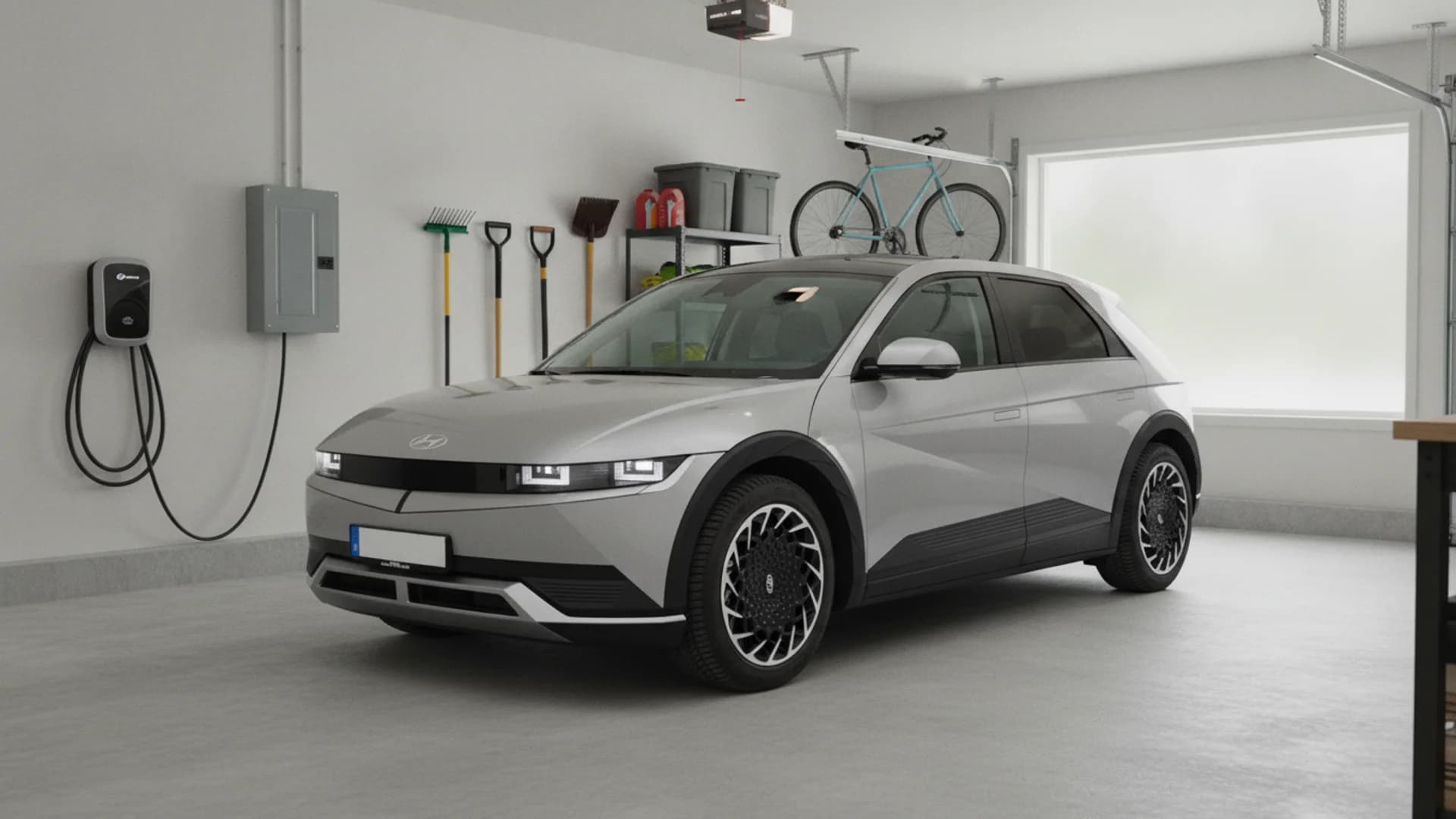
You just signed for a new EV and the dealer waved you off with "just plug it in at home." In 2026 Canada, that line costs somewhere between $1,000 and $3,000, and the charger itself is the smallest part of the bill.
Key takeaways
- A standard home Level 2 charger installation in Canada runs $1,000–$3,000 all-in in 2026 (charger, labour, permit, conduit), assuming a 200-amp panel and a parking spot within 10 metres.
- Upgrading a home from 100-amp to 200-amp service costs $1,500–$4,000 and is the single biggest hidden cost of going electric.
- A $150–$300 load-management device can often let a 100-amp home run a Level 2 charger without that panel upgrade, by throttling output when other big loads kick in.
- Quebec's Roulez vert offers up to $600 toward home charger installation and BC Hydro up to $350, while Ontario has no province-wide home-charger rebate in 2026.
- Charging at home overnight instead of public Level 3 saves a typical 15,000-km-a-year driver $400–$600 annually.
The real money lives inside your electrical panel, your municipal permit office, and the wall between your panel and your parking spot. Get those three right and you're at the low end. Get any of them wrong and the quote doubles overnight. Quebec owners can claw back up to $600 through Roulez Vert; there are two main types of EV chargers: alternating current (AC) charging stations and DC fast chargers, and you only need to worry about the AC kind at home. The rest is electrical work, paperwork, and one big question about your panel.
This is the practical, province-by-province version of what you'll actually pay, what you can actually claim back, and where the quote spread between contractors is telling you something important.
What Does EV Charger Installation Actually Cost in Canada?
The number for a standard home install in 2026: $1,000 to $3,000 all-in. That covers the charger, the labour, the permit, and basic conduit. It assumes your panel is already 200 amps and your parking spot is within about 10 metres of the panel.
Break that down and four line items appear:
- The charger unit: $400–$900 for a quality Level 2 from FLO, JuiceBox, Wallbox, or Grizzl-E. The cheap end ($400-ish) gets you a basic 32-amp unit with a plug; the upper end gets you 48-amp, hardwired, smart features, and a cold-weather warranty that actually applies in Winnipeg.
- Labour: $300–$700 for a straightforward install. An electrician runs a 240V circuit from your panel to a NEMA 14-50 outlet or hardwired termination, mounts the charger, and tests it. Two to four hours of work for most homes.
- Permit fees: $50–$200 depending on your municipality. In Toronto it's around $150. In smaller Ontario municipalities, closer to $80. In Vancouver, $90–$120. Never skip this. An uninspected EV install can void your home insurance and your charger warranty in the same afternoon.
- Inspection: sometimes bundled with the permit, sometimes a separate $50–$100. Your electrician should be quoting this in their final number, not surfacing it as a surprise.
Add it up: $750 (low end) to $1,900 (high end) for everything except the panel. If your home already has 200-amp service and a free breaker slot, you're done, and you can stop reading the next section.
If your home was built before 1990, brace yourself. The next section is where the real money lives.
The all-in band assumes one more thing the dealer didn't mention: your charger has to live near your parking spot. Driveway installs are easier than detached-garage installs. Detached garages need underground conduit or trenching, which can add $400–$1,200 depending on the run. A condo install is its own animal, that's later in the guide.
The case against budgeting at the high end: most single-family homes built after 2000 will land closer to $1,400 than $2,800, and overspending on a 48-amp hardwired unit when your EV's onboard charger caps at 11 kW is paying for capacity you'll never use. Concede that, then look at what you're actually buying at the upper band. A 2026 Hyundai Ioniq 5 or Kia EV6 with 800V architecture sips at home and gulps at DC fast chargers, so the 48-amp home unit is theatre. A Chevy Blazer EV on its 11.5 kW onboard charger genuinely benefits from the bigger circuit. Match the unit to the car, not to the catalogue.
The Hidden Costs That Catch Canadian Buyers Off Guard
The line item that turns a $1,500 install into a $5,000 install is the panel upgrade. And it surprises Canadian buyers because nobody mentions it at the dealership.
Homes built before about 1990 in Canada typically run 100-amp service. That was fine for a 1985 household: a few lights, a fridge, an electric range, baseboards. It is not fine for a 2026 household running heat pump, induction range, dryer, and a Level 2 EV charger drawing 40 amps at peak.
Panel upgrade from 100A to 200A: $1,500 to $4,000. The spread depends on whether your meter base needs replacing, whether your utility needs to upgrade the service drop from the pole, and whether your electrical permit triggers any other code-compliance work the inspector flags on the way through. Older Toronto and Montreal homes routinely hit the top of that range. A 1970s Burnaby bungalow with a clean panel and a short service drop will land closer to $1,800. The RIDEZ breakdown of hidden home-charging costs frames it bluntly: the real expense hides inside your electrical panel, your municipal permit office, and the wire path between them, which matches what every honest electrician will tell you on a site visit.
The conduit run is the second hidden cost. Anything over 10 metres adds $200–$600. Running through finished walls, drilling, fishing wire, patching drywall, pushes that higher. If your panel is in a finished basement and your parking spot is at the front of the house, expect the quote to climb $400–$800 just for the wire path.
The dodge is load management. Devices like the Emporia Smart Home Energy Monitor, the Wallbox Power Boost, or the Leviton Load Center cost $150–$300 and let your charger throttle itself when other big loads are running. The dryer kicks on, the charger temporarily drops from 40 amps to 16. You don't notice because you're asleep, and the panel never trips. For a household where the panel is "almost" enough, load management often defers a $3,000 upgrade indefinitely. Ask your electrician about it before agreeing to anything bigger.
Condo and strata installs are the other hidden-cost category. Shared panel access, strata board approval, shared metering, every variable inflates the quote. Cost range: $1,500 to $5,000+, sometimes more if the building needs an EV-ready electrical upgrade for the whole parkade. Strata buildings in BC and Quebec have it slightly easier thanks to right-to-charge provisions (more on those below).
One more: trenching. Detached garage in a Prairies city with frost-line requirements? You're not running surface conduit. You're trenching below frost (1.2 to 1.5 metres in most of Canada), and that's a $600–$1,500 add-on by itself.
If a contractor quotes you $1,200 and another quotes you $3,200 for what sounds like the same job, one of them spotted a panel issue, a conduit problem, or a trenching requirement the other missed. The cheap quote is not always the smart quote. For a deeper look at the provincial side of these costs, BC has its own quirks worth reading on.
Rebates by Province: What You Can Actually Claim in 2026
This is where Canadian buyers leave money on the table, usually because nobody told them which level of government runs which programme.
British Columbia. BC Hydro offers up to $350 toward qualifying Level 2 charger purchases and installation as of April 2026. That's a meaningful chunk of the charger unit cost, and BC Hydro processes claims relatively quickly. The catch: the charger has to be on BC Hydro's approved list, and the installation has to be permitted and inspected. CleanBC has run programmes in the past that stacked on top of this, but the live programme today is the BC Hydro one. Strata buildings get a separate, larger rebate path for shared infrastructure.
Quebec. Roulez Vert offers up to $600 for Level 2 home charger installation. Quebec runs the most generous home-charger rebate in the country, and the programme has been stable through multiple political cycles. Filing is paperwork-heavy but the money is real. You need a licensed Quebec electrician, a permit, and a charger from the Roulez Vert approved list.
Ontario. The cupboard is bare. The federal ZEVIP was Transport Canada's main incentive for home and workplace EV charger installs, and the home-charger stream wound down. No active provincial rebate covers home Level 2 installs in Ontario in 2026. Some utilities run pilot programmes, check Hydro One, Toronto Hydro, and Alectra for occasional time-limited offers, but there is no province-wide programme to count on. Toronto-area buyers should factor this in: your install is full freight.
Alberta and the Prairies. No universal provincial rebate. Some municipal programmes exist, Edmonton has run pilot incentives, Calgary's Enmax has offered time-of-use credits that effectively subsidise charging cost rather than install cost. Check your specific utility before assuming nothing's available.
Atlantic provinces. Patchwork. New Brunswick's EV incentives have shifted toward network buildout rather than home installs. Nova Scotia and PEI run small home-charger rebates through provincial utilities. Newfoundland and Labrador is the smallest programme of the group. Check NB Power, Nova Scotia Power, Maritime Electric, and NL Hydro individually.
Federal. The federal EV rebate, the Electric Vehicle Affordability Program (EVAP), launched February 16, 2026, is the big federal programme, but it covers the vehicle, not the charger. A lot of buyers conflate the two. Don't budget for a federal home-charger rebate; one doesn't currently exist outside the (mostly closed) ZEVIP streams.
A practical rule: stack what you can. A Quebec buyer can claim Roulez Vert ($600) for the charger install AND the federal EVAP rebate ($5,000) for the vehicle. A BC buyer can claim BC Hydro ($350) for the charger install AND EVAP ($5,000) for the vehicle. An Ontario buyer gets the vehicle rebate but eats the full install cost. That's the geography of EV ownership in Canada right now.
The counter-case is that Ontario buyers shop in the country's most competitive EV market, a $44,995 Chevy Equinox EV 1LT FWD versus a $49,990 Tesla Model Y Standard Range RWD gives Toronto and Ottawa buyers genuine pricing pressure that Quebec buyers, locked into a smaller dealer network, don't enjoy. The missing $350–$600 rebate is real money, but it's a rounding error against a $5,000 spread between two comparable crossovers. Province-shop your vehicle, not your install.
Level 1 vs Level 2: Which One Do You Actually Need?
Most Canadian EV buyers ask this question. The answer is short: for a battery-electric vehicle, Level 2. For a plug-in hybrid, Level 1 is fine.
Level 1 is the 120V outlet you already have. Plug into a standard outlet, add roughly 8 km of range per hour. Over a 12-hour overnight charge that's about 96 km, enough for an average commute, not enough for an average commute plus a weekend trip. Per the EVESCO guide referenced on EV resources like Power Sonic, Level 1 charging is the slowest tier, and it shows in the math.
Level 2 is the 240V circuit you install. At 32 amps, you get about 30 km/hr added. At 48 amps, closer to 50 km/hr. A full charge for a 70-kWh battery in 8–10 hours. Plug in at midnight, full battery by morning.
Real-world scenario for the Lower Mainland: a Burnaby-to-downtown-Vancouver commuter on a Tesla Model Y burns about 25 km worth of range each way, 50 km round trip. Level 1 technically replenishes that overnight. But it leaves zero buffer for cold weather (which can cut effective range 20-30%), grocery runs, or a weekend Squamish trip. The first time you wake up to a battery that didn't fully recover, you'll regret skipping Level 2.
Gear worth having
As an Amazon Associate, ThinkEV earns a small commission from qualifying purchases — at no extra cost to you.

Grizzl-E Classic Level 2 EV Charger (40A)
Canadian-made and rated for minus 40C winters. 40A / 9.6 kW, NEMA 14-50, indoor/outdoor, 24-ft cable. The charger built for Canadian weather.
As an Amazon Associate, ThinkEV earns from qualifying purchases — at no extra cost to you.
There's also the resale argument. A house with a Level 2 charger installed reads as EV-ready to the next buyer. A house without reads as a $2,000 project they'll have to handle. As EV adoption climbs through 2026 and 2027, and the Canadian EV market keeps expanding, that's a small but real point in your favour at sale time.
The hard recommendation: Level 2 is the right answer for any battery-electric vehicle in Canada. The math, the cold-weather buffer, the resale all point the same direction. Save Level 1 thinking for plug-in hybrids with batteries under 20 kWh.
One nuance: if your daily driving is genuinely under 50 km, you live in a mild climate, and your panel can't accommodate a Level 2 without a $3,000 upgrade, Level 1 plus load management can be a reasonable interim move for 12-18 months while you save for the panel work. It's not the dream setup. It's a workable one.
How to Choose an Electrician and What to Ask Before You Hire
The contractor you pick matters more than the charger brand. A licensed electrician who pulls permits and understands EV loads will save you four times what they cost in avoided panel problems, code violations, and warranty disputes.
Must be licensed in your province. This isn't a soft suggestion. Verify the licence number with your provincial regulator before signing anything, Electrical Safety Authority in Ontario, BC Safety Authority in British Columbia, RBQ in Quebec. If the contractor hedges on showing their licence number, that's the conversation ending.
Ask: "Will you pull the permit?" Anyone who suggests skipping the permit to save money is signalling that the rest of the job will cut similar corners. The permit fee is $50–$200; the cost of an uninspected install voiding your home insurance is the entire claim. The permit also means the inspector verifies the wire gauge, the breaker size, and the grounding, three things that fail silently if they're wrong, and fail dramatically if they're really wrong.
Get three quotes. This isn't paranoia; it's how you read the room. If two electricians come in at $1,800–$2,200 and a third comes in at $800, the cheap quote is probably missing the panel upgrade or the conduit run. If two come in at $1,500 and a third comes in at $4,200, the expensive quote either spotted something real (older panel, code issues) or is trying it on. Ask each contractor to itemize: charger, labour, permit, materials, panel work. The itemized quote tells you who saw what.
Ask about load management. Some contractors love panel upgrades because they're a big-ticket line item. The good ones will assess your existing capacity, walk you through load-management options ($150–$300 device, sometimes eliminates the need for the panel work), and let you choose. The pushy ones will quote a $3,500 panel upgrade without mentioning the load-management alternative existed. That conversation tells you everything about who you're hiring.
A few more questions that separate the pros from the pretenders:
- "What gauge wire are you running, and what amperage breaker?" (Should match your charger's max draw plus 25% per code.)
- "Where will you mount the charger and what's the conduit path?" (They should have walked the route already.)
- "What's your warranty on the install labour?" (One to two years is standard; less is a flag.)
- "Have you installed this specific charger brand before?" (FLO and JuiceBox installs differ; experience matters.)
The contractor who answers those four questions confidently and itemizes the quote on the spot is the one you hire, even if they're $200 more than the cheapest bid. The case against paying the $200 premium is that a permit-pulling electrician at any price tier delivers the same code-compliant outcome, the inspector signs off or doesn't. Concede the point on the install itself, then look at what you're really buying with the better contractor: the load-calculation honesty that saves you a $3,000 panel upgrade, the warranty conversation that holds up if your charger fails in eighteen months, and the willingness to come back when the inspector flags something minor. The cheapest licensed bid wins on paper. The slightly-more-expensive one wins over five years.
Condo and Apartment Owners: Your Path to Home Charging
The fastest-growing complication in Canadian EV ownership is the one nobody discusses at the dealership: most new buyers in Toronto, Vancouver, and Montreal live in condos or apartments, and condo charging is its own world.
Strata or condo board approval is the first gate. Before any electrical work happens, you need written approval from the board. Some buildings have an EV policy already in place; many don't. If your building is in the latter group, you may be the one writing the policy template they'll use for everyone else who follows you. That's a months-long process in some buildings.
EV-ready buildings are the easy case. A building constructed in the last five years often has dedicated metered circuits roughed in for EV charging, ask your building manager whether your parking spot is EV-ready, and what the activation cost is. Activation is usually $500–$1,500, much cheaper than a full retrofit.
Right-to-charge provisions exist in BC and Quebec, with similar legislation under discussion in other provinces. These laws limit how much a strata or condo board can veto an EV install. They don't guarantee approval, boards can still impose reasonable conditions on metering, insurance, and location, but they shift the default from "no by default" to "yes with conditions." Read your provincial legislation carefully before assuming you're stuck.
Cost range for condo installs: $1,500 to $5,000+. The variables: distance from your stall to the building's electrical room (longer runs cost more), whether the building's main panel can absorb a new circuit, whether shared metering is in place. Some buildings require you to install your own sub-meter so the building bills you back for the electricity, that's another $200–$400 in equipment.
If you're shopping for a condo and you drive (or plan to drive) an EV, ask about EV-ready stalls before you make an offer. It will save you a year of board meetings later. The broader picture of Canadian charging infrastructure shapes some of these condo decisions too, buildings near reliable public DC fast charging have more flexibility about whether every stall needs home charging.
One workplace-charging note: if your employer offers workplace charging, the condo equation changes entirely. A reliable 8-hour Level 2 charge at work means your condo install becomes a nice-to-have rather than a need-to-have. That's an increasingly common employer benefit in Canada and worth asking HR about before committing $4,000 to a strata install.
Is It Worth Installing Now, or Should You Wait?
Three forces shape the timing question: rebate availability, electricity rates, and the rest of your household's electrification roadmap.
Time-of-use rates make overnight charging dramatically cheaper than peak. BC Hydro's two-tier rates, Hydro One's TOU plans, Quebec's Hilo programme, overnight rates run 30–50% below peak in most Canadian utilities. A home charger that lets you set "start at 11pm, stop at 6am" pays back its install cost faster than public DC fast charging ever could. A typical Canadian driver doing 15,000 km/year saves $400–$600 annually charging at home overnight versus charging at a public Level 3.
Panel upgrades are easier to justify when they serve multiple purposes. If you're already planning a heat pump (because gas furnaces are quietly aging out of new builds across Canada), an induction range, or a second EV, the 200-amp panel becomes a household-level decision rather than an EV-specific cost. Spread $3,000 across three appliances and the math is different.
Waiting for better rebates is speculative. The BC Hydro and Roulez Vert programmes are active now. The federal ZEVIP home stream wound down. Ontario has no provincial programme. Anyone hoping for a richer federal home-charger rebate in 2027 is betting on something that hasn't been announced. The active rebates are the ones you can budget for.
Payback vs public charging: rough math, a $2,000 home install recovers in 2-3 years at typical Canadian driving rates against public Level 2 pricing of $1.50–$2.50/hour, and faster against DC fast charging at $0.40–$0.55/kWh. Add in the time you save not waiting at chargers and the recovery period drops further.
There's also the ownership-cost story. EVs eliminate oil changes, transmission fluid, exhaust work, and a long list of other line items, but they're not maintenance-free, and home charging is one of the cost levers you control. The full Canadian EV maintenance picture shows where the real numbers shake out.
What would change my mind on the install-now call: a confirmed federal home-charger rebate of $1,000+ announced in the 2027 budget, or a provincial Ontario programme matching Roulez Vert's $600. Either would shift the timing math for the bottom third of Canadian buyers who are sitting on a panel upgrade they can't justify yet. What I'd bet on instead: utility-side time-of-use deepening, the gap between overnight and peak rates widening as more EVs hit the grid through 2027, which rewards anyone who installed early and locked in the overnight habit.
Gear worth having
As an Amazon Associate, ThinkEV earns a small commission from qualifying purchases — at no extra cost to you.

Lectron Level 2 J1772 Charger (40A, WiFi)
Smart WiFi charger with real-time energy monitoring. 40A / 9.6 kW, J1772 with a NEMA 14-50 plug, schedule charging right from your phone.
As an Amazon Associate, ThinkEV earns from qualifying purchases — at no extra cost to you.
Buy / Wait / Skip
Buy now if: you own a single-family home with 200-amp service, you live in BC or Quebec (where rebates are active), or your household is electrifying multiple systems at once. The all-in cost lands at the low end and the rebates take real money off the top.
Wait if: you're shopping a condo without an EV-ready stall and your strata hasn't passed an EV policy yet. Push for the policy first, then install. A workplace charger or nearby reliable Level 2 can bridge the gap.
Skip (for now) if: your daily driving is under 50 km, you have a plug-in hybrid not a BEV, and your panel upgrade alone would exceed $3,000. Level 1 with load management is a defensible interim move, not the dream, but a workable one until your next major electrical project.
The trigger that flips a "wait" to a "buy": Ontario announcing a provincial home-charger rebate, or your utility opening a time-limited install incentive. Watch for those in fall 2026 budget cycles. The trigger that flips a "buy" to a "wait": a sudden announcement that BC Hydro or Roulez Vert is doubling their rebate (rare, but it has happened during election cycles).
What I'd watch next: whether Ontario brings back a provincial home-charger programme in the 2027 budget, and whether the EVAP framework expands to cover infrastructure as well as vehicles. Both would change the install math for the country's biggest car market overnight. Until then, the geography of where you live still determines what your install costs, and BC and Quebec buyers have the meaningful advantage.
Gear worth having
As an Amazon Associate, ThinkEV earns a small commission from qualifying purchases — at no extra cost to you.

ChargePoint Home Flex Level 2 Charger (50A)
Premium 50A / 12 kW charger with the best app ecosystem. Hardwired or NEMA 14-50, with real-time energy tracking and smart scheduling.
As an Amazon Associate, ThinkEV earns from qualifying purchases — at no extra cost to you.

Founder & Chief Editor
Vlad Pereira is the founder and chief editor of ThinkEV.ca, the Canadian electric-vehicle publication he writes and edits from Courtenay, British Columbia. He covers EV pricing, federal and provincial rebates, charging costs, and the Chinese manufacturers now entering Canada, from the buyer's side rather than the press-fleet side. ThinkEV is a venture of Vlad Pereira Online; his writing on health, income and the long game lives at vladpereira.com.
Frequently asked questions
Does my home need a panel upgrade before installing an EV charger?
Not always. Homes with 200-amp service and a free breaker slot are usually ready for a Level 2 install with no upgrade. Homes with 100-amp service often need either a full upgrade ($1,500–$4,000) or a load management device ($150–$300) that throttles the charger when other big loads are running.
The honest test: ask your electrician to run a load calculation on your existing panel before quoting any upgrade. Many homes with 100-amp service can run a 32-amp Level 2 charger safely with load management, no upgrade needed.
Can I install a Level 2 charger myself to save money?
Legally, no, in every Canadian province, a 240V circuit installation requires a licensed electrician and a permit. Doing it yourself voids your home insurance, voids the charger warranty, and creates a real safety risk. A miswired 40-amp circuit is a fire risk, not just a code violation.
What you can do yourself: mount the charger bracket if your electrician hardwires the unit afterward, choose and purchase the charger, and prep the wall surface. The electrical work itself is non-negotiable professional territory.
How long does a home EV charger installation take?
For a straightforward install with an existing 200-amp panel and a short conduit run: 2-4 hours of on-site work. Add 1-2 weeks for the permit application and inspection scheduling on either side.
If your home needs a panel upgrade, the project stretches to a full day of on-site work plus utility coordination (the power company may need to disconnect your service drop temporarily). Total elapsed time including permits and inspection: 3-6 weeks from quote to fully charging.
What rebates are available for EV charger installation in Ontario in 2026?
No active province-wide programme covers home Level 2 installation in Ontario in 2026. The federal ZEVIP home stream wound down, and Ontario has not replaced it with a provincial equivalent. Ontario buyers pay full freight on the install.
Watch for time-limited utility pilots from Hydro One, Toronto Hydro, and Alectra, these come and go, and they're usually not advertised heavily. Workplace charging programmes through your employer are a separate channel that may apply.
Can I claim EV charger installation as a home renovation tax credit?
Not as a standalone EV credit federally. Some provincial home-renovation tax credits (Ontario's Seniors' Home Safety Tax Credit, BC's Home Renovation Tax Credit for Seniors and Persons with Disabilities) may cover electrical upgrades if you qualify under the broader programme's eligibility rules, but no federal or provincial programme treats EV charger installation specifically as a tax credit in 2026.
Provincial rebates (BC Hydro, Roulez Vert) are direct rebates, not tax credits, and they're the cleanest path to recovering install costs where they're available.
More EV & road-trip finds
Affordable upgrades worth a look — tap any to check the price on Amazon.
 ★ 2,941
Microfiber Cleaning Cloths (Multi-Pack)
View on Amazon ★ 164
★ 164Solar-Powered LED Ambient Light
View on Amazon ★ 568
★ 568Personalized Photo and Text Keychain
View on Amazon ★ 27,769
Car Cup Holder Coasters (4-Pack)
View on Amazon ★ 692
★ 692USB-A to USB-C CarPlay Adapter (3-Pack)
View on Amazon ★ 121
★ 121Foldable Windshield Sun Umbrella
View on Amazon ★ 268
★ 268Anti-Slip Leather Steering Wheel Cover
View on Amazon ★ 96,686
PULIDIKI Car Cleaning Gel (Detailing Putty)
View on AmazonRead, Plan, Then Stay Current
Explore our expert articles to understand incentives and ownership costs, use the map to pressure-test charging reality, then subscribe so new EV coverage comes straight to you.
Continue Reading
EV Rebates in Canada: How EVAP and Provincial Stacking Work
BYD Atto 3 Canada: Price, Range & EVAP Rebate (2026)
Home EV Charging Setup: The Basics for New Owners
BYD Shark 6 Canada 2026: Price Band, Specs, Incentive Reality
EV Battery Degradation: What's Normal and How to Slow It