Hurricane Ian left flooded Teslas in Florida driveways, and some caught fire a week after the water receded. That is the sentence that decides how you should think about EV batteries in floods. The immersion is rarely what ignites the pack. What ignites it is the salt residue drying inside the cells, forming conductive bridges the battery management system never anticipated. The fire arrives on day three, or day five, or day seven, in a garage the owner assumed was safe.
The read on EV flood safety is narrower than the internet suggests. Rain, puddles, and the road spray any commuter meets: engineered for. Standing brackish water above the sill for six hours: a different risk class, and the one buyers in coastal BC, the St. Lawrence corridor, and hurricane-adjacent Ontario should actually plan for.
Key takeaways
- LFP batteries (BYD Blade, Ford Mach-E Standard Range) carry materially lower thermal runaway risk than NMC packs in floods.
- Post-Hurricane Ian EVs ignited 3–7 days after water receded from salt residue forming conductive bridges inside the pack.
- Saltwater immersion is presumed a write-off by insurers, pack replacement runs $15,000–$40,000 CAD.
- Don't charge a flood-exposed EV: applying voltage to a potentially shorted pack can trigger a garage fire.
- IP67/IP68 ratings apply to the battery pack in isolation, motors, inverters, and cabin electronics fail at much shallower depths.
Quick Answer: What Water Can an EV Battery Actually Handle?
Most modern EV battery packs carry an IP67 or IP68 ingress protection rating. Translated: dust-tight, and sealed against temporary immersion at defined depth and duration, usually a metre of freshwater for thirty minutes under lab conditions. The pack itself, in isolation, is the most water-resistant component in the vehicle.
The battery is not the weak point. The motors, the inverters, the high-voltage connectors, the 12V accessory loom, the HVAC intakes, and the door seals all have lower effective water resistance than the traction pack. Owner claims that "Teslas work well in floods because the battery is air tight so no water can get in" have circulated widely, and several owners have referenced the sealed nature of Tesla and other EV packs. The pack claim is roughly correct. The whole-vehicle claim is not, cabin electronics fail long before the battery does.
Read your owner's manual before you trust a general rule. Kia, Hyundai, Tesla, and BYD all publish different fording depths and different post-immersion protocols, and some explicitly forbid driving through standing water at any depth. The manual is the only specification that counts for warranty and insurance purposes.
For context on how battery packs are engineered against physical trauma more broadly, the crash structure and battery safety breakdown covers the mechanical protection layer that shares design DNA with the pack's water sealing.
Gear worth having
As an Amazon Associate, ThinkEV earns a small commission from qualifying purchases — at no extra cost to you.

Magnetic EV Charger Plug Cover
A magnetic cap that keeps rain, road salt, and grit out of your home charger handle between sessions.
As an Amazon Associate, ThinkEV earns from qualifying purchases — at no extra cost to you.
Why Saltwater Is a Different Problem Entirely
Freshwater is a nuisance. Saltwater is a chemistry problem.
When brackish or ocean water reaches the cell stack, through a seal breach, a damaged casing, or prolonged submersion beyond the IP rating's tested duration, the sodium and chloride ions deposit inside the pack as the water drains. Those deposits do not politely rinse away. They form solid, conductive bridges between cells and between cells and the pack chassis. The battery management system reads normal voltages the day after the flood. Then a bridge completes, current flows where it should not, local heating begins, and a single cell enters thermal runaway.
The fires reported after Hurricane Ian and Hurricane Ida followed this pattern, ignition three to seven days after the water receded, in driveways and garages, on vehicles that had passed a superficial post-flood inspection. Delayed thermal runaway is the signature of saltwater flood damage, and it is what makes the risk different from every other water exposure an EV meets.
Once thermal runaway begins in a lithium-ion pack, water suppression is largely futile. Thermal incidents in electric vehicles have documented failure modes tied to wear in the battery compartment and to charging conditions, and the runaway reaction runs hot enough, above 1,000°C, that firefighter tactics on EV pack fires now emphasise containment and cooling of surrounding structure rather than extinguishment of the pack itself. The lithium chemistry supplies its own oxygen. Adding water at that point mostly generates steam.
The chemistry underneath the fire matters. Li-NMC batteries using lithium nickel manganese cobalt oxides are the most common in EVs, and lithium iron phosphate (LFP) is on the rise. LFP packs, BYD's Blade, Ford's LFP-equipped Mustang Mach-E and F-150 Lightning Standard Range, carry a materially lower propensity for thermal runaway than NMC. In a flood-prone postal code, that is not marketing. It is a spec worth reading.
Freshwater intrusion is often recoverable with a proper inspection. Saltwater intrusion, in insurance practice, is presumed a write-off, and that presumption is why the delayed-fire pattern shows up in driveways rather than in dealer service bays. The car looked fine on day one.
How Deep Is Too Deep, and What Moving Water Does
The UK's AA and the Environment Agency publish the number most driving guides borrow: do not enter moving water deeper than 10 cm, and treat 30 cm of flowing water as capable of displacing any vehicle regardless of powertrain. Those thresholds are not EV-specific. They are about hydrodynamics, not chemistry.
An EV's low centre of gravity, battery mass concentrated in the floor, helps in a corner. It does not offset the buoyancy and drag of a moving flood. Half a metre of moving water lifts and rotates any passenger vehicle. The EV's advantage is that once displaced, it is less likely to be flipped by follow-on current than a tall SUV; that is a thin consolation when you are in it.
Gear worth having
As an Amazon Associate, ThinkEV earns a small commission from qualifying purchases — at no extra cost to you.

WeatherTech FloorLiner for Tesla Model 3
Deep-channel liners that trap every drop of slush and salt. The difference between a ruined interior and a showroom-fresh cabin after a Canadian winter.
As an Amazon Associate, ThinkEV earns from qualifying purchases — at no extra cost to you.
Idaho National Laboratory has run controlled immersion research on a fleet that includes four Tesla models, S, 3, X, and Y, plus a Porsche Taycan and a Lucid Air. The controlled tests show that IP-rated packs behave as advertised when the immersion matches the rating. The controlled tests also do not replicate real flood conditions: debris impact against the pack casing, prolonged submersion beyond the rated duration, salt content variance, hydrostatic pressure at depth, and the current-and-recharge cycle a submerged vehicle imposes on its own 12V system.
The depth threshold that matters for the buyer is the one the manufacturer will honour under warranty. That number is almost always lower than the marketing IP rating implies. Read the manual, not the badge.
Gear worth having
As an Amazon Associate, ThinkEV earns a small commission from qualifying purchases — at no extra cost to you.
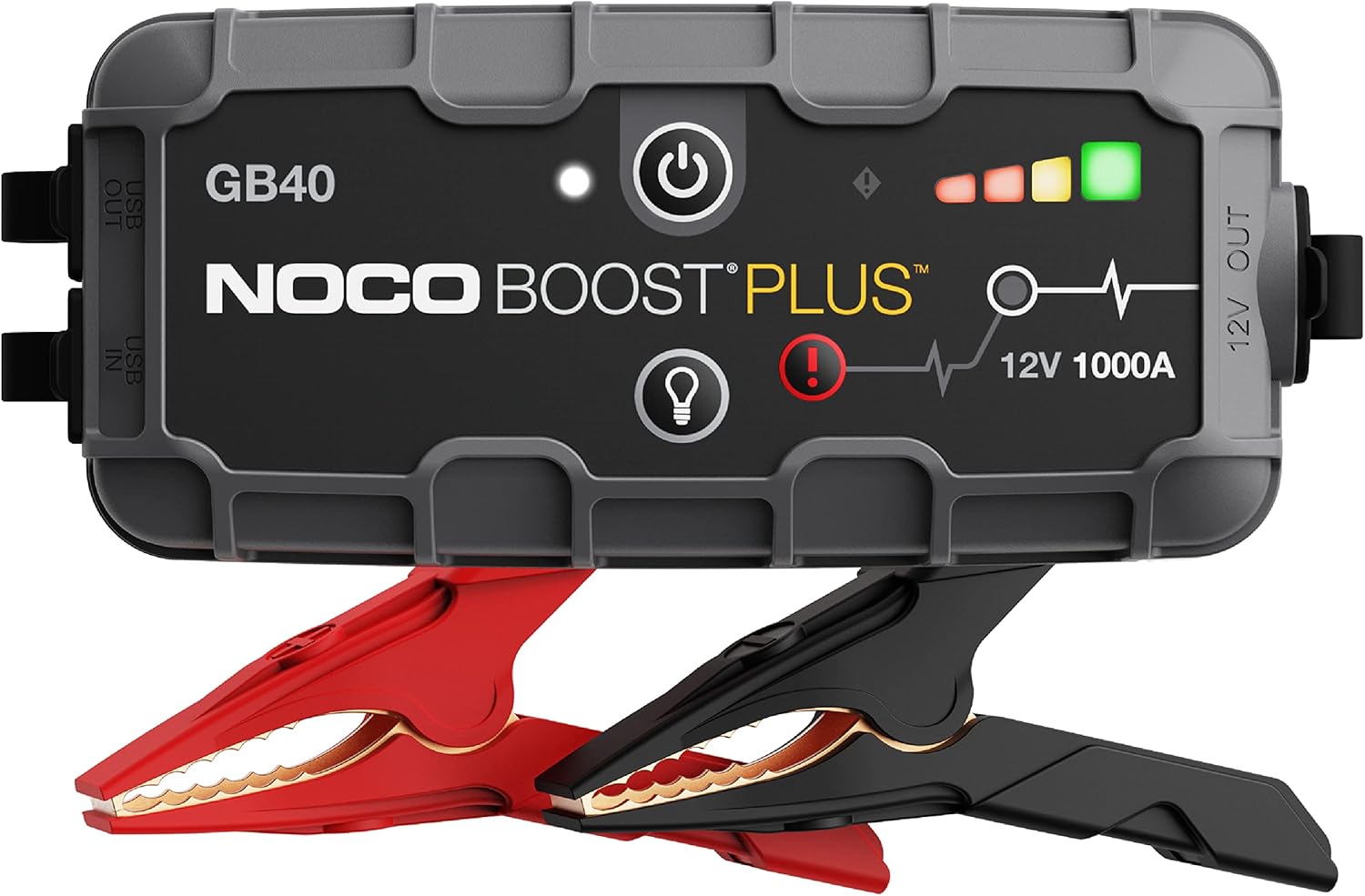
NOCO Boost Plus GB40 Jump Starter
A 1000A lithium jump starter that fits in your glovebox and works on any 12V battery. Your insurance against a dead 12V in a parking lot.
As an Amazon Associate, ThinkEV earns from qualifying purchases — at no extra cost to you.
After a Flood: What to Do and What Not to Do
Do not charge a flood-exposed EV. Not the next morning, not to "check if it works." Applying voltage to a pack with potential internal shorting is the fastest way to convert a repairable vehicle into a garage fire. The BMS may not detect the developing bridge; the AC-DC conversion cycle can complete it.
Do not park a flood-exposed EV in an enclosed structure. If thermal runaway starts on day four, proximity to your house is the variable that decides whether you lose a car or a home. Move the vehicle, on a flatbed, not under its own power, to open ground, ideally with clearance from other vehicles and vegetation.
Report the exposure to your insurer immediately, and be specific about whether the water was fresh, brackish, or saltwater. Most policies treat saltwater immersion as a total loss and treat delayed reporting as grounds to deny the claim. The economics of hiding the exposure are terrible: the pack replacement cost on a modern EV runs $15,000 to $40,000 CAD, and no independent shop will warranty the repair on a saltwater-exposed pack.
A certified technician's post-flood inspection checks three things: pack sealing integrity via pressure test, cell voltage variance across the module map, and BMS fault codes accumulated since the exposure. Any one of the three failing is a write-off recommendation. All three passing on a saltwater vehicle is still not a clean bill of health, it is a probabilistic bet, and the insurance industry has already priced the odds.
Gear worth having
As an Amazon Associate, ThinkEV earns a small commission from qualifying purchases — at no extra cost to you.

Amazon Basics Seat Belt Cutter and Window Hammer
The 10-dollar tool you hope to never use: cuts a jammed belt and shatters a window in an emergency. Mount it within reach.
As an Amazon Associate, ThinkEV earns from qualifying purchases — at no extra cost to you.
Canadian Context: Flood Zones, Coastal Buyers, and What to Watch
Canada's federal EV rebate is the Electric Vehicle Availability Program (EVAP), which pays up to $5,000 for a qualifying BEV under a $50,000 final transaction cap. EVAP does not cover flood damage, does not adjust for climate risk, and does not require the buyer to disclose floodplain residence. The retired iZEV program EVAP replaced was equally silent on the question. The federal rebate lens is on adoption, not on lifecycle risk.
That silence extends to guidance. NRCan has no published EV-specific flood safety protocol as of mid-2026. Transport Canada's guidance on flood-damaged vehicles predates mass EV adoption and treats the powertrain as a mechanical assembly. The regulatory catch-up will happen. It has not happened yet.
The buyer-facing implication is chemistry. In BC's Fraser Valley, the St. Lawrence lowlands, and the Ontario floodplain municipalities where storm-surge return intervals are shortening, LFP chemistry is a genuinely relevant spec, not a marketing preference. Li-NMC remains the most common EV chemistry, but LFP is on the rise, and its lower thermal runaway propensity is a live safety variable when the vehicle spends nights in an attached garage on the wrong side of a flood map. The technical case for LFP's chemistry advantage in Canadian conditions is worth reading before you dismiss it as a Chinese-brand talking point.
Public charging infrastructure is the other gap. FLO and BC Hydro operate the majority of Canada's coastal DC fast-charging capacity, and there is no published national standard for post-flood EVSE inspection, decommissioning, or reactivation. When a coastal charging site is submerged in a storm surge, the decision to re-energise is made site by site, operator by operator. That is not a scandal. It is a maturity gap in the infrastructure. It will close. In the meantime, do not assume a re-energised coastal charger has been through anything more rigorous than a visual inspection.
The broader lifecycle question, what actually happens to a written-off flood-damaged pack once the insurer takes it, connects to Canada's EV battery recycling infrastructure gap, where the answer today is that the recycling capacity is still being built.
The number to check in the next hurricane cycle is not how many EVs were flooded. It is how many of the flooded EVs ignited on day four, and how many of those were LFP versus NMC. The chemistry answer will not survive a large enough sample.
Gear worth having
As an Amazon Associate, ThinkEV earns a small commission from qualifying purchases — at no extra cost to you.

Roadside Emergency Safety Kit
Jumper cables, a portable air compressor, tow strap, first aid, and more for when something goes wrong between chargers. Canadian winters do not forgive the unprepared.
As an Amazon Associate, ThinkEV earns from qualifying purchases — at no extra cost to you.

Founder & Chief Editor
Vlad Pereira is the founder and chief editor of ThinkEV.ca, the Canadian electric-vehicle publication he writes and edits from Courtenay, British Columbia. He covers EV pricing, federal and provincial rebates, charging costs, and the Chinese manufacturers now entering Canada, from the buyer's side rather than the press-fleet side. ThinkEV is a venture of Vlad Pereira Online; his writing on health, income and the long game lives at vladpereira.com.
Frequently asked questions
Can you charge an EV after it sat in floodwater overnight?
Does LFP chemistry actually make a meaningful difference in floods?
Why did some Ian-flooded EVs catch fire a week later?
Is a saltwater-submerged EV ever worth repairing?
What depth of water is genuinely dangerous for any vehicle?
More EV & road-trip finds
Affordable upgrades worth a look — tap any to check the price on Amazon.
 ★ 392
★ 392Large Cup Holder Adapter (32-40oz)
View on Amazon ★ 8,681
Chemical Guys Complete Car Wash Kit
View on Amazon ★ 55
★ 55LED Car Door Logo Projector Light
View on Amazon ★ 4,626
HoogaLife Hanging Car Diffuser (2-Pack)
View on Amazon ★ 865
★ 865Collapsible Trunk Organizer
View on Amazon ★ 297
★ 297360-Degree One-Hand Dashboard Phone Mount
View on Amazon ★ 87
★ 87Car Window Sun Shades for Kids (4-Pack)
View on Amazon ★ 17,839
Qifutan Vent Phone Mount (Military-Grade Clip)
View on AmazonRead, Plan, Then Stay Current
Explore our expert articles to understand incentives and ownership costs, use the map to pressure-test charging reality, then subscribe so new EV coverage comes straight to you.
Continue Reading
Are EVs Safe? Crash Structure and Battery Safety Explained
Chinese Court Orders Blogger to Pay BYD $294,000
EV Fires vs Gas Cars: What the Safety Data Shows
Why Cold Weather Cuts EV Range, the Real Reasons
Are Canada's Repair Shops Ready for Chinese EVs?