Key takeaways
- The Hyundai Ioniq 5 Standard Range AWD starts at $54,999 CAD.
- The Kia EV6 Standard Range AWD starts at $54,995 CAD.
- The better ones, the Chevrolet Equinox EV is a good example, peaking at 150 kW, will get you from 10% to 80% in about 35 to 40 minutes at a capable station.
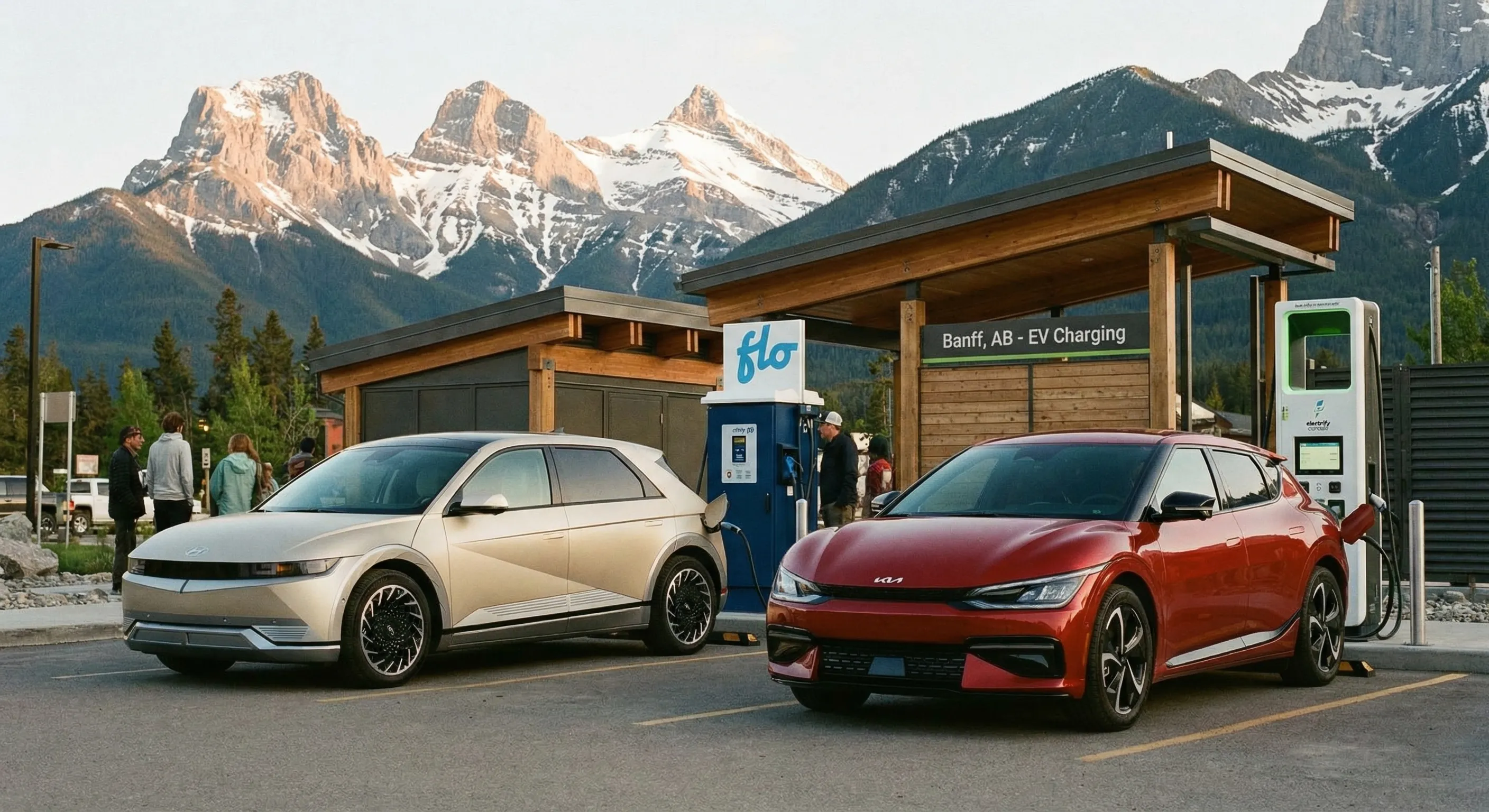
- On a real-world Electrify Canada 350 kW station, that 10% to 80% charge happens in under 18 minutes.
The Hyundai Ioniq 5 Standard Range AWD starts at $54,999 CAD. The Kia EV6 Standard Range AWD starts at $54,995 CAD. Four dollars. That is the gap. And if you spend more than four seconds thinking about which one is cheaper, you are already looking at this the wrong way.
These two cars are priced identically because Hyundai and Kia want you to think of them as interchangeable. They are not. They share a platform, a charging system, a powertrain architecture, and a parts ecosystem, but the engineers and designers at Hyundai and Kia made genuinely different decisions about what kind of vehicle they wanted to build on that shared foundation. One of them built a lounge on wheels. The other built a driver's car. The fact that they cost the same makes the choice harder, not easier, because it forces you to think clearly about what you actually want instead of letting price make the decision for you.
After going through every spec, every real-world ownership report, every Canadian winter driving consideration, and every corner of both lineups, the answer is clear: buy the Ioniq 5 if you carry people. Buy the EV6 if you care how the car drives. I'll spend the next 30 minutes explaining why that is the right framework, and why buying the wrong one is a real mistake.
The Platform: Why Sharing Bones Matters, And Why It's Not the Whole Story
Before we get into how different they feel to drive, it is worth spending real time on why the shared foundation matters. Because not all EVs are created equal, and E-GMP is genuinely one of the best electric vehicle platforms that has ever been built at any price. Understanding what it gives you, and what it does not, is the correct starting point.
Most EVs sold in Canada in 2026 run on 400-volt electrical systems. That includes the Tesla Model 3, the Volkswagen ID.4, the Nissan Ariya, the Ford Mustang Mach-E, and essentially every mainstream crossover EV you will find at dealerships outside of the Hyundai Motor Group. A 400V system typically maxes out somewhere between 50 kW and 150 kW for DC fast charging. The better ones, the Chevrolet Equinox EV is a good example, peaking at 150 kW, will get you from 10% to 80% in about 35 to 40 minutes at a capable station. That is fine. On a highway rest stop, it is one meal.
The Ioniq 5 and EV6 run 800 volts and can accept up to 350 kW of DC fast charging. On a real-world Electrify Canada 350 kW station, that 10% to 80% charge happens in under 18 minutes. That is one coffee. And because we are talking about Canada, where the Trans-Canada highway between Kenora and Thunder Bay is not exactly flush with charging stations, and where a January road trip from Calgary to Edmonton means you want every minute of that stop to count, the difference between one coffee and one meal is not trivial. It is the difference between a pleasant road trip and a trip you dread.
But here is what most comparisons get wrong about the 800V charging advantage: it is not just about how fast you charge on the best charger. It is about how you charge on every charger. On a Petro-Canada 150 kW station, which is what you will actually encounter on most Canadian highway routes, a 400V car and an 800V car both accept 150 kW in theory.
But in practice, because the 800V system operates at higher voltage, it requires lower current to deliver the same power. Lower current means less heat buildup in the battery. Less heat means the battery management system is less likely to throttle charging speed to protect itself. This matters most in winter, when cold batteries are already thermally stressed.
An Ioniq 5 or EV6 at -15°C on a 150 kW charger will charge closer to its rated peak than most 400V competitors at the same temperature.
The 800V platform also enables Vehicle-to-Load (V2L) on both the Ioniq 5 and EV6, the ability to use the car as a power source for external devices at up to 3.6 kW. This sounds like a gimmick until you are camping in Banff and running a portable coffee maker and a phone charger off your car's battery. Or until the power goes out in your neighbourhood for two days after an ice storm, which has happened to homeowners across Ontario, and you can run your refrigerator from the driveway. The Ioniq 5 has an external V2L outlet accessible from the charge port area as standard on most trims. The EV6 has V2L on higher trims. Not a deciding factor, but genuinely useful when you need it, and no competitor at this price point offers it.
The platform under both cars also uses rear-wheel drive as the base configuration, with a front motor added to create AWD. This is the architecturally correct way to build a high-performance EV platform, rear motor as primary, front motor as supplement, and it is why both the RWD and AWD versions of both cars drive better than many EV competitors. For comparison, the Volkswagen MEB platform (which underpins the ID.4 and ID.Buzz) was designed around front-wheel-drive packaging from the beginning, which creates compromises in both the RWD and AWD configurations. E-GMP does not have those compromises. It was designed for performance from the start.
All of that is shared. Every bit of it. If the platform were the whole story, you would flip a coin. But the platform is just the bones. What Hyundai and Kia built on top of those bones is where this comparison actually lives.
Price and Trims: Where the $4 Gap Becomes a Real Decision
Let me walk you through the 2026 Canadian lineup for both vehicles, because the $4 base price gap is a marketing move, and the real price structure requires some attention.
The 2026 Ioniq 5 lineup in Canada runs like this: Standard Range AWD at $54,999, Long Range RWD at approximately $56,499, Long Range AWD at approximately $61,499, and the Preferred Long Range AWD at approximately $64,499. At the top sits the Ioniq 5 N performance model at approximately $72,999. For practical purposes, the buying window for most Canadians is $54,999 to $64,499, and I will tell you right now: unless budget is genuinely the constraint, skip the Standard Range.
The 2026 EV6 lineup: Standard Range AWD at $54,995, Long Range RWD at approximately $55,995, Long Range AWD at approximately $60,995, Wind AWD at approximately $63,495, and the GT-Line AWD at approximately $65,995. The EV6 GT performance model, not cosmetic, actual performance, starts at approximately $76,995. The practical buying window is $54,995 to $65,995, and the same advice applies: get the Long Range.
When you compare trim levels directly, the EV6 tends to come in $500 to $2,000 cheaper than the equivalent Ioniq 5 for similar content. The EV6 Long Range AWD at $60,995 against the Ioniq 5 Long Range AWD at $61,499 is essentially a wash. The EV6 GT-Line AWD at around $65,995 against the Ioniq 5 Preferred Long Range AWD at $64,499 has the EV6 running about $1,500 more but arguably offering more sport-specific content, the GT-Line exterior kit, upgraded interior finishes, and the sportier suspension calibration. Whether that is worth the premium depends on which character you are buying into.
Here is what buyers in both camps tend to say after the fact: EV6 buyers feel they got slightly more equipment per dollar. Ioniq 5 buyers feel they got more space and comfort. Both groups are correct. The value equation is genuinely different depending on what you value, which is exactly why this comparison cannot be resolved with a spec sheet.
Now the rebate reality, which I will address once and not belabour: the Ioniq 5 does not qualify for the federal EVAP rebate at any 2026 trim, its lineup starts at $54,999, well above the $50,000 final transaction value cap. The EV6 is more nuanced: the LIGHT RWD base trim at $48,995 IS on Transport Canada's official EVAP eligible list and qualifies for the $5,000 rebate. However, that trim is not the subject of this comparison, it is a stripped-down entry variant, not the Long Range trims that make sense for most buyers. Every EV6 trim covered here (Standard Range AWD at $54,995 and above) exceeds the EVAP cap. So for the purposes of this comparison, no EVAP applies. If EVAP eligibility is your primary filter, the EV6 LIGHT RWD is worth a look on its own terms.
Provincial programmes are a different story. Quebec's Roulez Vert programme offers up to $7,000 on eligible new EVs with an eligibility cap at $65,000. Both the Ioniq 5 and EV6 qualify in Quebec at most trim levels, but note that final transaction value is what the programme evaluates, not MSRP. British Columbia's CleanBC Go Electric rebate offers up to $4,000 on eligible new EVs, with its own eligibility criteria and income thresholds. If you are buying in Quebec or BC, run your exact trim configuration through the provincial eligibility tool. There is real money available at the provincial level even when the federal programme has nothing for you.
Ontario, Alberta, Saskatchewan, no provincial EV rebates as of 2026. If you live in one of those provinces, your calculus is straightforward: MSRP plus fees, minus nothing. The fuel and maintenance savings over ownership still justify the purchase, but you should not be banking on government money.
Range: The 11 Kilometre Gap That Should Not Drive Your Decision
The Ioniq 5 Long Range RWD is rated at 488 km by Transport Canada. The EV6 Long Range RWD is rated at 499 km. The EV6 wins by 11 km. In AWD Long Range form, those numbers come down to approximately 431 km for the Ioniq 5 and 439 km for the EV6. The EV6 wins by 8 km.
I need to be direct about what those numbers mean in real-world Canadian driving: nothing. The 11 km paper advantage disappears entirely within the margin of variation from any two different driving days. Drive the Ioniq 5 at 110 km/h on the 401 in October and compare it to the EV6 at 95 km/h on the same road in July, and the Ioniq 5 has more range. Transport Canada ratings are useful for comparing cars under controlled conditions; they are not useful for predicting which car gives you more buffer on a specific trip on a specific day. Both cars are in the 430–499 km window depending on trim and configuration, and that is all that matters.
What does matter for Canadian range considerations is cold-weather performance, and here the numbers are worth knowing precisely because Canadian winters are real and the range penalty is real. Both the Ioniq 5 and EV6 have heat pumps, which extract ambient heat rather than generating it with resistive elements. Heat pumps are substantially more efficient than resistive heating between 0°C and -10°C. Below -15°C, they lose most of their efficiency advantage and both cars increasingly rely on resistive elements. This is not a flaw, it is physics. Every EV with a heat pump handles this the same way.
In real-world Canadian winter driving, temperatures below -10°C, highway speeds, defrost running, seat heaters on, expect both the Ioniq 5 and EV6 to deliver 25% to 35% less range than their rated figures. The Ioniq 5 Long Range RWD drops to roughly 320 to 365 km. The EV6 Long Range RWD drops to roughly 325 to 375 km. The gap between them in winter is still about 10 km. It is still irrelevant.
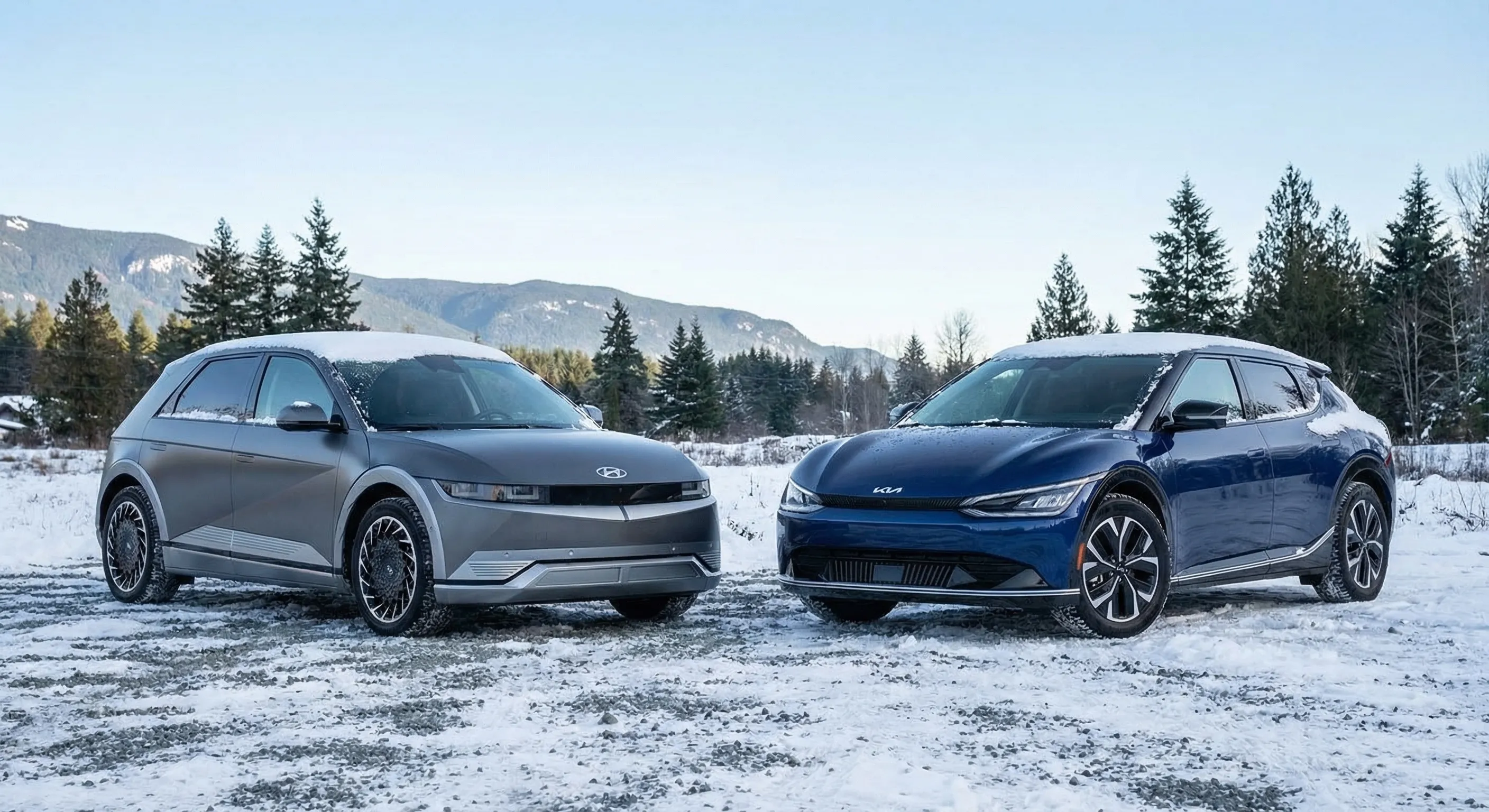
Where range becomes a more meaningful consideration is the Standard Range trim. Both base trims are AWD: the Ioniq 5 Standard Range AWD is rated at approximately 354 km, the EV6 Standard Range AWD at approximately 373 km. That 19 km difference is slightly more meaningful than the Long Range gap. In a Saskatchewan February, with the heater working hard, the Ioniq 5 Standard Range is looking at roughly 230 to 255 km of real-world range. The EV6 Standard Range is looking at roughly 245 to 270 km. Neither number is catastrophic for urban commuters, but if you regularly make 150+ km highway trips in January, the EV6 Standard Range gives you a marginally more comfortable buffer.
But the real answer to Standard Range versus Long Range is not about which brand: it is about spending the extra $1,500 to $2,000 to move to Long Range on whichever car you choose. The jump from roughly 360 km rated range to 488–499 km is enormous in practical terms. In summer, both Standard Range numbers are perfectly liveable. In winter, the Standard Range numbers require discipline and planning that most buyers do not want to exercise. Get the Long Range. Do not make the range comparison between cars your primary criterion when the range comparison between trims is vastly more consequential.
The aerodynamic difference is real but modest. The EV6 has a drag coefficient of 0.28 compared to the Ioniq 5's 0.288. That 0.008 difference in Cd accounts for a meaningful portion of the EV6's efficiency advantage. The EV6's lower, sleeker fastback profile catches less wind than the Ioniq 5's upright, boxy stance. This is a direct consequence of the design choices each automaker made, and it is a trade-off worth understanding: the Ioniq 5's boxier shape is what enables its more spacious interior. You cannot have both without a penalty somewhere, and in this case the Ioniq 5 pays it in aerodynamics and the EV6 pays it in cabin space.
Charging: Identical Where It Counts
There is no meaningful charging advantage between these two vehicles for a Canadian buyer. Both use the same 800V architecture. Both accept the same CCS1 connector. Both access the same public charging networks. If this were a comparison where one car could access a premium network the other could not, the way a Tesla owner has Supercharger access that a non-Tesla owner does not, it would be a significant differentiator. But the Ioniq 5 and EV6 are, for practical purposes, identical charging vehicles.
On the Electrify Canada network, the highest-power CCS network available in Canada, both cars can accept up to 350 kW. In practice, peak charging speed on a 350 kW Electrify Canada stall typically lands around 220 to 250 kW for both vehicles, because peak speed depends on state of charge, battery temperature, and how many other vehicles are sharing the station's power allocation. That real-world 220 to 250 kW is still fast. Significantly faster than any 400V competitor at the same station.
On Petro-Canada's national highway network, which tops out at 150 kW but has excellent coverage across Canada, including stations at every major fuel stop on the Trans-Canada and Highway 16, both cars accept the full 150 kW without issues. The 800V advantage here, as I mentioned earlier, is thermal efficiency at cold temperatures rather than raw speed.
On FLO, ChargePoint, EV Connect, and other third-party networks that make up the bulk of Canada's public charging footprint, both cars behave identically. They use J1772 for Level 2 AC and CCS1 for DC fast charging, same as every other non-Tesla EV sold in Canada.
For home charging, both cars are also identical. A 40A Level 2 circuit delivers roughly 30 to 40 km of range per hour for either vehicle. A depleted Long Range battery goes from 10% to full in about 8 to 9 hours of overnight charging. The Grizzl-E Classic 40A charger is the obvious Canadian choice for home installation, it is built in Canada, tested to -40°C, and priced around $499 on Amazon, which is the most competitive price for a UL and CSA-certified 40A home charger on the market. Both the Ioniq 5 and EV6 will work with any J1772-compatible Level 2 charger, so if you already have a home charger from a previous EV, it will work with either car.
Gear worth having
As an Amazon Associate, ThinkEV earns a small commission from qualifying purchases — at no extra cost to you.
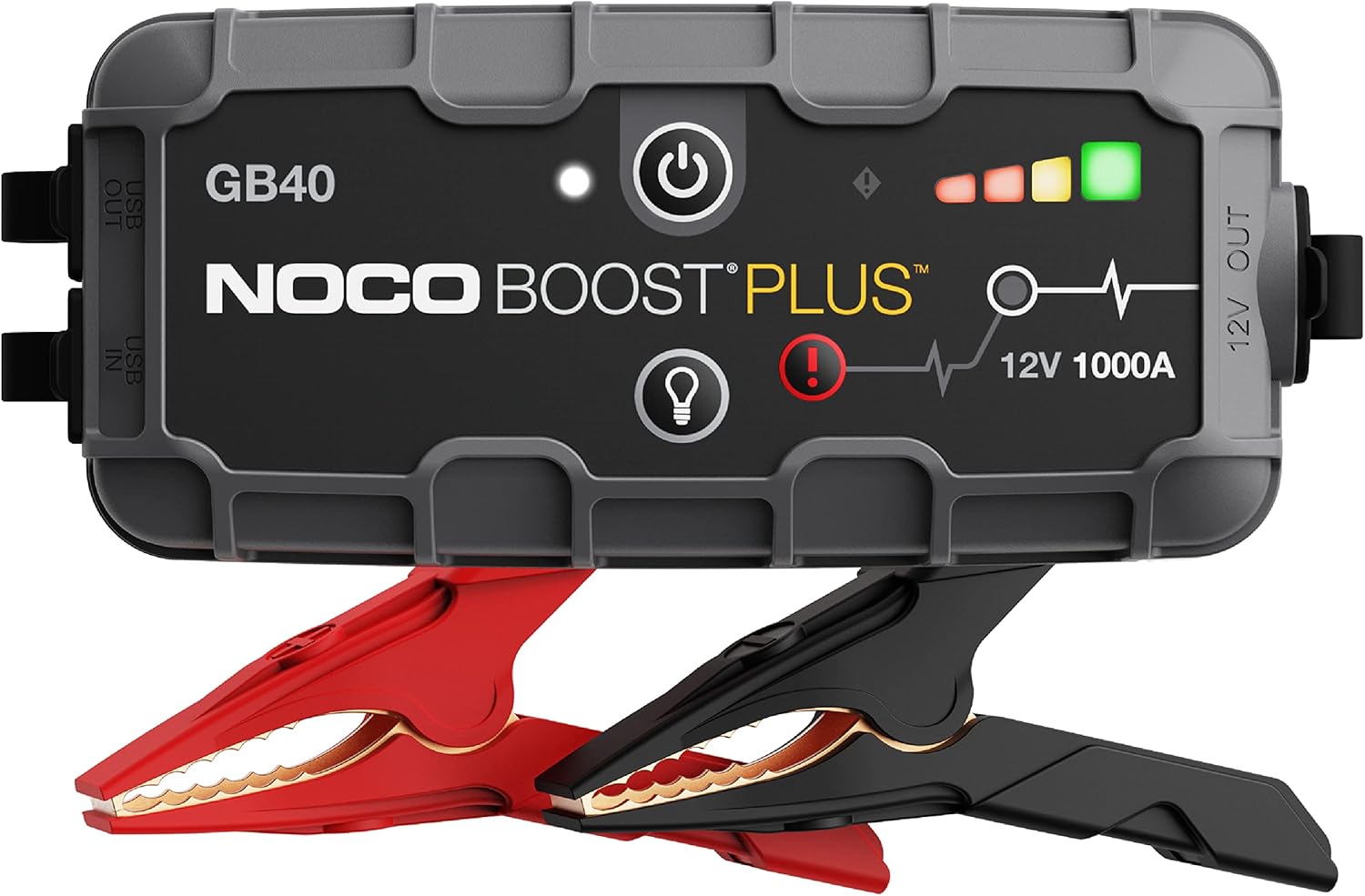
NOCO Boost Plus GB40 Jump Starter
A 1000A lithium jump starter that fits in your glovebox and works on any 12V battery. Your insurance against a dead 12V in a parking lot.
As an Amazon Associate, ThinkEV earns from qualifying purchases — at no extra cost to you.
One practical Canadian note: the CCS fast-charging network has improved dramatically since 2022, but it is still not at the point where you should assume every listed station is operational. Broken stalls happen. On popular highway routes in southern Ontario and BC, you are usually fine, there are enough redundant stations. On less-travelled routes, a non-functional stall can create real inconvenience.
Use PlugShare, check station reliability ratings before departing, and build mental flexibility for one unplanned stop per long trip. The NOCO Boost GB40 in your glove box is not for EV emergencies in the traditional sense, EVs do not run out of gas, but the 12V auxiliary battery that powers all your electronics can drain in extreme cold if the car sits unused for an extended period. Worth having regardless of which car you choose.
The Level 1 trickle charging (standard 120V household outlet) capability of both cars is identical. You gain about 4 to 5 km of range per hour on a standard outlet, meaning an overnight 120V charge adds roughly 40 to 50 km. This is not a primary charging method, but it is the difference between stranded and functional if your home charger breaks down and you need to get to work in the morning. Both cars include a portable Level 1 charging cable in the box.
Design and Exterior: The First Real Fork in the Road
This is where Hyundai and Kia made completely different calls, and both decisions are coherent and deliberate. This is not one being better-executed than the other, it is two different philosophies about what an EV should look like, and your reaction to that question should factor heavily into your choice.
The Ioniq 5 is styled after the 1974 Hyundai Pony concept. Boxy. Upright. Pixelated lighting. A flat hood. A nearly vertical rear window. Parametric pixel LED daytime running lights that look like they belong on a spacecraft. The whole thing is a deliberate throwback to angular 1970s design reinterpreted through a 21st-century EV lens, and it is the most distinctive-looking car in its price range by a significant margin. There is nothing else on the road that looks like an Ioniq 5 unless it is another Ioniq 5. People either find it fascinating or strange. There is not much middle ground.
Dimensionally: the Ioniq 5 is 4,635 mm long, 1,890 mm wide, and 1,605 mm tall, with a 3,000 mm wheelbase. That wheelbase number deserves emphasis. For context, the wheelbase on a current full-size BMW 5 Series is 2,976 mm. The Ioniq 5 has a longer wheelbase than a 5 Series, packed into a vehicle that is significantly shorter overall. The result is a cabin with interior proportions that feel disproportionately generous, because they genuinely are.
The EV6 went in the opposite direction. Its exterior is a low, sleek fastback crossover. 4,695 mm long, 1,880 mm wide, and 1,550 mm tall, 55 mm lower than the Ioniq 5, with a more pronounced rear roofline slope. The styling is contemporary performance-crossover: flowing lines, a coupe-like silhouette, an aggressive front face. It draws obvious visual references to the Porsche Taycan Cross Turismo, which is not an accident. Kia's designers clearly had that car in mind, and the EV6 carries the comparison without embarrassment. The EV6 looks fast. The Ioniq 5 looks interesting. Both have presence, but they project completely different personalities.
Colour options reinforce the character difference. The Ioniq 5 offers matte Atlas White and matte Gravity Gold, unusual finishes that suit the car's eccentric stance. Conventional metallic colours are available too, but the matte options are distinctive in a way that feels intentional for this car. The EV6 offers a striking Runway Red that suits its sporty posture, alongside conventional metallics that read as more traditional. If the Ioniq 5 is the car for someone who wants to make a statement, the EV6 is the car for someone who wants to look good without trying too hard.
Here is the practical design consideration for Canadian winters that most reviews skip: the Ioniq 5's more upright hatchback profile means snow tends to accumulate differently on the rear window. The nearly vertical rear glass sheds snow more readily than a sloped hatch, you will spend less time clearing it after an overnight snowfall. This is a small thing. But it is the kind of small thing that becomes a minor pleasure over the course of a Canadian winter.
Interior: The Ioniq 5 Wins Decisively, and It's Not Close
This is the section where I am going to be most direct, because the Ioniq 5's interior advantage over the EV6 is real, consistent, and meaningful for a broad range of Canadian buyers.
That 3,000 mm wheelbase does not just sound impressive on paper, you feel it the instant you open the rear door. The rear seat slides fore and aft by 135 mm, allowing you to prioritise legroom for tall passengers or maximise cargo volume behind the seat. The floor is completely flat, no transmission tunnel, because there is no transmission, which means the middle rear passenger is not perched on a hump for two hours on the way to the cottage. The ceiling is generous. The whole rear cabin feels like someone designed it thinking about the people who sit back there, not just the person in front.
Put a tall adult in the back of an Ioniq 5. Then put them in the back of an EV6. The difference in headroom and legroom is noticeable, not catastrophic in the EV6, but noticeable. And in a car costing $55,000 to $65,000, "noticeable" matters.
The front row of the Ioniq 5 is similarly well-considered. The sliding centre console moves forward or backward. The flat floor means you can step through the cabin from front to rear without climbing over anything. The seat height gives you a comfortable view over traffic, more minivan than sports car in terms of the driving position, which some people will find immediately comfortable and others will find immediately wrong for them. If you come from a sedan and like sitting low, the Ioniq 5's driving position will feel slightly elevated. If you come from an SUV or crossover, it will feel exactly right.
Cargo volume behind the rear seat is 531 litres in the Ioniq 5, expanding to approximately 1,587 litres with the rear seats folded. The EV6: 490 litres with seats up, 1,300 litres with seats folded. The Ioniq 5 wins by 41 litres with seats up and 287 litres with seats down. That 287-litre difference with seats folded is not theoretical, it is the difference between a bicycle fitting and not fitting, between two sets of golf clubs fitting and not fitting, between doing one Costco run versus two.
Both cars have a front trunk (frunk), though neither is particularly usable. The Ioniq 5's frunk holds approximately 24 litres, enough for charging cables and a small bag. The EV6's frunk is similarly modest. Think of it as extra space for the cables, not as a meaningful storage compartment.
The Ioniq 5's dual 12.3-inch screens, one instrument cluster, one infotainment, are integrated into a single curved display unit that looks clean and purposeful. The real differentiator is what sits below the screen: actual physical climate controls. Real buttons. Real dials. Things you can operate in January with gloves on without taking your eyes off the road. In a market where every manufacturer seems to be racing to remove every physical control in favour of a touchscreen, Hyundai made the correct call here, and owners consistently mention it in long-term reviews. Wireless Apple CarPlay and Android Auto are standard on most trims.
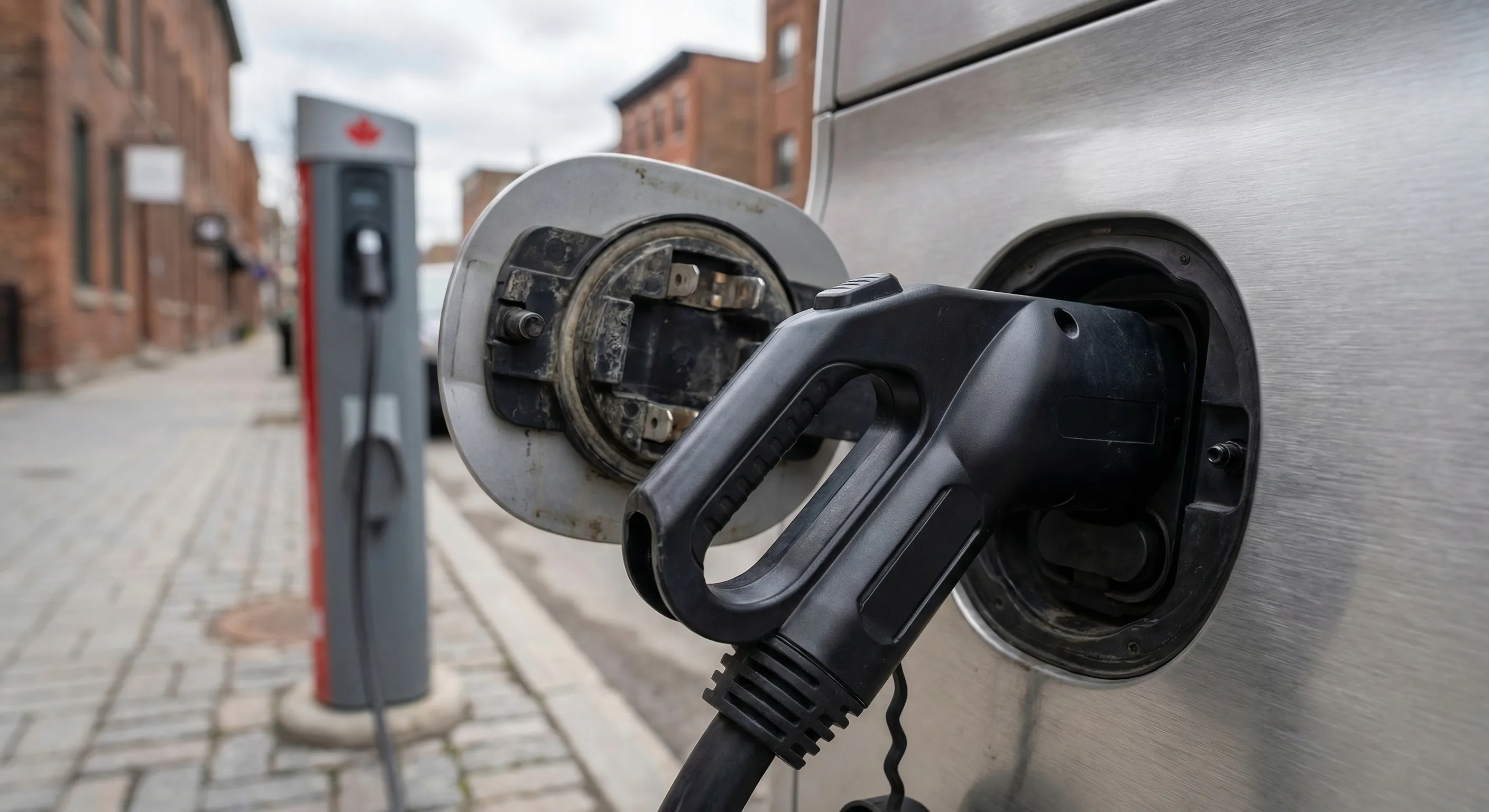
The EV6's interior is genuinely excellent, and I do not want to dismiss it. The curved instrument cluster sweeping toward the driver is beautiful. The materials quality is comparable to the Ioniq 5. The seat upholstery is good. But the compromises the EV6 makes in the name of its lower, sportier exterior shape are real: the rear passengers have less headroom, the rear bench is slightly more cramped, and cargo capacity is meaningfully smaller. These are deliberate trade-offs, not failures. But they are trade-offs that a family buyer or a frequent passenger hauler should weigh honestly.
Where the EV6 wins on interior is driver engagement. The steering wheel has a chunkier, weightier feel. The seat bolsters provide more lateral support. The whole driver's environment communicates that the car takes driving seriously. If you are the kind of driver who cares where the wheel is, how the seat holds you, and whether the cabin is oriented toward the driver or the passengers, the EV6's interior is calibrated for you in a way the Ioniq 5 is not.
One more interior note that gets overlooked: the Ioniq 5 on higher trims comes with Hyundai's multi-charge portable cable, which handles both Level 2 and DC charging in one unit. Minor convenience, but appreciated on trips where you need to adapt to whatever is available.
Both interiors use similar materials overall, hard plastics in the lower sections, soft-touch on the dashboard and door tops, decent seat upholstery that holds up to winter abuse. Neither feels cheap, and neither feels luxurious. They are well-executed Korean mass-market EVs in the $55,000–$65,000 range, and they feel exactly like what they are.
Gear worth having
As an Amazon Associate, ThinkEV earns a small commission from qualifying purchases — at no extra cost to you.

Grizzl-E Classic Level 2 EV Charger (40A)
Canadian-made and rated for minus 40C winters. 40A / 9.6 kW, NEMA 14-50, indoor/outdoor, 24-ft cable. The charger built for Canadian weather.
As an Amazon Associate, ThinkEV earns from qualifying purchases — at no extra cost to you.
Driving Dynamics: The EV6 Is the Better Driver's Car
The EV6 drives better. If how the car handles and communicates to the driver is important to you, the EV6 is the correct choice. That is not a close call.
The Ioniq 5 is tuned for comfort. Its suspension is soft, calibrated to absorb the kind of cracked, patched, frost-heaved road surfaces that describe most Canadian urban environments. The steering is light, deliberate, not vague, but not asking you to engage. Body roll in corners is present and not particularly controlled. The Ioniq 5 is not sloppy; it is not an embarrassing car to drive.
But it communicates clearly that it was designed for the 488 km of comfortable daily transportation it promises, not for making that transportation feel special. On Highway 1 through the Fraser Canyon, on the twisty roads north of Kingston, on any road where the surface changes unexpectedly, the Ioniq 5 absorbs it all with the competent indifference of a car that would rather you focus on the passengers and the destination.
The EV6 is tuned for driving. The suspension is firmer, not rough, not the head-jostling firmness of an overzealous sporty car, but controlled and purposeful in a way the Ioniq 5 is not. Body roll is significantly reduced. The steering is heavier and provides actual feedback about what the front tyres are doing. The AWD system distributes torque with more aggression in corners, producing a car that encourages you to take on-ramps with confidence rather than caution. The regenerative braking is sharper and more natural for one-pedal driving. The whole experience communicates that someone, at some point in the development process, drove this car on a good road and cared about how it felt.
The acceleration numbers: Ioniq 5 Long Range AWD, 0–100 km/h in 5.1 seconds. EV6 Long Range AWD, 0–100 km/h in 5.1 seconds. Identical. But the way those numbers feel is different in a way that is real and not imagined. The EV6 feels eager off the line, like it is pulling you into acceleration. The Ioniq 5 feels competent, like it is carrying you through acceleration. The difference is in tune, not hardware, and it matters if you are the kind of driver who notices it.
The EV6 GT deserves a mention because it shapes the character of the whole EV6 lineup in the same way a top-spec M3 makes a regular 3 Series feel like it has potential. The GT is not a cosmetic trim, it is dual motors, 577 horsepower, 0–100 km/h in 3.5 seconds, Brembo brakes, and an electronic limited-slip differential. At approximately $76,995, it is significantly more expensive than the standard EV6.
But it exists, and every EV6 you drive carries a faint awareness that this is a car line that takes performance seriously. The Ioniq 5 N exists too, at approximately $72,999, and it is also a genuinely fast car. But the Ioniq 5 N feels like a separate exercise from the standard Ioniq 5 in a way the EV6 GT does not. The EV6's standard lineup is more clearly reaching toward that performance potential in its everyday character.
Highway cruising at 120 km/h, the realistic speed of Canadian traffic on most divided highways, both cars are stable and quiet. Road noise is well suppressed in both. Wind noise is marginally more present in the Ioniq 5 due to its more upright profile and larger frontal area. Neither car is noisy on the highway. But the EV6's lower profile catches slightly less wind, and on a long haul from Vancouver to Kelowna you will occasionally notice the Ioniq 5's slight atmospheric resistance in a way you will not in the EV6. Not dramatic. But there.
The real-world driving difference between these two cars is not dramatic if you are commuting in Mississauga or Burnaby. It becomes real when you push either car on a road that rewards engagement. And it becomes a quality-of-life factor if you spend any time on roads with character.
Safety and Driver Assistance: No Meaningful Difference
Both the Ioniq 5 and EV6 come standard with comprehensive active safety suites that cover the same ground. Hyundai's SmartSense includes forward collision avoidance, lane keeping assist, driver attention warning, blind spot collision warning, rear cross-traffic alert, and smart cruise control with stop-and-go. Kia's DriveWise mirrors this feature for feature.
NHTSA five-star overall. Euro NCAP five stars. Insurance Institute for Highway Safety Top Safety Pick. These are the highest ratings available from the three most credible crash-testing organisations, and both cars achieve all of them. There is no meaningful safety difference between these vehicles. If you are choosing between them on safety grounds, you are choosing based on marketing, not data.
The highway driving assist systems in both cars work well in good conditions and struggle in the same conditions where every lane-keeping system struggles, heavy snow, worn pavement markings, construction zones, and roads through British Columbia where the lane paint is perpetually optimistic. Both systems require driver attention and should be treated as driver assistance, not autonomy. Neither approaches Tesla's Autopilot in sophistication, and neither claims to.
Remote parking assist is available on higher trims, the feature that lets you move the car into and out of a tight spot from outside the vehicle using the key fob. It will be used by approximately three percent of buyers in any given month, which is fine. It is a party trick, not a safety feature. Do not choose your car based on it.
Cold Weather Performance: What Canadian Buyers Need to Know Precisely
Cold weather EV performance is the question every Canadian should ask and most online reviews answer too vaguely. Here is what I know, stated precisely.
Both the Ioniq 5 and EV6 have heat pumps. A heat pump's efficiency advantage over resistive-only heating is significant between -5°C and -10°C, meaningful between -10°C and -15°C, and mostly gone below -15°C. Below -20°C, both cars primarily use resistive heating. This is not a fault, it is thermodynamics. Every EV with a heat pump handles this transition the same way.
At -20°C on the highway, with cabin heating running and seat heaters on, both the Ioniq 5 Long Range and EV6 Long Range will deliver roughly 290 to 330 km of real-world range. That is a steep reduction from the 480 to 499 km rated range, and it is the number that matters for trip planning.
For Canadian urban commuters, people covering 50 to 80 km daily round-trip, this winter range is not a problem. Even at -30°C in Winnipeg or Saskatoon, most urban commutes are well within both cars' cold-weather range. The scenario where range becomes genuinely stressful is the combination of longer highway trips, extreme cold, and limited charging infrastructure. If you are driving Highway 11 north of North Bay in January, or the Yellowhead Highway in Manitoba in February, both cars require careful pre-trip planning and charging stop discipline. That is not an indictment of these cars, it is a description of EV road tripping in northern Canada in winter with any vehicle.
Both cars support remote preconditioning via their smartphone apps: Hyundai's Blue Link and Kia's Connect. Use this every cold morning. Start the cabin heating while the car is still plugged in, so you draw from grid power rather than battery power for the initial warmup. This is the single most effective habit for preserving cold-weather range. An Ioniq 5 or EV6 that is preconditioned before departure in a -20°C morning will have meaningfully more range than one that was cold when you got in.
The 800V charging system's cold-weather advantage over 400V systems is worth understanding once and remembering permanently: because the 800V system uses higher voltage and therefore lower current for any given charging power level, the battery generates less heat during fast charging. Less heat means the battery management system is less likely to throttle charging speed at low temperatures. At -15°C, both the Ioniq 5 and EV6 will charge at close to their rated peak speeds on a compatible charger, while many 400V EVs see significant charging speed reduction at the same temperature. This is not a minor theoretical advantage, it is 10 to 20 minutes of real time saved on a cold highway stop.
Both cars support heated seats, heated steering wheel, and heated rear seats on most trims above base. Confirm before signing. Heated rear seats are easy to overlook on a spec sheet and genuinely important for rear passengers on cold mornings. Both cars also support seat ventilation on higher trims, which becomes relevant in a BC July as quickly as it becomes irrelevant in a Manitoba January.
One overlooked winter consideration: the Ioniq 5's external V2L outlet is particularly useful in Canadian camping contexts during shoulder season, late September in Banff, for instance, when it is cold enough to need a small electric heater overnight but not cold enough to need a full campsite hookup. Running a 1,500W electric heater for 4 hours draws about 6 kWh from the battery, which reduces range by roughly 75 km, a trade-off worth understanding but not disqualifying.
Ownership and Reliability: Shared Warranty, Shared Standards
Both the Ioniq 5 and EV6 are manufactured by Hyundai Motor Group, and they share not just a platform but quality control standards, warranty terms, and long-term service infrastructure. Understanding this shared ownership context matters for long-term planning.
The warranty on both vehicles is generous by industry standards: 5 years / 100,000 km bumper-to-bumper coverage, and 8 years / 160,000 km on the high-voltage battery pack. The battery warranty is the critical number for EV buyers. If your battery's capacity drops below 70% of original rated capacity within those terms, Hyundai or Kia covers replacement. This 8 year / 160,000 km battery warranty matches or exceeds most competitors in Canada at this price point. Hyundai's warranty on the US market extends to 10 years on the battery; the Canadian terms are 8/160,000, which is still above what most competitors offer.
The Hyundai dealer network and Kia dealer network are separate franchise systems with comparable geographic coverage. Major Canadian cities, Toronto, Vancouver, Calgary, Edmonton, Ottawa, Montreal, have multiple dealers for each brand. Mid-sized cities and smaller communities have variable coverage. The quality of service varies by dealer, as it does with any franchise network. Both brands rate above average in J.D. Power Canada service satisfaction surveys, though dealer-to-dealer variance is high enough that the brand average tells you less than a local review search tells you.
Reliability data on the Ioniq 5 and EV6 has been accumulating since 2021, and the pattern emerging from Canadian owner forums, Consumer Reports data, and J.D. Power Vehicle Dependability studies is broadly positive: both vehicles are generally reliable, with the most commonly reported issues being software-related (addressable via over-the-air updates in most cases) and minor sensor calibration drift. There are no widespread structural or powertrain defects reported through 2025 model year vehicles. For 2026 model year specifically, treat any new model year with appropriate early-adopter caution. If you are risk-averse, let other buyers absorb the first few months of production before committing.
Because E-GMP is a mature platform now in its fourth year of Canadian sales, a healthy parts ecosystem is developing around it. Independent mechanics with EV training can service these vehicles, and parts are not as proprietary as early-generation EV components. This matters for buyers outside major centres, if the nearest Hyundai or Kia dealer is an hour away, the growing availability of independent EV service shops that can handle E-GMP hardware is meaningful for routine service.
Software updates on both vehicles are delivered over-the-air for most functions. Major updates typically require a dealer visit to install, but routine calibration updates, feature additions, and bug fixes come wirelessly. Hyundai has been more consistent than Kia about meaningful OTA improvements to existing owners, this is a subjective assessment based on owner community feedback, not a hard data point, and it could change with either brand's software priorities.
Gear worth having
As an Amazon Associate, ThinkEV earns a small commission from qualifying purchases — at no extra cost to you.

PULIDIKI Car Cleaning Gel (Detailing Putty)
Press it into vents, buttons, and seams and it lifts out dust you did not know was there. Weirdly satisfying, genuinely useful.
As an Amazon Associate, ThinkEV earns from qualifying purchases — at no extra cost to you.
Total Cost of Ownership: Running the Real Numbers
The Ioniq 5 does not qualify for EVAP at any trim. The EV6 LIGHT RWD base ($48,995) qualifies for EVAP, but the trims compared here do not. Provincial rebates in Quebec and BC are real and potentially significant, up to $7,000 in Quebec, up to $4,000 in BC. Confirm your specific trim's eligibility before signing anything.
On fuel costs, the math is straightforward. Electricity in Canada averages roughly $0.12 to $0.17 per kWh across most provinces, with Quebec's hydroelectric grid making it cheaper (around $0.07/kWh for most Quebec residential customers) and BC Hydro keeping rates competitive. Charging either car from essentially empty to full costs approximately $9 to $13 at home. That represents roughly 430 to 499 km of range for under $13. Compare this to a 40-litre gasoline tank filled at $1.70 per litre, $68 per fill, representing roughly 500 to 600 km of range in a fuel-efficient gas car. The fuel cost delta is approximately $55 to $60 per tank-equivalent. At 20,000 km annually, that is roughly $2,200 to $3,000 saved on fuel per year.
Over a five-year ownership period, fuel savings alone amount to $11,000 to $15,000. That is real money. It does not fully offset the premium over a comparable gas car at the same price point, but it significantly narrows the actual cost gap. Add maintenance savings, no oil changes, no transmission service, reduced brake wear from regenerative braking, and the total cost picture improves further. Budget approximately $400 to $600 per year for maintenance on either car under normal Canadian conditions: tyres every 50,000 to 70,000 km, cabin air filters, wipers, and the occasional software service visit. Compared to $1,200 to $1,800 per year in typical gas car maintenance costs, the savings are meaningful.
Insurance for both vehicles runs broadly similar, in the $1,800 to $2,800 per year range depending on province, driver profile, and coverage. BC drivers will pay more. Quebec drivers less. Alberta sits somewhere in the middle depending on the insurer. Neither car is particularly expensive to insure relative to their price point, both are well within mainstream family vehicle insurance territory, not sports car territory.
On resale value: both the Ioniq 5 and EV6 have held their value better than most EVs since launch, partly because demand has remained strong and partly because the E-GMP platform's reputation for quality supports confidence. EV resale values generally are improving as the used EV market matures and buyers become more comfortable with battery longevity. The 8-year battery warranty transfers with the vehicle in most cases, confirm the warranty transferability terms with your dealer, but this warranty coverage is a meaningful factor for a used buyer's confidence, which in turn supports resale value for the original owner.
Long-Term Living With Each Car: What the Spec Sheet Misses
Spec sheets tell you dimensions, horsepower, range, and charging speed. They do not tell you what daily life with the car actually feels like after six months. So let me try to do that.
Living with the Ioniq 5 in Canada means: a distinctive car that generates conversation in parking lots. A rear seat that your mother-in-law will not complain about on the drive from Pearson to Oakville. A cargo area that genuinely accommodates the practical chaos of family life, hockey bags, camp chairs, flat-pack furniture from IKEA on a Sunday afternoon. An interior that feels open and airy because the flat floor and generous glass create a sense of space that photographs do not fully capture. A ride quality that makes Highway 400 feel smoother than it is. And a strange, endearing exterior that you will either grow to love or never quite stop noticing.
Living with the EV6 in Canada means: a car that looks good everywhere, in the way that a well-cut suit looks right in any room. A driving experience that makes the run from Kitchener to Toronto on a quiet Sunday morning feel like a reward rather than a commute. A rear seat that is fine, adults can sit there, they just will not have the generous space that an Ioniq 5 rear passenger has. A cargo area that handles most of life without drama, as long as you are not regularly loading bulky items. A car that makes you feel like you made a choice rather than a practical compromise, every time you get in.
Both are good cars. Excellent cars, at their price points. The comparison I am making is not "one is broken", it is "they do different things well, and only one of them is the right choice for your specific life."
Who Actually Buys Each Car, And Which Profile Is You
Ioniq 5 buyers, based on ownership community data and Canadian sales patterns, tend to be: families with children or regular adult passengers who prioritise interior space, comfort, and daily practicality. First-time EV buyers who are coming from a CUV, minivan, or family sedan and want the transition to EV to be smooth rather than exciting. People who work from their car, real estate agents, territory managers, people who spend three to four hours a day in the driver's seat and want that seat to feel like a comfortable office rather than a cockpit. Buyers who find the retro-futurist styling genuinely appealing or, at minimum, acceptable. People who want V2L capability for camping or emergency backup power.
EV6 buyers tend to be: drivers with opinions about their car. People who have driven a vehicle with good steering and would notice its absence. Buyers coming from a sporty sedan, a hot hatch, or a well-optioned performance vehicle who want the EV transition to preserve what they valued about their previous car's driving character. Singles or couples without children, or people whose children are old enough that rear passenger comfort is less critical. Buyers who find the lower, sleeker exterior more attractive than the boxy Ioniq 5. People who care less about cargo volume and more about how the car feels at the limit.
The real question is: which kind of driver are you? The answer is usually clear once you think about it directly rather than comparing spec sheets.
The Verdict: A Clear Winner for Each Buyer Profile, And One Default Recommendation
I promised you a clear answer, so here it is.
Buy the Ioniq 5 if you regularly carry people, if cargo space matters, if you prioritise interior comfort over driving engagement, or if you are buying your first EV and want the transition to feel easy. The Ioniq 5 serves a wider range of real-world Canadian buyer needs better than the EV6. More space. More comfort. More cargo. Better suited to families. Better V2L implementation. A more relaxed and accessible ownership experience. If you are not sure which camp you fall into, the Ioniq 5 is the safer default.
Buy the EV6 if driving dynamics matter to you, if you come from a car with good handling and would miss it, if you are a single buyer or a couple without children who will not consistently need the Ioniq 5's rear space, or if the EV6 GT-Line's sportier aesthetic is meaningfully more attractive to you than the Ioniq 5's retro-futurist design. The EV6 rewards the driver in ways the Ioniq 5 does not, and that reward is a real and daily one if you care about it.
The one recommendation I will make for both camps: do not buy Standard Range. Spend the extra $1,500 to $2,000 for Long Range. The jump from 354–373 km rated range to 488–499 km rated range is enormous in practical terms, and in a Canadian winter at -20°C, the difference between roughly 250 km of real-world range and roughly 330 km of real-world range is the difference between a comfortable trip and an anxious one. Standard Range works beautifully for urban commuters who charge at home every night and rarely exceed 120 km in a day. It requires more discipline than most buyers want to exercise on any drive longer than that. Get the Long Range. Consider it a $1,500 insurance policy against range anxiety and winter stress.
And on the $4 price difference between base trims: do not let it factor into your decision at all. These cars are priced identically by design. Hyundai and Kia set them at $54,999 and $54,995 so that price comparison leads nowhere, because they want you to compare the cars, not the sticker. That is actually good advice. Compare the cars. Buy the one that fits your life.
Gear worth having
As an Amazon Associate, ThinkEV earns a small commission from qualifying purchases — at no extra cost to you.

WixGear Magnetic Air Vent Phone Mount (2-Pack)
A magnet strong enough that your phone never flinches over potholes or rail crossings. Two in the box, one for each car.
As an Amazon Associate, ThinkEV earns from qualifying purchases — at no extra cost to you.
Related Reading
- Best EVs Under $50,000 in Canada, Budget-friendly EVs compared head to head.
- EV vs Gas: Total Cost of Ownership in Canada, The numbers that settle the debate once and for all.
- Every New EV Coming to Canada in 2026, What is arriving on Canadian roads this year.
Gear worth having
As an Amazon Associate, ThinkEV earns a small commission from qualifying purchases — at no extra cost to you.

Car Cup Holder Coasters (4-Pack)
Drop-in coasters that catch spills and crumbs so your cup holders stay clean. Rinse and reuse forever.
As an Amazon Associate, ThinkEV earns from qualifying purchases — at no extra cost to you.

Founder & Chief Editor
Vlad Pereira is the founder and chief editor of ThinkEV.ca, the Canadian electric-vehicle publication he writes and edits from Courtenay, British Columbia. He covers EV pricing, federal and provincial rebates, charging costs, and the Chinese manufacturers now entering Canada, from the buyer's side rather than the press-fleet side. ThinkEV is a venture of Vlad Pereira Online; his writing on health, income and the long game lives at vladpereira.com.
Frequently asked questions
Do the Ioniq 5 and EV6 qualify for the federal EVAP rebate in Canada?
Which is better for long highway trips across Canada?
How do they compare in Canadian winter driving?
What is the difference between the EV6 GT-Line and EV6 GT?
Does the Ioniq 5 really have more interior space than the EV6?
Is the Standard Range version worth buying, or should I always go Long Range?
Which car is better value for money in Canada?
More EV & road-trip finds
Affordable upgrades worth a look — tap any to check the price on Amazon.
 ★ 87
★ 87Car Window Sun Shades for Kids (4-Pack)
View on Amazon ★ 68
★ 68WeatherTech FloorLiner for Tesla Model 3
View on Amazon ★ 4,050
Touchscreen Mist Screen Cleaner Kit
View on Amazon ★ 419
★ 419RGB Car Interior LED Strip Light
View on Amazon ★ 900
★ 900Personalized Photo Car Air Freshener
View on Amazon ★ 4,424
Sun Visor Card and Document Organizer
View on Amazon ★ 12,834
P3 Kill A Watt Electricity Usage Monitor
View on Amazon ★ 121
★ 121Foldable Windshield Sun Umbrella
View on AmazonRead, Plan, Then Stay Current
Explore our expert articles to understand incentives and ownership costs, use the map to pressure-test charging reality, then subscribe so new EV coverage comes straight to you.
Continue Reading
Rivian R1T vs F-150 Lightning: Canada 2026 Test

EV vs Gas: 5-Year Cost of Ownership in Canada
BMW i4 vs Tesla Model 3: Is the $11K Premium Worth It?
BYD Atto 3 vs Hyundai Kona EV: The $35K Comparison
BYD Dolphin vs Chevy Bolt 2027: Cheapest EVs