
Lift your foot off the accelerator in a Nissan Leaf and the car stops dead. Do the same in a Tesla Model Y and it almost does. In a Hyundai IONIQ 6, you pick your preference from a paddle. Same underlying physics, three different driving experiences, and no industry consensus on what the feature should be called. The spec sheets confirm what test drives suggest: one-pedal is the most fragmented capability in mainstream EVs. This guide walks through what one-pedal driving is, why implementations vary so much, and when to use it, with the Canadian winter context baked in.
Key takeaways
- Nissan, GM, Volkswagen, Tesla, and Hyundai all implement one-pedal differently, muscle memory does not transfer between brands.
- Urban stop-and-go recaptures 10–25% of energy; on the highway, the gain rounds to near-zero.
- Tesla changed its automatic-hold behaviour across 2023–2024 OTA updates, making one-pedal a firmware spec, not a product spec.
- Nissan explicitly warns to disable e-Pedal on icy surfaces because sudden lift-off deceleration can break rear-wheel traction.
- Friction brakes still activate below roughly 7 km/h, so brake pads wear less on EVs but never disappear entirely.
Quick Answer: What One-Pedal Driving Actually Does
One-pedal driving is regenerative braking, tuned aggressively and mapped to the accelerator pedal. Lift your foot and the electric motor reverses into a generator, slowing the car while pushing energy back into the battery. In a full one-pedal implementation, that deceleration continues all the way to zero and the vehicle holds itself there until you press the accelerator again.
The brake pedal has not gone anywhere. It is still connected to the friction brakes, still mandatory for hard stops, and still what the car falls back on below roughly 7 km/h when regen alone cannot bring the vehicle to a smooth halt. One-pedal driving is a mode layered on top of the accelerator, not a mechanical replacement for the brake system. The dashboard shows kilowatts flowing back into the pack, not kilowatts leaving it, and that reversed arrow is the whole trick.
On urban commutes, one-pedal driving is genuinely useful and worth learning. On the highway it does very little. Across the industry, the implementation gap between brands is wide enough that the "how" matters more than the "whether."
The Physics: Why Electric Motors Brake Better Than Combustion Engines
An internal-combustion engine can only ever consume fuel. Even when you lift off the throttle and let engine braking slow the car, that deceleration is thermal loss: it warms the engine block and does nothing else. Electric motors are more interesting. Spin one under load and it pushes the car forward. Spin one with no current applied and the same hardware becomes a generator, resisting rotation and sending the resulting current back into the battery. This is regenerative braking, and it is the mechanism every one-pedal system is built on.
Regen intensity is measured by how many kilowatts the motor can absorb during deceleration. Modest systems in early EVs like the first-generation Leaf pull back around 30 kW. Modern performance EVs recover well over 200 kW under hard deceleration, enough to feel like a firm brake application. The pull-back is proportional to how completely you release the accelerator, which is why practised one-pedal drivers modulate the release rather than lifting fully.
The energy math is meaningful but bounded. In stop-and-go urban conditions, drivers typically recapture 10–25% of the energy they would otherwise have burned as friction heat, which shows up as extended range on the readout. On the highway, where deceleration events are rare, the gain rounds to near-zero; steady-state cruising is not where regen earns its keep.
There is a counterargument that experienced drivers should reject aggressive one-pedal in favour of coasting, on the grounds that a skilled driver blending regen with friction braking recovers more energy overall than pure one-pedal, which forces you to hold partial throttle at cruise. The number does not support the claim in urban use. Coasting recovers 0% at lift-off; even a mild regen setting recaptures 8–15% in city driving. The efficiency argument for coasting only wins on the highway, where nobody was using one-pedal anyway.
Two physical constraints determine when friction brakes take over. First, below roughly 7 km/h, most systems hand off to the hydraulic brakes because motor torque cannot produce smooth deceleration at very low speeds. Second, hard-stop demand, the kind of pedal press that means "stop now", always engages the friction brakes because regen alone cannot legally or physically match the deceleration a full brake application produces. This is why brake wear drops dramatically on EVs driven in one-pedal mode but does not disappear. The pads still exist for the moments regen cannot handle. Software layers built on top of this hardware shift, the kind AI firms treat as a language problem, are what brand-to-brand fragmentation actually runs on.
Gear worth having
As an Amazon Associate, ThinkEV earns a small commission from qualifying purchases — at no extra cost to you.

PULIDIKI Car Cleaning Gel (Detailing Putty)
Press it into vents, buttons, and seams and it lifts out dust you did not know was there. Weirdly satisfying, genuinely useful.
As an Amazon Associate, ThinkEV earns from qualifying purchases — at no extra cost to you.
The Fragmentation Problem: Every Brand Calls It Something Different
If regenerative braking is settled physics, one-pedal driving is anything but settled product. Nissan calls its implementation e-Pedal. GM calls it One-Pedal Driving. Volkswagen tucks it behind a B-mode selection on the shifter. Tesla labels the full-stop portion "Hold." Ford's Mustang Mach-E offers strong regen but does not bring the car to a complete stop unassisted. Hyundai and Kia use paddle-adjustable regen levels, sometimes marketed as i-Pedal at maximum setting, which is currently the most granular mainstream implementation.
The result is a category where a driver moving from one EV to another cannot rely on muscle memory. Some cars enable full one-pedal on every start-up. Others reset to a mild default and require a menu dive to re-enable. A few make you hold a paddle to escalate regen strength on a per-corner basis, which is closer to a manual transmission than to a driver-assist feature.
Consistency across firmware releases is a separate problem. Tesla adjusted its automatic-hold behaviour across 2023–2024 over-the-air updates, first weakening the effect and then partially restoring it after owner complaints. That is not a criticism of the software model, being able to change vehicle behaviour post-sale is one of the genuine advantages of the platform, but it does mean a review that describes one-pedal behaviour in a given Model 3 or Model Y may not describe how the car behaves after next quarter's firmware push. A feature whose behaviour changes with the next OTA is, by definition, a marketing spec rather than a product spec. Remember that when a review nails down the regen feel.
The naming chaos matters because it directly affects rental and test-drive scenarios. A driver who has learned one-pedal driving in a Chevrolet Bolt and jumps into a Ford Explorer EV will find the deceleration curve markedly different, and the muscle memory does not transfer cleanly. Canadian buyers cross-shopping across brands, a common situation given the wait times on individual models, should budget time for this during the test drive, not during the first commute home.
Gear worth having
As an Amazon Associate, ThinkEV earns a small commission from qualifying purchases — at no extra cost to you.

WeatherTech FloorLiner for Tesla Model 3
Deep-channel liners that trap every drop of slush and salt. The difference between a ruined interior and a showroom-fresh cabin after a Canadian winter.
As an Amazon Associate, ThinkEV earns from qualifying purchases — at no extra cost to you.
When One-Pedal Driving Helps and When to Turn It Off
Urban stop-and-go is where the feature earns its reputation. Frequent deceleration events mean frequent energy recapture, and the reduction in brake-pedal input reduces both driver fatigue and pad wear. In dense traffic, drivers who use one-pedal effectively tend to describe the experience as calmer than conventional two-pedal driving because they are managing a single input rather than swapping feet-of-mind between accelerator and brake.
Highway cruising is the opposite case. At steady speed there is nothing to regenerate, the car is not decelerating, and holding the accelerator at a partial position to prevent unwanted regen actually costs efficiency in some implementations. Several brands (Mercedes and BMW among them) offer a coasting or "sailing" mode that disengages the motor entirely at cruise speed, which is more efficient than any regen setting on an open highway. If your commute is 90% highway, one-pedal is a party trick rather than a range-extender.
Slippery roads deserve their own paragraph. Manufacturer guidance is not uniform:
- Nissan explicitly warns owners to disable e-Pedal on icy surfaces because sudden deceleration on lift-off can break rear-wheel traction.
- Hyundai, Kia, and Ford modulate regen automatically when they detect wheel slip.
- Tesla relies on stability control to intervene after the regen event, not before.
- GM reduces regen strength in low-traction driving modes but does not disable one-pedal outright.
Since Canada has ice for a meaningful share of the year, this is not academic. Read the owner's manual for your specific model rather than assuming behaviour transfers from a friend's Tesla to your Bolt.
Towing and steep descents are the one context where aggressive regen becomes genuinely valuable beyond efficiency. Sending kinetic energy into the battery rather than into brake pads means you can descend long grades without cooking the friction brakes, which matters on mountain routes. Vehicle-specific limits apply, the battery can only accept so much power before it refuses further regen, and towing capacity itself remains modest across most EVs in the Canadian market. But for the descents that matter, regen is doing work friction brakes should not have to do alone.
Gear worth having
As an Amazon Associate, ThinkEV earns a small commission from qualifying purchases — at no extra cost to you.

WixGear Magnetic Air Vent Phone Mount (2-Pack)
A magnet strong enough that your phone never flinches over potholes or rail crossings. Two in the box, one for each car.
As an Amazon Associate, ThinkEV earns from qualifying purchases — at no extra cost to you.
Learning Curve: How Long Before It Feels Normal
Most drivers adapt to one-pedal driving within one to three days of regular urban use. The initial sensation is unfamiliar, cars are not supposed to slow down that assertively when you lift off, and the first day usually produces jerky stops as the driver over-releases the accelerator. By day three, most people have learned to feather the release rather than lifting cleanly, which produces smooth deceleration in traffic.
The high-risk moment is the rental-car scenario. A driver who has never encountered strong regen, handed the keys to an unfamiliar EV in an unfamiliar city, is exactly the setup for a jerky first kilometre and possibly a rear-end from the vehicle behind. Rental fleets increasingly include EVs, and the pre-drive briefing typically does not explain one-pedal behaviour in detail. If you are picking up an EV rental for the first time, spend five minutes in the parking lot practising lift-off deceleration before joining traffic.
Brake-pedal "phantom reach", the reflexive foot movement toward the brake pedal in situations where it turns out not to be needed, fades quickly, usually within the first week. What takes longer is developing the discipline to leave regen on during highway stretches where a light coast would be more efficient. This is more habit than skill, and it is where the paddle-adjustable systems (Hyundai, Kia) have a real advantage: you can raise regen for the city block and lower it for the highway ramp without diving into a menu.
Canadian winter adds a specific wrinkle. Cold batteries reduce regen capacity, sometimes dramatically, because a cold pack cannot accept high charging currents safely, and the vehicle's software throttles regen accordingly to protect the cells. The practical effect: on a −20°C morning, your EV may coast more than expected on the first few kilometres of the commute, and the brake pedal will do more work than usual until the pack warms to operating temperature. This is not a fault. It is chemistry. Drivers who assume regen strength is constant across seasons will be surprised the first time they lift off in January and the car keeps rolling. Some traction-control interventions also temporarily disable one-pedal behaviour on slip detection; this varies by manufacturer, and it interacts with the SAE-level framework in ways that matter for how you think about assist systems generally, the SAE driving automation levels explainer covers the boundary between driver-controlled and system-controlled behaviours in more detail.
Gear worth having
As an Amazon Associate, ThinkEV earns a small commission from qualifying purchases — at no extra cost to you.
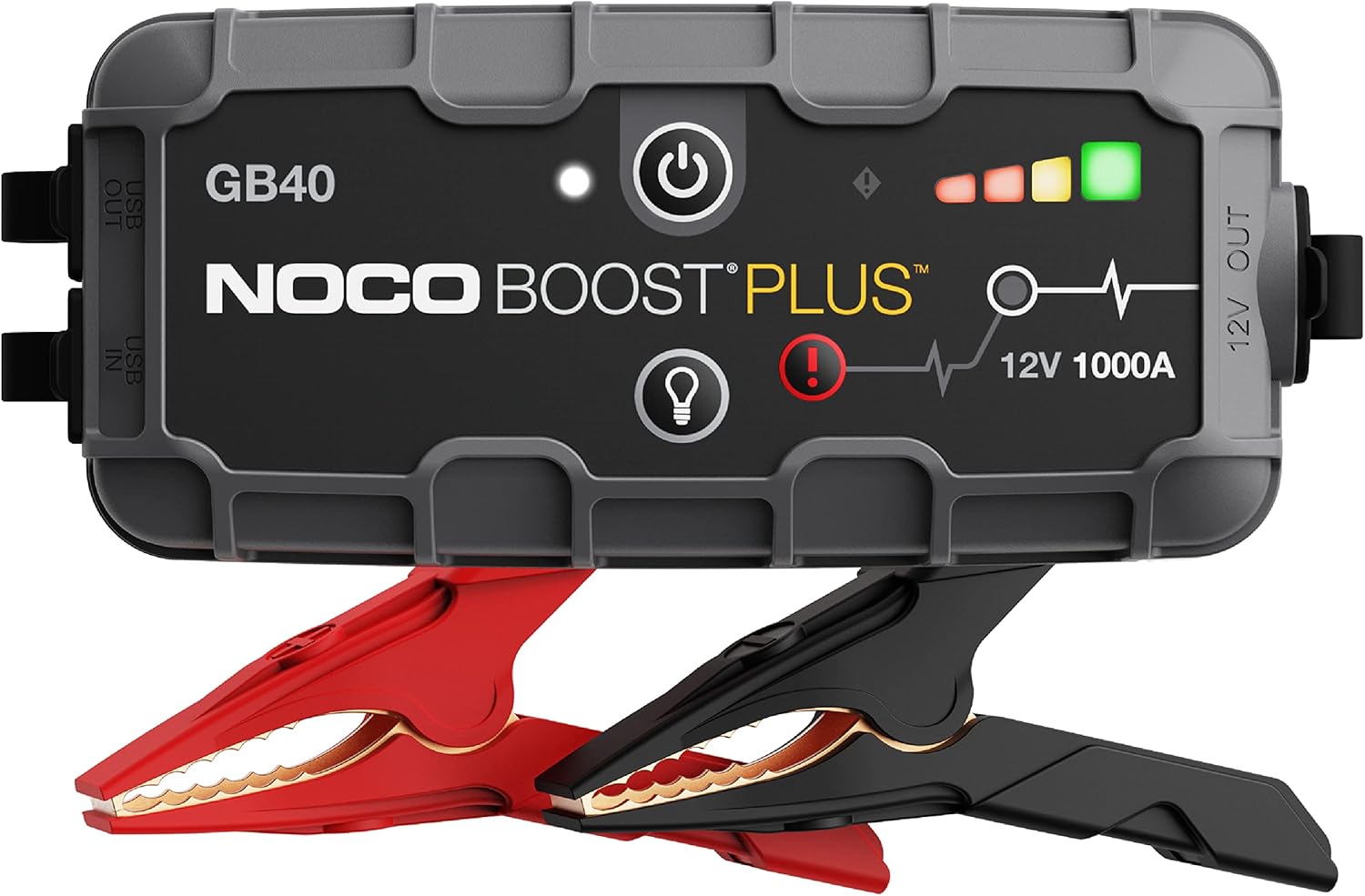
NOCO Boost Plus GB40 Jump Starter
A 1000A lithium jump starter that fits in your glovebox and works on any 12V battery. Your insurance against a dead 12V in a parking lot.
As an Amazon Associate, ThinkEV earns from qualifying purchases — at no extra cost to you.
Test the Regen, Not Just the Range
One-pedal driving is a real efficiency and comfort gain in the driving conditions most Canadian owners actually spend their time in, urban and suburban commutes with frequent stops. It is not a highway feature, it is not a winter miracle, and it is not consistent between brands. Buyers cross-shopping across manufacturers should treat one-pedal behaviour as a test-drive checklist item rather than an assumed capability, because the difference between "car stops itself at the light" and "car coasts through the light" is not a detail; it is a fundamentally different driving experience, and manufacturers have made different choices about which one is default. The Canadian buyer's move is to pick the implementation you actually want, verify it survives cold-weather regen throttling in the vehicle you are considering, and confirm the firmware behaviour has not shifted since the review you read. The physics is settled. The product is not.
Gear worth having
As an Amazon Associate, ThinkEV earns a small commission from qualifying purchases — at no extra cost to you.

Car Cup Holder Coasters (4-Pack)
Drop-in coasters that catch spills and crumbs so your cup holders stay clean. Rinse and reuse forever.
As an Amazon Associate, ThinkEV earns from qualifying purchases — at no extra cost to you.

Founder & Chief Editor
Vlad Pereira is the founder and chief editor of ThinkEV.ca, the Canadian electric-vehicle publication he writes and edits from Courtenay, British Columbia. He covers EV pricing, federal and provincial rebates, charging costs, and the Chinese manufacturers now entering Canada, from the buyer's side rather than the press-fleet side. ThinkEV is a venture of Vlad Pereira Online; his writing on health, income and the long game lives at vladpereira.com.
Frequently asked questions
Does one-pedal driving actually save your brake pads?
Can I switch off one-pedal if I hate it?
Does one-pedal regen still work in extreme cold?
Will I lose one-pedal behaviour after an OTA update?
Do rental EVs work the same as my own?
More EV & road-trip finds
Affordable upgrades worth a look — tap any to check the price on Amazon.
 ★ 1,944
VIOFO A229 Pro 4K Dash Cam
View on Amazon ★ 87
★ 87Car Window Sun Shades for Kids (4-Pack)
View on Amazon ★ 268
★ 268Anti-Slip Leather Steering Wheel Cover
View on Amazon ★ 8,681
Chemical Guys Complete Car Wash Kit
View on Amazon ★ 314
★ 314Mini USB LED Ambient Lamps (4-Pack)
View on Amazon ★ 4,626
HoogaLife Hanging Car Diffuser (2-Pack)
View on Amazon ★ 865
★ 865Collapsible Trunk Organizer
View on Amazon ★ 1,866
70mai A810 4K Dual Dash Cam
View on AmazonRead, Plan, Then Stay Current
Explore our expert articles to understand incentives and ownership costs, use the map to pressure-test charging reality, then subscribe so new EV coverage comes straight to you.
Continue Reading
How to Test-Drive an EV: What Gas-Car Buyers Miss

Software-Defined Vehicle: What It Really Means for EV Buyers

EV Highway vs City Range: Why They Flip
Which EVs Should Be Charged to 100%? The LFP Exception

First-Time EV Buyer Mistakes Worth Avoiding in Canada