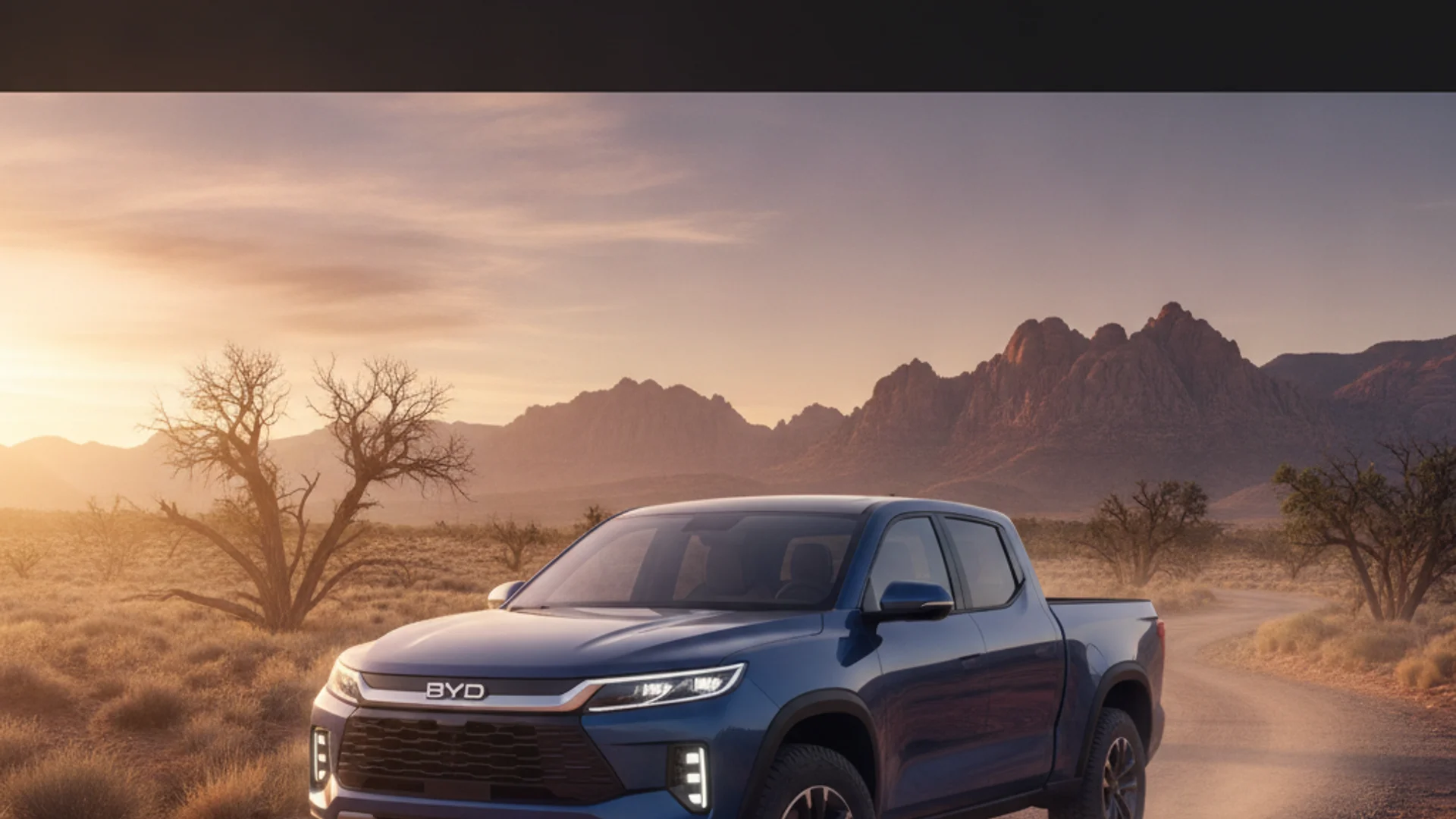
436 hp. 2,500 to 3,500 kg of towing depending on trim. A retail sticker below a base F-150 in Mexico. And no Canadian dealer network to sell it through. The BYD Shark 6 as of July 2026: a credible truck on a serious drivetrain, sold in Mexico, Australia, and the UK, with no confirmed Canadian arrival date. This guide walks through what the spec sheet actually says, what the tariff math produces if BYD does bring it, and when a Canadian buyer might realistically stand in a showroom looking at one.
Key takeaways
- BYD Shark 6 tows up to 3,500 kg and hits 100 km/h in 5.5 seconds, but Canada has no confirmed launch date.
- Canada's 100% tariff dropped to 6.1% in January 2026, landing the Shark 6 in the $65,000–$80,000 CAD range.
- Electric-only range is roughly 70 km in real Canadian conditions, useful for commutes, useless once a trailer is attached.
- The Shark competes with the Ford Ranger PHEV, not the F-150, lower price, higher torque, but no dealer network here.
- BYD skipped China entirely and launched the Shark 6 first in Mexico in May 2024, making it a purpose-built export product.
Quick Answer: What Is the BYD Shark 6?
The Shark 6 is BYD's first pickup truck, a body-on-frame plug-in hybrid measuring roughly 5.5 metres long, aimed squarely at the diesel mid-size segment. BYD announced the name in April 2024 and introduced the truck in Mexico on 14 May 2024, the first time BYD launched a vehicle globally outside China, the Shark is not marketed in China at all. That last detail is the tell. This is an export product engineered from day one for markets where diesel utes dominate and BYD wants a foothold: Mexico, Australia, Southeast Asia, and increasingly Europe.
The flagship is the Shark 6 Performance, and its numbers are not modest. A 2.0-litre turbocharged engine paired with the DMO Super Hybrid drivetrain produces a combined 350 kW and 700 Nm, moves the truck from 0 to 100 km/h in 5.5 seconds, and pulls up to 3,500 kg braked. Those are half-ton pickup figures delivered by a plug-in hybrid architecture, which is a genuinely new proposition in the segment.
A PHEV pickup carries two drivetrains, asks the buyer to plug in a five-and-a-half-metre truck, and delivers efficiency only when both conditions cooperate. The diesel Hilux buyer in Sydney already answered that objection, the Shark is BYD's fastest-selling export nameplate, and those buyers are choosing the compromise deliberately. The buyer who wants a truck that runs errands on electrons and tows on gasoline is the buyer this truck was engineered for, and there are more of them than the "why not full EV" crowd tends to admit.
Canada is not on any confirmed launch list. There is no BYD dealer network here, no Transport Canada compliance filing, and no announced distribution partner. The Shark 6 Canadian preview covers the current status in more detail; the summary is: interesting truck, no arrival date.
Gear worth having
As an Amazon Associate, ThinkEV earns a small commission from qualifying purchases — at no extra cost to you.

Lectron Level 2 J1772 Charger (40A, WiFi)
Smart WiFi charger with real-time energy monitoring. 40A / 9.6 kW, J1772 with a NEMA 14-50 plug, schedule charging right from your phone.
As an Amazon Associate, ThinkEV earns from qualifying purchases — at no extra cost to you.
Powertrain and Range: What the Numbers Actually Mean
The DMO Super Hybrid system is the engineering story. A turbocharged four-cylinder, 1.5 litres in the base trim, 2.0 litres in the Performance, pairs with dual electric motors and a battery large enough to run the truck on electrons alone for around 90 km on the CLTC test cycle. CLTC is China's domestic cycle and generously optimistic. The Shark is not sold in China, so the WLTP figure is the one that matters for markets that use it: roughly 56 miles of electric-only range on the UK-market Shark, which lands closer to 70 km in Canadian daily use.
Ninety kilometres of electric range is a useful number and a limited one. It covers a typical Canadian commute and a grocery run on battery alone. It does not cover a Vancouver-to-Whistler round trip, a weekend to the cottage, or any tow job of consequence, the moment the trailer is behind you, the gasoline engine is doing most of the work, and the "PHEV efficiency" figures collapse toward what a conventional truck delivers.
The Shark's body-on-frame construction still enables it to tow and haul serious loads, though it lacks a full transfer case and makes do with an all-wheel-drive system. No transfer case means no true low range for slow-speed crawling. No locking differentials means the truck's off-road envelope stops well short of a serious rock crawler, a limitation buyers on the electric-vehicles subreddit flagged explicitly in the truck's 7.5/10 review thread. The Shark 6 will handle a snowy driveway, a gravel forestry road, and a boat launch. It is not a Wrangler with a bed.
WLTP-certified combined efficiency lands near 81 mpg equivalent per Autocar's UK review, a figure that reads as marketing until you unpack it. That number assumes the battery is charged and the driver drives conservatively on the WLTP cycle. Empty the battery, load the bed, put a trailer behind you, and the fuel-economy number will find its way back to something a diesel Hilux driver would recognize. This is not a criticism, it is how PHEVs work. It is a caution against reading the headline number as a real-world promise.
Towing, Payload, and Whether It Competes with North American Trucks
Towing is where the Shark 6 becomes genuinely interesting for the Canadian buyer who might one day get to buy one. The Performance variant is rated at 3,500 kg braked in Australian spec. The base Premium variant sits around 2,500 kg in the UK-market truck, alongside 1,200 kg of payload. Those numbers put the Shark in the same conversation as a Ford Ranger PHEV or a Toyota Hilux, below a half-ton F-150 or RAM 1500's ceiling, but well above every PHEV or EV truck sold outside the United States.
The comparison to the F-150 PowerBoost is instructive. The PowerBoost is a full-hybrid half-ton with a 570-kg payload advantage and roughly double the towing capacity in its top configuration. The Shark 6 does not compete there. It competes with mid-size pickups, Ranger, Colorado, Frontier, Hilux, and inside that segment its towing number is at the top of the pack. The sharper comparison is with the Ford Ranger PHEV, which arrived in Australia and Europe on a similar 2024–2025 window and shares almost identical positioning: mid-size body, plug-in drivetrain, tradie buyer. The Ranger PHEV tows 3,500 kg on paper too. What the Shark brings is a lower list price in every market where both are sold, and a 700 Nm torque figure that outpoints the Ranger's system output. The Ranger brings a dealer network and a Ford badge. In Canada neither truck is currently for sale, so the fight is theoretical, but it is the fight, not the F-150 comparison, that will decide whether the Shark finds buyers here.
Payload figures for North American spec remain a gap in the public data. Australian material lists payload in the 790–830 kg range depending on trim. Canadian ratings could differ, and without a Transport Canada filing there is no confirmed number to publish. A serious work-truck buyer would need that figure before writing a cheque. A weekend hauler pulling a 2,500 kg trailer three times a summer would find the current Australian spec adequate.
Suspension tune is comfort-biased. MotorTrend spent a week with the Shark in Mexico City, a sprawling metropolis that turned out to be an apt test of the truck's range of abilities thanks to broken roads and thick traffic. The reviewer came away describing a ride quality closer to a crossover than a work truck. For a pickup that is going to spend more time in a Costco parking lot than a construction site, that is arguably the right call. For a landscaper's daily driver, it is a compromise.

Gear worth having
As an Amazon Associate, ThinkEV earns a small commission from qualifying purchases — at no extra cost to you.

USB-A to USB-C CarPlay Adapter (3-Pack)
Older car USB port, newer USB-C cable: this tiny bridge makes wired CarPlay just work. Three so you never lose the one.
As an Amazon Associate, ThinkEV earns from qualifying purchases — at no extra cost to you.
Canada Price Band: $65,000 to $80,000 CAD, and Why It's a Range
Landed Canadian retail: $65,000 to $80,000 CAD for a mid-trim transaction. Here is the math, and here is why the band does not collapse to a single number.
Gear worth having
As an Amazon Associate, ThinkEV earns a small commission from qualifying purchases — at no extra cost to you.

Grizzl-E Classic Level 2 EV Charger (40A)
Canadian-made and rated for minus 40C winters. 40A / 9.6 kW, NEMA 14-50, indoor/outdoor, 24-ft cable. The charger built for Canadian weather.
As an Amazon Associate, ThinkEV earns from qualifying purchases — at no extra cost to you.
The tariff math starts with Canada's rate change. The federal surtax on Chinese-built EVs dropped from 100% to 6.1% on January 16, 2026, inside a 49,000-unit annual quota. Above the quota the rate reverts to 100%. Mexico list pricing for the Shark 6 Premium sits at roughly CAD $50,000–$55,000 equivalent before any import cost. Apply a 6.1% tariff and you add $3,000 to $4,000. Add ocean freight, port handling, federal excise, provincial sales tax at the point of retail, distributor margin, and dealer margin, and the landed retail number climbs into the mid-sixties for a base trim.
The Performance variant, with its 350 kW drivetrain and 3,500 kg towing, would sit at the top of the band. Australia sells that trim at roughly AUD $70,000–$75,000, which converts to about CAD $65,000–$70,000 pre-import. Landed in Canada with tariff, freight, and margin, the Performance would realistically clear $75,000 and could touch $80,000 in provinces where sales tax stacks aggressively.
The wider factor is the federal rebate. China-built EVs are excluded from EVAP on country-of-origin grounds regardless of price. The Shark 6 does not qualify for the federal purchase incentive at any trim. That is a load-bearing detail for the buyer running the math against a Ford Maverick Hybrid or a Ranger PHEV, the sticker gap that looks close on paper widens by $5,000 the moment the rebate is applied to the domestic competition.
The counter-argument here comes from Canadian EV buyers themselves. The recurring line on the r/EVCanada thread on the Shark is that Canada already subsidizes American automakers through direct funding and tax breaks that flow to shareholders rather than to better vehicles or lower prices, so the rebate exclusion looks less like protecting a domestic industry and more like protecting an incumbent margin. That framing is politically potent, and it is not wrong on the underlying economics, but it does not change the buyer's math this year. The rebate is what it is. The $5,000 gap is real regardless of whether one thinks it should exist.
Provincial incentives are a mixed bag. Quebec's Roulez Vert program has its own eligibility criteria. British Columbia's CleanBC rebate applies to PHEVs meeting electric-range thresholds, the Shark 6 likely clears the 50-km CLTC minimum but would still need to survive the country-of-origin conversation that provincial programs have been quietly aligning with the federal one. Assume no provincial rebate until proven otherwise. The detailed price band analysis covers this in more depth; the number is defensible but every input is a range, not a point.
Gear worth having
As an Amazon Associate, ThinkEV earns a small commission from qualifying purchases — at no extra cost to you.

PULIDIKI Car Cleaning Gel (Detailing Putty)
Press it into vents, buttons, and seams and it lifts out dust you did not know was there. Weirdly satisfying, genuinely useful.
As an Amazon Associate, ThinkEV earns from qualifying purchases — at no extra cost to you.
When Could Canada Actually See the Shark 6?
BYD has not announced Canada in any Shark 6 launch roadmap as of July 2026. That is the single most important sentence in this guide, and it does not appear to be changing this year.
The precedent to watch is the Seal. BYD showed the Seal internationally in 2022. Australia got the car in 2023. Europe followed in 2024. Canada, despite Ontario's automotive-supply-chain infrastructure and BC's high EV adoption rate, has still not received a Seal through a formal BYD channel, the arrivals here have been grey-market imports and one-off dealer experiments. The pattern is clear: 12 to 24 months between international debut and Canadian retail, and even that timeline assumes BYD has committed to the market.
Right-hand-drive markets have been served first for pragmatic reasons. Mexico is next door to BYD's Nuevo León investment. Australia is the largest ute market in the developed world outside North America. The UK, right-hand-drive and ute-friendly, was a natural third stop. Left-hand-drive Canada requires a separate homologation, a separate compliance filing, and, critically, a distribution partner willing to take the political risk of importing a Chinese vehicle in a policy environment that could change again.
That policy risk is worth naming. The 6.1% tariff rate sits inside a 49,000-unit annual quota. Above the quota, the rate returns to 100%. A distributor bringing in Shark 6 units has to model not only the tariff at the point of import but the cumulative Chinese-EV quota position at that moment. A shipment landing in November of a heavy import year could face a completely different rate than one landing in January. That volatility is a genuine deterrent to any dealer considering committing to the model.
The optimistic read comes from the review commentariat. Coverage of the Shark's Canadian debut noted that reviewers were "convinced it would sell out" if the truck arrived at a competitive price, and that competitive Chinese pickups could create serious pressure on Western automakers slow to offer affordable electrified trucks. That is a real market signal. It is also a signal that has existed for eighteen months without moving a single BYD dealer contract across a Canadian border. Demand alone does not resolve the compliance and tariff-quota problems. It only makes them more expensive to leave unresolved.
Realistic window: late 2027 at earliest. That assumes the tariff framework holds, that BYD makes the strategic decision to enter Canada formally, that a distribution partner emerges, and that Transport Canada compliance clears in a reasonable timeframe. Any one of those slipping pushes the timeline into 2028. Any two slipping delays it further. The direct-answer breakdown of Canadian arrival covers the strategic case in more detail; the timeline math there aligns with what this guide's data supports.
The earliest confirmable public signal will not be a press release. It will be a Transport Canada filing, a homologation submission, a recall database entry against a Canadian VIN prefix, or an NRCan fuel economy listing. Those three databases are updated on regulatory cadence, not marketing cadence, and they capture the vehicle's Canadian existence before any showroom does. A buyer serious about tracking arrival should watch those filings. The truck shows up there first.
Two dated checkpoints worth marking on a calendar. First: the Q4 2026 federal quota utilization number. If the 49,000-unit Chinese-EV quota is under-subscribed at year end, say, below 30,000 units imported, the tariff certainty for a 2027 shipment improves materially, and the distributor case gets easier to underwrite. Second: any Transport Canada homologation filing under the BYD manufacturer code before June 2027. That single database entry is the earliest verifiable trigger that a formal Canadian launch is in motion, and it will surface months before any dealership signage does.
A credible PHEV pickup at a reachable price point, with no Canadian arrival date and no distributor willing to bet on one yet.
Gear worth having
As an Amazon Associate, ThinkEV earns a small commission from qualifying purchases — at no extra cost to you.

WixGear Magnetic Air Vent Phone Mount (2-Pack)
A magnet strong enough that your phone never flinches over potholes or rail crossings. Two in the box, one for each car.
As an Amazon Associate, ThinkEV earns from qualifying purchases — at no extra cost to you.

Founder & Chief Editor
Vlad Pereira is the founder and chief editor of ThinkEV.ca, the Canadian electric-vehicle publication he writes and edits from Courtenay, British Columbia. He covers EV pricing, federal and provincial rebates, charging costs, and the Chinese manufacturers now entering Canada, from the buyer's side rather than the press-fleet side. ThinkEV is a venture of Vlad Pereira Online; his writing on health, income and the long game lives at vladpereira.com.
Frequently asked questions
Does the Shark 6 qualify for Canada's federal EV rebate?
Can it run on gas only if the battery dies?
What trim would actually arrive in Canada first?
How does 3,500 kg towing hold up without a proper low range?
Which Canadian provinces would this truck make the most sense in?
More EV & road-trip finds
Affordable upgrades worth a look — tap any to check the price on Amazon.
 ★ 392
★ 392Large Cup Holder Adapter (32-40oz)
View on Amazon ★ 4,050
Touchscreen Mist Screen Cleaner Kit
View on Amazon ★ 537
★ 537USB Star Projector Roof Light
View on Amazon ★ 546
★ 546Funny Headrest Face Covers (2-Pack)
View on Amazon ★ 865
★ 865Collapsible Trunk Organizer
View on Amazon ★ 1,866
70mai A810 4K Dual Dash Cam
View on Amazon ★ 119
★ 119Foldable Waterproof Trunk Organizer
View on Amazon ★ 17,839
Qifutan Vent Phone Mount (Military-Grade Clip)
View on AmazonRead, Plan, Then Stay Current
Explore our expert articles to understand incentives and ownership costs, use the map to pressure-test charging reality, then subscribe so new EV coverage comes straight to you.
Continue Reading

EV Battery Size vs Range: Why Bigger Isn't Always Better
Which EVs Should Be Charged to 100%? The LFP Exception

First-Time EV Buyer Mistakes Worth Avoiding in Canada

Rivian Canada 2026: R1T, R1S Prices and R2 Release Date
Why Cold Weather Cuts EV Range, the Real Reasons