$55,000 to $68,000 CAD for the base trim, with the uncertainty labelled rather than rounded away. That is the landed-price band for a Chinese pickup truck with 3,500 kg towing and a plug-in hybrid powertrain the Big Three have been promising for years and still haven't shipped on a half-ton platform. That is the BYD Shark 6, and it is the reason "BYD truck" is now a live Canadian search query rather than an industry-conference footnote. Two separate BYD truck stories are live in Canada, most search intent lands on one of them, and the tariff classification is the load-bearing question for whether either story ends well for the retail buyer.
Key takeaways
- The BYD Shark 6 lands in a $55,000–$68,000 CAD price band, though that estimate stays deliberately wide until Canadian MSRP is confirmed.
- Its 3,500 kg tow rating in PHEV trim is a number neither the Tacoma PHEV nor the announced Ranger PHEV currently matches.
- Canada's 100% Chinese EV surtax dropped to 6.1% in January 2026 inside a 49,000-unit annual quota, above that, 100% returns.
- The Shark 6 debuted globally in Mexico in May 2024 and is explicitly not sold in China, making Canada's tariff ruling the pivotal question.
- Quoted at ~80 km electric range on CLTC, real-world Canadian mixed-condition range realistically trims to 55–65 km.
Quick Answer: What Is the BYD Truck Available in Canada?
BYD sells two distinct truck lines, and conflating them is the fastest way to get the buying decision wrong.
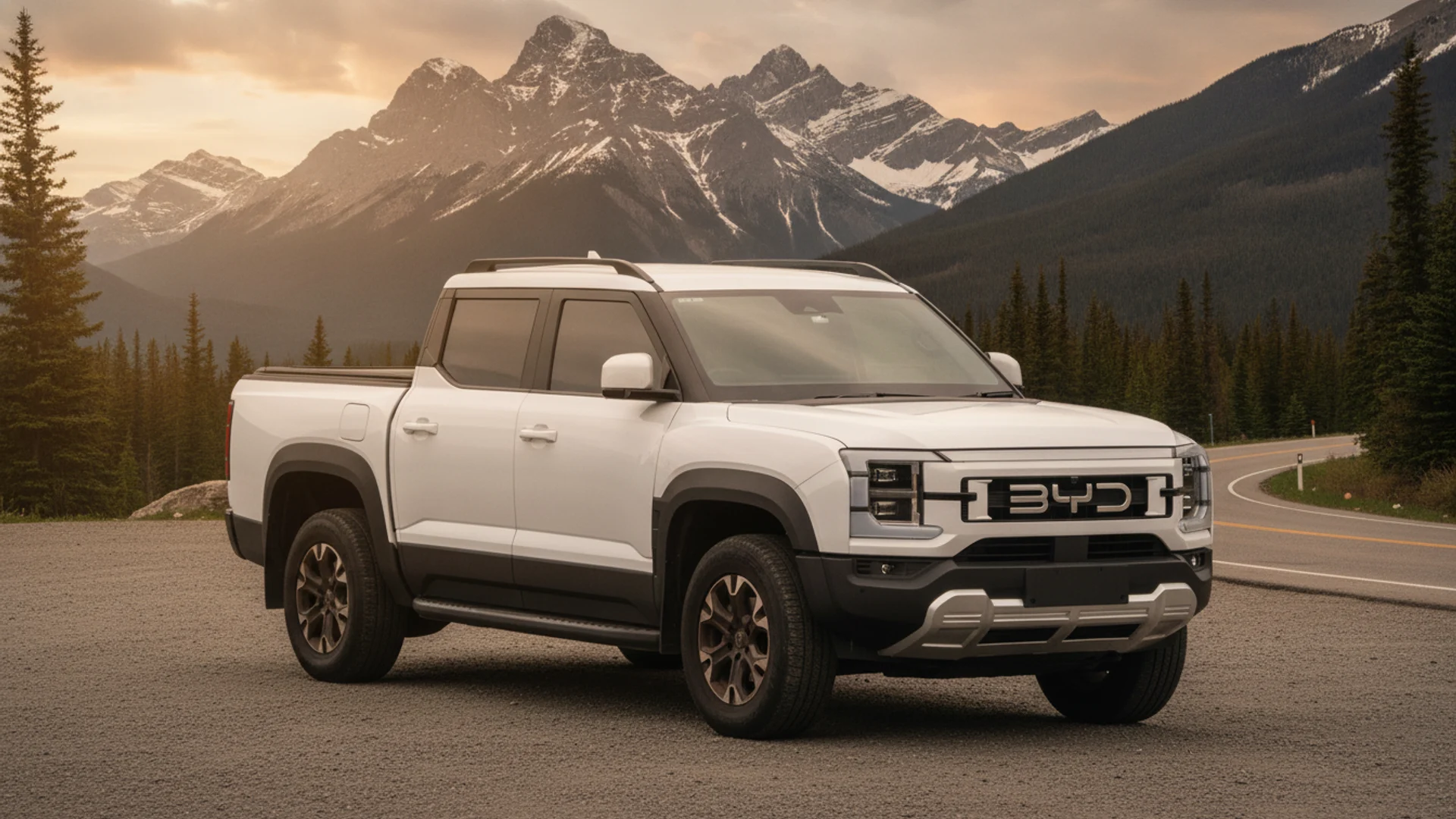
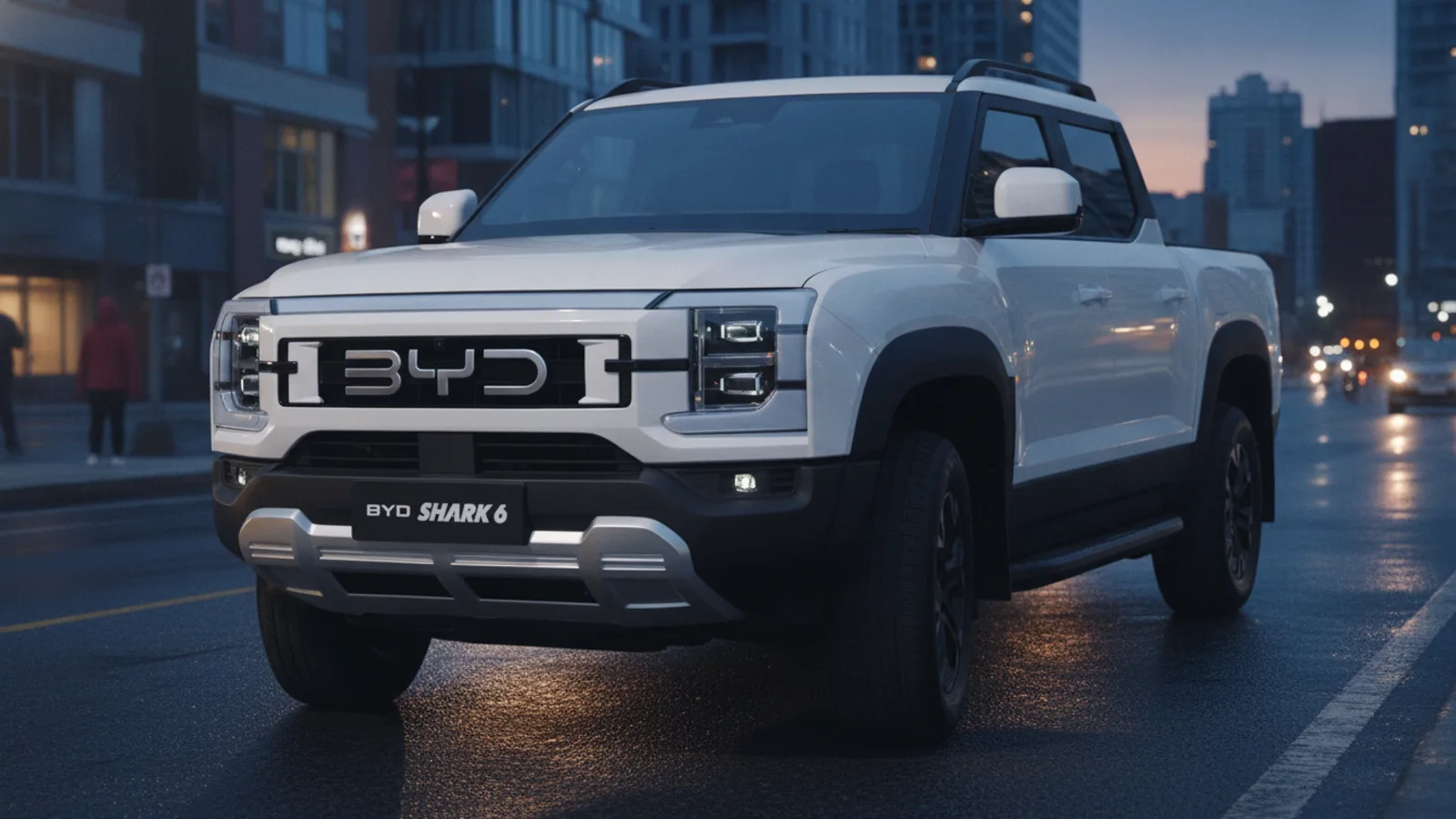
The Shark 6 is the consumer PHEV pickup, a body-on-frame half-ton. BYD announced in April 2024 that it would name its first pickup truck the BYD Shark, first introduced the truck in Mexico on 14 May 2024, and made it the first BYD vehicle to have a global debut launch outside China; the Shark is not marketed in China. The launch market was Mexico, not Canada, because Mexico's zero-tariff position on Chinese EVs is exactly the regulatory posture Canada does not share. Same truck, different border, different verdict. That is the vehicle Canadian buyers are searching for when they type "BYD truck", the one with the plug, the tow rating, and the 2026 timing.
The commercial line is a completely separate product family. Besides the 8TT Class 8 semi-truck, BYD offers a wide range of all-electric trucks, including the T10, a Class 8 chassis truck that can be equipped with many different superstructures and available with a 324 kWh battery; the T8, another Class 8 chassis truck; Class 6 trucks; and lighter commercial vehicles. These already operate in Canada in fleet and transit roles through commercial distributors. Different buyer, different sales channel, different rulebook.
If you are a fleet operator, the commercial catalogue is the conversation. If you want a driveway truck that plugs in, everything below is about the Shark 6.
Gear worth having
As an Amazon Associate, ThinkEV earns a small commission from qualifying purchases — at no extra cost to you.

Portable Level 2 EV Charger (40A, NEMA 14-50)
Throw it in the trunk and charge anywhere with a 240V outlet. 40A portable with NEMA 14-50 plug. Your road-trip insurance policy.
As an Amazon Associate, ThinkEV earns from qualifying purchases — at no extra cost to you.
BYD Shark 6 Specs: What the Powertrain Actually Delivers
The Shark 6 runs a 1.5-litre turbocharged engine paired with dual electric motors, combined output landing around 430 horsepower and 0–100 km/h in under 5.7 seconds. Those are supercar numbers on a pickup, which is either a marketing coup or an indictment of how long half-ton buyers have been asked to tolerate leisurely acceleration.
Electric-only range is quoted at roughly 80 km on the CLTC cycle. CLTC is the most optimistic test cycle in active use anywhere on Earth, so the honest Canadian mixed-conditions number lands closer to 55–65 km, enough to cover the average Canadian daily drive on the battery, with the turbo four handling everything past that. Total range with the tank full pushes past 800 km, which is a range figure, not a range anxiety figure.
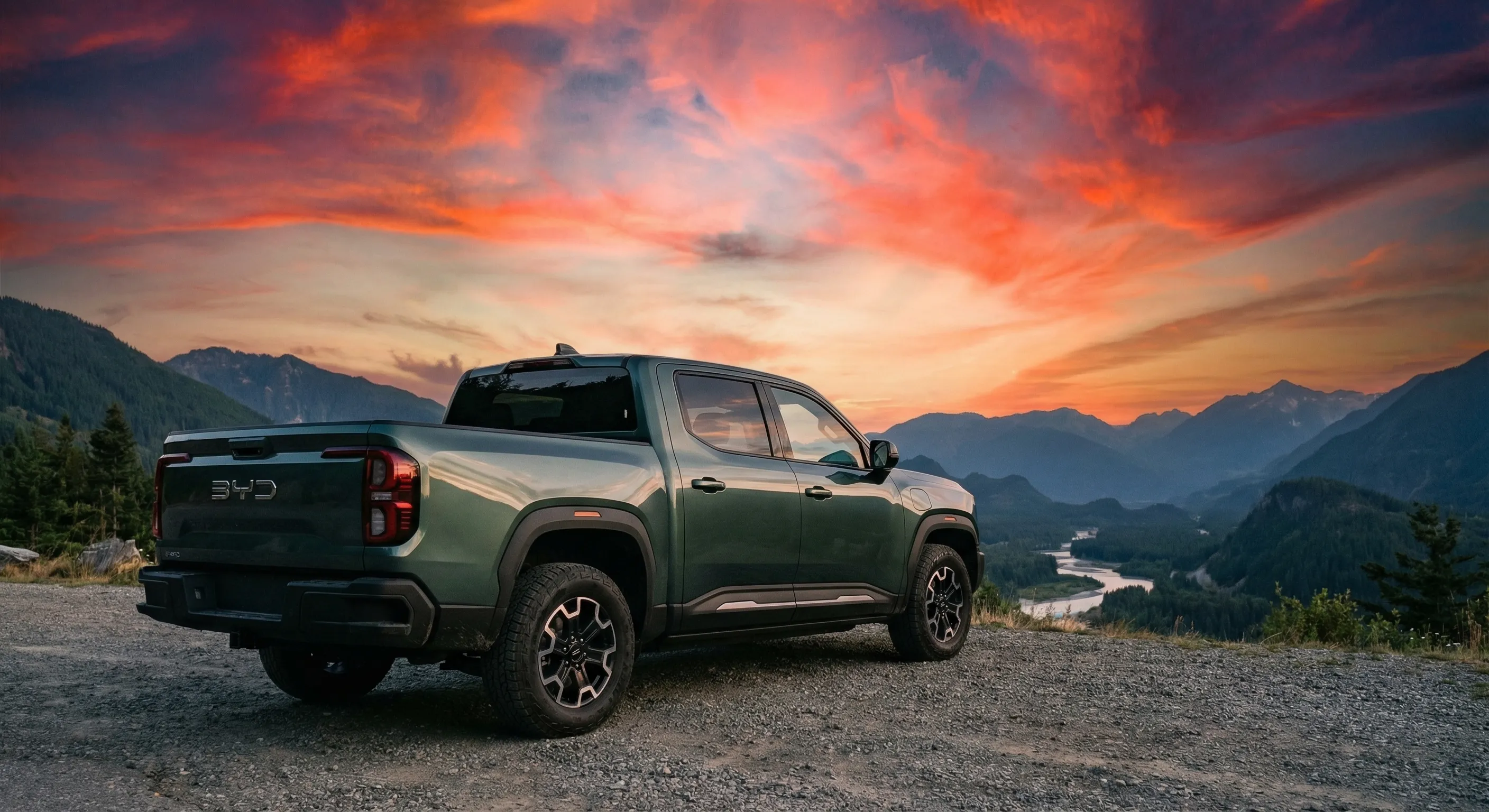
Towing is rated at 3,500 kg. Payload for the Canadian-spec truck is not yet published. The architecture is body-on-frame, not a unibody crossover wearing a truck bed for costume, a distinction that matters the first time you put a tandem-axle trailer behind it.
With a plug-in hybrid powertrain and aggressive pricing, the BYD Shark takes direct aim at the Toyota Tacoma and Ford Ranger. That is the segment. That is the pitch. The reviewer's read on why it matters, that it sent a clear message to traditional automakers: it's here to disrupt the segment, is the frame worth carrying into the Canadian analysis. Disruption for a Mexican or Australian buyer is a price on a lot. Disruption for a Canadian buyer is a tariff ruling that may or may not permit the price on the lot. Same truck, different verdict, and the difference is regulatory.
The Shark 6 is not the first electrified pickup to reach a Canadian conversation, the Ford Lightning has been in dealerships for years, but it is the first PHEV pickup with numbers this aggressive on a body-on-frame platform. For the shape of the electric-truck competitive field, Canada's Ford F-150 Lightning reality check is the reference point for what the incumbent's electric answer looks like at $84,000 MSRP.
How It Stacks Against the Tacoma PHEV and Ford Ranger
Toyota shipped the Tacoma PHEV in 2024 with roughly 40 km of electric range. On paper, the Shark 6 doubles that. In practice, "on paper" is doing real work in that sentence, CLTC-to-real-world haircuts are steep, and the Tacoma's EPA figure is a tougher test, but even after the discount, the Shark 6 clears the Tacoma by a comfortable margin.
Ford has announced a Ranger PHEV for select markets. North American timing remains unconfirmed as of mid-2026. Treating the Ranger PHEV as a Canadian counter-move to the Shark 6 requires assuming a launch that has not been scheduled, which is the kind of assumption the Big Three have been asking Canadian buyers to make about electrified pickups for the better part of a decade.
The obvious objection here is that spec-sheet comparisons flatter new entrants and punish incumbents. Toyota's dealer network, parts depth, and resale curve are worth real money that a launch-year import cannot match, and a buyer who trades trucks every four years absorbs depreciation risk that a Shark 6 owner cannot yet quantify. Fair. The rebuttal is that the Tacoma PHEV's 40-km electric range does not close on the Shark 6's number no matter how deep the dealer network runs, depreciation math only wins if the incumbent's product is competitive on the thing the buyer is buying, and on electric range and towing it is not.
The pricing gap is the story. BYD's Mexican launch positioned the Shark 6 well below Tacoma PHEV equivalents. Translating Mexican MSRP to a Canadian landed price is not arithmetic, it is a tariff and homologation question, but the base-trim band lands in the $55,000 to $68,000 CAD range on the current best evidence. That is an estimate, deliberately wide, and I won't round it to a single dollar figure until Canadian MSRP is confirmed.
Neither the Tacoma PHEV nor the announced Ranger PHEV is rated for 3,500 kg in PHEV trim, and that number is the wedge the incumbents have not answered. If you actually pull a trailer, the segment comparison stops being close.
Gear worth having
As an Amazon Associate, ThinkEV earns a small commission from qualifying purchases — at no extra cost to you.

WeatherTech FloorLiner for Tesla Model 3
Deep-channel liners that trap every drop of slush and salt. The difference between a ruined interior and a showroom-fresh cabin after a Canadian winter.
As an Amazon Associate, ThinkEV earns from qualifying purchases — at no extra cost to you.
For the full-size context, where 640-km-range electric trucks live at $90,000+ CAD, Chevy's Silverado EV Canada review shows what the price ladder looks like above the Shark 6. And for the "capable electric truck, priced accordingly" argument, Rivian's R1T Canada review is the boutique benchmark.
Gear worth having
As an Amazon Associate, ThinkEV earns a small commission from qualifying purchases — at no extra cost to you.

Grizzl-E Classic Level 2 EV Charger (40A)
Canadian-made and rated for minus 40C winters. 40A / 9.6 kW, NEMA 14-50, indoor/outdoor, 24-ft cable. The charger built for Canadian weather.
As an Amazon Associate, ThinkEV earns from qualifying purchases — at no extra cost to you.
Canada Availability, Tariffs, and the 100% Duty Question
Canada's 100% surtax on Chinese EVs took effect in October 2024 and dropped to 6.1% on January 16, 2026 inside a 49,000-unit annual quota. Above the quota, the rate reverts to 100%. That is the current regime, and the Shark 6's PHEV classification sits inside the single load-bearing ambiguity.
The surtax was written for battery-electric vehicles. Plug-in hybrids are classified differently in most trade codes, and the CRA ruling on whether the Shark 6 falls inside or outside the surtax perimeter is not yet public. If PHEVs are outside the surtax, the Shark 6 lands at the $55,000–$68,000 band on straight import economics. If PHEVs are inside, add roughly a 6.1% duty inside the quota and the number moves up a few thousand dollars, still competitive. If the ruling somehow puts the truck outside the quota entirely at the 100% rate, the price case collapses and this article's conclusion becomes academic. The classification ruling is the only number that moves the price case by an order of magnitude, every other variable is noise until that one prints.
Federal rebate exposure is the second question. EVAP replaced iZEV as the current federal rebate in February 2026, and EVAP excludes China-built vehicles regardless of price or trim. So no BYD model qualifies for the federal rebate at any Canadian MSRP. Provincial rebates in Quebec and BC apply their own eligibility rules; treat those as case-by-case rather than assumed.
A common counterpoint from Canadian EV buyers is that the surtax exists for legitimate industrial-policy reasons and should not be routed around. That framing is coherent, but it dodges the accounting: the federal government's own EV-adoption targets require price points the domestic manufacturers have not delivered on the pickup segment, and asking retail buyers to underwrite the adjustment period with $30,000 of forgone consumer surplus per truck is a policy choice worth naming out loud rather than laundering through tariff codes.
BYD has signalled Canada as a target market. No confirmed dealer network exists yet, and no import timeline has been published. A late-2026 announcement with mid-2027 retail delivery is the realistic floor for planning purposes. The full pricing breakdown, including the tariff scenarios modelled at each duty rate, sits alongside this piece.
Gear worth having
As an Amazon Associate, ThinkEV earns a small commission from qualifying purchases — at no extra cost to you.

PULIDIKI Car Cleaning Gel (Detailing Putty)
Press it into vents, buttons, and seams and it lifts out dust you did not know was there. Weirdly satisfying, genuinely useful.
As an Amazon Associate, ThinkEV earns from qualifying purchases — at no extra cost to you.
Who Should Wait for It, and Who Shouldn't
The Shark 6 is a strong fit for a specific buyer profile: fleet operators who need towing capacity but want daily-driver EV range to cut fuel costs, and urban truck buyers who genuinely plug in overnight. If your commute is 40 km round trip and you own a Level 2 charger, you will burn almost no gasoline in this truck. That is a fuel bill that looks less like a truck and more like a philosophy.
Poor fit: buyers who need a confirmed service network on day one, buyers whose calculation depends on OEM warranty coverage they can walk into a dealership for tomorrow, and buyers who need delivery this year. The Shark 6 does not clear any of those bars in Canada yet, and pretending otherwise is how buyers end up disappointed.
Heavy fleet buyers should be looking at the commercial line instead. The T8, T10, and 8TT semi are already available through Canadian distributors, a separate path with a separate sales channel, purpose-built for the operator who cares about depot charging, uptime warranties, and total-cost-of-ownership math over a 10-year service life. That is a different product and a different conversation.
The single largest risk to the Shark 6's Canadian price case is the tariff classification. If the CRA ruling lands unfavourably, putting the PHEV inside the 100% surtax perimeter outside the quota, the price advantage that makes this truck interesting evaporates, and the honest recommendation becomes "buy a Tacoma." I do not think that outcome is the base case; PHEV classification in Canadian trade code has historically diverged from BEV treatment, and the surtax's design pointed at pure battery-electrics. But I would not commit to a Shark 6 deposit until the classification is confirmed in writing.
The wave of Chinese EVs Canadian buyers will actually see over the next 24 months starts here, the Shark 6 is the highest-volume, highest-visibility test of whether Canada's post-January-2026 tariff regime translates into competitive retail pricing at the driveway, or gets eaten by the supply chain between Shenzhen and Vancouver. Three variables settle it: the CRA classification ruling whenever it prints, the BYD Canada dealer announcement the industry expects before December 2026, and the base-trim Canadian MSRP itself. Under $60,000 CAD validates the price case here; $60,000 to $70,000 keeps the argument intact with narrower margins; above $70,000 means the tariff regime ate the disruption before it reached the driveway, and the trajectory of every Chinese EV that follows will be legible in the same three numbers.
Gear worth having
As an Amazon Associate, ThinkEV earns a small commission from qualifying purchases — at no extra cost to you.

WixGear Magnetic Air Vent Phone Mount (2-Pack)
A magnet strong enough that your phone never flinches over potholes or rail crossings. Two in the box, one for each car.
As an Amazon Associate, ThinkEV earns from qualifying purchases — at no extra cost to you.

Founder & Chief Editor
Vlad Pereira is the founder and chief editor of ThinkEV.ca, the Canadian electric-vehicle publication he writes and edits from Courtenay, British Columbia. He covers EV pricing, federal and provincial rebates, charging costs, and the Chinese manufacturers now entering Canada, from the buyer's side rather than the press-fleet side. ThinkEV is a venture of Vlad Pereira Online; his writing on health, income and the long game lives at vladpereira.com.
Frequently asked questions
Does the 100% Chinese EV tariff actually apply to the Shark 6?
How does 80 km electric range translate to Canadian real-world driving?
Can the Shark 6 actually tow 3,500 kg in PHEV mode?
When can Canadians actually buy one?
Is BYD's commercial truck lineup the same as the Shark 6?
More EV & road-trip finds
Affordable upgrades worth a look — tap any to check the price on Amazon.
 ★ 8,681
Chemical Guys Complete Car Wash Kit
View on Amazon ★ 55
★ 55LED Car Door Logo Projector Light
View on Amazon ★ 1,083
Crystal Push-Start Button Ring (2-Pack)
View on Amazon ★ 27,769
Car Cup Holder Coasters (4-Pack)
View on Amazon ★ 721
★ 72145W USB-C Fast Car Charger
View on Amazon ★ 119
★ 119Foldable Waterproof Trunk Organizer
View on Amazon ★ 268
★ 268Anti-Slip Leather Steering Wheel Cover
View on Amazon ★ 2,941
Microfiber Cleaning Cloths (Multi-Pack)
View on AmazonRead, Plan, Then Stay Current
Explore our expert articles to understand incentives and ownership costs, use the map to pressure-test charging reality, then subscribe so new EV coverage comes straight to you.
Continue Reading
BYD Shark 6 Canada: Specs, Price Band & 2026 Lineup Guide
BYD Shark 6 Canada, The Direct Answer
BYD Shark 6 Price in Canada: $55K–$62K Estimate, Explained
BYD Truck Canada Price: The Number That Matters

Are Canada's Repair Shops Ready for Chinese EVs?