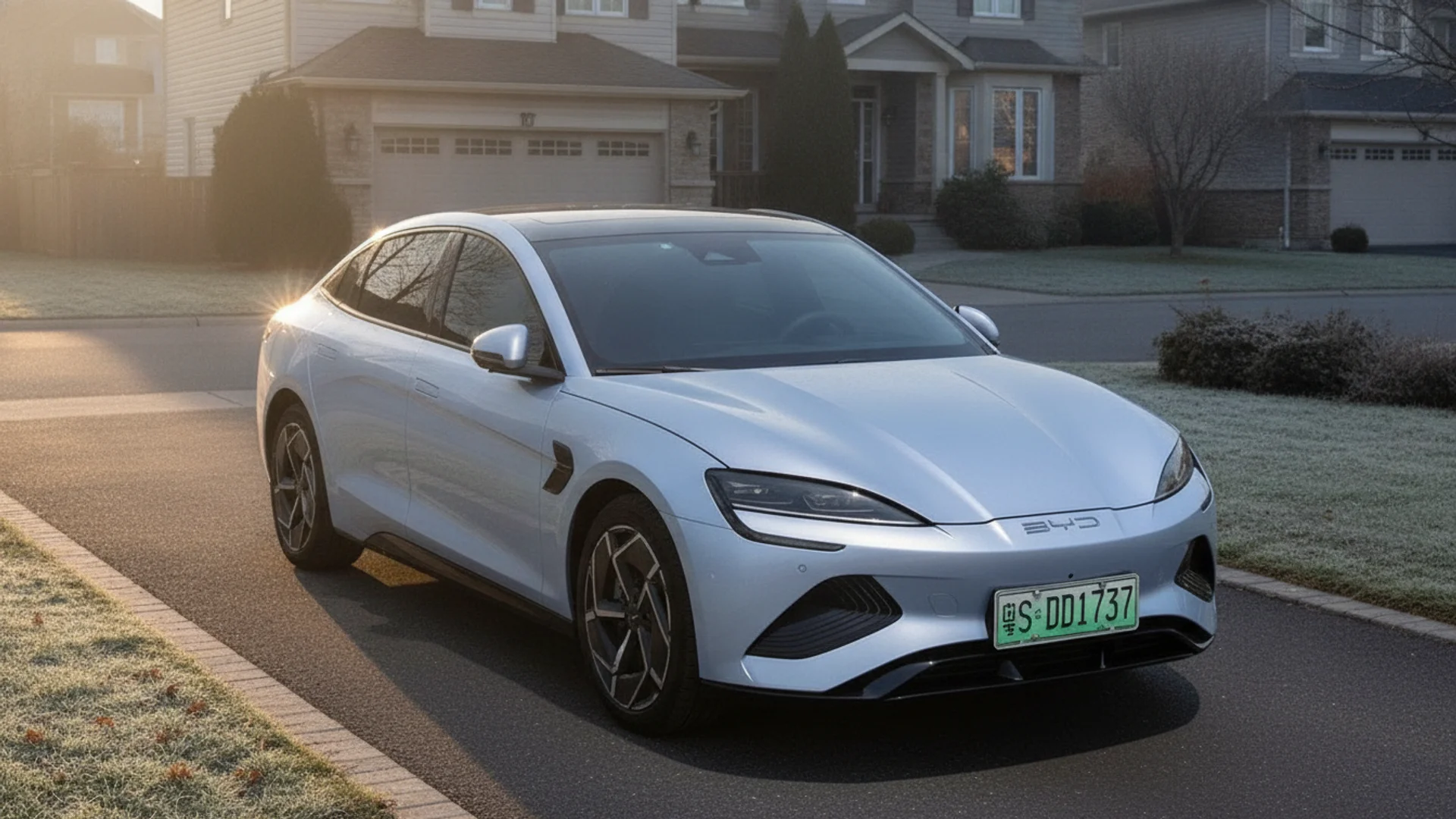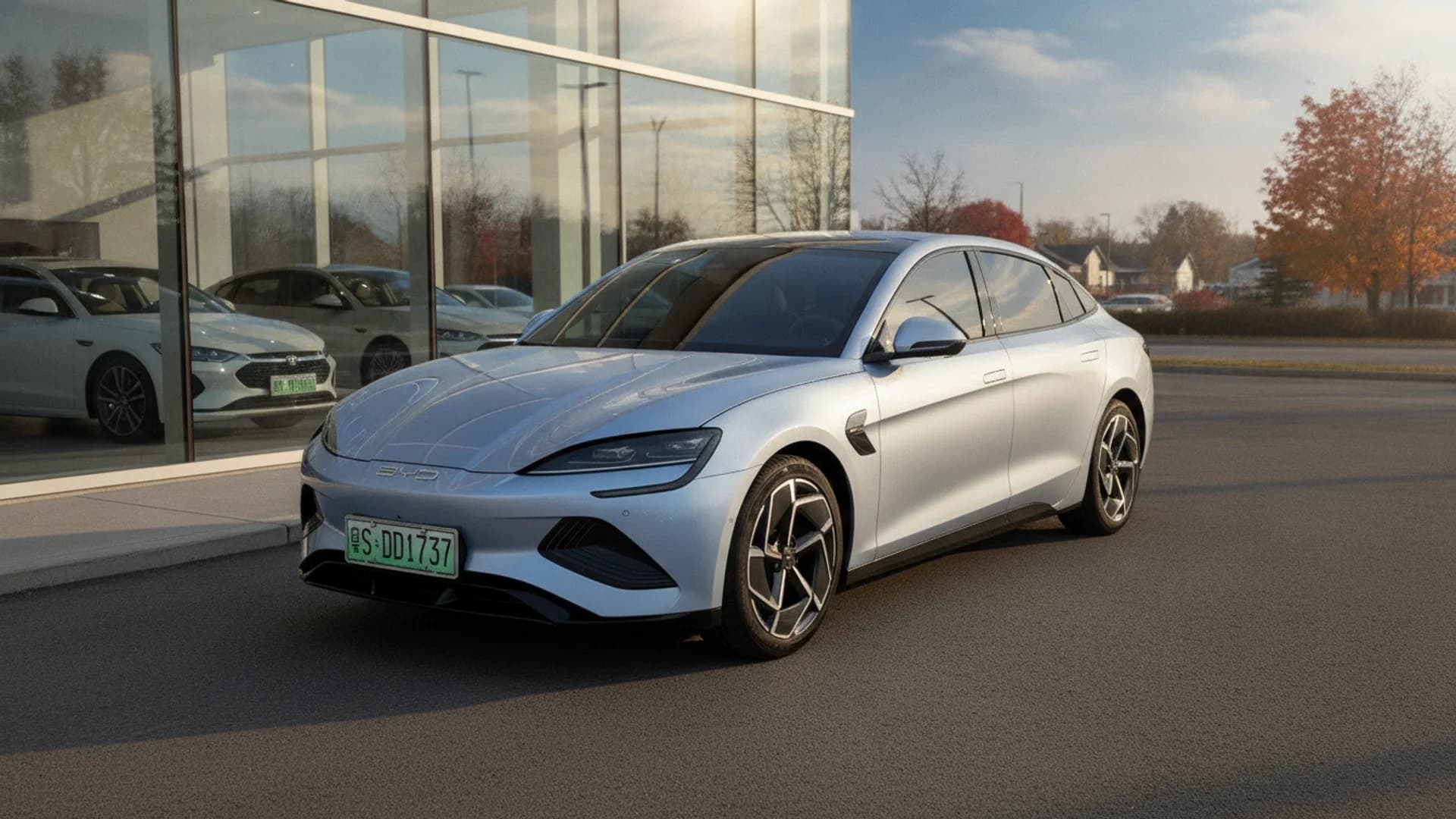
Ottawa set a 49,000-vehicle annual cap on Chinese EV imports. BYD alone is planning 20 dealerships. Someone is going to run out of room.
That arithmetic is the editorial frame for this post. Canada's pivot on Chinese EVs, 100% tariff in October 2024, slashed to 6.1% on January 16, 2026, is the sharpest reversal in recent Canadian automotive policy. The coverage so far has treated it as a story about tariffs and prices. It is not. It is a story about the quota, the dealer network, and the federal rebate carve-out, three constraints that will decide whether BYD's Canadian launch is the disruption the headlines promise or the slower, narrower entry the math actually permits.
I am going to put a position on the table early: this is a calculated industrial hedge by Ottawa, not a capitulation. Canada is buying leverage in a US-Canada automotive relationship that fractured over the last eighteen months. BYD is the most visible beneficiary today, but it is also the most exposed to the quota arithmetic that is going to govern who actually grows in this market and who stalls. The price band Canadian buyers will see on a BYD next year is wider than any single number suggests, and I will explain why I refuse to round it to one.
Key takeaways
- Ottawa's 49,000-unit Chinese EV quota is shared across all brands, not per-BYD.
- BYD's 20-dealer Canadian launch implies targeting 15,000–25,000 units of that 49,000 cap.
- The 6.1% tariff adds roughly $2,100 to a $35,000 vehicle, the quota is the real constraint.
- Quota allocation methodology is publicly unresolved: first-come, pre-allocated, auctioned, or hybrid.
- BYD's lineup spans sub-$25,000 to $50,000-plus, entering multiple Canadian segments simultaneously.
Why Ottawa Reversed Five Years of Chinese EV Policy in One Move
The tariff move was not gradual. October 2024: a 100% surtax on Chinese-built EVs, aligned with the United States, framed as a defence of the North American auto industry. Fifteen months later, that same surtax dropped to 6.1% with a hard import ceiling of 49,000 vehicles per year. Of the roughly half of Canadians considering a battery-electric model for their next vehicle, 12 per cent pointed to BYD as a brand they knew, according to AutoTrader.ca, and that recognition existed before a single Canadian retail sale. The market had already moved; the policy caught up.
The proximate cause was the rupture between the US and Canadian arms of the North American auto industry. When the cross-border consensus on Chinese EV policy collapsed, Ottawa was left holding a tariff structure designed for a continental alignment that no longer existed. Diversification became the politically available argument, and the Chinese supply chain became the available diversification. This is not a story about Canada loving Chinese industrial policy. It is a story about Ottawa choosing optionality over alignment with a partner that had become unreliable.
The 6.1% rate is the headline, but it is not the load-bearing element. The 49,000-unit annual quota is. A 6.1% tariff on a $35,000 vehicle is roughly $2,100, meaningful, but absorbed inside any reasonable margin structure. A 49,000-unit ceiling, shared across every Chinese automaker that wants to sell into Canada, is the binding constraint. The tariff is a price; the quota is a wall.
My editorial position: this is a deliberate, narrow opening, not an industrial surrender. Canada is testing whether Chinese supply can backfill demand the domestic and traditional-import channels cannot meet, without committing to scale that would unwind the rest of the trade architecture. The quota gives Ottawa a kill-switch. The 2031 step-up to 70,000 units gives it a renegotiation calendar. Read the policy as leverage being acquired, not leverage being given away, and the moves make sense in sequence. Read it as a free-market opening, and you will be confused by every signal that follows it.
The honest question for Canadian readers is whether the policy survives a change of government, a sharp domestic-job story, or a Chinese geopolitical incident that makes the optics untenable. None of those are remote. The 49,000 number is the ceiling; it is also the variable Ottawa can quietly walk back if any of those scenarios arrives. Buyers committing to a Chinese EV in 2026 should price that political risk into the residual-value question, a topic I will return to in the closing section.
The Quota Arithmetic Nobody Is Running Loudly Enough
Forty-nine thousand units, shared across every Chinese automaker selling into Canada. That includes BYD. It also includes NIO, Zeekr, Li Auto, XPeng, Geely, and whoever else clears the regulatory and homologation work in the next eighteen months. The cap is not per-brand. It is the entire Chinese-EV channel into Canada.
To put that in perspective: Canada registered roughly 185,000 zero-emission vehicles in 2024. The 49,000-unit Chinese quota is, at the ceiling, about a quarter of last year's total ZEV market, distributed across what could easily become five to eight Chinese brands competing for the same allocation. The cap rises to 70,000 in 2031, which gives the channel a roughly 43% headroom expansion over five years. That is constrained supply by any reasonable definition.
BYD's announced plan is 20 Canadian dealerships in 2026. That is an aggressive footprint for a brand selling its first Canadian unit this year, and it tells you exactly what BYD thinks about quota dynamics. A dealer network of that size implies the company is targeting a meaningful share of the 49,000-unit envelope from day one, somewhere in the 15,000 to 25,000-unit range, depending on how aggressive the launch sell-in turns out to be. The infrastructure investment only makes financial sense if the volume is there.
This is a land-grab dynamic, and it is the part of the story most coverage is underweighting. The Chinese automaker that moves fastest on dealer infrastructure in 2026 captures disproportionate quota share, because dealers translate into actual delivered units, and delivered units translate into quota consumption. NIO and Zeekr have signalled Canadian intent but moved more slowly on retail buildout. If BYD opens 20 stores in 2026 while its peers open three, the quota allocation question gets answered by market structure before it ever gets answered by Ottawa's allocation methodology.
The quota allocation methodology itself is the policy detail nobody has fully nailed down in public. Consider the candidate mechanisms:
- First-come-first-served at the border, rewards BYD's dealer-velocity strategy and front-loads whichever brand ships earliest.
- Pre-allocated to brands based on prior-year sales, would freeze out new entrants entirely, since none of them have prior-year Canadian sales.
- Auctioned quota, would convert the cap into a tradable asset and inflate landed costs by 5-10% across the board.
- Hybrid, partial pre-allocation, partial at-border, which is what governments default to when they have not thought it through.
I would bet on the hybrid. If you are advising a Canadian buyer on a Chinese EV right now, the quota mechanism is a bigger unknown than the vehicle itself.
There is one more piece of arithmetic worth running. If BYD captures even 30% of the 49,000-unit cap, call it 15,000 units, across 20 dealerships, that is 750 units per store per year. For a mass-market EV dealer, that is a respectable but not extraordinary throughput. Push the share to 40% and the per-store volume climbs to 980 units. The infrastructure investment pencils with surprisingly modest share assumptions; BYD does not need to dominate to make this work, but it does need the quota math to allow at least a third of the channel.
Gear worth having
As an Amazon Associate, ThinkEV earns a small commission from qualifying purchases — at no extra cost to you.

WeatherTech FloorLiner for Tesla Model 3
Deep-channel liners that trap every drop of slush and salt. The difference between a ruined interior and a showroom-fresh cabin after a Canadian winter.
As an Amazon Associate, ThinkEV earns from qualifying purchases — at no extra cost to you.
What BYD Is Actually Bringing, and What That Does to the Incumbent Price Stack
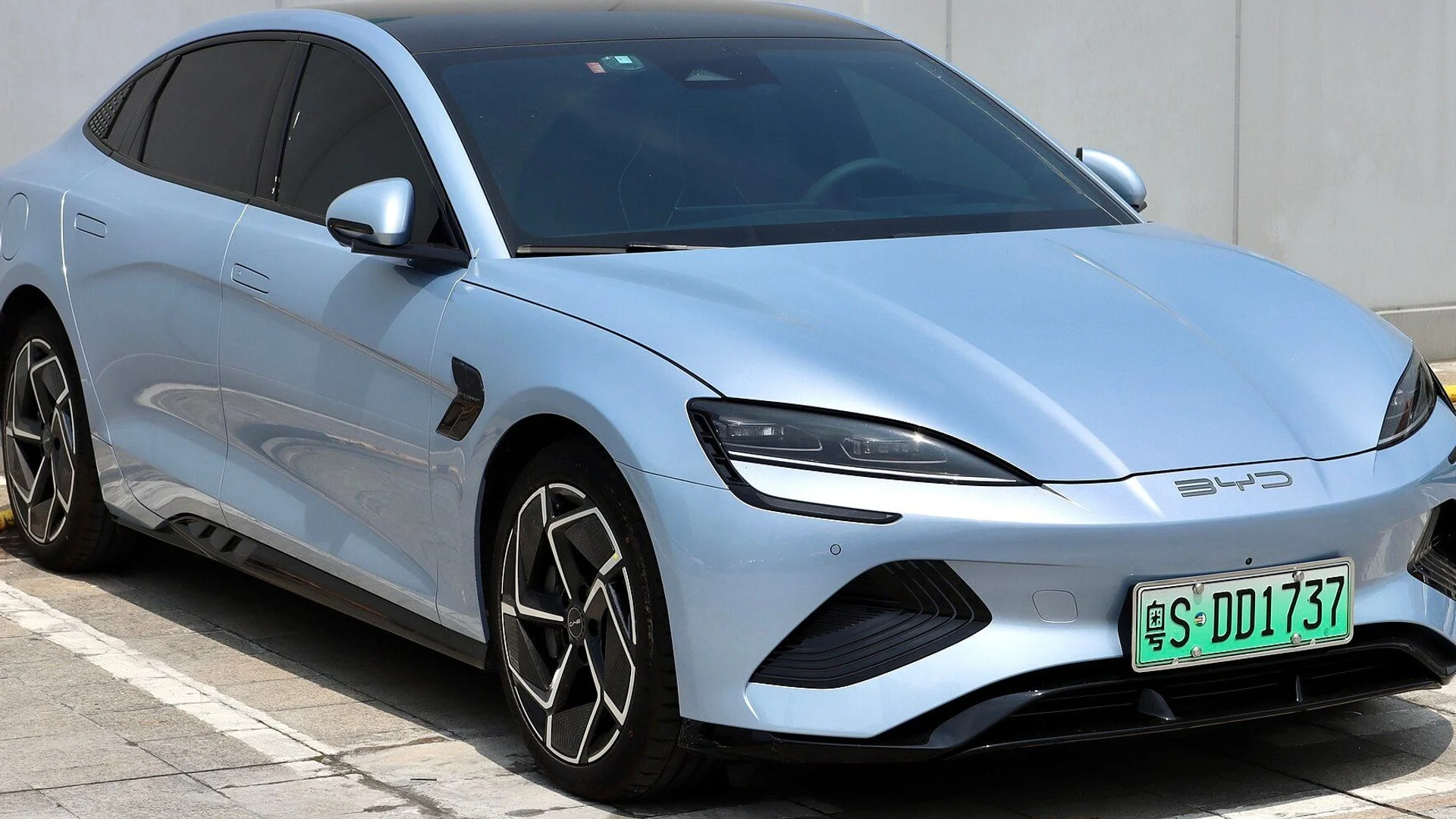
BYD's likely Canadian lineup spans seven distinct models, from a sub-$25,000 city car to a luxury sedan positioned to undercut the Tesla Model S by something in the $50,000-plus range. That price band is wider than any incumbent's lineup in Canada today, BYD is not entering one price segment. It is entering most of them simultaneously. The Atto 3 lands in the compact-SUV bracket against the Hyundai Kona Electric and Volkswagen ID.4. The Dolphin sits below anything currently sold new in Canada except a stripped Bolt successor. The Seal targets the Model 3 and the Hyundai Ioniq 6. The Han and the Tang push into Model S and Model X territory.
For readers tracking specific models, the BYD Atto 3 Canada review breaks down the $30,000 compact SUV with the LFP Blade battery, and the Atto 3 vs Hyundai Kona EV comparison runs the head-to-head under $40,000. Both posts dig into the spec-level details I am deliberately staying above in this editor's-note framing.
The 12% Canadian brand awareness number is the data point that should make incumbents nervous. Awareness without retail presence is unusual, it implies the brand reached Canadian buyers through media, social, and cross-border noise rather than through dealer foot traffic. That kind of awareness is sticky, because it was built without a salesperson incentive behind it. When the dealers do open, BYD is not starting from zero; it is starting from a quarter of the EV-considering population already knowing the name.
The pricing pressure on incumbents is going to be structural, not promotional. Hyundai's Ioniq 6 base trim, Volkswagen's ID.4, the base-spec Tesla Model 3, all of them face a credible competitor at a sticker price 10-15% lower before any incentive math runs. The traditional response in this scenario is a manufacturer-funded rebate or a dealer-funded discount, but that compresses margin on vehicles that are already running thin in the Canadian market. The more interesting response, and the one I would bet on, is feature-set repositioning, adding standard equipment to justify the price gap rather than closing it directly.
I will put a band on what a base BYD Atto 3 lands at in Canada in 2026: $34,000 to $39,000 before destination and dealer fees. I am refusing to give you one number because the variables, final dealer markup structure, ocean freight pricing in 2026, the exact specification mix BYD chooses to import, and the dollar-yuan exchange rate at the time of homologation, each move the answer by $1,000 to $2,000. Anyone giving you a single-dollar Canadian price for a vehicle that is not yet on sale is selling certainty they do not have. The band is the answer.
What would push the band lower? Aggressive dealer sell-in subsidy from BYD HQ to seed the market, which is plausible in year one. What would push it higher? A weaker Canadian dollar against the yuan, or BYD choosing to import higher-spec trims first to anchor the brand perception upward. Watch the first 90 days of pricing after the dealerships open, that is when the band collapses to a real number.
Gear worth having
As an Amazon Associate, ThinkEV earns a small commission from qualifying purchases — at no extra cost to you.

VEVOR Portable Level 2 EV Charger (32A)
A 240V portable charger you can keep in the trunk. 32A, NEMA 14-50, long cable. A reliable backup charger for travel and road trips.
As an Amazon Associate, ThinkEV earns from qualifying purchases — at no extra cost to you.
The Federal Rebate Problem BYD Cannot Solve Itself
The part of the story most of the coverage is missing is the rebate math. The 6.1% tariff applies to Chinese-built EVs, but the federal iZEV rebate, up to $5,000 toward the purchase of a qualifying zero-emission vehicle, does not. Chinese-built models are excluded from the Electric Vehicle Availability Program eligibility list. The math that matters to Canadian buyers is not the sticker price; it is the net-of-rebate landed cost.
A Hyundai Ioniq 5 base trim, EVAP-eligible, qualifies for the federal $5,000 plus the British Columbia provincial rebate of up to $4,000, plus the BC scrap-it credit where applicable. A BYD Atto 3, ineligible federally, gets the BC provincial rebate (which does not explicitly exclude by country of manufacture) but not the federal portion. The gap between sticker advantage and landed-cost advantage closes by $5,000 in the rebate-eligible provinces, sometimes more, sometimes a touch less depending on the provincial overlay.
This is provincially uneven in ways that matter for dealer-network planning. Quebec's Roulez vert program does not explicitly exclude by country of manufacture, so a BYD purchased in Quebec captures the provincial rebate. British Columbia's CleanBC Go Electric program operates on similar lines. Ontario has no provincial rebate at all, which means an Ontario buyer sees the full federal-exclusion hit with no provincial offset, and Ontario is exactly the province where BYD's GTA dealer density is the operational anchor. The province with the densest BYD footprint is also the province where the rebate exclusion bites hardest.
Run the math on a $38,000 BYD Atto 3 in three provinces. In British Columbia, after the provincial rebate, the out-the-door cost lands somewhere around $34,000, versus a $40,000 Ioniq 5 that nets to $31,000 after federal plus provincial. The BYD is $3,000 more expensive net. In Quebec, similar dynamics with a slightly different rebate stack. In Ontario, the BYD is $38,000 and the Ioniq 5 is $35,000, a $3,000 BYD premium in the largest provincial market.
That is the editorial thesis the BYD-launch coverage is missing. BYD wins on sticker. BYD loses on landed cost after incentives in two of the three provinces where it most needs to win. The dealer footprint cannot fix that. Only one of two things fixes it: BYD funds an effective $5,000 manufacturer rebate of its own to neutralize the federal exclusion, or Ottawa amends the iZEV eligibility rules to include Chinese-built models, which would require either a CUSMA-adjacent renegotiation or a unilateral policy move that nobody in the current government is signalling.
For Canadian buyers, the broader landscape of affordable EVs in Canada under $50,000 is the right frame for evaluating where BYD slots in. The post-rebate math is what makes or breaks the value case in this segment, and BYD is entering with a structural disadvantage on exactly that variable.
Gear worth having
As an Amazon Associate, ThinkEV earns a small commission from qualifying purchases — at no extra cost to you.

Grizzl-E Classic Level 2 EV Charger (40A)
Canadian-made and rated for minus 40C winters. 40A / 9.6 kW, NEMA 14-50, indoor/outdoor, 24-ft cable. The charger built for Canadian weather.
As an Amazon Associate, ThinkEV earns from qualifying purchases — at no extra cost to you.
Cold Weather, Brand Trust, and the Real Adoption Barrier
The technical case for Chinese EVs in Canada is stronger than the public discourse acknowledges. CAA cold-weather range testing has placed several Chinese-brand EVs ahead of European rivals on percentage-range retention at -20°C, a result that surprised the testing community and undermined the lazy narrative that Chinese EVs are not engineered for cold-weather markets. The Blade LFP chemistry BYD uses is, on the cold-weather metric, more robust than several legacy lithium-ion configurations.
The technical barrier is lower than the perception barrier. That gap, what the engineering says versus what the average Canadian buyer assumes, is the actual adoption variable for the first eighteen months of BYD's Canadian presence. The first 500 owners in Canada write the review corpus that everyone after them reads. Their charging experience, their service-bay experience, their parts-availability experience, and their winter-range experience become the brand's reputation, validated or destroyed at retail scale.
Twenty dealerships across a country with Canada's geographic spread is thin. Tesla operates roughly 30 Canadian retail and service locations alongside a Supercharger network that anchors the long-distance use case. The Hyundai dealer network exceeds 200 stores. BYD launching at 20 stores means an Atto 3 owner in Saskatoon is closer to no BYD service centre than to one, and that operational gap is the friction point that converts a 12% brand-awareness lead into a stalled-sale or, worse, a brand-trust loss after a service incident.
Parts availability is the under-discussed risk. A new entrant brand needs a parts depot strategy that survives the first major collision-repair backlog. BYD has not publicized its Canadian parts logistics in any detail. If a fender-bender on a BYD Seal in February 2026 generates an eight-week parts wait, that single story propagates faster across Canadian EV forums than any 12% brand-awareness figure can absorb. The first negative service review at scale is the brand's actual stress test. For context on what the home-charging experience looks like for any Canadian EV buyer regardless of brand, the Level 2 home charger guide for Canada in 2026 covers the infrastructure layer that lives independently of the manufacturer's service network.
The trust gap closes through delivery experience, not through specification sheets. BYD's first wave of Canadian buyers, call it the 2026 cohort, the early adopters who already followed the brand internationally, will be more forgiving of service hiccups than the 2027 cohort. By the time the second-wave buyer arrives, the brand has either built a service reputation worth showing up for, or it has built a reputation that closes the 12% awareness advantage faster than any pricing strategy can reopen it.
Gear worth having
As an Amazon Associate, ThinkEV earns a small commission from qualifying purchases — at no extra cost to you.

PULIDIKI Car Cleaning Gel (Detailing Putty)
Press it into vents, buttons, and seams and it lifts out dust you did not know was there. Weirdly satisfying, genuinely useful.
As an Amazon Associate, ThinkEV earns from qualifying purchases — at no extra cost to you.
What Would Change the Editorial Verdict Here
I am going to put four explicit watchpoints on this thesis and tell you what each one would mean.
First watchpoint: quota share. If BYD consumes more than 40% of the 49,000-unit annual cap by Q3 2026, the dealer-velocity land-grab thesis is confirmed and the rest of the Chinese-EV channel, NIO, Zeekr, the rest, is effectively boxed into the residual 60% split across three or four brands. That scenario locks in BYD as the de facto Chinese EV brand for Canadian buyers for the entire pre-2031 window. If BYD lands closer to 20% share, the channel stays fragmented and the 2027 entrant has a real shot at scale.
Second watchpoint: rebate eligibility. If Ottawa amends iZEV to include Chinese-built models, the entire price-stack math flips. The BYD landed-cost disadvantage in Ontario and elsewhere disappears, the volume curve steepens immediately, and the 49,000-unit quota starts looking small rather than ample. The political conditions for this change are not present today, but a soft federal economy in 2027 combined with a consumer affordability push could create them quickly.
Third watchpoint: the service-experience review corpus. If BYD's first 1,000 Canadian deliveries generate negative reviews at scale, parts delays, charging-network compatibility issues, app-platform problems, the 12% brand awareness converts from an asset to a liability. Awareness amplifies whatever the experience produces. A well-known brand with a bad service reputation declines faster than a no-name brand with a quiet launch.
Fourth watchpoint: the 2031 quota negotiation. The 70,000-unit ceiling for 2031 is the next structural inflection point, and negotiations over that cap will effectively begin around 2028. Whichever Chinese automaker has the strongest dealer network and the longest Canadian delivery history at that point gets the loudest voice in shaping the next quota regime. This is why BYD's 20-dealership move is not just a 2026 sales play, it is positioning for the 2028 negotiation.
The bet I would make: BYD lands somewhere in the 25-35% share band of the 49,000-unit quota in 2026, builds a Canadian delivery record strong enough to push for quota expansion in 2028, and faces its real test in 2027 when the second wave of Chinese entrants either splits the channel or fails to scale. The rebate exclusion is the variable that decides whether BYD's pricing advantage compounds or erodes. The 12% brand awareness is the variable that decides how forgiving Canadian buyers are when the inevitable launch-year service incidents arrive.
Canada's $0 bet, because the policy cost Ottawa nothing in direct outlay, was about acquiring optionality on the Chinese EV channel without committing to scale. BYD's 20-dealership bet is about converting that optionality into a market position before the next political cycle can reverse it. Both bets are smart. Neither is guaranteed. The arithmetic between them is what 2026 will resolve.
Gear worth having
As an Amazon Associate, ThinkEV earns a small commission from qualifying purchases — at no extra cost to you.

WixGear Magnetic Air Vent Phone Mount (2-Pack)
A magnet strong enough that your phone never flinches over potholes or rail crossings. Two in the box, one for each car.
As an Amazon Associate, ThinkEV earns from qualifying purchases — at no extra cost to you.

Founder & Chief Editor
Vlad Pereira is the founder and chief editor of ThinkEV.ca, the Canadian electric-vehicle publication he writes and edits from Courtenay, British Columbia. He covers EV pricing, federal and provincial rebates, charging costs, and the Chinese manufacturers now entering Canada, from the buyer's side rather than the press-fleet side. ThinkEV is a venture of Vlad Pereira Online; his writing on health, income and the long game lives at vladpereira.com.
Frequently asked questions
Does the 49,000-unit quota reset annually or is it cumulative?
Which Chinese brands besides BYD are competing for the same quota?
Is BYD eligible for Canada's federal EV rebate?
What happens to resale value if Ottawa tightens the quota later?
How does 6.1% tariff translate to actual dollars on a BYD?
More EV & road-trip finds
Affordable upgrades worth a look — tap any to check the price on Amazon.
 ★ 1,866
70mai A810 4K Dual Dash Cam
View on Amazon ★ 121
★ 121Foldable Windshield Sun Umbrella
View on Amazon ★ 392
★ 392Large Cup Holder Adapter (32-40oz)
View on Amazon ★ 2,941
Microfiber Cleaning Cloths (Multi-Pack)
View on Amazon ★ 55
★ 55LED Car Door Logo Projector Light
View on Amazon ★ 568
★ 568Personalized Photo and Text Keychain
View on Amazon ★ 4,424
Sun Visor Card and Document Organizer
View on Amazon ★ 15,014
Spigen Tempered Glass for Tesla Model 3/Y
View on AmazonRead, Plan, Then Stay Current
Explore our expert articles to understand incentives and ownership costs, use the map to pressure-test charging reality, then subscribe so new EV coverage comes straight to you.
Continue Reading
Chinese EVs in Canada: 15,603 In, Still No BYD
Are Canada's Repair Shops Ready for Chinese EVs?
BYD Dolphin Canada: Price, Specs & 2026 Launch Date
Why Chinese EV Interiors Feel a Generation Ahead
BYD Seal Canada: Demand Is Real, the Car Is Not Here