Key takeaways
- If you want a car that just works without drama, without requiring a tech degree to operate, the Kona Electric is probably your best bet under $50,000.
- The 2026 model is priced between $44,999 and $49,999 CAD, which puts it squarely in the "normal car" price bracket after the $5,000 federal EVAP rebate.
- At $39,999 out the door for the base model, you're getting 418 km of range, a 65.4 kWh battery, and 218 hp.
- With 418 km of rated range, you're looking at 340-380 km in real-world summer driving, which covers a full week of commuting for most people without plugging in at work.
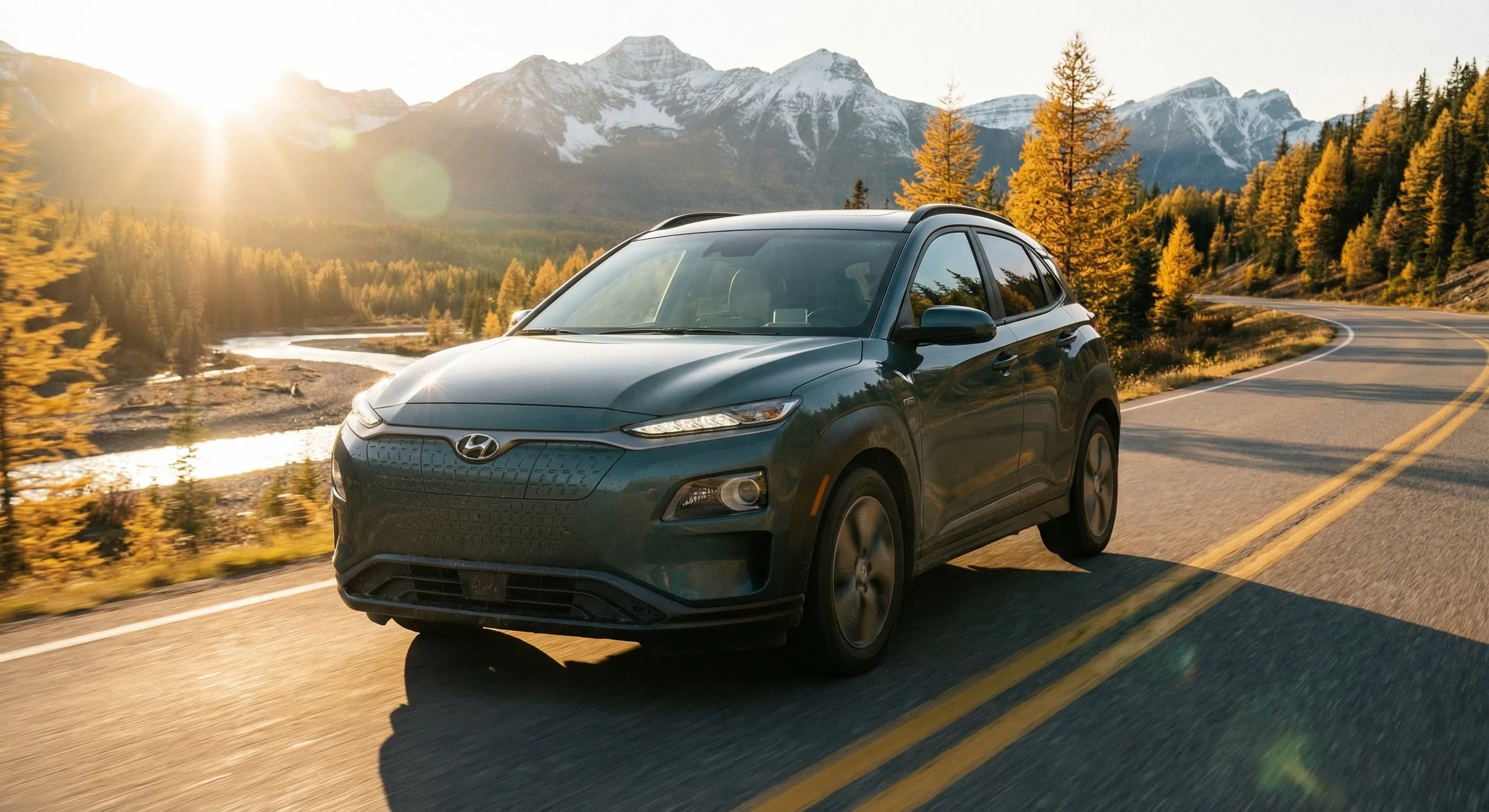
The Hyundai Kona Electric is not exciting. That is the point. It's reliable, practical, affordable, the Toyota Corolla of electric vehicles. If you want a car that just works without drama, without requiring a tech degree to operate, the Kona Electric is probably your best bet under $50,000. The 2026 model is priced between $44,999 and $49,999 CAD, which puts it squarely in the "normal car" price bracket after the $5,000 federal EVAP rebate. At $39,999 out the door for the base model, you're getting 418 km of range, a 65.4 kWh battery, and 218 hp. Those are solid numbers for a subcompact SUV that parks easily on any downtown Toronto street and fits into a Tim Hortons drive-through without clipping the mirrors.
Most Canadians don't need 500+ km of range, 800V charging, or a 0-60 time that would impress their teenager. They need a car that gets them to work, to Costco, and to their parents' place in Kitchener without running out of battery. The Kona does that. With 418 km of rated range, you're looking at 340-380 km in real-world summer driving, which covers a full week of commuting for most people without plugging in at work. It's the kind of car you charge overnight at home and don't think about again until Sunday. That's not a criticism, that's exactly what most buyers want.
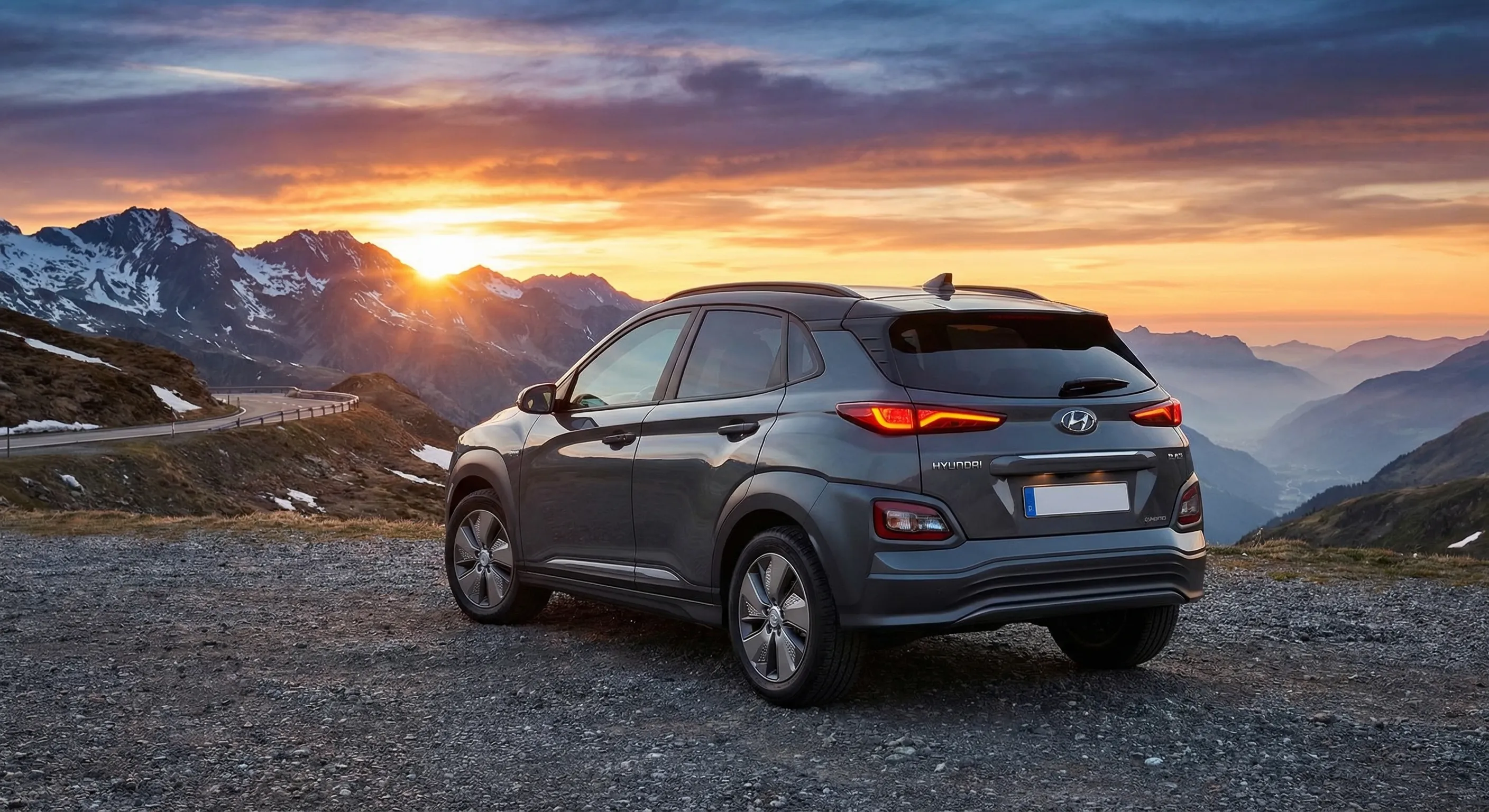
The 2026 model represents the second generation of the Kona Electric, which launched in 2024 as a complete redesign. The quirky, love-it-or-hate-it styling of the original is gone, replaced by something more grown-up and conventional. It's 10 cm longer than the first generation, which translates to noticeably more rear legroom and a cargo area that can actually handle a hockey bag plus groceries. The new design won't turn heads on Robson Street, but it won't embarrass you either. It looks like a normal car, which for many buyers is exactly the right amount of personality.
The Redesign
The 2024+ Kona Electric is genuinely a different vehicle from the original. The first-gen Kona Electric was built on a modified ICE platform, basically a gas car with a battery stuffed in. The new one rides on Hyundai's dedicated EV platform, which means the battery sits flat in the floor, the centre of gravity is lower, and there's actually room inside for people and things. The wheelbase is longer, the track is wider, and the whole car feels more substantial on the road.
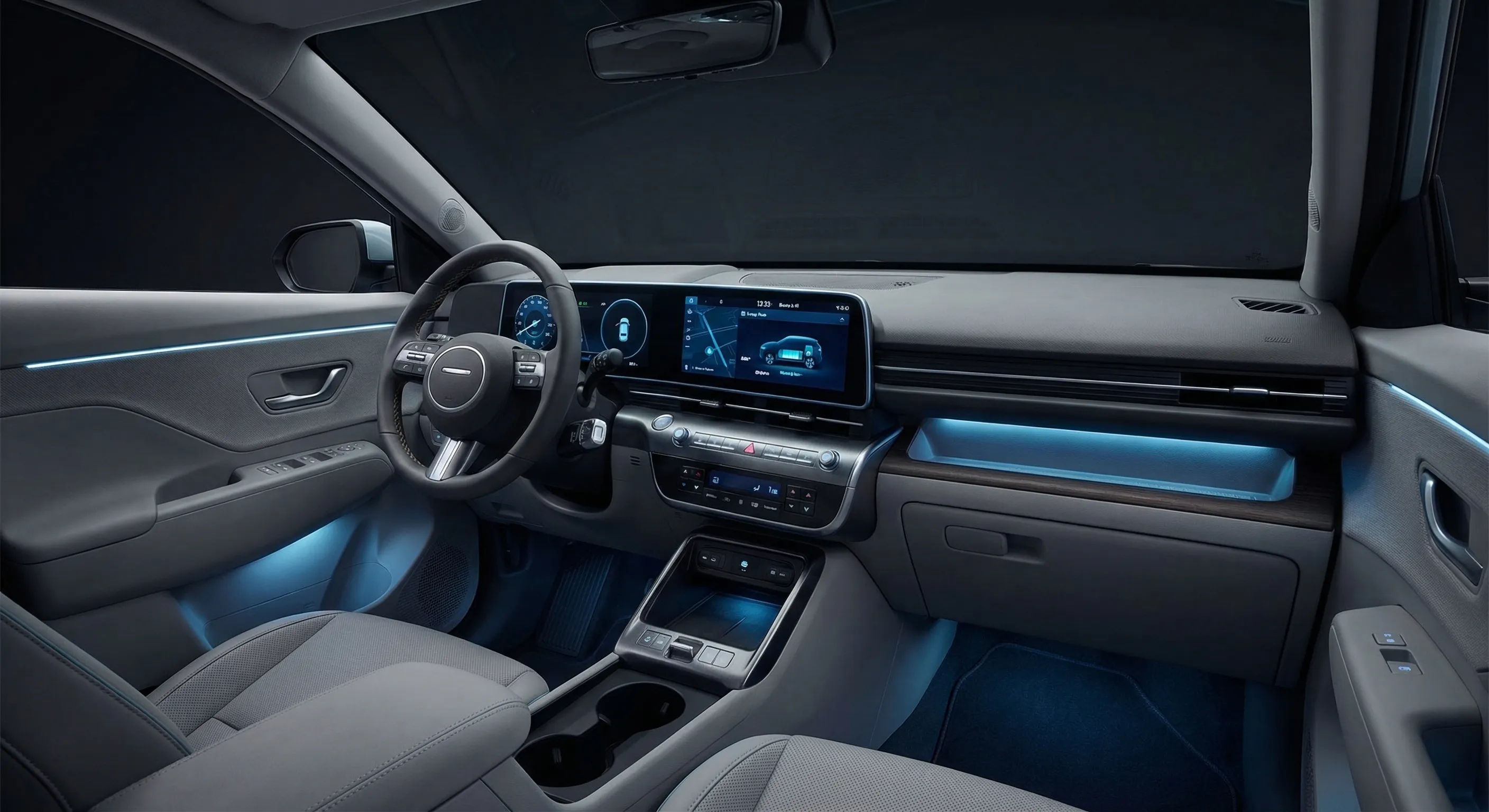
The interior is a significant upgrade. The dashboard features dual 12.3-inch screens, one for the instrument cluster, one for infotainment, running Hyundai's latest software with wireless Apple CarPlay and Android Auto. The materials are a step up from the original, with soft-touch surfaces on the upper dashboard and decent cloth seats that don't feel like they came from a rental fleet. The climate controls are still physical buttons, which drivers appreciate more every time they use a car that buried them in a touchscreen. In Edmonton, when you're wearing gloves in January, physical buttons aren't a luxury, they're a necessity.
Cargo space measures 466 litres behind the rear seats, expanding to around 1,300 litres with them folded. That's competitive with the Chevy Bolt and better than the Nissan Leaf, though smaller than the Equinox EV. There's also a small frunk up front, not big enough for much beyond a charging cable and a reusable grocery bag, but it's there. The rear seats have enough legroom for two adults to sit comfortably, though three across is tight. For a family of four, the Kona works. For a family of five, you'll want to look at the Ioniq 5 or Equinox EV.
Range and Charging
The 65.4 kWh battery delivers 418 km of rated range, and real-world summer driving typically lands between 340-380 km depending on your driving style and climate control usage. Highway driving at 110 km/h eats range faster than city driving, where regenerative braking helps recapture energy. In Calgary, where highway commutes are common and speeds tend to creep up, expect closer to 330 km in summer.
Gear worth having
As an Amazon Associate, ThinkEV earns a small commission from qualifying purchases — at no extra cost to you.

Grizzl-E Classic Level 2 EV Charger (40A)
Canadian-made and rated for minus 40C winters. 40A / 9.6 kW, NEMA 14-50, indoor/outdoor, 24-ft cable. The charger built for Canadian weather.
As an Amazon Associate, ThinkEV earns from qualifying purchases — at no extra cost to you.
Winter is the real test for any EV in Canada. At -15C to -20C, the Kona's range drops to roughly 280-330 km. That's about a 20-25% reduction, which is typical for this class of EV. The heat pump (standard on the 2026 model) helps preserve range compared to the resistive heating in older models. Preconditioning while plugged in, warming the battery and cabin before you leave, makes a measurable difference. Owner testing in Ottawa shows preconditioning adds roughly 25-30 km of usable range compared to cold-starting on a -18C morning.
DC fast charging maxes out at 100 kW, which is adequate but not fast by 2026 standards. A 10-80% charge takes about 41 minutes, which is noticeably slower than the Kia EV6's 18 minutes or the Tesla Model 3's 25 minutes. If you're relying on DC fast charging for road trips, the Kona isn't ideal, the stops are long enough to be annoying. For a daily driver that charges at home overnight, the charging speed is irrelevant. On a Level 2 home charger like the Grizzl-E, expect about 8 hours from 10-100%, which is a perfect overnight charge cycle.
Gear worth having
As an Amazon Associate, ThinkEV earns a small commission from qualifying purchases — at no extra cost to you.
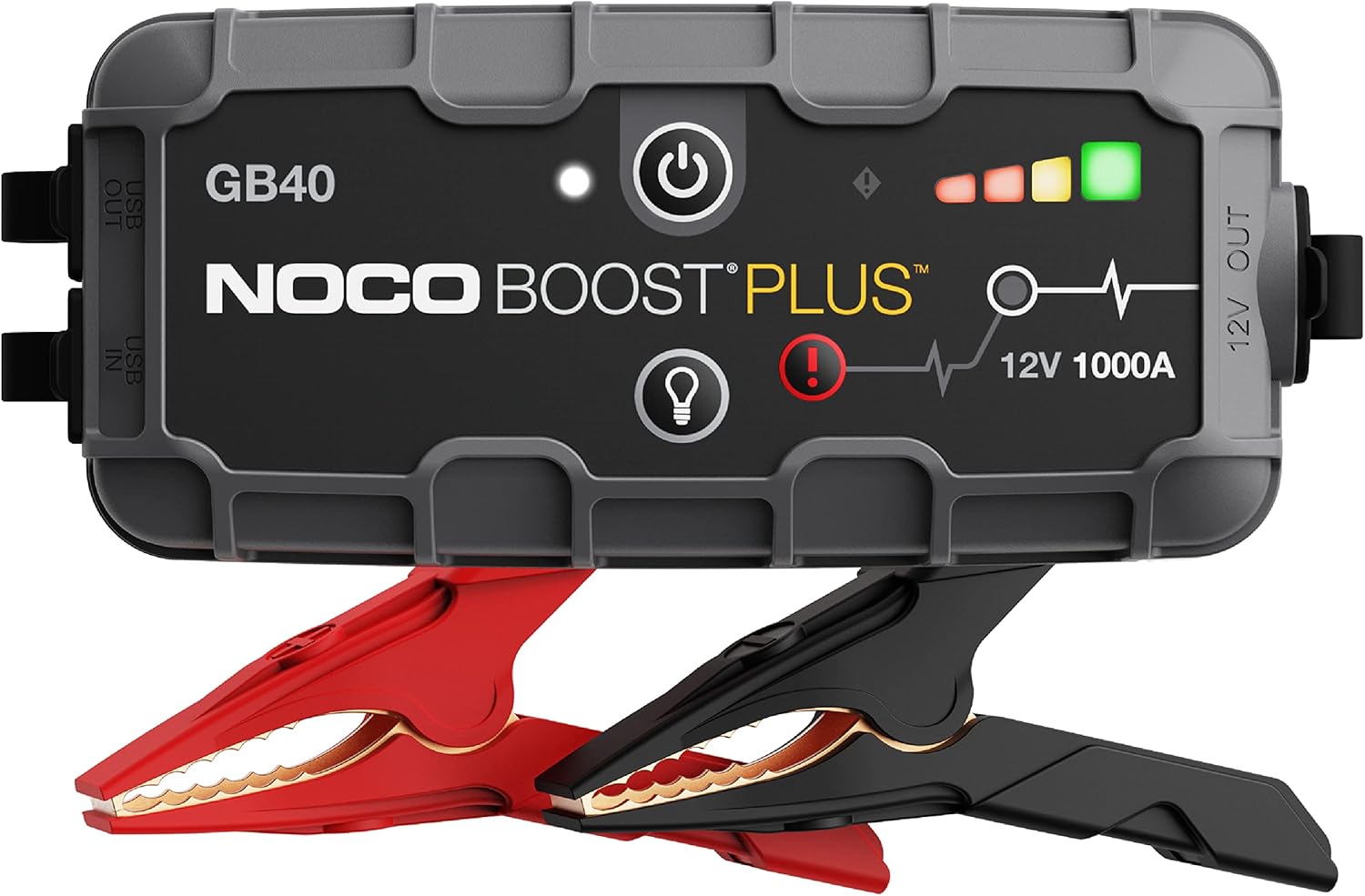
NOCO Boost Plus GB40 Jump Starter
A 1000A lithium jump starter that fits in your glovebox and works on any 12V battery. Your insurance against a dead 12V in a parking lot.
As an Amazon Associate, ThinkEV earns from qualifying purchases — at no extra cost to you.
Daily Life
The 218 hp motor is more than adequate for daily driving. It's not fast, 0-100 km/h in about 7.6 seconds, but it's peppy enough for merging onto the 401 and responsive enough in city traffic. The single-speed transmission is smooth, and the regenerative braking can be adjusted to your preference. In city driving around Vancouver, owners report leaving it in max regen mode and barely touching the brake pedal all week. One-pedal driving isn't quite as polished as Nissan's e-Pedal or the Bolt's implementation, but it works well enough.
The ride is comfortable without being soft. The Kona absorbs potholes and rough pavement reasonably well for a subcompact, though it's not as cushy as the Ioniq 5 or as composed as the EV6. Road noise at highway speeds is noticeable, more tire noise than wind noise, but not excessive. For the price, the NVH (noise, vibration, harshness) is acceptable. This isn't a luxury car, and it doesn't pretend to be.
Parking and manoeuvrability are the Kona's secret weapons. At 4,355 mm long, it's significantly shorter than the Equinox EV or Model Y, which makes parallel parking in downtown Montreal or finding a spot in a crowded Vancouver parkade noticeably easier. The turning circle is tight, the visibility is good, and the standard rear camera plus parking sensors make tight spaces manageable.
Gear worth having
As an Amazon Associate, ThinkEV earns a small commission from qualifying purchases — at no extra cost to you.

PULIDIKI Car Cleaning Gel (Detailing Putty)
Press it into vents, buttons, and seams and it lifts out dust you did not know was there. Weirdly satisfying, genuinely useful.
As an Amazon Associate, ThinkEV earns from qualifying purchases — at no extra cost to you.
The Verdict
The Kona Electric is the EV for people who don't want to think about their EV. It charges at home, it gets you to work, it fits in the parking garage, and it doesn't break the bank. At $39,999 after the EVAP rebate, it's one of the most affordable new EVs in Canada with a range that actually works for daily life.
It's not the best at anything. The Equinox EV has more range and space. The Kia EV6 charges faster and drives better. The Tesla Model 3 has a better software ecosystem. But the Kona is good enough at everything, and for a lot of Canadians, that's the right answer. If you're driving a 2018 Civic and you want to go electric without changing your lifestyle, the Kona Electric is the path of least resistance. Plug it in at night, drive it all week, and forget it's an EV.
The people who shouldn't buy this are road trippers (charging is too slow), performance enthusiasts (it's a commuter), and large families (it's a subcompact). For everyone else, especially urban commuters, retirees, and small families who can charge at home, the Kona Electric is an easy recommendation.
Gear worth having
As an Amazon Associate, ThinkEV earns a small commission from qualifying purchases — at no extra cost to you.

WixGear Magnetic Air Vent Phone Mount (2-Pack)
A magnet strong enough that your phone never flinches over potholes or rail crossings. Two in the box, one for each car.
As an Amazon Associate, ThinkEV earns from qualifying purchases — at no extra cost to you.
Related Reading
- BYD Atto 3 vs Hyundai Kona EV Canada 2026, Affordable SUV showdown
- Most Affordable EVs Canada 2026, All the budget-friendly options
- Hyundai Ioniq 5 vs Kia EV6 Canada 2026, If you want to spend more
Gear worth having
As an Amazon Associate, ThinkEV earns a small commission from qualifying purchases — at no extra cost to you.

Car Cup Holder Coasters (4-Pack)
Drop-in coasters that catch spills and crumbs so your cup holders stay clean. Rinse and reuse forever.
As an Amazon Associate, ThinkEV earns from qualifying purchases — at no extra cost to you.

Founder & Chief Editor
Vlad Pereira is the founder and chief editor of ThinkEV.ca, the Canadian electric-vehicle publication he writes and edits from Courtenay, British Columbia. He covers EV pricing, federal and provincial rebates, charging costs, and the Chinese manufacturers now entering Canada, from the buyer's side rather than the press-fleet side. ThinkEV is a venture of Vlad Pereira Online; his writing on health, income and the long game lives at vladpereira.com.
Frequently asked questions
Does the Hyundai Kona Electric qualify for Canada's $5,000 EVAP rebate?
What is the real winter range of the Kona Electric in Canada?
How does the Kona Electric compare to the Chevy Equinox EV?
Is the Kona Electric good for long road trips?
More EV & road-trip finds
Affordable upgrades worth a look — tap any to check the price on Amazon.
 ★ 537
★ 537USB Star Projector Roof Light
View on Amazon ★ 546
★ 546Funny Headrest Face Covers (2-Pack)
View on Amazon ★ 865
★ 865Collapsible Trunk Organizer
View on Amazon ★ 721
★ 72145W USB-C Fast Car Charger
View on Amazon ★ 119
★ 119Foldable Waterproof Trunk Organizer
View on Amazon ★ 392
★ 392Large Cup Holder Adapter (32-40oz)
View on Amazon ★ 8,681
Chemical Guys Complete Car Wash Kit
View on Amazon ★ 314
★ 314Mini USB LED Ambient Lamps (4-Pack)
View on AmazonRead, Plan, Then Stay Current
Explore our expert articles to understand incentives and ownership costs, use the map to pressure-test charging reality, then subscribe so new EV coverage comes straight to you.
Continue Reading
Hyundai Ioniq 5 N Canada Review: 601 hp Tested
Hyundai Ioniq 6 Canada Review: Range and Price
Volvo EX30 Canada Review: The Small One to Want

Rivian R1T Canada Review 2026: 515 km Quad-Motor
Rivian R2 Canada Price 2026: The $57K Electric SUV