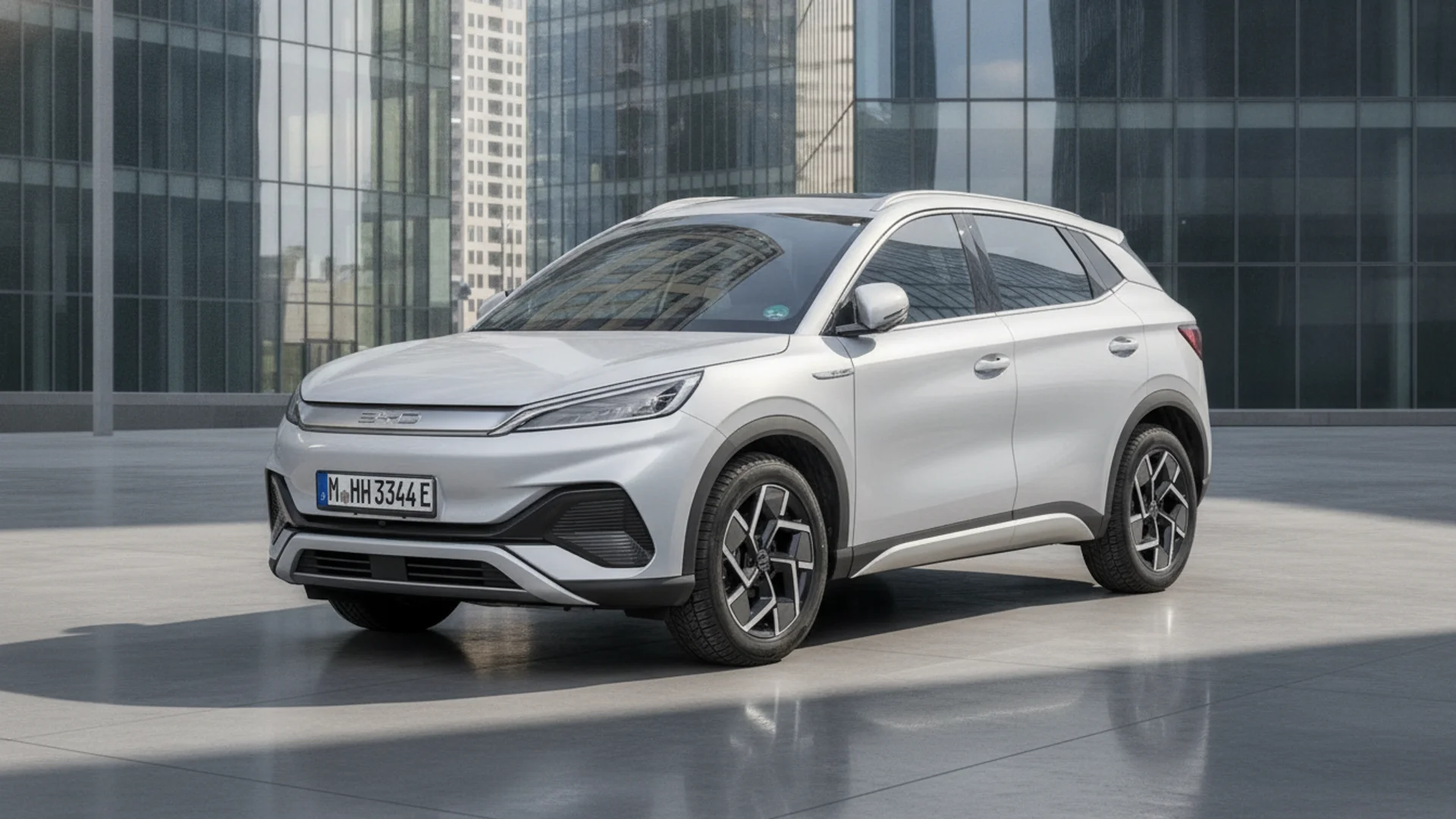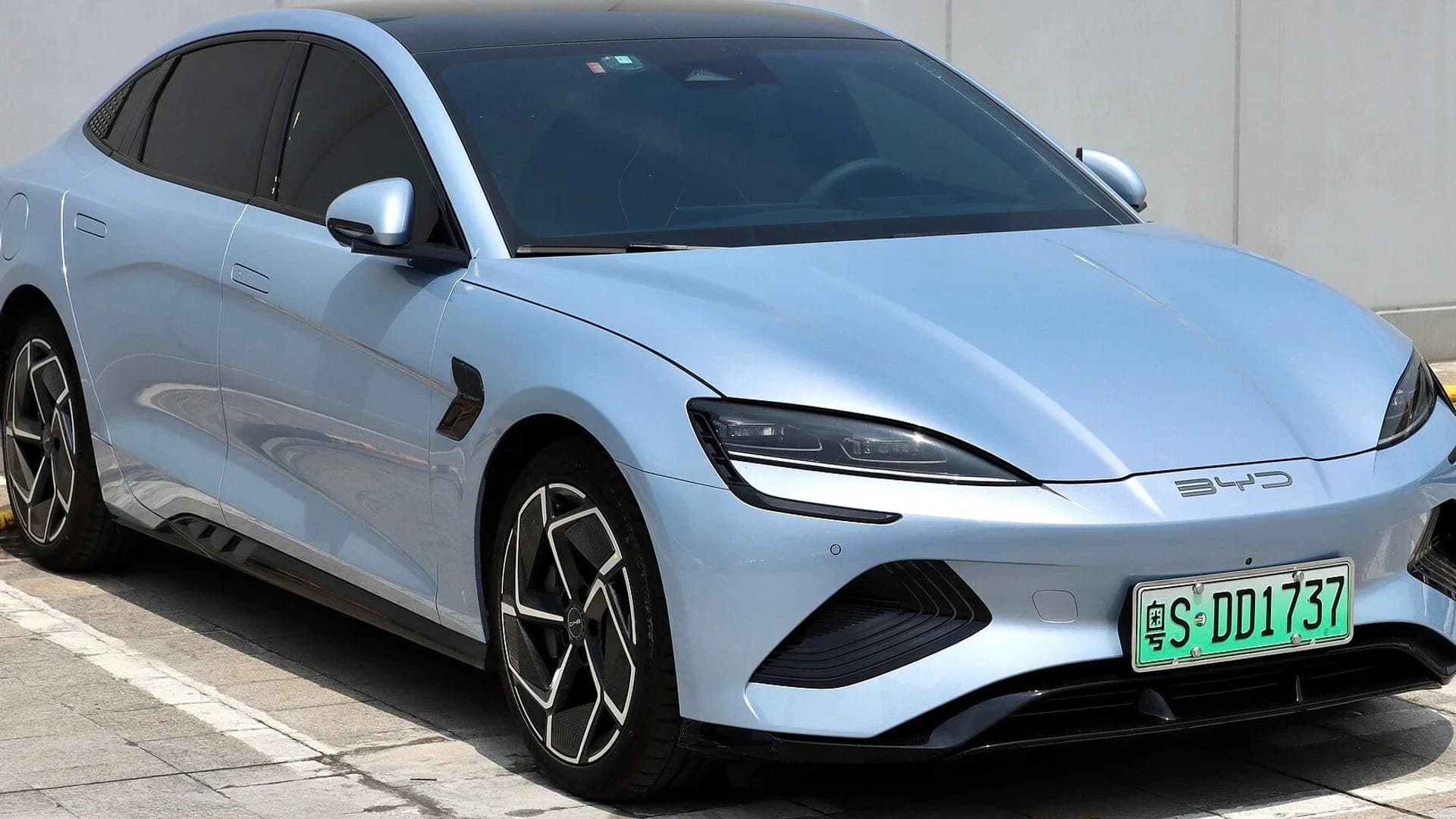
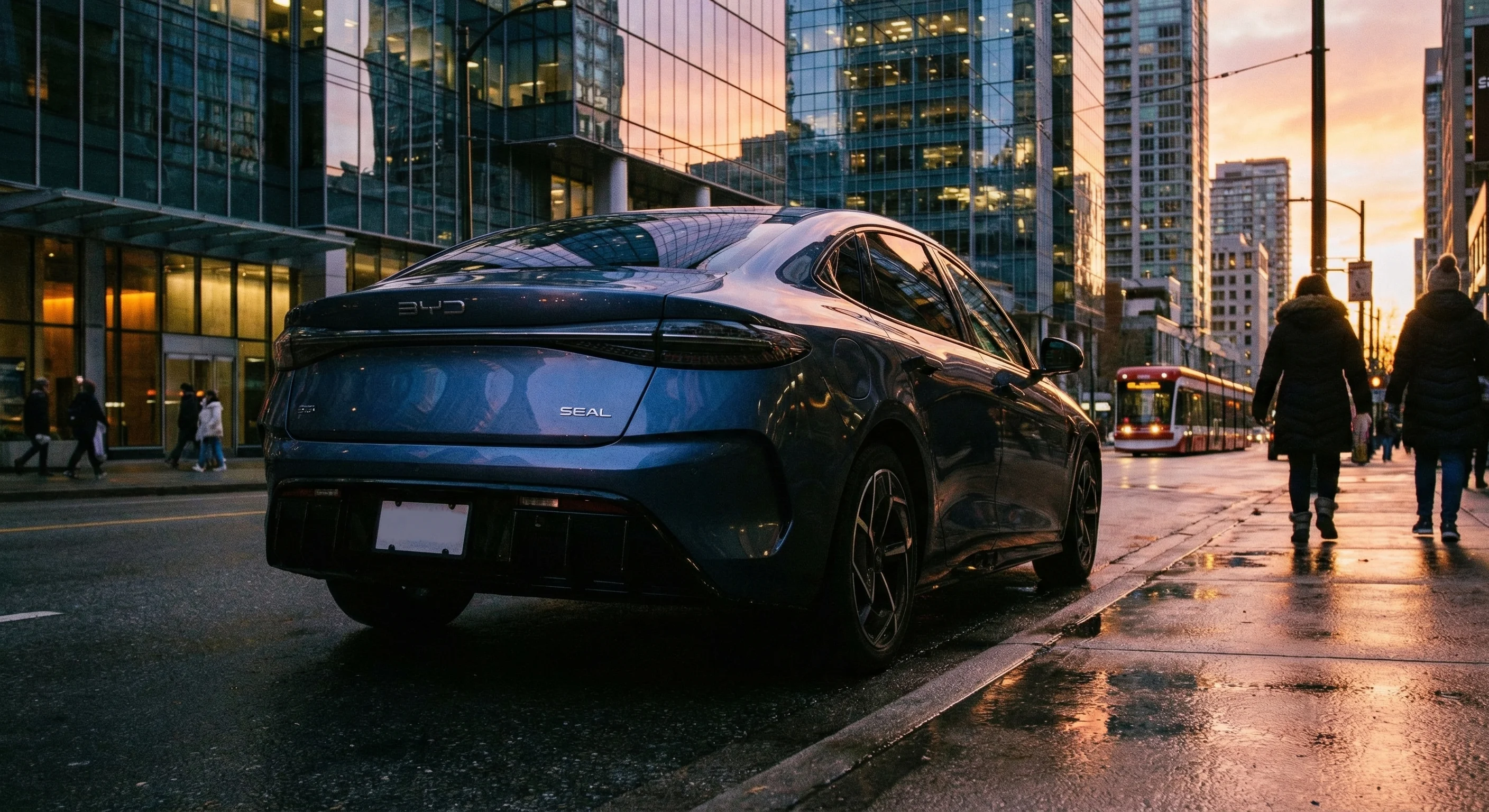
Position 8 on Google for "byd seal canada" means 359 Canadians a month are searching for a car they cannot buy. That number is the editorial subject of this post. The car ships in the United Kingdom, ships in Australia, ships across the European Union, and BYD's domestic production capacity is not the constraint. Canadian buyers are not waiting on a factory line. They are waiting on a tariff decision.
Key takeaways
- About 359 Canadians search "byd seal canada" on Google every month, demand for a sedan with no Canadian dealer network, no Transport Canada homologation in progress, and no arrival timeline as of mid-2026.
- The Seal Design trim pairs a 61.44 kWh Blade battery with a 230 kW rear motor for 460 km of WLTP range and a 7.6-second 0–100 km/h; the dual-motor Excellence makes 390 kW and 670 Nm, Model 3 Performance territory.
- Canada cut its tariff on Chinese-built EVs from 100% to 6.1% in January 2026 under a 49,000-unit annual quota, but Chinese-brand EVs are excluded from the federal EVAP rebate, so the Seal gets no $5,000.
- BYD builds right-hand-drive Seals in Thailand and is bringing a Hungarian plant online in 2026, and a Seal built outside China would not carry Canada's China-origin surtax under standard rules of origin.
- After Australia opened to BYD in 2022, competing EV prices there fell 8–12% within eighteen months, the kind of price pressure a Canadian Seal launch could bring.
I'll put the editorial position up front: blocking the Seal at the border does not build a Canadian EV industry. It sustains margin for the incumbents who pulled back from the segment. The data supports that read, the comparative market evidence supports it, and the silence from Stellantis, GM, and Ford on $45,000 EV sedans supports it. The rest of this post defends that claim.
Why the search demand is real and the supply is not
359 monthly impressions for a single long-tail query is not idle curiosity. That is purchase-intent search behaviour, the same shape Statistics Canada's household-spending data shows for vehicle research in the 90 days before a buy. People are typing the model name, the country, and the implied question: when, how much, and from whom. They are not finding answers because the answers do not yet exist on the Canadian side.
The supply side is the easier half of the story. The Seal is in showrooms in the United Kingdom and Australia. BYD ships it from its Shenzhen and Changsha plants, and the BYD Auto subsidiary has the export logistics, the right-hand-drive tooling for the UK and Australia, and the dealer-network playbook in twelve markets. Canadian port infrastructure handles roughly 200,000 imported vehicles a year through Vancouver alone. The vessel route, the customs broker network, the homologation process, none of these are the gap.
The gap is the 100% federal surtax applied to Chinese-built EVs in October 2024, layered on top of the existing 6.1% most-favoured-nation duty. That surtax was an explicit industrial-policy decision, announced alongside aligned moves from the United States and the European Union. It is not a safety regulation. It is not a homologation problem. It is a price wall, and it is the editorial subject of everything else in this post.
What Canadian buyers would actually be getting for $45,000
The Seal is built on BYD's e-Platform 3.0, which is the architectural piece worth naming. Cell-to-body battery integration, the Blade Battery is structural, not just packaged inside the floor, gives the platform a torsional stiffness number that competing skateboard architectures match only by adding weight. That is the engineering story, and it is the part the spec sheets do not foreground.
The trim ladder is two rungs. The Design trim is rear-wheel drive: a 61.44 kWh Blade Battery, a single 230 kW rear motor, 360 Nm of torque, 460 km on the WLTP cycle, and a 0–100 km/h time of 7.6 seconds. The Excellence trim is dual-motor all-wheel drive: 390 kW combined, 670 Nm of torque, and acceleration that puts it inside the same performance band as a Tesla Model 3 Performance, at a base price the Australian market has settled near A$58,000 to A$68,000 depending on trim, which converts to a Canadian indicative band of roughly C$52,000 to C$62,000 before any tariff stack.
That price band is the one buyers are circling. Tesla's Canadian Model 3 Long Range opens around C$60,000 after the most recent adjustment, and the Performance trim sits above C$72,000. A landed Seal Excellence at C$55,000 to C$62,000 would undercut the Performance by roughly $10,000 to $15,000 while matching it on the metrics most buyers actually compare, range, charging speed, interior finish, and 0–100 time. That is the comparison driving the search volume. I covered the price-band math in detail in the BYD Seal price analysis for Canada, and the spec-by-spec read against Tesla lives in the BYD Seal vs Tesla Model 3 Canada comparison.
The point is not that the Seal wins every comparison. It is that it competes, and the segment has not had a competitor at this price in Canada since the Bolt EUV was discontinued.
The tariff math and who it actually protects
Run the tariff arithmetic. A Seal Excellence landing at a notional C$45,000 pre-tariff base, plus 6.1% MFN duty, plus the 100% Chinese-EV surtax, plus GST, plus provincial sales tax in most provinces, lands the buyer between C$95,000 and C$105,000 depending on the province. That is not a Model 3 competitor. That is an aspirational German-sedan price point on a car that does not have the dealer network to service it. The tariff does not raise the Seal's price by a margin. It erases the value proposition entirely. That is its function.
Gear worth having
As an Amazon Associate, ThinkEV earns a small commission from qualifying purchases — at no extra cost to you.
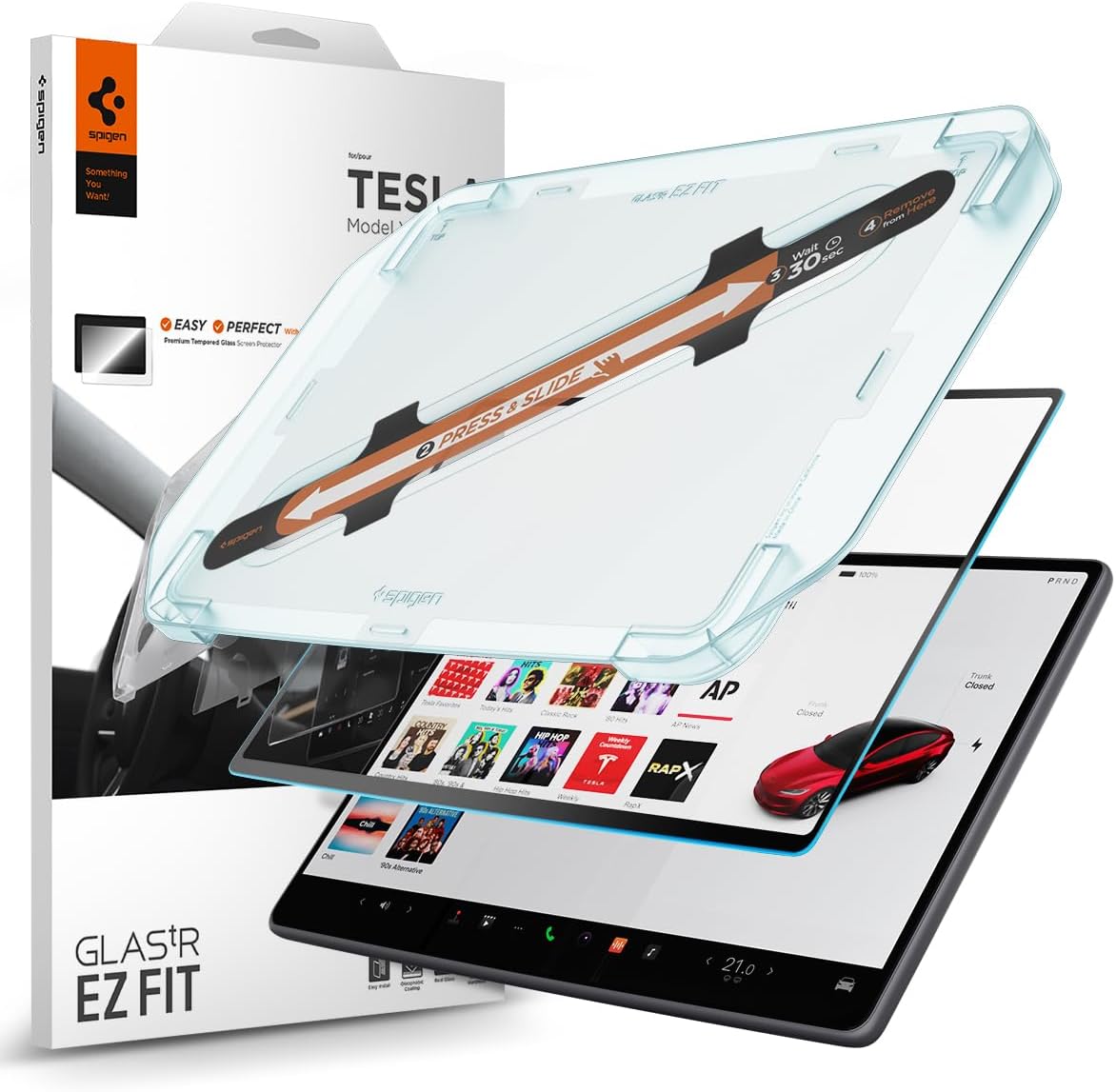
Spigen Tempered Glass for Tesla Model 3/Y
Tempered-glass protection for the touchscreen that kills fingerprints and scratches. Two minutes to install, lasts the life of the car.
As an Amazon Associate, ThinkEV earns from qualifying purchases — at no extra cost to you.
The defence offered for that wall is that it protects Canadian EV manufacturing jobs. Examine that claim. Stellantis paused EV production at Brampton and has not committed to a restart timeline. Ford delayed the Oakville EV retooling. GM's Ingersoll BrightDrop line is commercial vans, not consumer EVs. The Canadian EV manufacturing base the tariff is meant to protect is, in the consumer-passenger segment, largely a forward projection rather than a current operation. Protecting forward projections from price competition is a defensible policy choice, but it is a choice, and the cost of that choice is borne by Canadian buyers paying $10,000 to $15,000 more for comparable vehicles.
The January 2026 tariff framework reduces the Chinese-EV duty to 6.1%, but only for a 49,000-unit annual quota under the Electric Vehicle Availability Programme, and Chinese-brand vehicles are explicitly excluded from that quota's eligible-manufacturer list. The Seal does not benefit. The quota was structured to favour Korean, Japanese, and European manufacturers expanding Canadian sales. I tracked the same regulatory logic in the Sealion 06 policy-stack analysis, and the same arithmetic applies here: the policy is deliberate, the exclusion is intentional, and the consumer-price effect is the residual.
Competition is the only thing that will move Canadian EV prices
This is the position the editorial slate is making. Without a competitive floor at the $40,000 to $55,000 sedan tier, the incumbent OEMs have no pricing pressure. The empirical reference point is Australia, where BYD's market entry in 2022 coincided with an 8% to 12% decline in competing EV pricing within eighteen months, depending on the segment and the data set. That is not a coincidence. It is what price competition does to a thin-competitor market. The Australian regulator did not engineer that outcome, BYD's pricing did.
Canada's EV market in 2026 has the same structural setup Australia had in 2022. Thin competition in the affordable-premium sedan segment, incumbent pricing drifting upward, and a federal policy framework that treats Chinese supply as a strategic threat rather than a consumer-price lever. The Seal would not solve the structural problem on its own. But it would set a competitive floor that the market does not currently have, and Tesla, Hyundai, and Kia would have to respond. That is the lever the tariff suppresses.
The counterargument, that Canadian buyers should pay more now to underwrite a domestic industry that pays back later, is a defensible economic position, but it requires the domestic industry to actually show up. Three years into the tariff structure, the consumer-passenger Canadian EV manufacturing base has not. At some point the protection becomes the policy, and the policy becomes the cost.
What would change the outlook
Three triggers would move the Seal from search-result curiosity to dealer-floor reality.
The first is a Canada–China trade framework that carves an EV quota, likely modelled on the EU's countervailing-duty negotiation, where the European Commission settled per-manufacturer duty rates after BYD, Geely, and SAIC negotiated bilaterally. That negotiation is happening in real time and is the structural precedent. Canada is not at the table yet.
The second is a third-country sourcing route. BYD's Rayong plant in Thailand builds right-hand-drive Seals for the ASEAN and Oceania markets, and the Hungarian Szeged plant is coming online in 2026 for the EU market. Vehicles produced outside China are not subject to the Chinese-origin surtax under standard rules-of-origin frameworks. That is the structural door, narrow, contested, and not yet walked through, but it exists.
The third is the 2027 EVAP quota review. If the Canadian government expands the 49,000-unit cap or adjusts the eligible-manufacturer list, the lobbying pressure from Chinese brands, and from Canadian provincial governments looking at consumer affordability, increases sharply. Watch the 2027 review terms when they are published in late 2026.
The provincial rebate layer is the secondary gate. Even if the Seal cleared the federal tariff stack, iZEV and the major provincial programmes, Quebec's Roulez vert, BC's CleanBC Go Electric, apply MSRP caps and manufacturer-eligibility lists that would need amendment. That work has not started.
Gear worth having
As an Amazon Associate, ThinkEV earns a small commission from qualifying purchases — at no extra cost to you.

WeatherTech FloorLiner for Tesla Model 3
Deep-channel liners that trap every drop of slush and salt. The difference between a ruined interior and a showroom-fresh cabin after a Canadian winter.
As an Amazon Associate, ThinkEV earns from qualifying purchases — at no extra cost to you.
For readers still searching
The answer to the search query: there is no Canadian dealership network for the Seal, no confirmed Canadian price, no Transport Canada homologation in process, and no public BYD Canada timeline as of mid-2026. Grey-market import is legal under the federal vehicle-import framework, but voids the warranty, requires provincial safety inspection, and does not qualify for any rebate programme. That is not a real consumer path.
The two BYD vehicles closest to a plausible Canadian arrival are the Atto 3 and the Dolphin, smaller, cheaper, and structurally better positioned to slot into any tariff-relief framework that emerges. I tracked the model-by-model probability ranking and the Australian-pricing methodology in the BYD Seal Canada price-band analysis, and the standing summary of every Chinese-brand Canadian commitment lives in the BYD Seal 2026 review and dealer-network reality.
The search demand is documenting a market gap that policy is choosing to leave open. The car is real. The buyers are real. The only thing between them is a trade decision Ottawa has made and can unmake.
Gear worth having
As an Amazon Associate, ThinkEV earns a small commission from qualifying purchases — at no extra cost to you.
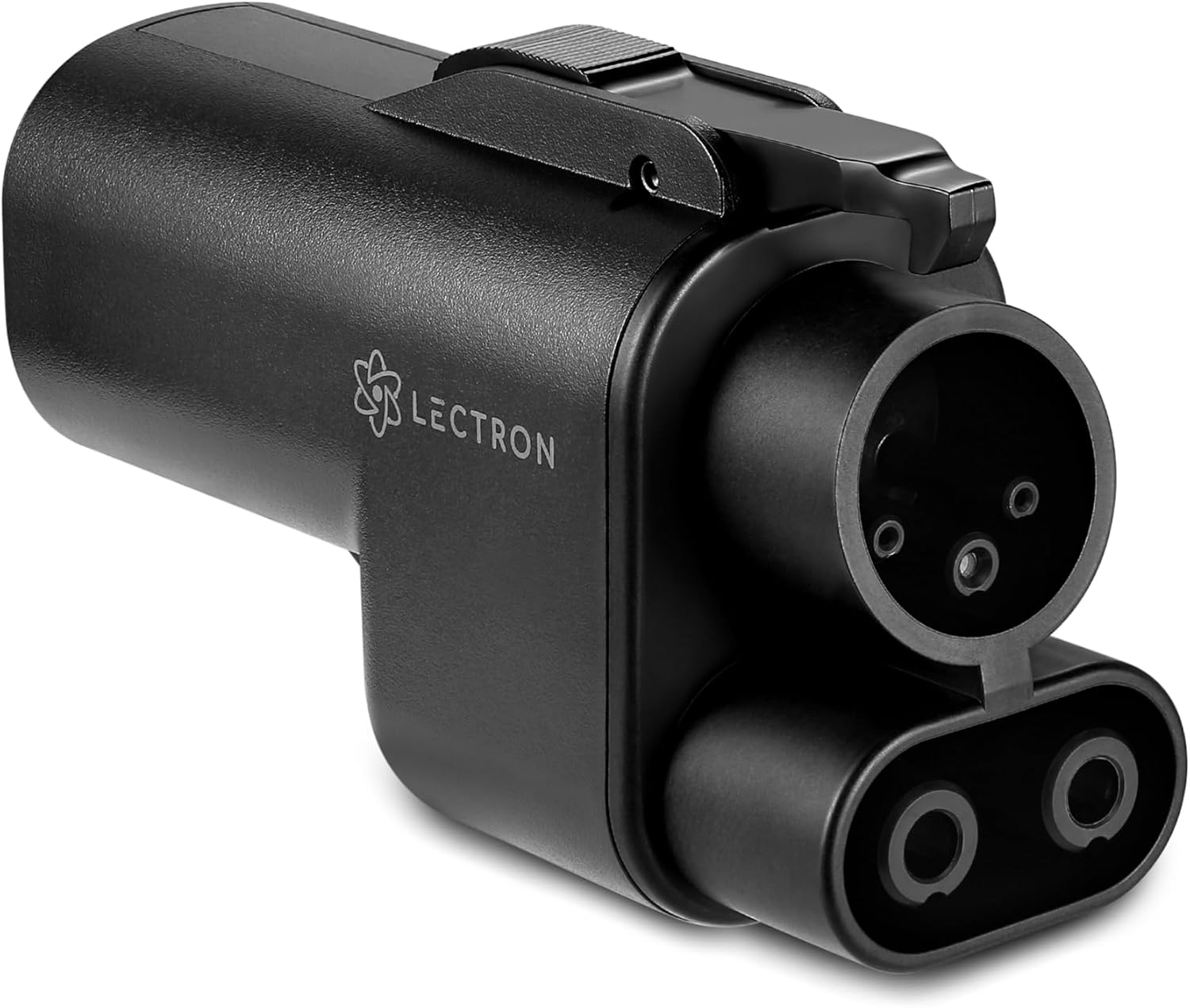
Lectron NACS to CCS Fast-Charge Adapter
Unlock every CCS fast charger for your Tesla, up to 500A DC. Never get stranded at a non-Tesla DC station again.
As an Amazon Associate, ThinkEV earns from qualifying purchases — at no extra cost to you.

Founder & Chief Editor
Vlad Pereira is the founder and chief editor of ThinkEV.ca, the Canadian electric-vehicle publication he writes and edits from Courtenay, British Columbia. He covers EV pricing, federal and provincial rebates, charging costs, and the Chinese manufacturers now entering Canada, from the buyer's side rather than the press-fleet side. ThinkEV is a venture of Vlad Pereira Online; his writing on health, income and the long game lives at vladpereira.com.
Frequently asked questions
Is the BYD Seal actually on sale in Canada?
What would a BYD Seal really cost a Canadian buyer today after tariffs?
Does Canada's 49,000-unit EV import quota make a cheaper Seal possible?
Could BYD sidestep the tariff by building the Seal outside China?
More EV & road-trip finds
Affordable upgrades worth a look — tap any to check the price on Amazon.
 ★ 17,839
Qifutan Vent Phone Mount (Military-Grade Clip)
View on Amazon ★ 8,681
Chemical Guys Complete Car Wash Kit
View on Amazon ★ 164
★ 164Solar-Powered LED Ambient Light
View on Amazon ★ 4,055
6-Speed Manual Shift Knob Display
View on Amazon ★ 865
★ 865Collapsible Trunk Organizer
View on Amazon ★ 297
★ 297360-Degree One-Hand Dashboard Phone Mount
View on Amazon ★ 61
★ 61Toddler Car Seat Snack and Cup Tray
View on Amazon ★ 268
★ 268Anti-Slip Leather Steering Wheel Cover
View on AmazonRead, Plan, Then Stay Current
Explore our expert articles to understand incentives and ownership costs, use the map to pressure-test charging reality, then subscribe so new EV coverage comes straight to you.
Continue Reading
BYD Dolphin Canada: Price, Specs & 2026 Launch Date
BYD in Canada: What You Can Buy and What It Costs
BYD Canada: The Quota Math Behind Ottawa's Bet
Chinese EVs in Canada: 15,603 In, Still No BYD
BYD Seal Canada Price: $45K Sedan, Is It Worth It?