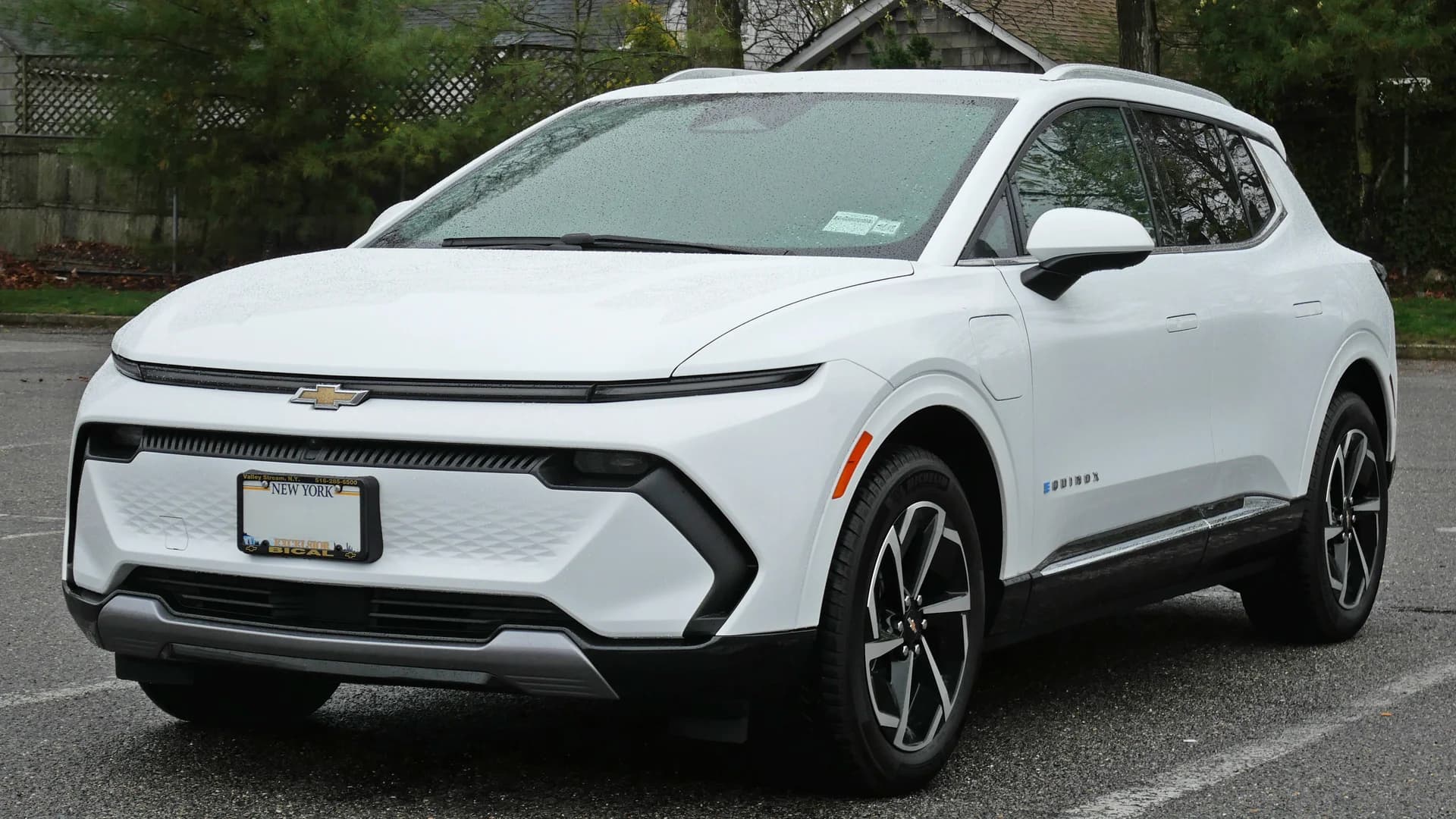
The Equinox EV base trim lands at $37,999 after the federal EVAP rebate. The gas Equinox base trim lands at $35,498. That is a $2,500 premium, not the apocalyptic gap GM Canada's own dealer body still talks about on the phone, and it closes in under two years of Canadian fuel and maintenance math.
I'll put the verdict up front: for the median Canadian family driving 18,000–22,000 km a year, the Equinox EV is the better total-cost-of-ownership pick against its gas twin, and it's the only GM EV currently on sale in Canada where that statement holds without caveat. Blazer EV and Silverado EV both blow through the federal rebate cap, and the budget case collapses with them. The incoming Bolt successor is the variable that could reset the entire argument by 2027, or fail to, which is the more interesting question.
Key takeaways
- The Equinox EV's real premium over its gas twin is $2,500 after the federal rebate, not $7,501.
- Fuel and maintenance savings on the Equinox EV combine to recover that $2,500 gap within 18–24 months.
- Of GM Canada's four current EVs, only the Equinox EV clears the $55,000 federal EVAP rebate cap.
- The 4:1 operating-cost advantage evaporates for families charging primarily on public DC networks at $0.45/kWh.
- GM's upcoming single-size Bolt under $40,000 could reshape the family-EV case entirely, if it hits the rebate cap.
The Price Gap Is Smaller Than GM's Marketing Admits
The Equinox EV starts at $42,999 MSRP. After the $5,000 federal EVAP rebate it lands at $37,999, a figure ThinkEV's family-EV shortlist has used as its anchor since the model arrived in Canadian showrooms, calling it the best-value family EV in Canada and noting that CAMI Ingersoll production sidesteps the import tariff and price cap issues that hobble most rivals. The gas Equinox base trim opens at $35,498. Strip out the rebate theatre and the actual delta is $2,500. That's the number any family-budget conversation has to start with, not the $7,501 MSRP-to-MSRP gap GM's competitive set keeps quoting.
Stack a provincial program on top and the math inverts in three of Canada's largest markets. Quebec's Roulez vert, BC's CleanBC, and (where it returns) Ontario's incentive history all push the post-incentive Equinox EV under the gas trim's drive-away price. That is not a marketing flourish, it's just the rebate stack doing what rebate stacks do.
The case against that framing is reasonable: a $2,500 premium is still a premium, and a family staring at a tight monthly nut doesn't pay for the truck in lifecycle math, they pay for it in next month's payment. Fair. But the financing delta on $2,500 over 60 months at a typical Canadian credit-union rate is under $50 a month, and the fuel savings I'll get to in the next section clear that hurdle in week one of any month with two tanks of gas avoided. The premium is real; it just isn't the obstacle the dealer phone tree pretends it is.
The more underappreciated piece sits upstream of the sticker. Driving's 2026 efficient-Chevrolet roundup puts the gas TrailBlazer at $28,699 to $35,599 plus $2,300 Freight & PDI with gasoline power from 137 to 155 hp, a useful reminder that GM's compact-gas pricing is itself climbing. Run the same data point back a year against Driving's 2024 list, where the Malibu opened at $28,699 with $2,000 PDI, and the freight charge alone has climbed $300 in two model years. The gap between an Equinox EV and the gas crossover GM actually wants families to buy is narrower every model year, and the EV's pricing is more stable because it doesn't ride the same currency and parts-import curve. The cheapest EVs under $50K in Canada for 2026 bear this out across the segment, not just at GM.
Fuel and Maintenance Math That Actually Holds in Canada
Canadian regular gas has hovered around $1.55/L through the first half of 2026, with provincial variance that swings the worst-case (BC interior, Atlantic) closer to $1.75. Home Level 2 charging on a standard residential rate sits near $0.12/kWh, the ratio in per-kilometre operating cost lands roughly 4:1 in the EV's favour for a household that does 80% of its charging at home.
Plug that into 20,000 km a year. A gas Equinox at 9.5 L/100 km combined runs about $2,945 in fuel. An Equinox EV at 19 kWh/100 km on home charging runs about $456. That is a $2,489 annual fuel delta, close enough to the up-front premium that you break even on fuel alone inside year one if you don't drive much DC fast charging.
Maintenance is the line item that gets undersold. No oil changes, no spark plugs, no exhaust work, regenerative braking that pushes pad and rotor life past 150,000 km for most drivers. Conservative Canadian dealer-quoted service averages put the gas Equinox at $1,100–$1,400 a year in routine maintenance once it's out of warranty; the EV equivalent runs $300–$500. Call it $800 a year saved, every year, indefinitely.
Combine fuel and maintenance and the $2,500 premium pays itself back in 18 to 24 months at average Canadian family use. Push to 25,000 km a year and you're at 14 months. This is also the moment to be honest about the limits of the calculation: a household that charges primarily on DC public networks at $0.45/kWh and rarely uses home power can erase most of the fuel advantage. The 4:1 ratio is a home-charger ratio. If you can't install one, the case narrows fast. Carnex's affordable-EV breakdown makes the corollary point worth holding next to the fuel math: paired with quality winter tires, the instant torque of an electric motor managed by modern traction control delivers precise control in Canadian winter, meaning the operating-cost savings don't come at a safety trade-off the way a downsized gas engine would. The same arithmetic governs the broader under-$50K Canadian EV shortlist.
Gear worth having
As an Amazon Associate, ThinkEV earns a small commission from qualifying purchases — at no extra cost to you.

Lectron Level 2 J1772 Charger (40A, WiFi)
Smart WiFi charger with real-time energy monitoring. 40A / 9.6 kW, J1772 with a NEMA 14-50 plug, schedule charging right from your phone.
As an Amazon Associate, ThinkEV earns from qualifying purchases — at no extra cost to you.
Which GM Canada Models Actually Qualify as Budget Family Vehicles
This is where the publisher's view diverges from the press-kit version. GM Canada sells four EVs at retail right now: Equinox EV, Blazer EV, Silverado EV, and the tail end of the original Bolt. Only one of those clears the budget-family bar.
- Equinox EV, Under the $55,000 federal EVAP MSRP cap. Eligible for the full $5,000 rebate. MyChoice's 2026 EV roundup puts the FWD model at up to 513 km of estimated range on GM's Ultium platform, with DC fast charging up to 150 kW replenishing most of the battery in roughly 30 minutes and Chevy Safety Assist plus HD Surround Vision as standard. Family-cargo geometry that matches the segment. This is the single GM EV the budget case applies to.
- Blazer EV, Crosses the EVAP cap on the trims most families would actually pick. No federal rebate. The price-to-utility ratio against a gas Equinox or TrailBlazer collapses.
- Silverado EV, Cap-exceeding by a wide margin and oriented toward work-truck use. Driving notes a 17.70-inch touchscreen, Carplay/Android Auto integration and 6-speaker audio, in-car wifi, navigation, synthetic leather seats and 18-inch steel wheels, the spec sheet is impressive, but it's not a family-budget product.
- Bolt (current generation), Inventory-only at this point and not the model the publication can recommend forward-looking to a 2026 buyer. The successor is the news.
That successor is the swing factor. GM CEO Mark Reuss told Driving Chevrolet is promising just one size of Bolt this time around, a deliberate departure from the Bolt/Bolt-EUV split that previously appealed to different segments of EV customers and, in practice, confused them. A single Bolt aimed under $40,000 Canadian, with EVAP eligibility intact, would be the most consequential GM Canada launch in a decade for family buyers. A single Bolt that misses either the price target or the rebate cap would leave the Equinox EV holding the entire weight of GM's family-budget argument by itself.
Gear worth having
As an Amazon Associate, ThinkEV earns a small commission from qualifying purchases — at no extra cost to you.

WeatherTech FloorLiner for Tesla Model 3
Deep-channel liners that trap every drop of slush and salt. The difference between a ruined interior and a showroom-fresh cabin after a Canadian winter.
As an Amazon Associate, ThinkEV earns from qualifying purchases — at no extra cost to you.
It's worth naming the competitor that benefits if GM fumbles the Bolt price. Reddit's r/EVCanada shortlist for entry buyers puts the Hyundai Ioniq 5, VW ID.4, Ford Mach-E and Chevrolet TrailBlazer in the same low-end consideration set, with Ioniq 9 and ID. Buzz as the up-size pairings. The Ioniq 5 in particular is the one that picks up the conquest sales, it clears the EVAP cap on multiple trims, has dealer footprint in every province, and a used-market floor that's already establishing itself. GM doesn't need to beat Hyundai on every dimension. It needs to beat Hyundai on one: the post-rebate, Canadian-built, sub-$40K family sticker. Bolt or nothing.
The Honest Winter Caveat Canadian Families Need to Hear
The Equinox EV's FWD trim carries a rated range north of 500 km, Most Efficient Chevrolet Cars in Canada coverage notes the Ultium-platform efficiency Driving has tracked across the segment, and the published number is not the number a Sudbury family sees in February.
Real-world Canadian winter range on the Equinox EV settles around 340–380 km on FWD trims, based on owner-reported aggregates and consistent with what other Ultium vehicles deliver in cold-climate conditions. That's a 25–30% derate from the rated figure. For urban and suburban family use, school runs, groceries, weekend trips inside a 200 km radius, it doesn't matter. The car charges overnight, the family starts every morning at full state of charge, and the cold-weather range is irrelevant to actual driving patterns.
For rural northern Ontario, the Prairies between cities, or any household whose typical week includes a 400 km one-way drive without charging infrastructure, the equation is different. The Equinox EV does not solve that use case. That's not a failure of the vehicle, it's a failure of fit, and the editorial position is to say so out loud rather than paper over it with marketing range figures.
The honest alternative for that household isn't a different EV, it's a hybrid, where the powertrain trades pure-electric operating cost for the fuel-economy and acceleration benefits a conventional drivetrain alone can't deliver. Recommending a family stretch into a long-range EV they can't charge reliably is worse advice than recommending a hybrid they can refuel anywhere on Highway 11. The budget argument has to acknowledge the geography of Canada, not just the geometry of a battery pack.
Winter tires are mandatory regardless of powertrain. That cost shouldn't be charged to the EV side of the ledger.
Gear worth having
As an Amazon Associate, ThinkEV earns a small commission from qualifying purchases — at no extra cost to you.

Cool Swinging Duck Dashboard Ornament
The internet-famous duck that bobs and swings as you drive. Pure joy on the dash, conversation starter at every light.
As an Amazon Associate, ThinkEV earns from qualifying purchases — at no extra cost to you.
Editorial Position: GM's Canadian Manufacturing Edge Is the Overlooked Argument
CAMI Ingersoll. That's the line the rest of the segment can't match.
The Equinox EV is built in Ontario. Not assembled in Ontario from largely imported content, actually built at GM's CAMI plant, with the BrightDrop facility's tooling and the Ultium battery supply chain integrated through Canadian and US partnerships. In a market where the 2025–2026 tariff cycle has whipsawed cross-border vehicle pricing more than once, that domestic production is a real structural advantage that doesn't show up on a spec sheet. The depth of GM's industrial footprint, a century-plus of car and truck manufacturing across a vast industrial scope, is the reason CAMI exists at the scale it does, and the reason a Korean or Chinese entrant can't match that footprint inside one tariff cycle.
Compare to the position of any imported family EV at the same price point. A vehicle that arrives via cross-border supply chain, whether from the US, Korea, or eventually under the new Chinese EV quota allocations Canada introduced in January 2026, carries pricing risk every time the political weather changes. The Equinox EV doesn't. Transport Canada's regulatory work and NRCan's EVAP administration both treat the vehicle as a Canadian product because it is one.
That insulation is worth real money to a budget family making a six- or seven-year ownership decision. The spec sheet doesn't say "your price won't move 8% next quarter because Washington picked a fight", but the manufacturing location does. The reason GM Canada's family-EV argument holds up better than the marketing makes it look is this, not the powertrain.
Gear worth having
As an Amazon Associate, ThinkEV earns a small commission from qualifying purchases — at no extra cost to you.

HoogaLife Hanging Car Diffuser (2-Pack)
A refillable wood-and-felt diffuser that beats the cheap cardboard trees and lasts months on a few drops of oil.
As an Amazon Associate, ThinkEV earns from qualifying purchases — at no extra cost to you.
What Would Change This Assessment
The judgment above isn't unconditional. Three things would move it materially.
If the federal EVAP MSRP cap rises above $55,000, a policy review NRCan has signalled is on the table for 2027, the Blazer EV re-enters the family-budget conversation and the GM Canada EV lineup looks much deeper. If the cap stays where it is, Blazer EV stays on the wrong side of the rebate threshold for most family buyers.
If the Bolt successor launches above $42,000 Canadian or misses EVAP eligibility on its base trim, the budget case narrows back to the Equinox EV alone, and a single-model budget argument is structurally weaker than a two-model one. GM's resale-value position in Canada depends on lineup depth as much as on individual model strength.
If provincial programs evaporate, Ontario ended its rebate in 2018 and could do so again, BC and Quebec both face budget pressure, the post-incentive math reverts to the federal-only $5,000 floor, and the break-even moves out from 18–24 months toward 28–32. Still a positive case, but a less aggressive one.
There's a fourth variable worth naming, even though it's outside GM's control. The used-EV market is where the budget case gets won or lost over a 10-year horizon, and Edmunds' dirt-cheap used-EV roundup carried by Halifax CityNews makes the point that volatile gas prices are pushing shoppers into hybrids, plug-in hybrids and used EVs as the price-conscious entry path. If the three-year-old Equinox EV holds value the way the original Bolt didn't, GM's family argument compounds across ownership cycles. If it depreciates like a 2019 Bolt, the second owner picks up the savings and the first owner eats the gap. I'd watch that residual curve more closely than the new-vehicle press releases.
The bottom line: the Equinox EV is the right answer for most budget Canadian families today, the Bolt successor is the variable that determines whether GM has a lineup or a single model in this segment by 2027, and the CAMI manufacturing position is the underrated structural advantage that nobody outside the trade press talks about. Watch the Bolt launch price. That's the number that decides where this lineup goes next.
Gear worth having
As an Amazon Associate, ThinkEV earns a small commission from qualifying purchases — at no extra cost to you.

Personalized Photo and Text Keychain
Put a face and a few words on a keychain that rides along on every drive. A five-minute gift that lands.
As an Amazon Associate, ThinkEV earns from qualifying purchases — at no extra cost to you.

Founder & Chief Editor
Vlad Pereira is the founder and chief editor of ThinkEV.ca, the Canadian electric-vehicle publication he writes and edits from Courtenay, British Columbia. He covers EV pricing, federal and provincial rebates, charging costs, and the Chinese manufacturers now entering Canada, from the buyer's side rather than the press-fleet side. ThinkEV is a venture of Vlad Pereira Online; his writing on health, income and the long game lives at vladpereira.com.
Frequently asked questions
Does the Equinox EV qualify for provincial incentives on top of the federal rebate?
What happens to the savings math if I can't charge at home?
Why doesn't the Blazer EV make the budget-family cut?
How much does maintenance actually save over the ownership period?
What makes the incoming Bolt successor such a pivotal product for GM?
More EV & road-trip finds
Affordable upgrades worth a look — tap any to check the price on Amazon.
 ★ 2,941
Microfiber Cleaning Cloths (Multi-Pack)
View on Amazon ★ 537
★ 537USB Star Projector Roof Light
View on Amazon ★ 401
★ 401Crochet Daisy Rear-View Mirror Charm
View on Amazon ★ 27,769
Car Cup Holder Coasters (4-Pack)
View on Amazon ★ 21,310
Magnetic Car Phone Mount
View on Amazon ★ 61
★ 61Toddler Car Seat Snack and Cup Tray
View on Amazon ★ 268
★ 268Anti-Slip Leather Steering Wheel Cover
View on Amazon ★ 96,686
PULIDIKI Car Cleaning Gel (Detailing Putty)
View on AmazonRead, Plan, Then Stay Current
Explore our expert articles to understand incentives and ownership costs, use the map to pressure-test charging reality, then subscribe so new EV coverage comes straight to you.
Continue Reading
First-Time EV Buyer Mistakes Worth Avoiding in Canada
BYD Seagull Price Canada 2026, The Real Number, Banded
EV Charging Cost Calculator: The Canadian Numbers

Are Any Electric Cars Made in Canada? The 2026 Reality
Buying Small to Save on Charging? Read This First