Key takeaways
- The base ID.4 Pro starts at $47,495 CAD, which qualifies for the $5,000 federal EVAP rebate (final transaction value under $50,000), bringing the effective price to $42,495.
- The Pro S RWD at $52,495 and the Pro S AWD at $55,995 exceed the $50,000 transaction value cap and do not qualify for EVAP.
- After the rebate on the base model, you're looking at $42,495 for a German-engineered electric crossover with solid range and VW's build quality.
The VW ID.4 is the EV equivalent of a well-fitted pair of shoes. It doesn't demand attention, it doesn't try to impress, and it doesn't do anything flashy. It just works. In a market full of EVs trying to be the fastest, the longest-range, or the most futuristic, the ID.4 quietly occupies the space labelled "competent, practical, and unexciting." That sounds like faint praise, but for a lot of Canadian buyers, it's exactly what they're looking for.
The base ID.4 Pro starts at $47,495 CAD, which qualifies for the $5,000 federal EVAP rebate (final transaction value under $50,000), bringing the effective price to $42,495. The Pro S RWD at $52,495 and the Pro S AWD at $55,995 exceed the $50,000 transaction value cap and do not qualify for EVAP. After the rebate on the base model, you're looking at $42,495 for a German-engineered electric crossover with solid range and VW's build quality. That's not a bad deal.
WHAT IT IS
The ID.4 sits on Volkswagen's MEB platform, which is the same modular electric architecture underpinning the ID.3, ID.5, ID.Buzz, Cupra Born, and Skoda Enyaq. That shared platform means the engineering is mature: this isn't a first-generation experiment. The battery is a floor-mounted 82 kWh pack (77 kWh usable), and the motor options are a 282 hp rear-wheel drive unit or a 295 hp all-wheel drive setup with a smaller motor added to the front axle.
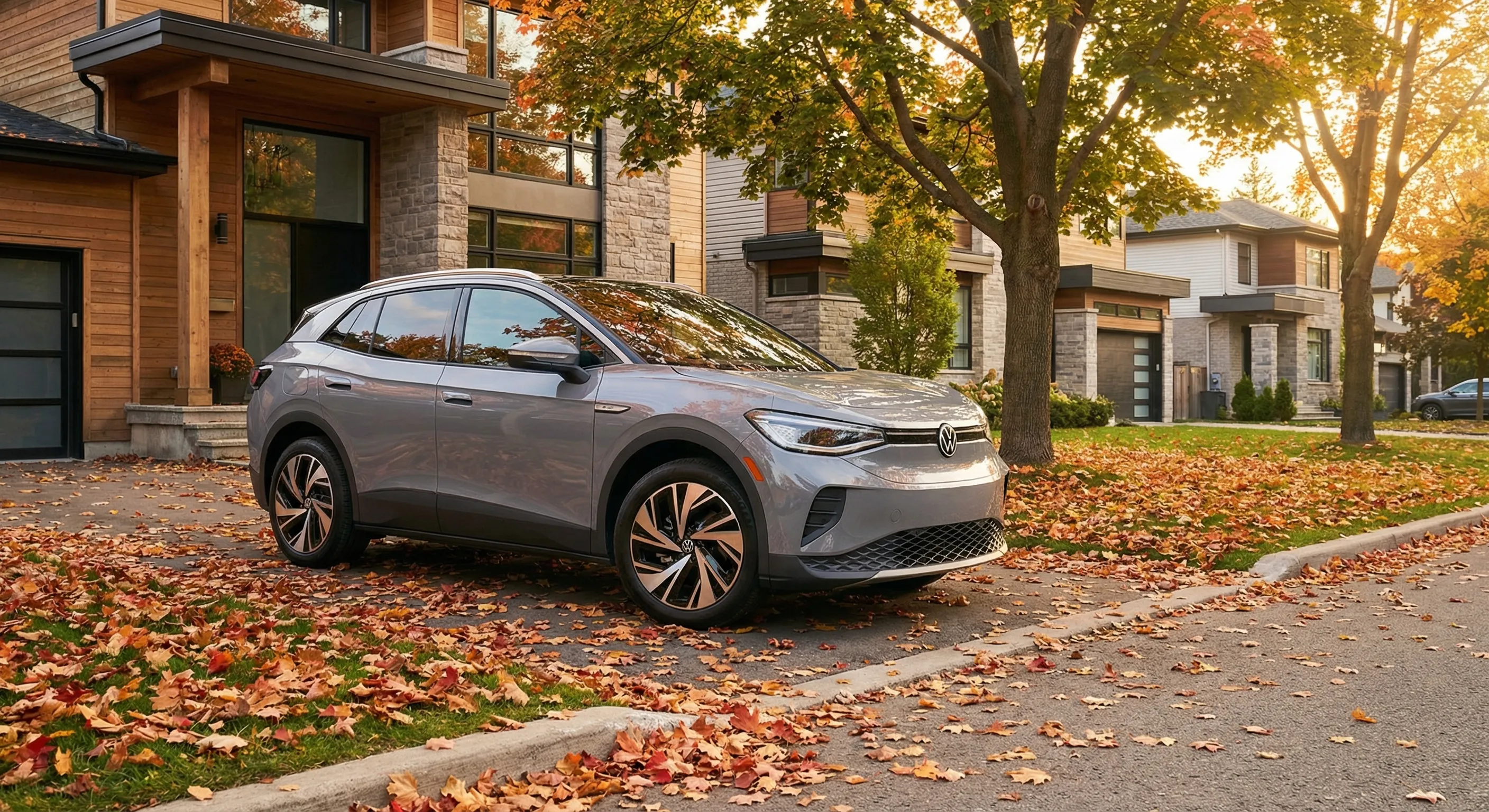
The exterior design is clean and restrained. No aggressive creases, no oversized grilles, no look-at-me styling cues. The proportions are balanced, it looks like a conventional compact SUV that happens to be electric. The LED headlights with the illuminated light bar across the front give it a modern face without being showy. In a parking lot, it blends in. Buyers who want something that announces itself will find this boring; buyers who want something their neighbours don't ask about will find it perfect.
Inside, the cabin is spacious for a compact crossover. The flat floor, thanks to the skateboard battery layout, means genuine legroom for rear passengers. The cargo area offers 543 litres behind the rear seats, expanding to approximately 1,575 litres with them folded. That's competitive with the Hyundai Ioniq 5 and slightly less than the Tesla Model Y. For families, groceries, hockey gear, and the general detritus of Canadian life, the ID.4 handles it without drama.
DRIVING
The ID.4 drives like a Volkswagen: solid, planted, and well-sorted. The steering is light but precise, the brakes are progressive with a good blend of regenerative and friction braking, and the suspension absorbs rough Canadian roads without transmitting every crack and pothole into the cabin. It's comfortable in a way that makes long drives easy and short drives forgettable, in the best sense.
The 282 hp RWD model is the one to get for most buyers. It's lighter than the AWD, has slightly better range, and the rear-motor layout gives it surprisingly good traction in dry and wet conditions. The 0-100 km/h time of about 6.7 seconds is perfectly adequate. Not fast enough to thrill, not slow enough to frustrate. Highway merges, passing manoeuvres, and city driving are all handled without hesitation.
The AWD model adds an extra motor up front for a combined 295 hp and genuine all-wheel-drive traction. If you live in an area with heavy snowfall and don't want to rely solely on winter tires, the AWD is worth the premium. But on dry roads, the difference between 282 hp RWD and 295 hp AWD is barely noticeable. The extra weight of the front motor actually dulls the driving experience slightly.
What the ID.4 doesn't do is excite you. There's no playful rear-end rotation, no sharp turn-in, no sense that the car wants to be driven hard. It's tuned for comfort and stability, and it delivers both in abundance. If you want a crossover that makes your commute feel effortless, the ID.4 is outstanding. If you want one that makes you take the long way home, look at the Mach-E or Ioniq 5.
Gear worth having
As an Amazon Associate, ThinkEV earns a small commission from qualifying purchases — at no extra cost to you.
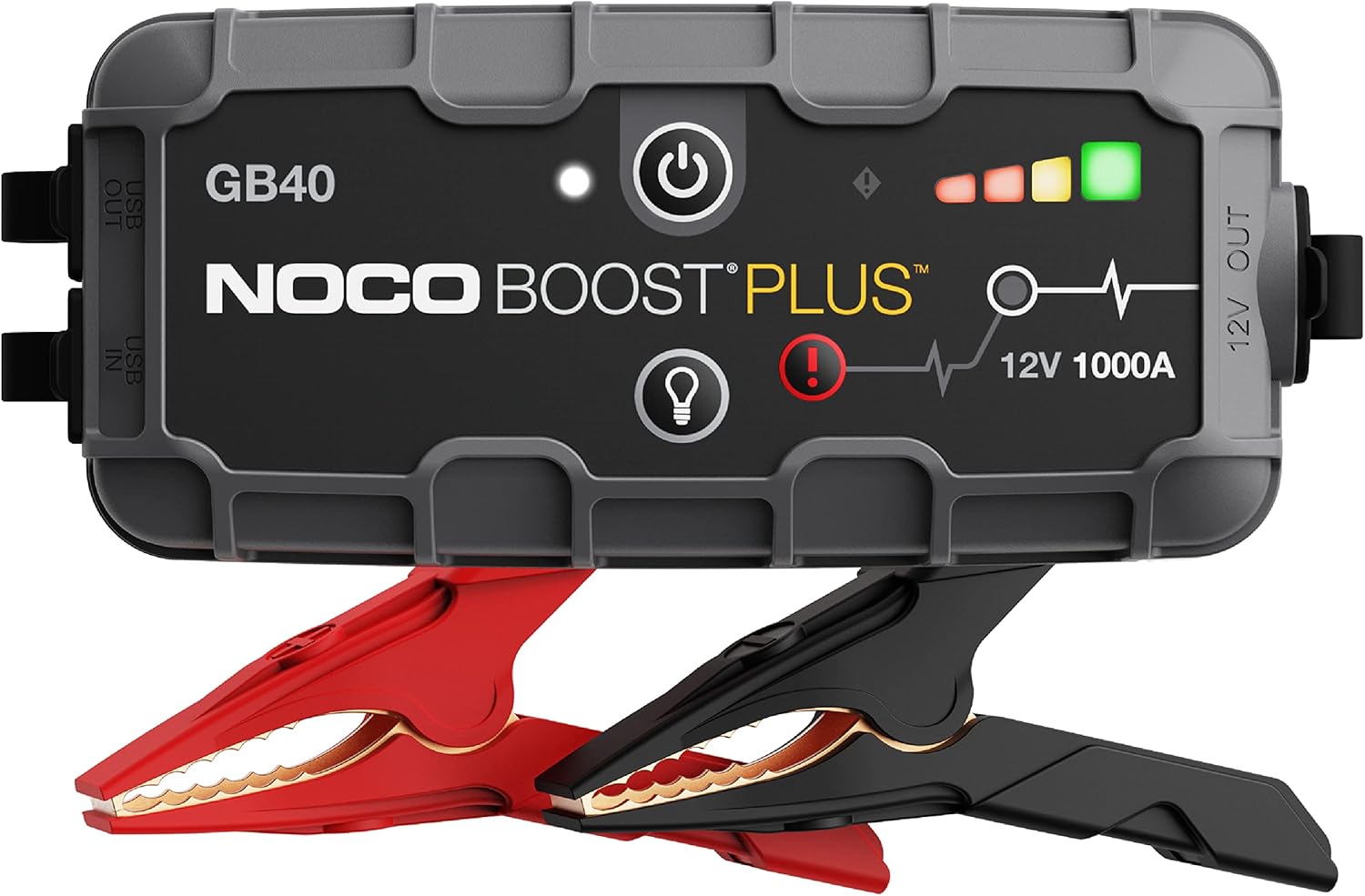
NOCO Boost Plus GB40 Jump Starter
A 1000A lithium jump starter that fits in your glovebox and works on any 12V battery. Your insurance against a dead 12V in a parking lot.
As an Amazon Associate, ThinkEV earns from qualifying purchases — at no extra cost to you.
RANGE AND CHARGING
The 82 kWh battery delivers 443 km of rated range on the Pro S RWD, which translates to roughly 360-400 km in real-world Canadian summer driving. The AWD model is rated at 413 km, or roughly 330-370 km real-world. These are solid numbers that put the ID.4 in the middle of the compact EV crossover pack, behind the Tesla Model Y (531 km rated) but ahead of the Chevy Equinox EV base (around 400 km rated).
Winter range drops to approximately 280-310 km for the RWD and 260-290 km for the AWD. For a daily commuter driving 50 km round trip, that's five to six days between charges. Practical and manageable, even in a Winnipeg January.
Gear worth having
As an Amazon Associate, ThinkEV earns a small commission from qualifying purchases — at no extra cost to you.

VIOFO A229 Pro 4K Dash Cam
4K front plus 2K rear with parking mode and GPS. Your silent witness for insurance claims, with always-on sentry recording while parked.
As an Amazon Associate, ThinkEV earns from qualifying purchases — at no extra cost to you.
DC fast charging peaks at 170 kW on the CCS connector, which gets you from 10% to 80% in about 30 minutes on a high-power station. That's competitive but not class-leading. The Hyundai Ioniq 5 on its 800V architecture does the same in about 18 minutes. The ID.4's 400V system is fast enough for occasional road trips but noticeably slower than the 800V competition during multi-stop journeys.
Home charging on a Level 2 (240V, 48A) circuit takes about 8 hours from empty to full. The ID.4 supports Plug & Charge on compatible networks, which means the car authenticates and starts charging automatically when you plug in. No app, no card, no tapping. It works on FLO and Electrify Canada stations across the country, and it's one of those quality-of-life features that makes daily charging feel genuinely effortless.
INTERIOR AND TECH
The 2026 ID.4's infotainment system has been significantly improved from the early models that launched with sluggish, frustrating software. The 12-inch centre touchscreen is now responsive, the menus are reorganized for fewer taps, and wireless Apple CarPlay and Android Auto work reliably. The touch-sensitive climate and volume controls along the bottom of the screen remain the ID.4's most annoying design choice, they're fiddly, imprecise, and require you to look away from the road. Volkswagen has added haptic feedback to help, but physical knobs would be better.
The front seats are comfortable with good support for long drives. Heated front seats, heated steering wheel, and heated rear seats are standard on the Pro S, which is as it should be for any car sold in Canada. The materials quality is solid, soft-touch surfaces on the upper dash and door panels, reasonable plastics below. It feels well-built in the way Volkswagens typically do, without feeling premium. The head-up display with augmented reality navigation is a welcome feature that projects turn-by-turn directions onto the windshield in a way that feels genuinely useful rather than gimmicky.
Gear worth having
As an Amazon Associate, ThinkEV earns a small commission from qualifying purchases — at no extra cost to you.

Grizzl-E Classic Level 2 EV Charger (40A)
Canadian-made and rated for minus 40C winters. 40A / 9.6 kW, NEMA 14-50, indoor/outdoor, 24-ft cable. The charger built for Canadian weather.
As an Amazon Associate, ThinkEV earns from qualifying purchases — at no extra cost to you.
THE COMPETITION PROBLEM
The ID.4's biggest challenge isn't what it does. It's what its competitors do for less money. The Chevrolet Equinox EV starts at approximately $42,500 CAD with a longer range and GM's Ultium platform. The Hyundai Ioniq 5 offers 800V ultra-fast charging and a more distinctive design at a similar price. The Tesla Model Y has the Supercharger network and better range.
The ID.4 doesn't beat any of these cars on any single metric. It doesn't have the best range, the fastest charging, the lowest price, or the most exciting driving dynamics. What it offers instead is a combination of all these things at a consistently good level. No single weakness that would be a dealbreaker, no single standout feature that would make it an obvious choice. It's the B+ student of electric crossovers: never the best, never the worst, always competent.
For some buyers, that's exactly right. If you value Volkswagen's build quality, the MEB platform's balanced ride, and a car that simply works without demanding attention, the ID.4 delivers. If you need to be impressed by at least one thing about your car, you might need to look elsewhere.
VERDICT
The ID.4 is a good car that suffers from the problem of being surrounded by good cars. In a vacuum, it would be an easy recommendation: solid range, comfortable ride, practical interior, competitive pricing after the EVAP rebate. In reality, it has to fight the Equinox EV on price, the Ioniq 5 on charging speed, and the Model Y on range and ecosystem.
The ID.4 earns its place through consistency, not highlights. For buyers who value German engineering, dislike drama, and want an EV that feels like a normal car, it's a strong choice. In a market full of EVs trying to reinvent the wheel, sometimes you just want the wheel to work.
Gear worth having
As an Amazon Associate, ThinkEV earns a small commission from qualifying purchases — at no extra cost to you.

PULIDIKI Car Cleaning Gel (Detailing Putty)
Press it into vents, buttons, and seams and it lifts out dust you did not know was there. Weirdly satisfying, genuinely useful.
As an Amazon Associate, ThinkEV earns from qualifying purchases — at no extra cost to you.
Related Reading
- VW ID.4 vs Chevy Equinox EV Canada 2026, Head-to-head with its closest competitor.
- Canada EV Rebate EVAP 2026 Guide, How to claim your $5,000 federal incentive.
- VW ID.Buzz Canada Review 2026: The Electric Microbus Family Hauler That Actually Delivers
- Chrysler Pacifica PHEV vs VW ID.Buzz: Canada's Only Electrified Minivan Battle
- BYD Atto 3 Review: The $30K EV That Doesn't Feel Like $30K
Gear worth having
As an Amazon Associate, ThinkEV earns a small commission from qualifying purchases — at no extra cost to you.

WixGear Magnetic Air Vent Phone Mount (2-Pack)
A magnet strong enough that your phone never flinches over potholes or rail crossings. Two in the box, one for each car.
As an Amazon Associate, ThinkEV earns from qualifying purchases — at no extra cost to you.

Founder & Chief Editor
Vlad Pereira is the founder and chief editor of ThinkEV.ca, the Canadian electric-vehicle publication he writes and edits from Courtenay, British Columbia. He covers EV pricing, federal and provincial rebates, charging costs, and the Chinese manufacturers now entering Canada, from the buyer's side rather than the press-fleet side. ThinkEV is a venture of Vlad Pereira Online; his writing on health, income and the long game lives at vladpereira.com.
Frequently asked questions
Does the VW ID.4 qualify for the $5,000 EVAP rebate?
How does the ID.4 handle Canadian winters?
RWD or AWD: which should I get?
How does the ID.4 compare to the Chevy Equinox EV?
More EV & road-trip finds
Affordable upgrades worth a look — tap any to check the price on Amazon.

TP-Link Kasa Smart Plug with Energy Monitoring
View on Amazon ★ 87
★ 87Car Window Sun Shades for Kids (4-Pack)
View on Amazon ★ 68
★ 68WeatherTech FloorLiner for Tesla Model 3
View on Amazon ★ 4,050
Touchscreen Mist Screen Cleaner Kit
View on Amazon ★ 164
★ 164Solar-Powered LED Ambient Light
View on Amazon ★ 900
★ 900Personalized Photo Car Air Freshener
View on Amazon ★ 4,424
Sun Visor Card and Document Organizer
View on Amazon ★ 12,834
P3 Kill A Watt Electricity Usage Monitor
View on AmazonRead, Plan, Then Stay Current
Explore our expert articles to understand incentives and ownership costs, use the map to pressure-test charging reality, then subscribe so new EV coverage comes straight to you.
Continue Reading
VW ID. Buzz Canada Review: $69,995 Electric Microbus
Volvo EX30 Canada Review: The Small One to Want

Rivian R1T Canada Review 2026: 515 km Quad-Motor

Rivian R2 Canada Price 2026: The $57K Electric SUV
BYD Dolphin Canada: Price, Specs and 2026 Review