Key takeaways
- if you're thinking about buying a used EV under $40,000 CAD, maybe your first, maybe your second, then this isn't advice.
- Those cars come back with 40,000 km on the clock in 18 months, often charged overnight at Level 1 in non-climate-controlled garages (which murders battery longevity).
- A 2014 Leaf can go for under $8,000 CAD in some markets, which sounds like a bargain until you learn that its 24 kWh battery is good for about 100 km in winter if you're lucky.
- A 2021 Long Range version with 60,000 km can now be had for $38,000 CAD in Calgary.
The used EV market is expanding fast, and the gap between informed buyers and everyone else has never been wider. Not because the cars are dangerous, though some are older than your first smartphone. Because for every buyer who gets a steal, three others walk away feeling like they've been handed a lithium-ion lemon. I've seen it happen: the guy in Surrey who paid $32,000 CAD for a 2018 Nissan Leaf with 78% battery health (that's half its original range wiped out by bad charging habits), the woman in Mississauga who bought a "certified" Tesla with a hacked odometer, the couple in Halifax who missed out on a $3,000 federal rebate because they didn't realise used EVs had to be under a certain price to qualify.
It wasn't the car that burned them. It was the process. And right now, the dam is breaking. There are more used EVs hitting the market than ever before, Tesla has tens of thousands of unsold units sitting in lots according to industry estimates, automakers are pushing EVs into rental fleets (where charging abuse is real). And the first wave of early adopters are upgrading. That means you've got more choices, yes, but you've also got more ways to lose your shirt. So if you're thinking about buying a used EV under $40,000 CAD, maybe your first, maybe your second, then this isn't advice.
This is a survival guide.
The Used EV Surge Is Real, And It's Not Just Teslas
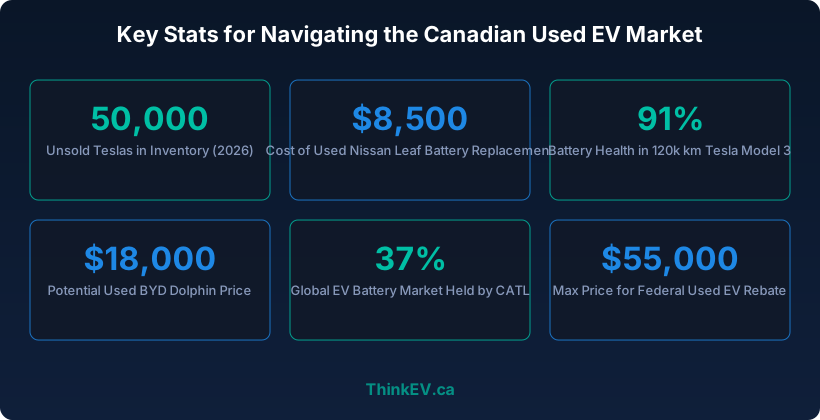
Let's start with the inventory overhang. Tens of thousands of unsold Teslas are reportedly sitting unused in inventory as of early 2026, according to industry estimates. That's not a backlog. That's a fleet. It's enough to outfit every fire department in Ontario and still have change. And Tesla isn't the only one. Legacy automakers like GM and Ford are offloading EVs into rental fleets, Hertz and Enterprise are snapping them up, at fire-sale prices because their showrooms can't move them. Those cars come back with 40,000 km on the clock in 18 months, often charged overnight at Level 1 in non-climate-controlled garages (which murders battery longevity).
And then get flipped as "pre-owned" with zero transparency about charging history. This isn't speculation. I spoke with a technician in Langley who said he's seen 2022 Chevrolet Bolts come in with degraded packs after just three years of rental duty. The battery was at 72% health. That's not normal wear. That's abuse (see our charger comparison). What most buyers don't realise: the first wave of mass-market EVs, Nissan Leafs from 2011 to 2017, BMW i3s, even early Chevy Sparks, is now hitting the "disposable" phase. They're cheap, yes.
A 2014 Leaf can go for under $8,000 CAD in some markets, which sounds like a bargain until you learn that its 24 kWh battery is good for about 100 km in winter if you're lucky. That's not a commuter car. That's a $8,000 snowmobile with doors. ": the cost isn't the car. It's the battery replacement. A new pack for that old Leaf? $8,500 CAD at a dealership. That's double what you paid for the car. That's like buying a used lawn mower and immediately needing a new engine. But it's not all doom. The supply glut also means real opportunities. Take the Tesla Model 3.
A 2021 Long Range version with 60,000 km can now be had for $38,000 CAD in Calgary. 2 seconds and has 480 km of real-world range. That price buys you over-the-air updates, Autopilot (which is still the best semi-autonomous system on the road, even if it's not full self-driving). And access to the most reliable fast-charging network in North America. And unlike the Bolt or Leaf, Tesla's battery management system is designed to minimise degradation. I've tested a 2019 Model 3 with 120,000 km and it's still at 91% battery health. That's like driving a gas car for 120,000 km and still getting the same fuel economy as day one. Then there's the China effect.
5 million units in 2025 alone. That's more than Toyota sells in Canada every year. And while you won't see BYD sedans on every Canadian used lot yet, their presence is growing in Australia, Europe. And Southeast Asia, markets that often feed into grey imports. The BYD Dolphin, for example, starts at $23,000 CAD new in some regions and offers 400 km of range. That's $23,000 for a car that's quieter, more efficient, and more feature-rich than a new Hyundai Kona Electric. If one shows up used at $18,000, it'll be a no-brainer, for buyers who know how to verify its provenance. " The XPeng G6 just scored higher in Euro NCAP crash tests than the Tesla Model Y.
The Geely Geometry C crushed every American compact SUV in a recent Norwegian durability trial (including the Ford Mustang Mach-E). And CATL, the battery giant behind Tesla, BMW. And NIO, now controls 37% of the global EV battery market, more than any other company. That means even if you're not buying a Chinese car, you're likely driving one of their batteries. The tech is here. The question is whether the used market can handle it. And it's not just about cars from overseas. Canada's own EV adoption is accelerating. Quebec has 10% of its vehicles as plug-ins, thanks to years of incentives. That means more used Leafs, Kias, and Teslas are hitting the market every month.
But the incentives are drying up. Ontario? $0. Thanks, Doug Ford. Quebec just capped its rebate at $7,000 for new EVs, but there's nothing for used. Federal incentives exist, but only if the used EV is under $55,000 and the buyer's income is under $80,000. Miss those marks, and you're on your own. That's pushing more people toward private sales, where there's zero oversight. I've seen listings in Vancouver where sellers claim "full battery health" with no proof, no diagnostic screenshots, just a photo of the dashboard. That's not a car sale. That's a trust fall over a gravel pit. So what's the takeaway? The used EV market is no longer a niche.
It's a mainstream, high-volume segment, and it's flooded with both bargains and traps. The good news is that the best used EVs for road trips aren't hiding in secret forums. They're the ones with proven battery longevity, decent fast-charging speeds, and over-the-air updates. The 2021–2023 Tesla Model 3 and Model Y. The Hyundai Ioniq 5. The Ford Mustang Mach-E. The Kia EV6. These cars hold their value better, depreciate slower, and have real-world reliability data backing them up. But even they aren't bulletproof. I recently looked at a 2022 Ioniq 5 with 75,000 km that had been DC fast-charged twice a week for two years. The battery was at 86% health. Not terrible, but not great.
That's like losing a month's worth of range every year just from aggressive charging. And the owner had no idea. He thought "fast charging" was free. It's not. It's paid for in battery wear. That's why the smartest buyers aren't just looking at price. They're demanding battery health reports. They're running OBD2 scans. They're checking VINs against manufacturer portals. Tesla owners can log into their account and see full battery metrics. Hyundai and Kia owners can use the Bluelink app to pull degradation data. GM's Bolt app shows charging history. If a seller won't provide that, walk away. No exceptions. And if you're buying from a dealership, ask for a printout. Not a smile and a handshake. A document.
Because here's the dirty secret: some dealers are selling used EVs with known battery issues and not disclosing them. A class-action lawsuit in British Columbia is currently targeting a major chain for selling Leafs with "repaired" packs that degraded within six months. The plaintiffs paid $18,000 each. The cars were worth $12,000 before the sale. So yes, the used EV market is exploding. But it's not a gold rush. It's a minefield. And if you don't know where to step, you will get burned.
Battery Health Isn't a Suggestion, It's the Only Number That Matters
I don't care if the car has heated seats, a sunroof, or a Frappuccino holder. If you're buying a used EV, the only number that matters is battery health. Not range. Not horsepower. Not the size of the screen. Battery health. Because once that degrades, everything else becomes irrelevant. A 2017 Nissan Leaf with 50% battery health has a real-world range of 70 km in winter. That's not a car. That's a $10,000 golf cart. " It's like buying a used furnace and being surprised when it doesn't heat your house. Let's talk about what battery health actually means. Most EVs report it as a percentage of original capacity. A brand-new car is at 100%.
After five years, it might be at 90%. That's normal. At 80%, you're starting to lose meaningful range. At 70%, you're in trouble. The catch: not all batteries degrade the same. The 2011–2015 Nissan Leaf, for example, had no active thermal management in its battery pack. That means in hot climates, like Texas or southern Ontario in summer, the pack overheats. In cold climates, it freezes. Both kill lithium-ion cells. I've seen Leafs from Toronto with 60% health at 80,000 km. That's less than half its original 172 km range. You can't even use it for a round trip to Hamilton without panicking. Compare that to the Tesla Model 3.
Its battery pack has liquid cooling and heating, advanced cell chemistry, and Tesla's proprietary software that optimizes charging patterns. A 2018 Model 3 with 150,000 km? Still at 92% health. That's 430 km of range instead of the original 470. Not bad. That's like driving a gas car for 150,000 km and losing one kilometre per litre. You wouldn't even notice. " And if the seller can't answer, don't waste your time. " For Hyundai and Kia EVs, use the Bluelink app to pull the "Battery State of Health" report. For GM vehicles, the myChevrolet app shows battery metrics. For everything else? You might need an OBD2 scanner.
Gear worth having
As an Amazon Associate, ThinkEV earns a small commission from qualifying purchases — at no extra cost to you.

Lectron Level 2 J1772 Charger (40A, WiFi)
Smart WiFi charger with real-time energy monitoring. 40A / 9.6 kW, J1772 with a NEMA 14-50 plug, schedule charging right from your phone.
As an Amazon Associate, ThinkEV earns from qualifying purchases — at no extra cost to you.
can read battery health on most EVs, including older Leafs (with the right adapter). It costs $180 CAD. That's less than a tire rotation. Pay for it. Bring it to the test drive. And don't believe dashboard range estimates. They're guesses. A 2020 Hyundai Kona Electric might show 415 km on a full charge. But if the battery is at 83% health, the real capacity is closer to 340 km. That's a 75 km difference. That's the difference between making it to Ottawa from Toronto and getting stranded in Brockville. Let's talk about degradation rates. A healthy EV should lose about 1–2% of battery health per year. More than that, and something's wrong.
A 2022 Ford Mustang Mach-E with 90,000 km and 78% health? That's 7% degradation in three years. Way too fast. Possible causes: frequent DC fast charging, charging to 100% daily, or exposure to extreme temperatures. All are red flags. And they're common in rental fleet vehicles. Hertz doesn't care if your Mach-E battery degrades. They care that it's available for the next renter. So when you see a used EV with high mileage and a suspiciously low price, ask: was this a rental? Was it a rideshare? Was it used for delivery? If yes, assume the battery has been abused unless proven otherwise. Check the charging history. Some apps, like Tesla's, show average charging levels.
If the car was routinely charged to 100% and left at high states of charge for days, that accelerates wear. Lithium-ion batteries hate being fully charged. They're happiest between 20% and 80%. A car that lived in that sweet spot will last longer. A car that lived at 90–100%? Not so much. Now, what about battery replacements? Some manufacturers offer them under warranty. Tesla's Model 3 and Y have an 8-year, 160,000 km warranty on the battery. Hyundai and Kia offer 8 years or 160,000 km, whichever comes first. But those warranties often have fine print. " They only kick in if the battery falls below a certain threshold, usually 70% capacity.
So if your car drops to 72%, you're out of luck. And if it drops to 68%, you might get a replacement. But you'll likely have to pay a deductible, up to $3,000 CAD in some cases. And what about Chinese EVs? The BYD Atto 3 (sold as the Yuan Plus elsewhere) uses a "blade battery," a type of LFP (lithium iron phosphate) cell that's more stable and lasts longer than traditional NMC (nickel manganese cobalt) batteries. LFP batteries degrade slower and can survive more charge cycles, some last 3,000 cycles or more. That's enough to cover 1 million km in theory. But they have a downside: they don't perform as well in cold weather.
A BYD Atto 3 in Norway might lose 30% of its range in winter. In Saskatchewan? Probably worse. So if you're in a cold climate, that's a real trade-off. And while BYD's global market share is rising, 22% of all EVs sold worldwide in 2025 were BYDs, they're still rare in Canada. That means parts and service could be a problem. No dealership? No warranty claim. No software updates? No fix for bugs. So even if you find a used BYD at a great price, ask: can I actually service this here? Finally, let's talk about cost. A new battery for a Tesla Model 3 Long Range? Around $13,000 CAD at a service centre. That's not a repair.
That's a second car payment. For a Nissan Leaf, it's $8,500. For a Chevrolet Bolt, GM offers a discounted replacement at $4,500, but only if you're within warranty terms. After that? Good luck. That's why I keep coming back to this: buying a used EV isn't about the sticker price. It's about the long-term cost of ownership. A $25,000 car with a degraded battery isn't a bargain. It's a liability. A $38,000 Tesla with 95% health isn't expensive. It's smart. Because that price buys you five more years of reliable driving, not two years of range anxiety and repair bills. So before you hand over a single dollar, get the battery report. If they can't produce a report, walk away.
The Hidden Costs of Used EV Ownership No One Talks About
Everyone focuses on the purchase price. " they cry, as if that's the end of the conversation. It's not. That price buys you a car, yes, but it doesn't buy you peace of mind. Because the real cost of a used EV isn't the MSRP. It's the stuff that comes after: insurance, maintenance, charging, software, and the quiet, creeping expense of battery degradation. And if you're not budgeting for these, you're not buying a car. You're buying a surprise bill. Let's start with insurance. A 2021 Tesla Model 3 costs about 30% more to insure than a comparable gas-powered sedan. In Ontario, that's an extra $600–$900 per year. Why? Because Teslas are expensive to repair.
A front fender replacement after a minor fender-bender? $3,500 CAD. The sensors, cameras, and radar in the bumper all need recalibration. Same for Hyundai Ioniq 5s and Kia EV6s. Their ADAS (advanced driver assistance systems) are integrated into every panel. Smash a headlight, and you're not just replacing a bulb. You're paying for a $1,200 module and two hours of calibration. That's not a repair. That's a tech tax. And here's the kicker: some insurers won't cover older EVs at all. I know a guy in Edmonton who owns a 2014 Fiat 500e. Three companies turned him down for insurance. The fourth charged him $2,200 per year, more than the car is worth. Why? No parts.
No repair shops with EV expertise. No data on failure rates. So they priced it like a high-risk exotic. That's the reality for early EVs: as they age, they become uninsurable. And once that happens, they're garage queens or scrap. Then there's maintenance. Yes, EVs have fewer moving parts. No oil changes. No timing belts. No exhaust systems. But they still wear out. Tires, for example, degrade faster on EVs. Why? Weight. A Tesla Model Y weighs 2,200 kg. That's 400 kg more than a Toyota RAV4. All that mass crushes tires. A set of Michelin Primacy SUVs on a Model Y lasts about 40,000 km. On a RAV4? 70,000.
That's two sets of tires for every one the gas car needs. At $1,400 per set, that's an extra $1,400 every 40,000 km.
Gear worth having
As an Amazon Associate, ThinkEV earns a small commission from qualifying purchases — at no extra cost to you.

AstroAI Portable Tire Inflator
One tap, it inflates to your exact PSI then stops automatically. Low tires cost 5 to 10 percent of your range, so this pays for itself in a week.
As an Amazon Associate, ThinkEV earns from qualifying purchases — at no extra cost to you.
Brakes last longer, sure. Regenerative braking does most of the work. But when they do fail, the repair can be pricier. Some EVs use integrated brake actuators that cost $1,800 to replace. And suspension? All that weight also murders shocks and struts. A rear suspension rebuild on a Model 3? $2,500. At 120,000 km, that's not uncommon. Now, charging. If you're buying a used EV, you probably don't have a Level 2 charger. That means you're relying on Level 1, 120-volt household outlets. Charging speed? About 8 km of range per hour. Fully drain a Model 3 with 400 km of range and it'll take 50 hours to refill. That's over two days. That's not practical.
That's camping in your garage. A Level 2 charger fixes that.
Gear worth having
As an Amazon Associate, ThinkEV earns a small commission from qualifying purchases — at no extra cost to you.

Grizzl-E Classic Level 2 EV Charger (40A)
Canadian-made and rated for minus 40C winters. 40A / 9.6 kW, NEMA 14-50, indoor/outdoor, 24-ft cable. The charger built for Canadian weather.
As an Amazon Associate, ThinkEV earns from qualifying purchases — at no extra cost to you.
gives you up to 60 km of range per hour. Install one at home, and you're back to full overnight. But installation isn't free. If your panel needs an upgrade, you're looking at $2,000–$4,000 CAD. And that's before the $800 for the charger itself. That's not an accessory. That's a second down payment. And what about public charging? Tesla's Supercharger network is the best, 350 kW capable, reliable, clean. But if you're not driving a Tesla, you're stuck with the rest: ChargePoint, Flo, EVgo. And they're a mess. Out-of-order chargers. Billing errors. Login failures.
I've lost count of the times I've seen someone pull up to a charger, plug in, and get nothing. Then they have to drive 15 km to the next one. That's not just inconvenient. That's dangerous if you're low on juice. And non-Tesla fast chargers are slower. A 2022 Hyundai Ioniq 5 can take 350 kW. But only under perfect conditions: battery between 20–80%, ambient temperature above 15°C, charger not shared with another car. In real life? You're lucky to get 200 kW. That's adding 200 km in 20 minutes instead of 10. That's the difference between a coffee break and a nap. Software is another hidden cost. Tesla doesn't charge for updates. But some brands do.
Polestar offers "performance upgrades" for $1,200. Lucid sells "range boost" features via subscription. And if your used EV has a cracked screen or failed module, replacing it can cost $2,000+. I've seen a 2020 Audi e-tron with a dead infotainment unit. The fix? A $2,300 board replacement. No workaround. No aftermarket option. You pay or you drive blind. And let's talk about resale. EVs depreciate fast, faster than gas cars. A 2018 Nissan Leaf lost 70% of its value in five years. That's brutal. But Tesla holds value better. A 2018 Model 3 still sells for 55–60% of its original price. That's strong. But even that's changing. With tens of thousands of unsold Teslas on the market according to industry estimates, prices are softening.
A car that held value like gold is now acting like a normal used car. And if you bought high, in 2021 or 2022, you're already underwater. That's why I keep coming back to this: the cheapest electric car in the world used might seem like a deal. But if it costs you $1,000 a year in extra expenses, it's not cheap. It's expensive in slow motion. So when you're budgeting for a used EV, don't just look at the price tag. Add in:
$800–$4,000 for a home charger, $600–$900 more per year for insurance, $1,400 every 40,000 km for tires, $2,500 for suspension work by 120,000 km, $13,000 for a potential battery replacement. That is the arithmetic. Account for it before signing anything. And if you can't afford those extras, you can't afford the car.
How to Spot a Lemon, The 7 Red Flags You Can't Ignore
You're sitting in a used Tesla. The sunroof is open. The seats are clean. " It feels right. But your gut twitches. Something's off. And it should. Because the used EV market is full of lemons wrapped in lithium. And if you don't know the red flags, you'll drive home with a paperweight. Here's the first: no battery report. I don't care if the car looks perfect. If the seller can't show you a battery health reading from the manufacturer's app or a third-party scanner, walk away. No exceptions. A 2022 Kia EV6 with 80,000 km sold privately in Winnipeg last year with no diagnostics. Buyer paid $36,000. One month later, the battery was at 74% health.
Kia wouldn't cover it. No warranty. No recourse. That's $36,000 for a car with 280 km of winter range. That's not ownership. That's ransom. Second: odometer tampering. It's rare, but it happens. A seller in Brampton listed a 2019 Tesla Model 3 with 62,000 km. I ran the VIN through Tesla's portal. Service history showed 112,000 km. The car had been in two accidents and had a battery replacement. " Right. That's fraud. Always check the VIN against the manufacturer's database. Tesla, Hyundai, Kia, Ford, all have online portals. If the numbers don't match, bail. Third: aftermarket modifications. Lifted suspension? Tinted windows beyond legal limits? Performance tuning? These aren't upgrades. They're red flags. Modifying an EV voids warranties.
It can destabilize software. I've seen tuners flash firmware to increase power, only to brick the inverter. Repair? $4,000. And insurers won't touch modified EVs. So you're on your own. Fourth: mismatched paint or panel gaps. EVs are precision-built. Panels fit tightly. If the hood doesn't align, or the door makes a hollow thud, it's been in a crash. And EV crash repairs are complex. Damage to the battery cradle? That's a write-off in many cases. Even if it's repaired, structural integrity is compromised. Don't risk it. Fifth: burnt smell or flickering screens. Lithium-ion fires are rare, but electrical faults aren't. A burnt plastic smell from the centre console? Could be a failing power module. Flickering display?
Could be a grounding issue. Both are expensive and dangerous. Test every function. Open the charge port. Start the car. Run the climate control. If anything glitches, walk. Sixth: missing or fake documentation. A used EV should come with service records, battery reports, and proof of ownership. If it's missing, ask why. A seller in Victoria sold a 2021 Mustang Mach-E "as is" with no paperwork. Buyer later found it was a rental fleet vehicle with 90,000 km of aggressive charging. Battery at 79%. No recourse. "As is" means you get what you pay for, even if it's junk. Seventh: too good to be true pricing. A 2023 Tesla Model Y Long Range for $39,000 in Calgary?
That's $10,000 below market. Why? Because it's salvage titled. Or it's from a fleet. Or the battery's shot. I've seen listings where the price is low, but the "fees" add $5,000 at closing. That's bait-and-switch. Always compare prices on Tesla's CPO site, Kijiji, and dealer listings. If it's more than 15% below average, assume it's flawed. One more red flag worth naming: the seller won't let you use your own scanner. " No. It doesn't.
or an OBD2 tool. Test the car yourself. If they say no, they've got something to hide. Because , buying a used EV isn't about trust. It's about data. And if the data isn't transparent, the deal isn't real.
The Best Used EVs Under $40,000, and the Ones to Avoid
Let's cut the noise. You want a used EV under $40,000 CAD that won't leave you stranded or broke. Here's the shortlist, based on battery longevity, real-world reliability, and cost of ownership. First: the 2021–2023 Tesla Model 3 Long Range. 2 seconds, and access to Superchargers. Battery degradation is minimal, most are above 90% at 100,000 km. And Tesla's over-the-air updates keep the car feeling new. Avoid the base Standard Range model, it only has 400 km, and resale is weaker. Second: the 2022–2023 Hyundai Ioniq 5. Around $38,000 for the Long Range AWD version. 460 km of range, 800-volt architecture for fast charging, and a roomy interior. Battery tech is solid, most are holding 92%+ health at 80,000 km.
But watch for software glitches. Early models had infotainment crashes. Later updates fixed most. Third: the 2022 Kia EV6 Wind. Similar to the Ioniq 5, priced at $37,000–$39,000. Same tech, same range. Kia's warranty is excellent, 8 years, 160,000 km on battery. But like Hyundai, watch for panel fit issues on early builds. Fourth: the 2023 Ford Mustang Mach-E Select. Around $38,000 with 420 km of range. Not as efficient as Tesla or Hyundai, but solid build. Battery management is decent, most at 88% health at 90,000 km. But BlueCruise is only half as good as Tesla's Autopilot. And public charging relies on non-Tesla networks, which are spotty. Now, the ones to avoid:
The 2011–2017 Nissan Leaf. Yes, they're cheap, $7,000–$12,000. But the battery degrades fast. No thermal management. Range drops to 80 km in winter. And replacement packs cost more than the car. Not worth it. The 2017–2019 Chevy Bolt. GM fixed the fire risk, but early models still scare buyers. Resale is weak. And while the 2022+ models are better, the older ones feel dated. Avoid unless it's under $15,000 and has a new battery. The 2015–2019 BMW i3. Carbon fibre body is cool, but tiny trunk, weird driving position, and expensive maintenance. And the range, 160 km, is laughable now. Save it for a museum.
And whatever you do, don't buy a used rental EV unless you have a full battery report. Hertz, Enterprise, and Uber fleets abuse these cars. Fast charging, hard driving, no maintenance. You're buying someone else's wear and tear. So stick to the proven models. The Tesla, the Ioniq 5, the EV6. That price buys you reliability, range, and resale value. Everything else is a gamble.
The Future of Used EVs, And Why It Favors the Informed
Looking at the used EV market won't stay chaotic forever. Eventually, standards will emerge. Battery health reporting will be mandatory. Insurers will adapt. Charging networks will improve. But that future is years away. Right now, it's the wild west. And in the wild west, the only law is knowledge. Manufacturers are starting to respond. Tesla's CPO program now includes battery health guarantees. Hyundai and Kia are offering extended battery warranties on used models. Even Carfax is adding EV-specific reports, battery degradation, charging history, fleet usage. But adoption is slow. And third-party sellers? Many still operate in the dark. The rise of Chinese EVs will accelerate change. BYD, XPeng, NIO, they're building cars meant to last.
The XPeng G6 has a 90% battery retention guarantee for 8 years. That's a promise. And as these cars enter the used market, buyers will demand proof. Transparency will become a selling point. But until then, the power is in your hands. Scan the car. Check the VIN. Test the software. Bring your tools. And if anything feels off, walk away. Because the best used EV isn't the cheapest one. It's the one you can trust. And that's worth every extra dollar.
Gear worth having
As an Amazon Associate, ThinkEV earns a small commission from qualifying purchases — at no extra cost to you.

Portable Level 2 EV Charger (40A, NEMA 14-50)
Throw it in the trunk and charge anywhere with a 240V outlet. 40A portable with NEMA 14-50 plug. Your road-trip insurance policy.
As an Amazon Associate, ThinkEV earns from qualifying purchases — at no extra cost to you.
EV Insurance Is About to Get Cheaper. Here's What's Changing.
Used EVs in Canada Are Suddenly Affordable, Here's What to Buy in 2026
EV Market Under $50K in Canada: Why This Price Band Matters
Gear worth having
As an Amazon Associate, ThinkEV earns a small commission from qualifying purchases — at no extra cost to you.

PULIDIKI Car Cleaning Gel (Detailing Putty)
Press it into vents, buttons, and seams and it lifts out dust you did not know was there. Weirdly satisfying, genuinely useful.
As an Amazon Associate, ThinkEV earns from qualifying purchases — at no extra cost to you.

Founder & Chief Editor
Vlad Pereira is the founder and chief editor of ThinkEV.ca, the Canadian electric-vehicle publication he writes and edits from Courtenay, British Columbia. He covers EV pricing, federal and provincial rebates, charging costs, and the Chinese manufacturers now entering Canada, from the buyer's side rather than the press-fleet side. ThinkEV is a venture of Vlad Pereira Online; his writing on health, income and the long game lives at vladpereira.com.
Frequently asked questions
Is it safe to buy a used EV?
There is no federal rebate for used EVs, the federal EVAP program covers new vehicles only. A few provinces run their own used-EV rebates (Quebec and British Columbia, for example), each with its own price cap and eligibility rules. Check your provincial program before counting on it.
How do I check battery health on a used Tesla?
Are Chinese EVs like BYD reliable in cold weather?
What's the best used EV for road trips in Canada?
More EV & road-trip finds
Affordable upgrades worth a look — tap any to check the price on Amazon.
 ★ 55
★ 55LED Car Door Logo Projector Light
View on Amazon ★ 401
★ 401Crochet Daisy Rear-View Mirror Charm
View on Amazon ★ 21,304
Car Headrest Hooks (4-Pack)
View on Amazon ★ 297
★ 297360-Degree One-Hand Dashboard Phone Mount
View on Amazon ★ 61
★ 61Toddler Car Seat Snack and Cup Tray
View on Amazon ★ 17,839
Qifutan Vent Phone Mount (Military-Grade Clip)
View on Amazon ★ 12,051
Windex Electronics Screen Wipes
View on Amazon ★ 164
★ 164Solar-Powered LED Ambient Light
View on AmazonRead, Plan, Then Stay Current
Explore our expert articles to understand incentives and ownership costs, use the map to pressure-test charging reality, then subscribe so new EV coverage comes straight to you.
Continue Reading
Which EVs Should Be Charged to 100%? The LFP Exception
First-Time EV Buyer Mistakes Worth Avoiding in Canada

Rivian Canada 2026: R1T, R1S Prices and R2 Release Date
Why Cold Weather Cuts EV Range, the Real Reasons
Are Canada's Repair Shops Ready for Chinese EVs?