
Key takeaways
- Alberta has no provincial EV rebate, no provincial charging fund, and no ZEV mandate, so the federal EVAP rebate is the only government incentive Alberta buyers get.
- EVAP pays $5,000 for BEVs and FCEVs, $2,500 for PHEVs with at least 50 km of electric range, and $1,500 for shorter-range PHEVs, and each person can claim it only once over the program's five-year life.
- There's one significant exception to that $50,000 ceiling: vehicles manufactured in Canada carry no price cap under EVAP at all.
- Right now, this primarily benefits the Chevrolet Equinox EV, built in Ingersoll, which qualifies for the full $5,000 EVAP rebate regardless of which trim level you choose.
- EVAP's cap is based on final transaction value, base MSRP plus dealer-installed options and fees, so a car listed at $48,500 can lose eligibility once add-ons push it past $50,000.
Most important: right up front: Alberta is the worst province in Canada if you're counting on government help to buy an electric vehicle. No provincial rebate. No provincial charging fund. No provincial ZEV mandate. Zero. While Manitoba and PEI buyers still collect $4,000 provincial cheques on top of the federal rebate, the Alberta government has never put a dollar on the table, and if you live in Calgary or Edmonton, you deserve a straight answer about what that actually costs you.
But "worst" doesn't mean "walk away." The federal EVAP rebate still pays out $5,000 at the dealership, the province's deregulated electricity market is a genuine financial advantage most people don't know to use, and the five-year operating math on a qualifying EV is compelling even without a single dollar of provincial help.
The Federal EVAP Rebate: What Albertans Are Actually Working With
The federal Electric Vehicle Availability Program, EVAP, launched February 16, 2026. It replaced the old iZEV program, which ran from 2019 through early 2026 and put rebates on more than 100,000 vehicles during its run. For most Albertans, EVAP is not a bonus on top of provincial support. It's the entire support structure.
The rebate tiers are straightforward:
- $5,000 for a fully battery-electric vehicle (BEV) or hydrogen fuel cell vehicle (FCEV)
- $2,500 for a plug-in hybrid (PHEV) with at least 50 km of all-electric range
- $1,500 for a PHEV with less than 50 km of electric range
The program runs for five years from its February 2026 launch. And here's a constraint that matters more than most guides acknowledge: each person gets one EVAP rebate for the program's entire five-year lifespan. Claim it on a 2026 purchase, sell the car in 2028, buy a new EV in 2029, you're not eligible again. That's a deliberate policy choice to prevent serial rebate-hunting, and it means the decision of which vehicle to buy with your EVAP claim deserves real consideration. Don't waste it on a car that barely qualifies.
The $50,000 Cap, And Why Most People Misunderstand It
The price cap is $50,000, and that number does not mean what most buyers assume. Under EVAP, the relevant figure is "final transaction value," which is defined as: base MSRP plus dealer-installed options and accessories plus dealer fees. Taxes and freight charges are excluded from the calculation.
In real terms, a vehicle listed at $48,500 can sail past the $50,000 threshold once the dealer adds a paint package, floor mats, paint protection film, a nitrogen tire fill, and a dealer documentation fee. I've seen buyers lose their rebate eligibility over exactly this kind of small-print dealer arithmetic. Before you get emotionally invested in a particular vehicle at a particular dealership, ask for a pre-tax, pre-freight breakdown of the final transaction value as EVAP defines it. Put it in writing. Some dealers will deliberately obscure this because a confused buyer is easier to manage than an informed one.
There's one significant exception to that $50,000 ceiling: vehicles manufactured in Canada carry no price cap under EVAP at all. That's federal policy designed to support domestic EV manufacturing, the Stellantis-LG battery partnership in Windsor and GM's facility in Ingersoll, Ontario. Right now, this primarily benefits the Chevrolet Equinox EV, built in Ingersoll, which qualifies for the full $5,000 EVAP rebate regardless of which trim level you choose. For most Alberta buyers, this makes the Equinox EV significantly more interesting than it might look at first glance on a spec sheet comparison.
Country of Origin: The Rule That Disqualifies Chinese EVs
Vehicles must be manufactured in Canada or a free-trade-agreement country to qualify for EVAP. That covers the US, Mexico, EU member states, South Korea, Japan, and other FTA partners under CUSMA, CETA, and CPTPP. It excludes China.
This matters because of where it applies to the tariff conversation. Canada imposed 100% tariffs on Chinese EVs in October 2024, then negotiated those down to 6.1% for a 49,000-vehicle annual quota starting January 16, 2026. But the EVAP country-of-origin exclusion is a separate policy instrument from the tariff regime. A lower tariff rate doesn't unlock EVAP eligibility. BYD, NIO, Xpeng, Zeekr, none of them qualify for EVAP, regardless of the tariff situation, regardless of how competitively they're priced. If a salesperson tells you that a Chinese-manufactured EV now qualifies because the tariffs came down, that's either confusion or salesmanship. Either way, it's wrong.
How You Actually Get the Money
The mechanics are simple and there's no paperwork on your end. Participating dealers apply the $5,000 directly to your purchase price at the point of sale, it shows up as a line item on your purchase agreement, reducing what you owe. The dealer then claims reimbursement from the federal government on the backend. You don't apply for anything, wait for a cheque, or work through a government portal.
The operative word there is "participating." Not every dealer is EVAP-enrolled. Most franchise dealers for major EV brands, GM, Hyundai, Kia, Tesla, BMW, Volkswagen, Mercedes, Volvo, Stellantis, are enrolled. Independent used-vehicle dealers generally are not. Before you book a test drive, confirm the specific location participates in EVAP. Natural Resources Canada keeps an updated list at nrcan.gc.ca. Check it; the list changes as vehicles are added or removed.
Which Alberta EVs Actually Qualify for EVAP
The eligible list is where abstract policy becomes real money. Actual 2026 numbers:
For vehicles under the standard $50,000 final transaction value cap, the strongest Alberta options are the Chevrolet Equinox EV (from $37,498, built in Ingersoll, and with no price cap on Canadian-built vehicles, every Equinox EV trim qualifies), the Hyundai Ioniq 6 Standard Range (from approximately $42,000, built in South Korea under CUSMA-equivalent FTA terms), the Kia EV6 Standard Range (from approximately $43,000, built in South Korea), the Tesla Model 3 Standard Range (from approximately $44,990, built in Fremont, California, FTA-eligible), the Volkswagen ID.4 (from approximately $45,995, built in Chattanooga, Tennessee), the Nissan Leaf (from approximately $38,000, built in Smyrna, Tennessee), and the Volvo EX30 in qualifying trim levels.
For Canadian-built vehicles with no price cap, the Chevrolet Equinox EV covers all trims, and the Chevrolet Blazer EV (also built in Ingersoll) qualifies regardless of final transaction value.
For vehicles approaching or exceeding the cap, the picture gets complicated quickly. The 2026 Tesla Model Y RWD base ($49,990) is on Transport Canada's official EVAP eligible list and can qualify for the $5,000 rebate, but the final transaction value including all fees must stay at or under $50,000. Negotiate dealer fees carefully and confirm in writing before signing. The Long Range AWD ($59,990) and Performance ($69,990) trims are well above cap and do not qualify. In practice, only the base RWD has any path to EVAP eligibility. The Hyundai Ioniq 5 sits right at the $50,000 boundary; dealer fees can push it over. The Kia EV6 Long Range from approximately $51,000 likely exceeds the cap. BMW and Mercedes EVs typically blow past it at most trims.
Here's why this matters specifically for Alberta buyers: the $5,000 EVAP rebate is the only provincial or federal cash available to you. There's no second layer. Choosing a vehicle that doesn't qualify isn't just leaving money on the table, it's leaving $5,000 on the table for no reason, in a province that gives you nothing additional to compensate.
I regularly see Alberta forum discussions where people agonize over Model Y versus Equinox EV, treating them as near-equivalent value propositions and deciding based on brand preference. They're not equivalent. The Equinox EV with the full $5,000 EVAP rebate applied comes in around $33,998 effective price. The Model Y base RWD starts at $49,990, and while it IS on the official EVAP list, you need to negotiate dealer fees carefully to keep the final transaction value under $50,000. If you pull it off, the base Model Y can qualify for the $5,000 rebate too, putting the net price at $44,990, still an $11,000 gap versus the Equinox EV at $33,998. The Long Range AWD ($59,990) and Performance ($69,990) trims get no rebate at all, so factor that fully into any cross-trim comparison.
Why Alberta Has No Provincial Rebate, And Whether That Will Change
The short answer: it won't. Not in the next budget cycle, probably not in the next government, and almost certainly not while current political dynamics hold.
Alberta's provincial government has shown zero appetite for EV incentive programs. The province's economic identity is tied to oil and gas, and provincial EV rebates are politically coded as climate policy, which is politically radioactive in much of Alberta's electoral geography. That's not editorializing; it's visible directly in provincial budget priorities and in the government's explicit, on-the-record opposition to federal ZEV mandates.
On that front: the federal government has pushed a ZEV sales mandate requiring 20% of new light-duty vehicle sales to be zero-emission by 2026, scaling to 100% by 2035. Alberta has been among the loudest provincial opponents, framing it as unconstitutional federal overreach into provincial jurisdiction. If the provincial government is actively fighting federal ZEV policy in court, the probability of that same government writing EV rebate cheques is effectively zero.
For historical context: Alberta did have a narrow provincial EV incentive from 2015 to 2019 under the NDP government, a $1,000 rebate, modest by any standard. It was cancelled in 2019 when the government changed. The political environment for EV policy is materially less favourable now than it was during that brief NDP window, not more.
What this means for your planning: if you're waiting for a provincial rebate to materialize before buying, you are making a financial decision that is more likely to cost you than save you. Every year you wait for an Alberta provincial rebate that isn't coming is another year of gas costs you didn't need to pay. The EVAP federal rebate is available right now. It pays $5,000 at the dealership. Use it.
How Alberta Compares to the Rest of Canada
It helps to see the actual numbers side by side, because the gap is larger than most Alberta buyers realize.
British Columbia ended its CleanBC Go Electric passenger rebate in late 2025, so BC buyers, like Albertans, now get only the federal $5,000 on a new EV. The provinces that still stack provincial money on top are Manitoba and PEI.
Quebec's Roulez vert still adds $2,000 (down from $7,000 in 2024, and ending December 31, 2026), for a combined $7,000. Manitoba and PEI each add $4,000, for the country's best current stack of $9,000. Quebec also offers a $600 rebate on Level 2 home charger installation.
Ontario ended its provincial EV rebate in 2018 and hasn't reinstated it, so Ontario and Alberta are in similar positions provincially. But Ontario has various municipal and utility-administered programs that provide workplace charging incentives and other supports that don't exist in Alberta.
Manitoba and PEI each add $4,000 on top of the federal rebate. Nova Scotia, New Brunswick, Newfoundland and the Yukon have all ended their programs; Saskatchewan, like Alberta, never had one.
That translates to: a Manitoba or PEI resident buying a $45,000 qualifying EV gets $9,000 in combined incentives. An Albertan buying the identical car gets $5,000, the same as a buyer in BC, Ontario or Saskatchewan, all of which are federal-only in 2026. That $4,000 gap versus Manitoba and PEI is Alberta's policy choice. I'm not making a political argument, I'm pointing out what the policy decision costs you specifically, so you can plan around it accurately.
Edmonton's EV Programs: What the City Actually Offers
Edmonton has been more proactive than the province on EV adoption, and the city deserves credit for concrete action, even if the scope is narrower than some guides suggest.
The most substantive Edmonton EV program is on the charging infrastructure side. Edmonton has deployed a network of public Level 2 and DC fast-chargers with a particular focus on the downtown core, the river valley park system, and transit-adjacent locations. For residents, the more tangible benefit is the parking incentive: registered zero-emission vehicles qualify for preferential rates at certain municipal parkades, typically $2 to $4 less than the standard daily maximum rate at participating city-owned facilities. For a daily commuter parking downtown five days a week, that adds up to $400 to $800 per year in parking savings. It's not nothing, and it's consistently underreported in guides focused only on purchase incentives.
Edmonton has also participated extensively in the federal Zero Emission Vehicle Infrastructure Program (ZEVIP), which has funded charging stations at apartment buildings, workplaces, and public locations across the city. ZEVIP doesn't put money in your pocket at purchase, but it has materially expanded the charging network you depend on when you're away from home.
What Edmonton does not offer, and this needs to be stated clearly because other articles on this topic routinely get it wrong, is a direct purchase rebate for individual EV buyers. There is no city voucher, no low-emission zone discount, no municipal cash-back for buying an EV. The city's contribution is infrastructure and parking benefits. Edmonton City Council has debated whether to introduce a direct purchase incentive through its Climate and Energy Transition Fund, but as of early 2026, no such program has been approved. Keep an eye on the council budget process if this matters to your decision.
Calgary's Approach: Infrastructure and the Fleet Pivot
Calgary has taken a slightly different approach than Edmonton, investing heavily in its own public charging network while also pushing hard on electrifying city-owned fleet vehicles. The strategy is infrastructure-first rather than purchase-incentive-first, which tells you something about the political constraints Calgary operates under.
For residents, the most tangible Calgary benefit is the ENMAX-operated public charging network. ENMAX has expanded Level 2 stations at parks, recreation centres, and downtown parkades throughout the city. Many of these stations operate at lower per-kWh rates than commercial networks like ChargePoint or Flo, specifically because the infrastructure cost was partially subsidized through city programs. This matters if you live in an apartment or condo without home charging, your cost per charge at an ENMAX municipal station is meaningfully lower than at a private network station.
Calgary also benefits from Emissions Reduction Alberta (ERA), a provincially funded but independently governed body that has allocated significant capital to transportation electrification. ERA has funded fleet electrification projects and charging infrastructure at commercial properties across the province. ERA grants aren't available to individual vehicle purchasers, but they've funded the chargers you use at strip malls, hotels, and recreation centres when you're on the road.
The one individual benefit worth actively tracking in Calgary is the Residential Energy Efficiency Program (REEP). In various years, REEP has included rebates for home EV charging equipment installation, covering part of the equipment cost and sometimes installation labour. These programs are not permanent. They open and close based on funding cycles, and they're frequently oversubscribed within days of opening. The right approach is to check calgary.ca directly and set up a browser notification if you can. When an intake opens, move immediately.
Like Edmonton, Calgary does not offer a direct purchase rebate for individual EV buyers. The city's programs are infrastructure-focused and, where they touch individuals, are primarily installation rebates rather than vehicle price reductions.
Alberta's Highway Charging Network: A Realistic Assessment
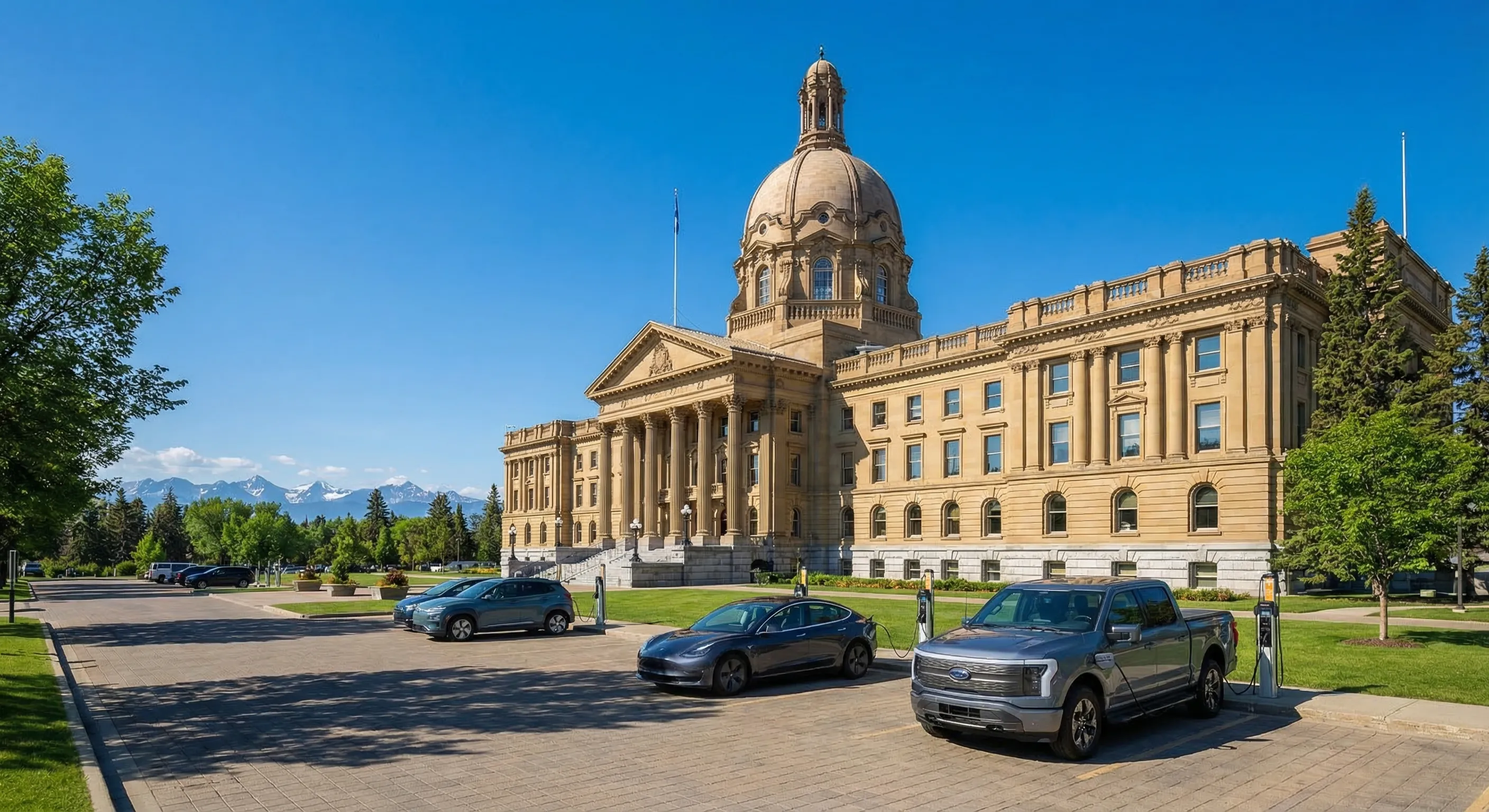
Alberta has the longest highway corridors of any Canadian province, and its EV charging infrastructure has historically been thin outside of Edmonton and Calgary. The situation has improved, but unevenly, and where it remains inadequate matters for your purchase decision.
Here's what the picture actually looks like as of early 2026.
The QE2 corridor between Calgary and Edmonton, 300 km, the province's busiest highway, now has workable DC fast-charge coverage for modern EVs with 300-plus km of rated range. Tesla's Supercharger network has stations in Airdrie, Red Deer, Lacombe (or Ponoka), and the city anchors at both ends. For non-Tesla vehicles on CCS standard, ChargePoint and Flo stations in Red Deer provide the main mid-route option, with SWTCH Energy expanding corridor presence under federal ZEVIP funding. The Edmonton-Calgary drive in a modern long-range EV is no longer an anxiety-inducing exercise, you can do it comfortably on a single charge in summer, and with one brief stop in winter if you're leaving Calgary cold-soaked.
Lethbridge and Red Deer both have multi-station charging locations now. Medicine Hat, Banff, Canmore, and Lake Louise have had reasonable coverage for a while, partly because tourism demand from American visitors created a market incentive for private network investment. The Trans-Canada mountain corridor is well-served for the same reason.
The genuine gap is northern Alberta. Fort McMurray to Edmonton is 450 km, and while Tesla's network now includes a Supercharger in Athabasca at roughly the midpoint, other network coverage remains thin. For Fort McMurray residents specifically, the long-distance charging concern is real. It's not a showstopper for city driving, but any trip toward Edmonton requires planning that a Grande Prairie or Peace River resident doing the same math to Edmonton also faces. If you live in the north, this deserves honest weight in your decision, not reassurance.
For the majority of Alberta EV buyers, concentrated in Calgary and Edmonton, urban infrastructure is genuinely adequate for daily use, and highway coverage is sufficient for most in-province trips. Northern and rural Alberta is a different calculation.
Worth knowing: the provincial government has not committed dedicated provincial funding to EV charging infrastructure in any recent budget. What exists is federally funded through ZEVIP, utility-funded through regulated cost recovery (ATCO, ENMAX), or privately funded by Tesla Supercharger, ChargePoint, Flo, and SWTCH. Alberta's provincial charging strategy is, in practice: let the federal government and the utilities handle it, and let private networks fill the gaps.
Alberta's Deregulated Electricity Market: The Hidden Advantage Nobody Talks About
Alberta's electricity situation is genuinely unusual in Canada and it matters for operating costs more than people realize.
Alberta is the only Canadian province with a fully deregulated retail electricity market. You can choose your electricity retailer from dozens of competing providers, and those providers compete on price, contract terms, and rate structures. Every other major Canadian province has a regulated utility with government-set rates, BC Hydro, Hydro-Québec, Ontario's Hydro One, all rate-controlled. Alberta doesn't work that way. You have real market competition, and for EV owners who know how to use it, that competition is a material financial advantage.
The baseline residential electricity cost in Alberta runs approximately $0.10 to $0.15 per kWh depending on your provider and contract type. But the Regulated Rate Option, the default rate for customers who haven't actively chosen a retailer, floats with the spot market, and it can be violently volatile. Alberta's grid is roughly 45 to 50 percent gas-fired, which means that during cold snaps when natural gas demand spikes, the RRO spikes with it. In January 2024, the RRO climbed above $0.25 per kWh during a sustained cold period. That volatility is particularly problematic for EV owners, because the coldest Alberta winters are exactly when you're doing the most home charging. The RRO is fine during mild weather; it's a liability during the months that matter most.
Several Alberta electricity retailers now offer EV-specific time-of-use rate structures, lower rates between roughly 9 PM and 7 AM, when grid demand is lowest and when Alberta's significant wind capacity (over 4,000 MW of installed wind, primarily in the south) is often running at high output. Off-peak rates from competitive retailers can run as low as $0.075 to $0.09 per kWh. That's meaningfully cheaper than the RRO average and dramatically cheaper than commercial charging network rates.
Retailers worth researching for EV-specific plans include Direct Energy (now part of Centrica), Enmax Energy (particularly for Calgary residents), ATCO Energy, and various smaller regional providers that have been expanding EV rate offerings. The Alberta Utilities Commission operates a free rate comparison tool at ucahelps.gov.ab.ca that pulls live retailer pricing. Use it. Five minutes there could save you hundreds of dollars per year.
What does this mean in actual dollars? A 2026 Tesla Model Y Long Range has a 75 kWh battery. Charging from near-empty at a $0.08 per kWh off-peak rate costs $6.00. At a real-world Alberta energy efficiency of roughly 15 kWh per 100 km in mixed driving, that's approximately $0.012 per kilometre, or $1.20 per 100 km. Compare that to a comparable gasoline SUV doing 10L/100km at $1.65 per litre: that's $16.50 per 100 km. The EV running on cheap overnight electricity costs about 7 percent of what the gas vehicle costs per kilometre. Even on a bad day, RRO spiking to $0.20 per kWh, inefficient charging, the EV comes in around $3.00 per 100 km versus $16.50. The electricity advantage doesn't disappear with Alberta's grid volatility. It narrows from extraordinary to still very strong.
The deregulated market is one of the few areas where being an Alberta EV owner is genuinely better than being one in a regulated-utility province. BC Hydro sets your rate; Alberta lets you shop. When you're adding 15,000 to 20,000 km of charging per year to your electricity bill, the difference between $0.085 per kWh on a locked-in off-peak plan and $0.13 per kWh on a regulated rate is several hundred dollars annually. Over five years, we're talking about real money.
Home Charging in Alberta: Level 1 vs Level 2, and What the Math Actually Shows
The home charging decision comes down to one variable: do you have access to a 240V outlet, or are you willing to install one?
Level 1 charging uses the standard 120V portable EVSE that comes bundled with your car, plugging into a regular household outlet. It adds approximately 5 to 7 km of range per hour. For a 60 kWh battery pack, a full charge from near-empty takes 18 to 22 hours. That sounds slow, and it is slow, but for most urban drivers it doesn't matter, because you're not doing a full charge from empty every night. You're topping up 30 to 50 km of daily driving while the car sits overnight for eight hours. At 6 km per hour on Level 1, eight hours gives you 48 km of range, which covers the average Canadian's daily drive of 37 km with buffer to spare.
Level 1 is significantly underrated in mainstream EV coverage. Many EV owners discover in year one that they never actually needed Level 2 for their normal routine. If you drive under 60 km per day, have a reliable overnight plug-in spot, and aren't making frequent long highway trips, Level 1 works. It's not glamorous, but it's free, no installation cost, no permit, no electrician.
Level 2 charging uses a dedicated 240V circuit, either hardwired or on a NEMA 14-50 outlet, with a proper EVSE unit. It adds approximately 25 to 50 km of range per hour depending on your vehicle's onboard charger capacity and the EVSE's output rating. Most modern EVs accept 7.2 kW of Level 2 charging (some accept 11.5 kW or higher). At 7.2 kW, a 60 kWh battery charges in about 8 hours; at 11.5 kW, closer to 5 hours. The real operational difference isn't speed for its own sake, it's that Level 2 eliminates range anxiety entirely. Arrive home with 15% battery after a long day, plug in, wake up to 100%. The car is always full when you need it. It changes your mental model from managing a resource to just having a car.
Gear worth having
As an Amazon Associate, ThinkEV earns a small commission from qualifying purchases — at no extra cost to you.

Grizzl-E Classic Level 2 EV Charger (40A)
Canadian-made and rated for minus 40C winters. 40A / 9.6 kW, NEMA 14-50, indoor/outdoor, 24-ft cable. The charger built for Canadian weather.
As an Amazon Associate, ThinkEV earns from qualifying purchases — at no extra cost to you.
Installing a Level 2 charger in Alberta typically costs $400 to $1,200 for the electrical work, not counting panel upgrades. The range depends on the distance from your electrical panel to your parking spot and local labour rates, Edmonton and Calgary have competitive markets for EV-certified electricians, which keeps prices reasonable. Permits are required in both cities; skipping the permit is not optional and matters for home insurance and eventual resale. The EVSE unit itself runs $300 to $900 for a quality unit. The Grizzl-E has become a popular choice in Canada specifically because it's designed and rated for extreme cold, which in Alberta is not a marketing claim but a practical necessity, and carries a five-year warranty.
Total installed cost: call it $800 to $2,000 for a typical Alberta garage installation. The payback math is straightforward. If you're currently spending $100 per month on commercial charging at $0.40 per kWh average (a typical ChargePoint or Flo rate in Alberta), switching to home Level 2 charging at $0.09 per kWh reduces that same 250 kWh monthly charge to $22.50. That's $927 per year in savings. A $1,500 Level 2 installation pays back in under 18 months. After payback, it's pure savings for the life of every EV you own going forward, it's not a car-specific investment, it's a home infrastructure investment.
Gear worth having
As an Amazon Associate, ThinkEV earns a small commission from qualifying purchases — at no extra cost to you.
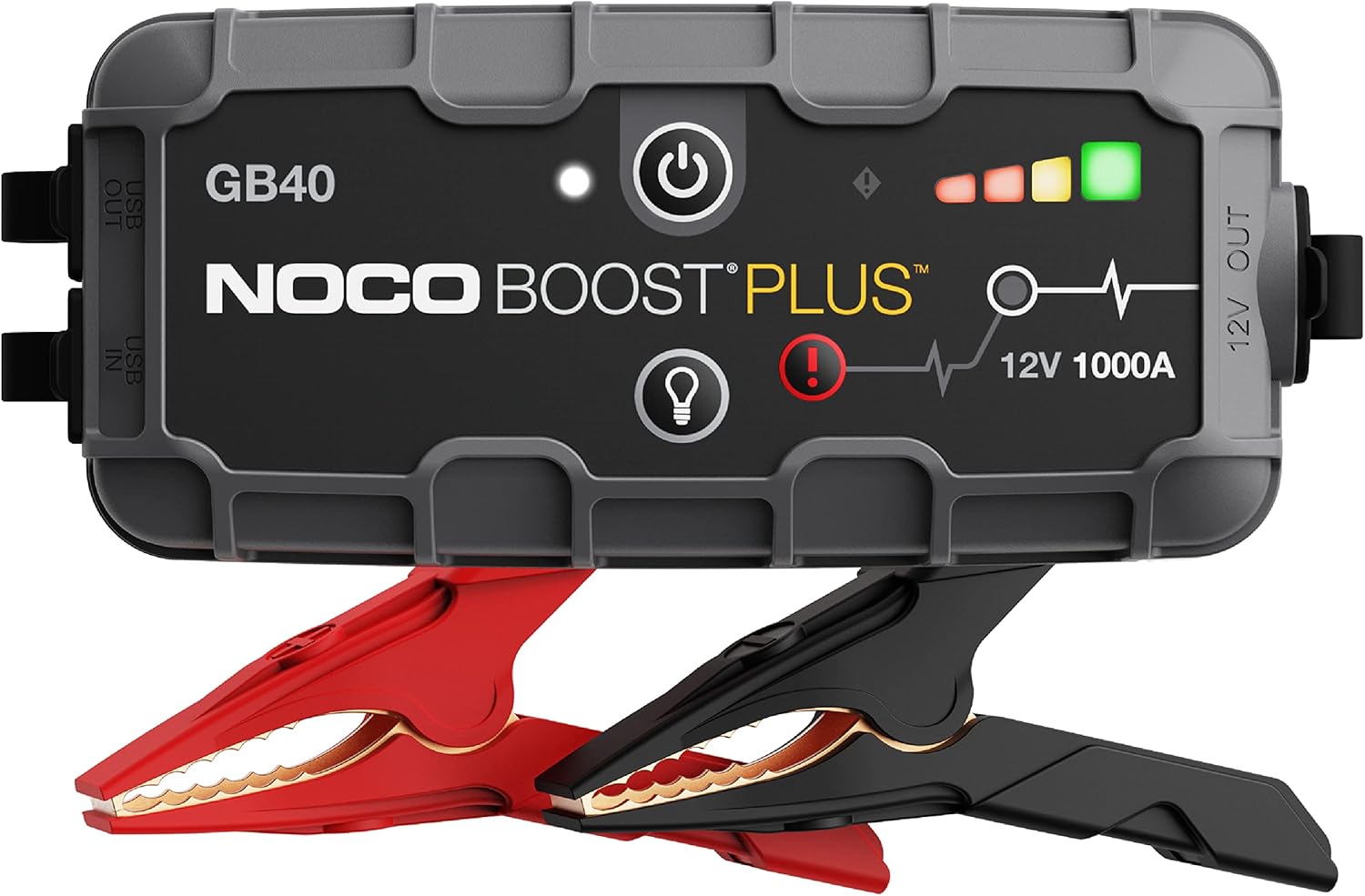
NOCO Boost Plus GB40 Jump Starter
A 1000A lithium jump starter that fits in your glovebox and works on any 12V battery. Your insurance against a dead 12V in a parking lot.
As an Amazon Associate, ThinkEV earns from qualifying purchases — at no extra cost to you.
One Alberta-specific cold-weather note for charging: at -30°C, Level 2 charging takes roughly 10 to 20 percent longer than in mild weather. The battery's thermal management system prioritizes keeping the battery in its safe operating range over maximizing charge rate, which is the right engineering choice but means slower overnight charges during deep cold snaps. If you have a heated garage, this largely disappears. For outdoor parking situations, budget for it in your planning.
Cold Weather Performance: The Honest Conversation Alberta Buyers Need
Alberta winters are not a marginal consideration for EV ownership. They're the dominant technical variable, and most guides either overstate the problem or dismiss it with unfounded reassurance. Let's be accurate.
The science is well-established: lithium-ion batteries lose electrochemical efficiency at low temperatures. The typical real-world range loss is 20 to 40 percent at sustained temperatures between -20°C and -30°C, depending on the vehicle, its thermal management system, and how much cabin heating is required. A Tesla Model Y with a rated range of 533 km under ideal conditions might realistically deliver 360 to 420 km in an Edmonton January. A Chevrolet Equinox EV rated at 483 km might deliver 320 to 370 km. A Hyundai Ioniq 6 rated at 581 km, with its heat pump operating efficiently, might manage 400 to 460 km.
Those numbers sound concerning until you put them against actual driving patterns. The average Canadian drives 37 km per day. At maximum cold-weather degradation, most modern EVs with 400-plus km of rated range still have enough winter-degraded buffer for five to eight days of typical Canadian driving between charges. Cold weather becomes a real issue in two specific scenarios: long-distance inter-city trips in January, and situations where you can't charge overnight for multiple consecutive days. For daily urban driving in Calgary or Edmonton, a modern long-range EV in winter is not materially more constrained than it is in summer.
The archetypal Alberta EV test case is Edmonton to Calgary: 300 km, mostly highway, often in January. On a modern long-range EV in cold weather, most drivers arrive in Calgary with a workable buffer, or plan a 20-minute DC fast-charge stop in Red Deer. That's a constraint, but not a showstopper. The Cold Lake to Edmonton trip (300 km) and Lethbridge to Calgary (220 km) involve similar math. Plan for one stop on the longer winter runs; you'll rarely need it if you're leaving from a full charge.
The vehicles that handle Alberta winters best share two features: heat pump systems and active battery thermal management with pre-conditioning capability.
Heat pumps move thermal energy rather than generating it directly from electricity, making them roughly three to four times more efficient for cabin heating than resistive heating elements. In real-world cold-weather driving, a heat pump represents 15 to 25 percent more winter range compared to an equivalent vehicle with resistive heating only. For Alberta buyers, this isn't a luxury feature, it's a meaningful winter performance specification. Vehicles with heat pumps as standard or available equipment include: Tesla Model Y and Model 3 (2021 and newer), Hyundai Ioniq 5 and Ioniq 6, Kia EV6, BMW iX series, Volkswagen ID.4 (2023 and newer), and the Chevrolet Equinox EV. If you're considering a vehicle without a heat pump for use in Alberta, run the winter range numbers carefully.
Pre-conditioning is the single most effective cold-weather management technique, and most EV owners don't use it consistently. Pre-conditioning means warming the battery and cabin to operating temperature while the car is still connected to home charging, before you leave for the morning. Because it draws from the grid rather than the battery, the warming is effectively free, you're not consuming your charge to heat your car.
Pre-conditioning before a -30°C Alberta morning can recover 15 to 20 percent of the range you'd otherwise lose to cold soak. Most modern EVs support scheduled departure times via their smartphone apps. Set it up. Use it every morning below -10°C. This single habit, reliably executed, is the functional equivalent of upgrading your EV's winter range by 15 to 20 percent at zero additional cost.
The worst-case Alberta cold-weather scenarios involve sustained temperature inversions, three or four consecutive days of -40°C in Calgary, and vehicles without active battery thermal management. Older EVs (pre-2018) and some budget vehicles lack active thermal management, meaning they can't maintain optimal battery temperature during extended cold exposure. These vehicles can see range degradation of 50 percent or more in extreme Alberta winters. For new vehicles in 2026, virtually every major-brand EV above $35,000 includes active thermal management. But if you're shopping the used market, verify this specification explicitly. It's not uniformly present across all used EVs at all trim levels.
How to Buy an EV in Alberta: The Sequence That Maximises Every Dollar
The actual sequence that maximises what's available to an Alberta buyer in 2026, in order:
Step one: Determine EVAP eligibility before choosing your vehicle. Not after you've fallen in love with a specific car. Look up the model's manufacturing origin, US, South Korea, Germany, Japan, Mexico all qualify; China doesn't. Confirm the trim you're considering has a final transaction value under $50,000 as EVAP defines it, or confirm it's Canadian-built (no cap). Verify the dealer is EVAP-enrolled. Natural Resources Canada maintains an updated vehicle and dealer list at nrcan.gc.ca. Check it before you book a test drive.
Step two: Negotiate the vehicle price before the rebate enters the conversation. Dealers understand that EVAP represents $5,000 of buyer goodwill, and some will try to price the vehicle $4,000 to $5,000 higher than they'd otherwise go, knowing you'll mentally net it out against the rebate and still feel like you got a deal. Negotiate the pre-rebate price first, treat the $5,000 as a separate government program that you'll confirm on the final paperwork, and get both numbers in writing before signing anything.
Step three: Choose your electricity retailer before your car arrives. Use the Alberta Utilities Commission comparison tool at ucahelps.gov.ab.ca, identify the best fixed-rate or time-of-use plan with the lowest off-peak rate for your area, and lock it in. Don't wait until the car is in your driveway, you want to be on the right electricity rate from the first plug-in.
Step four: Arrange Level 2 charging installation if you have a garage. Get at least three quotes from licensed electricians in your area. In Calgary and Edmonton, there's meaningful price competition; don't accept the first number you're given. Check calgary.ca specifically for any current REEP intake that covers home charger installation, it's worth five minutes to check and could save $250 to $500.
Step five: Learn your pre-conditioning schedule and use it every winter morning below -10°C. Set a scheduled departure time in your vehicle's app, 30 to 45 minutes before you need to leave. The battery and cabin warm up while you're still connected, drawing from grid power. This one habit is worth 15 to 20 percent of your winter range.
Step six: Know your EVAP paper trail. Confirm the $5,000 rebate appears as a line item on your purchase agreement before you sign. Confirm the vehicle appears on the NRCan eligible list. If a dealer tells you a vehicle qualifies but it doesn't appear on the list, don't proceed until you've verified it independently.
The Five-Year Financial Picture: All the Numbers Together
A complete financial model for an Alberta buyer in 2026 shows that the sticker price comparison is only the beginning.
Scenario: a 2026 Chevrolet Equinox EV 1LT versus a 2026 Honda CR-V gasoline, comparable segment, both purchased in Alberta with no provincial rebate.
Purchase price and incentives. The Equinox EV 1LT starts at $38,998 MSRP. After the federal EVAP rebate of $5,000 (applied at the dealership on this Canadian-built vehicle with no price cap), the effective purchase price before taxes is $33,998. The Honda CR-V in comparable trim starts at approximately $36,500. So the EV, post-rebate, is actually $2,502 cheaper than the gas vehicle before you start the engine. Alberta gets to $5,000 in federal support; the EV is already ahead.
Annual fuel costs at 15,000 km per year. The CR-V at 8.5L per 100 km at $1.65 per litre costs $2,103 per year in fuel. The Equinox EV at 16 kWh per 100 km, a realistic Alberta mixed-season figure that accounts for winter degradation, costs roughly $216 per year at home on off-peak electricity at $0.09 per kWh (assuming 80% of charging done at home) plus approximately $200 per year for the 20% charged on commercial networks at $0.35 per kWh average. Total annual electricity cost: roughly $416. Annual fuel saving in favour of the EV: $1,687.
Annual maintenance at 15,000 km per year. Industry averages put a gasoline CR-V at approximately $1,200 per year in maintenance, oil changes every 5,000 to 6,000 km at $90 to $130 each, tire rotations, brake service, spark plugs, transmission service, air filters, and incidental repairs. The Equinox EV has no engine oil, minimal brake wear (regenerative braking does most of the work), no spark plugs, no transmission fluid, no timing belt. Realistic annual maintenance for the EV runs approximately $450, tire rotations, wiper blades, cabin air filters, and occasional items. Annual maintenance saving in favour of the EV: $750.
Five-year total cost of ownership, excluding financing charges and depreciation. CR-V over five years: $36,500 purchase plus $10,515 fuel plus $6,000 maintenance, totalling $53,015. Equinox EV over five years: $33,998 effective post-rebate purchase plus $2,080 electricity plus $2,250 maintenance, totalling $38,328. Five-year financial advantage for the EV: $14,687.
That's not a marginal number. In Alberta, with zero provincial support, after a $5,000 federal rebate and five years of driving, the EV comes out $14,700 ahead of a comparable gas vehicle. The rebate makes the purchase price competitive at entry; the operating costs do the heavy lifting from there.
The reasonable counterargument: financing costs. A vehicle with a higher sticker price carries higher monthly payments. At current Canadian auto loan rates of 7 to 9 percent for qualified buyers, the difference in monthly payment between $36,500 and $38,998 over a 60-month term runs approximately $45 to $60 per month. But the fuel and maintenance savings, approximately $2,437 per year combined, dwarf that difference. The monthly payment gap is covered and then some by month two of driving.
One thing worth adding to the five-year model: Level 2 charger installation at home, if you do it, costs $800 to $2,000 once and isn't captured in the ongoing fuel cost comparison because I've already built home charging rates into the electricity estimate. The charger installation is a capital expenditure that pays back within two years through avoided commercial charging costs and continues generating savings for every subsequent EV you own. It's an investment in your home's infrastructure, not just your current car.

Alberta's EV Adoption Numbers: Where the Province Actually Stands
Alberta's EV uptake has lagged the national average, and that's not surprising given the policy environment and the province's cultural relationship with the petroleum industry. But the trajectory is consistently upward, and the gap with leading provinces is narrowing year over year.
In 2024, approximately 6.5 percent of new light-duty vehicle registrations in Alberta were zero-emission vehicles. That's below the national average of roughly 11 percent, well below BC's 22 percent, and behind Quebec's 16 percent. But it's also nearly double Alberta's 2022 figure of 3.1 percent. The technology adoption curve is running, just from a lower baseline, and without the provincial policy tailwind that BC and Quebec buyers have enjoyed.
What's driving Alberta adoption without provincial support? Primarily fuel costs. Alberta consistently has among the highest per-litre gasoline prices in Canada outside of BC, driven by provincial carbon pricing and regional refinery economics. When gasoline runs above $1.60 per litre consistently in Calgary, as it has for much of 2024 and 2025, the electricity arithmetic becomes compelling on its own. The $5,000 federal rebate is gravy; the fuel savings close much of the purchase price gap without it.
Fleet operators have moved faster than individual consumers. Major Alberta municipalities, commercial fleet operators, and energy companies have accelerated EV deployment in their light-duty fleets based on total cost of ownership analyses that don't depend on incentive programs at all. Fleet buyers run five-year TCO calculations, and the numbers work in Alberta even without provincial support. Individual buyers are increasingly arriving at the same conclusion.
Buying Used: The Federal Used EV Incentive and the 2026 Used Market
The focus on new-vehicle incentives tends to overshadow the used EV market, which in 2026 is genuinely compelling for Alberta buyers on a tighter budget. Used EV prices have come down substantially from their 2021 to 2022 peak, when supply chain disruptions created artificial scarcity and used EVs traded at near-new prices. The correction has been significant.
The federal government offers a used ZEV incentive through the iZEV Used program: $2,500 for eligible used battery-electric and plug-in hybrid vehicles. Eligibility follows similar rules to the new-vehicle EVAP, with additional constraints, the vehicle must be the first private resale (not previously transferred as a private sale), and the purchase price must fall under a specified ceiling that varies by vehicle category (verify the current cap at nrcan.gc.ca since it has been adjusted across program iterations). The rebate applies at participating dealers only, not through private sales, which limits where you can access it.
Even without the used incentive applying to a specific transaction, the used EV market in Alberta presents genuine value in 2026. A 2022 Tesla Model 3 Standard Range in good condition trades in the $28,000 to $33,000 range, roughly half the new-vehicle price. A 2021 Chevrolet Bolt EV, which went through a battery recall and replacement program (Chevrolet replaced affected battery modules at no charge to owners), trades in the $22,000 to $27,000 range. A 2021 or 2022 Hyundai Kona Electric typically runs $26,000 to $31,000 depending on mileage and condition.
The used EV buyer's checklist for Alberta is somewhat different from what you'd run in a mild-climate province. A few things to check carefully.
Battery health report: most dealers can pull this. Tesla shows battery degradation directly in the app. Hyundai and Kia have similar diagnostic tools accessible through their apps or dealer equipment. Alberta cold cycling, particularly for vehicles that spent winters regularly cold-soaked without being plugged in, accelerates capacity loss on vehicles without active battery thermal management.
Heat pump presence: it's a critical specification on older used EVs where some trim levels included it and others didn't. For Alberta winters, the difference between heat pump and resistive heating represents meaningfully more winter range. Verify this explicitly for any used EV you're seriously considering.
EVAP or iZEV Used eligibility: if you're hoping to access the $2,500 used incentive, confirm the vehicle and the specific dealer qualify before you get emotionally invested. Most used EV dealerships in Edmonton and Calgary are familiar with the program; independent dealers may not be.
Battery warranty coverage: most major manufacturers offer 8-year, 160,000 km battery warranties. On a 2021 vehicle purchased in 2026, you may have three years of battery warranty remaining. That's valuable protection against the most expensive potential repair, make sure you know exactly what's left and what's covered.
Previous charging habits in cold weather: an EV that spent three Alberta winters parked outside for days at a time without being connected to charging will have measurably more battery degradation than one that was consistently plugged in and thermally managed. Ask. The previous owner's habits show up in the battery data.
The used EV market doesn't carry the $5,000 new-vehicle EVAP rebate unless the specific purchase qualifies for the used program. But the lower acquisition cost compensates materially. A $28,000 used Model 3 with clean battery health is a fundamentally different financial calculation than a $49,000 new one, and the operating cost savings, fuel and maintenance economics, are identical regardless of whether you bought it new or used.
EV Charging on the Road: What You Actually Need to Know About Alberta's Network
For daily urban driving in Calgary or Edmonton, you are very unlikely to ever use a public charger if you have home charging. The numbers make this clear: a 15,000 km per year driver averages 41 km per day, and a modern EV with 400-plus km of range can go a week on that pace without a public charge. Public charging infrastructure matters primarily for three situations: long-distance highway driving, apartment and condo residents without home charging access, and workplace charging.
On the QE2, the Calgary-Edmonton corridor, the charging picture is now functional. Tesla's Supercharger network provides strong coverage with stations in Airdrie, Red Deer, and the Lacombe-Ponoka stretch in addition to the city anchors. For non-Tesla EVs on CCS standard, Red Deer has ChargePoint and Flo stations that cover the mid-route need. SWTCH Energy has been adding highway corridor presence under federal ZEVIP funding, though it's still thinner than the Supercharger network at most points.
East-west on the Trans-Canada from Calgary toward Banff and the mountain corridor: solid DC fast-charge coverage exists in Canmore, Banff, and Lake Louise, heavily maintained because of American tourist demand. Golden, BC, is the next meaningful stop heading west into the mountains.
The Medicine Hat corridor, Calgary east toward Saskatchewan, has improved but remains sparse. If regular trips to Medicine Hat or the Saskatchewan border are part of your driving pattern, verify current station options before assuming coverage is adequate. Don't rely on outdated guides; the network changes frequently enough that real-time verification matters.
For trip planning specifically: the PlugShare app provides real-time network status and user check-ins across all charging networks, it'll show you whether a specific station was actually working last Tuesday, which is information you can't get from any static map. ABRP (A Better Route Planner) integrates with most EV apps and can optimise your route around charging stops using live network data. Both are free, and any Alberta EV owner planning trips beyond their home city should have both installed.
Alberta Leaves Federal-Only Money On The Table
Alberta's provincial government has chosen not to support EV adoption with provincial incentives. In 2026 that leaves Alberta tied with BC, Ontario and Saskatchewan (all federal-only), and behind Manitoba and PEI by $4,000 and Quebec by $2,000. It's a smaller gap than it was when BC and Quebec ran richer programs, but it's still real money out of Alberta households' pockets that could have stayed there.
But the calculation doesn't end there. The federal EVAP rebate pays $5,000 at the dealership on qualifying vehicles, and it works. Alberta's deregulated electricity market, if you use it correctly with a locked-in off-peak rate, delivers some of the lowest home EV charging costs in Canada. And the five-year operating economics, fuel savings plus maintenance savings, produce a $14,000-plus advantage for a qualifying EV against a comparable gas vehicle, even without a dollar of provincial support.
For most people, the vehicles that make the clearest financial sense under current Alberta conditions are those that qualify cleanly for EVAP with proven cold-weather performance. The Chevrolet Equinox EV is the most compelling pure value play, built in Ontario so there's no price cap, it qualifies for EVAP at every trim level, and it has a heat pump and strong winter reviews. The Hyundai Ioniq 6 delivers best-in-class efficiency with a heat pump standard. The Kia EV6 has a proven record of Alberta winter performance. The Tesla Model 3 Standard Range stays under the cap, has strong thermal management, and benefits from the province's best DC fast-charge network coverage on highway routes.
Confirm EVAP eligibility before you fall in love with a specific car. Negotiate the pre-rebate price first. Lock in an off-peak electricity contract before your car arrives. Install Level 2 charging if you have a garage. Pre-condition your battery every cold morning. Stack every advantage that exists. The provincial government hasn't done its job here. Use what the federal government provides, use the electricity market intelligently, and make your decision with accurate numbers rather than optimism about provincial support that isn't coming.
Gear worth having
As an Amazon Associate, ThinkEV earns a small commission from qualifying purchases — at no extra cost to you.

PULIDIKI Car Cleaning Gel (Detailing Putty)
Press it into vents, buttons, and seams and it lifts out dust you did not know was there. Weirdly satisfying, genuinely useful.
As an Amazon Associate, ThinkEV earns from qualifying purchases — at no extra cost to you.
Gear worth having
As an Amazon Associate, ThinkEV earns a small commission from qualifying purchases — at no extra cost to you.

WixGear Magnetic Air Vent Phone Mount (2-Pack)
A magnet strong enough that your phone never flinches over potholes or rail crossings. Two in the box, one for each car.
As an Amazon Associate, ThinkEV earns from qualifying purchases — at no extra cost to you.
Related Reading
- EV vs Gas: Total Cost of Ownership in Canada, The real numbers on fuel, maintenance, and long-term savings.
- Home EV Charger Installation Guide, Costs, permits, and what to expect from start to finish.
- EV Charging Costs by Province, What you will actually pay to charge at home and on the road.
Gear worth having
As an Amazon Associate, ThinkEV earns a small commission from qualifying purchases — at no extra cost to you.

Car Cup Holder Coasters (4-Pack)
Drop-in coasters that catch spills and crumbs so your cup holders stay clean. Rinse and reuse forever.
As an Amazon Associate, ThinkEV earns from qualifying purchases — at no extra cost to you.

Founder & Chief Editor
Vlad Pereira is the founder and chief editor of ThinkEV.ca, the Canadian electric-vehicle publication he writes and edits from Courtenay, British Columbia. He covers EV pricing, federal and provincial rebates, charging costs, and the Chinese manufacturers now entering Canada, from the buyer's side rather than the press-fleet side. ThinkEV is a venture of Vlad Pereira Online; his writing on health, income and the long game lives at vladpereira.com.
Frequently asked questions
Is there an EV rebate in Alberta?
How much is the federal EVAP rebate and what are the eligibility rules?
Do Edmonton and Calgary offer EV purchase rebates?
How much does it cost to charge an EV at home in Alberta?
Do EVs work well in Alberta winters?
Which EVs make the most sense to buy in Alberta in 2026?
How does Alberta's EV incentive situation compare to other provinces?
More EV & road-trip finds
Affordable upgrades worth a look — tap any to check the price on Amazon.
 ★ 419
★ 419RGB Car Interior LED Strip Light
View on Amazon ★ 1,083
Crystal Push-Start Button Ring (2-Pack)
View on Amazon ★ 12,396
K KNODEL Car Trash Can with Lid
View on Amazon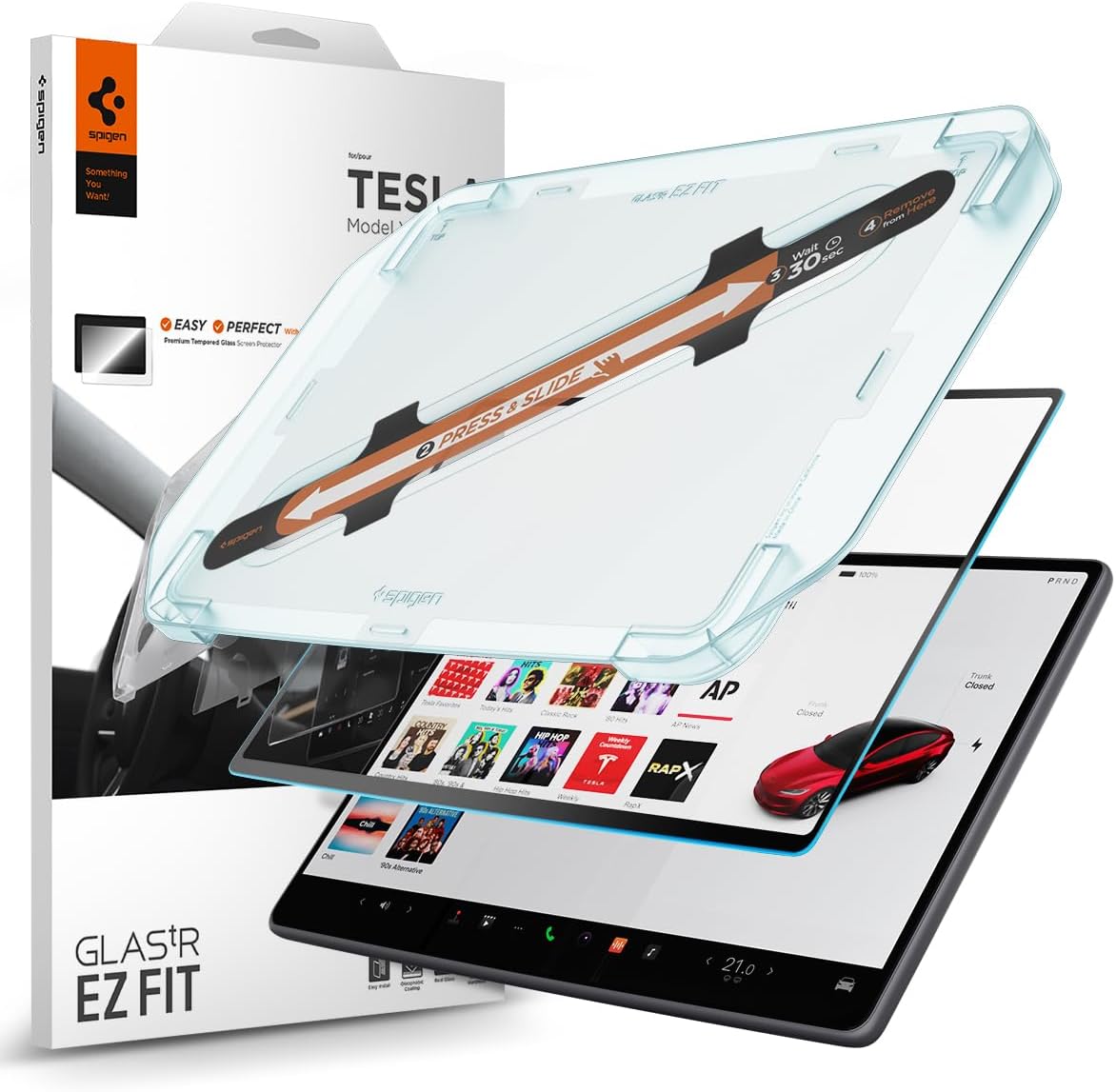 ★ 15,014
Spigen Tempered Glass for Tesla Model 3/Y
View on Amazon ★ 119
★ 119Foldable Waterproof Trunk Organizer
View on Amazon ★ 392
★ 392Large Cup Holder Adapter (32-40oz)
View on Amazon ★ 47,507
HOMEXCEL Microfiber Cloths (12-Pack)
View on Amazon ★ 537
★ 537USB Star Projector Roof Light
View on AmazonRead, Plan, Then Stay Current
Explore our expert articles to understand incentives and ownership costs, use the map to pressure-test charging reality, then subscribe so new EV coverage comes straight to you.
Continue Reading
BC EV Rebates 2026: What's Left After the Cuts
Manitoba EV Rebates 2026: $4,000 Incentive Ends March 31
Newfoundland EV Rebates 2026: What You Can Claim

PEI EV Rebates 2026: The Island's Surprising $5,000 EV Deal
Quebec EV Rebates 2026: The Roulez Vert Changes