Key takeaways
- Global EV sales hit 17.8 million in 2025, up 25% from 14.2 million in 2024.
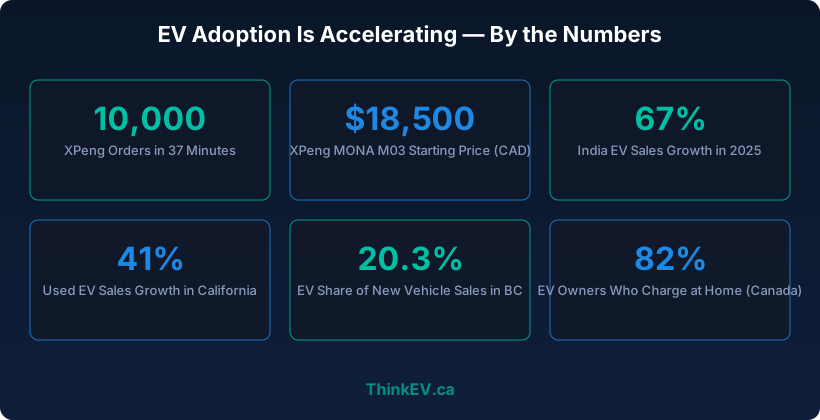
- BC's EV adoption rate reached 20.3% of new vehicle sales in 2025, on track to beat 2030 targets.
- China exported 1.4 million EVs in 2025, more than double from 2023. BYD shipped over 500,000 vehicles abroad.
- CATL's sodium-ion batteries launching in 2026 could cut battery pack costs by 20-30%.
Open Reddit on any given morning and the headlines fight each other: "Tesla Is Sitting On A Record 50,000 Unsold EVs." Sounds like the EV bubble finally burst. Then scroll two posts down. XPeng just took 10,000 orders in 37 minutes. A Geely SUV outperformed every American rival in crash testing. And in Israel, a Model Y's glass roof reportedly withstood missile debris. So which is it? Stalling adoption or accelerating momentum? The noise is deafening, but the data isn't lying. If you're only paying attention to headlines about Tesla inventory or charging infrastructure complaints, you're missing the real story: a global shift that's not just continuing, but evolving in ways most North Americans haven't noticed yet. When people say "EV adoption," they picture Norway or California. The real action is broader: Chengdu, where families are trading scooters for BYD Seagulls. It's in Delhi, where e-rickshaws now outnumber auto-rickshaws in some districts. It's in Saskatchewan, where a farmer just switched his entire fleet to electric because the math finally works. The engine has changed. This is about cost, resilience, and national strategy. The data points in the opposite direction from a slowdown. 
The Myth of the EV Slowdown: What the Headlines Get Wrong
Yes, Tesla has 50,000 unsold vehicles sitting in lots. That's not a rumour, it's a reported figure from late 2025, and it sounds alarming at first glance. Fifty thousand cars is roughly the annual sales volume of a mid-tier automaker in Canada. It's enough to supply every household in a city the size of Victoria, B.C., twice over.
But here's the real question: does that mean EV adoption is slowing? Or does it mean Tesla's sales strategy is misfiring while the broader market keeps moving? Because the two aren't the same. If you're basing your understanding of EV adoption on Tesla's quarterly inventory reports, you're like someone trying to gauge the health of the entire Canadian economy by watching only Bombardier's stock price. Yes, Tesla was the spark. They pulled the entire industry forward like a magnet. But the market has outgrown them. And while they're wrestling with Cybertruck production bottlenecks and pricing missteps, the rest of the world is busy building something bigger.
Take XPeng, for example. On launch night, their refreshed MONA M03 drew 10,000 orders in 37 minutes. That's not a flash sale anomaly, it's a sign of real consumer demand in a market that's pricing vehicles where people actually live. The MONA M03 starts at around 100,000 RMB, which is about $18,500 CAD. That's less than the cost of a base-model Toyota Corolla in Canada. And it's not a golf cart, it's a compact sedan with 500 km of range, Level 2 autonomy, and over-the-air updates. Ten thousand people didn't just buy a car. They bought a better deal.
India tells the same story: EV sales grew 67% in 2025 compared to the previous year. That might sound like a small market, after all, only about 5% of new car sales in India are electric. But 5% of 4.5 million annual vehicle sales is 225,000 units. That's like replacing every car sold in British Columbia with an EV and still having thousands left over. And the growth isn't coming from luxury sedans. It's from two- and three-wheelers, e-rickshaws, electric scooters, last-mile delivery vehicles. In cities like Jaipur and Lucknow, you can now go blocks without seeing a petrol-powered rickshaw. That is displacement, not adoption.
But let's come back to North America, where the narrative is messiest. Yes, EV sales growth slowed in the U.S. in 2025. The annual rate climbed just 12%, down from 46% the year before. That sounds like a crash, until you realise it's the natural result of a market maturing. When you've already sold millions of cars, adding another million represents a smaller percentage. It's like saying a city of two million people isn't growing because it only added 100,000 residents this year. Growth isn't slowing, scaling is changing.
And within that 12%, there are pockets of explosive demand. California still leads, but not in the way you might think. The fastest-growing segment isn't luxury EVs, it's affordable, used EVs. In 2025, used EV sales in California increased by 41%. Why? Because leases are ending. And people are discovering they can buy a three-year-old Hyundai Kona Electric for $18,000 CAD with 70% battery health, less than half the price of a new one. That's not slowing adoption. That's accelerating accessibility.
BC tells a similar story. The province's EV adoption rate hit 20.3% of new light-duty vehicle sales in 2025, up from 16.7% the year before. That's one in five cars leaving a dealership in B.C. running on electrons. And that doesn't count plug-in hybrids, which add another 5.4 percentage points. If current trends hold, B.C. will exceed its 2030 target of 100% zero-emission vehicle sales, yes, including PHEVs, well before the deadline. That's not stagnation. That's momentum.
And what about the claim that charging infrastructure can't keep up? It's true that public charging availability remains a challenge in rural areas. But in practice, most people aren't relying on it. A 2025 survey by Natural Resources Canada found that 82% of EV owners charge at home. That's not a stopgap, it's the model. And for those who need public charging, networks like BC Hydro's EVgo partnership are adding 50 new fast chargers per quarter. Each one can add 300 km of range in 20 minutes, enough to get you from Kamloops to Revelstoke during a coffee and stretch break.
The real issue isn't adoption slowing. It's that the conversation hasn't caught up to reality. We're still asking, "Are people buying EVs?" when the question should be, "How are they using them, where are they buying them. And what does that mean for the next five years?"
Because the answer is shifting fast . In China, for instance, EV adoption isn't just about consumer choice. It's a national strategy. The government has set a target of 50% of all new car sales being electric by 2025, a goal they missed by a slim margin. But they're now aiming for 60% by 2027. And they're not just pushing sales. They're building the entire ecosystem: battery plants, charging corridors, raw material supply chains. CATL, the world's largest battery manufacturer, now supplies cells to Ford, Tesla, and BMW. Their new sodium-ion batteries, which don't rely on lithium, are rolling out in 2026 and are expected to cut costs by 20%. That's not incremental progress. That's a materials revolution.
And let's talk about exports. China's EV exports hit 1.4 million units in 2025, up from 679,000 in 2023. That's more than double in two years. BYD alone shipped over 500,000 vehicles abroad, to Southeast Asia, Latin America, Europe. And even Canada, where their Seal and Dolphin models are slowly appearing in dealerships. That's not a niche. That's a global footprint. And it's not being driven by subsidies alone. It's being driven by quality. A recent Euro NCAP test gave the BYD Atto 3 (sold as the Yuan Plus elsewhere) a five-star rating, the same as the Tesla Model 3 and Volkswagen ID.4. That's not "almost as good." That's on par.
So when people say "Chinese EVs aren't ready," they're either misinformed or nostalgic for a time when American and European automakers had no competition. The Geely Galaxy E8, mentioned in a Reddit post this week, just scored higher in crash tests than the Ford Mustang Mach-E, Chevrolet Blazer EV. And even the Rivian R1S. And it starts at 220,000 RMB, about $41,000 CAD. That's not a bargain bin special. That's a premium sedan at a mid-tier price.
The data doesn't lie. Global EV sales hit 17.8 million in 2025, up from 14.2 million in 2024. That's an increase of 3.6 million vehicles, equivalent to replacing every car sold in Canada, Germany. And Sweden combined in a single year. And analysts at BloombergNEF expect 2026 to add another 4 million. If that holds, EVs will make up 22% of all new car sales worldwide by the end of the year. Not 5%. Not 10%. Twenty-two percent.
Commercial fleets are switching faster than most people realise. Amazon's electric delivery vans, built by Rivian, now make up 12% of their North American last-mile fleet. That's over 5,000 vehicles, each driving 200 km per day on urban routes. In Vancouver, the city's new electric bus fleet has reduced emissions by 78% on major routes. Each one saves about $40,000 CAD annually in fuel and maintenance, enough to cover the salary of a skilled tradesperson.
EV adoption is not losing steam. The market has shifted from early adopters to cost-conscious families, delivery drivers, city planners, and governments with long-term strategies. Measuring progress by whether a neighbour bought a Tesla last year is looking at the tailpipe instead of the road ahead.
Gear worth having
As an Amazon Associate, ThinkEV earns a small commission from qualifying purchases — at no extra cost to you.

Grizzl-E Classic Level 2 EV Charger (40A)
Canadian-made and rated for minus 40C winters. 40A / 9.6 kW, NEMA 14-50, indoor/outdoor, 24-ft cable. The charger built for Canadian weather.
As an Amazon Associate, ThinkEV earns from qualifying purchases — at no extra cost to you.
The Quiet Revolution in Affordability and Ownership Costs
If you've ever stood in a dealership and felt sticker shock at an EV's price tag, you're not alone. The base model Tesla Model 3 starts at $47,990 CAD. The Ford Mustang Mach-E? $49,999. And the BMW i4? $65,000 before options. On paper, that looks like a premium product, something for people who can afford to pay more for ideals. But that's not how most people are buying EVs anymore. The real shift isn't in list prices. It's in lifetime ownership cost. And that's where the quiet revolution is happening.
Think about it this way: when was the last time you bought a car based solely on the sticker price? Most people don't. They think about fuel, maintenance, insurance, depreciation. And when you factor in all of it, EVs are now cheaper to own than gas-powered cars in most Canadian climates, even without incentives. A 2025 study by the Canadian Automobile Association (CAA) found that the average annual cost of owning a compact EV like the Hyundai Kona Electric is $8,900 CAD. Compare that to $11,200 for a comparable gas-powered SUV like the Toyota RAV4. That's a difference of $2,300 per year, enough to cover your winter tires, roof rack, and a long weekend in Tofino. Over a five-year ownership period, that's $11,500 in savings. That's not pocket change. That's a used car down payment.
And the gap is widening. Electricity prices in Canada have stayed relatively flat, around 13 cents per kWh on average. But gas prices? In 2025, the national average hit $1.85 per litre. At that rate, driving a RAV4 20,000 km a year costs about $1,850 in fuel. The Kona Electric? About $520, assuming you're not charging entirely at home. That's $1,330 saved annually. In Vancouver, where gas regularly hits $2.00 per litre, the savings jump to nearly $1,600.
But the real killer is maintenance. EVs have fewer moving parts. No oil changes. No transmission flushes. No spark plugs. A 2024 analysis by J.D. Power found that EV owners spend 34% less on maintenance over the first five years than gas car owners. For a vehicle like the Chevrolet Bolt, that's about $1,200 in savings. For a Tesla Model Y, it's closer to $1,800, partly because Tesla's service network is still limited, but also because there's simply less to go wrong.
And then there's depreciation. This used to be the Achilles' heel of EVs. Early Nissan Leafs lost half their value in three years. But today's models are holding value far better. The Tesla Model 3 now retains 68% of its value after three years, on par with the Toyota Camry. The Hyundai Ioniq 5? 65%. And the Ford Mustang Mach-E? 63%. That's not just better than early EVs. That's better than most gas-powered crossovers, which average around 58%.
So why aren't more people making the switch? The biggest barrier isn't cost. It's awareness. Most consumers still think of EVs as expensive up front, which they often are, without realizing how quickly that gap closes. A $50,000 EV that saves you $2,300 a year pays for itself in just over four years. After that, every kilometre is essentially free compared to gas. And if you charge at home using off-peak rates, say, 8 cents per kWh in Ontario, your "fuel" cost drops to about $320 a year. That's less than the monthly car payment on a financed gas SUV.
And now, the market is finally offering truly affordable options. The BYD Seagull starts at 78,800 RMB, about $14,600 CAD. That's less than a base-model Mazda3. It has a 305 km range, rear-wheel drive, and a 7-inch touchscreen. Is it luxurious? No. But it's reliable, safe, and efficient. In China, it sold over 200,000 units in 2025, more than any other EV in the world. And it's starting to appear in Canada through grey-market imports, despite federal tariffs.
Then there's the new wave of Indian EVs. Tata Motors' Tiago EV starts at around 850,000 INR, about $14,000 CAD, and has a 315 km range. It's already the best-selling EV in India. And while it's not officially available in Canada yet, the fact that a major automaker can build a safe, functional EV for that price means the floor is falling out from under the entire market. The cheapest electric car in the world data isn't just a trivia point, it's a warning signal to legacy automakers. If Tata and BYD can build profitable EVs for under $15,000 CAD, then why is anyone paying $40,000 for a base model?
The used EV market is also finally viable. In 2025, the average price of a three-year-old Nissan Leaf dropped to $17,500 CAD. A used Chevrolet Bolt? $19,000. And both have real-world ranges of 250-300 km, enough for most daily commutes. For a young driver, a city dweller, or a second car, that's a no-brainer.
Gear worth having
As an Amazon Associate, ThinkEV earns a small commission from qualifying purchases — at no extra cost to you.

Lectron Level 2 J1772 Charger (40A, WiFi)
Smart WiFi charger with real-time energy monitoring. 40A / 9.6 kW, J1772 with a NEMA 14-50 plug, schedule charging right from your phone.
As an Amazon Associate, ThinkEV earns from qualifying purchases — at no extra cost to you.
But the most significant shift is happening outside personal vehicles. In commercial fleets, the math is even more compelling. A delivery van like the BrightDrop Zevo 600 costs about $100,000 CAD, $20,000 more than a gas-powered equivalent. But it saves $18,000 annually in fuel and maintenance. That means the payback period is just over a year. After that, every delivery run is pure savings. No wonder companies like Purolator, Canada Post, and Loblaws are placing bulk orders.
Home charging is the biggest hidden cost of EV ownership, not the car itself. A Level 2 home charger can add $1,500 to $2,500 to your upfront cost. But there are ways around it. The Grizzl-e Level 2 charger, for example, is designed for DIY installation and costs under $1,000 CAD, about half the price of branded units. And if you're renting or live in an apartment, portable Level 2 chargers like the Lectron V-Box 48 let you charge at 48 amps using a standard NEMA 14-50 outlet, the kind already installed for RVs or electric stoves.
The real question isn't whether people can afford EVs. It's whether they understand the full picture, and most don't. Car dealerships still focus on MSRP. Loan calculators don't include fuel savings. And government incentives, like Canada's $5,000 iZEV rebate, are helpful but temporary. The permanent advantage is in the math, not the marketing. And that math is only getting better. CATL's new sodium-ion batteries, expected to roll out in 2026, could reduce battery pack costs by 20-30%. That is the difference between a $40,000 EV and a $28,000 one. And because sodium is abundant and doesn't rely on geopolitically risky supply chains, prices could stay low. That's why analysts at Benchmark Mineral Intelligence predict that by 2027, the average EV will be cheaper to manufacture than a gas car, even without subsidies. When that happens, the price gap reverses, and the slowdown narrative looks as outdated as it already is.
China's Export Machine and the New Global EV Order
If you still think of Chinese cars as knockoffs or budget options, you haven't been paying attention. The Geely Galaxy E8 didn't just beat American EVs in crash tests, it exposed a growing gap in value, safety, and innovation. And it's not alone. BYD, NIO, XPeng. And Zeekr are all exporting vehicles that match or exceed Western models in performance, features, and build quality, at significantly lower prices. This isn't a blip. It's a strategic shift in the global auto industry, and Canada is starting to feel it.
China's EV exports hit 1.4 million units in 2025, a 106% increase from 2023. That's not just growth. That's dominance. To put that number in perspective, 1.4 million cars is more than Ford sells in North America in a year. It's equivalent to replacing every vehicle registered in Quebec and Newfoundland combined. And China isn't just exporting to developing markets. They're selling in Germany, Norway, Australia, and increasingly, Canada.
BYD, the world's largest EV maker, now sells the Dolphin, Seal, and Seagull in Canadian markets through select dealerships and grey-market importers. The Dolphin starts at around $29,000 CAD, less than a base-model Tesla Model 3. And offers 410 km of range, a five-star Euro NCAP rating, and standard Level 2 autonomy. It's not "almost as good" as a Hyundai Ioniq 5. In many ways, it's better. And it's priced to move.
The bigger story is batteries. CATL, China's battery giant, supplies cells to Tesla, Ford, and Volvo. Their new sodium-ion technology, launching in 2026, could make lithium-ion obsolete for entry-level EVs. Sodium is cheaper, more abundant, and less prone to thermal runaway. A 60 kWh sodium-ion pack costs about $6,000 CAD to produce, $2,000 less than a comparable lithium pack. That is a cost advantage and a manufacturing shift. With 75% of global battery cell production, China is setting the standard.
The CCS (Combined Charging System) was supposed to be the global norm. But China developed its own plug, the GB/T. And now it's gaining traction in Southeast Asia, the Middle East, and even parts of Africa. Meanwhile, Tesla's NACS connector is being adopted in North America, creating a three-standard mess that's confusing for consumers and costly for infrastructure planners. The data on charging standard CCS vs NACS shows a fragmented future. In Europe, CCS remains dominant. In North America, NACS is winning by default because of Tesla's market share. But in China, GB/T is the only game in town. And because Chinese automakers are exporting entire vehicle platforms, not just cars, they're exporting their charging systems too. That means a BYD exported to Chile or Saudi Arabia will use GB/T, not CCS. Over time, that could split the global market into charging blocs, much like phone chargers before USB-C.
But the most underrated factor is software. Chinese EVs come with over-the-air updates, voice assistants that understand regional dialects. And infotainment systems that integrate with local apps like WeChat and Alipay. When a XPeng owner in Guangzhou gets a software update that improves navigation in monsoon conditions, it's not a gimmick. It's a tailored experience. And as these features improve, they create loyalty that's hard to break. Compare that to most Western EVs, which still treat software as an afterthought. How many Tesla owners have waited months for promised features? How many Ford Mustang Mach-E drivers have complained about SYNC-UP bugs? Chinese automakers are treating the car as a tech platform, and they're moving faster.
And they're not just selling vehicles. They're building ecosystems. BYD operates its own charging network in China, over 100,000 public chargers, and is expanding it abroad. NIO offers battery swapping stations that let drivers exchange a depleted pack for a full one in three minutes. That's faster than refuelling a gas car. And while swapping hasn't taken off in North America, it's proving viable in dense urban areas where parking and charging time are precious.
The result? Chinese EV quality data shows they're no longer playing catch-up. They're leading. A 2025 J.D. Power study found that BYD and Geely ranked in the top three for initial quality in China, ahead of Tesla and most German brands. And in export markets, early feedback on the BYD Atto 3 has been overwhelmingly positive, especially on ride comfort, interior materials. And reliability.
So why aren't they everywhere in Canada yet? Partly because of tariffs. The Canadian government still imposes a 6.1% import duty on Chinese vehicles, not enough to block sales, but enough to slow adoption. And partly because of perception. Many Canadian consumers still associate "Made in China" with low quality, even though that hasn't been true for years. But that's changing. As more people see Chinese EVs on the road, quietly, efficiently, without breaking down, the stigma is fading. And when the next round of affordable models hits the market, like the $25,000 BYD Seal RWD or the $30,000 XPeng G6, Canadian buyers will have a real choice. And if they're looking for the cheapest electric car world data Canada, they'll find it's no longer a European city car or a Korean compact. It's a Chinese import.
Gear worth having
As an Amazon Associate, ThinkEV earns a small commission from qualifying purchases — at no extra cost to you.

Portable Level 2 EV Charger (40A, NEMA 14-50)
Throw it in the trunk and charge anywhere with a 240V outlet. 40A portable with NEMA 14-50 plug. Your road-trip insurance policy.
As an Amazon Associate, ThinkEV earns from qualifying purchases — at no extra cost to you.
The Hidden Driver: Energy Security and National Strategy
EV adoption isn't just about saving money or reducing emissions. In many countries, it's a matter of national security. And that's a conversation we're not having enough in Canada. Think about it this way: every litre of gasoline burned in a Canadian car represents a transfer of wealth to oil-producing nations, some of which don't share our values. When you fill up your tank with Russian, Saudi, or Venezuelan oil, you're funding regimes that may be destabilizing global markets, influencing geopolitics, or violating human rights. EVs break that chain.
China gets it. That's why their EV push isn't just about pollution or tech leadership. It's about energy independence. China imports over 70% of its oil. The U.S. imports about 25%. Canada exports most of its oil but still imports refined products in some regions, like Eastern Canada, which relies on foreign refineries. Every EV on the road reduces that dependency.
In 2025, China generated 32% of its electricity from renewable sources, hydro, wind, and solar. Another 3% came from nuclear. That means over a third of the country's power is domestically produced and non-fossil. When you charge an EV in China, you're mostly using energy that came from inside the country. When you drive a gas car, you're using energy that had to be shipped across oceans.
The same logic applies to Canada. We generate about 67% of our electricity from hydro, the highest share in the G7. In Quebec and British Columbia, it's over 90%. That means an EV charged in Montreal or Vancouver is running on energy that's not just clean, it's sovereign. No pipelines, no tankers, no foreign supply chains. Just water falling from mountains. And that's a strategic advantage. When global oil prices spike, like they did in 2022 after the Red Sea disruptions, Canadians with EVs were insulated. Their "fuel" costs stayed flat. Their commutes didn't get more expensive. That's not just personal savings. That's economic resilience.
Countries are starting to treat EVs as infrastructure, not just consumer products. India, for example, has banned the sale of new petrol-powered two-wheelers over 150cc by 2028. That's not a suggestion. It's a mandate. And it's driven by air quality, yes, but also by the fact that India imports 85% of its oil. Every electric scooter on the road is a small act of energy defiance.
The same thinking is behind China's export strategy. By dominating the EV and battery supply chain, they're not just selling cars. They're locking in influence. Countries that buy Chinese EVs will rely on Chinese charging standards, Chinese software updates, and Chinese battery tech. Over time, that creates dependency, the kind that shapes foreign policy.
The West is responding. The U.S. Inflation Reduction Act includes strict rules about where batteries must be made to qualify for tax credits. Canada is investing in critical mineral mining in the Northwest Territories and Quebec. The EU has launched its own battery alliance to reduce reliance on Asia. But the race is already underway. CATL has a plant in Hungary supplying Europe. BYD is building a factory in Hungary too. And Gotion High-Tech, another Chinese battery maker, is setting up in the U.S. South. They are not waiting for permission.
For Canada, the lesson is clear: EV adoption isn't just about meeting climate targets. It's about building a resilient, independent energy system. And if we don't accelerate our own transition, we risk becoming a market, not a player.
Autonomous EV Technology: The Quiet Leap Forward
Autonomous EV technology data shows something surprising: progress hasn't slowed. It's gone quiet. While the hype around robotaxis has cooled, remember when Waymo was going to take over cities by 2024?, real advancements are happening in the background. Level 2+ systems from Tesla, XPeng, and NIO are now handling highway driving, lane changes, and urban navigation with minimal input. The data isn't in flashy launches. It's in miles driven. Tesla's FSD Beta fleet has driven over 1 billion miles in "active supervision" mode. That's not full autonomy. But it's a mountain of real-world data used to train AI models. XPeng's XNGP system is now live in 243 Chinese cities, handling complex intersections and night driving. And NIO's NOP+ can mountain highways in Sichuan with no input for stretches of 100 km. This isn't sci-fi. It's software eating the car. And it's happening in the background, one update at a time.
Gear worth having
As an Amazon Associate, ThinkEV earns a small commission from qualifying purchases — at no extra cost to you.

PULIDIKI Car Cleaning Gel (Detailing Putty)
Press it into vents, buttons, and seams and it lifts out dust you did not know was there. Weirdly satisfying, genuinely useful.
As an Amazon Associate, ThinkEV earns from qualifying purchases — at no extra cost to you.
Related Reading
Gear worth having
As an Amazon Associate, ThinkEV earns a small commission from qualifying purchases — at no extra cost to you.

WixGear Magnetic Air Vent Phone Mount (2-Pack)
A magnet strong enough that your phone never flinches over potholes or rail crossings. Two in the box, one for each car.
As an Amazon Associate, ThinkEV earns from qualifying purchases — at no extra cost to you.

Founder & Chief Editor
Vlad Pereira is the founder and chief editor of ThinkEV.ca, the Canadian electric-vehicle publication he writes and edits from Courtenay, British Columbia. He covers EV pricing, federal and provincial rebates, charging costs, and the Chinese manufacturers now entering Canada, from the buyer's side rather than the press-fleet side. ThinkEV is a venture of Vlad Pereira Online; his writing on health, income and the long game lives at vladpereira.com.
Frequently asked questions
Is EV adoption really still growing globally?
Are Chinese EVs really as good as Western ones?
What's the cheapest electric car available in Canada?
Does BC have a high EV adoption rate?
Are sodium-ion batteries coming in 2026?
More EV & road-trip finds
Affordable upgrades worth a look — tap any to check the price on Amazon.
 ★ 55
★ 55LED Car Door Logo Projector Light
View on Amazon ★ 900
★ 900Personalized Photo Car Air Freshener
View on Amazon ★ 21,304
Car Headrest Hooks (4-Pack)
View on Amazon ★ 848
★ 848Coiled USB-C to USB-C Car Cable (2-Pack)
View on Amazon ★ 87
★ 87Car Window Sun Shades for Kids (4-Pack)
View on Amazon ★ 68
★ 68WeatherTech FloorLiner for Tesla Model 3
View on Amazon ★ 47,507
HOMEXCEL Microfiber Cloths (12-Pack)
View on Amazon ★ 164
★ 164Solar-Powered LED Ambient Light
View on AmazonRead, Plan, Then Stay Current
Explore our expert articles to understand incentives and ownership costs, use the map to pressure-test charging reality, then subscribe so new EV coverage comes straight to you.
Continue Reading
EV Battery Degradation: 22,700 Vehicles Analysed
Stop Waiting: The Best Time to Buy an EV Is Now
Chinese EVs in Canada: Security Politics vs Value
Ontario EV Rebate 2026: $0 Provincial Since 2018
The Best Electric SUVs in Canada (2026): Ranked by Value