Key takeaways
- In China, the BYD Seagull starts at approximately 69,800 yuan.
- At current exchange rates, that's roughly $13,000 to $14,000 CAD.
- The higher-spec version with the larger battery tops out around 99,800 yuan, about $18,500 to $19,500 CAD.
- The standard 30.08 kWh LFP Blade pack rates about 305 km on China's CLTC cycle, dropping to roughly 185–215 km of real-world range in -15 to -20°C Canadian winter.
- The Seagull earned a 5-star ANCAP safety rating but won't qualify for Canada's $5,000 federal EVAP rebate, as a China-built car.
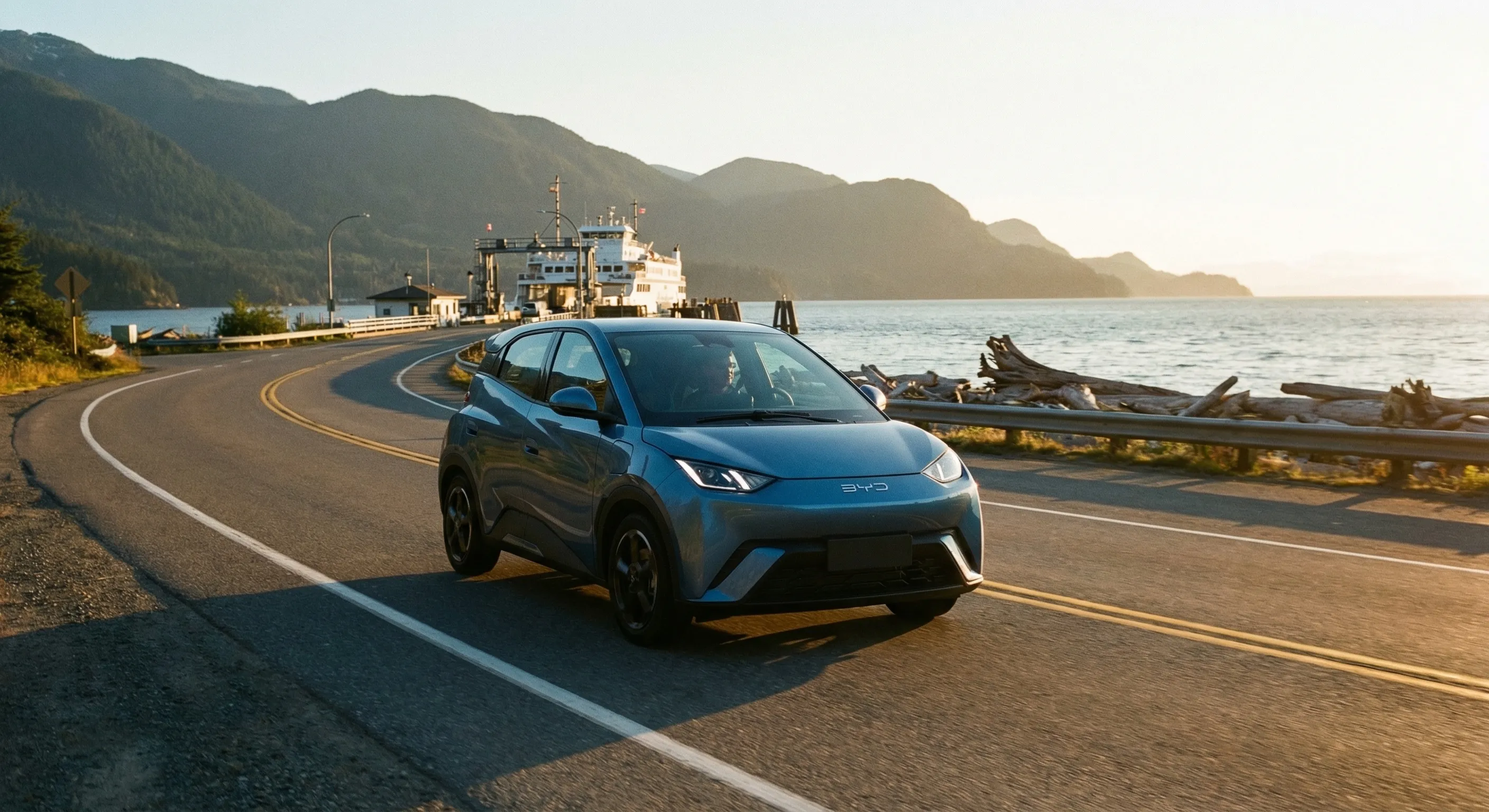
There is a car in China right now that costs less than a set of snow tires and rims for an F-150. It seats four adults, drives 300 kilometres on a charge, and comes with features that would make a base-model Civic blush. It's called the BYD Seagull, and if it ever reaches Canadian dealerships at anything close to its global pricing, the entire affordable car market is going to need a rethink.
I don't say that for drama. I say it because the numbers are genuinely disruptive.
In China, the BYD Seagull starts at approximately 69,800 yuan. At current exchange rates, that's roughly $13,000 to $14,000 CAD. The higher-spec version with the larger battery tops out around 99,800 yuan, about $18,500 to $19,500 CAD. Even after you layer on shipping costs, Canadian compliance testing, dealer margins, and the 6.1% MFN tariff that now applies to Chinese-built EVs under Canada's 2026 import framework, the Seagull would still likely land somewhere in the $22,000 to $28,000 CAD range. That is, if BYD decides to bring it here at all.
And that "if" is the most important word in this entire article.
Below is the full picture: what the Seagull actually is, the Canadian tariff situation, and the realistic timeline.
What the BYD Seagull Actually Is
The Seagull is a four-door subcompact electric hatchback. It sits below the Dolphin in BYD's lineup, the entry point to the entire BYD ocean-themed EV family. It's been on sale in China since mid-2023 and has already become one of the best-selling EVs in the world, with over 400,000 units sold in its first full year of production.
The dimensions tell you immediately what kind of car this is:
- Length: 3,780 mm (about 360 mm shorter than a Honda Fit)
- Width: 1,715 mm
- Height: 1,540 mm
- Wheelbase: 2,500 mm
That makes it one of the smallest EVs you'll find anywhere. For Canadian context, it's smaller than a Nissan Kicks, shorter than a Hyundai Venue, and roughly the same footprint as a Chevrolet Spark, a car discontinued in 2022 partly because nobody could figure out how to make a profit on a subcompact at $10,000 USD.
BYD figured it out.
The Specs That Matter
Global-market Seagull spec sheets indicate two battery configurations, both reportedly using BYD's Blade Battery LFP chemistry:
- Standard range: 30.08 kWh battery, approximately 305 km CLTC range
- Long range: 38.88 kWh battery, approximately 405 km CLTC range
Now, CLTC is China's test cycle, and it's optimistic. For realistic Canadian summer driving, knock about 20-25% off those numbers. For Canadian winter driving at -15 to -20 degrees, knock 30-40% off. That gives you:
- Standard range, real-world summer: approximately 230-245 km
- Standard range, real-world winter: approximately 185-215 km
- Long range, real-world summer: approximately 305-325 km
- Long range, real-world winter: approximately 245-285 km
Those winter numbers on the standard range model are tight for some Canadian use cases. But for a city commuter doing 40-60 km per day with home charging? Even the base battery covers three to four days of driving between plugs in the dead of winter. The long range model gives you five to six days. For a second car or a dedicated urban runabout, that's more than sufficient.
Both models use a single front-mounted motor producing 55 kW (74 hp) on the base and 75 kW (100 hp) on the long range. Those are modest numbers. The Seagull isn't quick: 0–100 km/h comes in around 11–13 seconds depending on the variant. But it's perfectly adequate for city driving. The top speed is limited to 130 km/h, which is fine for every posted speed limit in Canada but means highway merging at 110 km/h requires a bit of planning.
DC fast charging peaks at 40 kW on the standard model and 40-60 kW on the long range. That's slow by today's standards, an Ioniq 5 charges at six times that rate. A 10% to 80% fast charge takes roughly 30-35 minutes. For a car that's designed to charge at home overnight and rarely visit a public charger, this is an acceptable trade-off. For road trips, the Seagull is not the right tool. But BYD knows that. The Seagull is a city car that happens to be electric, not an electric car that happens to work in the city.
Level 2 home charging at 6.6 kW takes about 5 hours for the standard battery and 6-7 hours for the long range. Plug in after dinner, wake up full. The charging experience is identical to every other EV in its class, the main difference is that your electricity bill for a month of Seagull charging is about $25 to $30.
How It Compares to the Nissan Leaf
The comparison that everyone wants to make is with the Nissan Leaf, because the Leaf has been Canada's default "affordable EV" for over a decade. Here's how they stack up:
BYD Seagull (long range) vs. Nissan Leaf S Plus:
- Seagull estimated Canadian price: $24,000-$28,000 CAD (no EVAP rebate)
- Leaf S Plus MSRP: $44,298 CAD (eligible for $5,000 EVAP, net $39,298)
- Seagull range (WLTP-equivalent estimate): 320-340 km
- Leaf S Plus range (EPA): 342 km
- Seagull battery (global-market spec): approximately 38.88 kWh LFP (Blade Battery)
- Leaf battery: 62 kWh NMC (air-cooled)
- Seagull DC fast charge: 40-60 kW (CHAdeMO/CCS TBD for Canada)
- Leaf DC fast charge: 100 kW (CCS on latest models)
- Seagull 0-100 km/h: approximately 11 seconds
- Leaf 0-100 km/h: approximately 7.9 seconds
- Seagull weight: approximately 1,240 kg
- Leaf weight: approximately 1,740 kg
The Leaf is the better car in almost every performance metric. It's faster, it charges faster, and it has more absolute range. But the Seagull costs roughly $11,000 to $15,000 less even after the Leaf gets its EVAP rebate. That price gap buys a lot of forgiveness for slower acceleration and a smaller battery.
And here's the comparison that matters most for long-term ownership: the Seagull's LFP Blade Battery can be charged to 100% every single day without degradation concerns. The Leaf's air-cooled NMC battery has a documented history of capacity loss over time, especially in warmer climates. BYD's battery will likely retain 90%+ of its capacity after ten years of daily charging. The Leaf's track record is less consistent.
The Leaf also weighs 500 kg more than the Seagull despite having a similar footprint. That weight difference means the Seagull uses less energy per kilometre, puts less wear on tires and brakes, and is generally more efficient to operate. Less mass moving through space equals less energy required, physics doesn't care about brand reputation.
The Design: Small But Not Cheap
The Seagull follows BYD's Ocean Aesthetic design language, the same design philosophy that shaped the Dolphin and the Seal. The front end features a closed-off grille (obviously, no engine to cool), pixel-style LED headlights, and a friendly face that reads as approachable rather than aggressive. The roofline has a gentle arc from front to rear, giving the car a slightly sporty silhouette despite its compact dimensions.
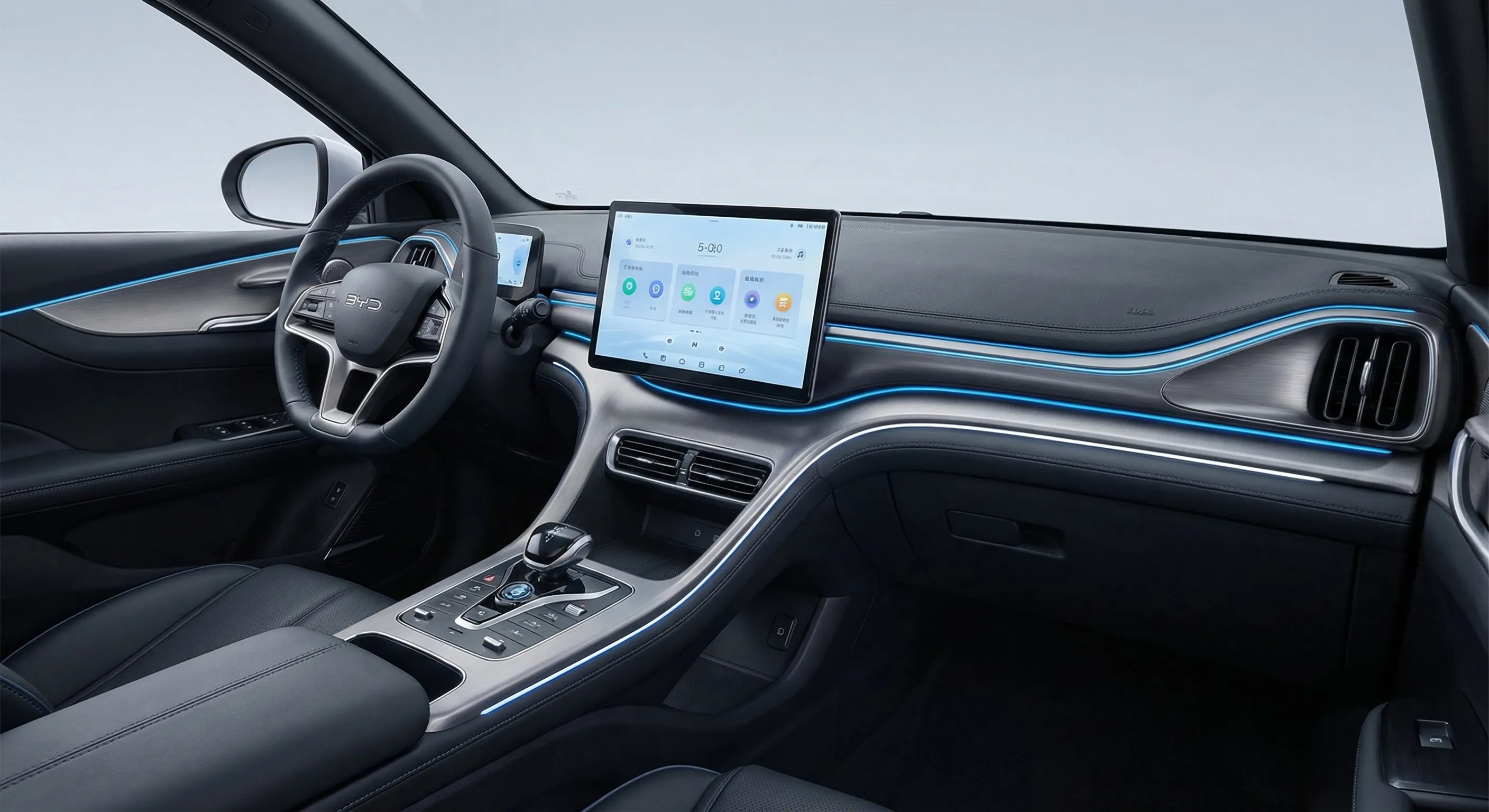
The interior is where BYD invested most of its per-dollar design effort. The centrepiece is a 10.1-inch rotating touchscreen, the same rotating concept from the Dolphin and Atto 3, scaled down slightly. It runs BYD's DiLink system with wireless Apple CarPlay and Android Auto support. The instrument cluster is a 5-inch digital display, small but functional.
Materials are a mix of soft-touch surfaces on the upper dashboard and harder plastics lower down. For a car at this price point, the quality is remarkable. Australian and Southeast Asian reviewers who have driven the Seagull consistently note that the interior feels like it belongs in a car costing 50% more. The steering wheel is leather-wrapped. The seats are comfortable for city driving. The rear seat fits two adults or two child seats without complaint, three across is tight but possible for short trips.
Cargo space is 122 litres behind the rear seats. That's small, significantly smaller than the Dolphin's 345 litres. With the rear seats folded, you get around 440 litres, which is enough for a weekly grocery run or a couple of carry-on suitcases. The Seagull is not a car for IKEA hauls. It's a car for daily commuting with occasional practical duties.
The Tariff Situation: Why This Gets Complicated
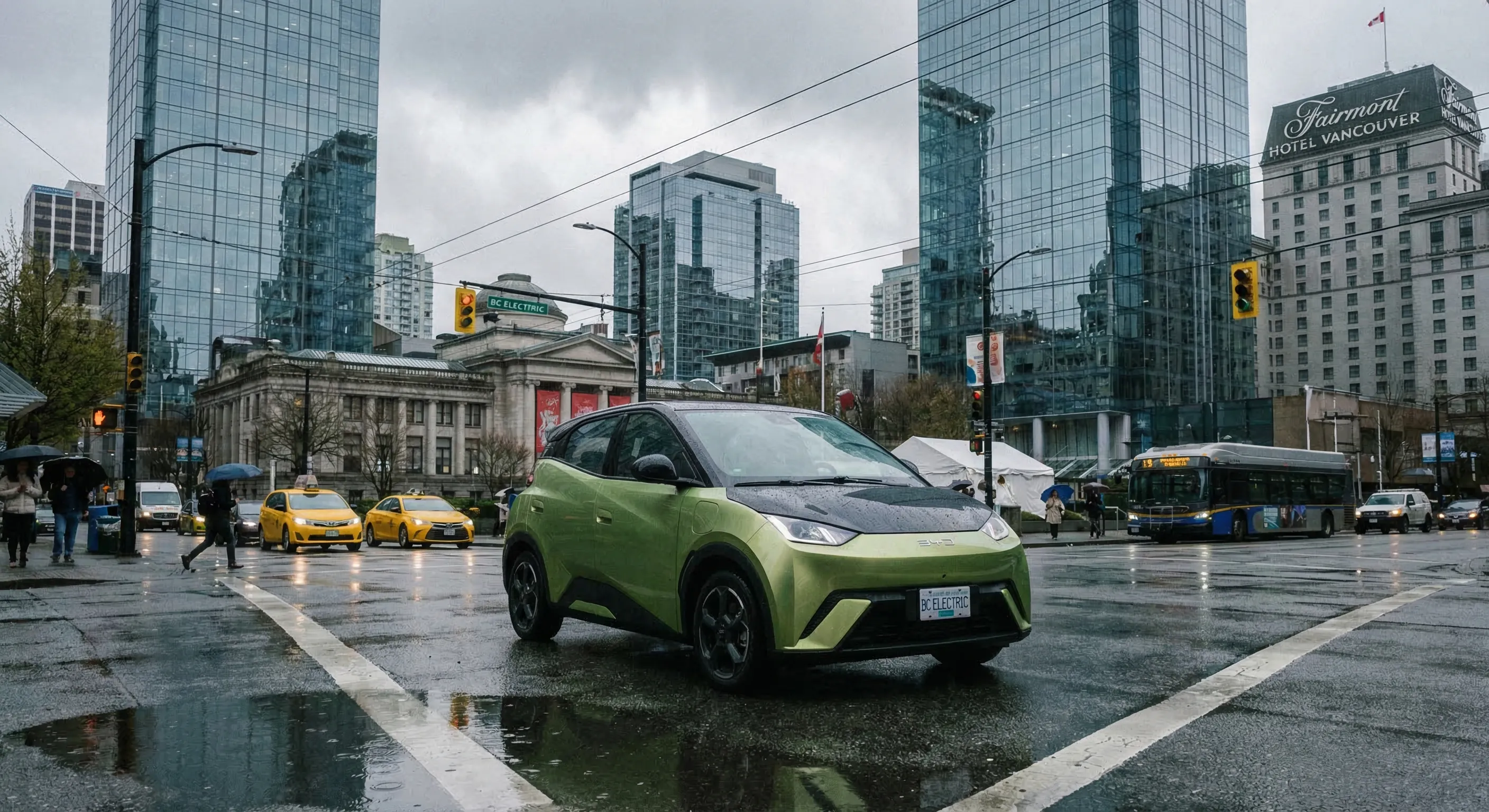
Canada's relationship with Chinese-manufactured EVs is complicated, and the Seagull sits right in the middle of that complexity.
In October 2024, Canada imposed a 100% tariff on Chinese-manufactured EVs. At 100%, the Seagull's landed cost would roughly double, eliminating its price advantage entirely. A $14,000 USD car with a 100% tariff becomes a $28,000 USD car before shipping, compliance, dealer margins, and taxes. At that point, you might as well buy a Nissan Leaf.
In January 2026, Canada revised its approach. The 100% tariff was replaced with a permit-based system allowing up to 49,000 Chinese-built EVs per year to enter Canada at the standard 6.1% MFN (Most Favoured Nation) tariff rate. This is the framework that BYD is using to bring the Atto 3, Seal, and Dolphin to Canada. The Seagull could theoretically enter under the same framework.
But there's a wrinkle. The 49,000-unit quota covers all Chinese-manufactured EVs, not just BYD. That quota is shared with any other Chinese brand that wants to sell in Canada, NIO, XPeng, Zeekr, Chery, and others. BYD will get the largest allocation, but they have to prioritize which models to bring. When you have a limited number of import permits, you bring the vehicles with the highest margin first. The Seal and Atto 3 are higher-margin vehicles than the Seagull. The Dolphin is already pushing the lower bound of what's commercially viable after shipping and compliance costs.
The Seagull, with its ultra-low price point, presents a razor-thin margin challenge. BYD's profit on a Seagull sold in China is estimated at $1,000 to $1,500 USD per vehicle, tight even before you add trans-Pacific shipping, Canadian safety and emissions compliance, homologation testing, dealer setup costs, and warranty reserves. The math might not work at scale unless BYD treats the Seagull as a loss leader to build market share, or finds a way to manufacture it closer to North America.
There's a reason BYD has been building factories in Mexico and Brazil. A Mexico-built Seagull would qualify for USMCA trade treatment and face a much lower tariff barrier. BYD's Monterrey factory is under construction and could theoretically produce Seagull-class vehicles for the North American market by 2027-2028. If that happens, the Canadian pricing equation changes dramatically.
Additionally, the Seagull does not qualify for Canada's $5,000 federal EVAP rebate. EVAP requires vehicles to be manufactured in Canada or a free trade agreement country. Even under the revised tariff framework, Chinese-manufactured vehicles remain excluded from EVAP. A Mexico-built Seagull would potentially qualify for EVAP, which would make it the most aggressively priced new EV in Canadian history.
Gear worth having
As an Amazon Associate, ThinkEV earns a small commission from qualifying purchases — at no extra cost to you.

Grizzl-E Classic Level 2 EV Charger (40A)
Canadian-made and rated for minus 40C winters. 40A / 9.6 kW, NEMA 14-50, indoor/outdoor, 24-ft cable. The charger built for Canadian weather.
As an Amazon Associate, ThinkEV earns from qualifying purchases — at no extra cost to you.
Why the Seagull Scares Legacy Automakers
The BYD Seagull is not just a car. It's a proof of concept that a fully functional electric vehicle with modern technology, decent range, and acceptable build quality can be manufactured profitably at a price point that legacy automakers thought was impossible.
Every major automaker has a "most affordable EV" in their lineup. Let me list what those cost in Canada right now:
- Nissan Leaf S: $39,298 CAD (after EVAP)
- Chevrolet Equinox EV 1LT: $42,999 CAD (before EVAP)
- Hyundai Kona Electric Essential: $42,999 CAD (before EVAP)
- Volkswagen ID.4 Pro: $44,995 CAD (before EVAP)
- Kia EV3: approximately $39,990 CAD (estimated, before EVAP)
The cheapest new EV you can buy in Canada today, after all rebates, is around $35,000 CAD. The BYD Seagull, even with tariffs, shipping, and margins, would likely land between $22,000 and $28,000 CAD. That's a gap of $7,000 to $13,000 between the Seagull and the next cheapest option.
Legacy automakers cannot match this price with their current cost structures. GM, Ford, Hyundai, and Volkswagen all buy batteries from external suppliers (CATL, LG, Samsung SDI, SK On) at market prices. BYD makes its own batteries in its own factories using its own raw material supply chains. BYD's battery cost per kWh is estimated at 30-40% lower than what legacy automakers pay their suppliers. That cost advantage cascades through the entire vehicle, cheaper battery means cheaper car means lower price.
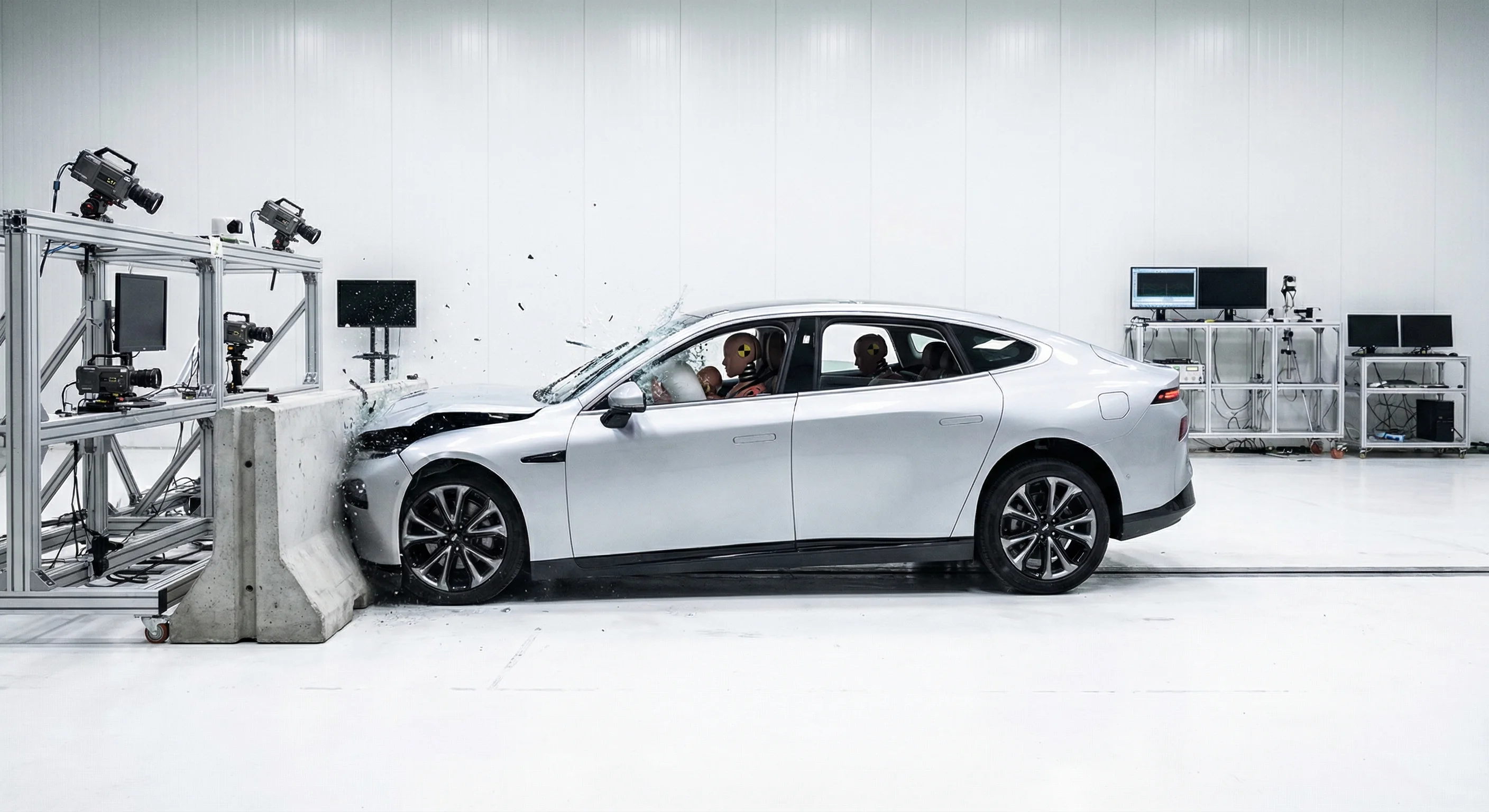
This is why the United States imposed a 100% tariff on Chinese EVs and why Canada had a 100% tariff before the 2026 revision. It's not about safety concerns or quality issues. The Seagull earned a 5-star crash rating in Australian ANCAP testing, it's a safe car. The tariffs exist because the Seagull is too affordable. It would undercut domestic and allied manufacturers so severely that they couldn't compete, and the political implications of that are enormous.
The Safety Question
Because it always comes up with Chinese EVs, and because it should: is the Seagull safe?
The answer, based on available crash test data, is yes.
Australian-market coverage indicates the BYD Seagull achieved a 5-star ANCAP safety rating. Adult occupant protection reportedly scored well, and the LFP Blade Battery is commonly cited as an extra safety buffer because BYD uses the same chemistry in the company's well-known nail-penetration demonstrations.
Standard safety equipment includes:
- Front and side airbags (6 total on higher trims)
- Automatic emergency braking with pedestrian detection
- Lane departure warning
- Rear parking sensors
- Reversing camera
- Electronic stability control
- Tire pressure monitoring
The higher-spec model adds adaptive cruise control, lane-keeping assist, and a 360-degree camera system. For a car at this price point, the safety equipment is comprehensive. Compare that to a Chevrolet Spark in its final year, no automatic emergency braking, no lane departure warning, minimal active safety. The Seagull has more safety technology than cars that cost twice as much five years ago.
Gear worth having
As an Amazon Associate, ThinkEV earns a small commission from qualifying purchases — at no extra cost to you.
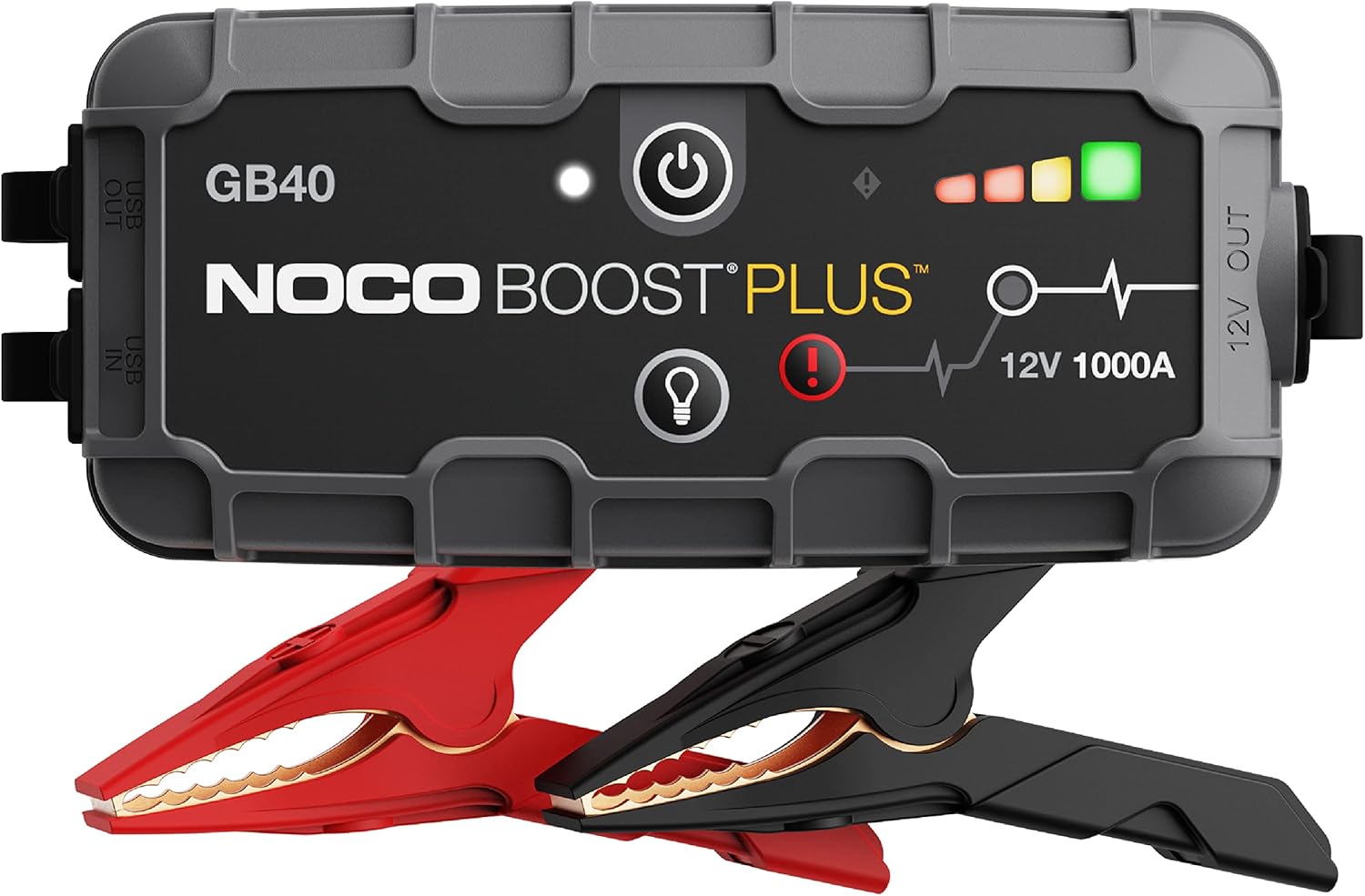
NOCO Boost Plus GB40 Jump Starter
A 1000A lithium jump starter that fits in your glovebox and works on any 12V battery. Your insurance against a dead 12V in a parking lot.
As an Amazon Associate, ThinkEV earns from qualifying purchases — at no extra cost to you.
The structural engineering is sound. BYD uses ultra-high-strength steel in the passenger cell, and the battery pack itself acts as a structural element, increasing rigidity. The low centre of gravity from the floor-mounted battery reduces rollover risk, which is a meaningful safety advantage for any vehicle.
For the full picture on Chinese EV safety data and crash test performance, read our complete safety analysis.
What Would the Seagull Mean for Canada?
If the BYD Seagull reaches Canadian dealerships at anything near its expected pricing, the implications are significant.
For first-time EV buyers: The Seagull would be the first genuinely affordable new EV in Canada. Not "affordable for an EV", affordable, period. A $24,000 car with zero fuel costs and minimal maintenance is within reach for young buyers, single-income households, and anyone who has been priced out of the new car market by $55,000 average transaction prices. It would make electric driving accessible to a demographic that currently can't participate.
For the used car market: A new Seagull at $24,000-$28,000 competes directly with used gas cars in the $20,000-$30,000 range. A three-year-old Honda Civic with 60,000 km costs about $22,000-$26,000. A three-year-old Hyundai Kona (gas) is about $20,000-$24,000. The Seagull would be brand new, with a full warranty, zero fuel costs, and minimal maintenance, competing with used gas vehicles that need oil changes, brake pads, timing belts, and $1.60/litre gasoline. The value proposition is almost absurd.
For fleet buyers and car-sharing services: A low-cost, low-maintenance EV with compact dimensions is exactly what urban car-sharing fleets want. Communauto, Evo, and similar services would likely find the Seagull's operating economics compelling. The compact footprint means more cars per parking bay. The LFP battery should also be attractive for heavy cycling, although Canadian buyers should still wait for final local validation before treating that as settled.
For two-car households: The Seagull fills the "second car" role perfectly. Your primary vehicle handles road trips and family duties. The Seagull handles commuting, errands, and school runs at a fraction of the operating cost. At $24,000-$28,000, it's cheap enough to justify as a dedicated commuter without feeling like an extravagance.
For legacy automakers: Panic. The Seagull proves that an EV can be built profitably at a price point that GM, Ford, and Toyota have declared impossible. If BYD can build a $14,000 USD EV and make money on it, the implication is that legacy automakers' cost structures are too high, not that the Seagull is too cheap. That's a difficult message to counter with marketing.
The Battery Advantage: LFP at Scale
In global-market materials, the Seagull is described as using BYD's Blade Battery, the same lithium iron phosphate cell-to-pack design associated with the Dolphin, Atto 3, and Seal. I've covered LFP technology in detail in our BYD Dolphin review, but the key points bear repeating because they directly affect ownership economics.
LFP batteries can be charged to 100% every day without accelerated degradation. You plug in when you get home, let it fill up overnight, and wake up to a full battery. No managing charge limits. No "only charge to 80% to preserve battery health." Just plug in and forget about it.
Cycle life on LFP is approximately 3,000-5,000 full cycles before meaningful capacity loss. If you fully charge and fully deplete the Seagull's battery every single day, which almost nobody does, 3,000 cycles is over eight years. In realistic use with partial charges, the battery should last 15-20 years. BYD warrants the battery for 8 years and 200,000 km, but the underlying chemistry will likely far outlast that warranty.
The Blade Battery design also means the Seagull is inherently safe. LFP chemistry cannot undergo the kind of thermal runaway that causes battery fires in nickel-based cells. This is not marketing, it's chemistry. The phosphate cathode material is thermally stable in a way that nickel-manganese-cobalt simply is not. For a car that might be someone's first EV, that peace of mind matters.
The trade-off, as always with LFP, is energy density. On paper, the Seagull's approximately 38.88 kWh battery weighs more per kWh stored than an equivalent NMC pack. But BYD appears to have optimized the cell-to-pack ratio well enough that the vehicle still lands around 1,240 kg, lighter than a Volkswagen Golf.
Gear worth having
As an Amazon Associate, ThinkEV earns a small commission from qualifying purchases — at no extra cost to you.

PULIDIKI Car Cleaning Gel (Detailing Putty)
Press it into vents, buttons, and seams and it lifts out dust you did not know was there. Weirdly satisfying, genuinely useful.
As an Amazon Associate, ThinkEV earns from qualifying purchases — at no extra cost to you.
Winter Performance: The Canadian Question
Every EV article for Canada has to address winter, and the Seagull is no exception. Here's the assessment.
The Seagull's LFP battery will lose more range in cold weather than an NMC battery in a comparable vehicle. LFP chemistry is inherently more affected by low temperatures, the lithium ions move more slowly through the electrolyte when the battery is cold, which reduces available capacity and charge acceptance speed. At -20 degrees, expect a 30-40% range reduction from rated numbers.
For the standard 30.08 kWh model, that means approximately 185-215 km in a Canadian winter. That's enough for a 40 km daily commute with comfortable margin, but it doesn't leave a lot of buffer for unexpected detours or forgetting to plug in for a night. The long range 38.88 kWh model gives you 245-285 km in winter, which is significantly more comfortable.
The Seagull has a heat pump for cabin heating, which is the most efficient approach to climate control in an EV. The heat pump uses less energy than resistive heating, preserving more range for driving. Preconditioning the cabin and battery while plugged in, using wall power instead of battery power, is the single best habit you can adopt for winter EV driving, and the Seagull supports it.
Traction is front-wheel drive only. No AWD option. For urban and suburban driving on plowed roads with proper winter tires, FWD is perfectly adequate. The Seagull's low centre of gravity (battery in the floor) helps with stability on slippery surfaces. But if you're in a rural area with unreliable plowing or regularly work through steep, icy hills, the lack of AWD is a limitation.
Winter tires are mandatory in Quebec and highly recommended everywhere else. The Seagull uses 185/60R15 tires on the base model. A set of winter tires on steel rims will cost approximately $600-$800, budget for it.
The bottom line on winter: the Seagull is a viable year-round urban commuter in most of Canada. It's not the car I'd choose for a daily 120 km highway commute in northern Ontario in January. But for the majority of Canadian drivers who do most of their driving within city limits, it works. The key is home charging, you need to plug in every night in winter, not every third night.
When Could the Seagull Arrive in Canada?
There is no confirmed timeline for the BYD Seagull in Canada.
BYD's Canadian market entry strategy is focused on higher-margin vehicles first. The Atto 3 and Seal are the priority models for late 2026, with the Dolphin likely following in 2027. The Seagull, as the lowest-priced vehicle in BYD's lineup, would logically be the last to arrive.
Here are the realistic scenarios:
Scenario 1: China-built Seagull under the import quota (2027-2028). BYD allocates some of its 49,000-unit quota to Seagull imports. Pricing lands at $24,000-$28,000 CAD. No EVAP rebate. Limited initial availability in Toronto, Vancouver, and Montreal. This is the most likely path in the near term, but the thin margins make it a tough business case.
Scenario 2: Mexico-built Seagull (2028-2029). BYD's Monterrey factory begins producing the Seagull or a similar subcompact for the North American market. USMCA trade treatment eliminates the tariff issue. Potentially EVAP-eligible, which could bring the effective price below $20,000 CAD. This is the scenario that legacy automakers are most concerned about, and it's the most significant for the Canadian market.
Scenario 3: The Seagull doesn't come to Canada at all. BYD decides the margins are too thin, the tariff environment is too uncertain, or the dealer network can't support a vehicle at this price point. They focus on higher-margin models and leave the sub-$30,000 segment to the Dolphin. This is a realistic possibility, businesses don't sell products at a loss, and the Seagull's margin structure in Canada is challenging.
My best guess: the Seagull or a close successor arrives in Canada in 2028, most likely built in Mexico. The current China-built version is a harder sell under the import quota system unless BYD is willing to accept very low per-unit margins as a market penetration strategy.
What to Buy Right Now if You Can't Wait
If you're reading this article and thinking "I want an affordable EV now, not in two years," here are your current options in Canada:
- BYD Dolphin (expected late 2026 or 2027): The closest thing to the Seagull that BYD is actually bringing to Canada. Expected around $28,000-$33,000 CAD. More range, more power, better fast charging than the Seagull, but also more expensive. Read our full Dolphin review.
- Nissan Leaf S (available now): $39,298 after EVAP.
More range than the Seagull, faster charging, established dealer network. But $11,000-$17,000 more expensive than the Seagull would be.
- Chevrolet Bolt EUV (used, 2022-2023): $18,000-$24,000 on the used market. 397 km EPA range, 150 kW fast charging, proven platform. The best value in the used EV market right now, arguably the closest equivalent to what the Seagull would be in Canada.
- Kia EV3 (coming 2026): Expected around $39,990 CAD before EVAP. More range and faster charging than the Seagull, but roughly $12,000-$16,000 more expensive.
The used Bolt EUV is probably the closest match to the Seagull's value proposition that you can actually buy today. A 2023 Bolt EUV with low kilometres for $20,000-$22,000 gives you more range, faster charging, and an established GM dealer network, all for a price that's in the same ballpark as where the Seagull would land.
The Bigger Picture: Affordable EVs Are Coming
The BYD Seagull is not just a cheap car. It's a proof point that the "EVs are expensive" equation has already been solved at the factory level, at scale.
For years, the EV conversation in Canada has been dominated by vehicles costing $45,000 to $80,000. The Model 3. The Ioniq 5. The Mustang Mach-E. These are good vehicles, but they're out of reach for a significant portion of the Canadian population. The average household income in Canada is about $75,000 before tax. Asking someone to spend $55,000 on a car, even if the operating costs are lower, requires either significant savings or a large loan.
The Seagull, and vehicles like it, change that math. A $24,000 car with $30/month electricity costs and $200/year maintenance costs is genuinely accessible to middle-income Canadians. It's accessible in the way that the original Honda Civic was accessible in the 1970s, or the way the Toyota Corolla has been accessible for four decades. It's a car that you buy because the economics make sense, not because you're making an ideological statement about the environment.
BYD is not the only manufacturer working on affordable EVs. The new Chevrolet Bolt (2027 model) is expected at $39,999 CAD, and Renault's R5 Electric is targeting a similar price point in Europe. Stellantis is developing a sub-$25,000 EUR EV for the European market. But BYD is the first manufacturer to actually deliver a sub-$15,000 USD EV at scale, with hundreds of thousands of units sold and proven in real-world conditions across multiple countries.
The Seagull isn't a concept car. It's not a press release with "expected by 2028" attached. It's a production vehicle that people are buying and driving right now. The only question for Canada is when, not if, this tier of affordable EV arrives.
Gear worth having
As an Amazon Associate, ThinkEV earns a small commission from qualifying purchases — at no extra cost to you.

WixGear Magnetic Air Vent Phone Mount (2-Pack)
A magnet strong enough that your phone never flinches over potholes or rail crossings. Two in the box, one for each car.
As an Amazon Associate, ThinkEV earns from qualifying purchases — at no extra cost to you.
Further Reading
- BYD Dolphin Canada Review: The $28K EV Nobody Expected, BYD's next-tier affordable EV, with more range and faster charging
- BYD Atto 3 Review: The $30K EV That Doesn't Feel Like $30K, BYD's compact SUV for Canadian buyers
- BYD Is Coming to Canada, What the Tariff Deal Really Means for Buyers, The complete breakdown of BYD's Canadian market entry and tariff framework
- Most Affordable EVs in Canada 2026, Every budget-friendly EV ranked by value
- Are Chinese EVs Safe? Complete Safety Analysis, Crash testing, battery safety, and what the data shows
- Canada EV Rebate EVAP 2026 Guide, How to claim your $5,000 federal EV incentive (and which cars qualify)
Gear worth having
As an Amazon Associate, ThinkEV earns a small commission from qualifying purchases — at no extra cost to you.

Car Cup Holder Coasters (4-Pack)
Drop-in coasters that catch spills and crumbs so your cup holders stay clean. Rinse and reuse forever.
As an Amazon Associate, ThinkEV earns from qualifying purchases — at no extra cost to you.

Founder & Chief Editor
Vlad Pereira is the founder and chief editor of ThinkEV.ca, the Canadian electric-vehicle publication he writes and edits from Courtenay, British Columbia. He covers EV pricing, federal and provincial rebates, charging costs, and the Chinese manufacturers now entering Canada, from the buyer's side rather than the press-fleet side. ThinkEV is a venture of Vlad Pereira Online; his writing on health, income and the long game lives at vladpereira.com.
Frequently asked questions
How much would the BYD Seagull cost in Canada?
When will the BYD Seagull be available in Canada?
Does the BYD Seagull qualify for the $5,000 EVAP rebate?
What is the real winter range of the BYD Seagull?
Is the BYD Seagull safe?
How does the BYD Seagull compare to the BYD Dolphin?
Can the Seagull handle Canadian highways?
Is the BYD Seagull good for a first EV?
More EV & road-trip finds
Affordable upgrades worth a look — tap any to check the price on Amazon.
 ★ 297
★ 297360-Degree One-Hand Dashboard Phone Mount
View on Amazon ★ 61
★ 61Toddler Car Seat Snack and Cup Tray
View on Amazon ★ 17,839
Qifutan Vent Phone Mount (Military-Grade Clip)
View on Amazon ★ 12,051
Windex Electronics Screen Wipes
View on Amazon ★ 314
★ 314Mini USB LED Ambient Lamps (4-Pack)
View on Amazon ★ 401
★ 401Crochet Daisy Rear-View Mirror Charm
View on Amazon ★ 979
★ 979Leather Headrest Purse Hook
View on Amazon ★ 1,944
VIOFO A229 Pro 4K Dash Cam
View on AmazonRead, Plan, Then Stay Current
Explore our expert articles to understand incentives and ownership costs, use the map to pressure-test charging reality, then subscribe so new EV coverage comes straight to you.
Continue Reading

BYD 1.5MW Charging Canada: 400 km in Five Minutes
Chinese EVs in Canada: Security Politics vs Value

Should I Wait for BYD to Come to Canada?

How to Choose an EV Under $50K in Canada
Chinese EV Resale Value in Canada: What to Expect