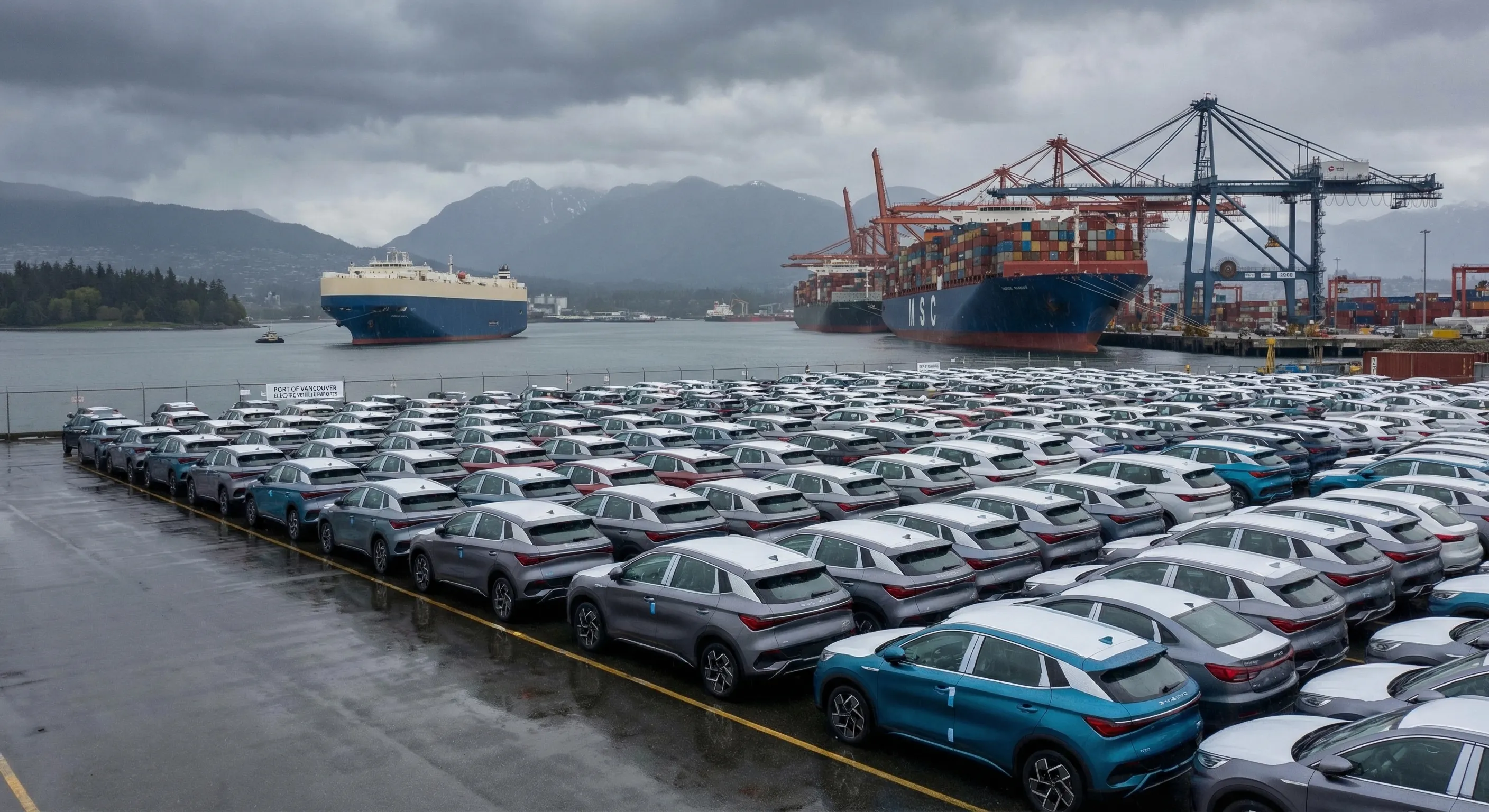
The CBC ran the headline. Reddit lit up. Your Facebook feed got weird. And somewhere in a Mississauga parking lot, someone looked at their $58,000 Hyundai Ioniq 6 and felt a small, familiar anxiety creeping in.
Chinese EV entry into the Canadian market is being discussed much more seriously than it was a year ago. Not as a fringe thought experiment, but as a live policy and regulatory question with real implications for pricing, brand strategy, and buyer behaviour.
Several automakers are being discussed as plausible near-term entrants. The tariff framework that once made this economically implausible shifted from 100% to 6.1% on January 16, 2026 under the current federal deal. If that policy holds, this stops being just a story about cheap cars and becomes a story about competitive pressure across the whole Canadian EV market.
This is a restructuring of the entire Canadian auto market. And most buyers have no idea what's coming.
Key takeaways
- BYD is the clearest near-term candidate, while Zeekr and Geely remain watch-list brands rather than settled Canadian launches
- Canada's tariff on Chinese EVs dropped from 100% to 6.1% on January 16, 2026, under a 49,000-vehicle annual quota
- Chinese-manufactured EVs are excluded from the $5,000 federal EVAP rebate, price advantages must stand on their own
- Cold-weather claims around Chinese EVs are still highly source-sensitive and should be treated as indicative, not settled Canadian proof
- The BYD Seal is one of the first Chinese EVs that could genuinely pressure Tesla on performance, range, and interior quality, not just price
How We Got Here, The Tariff Timeline You Need to Understand
Before we talk about what's coming, let's be clear about what was blocking it.
Canada had zero serious policy against Chinese EVs until the United States made it politically untenable to stay neutral. In October 2024, Ottawa imposed a 100% surtax on Chinese-made electric vehicles, a measure that was, bluntly, more about optics than economics. The US had already gone to 100%. Canada followed. Industry analysts immediately noted that this effectively ended any realistic timeline for affordable Chinese EVs entering the Canadian market.
A $15,000 BYD Seagull at the factory gate. Add 100% tariff: $30,000. Add shipping, compliance costs, dealer margin: $38,000-$42,000. At that price, you're competing directly with established brands that Canadians trust, with functioning dealer networks, with warranty service on every corner. Dead on arrival.
Then something interesting happened. The political winds shifted. Prime Minister Mark Carney's government, under pressure from affordability concerns and prairie farm lobbying, reopened negotiations with Beijing. The result, announced January 16, 2026 and covered extensively by CBC, was a quota-based deal: 49,000 Chinese EVs per year enter Canada at 6.1% tariff. Half of that quota, roughly 24,500 vehicles, must be priced at $35,000 or under.
That is a complete reversal.

What 6.1% Actually Does to the Price
The pricing math is illustrative, not official.
Take the BYD Seagull. Chinese domestic price approximately $11,000-$13,000 CAD equivalent. At 100% tariff: $22,000-$26,000 before a single dollar of shipping, compliance, or dealer costs. Unworkable. At 6.1% tariff: $11,671-$13,793 at the border. Add shipping from China to Vancouver or Halifax (roughly $1,200-$1,800 per vehicle at scale), Transport Canada compliance costs amortised across the import volume, and dealer margin: you're looking at retail pricing in the $22,000-$27,000 range. That is a category-creating price point. Nothing new and electric exists in Canada at that number.
The BYD Dolphin. European pricing around €24,000, call it $35,000 CAD equivalent before tariff. At 6.1%: $37,135. Shipping, compliance, margin: $40,000-$44,000 retail. Still under the $45,000+ entry point for most established EVs in Canada.
The BYD Atto 3, an electric crossover the size of a RAV4, lands at roughly $42,000-$48,000 under this regime. That competes directly with the Hyundai Kona Electric ($46,000) and Kia EV3 (likely $42,000+), without the $5,000 EVAP rebate advantage those vehicles carry.
The BYD Seal is where it gets genuinely uncomfortable for premium EV brands. Expected retail is still usually modeled around $47,000-$55,000. The Tesla Model 3 Long Range AWD is $59,990. The BMW i4 eDrive35 starts at $66,900. The Polestar 2 Long Range starts at $59,900. If the Seal launches near those modeled numbers, it brings comparable performance, more interior space, and a richer feature story at a starting price $5,000-$12,000 cheaper than those competitors.
The EVAP exclusion matters, but it does not automatically erase the modeled price gap. If the Seal lands near the lower end of the Canadian scenarios currently being discussed, a buyer could still see a meaningful net-price advantage versus some established rivals even after accounting for the missing rebate. The key word there is "if", the final Canadian MSRP still matters.
The Likely Entrants, And The Brands Still In Watch Mode
Not every Chinese brand is ready for Canada. Regulatory certification through Transport Canada takes time, cold-weather validation costs money, and building a dealer network from nothing requires capital and commitment. Some brands may move sooner than others, but the 2026 picture still includes meaningful uncertainty.
BYD: The World's Largest EV Maker, Now Coming to Your City
BYD is not a scrappy startup. They are the largest electric vehicle manufacturer on the planet by unit volume, they outsold Tesla globally in 2023 and 2024. They produce their own batteries, motors, semiconductors, and even the steel that goes into some of their vehicles. The vertical integration is staggering. It's the primary reason they can price where they price and still make money.
Critically, BYD appears to be the clearest near-term candidate in current reporting. But buyers should still distinguish between broad regulatory readiness, model-by-model compliance, and actual retail launch readiness. Those are not the same thing.
Four models are widely discussed as the most plausible BYD candidates if Canada entry moves ahead on the timelines enthusiasts expect:
The BYD Seagull, estimated $22,000-$27,000 CAD
Read our full BYD Seagull Canada preview for the technical deep-dive. The short version: this is a subcompact electric hatchback with a 300-400 km range depending on battery pack, and a build quality that has genuinely surprised European reviewers who expected a toy. It is not a toy. It is a competently engineered small car that happens to cost roughly the same as a well-equipped Honda Civic, except the fuel is essentially free.
Cold-weather validation and launch timing remain uncertain. Late 2026 to early 2027 is a common scenario in current commentary, not a confirmed dealer commitment.
The BYD Dolphin, estimated $34,000-$40,000 CAD
Our BYD Dolphin Canada review covers the driving experience in detail. The Dolphin is a proper compact car, Honda Fit-sized exterior, surprisingly spacious interior, with up to 427 km of range in the Long Range variant. It's been the best-selling EV in Australia and several European markets. It drives well, the interior quality is legitimately good, and the 100 kW DC fast charging handles Canadian highway driving comfortably.
The Dolphin may prove easier to launch than the Seagull, but Q3-Q4 2026 remains a forecast, not a confirmed showroom date.
The BYD Atto 3, estimated $42,000-$48,000 CAD
The Atto 3 is BYD's global volume leader, a compact electric crossover that looks like it belongs in a parking lot beside a RAV4 or Rogue, drives better than both, and offers 480 km of real-world range. The BYD Atto 3 review goes deep on the specifics. The interior uses a rotating 12.8-inch screen (genuinely clever, not a gimmick), the backseat is more spacious than the Model Y's, and the charging performance is solid without being exceptional.
This is the model I expect to move the most units in Canada if BYD launches smoothly, because Canadians love crossovers and about $45,000 is a psychologically acceptable number for a full-featured family vehicle. Without the EVAP rebate, it still has to justify every dollar on its own merits.
The BYD Seal, estimated $47,000-$55,000 CAD
The Seal is one of the Chinese EVs most likely to pressure Tesla if the Canadian launch pricing lands near current scenarios. We've reviewed it in detail, and the core takeaway is still strong: BYD built a premium-feeling sedan that looks competitive on performance, space, and feature value. What remains unsettled is the exact Canadian retail sheet around it.
Nappa leather standard in widely cited global trims. Harman Kardon 12-speaker audio standard on upper trims. Dual-motor AWD available. 0-100 km/h in 3.8 seconds in the performance variant. BYD's Blade Battery uses LFP chemistry, which is generally more thermally stable than nickel-rich alternatives. And up to 570 km of CLTC-rated range, which translates more loosely to a lower real-world figure rather than a guaranteed Canadian outcome.
The winter-performance question is one of the most repeated claims in this whole story, which is exactly why it needs caution. BYD's own testing and some owner-reported data from cold markets are encouraging, but they are not the same thing as a settled Canadian evidence base. Treat the Seal as promising in winter, not conclusively proven superior.
Zeekr: Geely's Premium Sub-Brand
Zeekr is what happens when Volvo's parent company decides to build a pure EV brand without the legacy costs.
Geely, the Chinese conglomerate that owns Volvo, Lotus, and holds a major stake in Daimler, created Zeekr as its premium electric sub-brand. And they did not cut corners. The Zeekr 001 is a fastback shooting brake that, on design alone, would turn heads in any country. The Zeekr 007 is a sport sedan that competes directly with the Model 3 and BYD Seal. The Zeekr X is a compact SUV.
Zeekr has been discussed as a possible Canadian entrant, with the 007 sedan often mentioned as the most likely launch vehicle. But this remains meaningfully less settled than the BYD story.

Expected pricing for the Zeekr 007 in Canada: $52,000-$60,000. That's Tesla Model 3 Long Range territory. The question is whether Zeekr's brand cachet, and it has genuine brand cachet in China and Europe, translates to Canadian buyers who've never heard of them. My read: harder sell than BYD, which at least has the pricing story. Zeekr's story is "we're better," which is a more difficult argument for an unknown brand.
The Zeekr 007's technical specifications are genuinely impressive. 800-volt architecture, the same fast-charging platform used by the Hyundai Ioniq 6 and Kia EV6, allows DC charging at up to 200 kW. At 200 kW, you add roughly 280 km of range in 15 minutes. For a brand entering Canada at $55,000, that's the kind of spec sheet that can justify the price if you can get people in front of it. The problem is getting people in front of it when nobody knows what Zeekr is. Brand recognition is worth tens of thousands of marketing dollars, and Zeekr starts with none in Canada.
The Zeekr X, if it arrives, would likely be priced $40,000-$46,000, a compact electric SUV that goes head-to-head with the Atto 3 and Kona EV. That's a brutal segment to enter as an unknown brand with no rebate advantage.
Worth noting: Polestar is technically a Geely brand (51% Geely-owned, though Swedish-designed and born from Volvo). Polestar has been in Canada for years and has Canadian brand recognition. The relationship between Polestar and Zeekr is complicated, they share platforms and technology but operate as entirely separate commercial entities. Polestar's established Canadian presence doesn't transfer to Zeekr. However, it does establish a proof of concept: a Geely-connected brand can build credibility in the Canadian market over time. That's the most optimistic case for Zeekr's long-term trajectory in Canada.
Geely Direct: The Parent Enters
Beyond Zeekr, Geely itself is evaluating direct Canadian market entry under the Geely brand, distinct from its sub-brands Zeekr, Lynk & Co, and Lotus (already sold here). The Geely Galaxy lineup, their mainstream EV platform, includes crossovers in the $32,000-$45,000 range that would compete squarely with the Atto 3 and similar vehicles.
The Galaxy E5, a compact SUV with approximately 400 km of range, is the model most likely to serve as Geely's Canadian market entry point if they proceed. At an estimated $35,000-$42,000, it would land squarely in the affordability requirement zone of the tariff deal's quota and would represent genuine value for a Canadian crossover buyer. The Galaxy platform uses CATL battery cells, not BYD's proprietary Blade chemistry, which is a distinction worth noting for buyers who have followed battery technology closely.
Geely direct is the most speculative part of this discussion. "Confirmed for 2026" is too strong. "Being discussed as a possible near-term entrant" is safer.
The Rebate Reality, Do the Numbers Still Work?
This is the part where I have to be honest about a headwind these vehicles face that has nothing to do with their quality.
The federal EVAP rebate, worth $5,000 on eligible vehicles, explicitly excludes vehicles manufactured in China. This is baked into the EVAP eligibility rules: the vehicle must be manufactured in Canada or an FTA country. China is not an FTA partner. Every Chinese-manufactured EV, BYD, Zeekr, Geely, all of them, is excluded from EVAP. The complete EVAP guide covers the eligibility rules in detail.
Provincial rebates are a different story, and this is where it gets nuanced.
Quebec's Roulez vert programme offers up to $4,000 for a new BEV, with an MSRP cap of $65,000. The Roulez vert programme does not apply Chinese-manufacture exclusions, it's based on vehicle price and battery capacity, not country of origin. A BYD Dolphin at $37,000 would qualify. A BYD Seal at $50,000 would qualify. That's $4,000 back from Quebec on vehicles that get nothing federally.
BC's CleanBC programme is being revised as of early 2026. The current structure offers up to $4,000 on eligible EVs with a $55,000 MSRP cap, but the Chinese-manufacture question is still being worked through at the provincial level. Watch this space, BC has historically been more aggressively pro-EV than the federal government on incentive programmes.
Ontario, Alberta, and most other provinces currently offer no meaningful point-of-sale EV rebate. Quebec buyers get the best deal on Chinese EVs; Ontario buyers get the Chinese EV's price advantage alone.
Here's how one modeled Ontario scenario stacks up practically. Use this as directional math, not a final Canadian retail sheet: BYD Seal at roughly $50,000 versus Tesla Model 3 Long Range at $54,990. The Model 3 Long Range exceeds the $50,000 EVAP cap, so it gets no federal rebate.
- Net Tesla cost: $54,990 (no EVAP, over cap)
- Net BYD Seal cost: $50,000 (no EVAP, excluded as Chinese-made)
- Advantage: BYD Seal by $4,990
That's still meaningful. Now run the same calculation in Quebec:
- Net Tesla: $54,990 (doesn't qualify for Roulez vert above $65K cap? The Model 3 LR at $54,990 qualifies for Roulez vert, subtract $2,000 = $52,990)
- Net BYD Seal: $50,000 minus $2,000 Roulez vert = $48,000
- Advantage: BYD Seal by $4,990
Quebec is where Chinese EVs become absolutely dominant on value. And Quebec is Canada's second-largest province by population and historically its strongest EV adoption market.
For full 2026 incentives across every province, the breakdown shows clearly which markets Chinese EVs are best positioned in.
The Winter Question, Still Worth Treating Carefully
Every Reddit thread about Chinese EVs in Canada eventually becomes a debate about winter. "Chinese EVs aren't built for our climate." "BYD never had to deal with -30 in Winnipeg." "The Blade Battery sounds great until January." I've seen versions of this argument hundreds of times. Most of it is speculation dressed as knowledge.
The safer way to read the available data:
BYD's Blade Battery, lithium iron phosphate (LFP) chemistry, has a different cold-weather profile than the nickel-manganese-cobalt (NMC) cells used in Tesla, BMW, and most Korean EVs. LFP cells have historically had worse cold-weather performance than NMC. That was accurate through about 2022. BYD's Blade 2.0, released in 2024, closes most of that gap.
Some sources cite strong cold-weather retention figures for newer BYD battery systems, including testing and owner-reported observations from cold markets. That is useful signal, but it is not the same thing as a single definitive verified number for all Canadian use cases.
For context, winter range loss varies widely by speed, preconditioning, tire choice, route profile, and cabin-heating behaviour. Comparative cold-weather claims should be read as directional, not absolute.
Does this mean BYD is better than Tesla in winter? No. Tesla's heat pump system and overall thermal management has years of refinement and a deeper North American data set. What it means is that blanket claims about Chinese EVs being unable to handle Canadian winters should be treated with skepticism, not repeated as settled fact.
The Chinese EV safety analysis covers the crash test and battery safety data specifically. The short version: BYD models have 5-star Euro NCAP ratings, LFP chemistry eliminates thermal runaway risk, and the structural safety of BYD vehicles is comparable to established European brands.
What This Does to Established Brands, The Real Story
Nobody wants to say this plainly, so I will: the entry of Chinese EVs at these price points is going to be painful for some manufacturers, and some of them have already started responding.
Hyundai and Kia are the most exposed. The Kona Electric and EV3 sit in precisely the price range where Chinese competitors are most dangerous. Hyundai's response has been to lean hard on EVAP eligibility (Kona Electric is Canadian-assembled, qualifying for the full $5,000 rebate), service network ubiquity, and long-established warranty credibility. That's a real defence. It's not nothing. But it requires Hyundai to keep Canadian-assembled production competitive, and that manufacturing arrangement is not guaranteed beyond current model cycles.
Volkswagen has a genuine problem. The ID.4 and ID.5 are German-assembled vehicles that don't qualify for EVAP (not Canadian or FTA manufacture). A BYD Atto 3 at $45,000 and an ID.4 at $47,000 are in the same conversation, and the BYD arrives with tech features the VW doesn't have, no EVAP rebate disadvantage because neither qualifies, and potentially better real-world range. VW needs to accelerate North American production plans, and they know it.
Tesla is in a complex position. The Model 3 (assembled in California) qualifies for EVAP. The BYD Seal, its closest Chinese competitor, doesn't. That $5,000 rebate gap is meaningful. But Tesla's brand has taken credibility hits in the past 18 months due to quality consistency complaints and Musk's political positioning alienating a segment of the EV buyer base that is, let's say, not aligned with his recent public statements. Some buyers who would have defaulted to Tesla are now actively looking for alternatives. Chinese EVs are alternatives.
Stellantis, GM, and Ford are largely competing in different segments (trucks, SUVs, higher price points) where Chinese entrants aren't landing immediately. The BYD Seal doesn't threaten an F-150 Lightning. But over a five-year arc, Chinese manufacturers will move upmarket. The North American legacy brands are watching.
The comparison of emerging versus established EV brands goes deep on how these dynamics play out across specific model comparisons.
Who's Actually Buying, Consumer Sentiment in 2026
A Leger poll from February 2026, surveying 1,570 Canadians, produced numbers that surprised a lot of people: 61% of Canadians now support allowing Chinese EVs into the market. That's up from roughly 39% in late 2024. The shift happened fast.
A separate Nanos Research/Bloomberg poll found 53% of Canadians say country of origin wouldn't affect their purchase decision at all. Fifteen percent said they'd be more likely to buy an EV specifically because it was made in China, citing price and technology leadership.
The demographic breakdown of those polling numbers is instructive. Support is highest among 25-44 year olds (71%), the household formation age group that is most acutely feeling housing and cost-of-living pressures and most likely to view a $23,000 EV as genuinely life-changing. Support drops among 55+ (52%), who show higher concern about brand familiarity and service network coverage. Geographically, Quebec leads adoption intent at 68%, followed by BC at 64%. Prairie provinces sit around 54%, where range anxiety related to highway distances and domestic auto sector employment concerns weigh heavier.
The concern that moved least: data privacy. Thirty-three percent of Canadians still worry about data from Chinese-connected vehicles being accessible to Chinese authorities. BYD and every other Chinese automaker operating in regulatory-supervised markets says they comply with local data laws. That answer doesn't fully satisfy the concern, and it won't until there's a track record in the market. This is the most legitimate remaining objection to Chinese EVs and it deserves to be taken seriously, not dismissed.
Gear worth having
As an Amazon Associate, ThinkEV earns a small commission from qualifying purchases — at no extra cost to you.

Grizzl-E Classic Level 2 EV Charger (40A)
Canadian-made and rated for minus 40C winters. 40A / 9.6 kW, NEMA 14-50, indoor/outdoor, 24-ft cable. The charger built for Canadian weather.
As an Amazon Associate, ThinkEV earns from qualifying purchases — at no extra cost to you.
The data privacy question is more nuanced than the headline makes it sound. Modern connected vehicles, from every major manufacturer including Ford, GM, Tesla, and Hyundai, collect substantial amounts of driver behaviour data. Tesla's data practices have been extensively documented and debated. The specific concern with Chinese vehicles is that Chinese law can theoretically compel Chinese companies to share data with state security authorities.
BYD stores Canadian user data on Canadian servers and states it does not share data with Chinese government entities. Whether you find that sufficient is a personal risk assessment. What's clear is that the conversation about data privacy in connected vehicles is not unique to Chinese brands, it's a conversation that applies to the entire industry.
There's also genuine consumer confusion about the "is this Canadian" question. A recent thread in r/BuyCanadian asked exactly that: are Chinese EVs good for Canada, bad for Canada, or somewhere in between? The responses ranged across the full spectrum, from "buy anything that keeps money in Canada" to "I just want the best price for my family. " The economics are complicated.
A $25,000 Chinese EV puts an EV within reach of a household that couldn't afford one at $45,000. That household spending less on fuel is net positive for Canadian consumer spending. The manufacturing jobs question is real, but most EV components aren't currently assembled in Canada anyway, the battery pack in your Hyundai is made in Korea. The steel in a Canadian-built Equinox EV comes from wherever the global supply chain sources it cheapest.
The idea that "Canadian-assembled" means "Canadian content" is increasingly a fiction across all automakers, not just Chinese ones.
What the polling data doesn't capture is the enthusiasm of the early-adopter community, the people who have been following BYD's global expansion for two years, who have watched the European sales figures, who have read the Australian owner forums, and who are genuinely excited about what these vehicles represent. That community exists in Canada, it's not small, and it will provide the first-wave sales and owner reviews that will shape perception of Chinese EVs in this market for years.
The Models Breakdown, Pricing, Range, and the Assessment
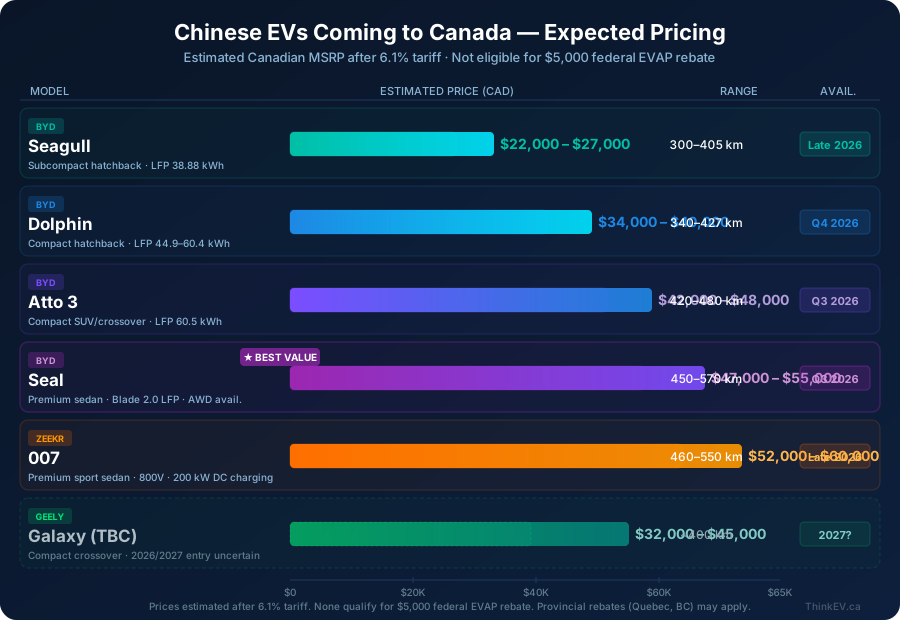
Here's the full picture of what's expected to land in Canada in 2026 and what it'll cost you.
BYD Seagull
- Estimated Canadian MSRP: $22,000-$27,000
- Range: 300-405 km (LFP, 38.88 kWh)
- Charging: CCS1, up to 40 kW DC
- Best for: Urban commuters, secondary household vehicle, first EV on a tight budget
- Weakness: Slow DC charging, small interior, no EVAP, uncertain availability timeline
- Verdict: If it lands at $23,000, it's the most important affordable EV Canada has ever seen. But it needs cold-weather validation first.
More detail in the BYD Seagull Canada preview.
BYD Dolphin
- Estimated Canadian MSRP: $34,000-$40,000
- Range: 340-427 km (LFP, 44.9-60.4 kWh depending on variant)
- Charging: CCS1, up to 100 kW DC (Long Range)
- Best for: Young professionals, small families, anyone upgrading from a Civic or Corolla
- Weakness: No EVAP, brand unfamiliarity, limited service network initially
- Verdict: The Dolphin has proven itself in Europe and Australia. It's ready for Canada. If BYD launches well, the Dolphin becomes a top-five selling EV in Canada within 24 months.
Full analysis in our BYD Dolphin Canada review.
BYD Atto 3
- Estimated Canadian MSRP: $42,000-$48,000
- Range: 420-480 km (LFP, 60.5 kWh)
- Charging: CCS1, up to 120 kW DC
- Best for: Families, crossover loyalists, buyers who need cargo space
- Weakness: No EVAP, competes against EVAP-eligible Kona EV with a full-$5,000 disadvantage
- Verdict: The Kona EV's EVAP rebate closes the price gap significantly. The Atto 3 needs to win on features, quality, and range, and based on reviews from Australia and Europe, it can make that argument.
Our BYD Atto 3 review covers the specifics.
BYD Seal
- Estimated Canadian MSRP: $47,000-$55,000
- Range: 450-570 km (CLTC; real-world ~420-480 km)
- Charging: CCS1, up to 150 kW DC
- Best for: Anyone cross-shopping Tesla Model 3, BMW i4, or Polestar 2
- Weakness: No EVAP, new brand with no Canadian service history
- Verdict: Potentially one of the strongest value plays in its class if the Canadian launch pricing lands where current estimates suggest. The service-network question remains central.
The BYD Seal review makes the case in full.
Zeekr 007
- Estimated Canadian MSRP: $52,000-$60,000
- Range: 520-630 km (CLTC; expect ~460-550 km real-world)
- Charging: CCS1, 800V architecture, up to 200 kW DC
- Best for: Performance-oriented buyers who want something different from Tesla
- Weakness: No EVAP, zero Canadian brand awareness, premium pricing requires premium brand trust
- Verdict: Harder sell than the BYD lineup. The tech is impressive, 800V charging at 200 kW genuinely changes the road trip equation. But Zeekr needs to build reputation from zero. That takes time and flawless execution.
Geely Galaxy Lineup (if confirmed for 2026)
- Estimated Canadian MSRP: $32,000-$45,000 (various models)
- Vehicles: Likely the Galaxy E5 or E8 crossovers
- Best for: Buyers who want something in the Dolphin-to-Atto 3 range with a slightly different design language
- Verdict: Too speculative to rate confidently. 2026 entry is optimistic; late 2026 or early 2027 is more realistic.
For the broader context on Chinese EVs priced under $35,000 coming to Canada, the picture is more complete than just BYD. But BYD is the anchor of this story.
The Service Network Problem, Real, But Overstated
Every discussion of Chinese EVs in Canada eventually hits the service network question. "Where do I get it fixed?" It's a fair question, and I'll give you a fair answer.
In the short term, this is a genuine limitation. If BYD launches on the timelines now being discussed, early buyers would likely see the most support in major metros first. But until an official Canadian service map exists, treat all rollout geography as provisional.
This matters differently depending on what you need. BYD's LFP battery is designed for minimal maintenance, no oil changes, longer brake pad life due to regenerative braking, and a battery chemistry that doesn't degrade as aggressively as NMC. The probability that you need a dealer visit in the first three years for something other than a software update is lower for these vehicles than for traditional ICE cars. But it's not zero, and when you need it, having a nearby service option matters.
BYD's Canadian service strategy appears to follow the independent authorized workshop model that worked in Australia, rather than building a proprietary dealer network from scratch, they partner with existing EV-capable independent workshops and provide factory training and parts supply. This is faster to scale than a greenfield dealer network, and it means service coverage expands as certified workshop count grows rather than waiting for BYD-branded retail locations. The trade-off is less brand consistency in the service experience. An authorized workshop in Vancouver may not look or feel like one in Toronto. For buyers who care about dealership uniformity, this is a real limitation.
Parts availability is the other service concern worth naming. BYD manufactures the vast majority of their components in-house, they control the supply chain rather than depending on a network of third-party suppliers. Whether that advantage translates to fast Canadian parts delivery in 2026 depends entirely on how aggressively they stock Canadian distribution points. Early Tesla owners in Canada routinely faced two-to-four week waits for collision repair parts in 2015 and 2016. That improved dramatically as the brand matured. Expect a similar arc with BYD.
By 2027-2028, assuming BYD reaches reasonable sales volumes, the service network will look materially different. That's the typical trajectory for any new brand entering a mature market, Tesla's service network in Canada was thin in 2014 and comprehensive by 2018.
If service network coverage is a hard requirement for your purchase decision today, wait another 12-18 months. If you're an early adopter who can handle some inconvenience in exchange for being first to drive something genuinely interesting, the timing works.
The new EV brands coming to Canada guide has detailed coverage of which brands have committed to specific service network build-outs and timelines.
The Charging Question, CCS1 and What It Means
If BYD launches passenger vehicles in Canada, CCS1 is the most likely native charging standard. That would imply compatibility with:
- Petro-Canada CHARGE network (nationwide, 50-150 kW)
- FLO Network (dense in Quebec, expanding nationally)
- Electrify Canada (350 kW capable stations, major highway corridors)
- SWTCH Energy (urban charging, parking structures)
- ChargePoint (widespread, 50-150 kW)
That would be good news for interoperability. But this is still the kind of launch-detail claim that should be confirmed model by model once Canadian specs are official.
The one caveat: BYD's DC fast charging speeds on models like the Seagull and Dolphin Standard Range are modest, 40 kW and 60 kW respectively. At 40 kW, adding 200 km of range takes roughly 45-55 minutes. That's not a road trip-friendly number if you need to stop frequently. The Dolphin Long Range at 100 kW and the Atto 3 at 120 kW are more practical for highway use. The Seal at 150 kW and Zeekr 007 at 200 kW (800V architecture) are genuinely rapid.
Plan your charging strategy around the specific model you're considering. The Seagull is an urban commuter car, design your life around that and it works perfectly. The Seal handles highway driving with ease.
My Prediction, Who Wins, Who Loses, What the Market Looks Like in 2028
Here's where I take the position that industry analysts hedge around. These are my calls, and I'm willing to be wrong in public.
BYD has a real path to outselling smaller premium EV players in Canada by 2027, but I would still treat that as an aggressive scenario, not a bankable forecast. The price positioning, the product quality, and the momentum are all pointing in that direction. Early retail activity will still depend on import execution, dealer rollout, and whether the quota system remains stable enough for volume.
The BYD Seal could put real pressure on Polestar 2 volume within 12 months of a Canadian launch if the price gap lands where current scenarios suggest. Polestar has brand recognition and a service network. BYD has the potential for a stronger value equation. But the exact gap still depends on Canadian MSRP, trim structure, and launch execution.
The BYD Seagull does not hit $22,000 at Canadian dealers. I expect it to land $25,000-$28,000 due to compliance costs, first-year supply constraints, and dealer margin that new brands have no leverage to control in the first 12 months. Still significant, but not quite as cheap as the optimistic estimates suggest. The economics of Canadian auto retail don't accommodate sub-$23,000 pricing for a new-brand vehicle without volume efficiencies that won't exist in year one.
Zeekr struggles in Canada for 18-24 months. The brand recognition deficit at $55,000+ is too large. They'll survive and eventually build a following, but the launch year will be painful. Zeekr's best hope is a breakout moment, a single viral review, a high-profile early adopter, a moment where the 800V charging architecture gets demonstrated memorably. Without that kind of catalyst, they're selling performance data sheets to an audience that's never heard of them.
One established brand likely responds with a meaningful price cut or incentive package within 18 months of a credible BYD launch. My bet is still on Volkswagen with the ID.4, they're exposed on pricing and do not have an EVAP-origin advantage to hide behind. But the exact response could come through rebates, finance support, or trim repositioning rather than one obvious headline MSRP cut.
The $5,000 EVAP exclusion for Chinese EVs comes under political pressure by 2027. The optics of having a federal affordability rebate that specifically excludes the most affordable EVs on the market will become untenable. A BYD Seagull at $26,000 gets no federal support. A $50,000 Chevrolet Equinox EV gets $5,000 back. That disparity will be politically difficult to sustain once Chinese EVs are visible on Canadian streets and in Canadian driveways. Either the rebate structure changes, or the FTA eligibility rules are modified in ways that create a pathway for Chinese EVs. Watch for this by the 2027 federal budget cycle.
Resale value will surprise everyone, in the wrong direction initially. First-generation Chinese EVs in a new market always face a resale discount from uncertainty. Canadians buying a BYD Seal in 2026 should expect softer resale values in 2028-2029 than equivalent established-brand vehicles, simply because the Canadian used-EV market won't yet have the confidence or pricing infrastructure for Chinese brands. This is a real cost that the sticker price advantage doesn't fully offset for buyers with short ownership timelines.
The comparison of new and established EV brands gives the full competitive picture for anyone wanting to understand the picture before making a buying decision.
What Canadian Buyers Should Actually Do Right Now
Enough prediction. Practical advice for people making a real purchase decision.
If your lease is up this spring and you need a car now, do not base the decision on hoped-for Chinese-EV timelines. Buy something with a live Canadian retail path, confirmed service support, and incentives you can actually claim today.
If you can wait until late 2026, the BYD Atto 3 and Seal are two of the models most often discussed as realistic early candidates. At that point you may have a genuine decision: established brand with EVAP rebate versus Chinese brand without rebate but with a lower sticker price. Run the numbers for your province. In Quebec, the Roulez vert treatment can change the calculus significantly.
If price is your primary driver and you're targeting under $30,000, the BYD Dolphin is one of the clearest models to watch if it launches near the more aggressive pricing scenarios. Nothing established comes close at that price point for a new BEV.
If you're specifically cross-shopping the Tesla Model 3 and have time to wait, keep an eye on the BYD Seal. If it launches in Canada anywhere near the price range current estimates suggest, it becomes a serious comparison point. Read both our Seal review and the EV incentives guide before making that call.
Do not buy a first-year example of any new brand's Canadian launch vehicle if you need flawless dealership support immediately. Wait for the second shipment. First-shipment vehicles are always the ones that surface the market-specific software bugs, the user interface localisation quirks, the infotainment language issues that escaped pre-launch testing. Second-shipment vehicles arrive with OTA updates already applied. This is true of every new brand entry into every new market, not just Chinese EVs in Canada.
Also factor in what I'd call the "conversation cost" of being first. Owning a BYD or Zeekr in Canada in 2026 means explaining your car to everyone, every parking lot, every family gathering, every service appointment at a non-BYD mechanic who's never seen one. That can be part of the fun if you're an early adopter personality. It's exhausting if you just want a reliable car that gets you to work without commentary.
The Verdict
Chinese EVs arriving in Canada is not a consumer story dressed up as geopolitics. It is genuinely both. The tariff reduction from 100% to 6.1% represents a policy decision that will have measurable downstream effects on what Canadians pay for vehicles, what options they have, and which automakers maintain market share.
BYD is the story that matters most. They are the world's largest EV manufacturer. They have the product range to attack several meaningful price points in the Canadian market if launch approvals, pricing, and service execution line up. And they have a battery technology story that looks much stronger than the old Reddit caricature, even if Canadian winter proof still needs to be built with real local ownership data.
The EVAP exclusion is a genuine headwind. Provincial rebates partially compensate in Quebec and potentially BC. In the rest of Canada, Chinese EVs need to win on price and product alone.
They can. Whether they do depends on how cleanly launch execution, pricing, and service reality line up with the current story.
The Seal is one of the most important EVs to watch in Canada's 2026-2027 window. Not because it is already on sale here, but because it is the clearest premium example of how Chinese EV entry could pressure Tesla, Polestar, BMW, and others on value. That pressure benefits every Canadian EV buyer, whether you buy a BYD or not.
Chinese EV entry into Canada looks materially more plausible than it did twelve months ago. The exact launch sequence, permit picture, pricing, and service footprint still require verification as events unfold.
Gear worth having
As an Amazon Associate, ThinkEV earns a small commission from qualifying purchases — at no extra cost to you.

PULIDIKI Car Cleaning Gel (Detailing Putty)
Press it into vents, buttons, and seams and it lifts out dust you did not know was there. Weirdly satisfying, genuinely useful.
As an Amazon Associate, ThinkEV earns from qualifying purchases — at no extra cost to you.
Related Reading
- BYD Is Coming to Canada, What the Tariff Deal Really Means for Buyers, The full breakdown of the January 2026 trade deal and its implications
- BYD Seal Review: Is $45K Actually Worth It?, Our in-depth review of BYD's premium sedan
- Chinese EVs Safety Ratings, Euro NCAP Results, Crash test data and battery safety analysis for Chinese EV brands
- New EV Brands Coming to Canada in 2026, Every brand entering the Canadian market, timelines and details
- Canada EV Rebate EVAP 2026, Complete Guide, Who qualifies, how to claim, and how Chinese EV exclusions affect your math
- Chinese EVs Under $35,000 Coming to Canada, The affordable end of the incoming Chinese EV lineup
Gear worth having
As an Amazon Associate, ThinkEV earns a small commission from qualifying purchases — at no extra cost to you.

WixGear Magnetic Air Vent Phone Mount (2-Pack)
A magnet strong enough that your phone never flinches over potholes or rail crossings. Two in the box, one for each car.
As an Amazon Associate, ThinkEV earns from qualifying purchases — at no extra cost to you.

Founder & Chief Editor
Vlad Pereira is the founder and chief editor of ThinkEV.ca, the Canadian electric-vehicle publication he writes and edits from Courtenay, British Columbia. He covers EV pricing, federal and provincial rebates, charging costs, and the Chinese manufacturers now entering Canada, from the buyer's side rather than the press-fleet side. ThinkEV is a venture of Vlad Pereira Online; his writing on health, income and the long game lives at vladpereira.com.
Frequently asked questions
Which Chinese EV brands look closest to Canada in 2026?
Do Chinese EVs qualify for the $5,000 federal EVAP rebate?
How do Chinese EVs perform in Canadian winters?
What is the 49,000-vehicle quota and how does it work?
Where can I service a Chinese EV in Canada?
Is the BYD Seal better value than the Tesla Model 3 for Canadian buyers?
When exactly can I walk into a dealer and buy a Chinese EV in Canada?
Does the tariff reduction mean Canada broke with the US on China EV policy?
More EV & road-trip finds
Affordable upgrades worth a look — tap any to check the price on Amazon.
 ★ 401
★ 401Crochet Daisy Rear-View Mirror Charm
View on Amazon ★ 12,396
K KNODEL Car Trash Can with Lid
View on Amazon
TP-Link Kasa Smart Plug with Energy Monitoring
View on Amazon ★ 61
★ 61Toddler Car Seat Snack and Cup Tray
View on Amazon ★ 17,839
Qifutan Vent Phone Mount (Military-Grade Clip)
View on Amazon ★ 9,349
Auto Detailing Brush Set (10-Piece)
View on Amazon ★ 55
★ 55LED Car Door Logo Projector Light
View on Amazon ★ 900
★ 900Personalized Photo Car Air Freshener
View on AmazonRead, Plan, Then Stay Current
Explore our expert articles to understand incentives and ownership costs, use the map to pressure-test charging reality, then subscribe so new EV coverage comes straight to you.
Continue Reading

Gen Z and Millennials Are Fuelling Canada's EV Boom
BYD Coming to Canada 2026: Tariff Deal and Pricing
7 Chinese EVs Under $35,000 Coming to Canada
New EVs Coming to Canada: Which Are Worth Buying
Buy or Lease an EV in Canada? The 2026 Answer