
Key takeaways
- BYD is opening 20 branded dealerships across Canada, starting in the Greater Toronto Area, the first is expected to open in 2026.
- Canada slashed its tariff on Chinese EVs from 100% down to 6.1% in early 2026, paired with a 49,000-vehicle annual import quota, making BYD vehicles financially viable here for the first time.
- Expected models range from the Seagull at around $25,000 CAD to the Seal at around $45,000 CAD, but none of them qualify for the federal $5,000 EVAP rebate.
- Ontario Premier Doug Ford has called BYD vehicles "spy vehicles" and is pushing for a Canada-wide boycott, but there is no federal ban in place.
- BYD's LFP Blade Battery puts cells directly into the structural pack with no module layer, a proven 2020-era design, though LFP still loses 30–40% of range at -20°C, a steeper cold-weather penalty than NMC rivals.
The Announcement, and Why It Actually Matters This Time
You have probably seen BYD headlines before. The world's largest EV maker coming to Canada has been a rumour for years, something that always seemed like it was about to happen and then didn't. This time is different, and the reason is straightforward: the economics finally work.
On January 16, 2026, Canada reduced its tariff on Chinese-made electric vehicles from 100% to 6.1%. That is not a small adjustment. That is the difference between a car that costs twice as much as it should and one that can actually compete on a dealership floor. For context, the 100% tariff was introduced in October 2024 as a direct response to what the federal government described as unfair subsidies in China's EV manufacturing sector. It was the same playbook the United States used, and at the time it effectively locked every Chinese EV brand out of the Canadian market overnight.
The new 6.1% rate comes with a framework attached. There is a 49,000-vehicle annual quota under the arrangement, meaning imports above that number would face higher duties. That quota is significant, it is large enough to supply a serious dealership network, but small enough that BYD will have to prioritize where it allocates inventory. The GTA getting the first dealerships is not a coincidence. It is where the volume is.
BYD has already done the regulatory groundwork. Vehicles produced at its Shenzhen and Xi'an factories have been registered for Canadian export, which means the safety certifications, Transport Canada compliance work, and import paperwork are either done or in progress. This is not a company that just announced a vague intention to show up. The registered vehicles represent actual units that can move through customs.
The 20-dealership target for year one is aggressive but not unrealistic for a company of BYD's scale. They are the world's largest EV maker, not largest EV startup, not largest in a specific segment, but largest full-stop. In 2025 BYD sold more electric vehicles globally than any other company, and they have established dealer networks across Europe, Southeast Asia, Australia, and Latin America. Canada is late to this particular party, but BYD knows how to build a retail presence quickly.
What this announcement means for you specifically depends on your situation. If you are currently in the market for an EV priced between $25,000 and $45,000, you now have reason to wait a few months and see what actually lands on Canadian lots. If you are not in the market right now, this still matters because BYD's entry creates competitive pressure that will affect pricing and feature sets across every brand operating in Canada. That is not speculation, it is what happened in every other market where BYD showed up in volume.
For the broader picture of what is coming from China and why the tariff shift matters, the Chinese EVs Entering Canada breakdown covers the policy and competitive picture in full.
The Four Models BYD Is Expected to Bring, and What They Actually Are
Let's talk about the cars themselves, because the model names get thrown around without much context and that makes it hard to evaluate whether any of this is relevant to your life.
BYD is expected to launch four models in Canada: the Seal, the Dolphin, the Atto 3, and the Seagull. These are not concept vehicles or future products. They are in active production right now and selling in large volumes in other markets. Here is what each one actually is.
The Seal (estimated ~$45,000 CAD)
The Seal is BYD's premium sedan, and it is the one that competes most directly with the Tesla Model 3. It sits on a dedicated EV platform, uses a structural battery pack (the Blade Battery is integrated into the floor of the car), and in other markets delivers around 570 km of range on the CLTC cycle, real-world Canadian range in winter conditions will be lower than that, as it is with every EV. The interior is clean and well-executed, the drive feel is genuinely good by any objective standard, and the technology package is competitive. At $45,000 before taxes, it undercuts the Model 3 Long Range meaningfully. No federal rebate applies, which we will get into, but the base price gap does a lot of work.
The Dolphin (estimated ~$35,000 CAD)
The Dolphin is a compact hatchback, roughly the size of a Chevy Bolt or a Volkswagen Golf. It is the best-selling BYD model globally in several markets, and the reason is simple: it is practical, reasonably spacious for its footprint, and priced where a lot of people actually shop. At around $35,000, it sits in a segment that has very few good options in Canada right now. The Bolt EUV is gone. The Leaf is aging. The Dolphin is purpose-built for this gap.
The Atto 3 (estimated ~$38,000 CAD)
The Atto 3 is a compact crossover SUV, which is the body style most Canadians actually buy. If you want a BYD that looks like the car your neighbour drives, the Atto 3 is it. It has a more conventional silhouette than the Seal or Dolphin, a higher seating position, and in other markets it has sold well to buyers who want EV efficiency without anything that feels like a statement. The estimated $38,000 price point puts it in direct conversation with the Chevy Equinox EV and the Hyundai Kona Electric.
The Seagull (estimated ~$25,000 CAD)
The Seagull is the one that changes the conversation entirely. A $25,000 electric vehicle with a real manufacturer backing it and a proper warranty is not something that currently exists in Canada. The Seagull is a subcompact city car, think smaller than a Honda Fit, and its range reflects that. You are not driving from Toronto to Ottawa on a single charge. But for someone doing urban commuting, running errands, and occasionally taking a highway trip, it covers the real use case for a second car or a primary city vehicle. If BYD actually lands the Seagull at $25,000 CAD with a competitive warranty, it will be the most disruptive product in the Canadian market in years.
For deeper specs and a full comparison of all four models against their Canadian competitors, the BYD Canada Lineup breakdown has everything you need.
The Tariff Situation, Explained Without the Political Noise
The tariff story is complicated by the fact that two different things happened at roughly the same time, and the coverage has mixed them together in ways that obscure what is actually relevant to a car buyer.
Here is the clean version.
In October 2024, Canada introduced a 100% surtax on Chinese-made EVs. This was on top of the existing 6.1% Most Favoured Nation tariff rate. The 100% number was the policy decision, not the base rate. So when you heard "Canada put a 100% tariff on Chinese EVs," that was accurate, but the underlying base rate was always 6.1%, and that base rate is what trade agreements and quota frameworks operate against.
What changed on January 16, 2026 is that the 100% surtax was removed, bringing the effective rate back down to the base 6.1%, but only within the 49,000-vehicle annual quota. Imports above the quota ceiling would face a higher rate. This is a managed trade arrangement, not a full liberalization. The Canadian government is letting BYD and other Chinese EV brands in, but under controlled conditions that limit the volume and give domestic and allied manufacturers time to respond.
The 6.1% rate on a $35,000 vehicle works out to roughly $2,135 in import duty. That is real money, but it is the kind of number a manufacturer can absorb into their margin, price into MSRP, or split between themselves and the dealer depending on how aggressively they want to establish market share. In Europe and Australia, BYD came in with pricing that absorbed similar duty costs and still undercut local competitors. There is no reason to assume they will do anything different here.
The 49,000-unit quota sounds large in isolation, but it needs context. Canadian EV sales fell 25% in 2025, driven heavily by policy uncertainty and Tesla's collapse. Total EV sales in Canada in a normal year are roughly 100,000 to 150,000 units. A 49,000-unit cap means BYD could theoretically supply about a third of the total market, but they are not going to do that in year one. They are building a network, training technicians, establishing brand recognition, and managing the logistics of parts supply and warranty service. The quota is a ceiling they will not come close to hitting in the first twelve months.
The full policy analysis, including what the trade deal structure means for other Chinese brands like Geely, SAIC, and Chery, is in the tariff deal breakdown if you want to go deeper.
Why BYD Cannot Get You the $5,000 Federal Rebate, and What That Actually Costs You
This is the part that matters most to your wallet, and it is worth being direct about.
Canada's Incentives for Zero-Emission Vehicles program, EVAP, or what most people call the federal rebate, provides $5,000 toward the purchase of eligible new EVs. The eligibility criteria include a Canadian retail price cap (vehicles must be under $55,000 for base trims, under $65,000 for larger models), and a requirement that the vehicle be manufactured in a country that has a free trade agreement with Canada. China does not have a free trade agreement with Canada. BYD's vehicles, manufactured in Shenzhen and Xi'an, do not qualify.
This is not a technicality that will get fixed. It is a structural policy decision that reflects Canada's trade relationship with China, and it is unlikely to change in the near term regardless of what happens with tariff rates. The EVAP criteria were specifically written to favour North American, European, Korean, and Japanese production, countries that are CUSMA, CETA, or CKFTA partners.
What this means practically: every BYD purchase in Canada is a full-price purchase from a federal incentive standpoint. The $5,000 gap is real and you need to factor it into your comparison.
Let's do the math with the Dolphin as an example. If the Dolphin lands at $35,000 CAD, it competes with the Hyundai Kona Electric, which is assembled in Korea. The Kona Electric qualifies for EVAP. So the real comparison is $35,000 for the BYD Dolphin versus roughly $45,000 for a Kona Electric minus the $5,000 rebate, which nets to $40,000. The BYD is still cheaper, but the gap is $5,000, not $10,000. That changes the decision calculus, especially when you factor in the Kona's established Canadian service network and the certainty of parts availability.
Provincial rebates add more complexity. British Columbia's SCRAP-IT and CleanBC Go Electric programs have their own eligibility criteria, and Quebec's Roulez Vert program similarly excludes vehicles from countries without free trade agreements. Ontario eliminated its provincial EV rebate years ago, so that is a non-issue in the GTA specifically, but if BYD's Canadian expansion eventually reaches BC or Quebec, those provincial rebates also will not apply.
The summary: BYD vehicles will be cheaper than most comparable Canadian options even after accounting for the rebate gap, but not as much cheaper as the sticker price alone suggests. Do the full math before you make a decision, and factor in your province.
Doug Ford Called Them Spy Vehicles, Let's Be Fair About What That Claim Actually Is
Ontario Premier Doug Ford's "spy vehicles" comment landed hard in Canadian media, and it deserves a fair examination rather than either dismissal or amplification.
Ford's position is that BYD vehicles represent a national security risk because they collect data, location, driving patterns, connectivity logs, and that data is subject to Chinese law, which can compel companies to hand it over to the state. He has called for a Canada-wide boycott and has made clear he would prefer the federal government to follow the United States' approach and ban Chinese EVs outright.
Here is what is accurate in that framing: modern connected vehicles collect substantial data. Every manufacturer does this, Tesla, GM, Ford, Volkswagen, Hyundai. BYD's vehicles are no different in terms of data collection capability. The specific concern with Chinese manufacturers is that the Chinese National Intelligence Law of 2017 obligates Chinese companies and citizens to cooperate with state intelligence agencies when asked, and there is no independent judicial review process equivalent to what exists in Canada, the US, or Europe. That is a real legal and structural difference.
Here is what is not accurate, or at least not established: there is no documented case of BYD vehicles being used as surveillance tools against private citizens in Western countries. The concern is theoretical and structural, not based on a specific incident. The same theoretical concern applies to any connected device manufactured in China, smartphones, routers, laptops, and Canada has not banned those categories.
The geopolitical context matters here too. The spy vehicle framing is partly substantive security concern and partly politics. Ford's opposition to BYD aligns with his broader posture on China trade, and it lands in a moment when Canada-US relations are strained and there is political pressure to demonstrate alignment with American trade policy. That does not make the concern fake, but it does mean you should weigh it against evidence rather than rhetoric.
The European Union conducted a thorough investigation of Chinese EV subsidies and data practices and landed on tariffs rather than a ban. Australia, which has its own complicated relationship with China, has allowed BYD to operate freely and BYD is now among the top-selling EV brands there. These are not naive countries, and their regulatory decisions reflect a different risk assessment than Ford's.
If data privacy is a real concern for you, and it is a legitimate concern, the question to ask is not whether BYD collects data but what the specific exposure is for a Canadian consumer and what mitigations are available. That is a harder question than a boycott call, but it is the right one.
How BYD Stacks Up Against What You Can Actually Buy Right Now
The Canadian EV market in early 2026 is in a strange place. Tesla's sales collapsed 60% in 2025, and while the Model 3 and Model Y are still on lots, brand sentiment has shifted significantly and inventory management has become unpredictable. The legacy manufacturers, GM, Ford, Hyundai, Kia, Volkswagen, are all in the market with solid products, but their EV lineups cluster in the $40,000 to $65,000 range with a few outliers.
Let's run through the realistic competitive picture for each BYD model.
Seal vs. the field at ~$45,000
At $45,000, the Seal competes with the Tesla Model 3 Standard Range (which qualifies for EVAP at that price point), the Polestar 2 (which also qualifies for EVAP as it is made in South Korea), and the Volkswagen ID.4. The Seal's advantage is platform maturity and the structural Blade Battery integration. Its disadvantage is an unproven Canadian service network and no rebate eligibility. The Model 3 with EVAP applied comes in at a net cost of $40,000 or below depending on trim. That is a $5,000 advantage that the Seal's base price does not fully close, though it comes close.
Dolphin vs. the compact hatch segment at ~$35,000
This is where BYD has the clearest opening. The Chevy Bolt EV was discontinued. The Nissan Leaf is at end of life. The Mini Electric is a niche product. The Dolphin at $35,000, even without the $5,000 rebate, is competing in a segment with no strong incumbent. The closest competitor is probably the Hyundai Kona Electric, which qualifies for EVAP and has a solid reputation, but it lands closer to $45,000 before incentives. Even netting the rebate, the Kona is pricier.
Gear worth having
As an Amazon Associate, ThinkEV earns a small commission from qualifying purchases — at no extra cost to you.

Grizzl-E Classic Level 2 EV Charger (40A)
Canadian-made and rated for minus 40C winters. 40A / 9.6 kW, NEMA 14-50, indoor/outdoor, 24-ft cable. The charger built for Canadian weather.
As an Amazon Associate, ThinkEV earns from qualifying purchases — at no extra cost to you.
Atto 3 vs. compact crossovers at ~$38,000
The Atto 3's competition is stiff. The Chevy Equinox EV starts around $38,000 and qualifies for EVAP, bringing its effective cost to $33,000, below the Atto 3's expected price. The Kia Niro EV is in the same neighbourhood. The Atto 3 needs to differentiate on features, warranty, or ownership cost rather than price, which is a harder sell until it has a track record in Canada.
Seagull vs. nothing at ~$25,000
There is nothing in Canada at $25,000 that is a credible new EV from a major manufacturer. The Seagull does not compete with other EVs, it competes with used EVs and new entry-level ICE vehicles. If BYD can actually land it at that price with a proper warranty, it creates a category that does not currently exist.
For a side-by-side comparison of EVs across price ranges, the Compare EVs tool lets you filter by price, range, and eligibility.
Gear worth having
As an Amazon Associate, ThinkEV earns a small commission from qualifying purchases — at no extra cost to you.

Portable Level 2 EV Charger (40A, NEMA 14-50)
Throw it in the trunk and charge anywhere with a 240V outlet. 40A portable with NEMA 14-50 plug. Your road-trip insurance policy.
As an Amazon Associate, ThinkEV earns from qualifying purchases — at no extra cost to you.
One thing worth noting: whatever EV you buy, home charging infrastructure is the upgrade that makes the biggest quality-of-life difference. A Level 2 charger at home means you start every day with a full battery. If you are seriously considering a BYD or any other EV in this range, that is the investment to plan for alongside the car purchase.
What BYD's Blade Battery Is and Why It Actually Matters
The Blade Battery gets mentioned in almost every BYD article, but usually without enough explanation to understand why it is significant. Let's fix that.
BYD developed the Blade Battery in-house and introduced it commercially in 2020. It uses lithium iron phosphate chemistry, LFP, which is a different chemistry from the nickel manganese cobalt (NMC) cells that most other manufacturers use. LFP has been around for decades and is well understood. The trade-offs compared to NMC are well established.
LFP advantages:
- Significantly better thermal stability, LFP cells are much less prone to thermal runaway, which is the failure mode that causes battery fires. The chemistry is fundamentally more stable at high temperatures.
- Longer cycle life, LFP batteries retain capacity over more charge cycles than NMC. Real-world longevity in taxi and fleet applications in China and Europe has been impressive.
- No cobalt dependency, cobalt is the expensive and ethically complicated part of the NMC supply chain. LFP does not use it, which reduces both cost and sourcing risk.
- Better performance at high state of charge, LFP can sit at 100% charge without the degradation acceleration that affects NMC batteries, which means you can charge to full every night without worrying about long-term capacity loss.
LFP disadvantages:
- Lower energy density, for the same weight and volume, LFP stores less energy than NMC. This is why LFP-equipped vehicles typically have lower range numbers than NMC competitors of the same size.
- Reduced cold weather performance, LFP chemistry performs worse at low temperatures than NMC. In a Canadian winter, an LFP vehicle will show more range reduction in cold conditions than an equivalent NMC vehicle. This is a real consideration in Canada and is not something to dismiss.
BYD's specific contribution with the Blade Battery is the cell-to-pack architecture. Traditional battery packs put cells in modules, then stack modules in a pack. BYD eliminated the module layer, the cells go directly into the structural pack. This recovers the space lost to module packaging, partially compensating for LFP's lower energy density. The result is a battery that combines LFP's safety and longevity advantages with better volumetric efficiency than conventional LFP packs.
The nail penetration test BYD performed publicly on the Blade Battery, driving a nail through a fully charged cell and showing it did not catch fire, got a lot of attention, and the underlying chemistry supports the demonstration. It is not marketing theatre; LFP genuinely does not propagate thermal events the way NMC can.
For Canadian buyers specifically, the cold weather penalty on LFP is the number to watch. When BYD publishes Canadian-spec range figures, the winter range number will tell you more than the rated range. Budget for meaningful reduction in your first January with the car.
If you are considering a BYD and spend time in areas without reliable fast charging infrastructure, a portable Level 2 charger in the trunk is good insurance. You can use it at any NEMA 14-50 outlet, RV parks, campgrounds, certain commercial parking, and it dramatically expands your options on longer trips.
Should You Wait for BYD or Buy Something Else Now?
This is the actual question, and the answer depends on your situation more than any general recommendation can capture. But let's work through the decision framework honestly.
If you are replacing a car that is failing or gone right now:
Do not wait for BYD. The first GTA dealerships are not open yet, real Canadian pricing is not confirmed, the service network does not exist, and you have no way to test drive or evaluate the actual car in your actual conditions. Buying an unknown vehicle from an unestablished dealer network because the price looked good in a news article is not a good plan. Buy a known quantity, Kona Electric, Equinox EV, Model 3, Ioniq 6, that has Canadian service history and available parts.
If you have 6 to 12 months of flexibility:
Wait and watch. By late 2026, the first Canadian BYD dealerships should be operational and the first Canadian-spec pricing should be public. You will be able to test drive, read Canadian owner reviews, and evaluate the service experience before committing. The Dolphin and Seagull in particular are worth waiting to evaluate if you are in their price range, because there is genuinely nothing comparable in Canada right now.
If budget is the primary driver:
The Seagull at $25,000 and the Dolphin at $35,000 represent price points that do not have strong competitors in Canada, even after accounting for the EVAP gap. If you are shopping in that range and have flexibility, watching how BYD's Canadian launch unfolds over the next 6 to 9 months is worth doing before you make a decision.
If you are in BC or Quebec and rely on provincial rebates:
The rebate exclusion hits harder in provinces where provincial programs stack with the federal rebate. In those markets, the effective subsidy gap between a BYD and a Korean or European EV can be $8,000 to $10,000 once you account for both federal and provincial incentives. That changes the math significantly and makes the case for waiting weaker, you may be better served by a Kona Electric or Ioniq 5 that gets the full incentive stack.
If the Doug Ford argument concerns you:
Make your own call on the data privacy question, but do not let political framing make it for you. If you use a Chinese-made smartphone, you are already in a comparable position from a data exposure standpoint. If you are genuinely concerned about state-level data access through connected vehicles, that concern applies broadly to all connected cars and deserves a full evaluation, not a boycott of one brand.
The honest bottom line: BYD's Canadian arrival is real and the products are good. The lack of rebate eligibility and the unproven service network are the two legitimate concerns for a Canadian buyer. Both of those improve over time as the network matures and as the price gap to rebate-eligible competitors either widens or narrows based on real Canadian MSRPs. Waiting for 6 to 9 months before making a decision costs you nothing if you have the flexibility.
Gear worth having
As an Amazon Associate, ThinkEV earns a small commission from qualifying purchases — at no extra cost to you.
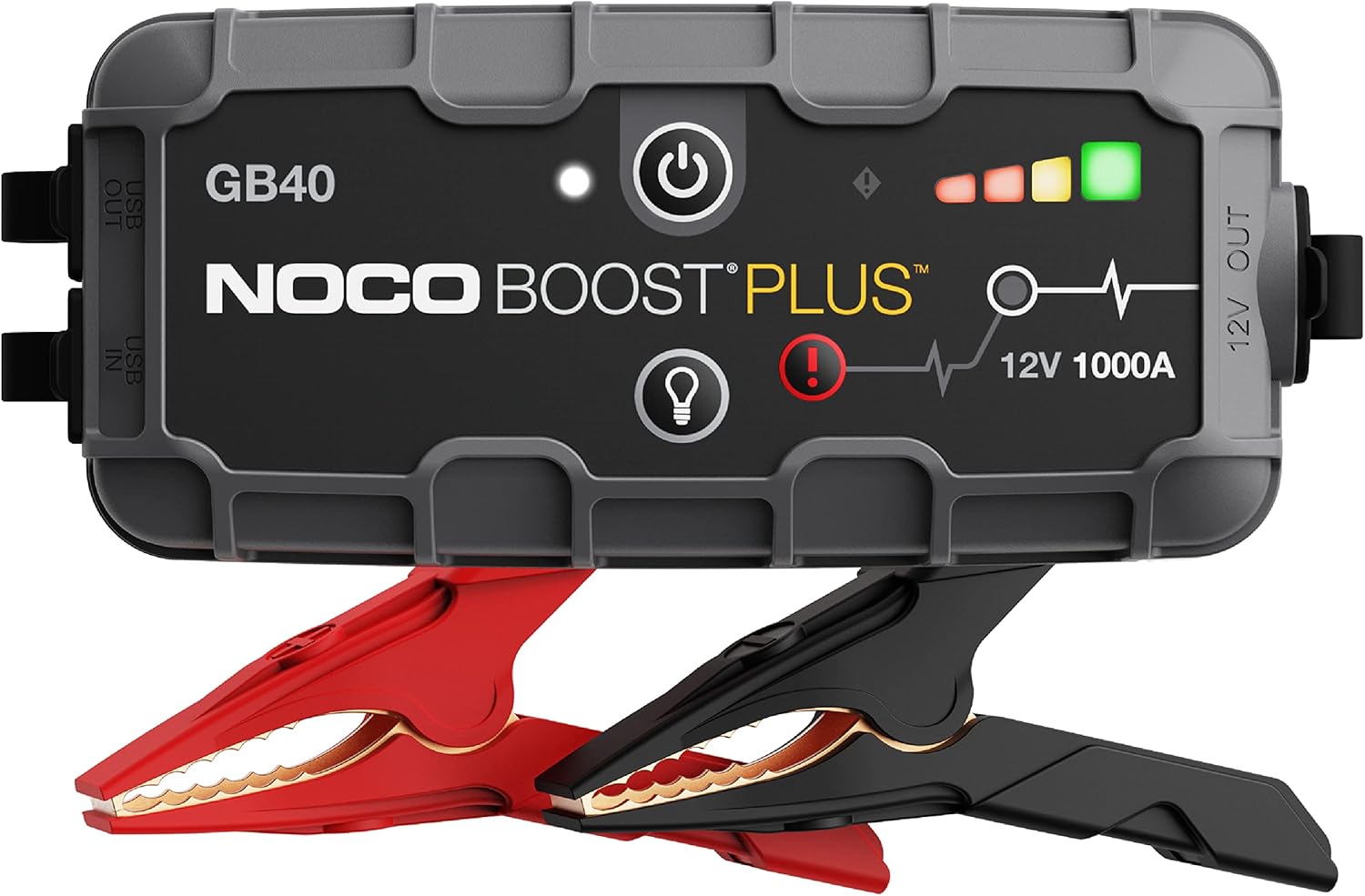
NOCO Boost Plus GB40 Jump Starter
A 1000A lithium jump starter that fits in your glovebox and works on any 12V battery. Your insurance against a dead 12V in a parking lot.
As an Amazon Associate, ThinkEV earns from qualifying purchases — at no extra cost to you.
Regardless of which EV you end up buying, a quality jump starter is worth having in the car, not because EVs die like ICE vehicles, but because 12-volt accessory batteries still fail in cold weather, and having one on hand is straightforward insurance.
What BYD's Arrival Means for the Broader Canadian Market
BYD does not arrive in a vacuum. Their presence changes the competitive environment for every EV brand operating in Canada, and those second-order effects may matter as much as the direct question of whether to buy a BYD.
Canadian EV sales fell 25% in 2025. That decline was driven by a combination of factors: policy uncertainty around rebates, Tesla's brand crisis and the political weight it now carries, interest rate pressure on large purchases, and a general sense among consumers that the transition was moving faster than the infrastructure could support. The market was already under stress before BYD announced a single dealership.
BYD's entry adds a new dynamic. A credible, affordable, well-engineered EV option at $25,000 to $35,000 does not compete primarily with Tesla or Hyundai's upper trims, it competes with the decision to keep your ICE vehicle. The Seagull at $25,000 is not a luxury purchase, it is a practical one. That segment has been almost completely absent from the Canadian market, and its absence has been one of the structural reasons EV adoption has remained concentrated among higher-income households.
If BYD succeeds in Canada, the other manufacturers will respond. They already have in Europe. Volkswagen cut prices. Stellantis accelerated affordable EV development. Hyundai pushed the Inster into new markets. Competition at the bottom of the price range forces the whole market to be more efficient. That is good for Canadian consumers regardless of whether you ever buy a BYD.
The 49,000-vehicle quota is also relevant here. If BYD fills the quota in year one, which seems unlikely but not impossible given the pent-up demand in the affordable segment, there will be pressure on the federal government to revisit the framework. That is a policy pressure point worth watching, particularly if the Canadian auto sector responds by accelerating domestic EV production to compete.
For Ontario specifically, Ford's boycott call creates an awkward dynamic. Ontario has the highest concentration of auto manufacturing jobs in Canada and a government that has been consistently hostile to policies it perceives as threatening that sector. BYD's GTA entry is partly a bet that consumer demand overrides political pressure, which is generally how market entries work. Whether individual Ontario dealers are willing to take on a BYD franchise under that political environment is an open question that will play out over the next 12 months.
The broader EV picture, including what other new brands are planning Canadian launches, is covered in New EV Brands Coming to Canada, which tracks the full pipeline beyond BYD.
The Questions You Should Be Asking Before BYD Opens Its Doors
There is a lot that is not yet known about BYD's Canadian operation, and these are the things to watch as the launch unfolds.
Where exactly will the 20 dealerships be?
GTA first is confirmed directionally, but the specific locations, ownership structures, and service facility sizes matter for anyone evaluating long-term ownership. A dealership in Mississauga is a very different ownership experience than one in Barrie or Oshawa if you need warranty service or a recall addressed.
What are the actual Canadian MSRPs?
Every price figure here is an estimate based on other markets and the tariff structure. BYD has not published Canadian MSRPs. When they do, those numbers will either validate or change the competitive analysis significantly. Watch for official pricing announcements in Q2 or Q3 2026.
What warranty terms are on offer in Canada?
BYD offers competitive warranty terms in other markets, typically 6 to 8 years on the battery and 3 to 5 years on the vehicle. Canadian-specific warranty terms have not been announced. This matters enormously for a brand without an established Canadian reputation. A strong warranty is how you buy confidence from a buyer who is skeptical.
How will BYD handle cold weather?
LFP chemistry and Canadian winters are a known combination with known trade-offs. What matters is whether BYD has done cold-weather-specific engineering for the Canadian market, battery pre-conditioning, cold weather charging behaviour, heat pump integration, and what the real-world winter range figures look like in -20C conditions, not just the nominal range.
Who is doing the service work?
Independent dealers servicing Chinese-brand EVs is a new category in Canada. The technician training pipeline, parts availability, and turnaround time for warranty claims are all unknowns. In the early years of any new brand launch, service quality is inconsistent. Early adopters need to go in with that expectation.
What happens if the political environment shifts?
BYD is launching into a Canada where the federal government changed the tariff framework, but where significant political opposition exists at the provincial level. If a future federal government reverses the tariff arrangement, the ownership experience for BYD buyers gets significantly more complicated in terms of parts supply, resale value, and service infrastructure continuity. This is a low-probability risk but not a zero one, and it is worth factoring into a long-term ownership decision.
Gear worth having
As an Amazon Associate, ThinkEV earns a small commission from qualifying purchases — at no extra cost to you.

PULIDIKI Car Cleaning Gel (Detailing Putty)
Press it into vents, buttons, and seams and it lifts out dust you did not know was there. Weirdly satisfying, genuinely useful.
As an Amazon Associate, ThinkEV earns from qualifying purchases — at no extra cost to you.
Related Reading
- BYD's Canada Lineup: The Four Models, Each model's specs, range, and how they compare to current Canadian options
- What the Tariff Deal Really Means, The full policy breakdown: how the 6.1% rate works, what the quota means, and which other Chinese brands it affects
- Chinese EVs Entering Canada, BYD is not the only one. Here is the full picture of what is coming and when.
- New EV Brands Coming to Canada, The complete pipeline of new manufacturers planning Canadian launches in 2026 and beyond
- Compare EVs, Side-by-side comparison tool for EVs available in Canada, filterable by price, range, and incentive eligibility
Gear worth having
As an Amazon Associate, ThinkEV earns a small commission from qualifying purchases — at no extra cost to you.

WixGear Magnetic Air Vent Phone Mount (2-Pack)
A magnet strong enough that your phone never flinches over potholes or rail crossings. Two in the box, one for each car.
As an Amazon Associate, ThinkEV earns from qualifying purchases — at no extra cost to you.

Founder & Chief Editor
Vlad Pereira is the founder and chief editor of ThinkEV.ca, the Canadian electric-vehicle publication he writes and edits from Courtenay, British Columbia. He covers EV pricing, federal and provincial rebates, charging costs, and the Chinese manufacturers now entering Canada, from the buyer's side rather than the press-fleet side. ThinkEV is a venture of Vlad Pereira Online; his writing on health, income and the long game lives at vladpereira.com.
Frequently asked questions
When will BYD dealerships actually open in Canada?
Do any BYD vehicles qualify for the $5,000 federal EVAP rebate?
Is the "spy vehicle" concern about BYD legitimate?
How does BYD's Blade Battery handle Canadian winters?
Which BYD model makes the most sense for a Canadian buyer?
What happens to BYD resale values in Canada if the political situation changes?
More EV & road-trip finds
Affordable upgrades worth a look — tap any to check the price on Amazon.
 ★ 546
★ 546Funny Headrest Face Covers (2-Pack)
View on Amazon ★ 12,396
K KNODEL Car Trash Can with Lid
View on Amazon ★ 721
★ 72145W USB-C Fast Car Charger
View on Amazon ★ 119
★ 119Foldable Waterproof Trunk Organizer
View on Amazon ★ 392
★ 392Large Cup Holder Adapter (32-40oz)
View on Amazon ★ 8,681
Chemical Guys Complete Car Wash Kit
View on Amazon ★ 537
★ 537USB Star Projector Roof Light
View on Amazon ★ 4,055
6-Speed Manual Shift Knob Display
View on AmazonRead, Plan, Then Stay Current
Explore our expert articles to understand incentives and ownership costs, use the map to pressure-test charging reality, then subscribe so new EV coverage comes straight to you.
Continue Reading
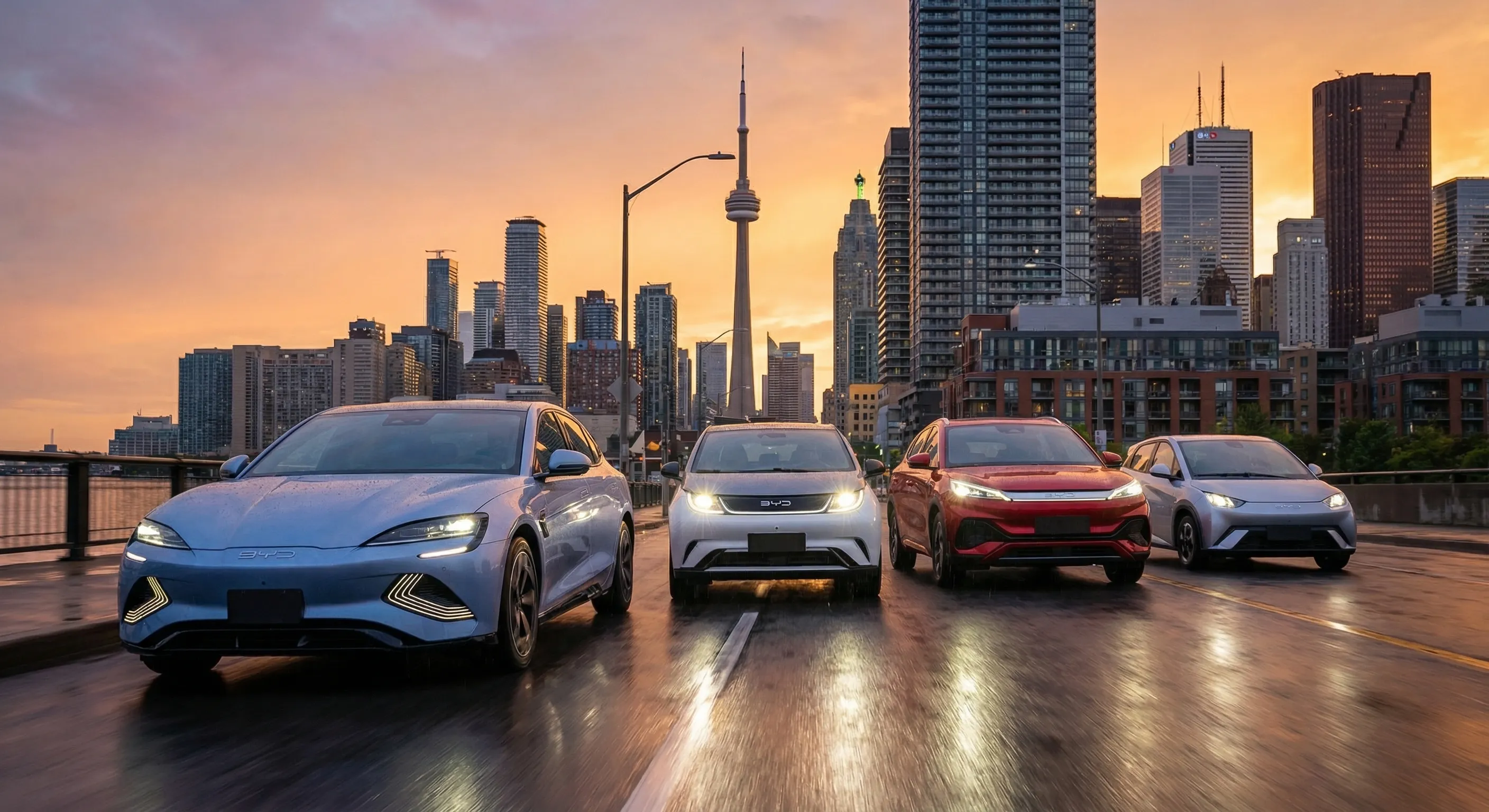
BYD Canada Lineup: The Four Models Coming First
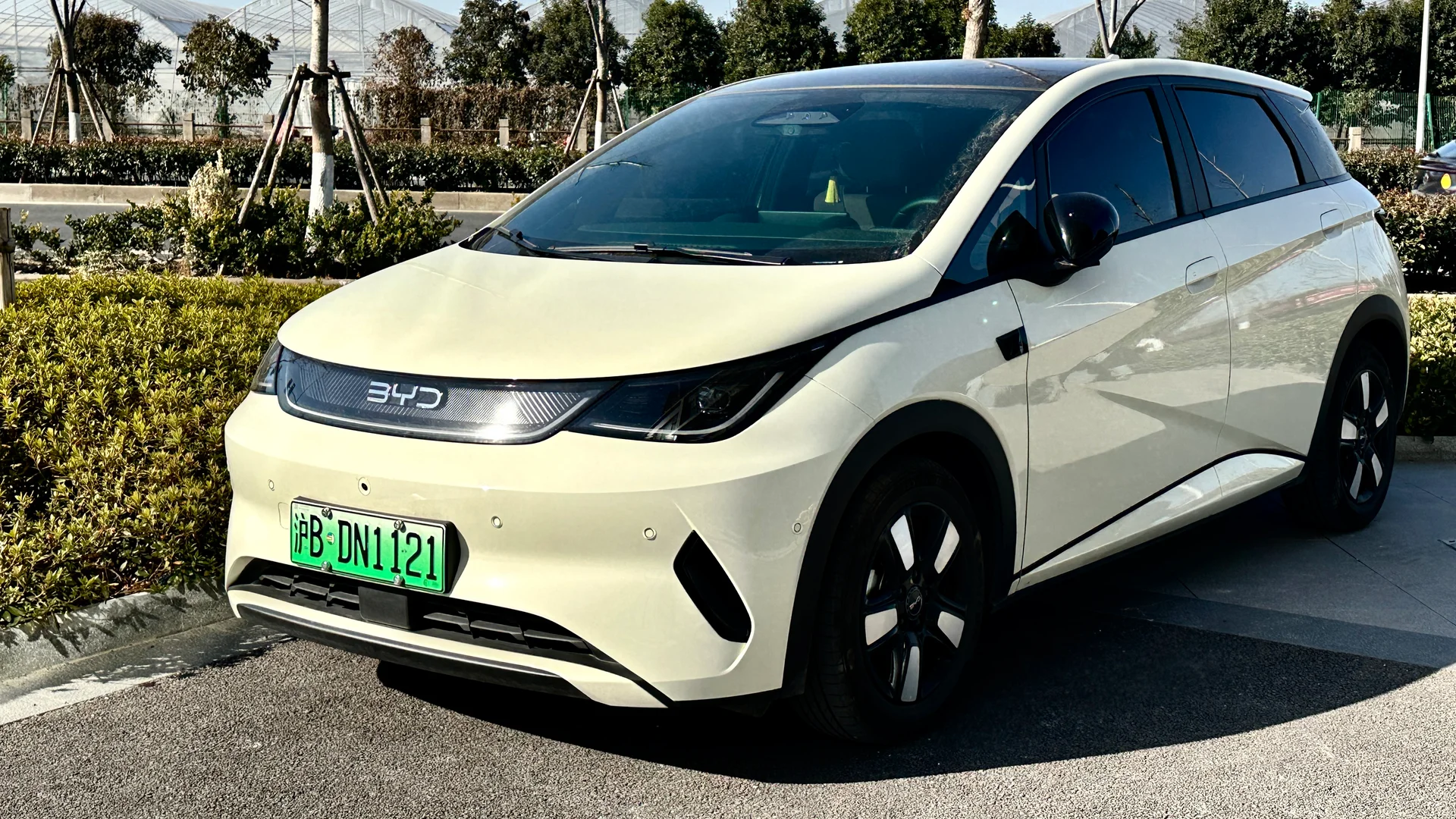
BYD Dolphin Cargo e-Van: What Fleet Buyers Get
Chinese EV Warranties in Canada: BYD, Zeekr, Chery
BYD Blade 2.0 Battery: What 5-Minute Charging Needs
BYD Coming to Canada 2026: Tariff Deal and Pricing