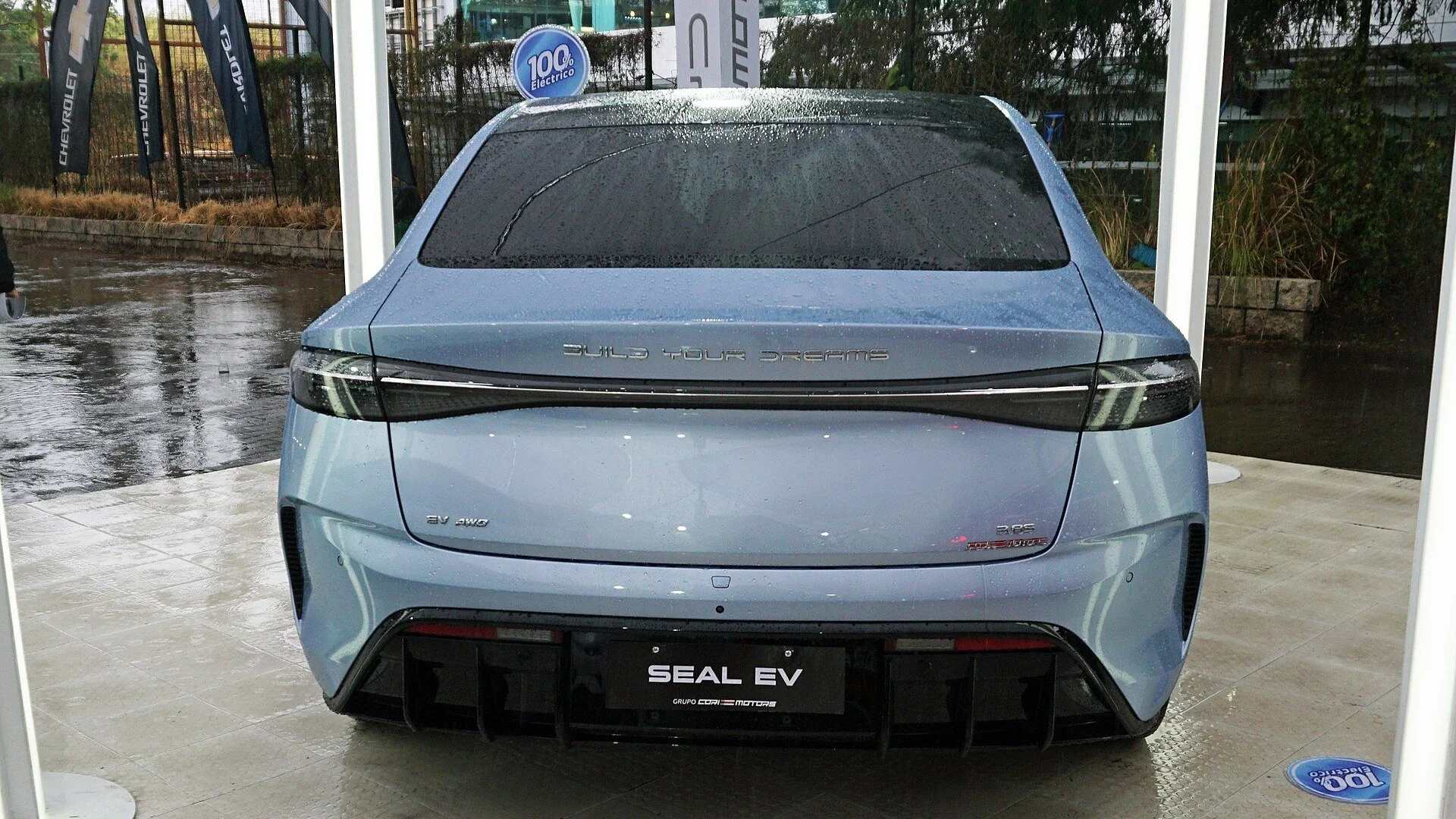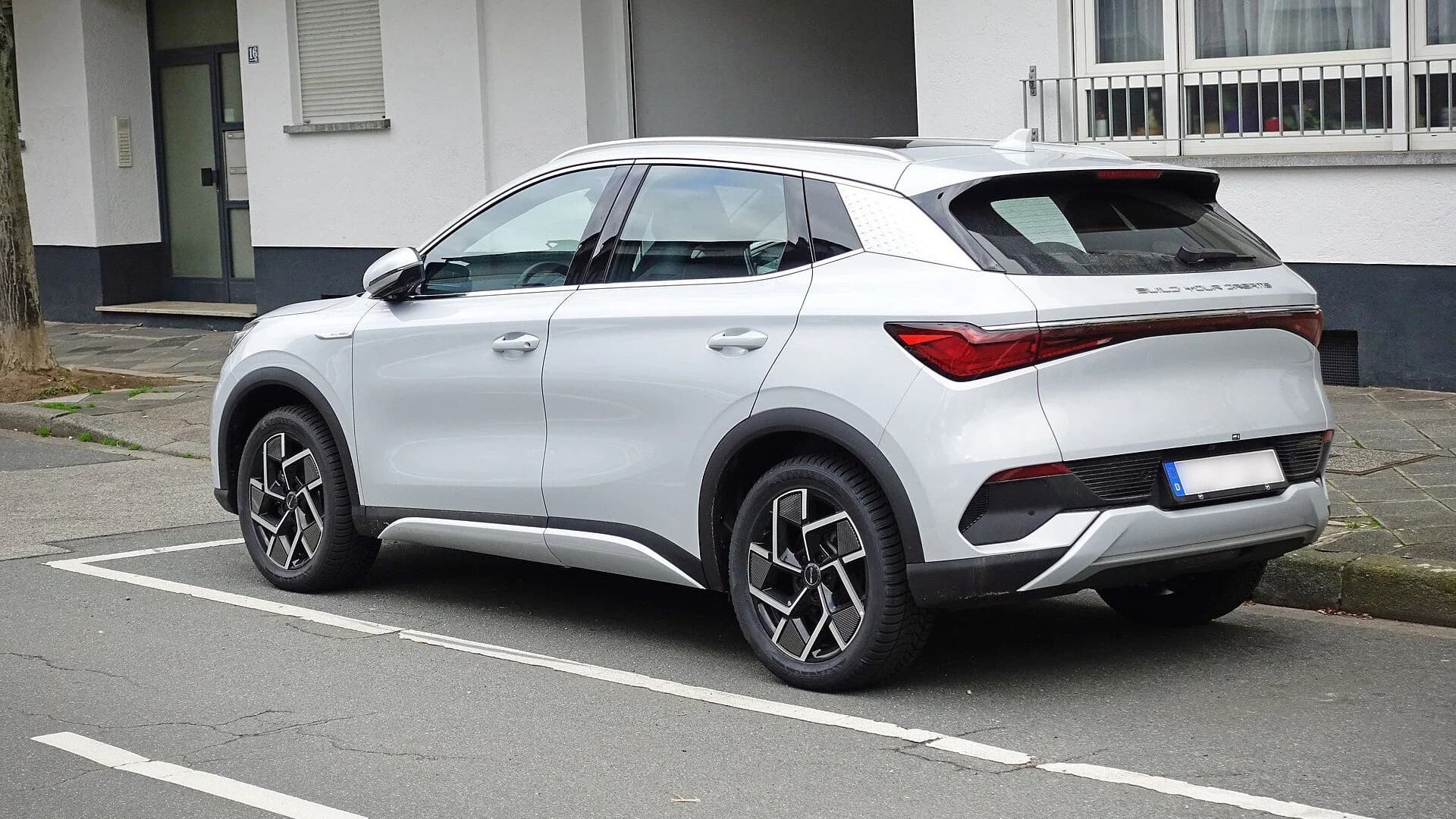
BYD's Atto 3 costs roughly $15,990 USD in China. By the time it reaches a Canadian driveway, that number roughly triples, and the math tells a story about manufacturing philosophy, not just shipping invoices. The defensible Canadian price band sits at $39,000–$42,000 CAD, derived from the Australian market that already runs this exact car under right-hand-drive homologation and an established dealer network.
That triple-up is not a tariff story. The January 16 cut from 100% to 6.1%, the regulatory event that unlocked the Canadian retail math at all, adds only about $1,200 to the landed cost of a $20K vehicle. The rest is structural. BYD does not price the Atto 3 the way Hyundai prices the Kona Electric, and reading the gap as a tariff gap misses what the company is actually doing. The Atto 3's Canadian sticker is a window into how BYD builds margin into every export market it enters, and why that margin architecture, more than any single spec, is the real news in the Chinese EV arrival in Canada.
Key takeaways
- The defensible Canadian price band is $39,000–$42,000 CAD, derived from Australia's established Atto 3 retail market.
- The January 16 tariff cut from 100% to 6.1% adds only ~$1,200 to landed cost, the rest is structural margin.
- BYD's Blade Battery LFP chemistry gives a $1,800–$2,400 cell-cost advantage over the Kona Electric's NCM chemistry.
- The 2026 Atto 3 EVO hits 220 kW DC fast charging and 800V architecture at a price point Hyundai only reaches with the Ioniq 5.
- A standard heat pump across all trims signals BYD's cold-climate engineering priorities, Hyundai charges extra for the same hardware.
What the Australian Price Reveals About BYD's Global Margin Strategy
Australia is the closest available proxy for Canadian pricing, and it is a remarkably clean one. Right-hand-drive, post-tariff equilibrium, a dealer network three years deeper than anything BYD has stood up in North America, and a currency that converts to Canadian dollars almost one-for-one. Applying current exchange rates (1 AUD ≈ 1.040 CAD as of early April 2026) to Australian retail produces the $39,000–$42,000 CAD band that anchors this entire piece. That is not a guess. It is a model with a published method behind it.
The mechanic underneath that band is the part that explains everything else. The Seal carries a 27 per cent margin over its Chinese base in Australia, while the Seagull and Atto 3 both sit closer to 63–64 per cent, and the Dolphin at roughly 43 per cent, differences that reflect segment positioning, shipping costs, and local spec upgrades. BYD does not apply a blanket export markup; it engineers a model-specific one. The Atto 3 carries a heavier markup than the Seal because BYD has decided the compact-SUV segment can absorb it, not because shipping a smaller car costs more per unit.
Read that decision the way an engineer reads a spec sheet. It tells you BYD treats export markets, Canada included, as premium tiers rather than cost-leadership plays. The company has the cost structure to undercut the Kona Electric by ten thousand dollars. It chooses not to. The chosen price respects the segment's price floor while leaving room for variant ladders later. That is the same playbook used in Europe, where buyers can pick up a BYD Atto 3 for €35,000 against a Chinese MSRP roughly a third of that.
The Australian proxy works because Australia is what Canada is about to become: a quota-bound, dealer-thin, right-of-centre EV market with weather and distance problems. If you want to know what BYD will charge here, look at what BYD already charges there, and apply the exchange rate. The number that falls out is uncomfortably specific, but that specificity is the point.
The Blade Battery Is Not Just a Spec, It Is the Business Case
Every conversation about BYD eventually gets to the Blade Battery, and most of them treat it as a safety story. The safety story is real. The business story is bigger. BYD ATTO 3 is positioned to compete with models like the Hyundai Kona Electric and MG4, combining BYD's in-house Blade Battery technology with a focus on practicality, affordability, and updated in-car technology for global markets. The phrase doing the heavy lifting in that sentence is "in-house."
LFP chemistry, lithium iron phosphate, the chemistry the Blade format wraps around, costs less per kilowatt-hour than the nickel-rich NCM chemistry Hyundai uses in the Kona Electric. That delta is roughly $30–40 per kWh at current cell prices. On a 60.5 kWh standard Atto 3, that is somewhere between $1,800 and $2,400 in cell-cost advantage before BYD's vertical integration kicks in. The integration is where the gap widens. Consider the supply chain:
- Hyundai pays LG for cells.
- Kia pays SK On for cells.
- BYD pays BYD for cells, packs, e-axles, and the BMS.
That is the real reason a $39,000 Atto 3 can be profitable in Canada and a $39,000 Kona Electric, configured the same way, cannot. It is not Chinese labour costs. It is not currency manipulation. It is one company that owns the cell, the pack, the e-axle, the BMS, and the assembly line, versus competitors who buy four of those five from somebody else and pay a margin on each.
The 2026 EVO variant pushes this further. BYD addressed earlier charging-speed objections with a 2026 Atto 3 EVO variant approved for Australian sale, featuring an 800-volt architecture, 74.8 kWh battery, 220 kW DC fast charging, and an all-wheel-drive option producing 330 kW. A jump from 87 kW to 220 kW DC charging on a vehicle in this price band is not normal. Hyundai's 800V architecture lives in the Ioniq 5 at twenty thousand dollars north of where the EVO will land. BYD can do it earlier because the cost structure underneath the spec sheet is fundamentally different.
The strategic implication: BYD is not competing on price the way the press release framing suggests. BYD is competing on integration depth, and the price is the visible expression of that depth. Every other manufacturer in this segment is solving a sourcing problem. BYD already solved it ten years ago and is now spending the savings on spec.
Gear worth having
As an Amazon Associate, ThinkEV earns a small commission from qualifying purchases — at no extra cost to you.

ChargePoint Home Flex Level 2 Charger (50A)
Premium 50A / 12 kW charger with the best app ecosystem. Hardwired or NEMA 14-50, with real-time energy tracking and smart scheduling.
As an Amazon Associate, ThinkEV earns from qualifying purchases — at no extra cost to you.
Engineering Philosophy in the Cabin: Where BYD Spends and Where It Doesn't
The Atto 3's cabin reads as a thesis on what Chinese consumer-electronics design assumes about cars. The 12.8-inch rotating touchscreen, yes, the one that pivots between landscape and portrait, is the obvious tell. The DiLink operating system underneath it is the less obvious one. Both treat the dashboard as a smartphone surface, not a traditional automotive HMI. That is a deliberate worldview, and it carries consequences the spec sheet does not list.
The heat pump is standard across trims. In a segment where the Kona Electric still asks Canadian buyers to climb a trim level for the same hardware, that single decision tells you what BYD's engineering priorities look like when they hit a cold-climate market. A heat pump in Quebec winter pays for itself in eighteen months of range preservation. Hyundai knows this. So does Kia. They charge for it anyway because the cost-engineering relationship to their cell suppliers does not give them room to standardize it. BYD has that room.
The suspension and NVH tuning are where the budget visibly stops. Highway-speed wind isolation is segment-average at best. Damping is tuned for urban commute, not for the four-hundred-kilometre Toronto-Ottawa run that any Canadian compact-SUV buyer eventually makes. That is a choice, not a failure. BYD reads its target buyer as a city-dweller with occasional intercity range, exactly the buyer profile that the European and Australian markets validated. Whether that buyer profile maps cleanly onto Canada, where intercity distance is a feature of the geography, is the open question.
Material choices land above segment average:
- Vegan leather across trims, not just the top spec.
- Soft-touch dash surfaces where Hyundai uses hard plastic in the Kona's lower trims.
- Ambient lighting as standard equipment.
- A panoramic glass roof on most configurations.
BYD allocates what an automotive designer would call "perception budget" carefully, the surfaces a buyer touches in the first five minutes of a test drive get the money, and the surfaces nobody notices get value-engineered. The deeper read: BYD has run a study on which luxuries a $40,000 EV buyer prices into their decision and which they ignore once they sit in the seat. The vegan leather and rotating screen are not styling flourishes. They are the line items the company has decided are worth the cost of goods because they convert test drives. The damping budget loses that argument every time.
The cabin, read this way, is not a Chinese knock-off of Korean design. It is a fundamentally different bet about what a $40,000 EV interior should optimize for. The bet may not land identically in Canada as in Sydney. Watching how the first wave of Canadian reviewers respond to the rotating screen will tell you whether the bet generalizes.
Gear worth having
As an Amazon Associate, ThinkEV earns a small commission from qualifying purchases — at no extra cost to you.

WeatherTech FloorLiner for Tesla Model 3
Deep-channel liners that trap every drop of slush and salt. The difference between a ruined interior and a showroom-fresh cabin after a Canadian winter.
As an Amazon Associate, ThinkEV earns from qualifying purchases — at no extra cost to you.
The Tariff Cut Changed the Ceiling, Not the Floor
The January 16 surtax cut gets too much credit in this analysis, and the structural pricing gets too little. Yes, the regulatory shift mattered. Without it, no version of this conversation happens. The 100% surtax is replaced by 6.1% tariff for vehicles within the 49,000 annual quota. But the magnitude of what the cut actually changes in retail math is smaller than the headlines suggest.
At a roughly $20,000 landed cost, the figure that falls out of the Chinese MSRP plus shipping plus pre-tariff duty, the 6.1% replacement adds approximately $1,200. That is a rounding error in a $39,000 sticker. The cut did not create the Atto 3's Canadian price band. The Australian markup pattern created the band. The cut simply removed the regulatory blocker that made the band impossible to reach. Global Affairs Canada published Notice 1162 on February 25, 2026, establishing the quota rules. Import permit applications open March 1, 2026.
What the cut did change is the ceiling. At 100% surtax, BYD's choice was to absorb the differential, destroying margin and the export-pricing discipline that makes the rest of the global model work, or to price the Atto 3 above the Kona Electric and out of the segment it was engineered to win. Neither was viable. The Canadian Atto 3 program did not start until the regulatory math allowed BYD to keep its Australian markup intact. That is the actual unlock.
The 49,000-unit annual quota is the other half of this story, and it deserves more attention than it is getting. Scarcity, even artificial scarcity, sustains price discipline. With a hard cap on how many Chinese-built EVs can enter Canada in a calendar year, BYD has no incentive to discount aggressively to capture share, there is no share to capture beyond the quota. Analysts forecasting a price war in Canadian compact EVs are reading the cost structure correctly and the regulatory environment incorrectly. Canada's January 16 cut from 100% to 6.1% tariff, paired with a 49,000-unit annual quota, is what makes any of this pricing possible. The quota is what keeps the pricing where BYD wants it.
This is why the same tariff math applies to the BYD Shark, and why the Shark's defensible band sits where it does for structurally identical reasons.
Gear worth having
As an Amazon Associate, ThinkEV earns a small commission from qualifying purchases — at no extra cost to you.

Grizzl-E Classic Level 2 EV Charger (40A)
Canadian-made and rated for minus 40C winters. 40A / 9.6 kW, NEMA 14-50, indoor/outdoor, 24-ft cable. The charger built for Canadian weather.
As an Amazon Associate, ThinkEV earns from qualifying purchases — at no extra cost to you.
Comparing the Atto 3 to the Hyundai Kona Electric: Same Price Band, Different Bets
The Hyundai Kona Electric is the comparison that matters, and not because the cars are similar. They are similar in segment and price. They are not similar in design intent. The 2026 Kona Electric starts near $44,000 CAD and qualifies for the federal EVAP rebate. The Atto 3 does not qualify for the $5,000 federal EVAP rebate since it's manufactured in China. That single regulatory line item closes the headline price gap between the two vehicles to about $3,000, a much narrower margin than the sticker comparison implies.
In Quebec, the gap narrows further. In Quebec, the $2,000 Roulez vert rebate could bring the price as low as $27,990. That figure is from a narrower pricing reading anchored on a sub-$30K base; in the $39,000–$42,000 band this piece is anchoring to the Australian proxy, the Quebec-net price lands at roughly $37,000–$40,000 instead. The Kona Electric, with EVAP plus Roulez vert, lands around $37,000 in the same province. The two cars converge to within a thousand dollars net of incentive, and at that point, the buyer's decision stops being about price and starts being about everything else.
Everything else is where the engineering bets diverge. The Kona Electric, in its higher trims, runs an 800V-capable architecture that pushes DC charging toward 350 kW peak. The standard Atto 3 caps at 87 kW. On the Toronto-Montreal run, that is the difference between a twenty-five-minute charging stop and a fifty-minute one. Hyundai bet that charging speed is the long-term retention tool. BYD bet that buyers will accept slower charging for an integrated battery the manufacturer fully owns, and that the EVO variant, when it arrives, will close the charging gap.
Both bets are defensible. Both will be tested in Canadian winters, where charging speed compounds with thermal management and the gap between an 800V and a 400V architecture stops being theoretical. The deeper comparison lives in the full Atto 3 versus Kona Electric breakdown, but the headline read is this: same price band, two genuinely different theories of what the next decade of compact EV ownership looks like. For shoppers also cross-shopping the Tesla side of this segment, the Model 3 Standard Range comparison sits adjacent to where the EVO variant will eventually land.
Gear worth having
As an Amazon Associate, ThinkEV earns a small commission from qualifying purchases — at no extra cost to you.

PULIDIKI Car Cleaning Gel (Detailing Putty)
Press it into vents, buttons, and seams and it lifts out dust you did not know was there. Weirdly satisfying, genuinely useful.
As an Amazon Associate, ThinkEV earns from qualifying purchases — at no extra cost to you.
What the Atto 3 EVO Variant Signals About BYD's Canadian Ambitions
The 2026 Atto 3 EVO, 74.8 kWh, 800V architecture, 220 kW DC fast charging, optional all-wheel-drive producing 330 kW, does not exist in a vacuum. It exists because BYD's standard Atto 3 has charging-speed objections in every market it enters, and BYD has decided to answer those objections with hardware rather than discount the base car. The EVO is the answer. The Australian homologation is the rehearsal.
Canadian arrival timing for the EVO is the more interesting question. The regulatory work for the standard Atto 3, Transport Canada approval, daytime running lights to Canadian spec, bumper height, the entire homologation file, is most of the cost. Adding the EVO variant on top of an approved base car is incremental. BYD's European rollout sequence, launch base, follow with performance variant within eighteen months, is the template. Import permit applications open March 1, 2026. The timeline is accelerating. BYD is coming to Canada.
EVO pricing in Canada, on the same Australian-proxy methodology, would likely land $5,000–$8,000 above the standard variant. That puts the EVO into the $44,000–$50,000 band, directly against the Tesla Model 3 Standard Range and the higher Kona Electric trims. At that price, the conversation shifts from "Chinese EV value play" to "premium compact EV with a vertically integrated battery story." That is a much harder pitch, and it is the pitch BYD has been quietly preparing for since the Australian launch. For Canadian buyers weighing the wider Chinese-brand landscape, the new EVs entering the Canadian market is where this comparison plays out in practice.
The Atto 3's Canadian price band, $39,000–$42,000, is the visible number. The strategy behind it is the part to track closely. BYD did not pick this band to win a price war. BYD picked it to install a margin discipline that survives quota expansion, dealer growth, and the inevitable variant ladder. The number to watch is not what the Atto 3 lists at on launch day. It is whether BYD holds that number eighteen months later when the EVO arrives and the standard variant could theoretically discount. If the standard holds, BYD's Canadian strategy is working exactly as designed. If it cracks, the press-release framing about cost leadership turns out to have been right after all.
Bottom line: bet on the band holding. Watch the EVO launch timing as the leading indicator. And read the next BYD model that lands in Canada, Seal, Dolphin, Sealion, through the same Australian-markup lens, because the pattern is the company.
Gear worth having
As an Amazon Associate, ThinkEV earns a small commission from qualifying purchases — at no extra cost to you.

WixGear Magnetic Air Vent Phone Mount (2-Pack)
A magnet strong enough that your phone never flinches over potholes or rail crossings. Two in the box, one for each car.
As an Amazon Associate, ThinkEV earns from qualifying purchases — at no extra cost to you.

Founder & Chief Editor
Vlad Pereira is the founder and chief editor of ThinkEV.ca, the Canadian electric-vehicle publication he writes and edits from Courtenay, British Columbia. He covers EV pricing, federal and provincial rebates, charging costs, and the Chinese manufacturers now entering Canada, from the buyer's side rather than the press-fleet side. ThinkEV is a venture of Vlad Pereira Online; his writing on health, income and the long game lives at vladpereira.com.
Frequently asked questions
Does the $39,000–$42,000 band include federal incentives?
Why is the Atto 3's markup higher than the BYD Seal's?
Will the 800V EVO variant cost more in Canada?
Is LFP chemistry actually worse in Canadian winters?
Could BYD undercut this price band if competition forces it?
More EV & road-trip finds
Affordable upgrades worth a look — tap any to check the price on Amazon.
 ★ 1,349
Cool Swinging Duck Dashboard Ornament
View on Amazon ★ 12,396
K KNODEL Car Trash Can with Lid
View on Amazon ★ 1,866
70mai A810 4K Dual Dash Cam
View on Amazon ★ 121
★ 121Foldable Windshield Sun Umbrella
View on Amazon ★ 392
★ 392Large Cup Holder Adapter (32-40oz)
View on Amazon ★ 2,941
Microfiber Cleaning Cloths (Multi-Pack)
View on Amazon ★ 419
★ 419RGB Car Interior LED Strip Light
View on Amazon ★ 1,083
Crystal Push-Start Button Ring (2-Pack)
View on AmazonRead, Plan, Then Stay Current
Explore our expert articles to understand incentives and ownership costs, use the map to pressure-test charging reality, then subscribe so new EV coverage comes straight to you.
Continue Reading
BYD Atto 3 Canada: Price, Range & EVAP Rebate (2026)
BYD in Canada: What You Can Buy and What It Costs
BYD Shark 6 Price in Canada: $55K–$62K Estimate, Explained
BYD Shark 6 Canada 2026: Price Band, Specs, Incentive Reality
Are Canada's Repair Shops Ready for Chinese EVs?