Key takeaways
- This is a $66,000-versus-$54,990 decision.
- The $11,000 price gap between these two cars is difficult to justify on pure economics.
- There's no federal rebate to soften the blow, both exceed the $50,000 EVAP cap.
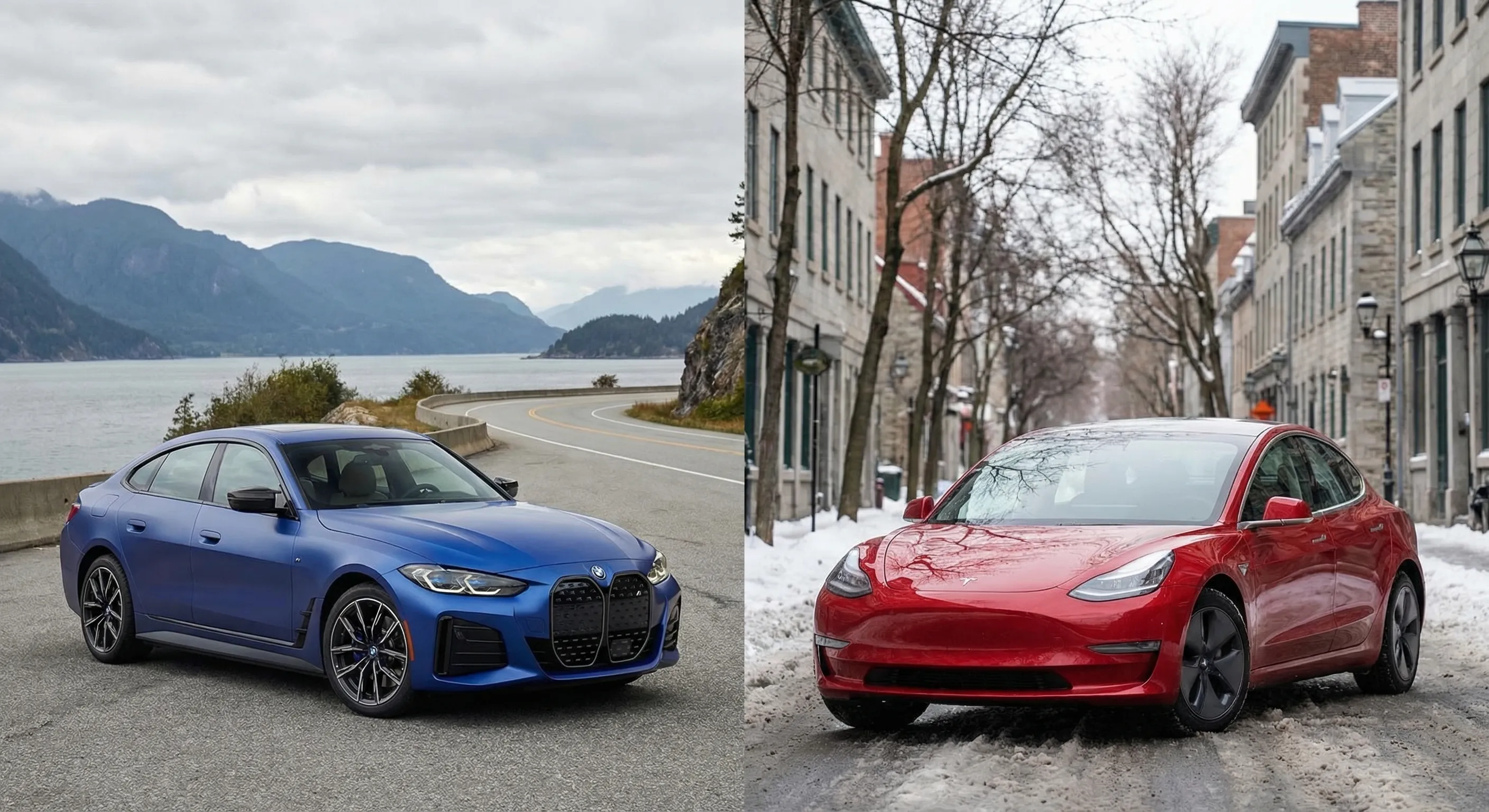
This is a $66,000-versus-$54,990 decision. Two electric sedans. Two fundamentally different philosophies about what a car should be. One is built by a Bavarian company that has spent a century refining the relationship between driver, steering wheel, and road. The other is built by a Silicon Valley company that thinks the steering wheel is a legacy interface it will eventually eliminate. Both are excellent. Only one is the right car for most Canadian buyers.
The BMW i4 and the Tesla Model 3 Long Range sit in the same segment, the electric luxury sedan, but they arrive at that segment from opposite directions. BMW started with a driving machine and electrified it. Tesla started with a technology platform and shaped it into a car. That philosophical gap defines every meaningful difference between them: how they drive, how they charge, how they age, and what they cost you over five years of Canadian ownership.
The $11,000 price gap between these two cars is difficult to justify on pure economics. There's no federal rebate to soften the blow, both exceed the $50,000 EVAP cap. The i4 has shorter range. Its charging network is less reliable. Its technology evolves slower. On paper, the Model 3 wins four out of five major buying categories. But "on paper" has never been the whole story with BMW, and it isn't here either.
This comparison covers pricing and total ownership cost, range and battery technology, charging infrastructure across Canada, driving dynamics, interior and tech ecosystems, winter performance, warranty and service access, and driver-assist systems.
DECISION FRAME
For most Canadian buyers, the Tesla Model 3 is the better buy. It's $11,000 cheaper, has longer range, and sits on the most capable charging network in the country. The i4 is a genuinely excellent car, but you're paying a significant premium for driving dynamics and brand prestige, not for practicality.
- Buy the Model 3 if you want range, charging convenience, and tech that updates itself
- Buy the i4 if you prioritize chassis feel, BMW's interior quality, and a more traditional luxury experience, and you can afford the gap
Both cars exceed the $50,000 federal EVAP rebate cap, so neither gets the $5,000 credit. That makes the $11,000 price difference between the i4 ($66,000) and the Model 3 Long Range ($54,990) even more significant, there's no rebate to soften it.
In monthly terms: over a 60-month finance at 6.5% (a representative rate for 2026), the i4 eDrive40 costs roughly $1,290/month. The Model 3 Long Range comes in around $1,075/month. That's a $215/month difference, or about $2,580/year, flowing straight from your bank account into BMW's brand equity. Over the full term, the i4 buyer pays approximately $12,900 more in total payments, factoring in interest. For some buyers, that buys a superior driving experience they value every single day. For others, it's $12,900 that could have gone toward a home charger installation, winter tires, and three years of electricity.
On range, the Model 3 wins again: 507–629 km versus the i4's 435–590 km (Natural Resources Canada). That's a real-world difference on a cross-country drive through Ontario or BC, where charger spacing matters.
The depreciation picture adds another dimension. Tesla vehicles have historically held their value better than most EVs in the Canadian market, though the gap has narrowed. The i4's depreciation curve is steeper, luxury European EVs tend to lose 40-50% of their value in the first three years, compared to 30-40% for the Model 3. If you're planning to sell or trade in at the three-year mark, the Model 3 owner is likely sitting on $5,000-$8,000 more equity. That's not a small number.
Who is each car really for? The Model 3 buyer is someone who sees a car as a technology appliance that should be efficient, connected, and constantly improving. They don't need the car to validate their taste, they want it to solve the transportation problem better than anything else on the road. The i4 buyer is someone who sees a car as an experience. They want to feel the road through the steering wheel, sit in materials that feel expensive because they are, and drive something that communicates "I chose this deliberately" to anyone who knows cars. Both are valid. Neither is wrong. But only one of them is also the rational financial choice.
PRICE AND VALUE
Winner: Tesla Model 3, $11,000 cheaper at the most comparable trim, better residual value, and lower total ownership cost over five years.
Full trim lineups and what you're actually paying at each level:
BMW i4 trim breakdown (2026 Canadian MSRP):
- eDrive35: ~$56,000-435 km range, RWD, 286 hp, 0-100 km/h in ~5.7 seconds. The entry point. Respectable range, but 435 km shrinks fast in a Canadian winter. This is the trim most cross-shoppers will look at but few will buy, the eDrive40's range bump is too compelling to ignore.
- eDrive40: $66,000-590 km range, RWD, 340 hp, 0-100 km/h in ~5.6 seconds.
The volume seller. This is the i4 that competes directly with the Model 3 Long Range, and it's the one this comparison centres on. The 590 km range is genuinely competitive, though it costs $11,000 more to get there.
- xDrive40: ~$69,000-510 km range, AWD, 401 hp. The winter warrior. AWD comes at a 80 km range penalty, which is the typical trade-off.
Worth it if you live somewhere that gets serious snow and you refuse to run winter tires (though you should run winter tires regardless).
- M50: ~$86,000-475 km range, AWD, 544 hp, 0-100 km/h in 3.9 seconds. The performance trim. Absurdly quick, beautifully appointed, and $31,000 more than a Model 3 Long Range. At this price, you're shopping against the Model 3 Performance and several other competitors entirely.
Tesla Model 3 (2026 Canadian pricing):
- Long Range AWD: $54,990-629 km range, AWD, 346 hp, 0-100 km/h in 4.4 seconds. This is the trim. AWD standard, longest range in the segment, and the price undercuts even the cheapest i4 by $1,000. The Highland refresh brought a better interior, rear screen, and improved NVH, it's a substantially better car than the pre-refresh Model 3.
Neither car qualifies for the federal iZEV/EVAP rebate. The $50,000 MSRP cap eliminates both. Some provinces offer their own incentives, Quebec's Roulez vert program, for instance, has its own thresholds, but at the federal level, you're paying full sticker on both cars. This is worth emphasizing because it makes the price gap entirely real. There's no rebate math to close the distance.
Lease comparison: BMW typically offers more competitive lease rates than Tesla, partly because BMW Financial Services is a mature operation with decades of residual value modelling. A 48-month lease on the i4 eDrive40 might land around $850-$950/month with $5,000 down. The Model 3 Long Range leases through Tesla Financial at roughly $700-$800/month with similar down payment. The monthly gap narrows on a lease versus a purchase, but it doesn't close.
Five-year total cost of ownership (estimated):
- BMW i4 eDrive40: $66,000 purchase + $4,000-$6,000 maintenance + $3,600-$6,000 charging + $6,000-$8,000 insurance premium over Model 3 baseline = approximately $83,000-$90,000 total outlay before resale. Resale at 5 years: ~$26,000-$33,000. Net cost: ~$57,000-$64,000.
- Tesla Model 3 LR: $54,990 purchase + $2,500-$4,000 maintenance + $3,000-$5,000 charging + insurance baseline = approximately $64,000-$68,000 total outlay before resale. Resale at 5 years: ~$27,000-$33,000. Net cost: ~$31,000-$41,000.
The five-year ownership cost gap ranges from $16,000 to $33,000 in the Model 3's favour. That's not a rounding error. That's a used car. The i4 buyer needs to genuinely love the driving experience enough to justify that delta, and some buyers absolutely will.
Insurance note: BMW i4 insurance premiums in Canada typically run 10-15% higher than the Model 3. The reasons are predictable: higher MSRP, more expensive parts, fewer independent shops equipped to service BMW EVs. In Ontario, expect $2,400-$3,200/year for the i4 versus $2,000-$2,800/year for the Model 3, depending on your driving record and postal code.
RANGE AND BATTERY
Winner: Tesla Model 3, 629 km rated range beats the i4 eDrive40's 590 km, with better real-world efficiency and a larger effective range in winter conditions.
Both cars use NMC (nickel-manganese-cobalt) lithium-ion battery chemistry. The i4 carries an 83.9 kWh gross battery (approximately 80.7 kWh usable). The Model 3 Long Range packs 82 kWh. Despite the slightly smaller battery, the Model 3 extracts more range, 629 km versus 590 km for the eDrive40. That's a testament to Tesla's efficiency advantage. The Model 3 uses approximately 13.0 kWh/100 km versus the i4's 14.1 kWh/100 km. It's not a dramatic gap, but over hundreds of thousands of kilometres, it adds up in charging costs and convenience.
NRCan-rated ranges by trim:
- i4 eDrive35: 435 km (smaller 66 kWh battery)
- i4 eDrive40: 590 km
- i4 xDrive40: 510 km (AWD penalty)
- i4 M50: 475 km (power penalty)
- Model 3 Long Range AWD: 629 km
Real-world range, summer (15-25°C): Expect roughly 85-90% of rated range in mixed driving conditions. The i4 eDrive40 will deliver approximately 500-530 km. The Model 3 Long Range will deliver approximately 535-565 km. Both are more than adequate for daily driving and most inter-city trips in southern Canada. A Toronto-to-Ottawa drive (450 km) is comfortably one-charge territory for either car in summer.
Real-world range, winter (-15 to -25°C): This is where the conversation gets serious for Canadian buyers. Cold weather reduces EV range by 25-40%, depending on temperature, cabin heating demand, and driving style. In a Prairie winter at -25°C:
- i4 eDrive40: expect 350-440 km of real range
- Model 3 Long Range: expect 375-470 km of real range
The Model 3's efficiency advantage compounds in winter. Its heat pump system is more mature (Tesla has been iterating on heat pump design since the Model Y launch), and its cabin heating draws slightly less from the battery at equivalent comfort levels. The i4 also has a heat pump, and BMW's implementation is competent, but Tesla's thermal management system is a generation ahead in optimization.
Highway range: Both cars lose range at sustained highway speeds, as aerodynamic drag increases exponentially with velocity. At a steady 120 km/h on the Trans-Canada:
- i4 eDrive40: approximately 440-480 km
- Model 3 Long Range: approximately 480-520 km
The Model 3's lower drag coefficient (0.219 Cd for the Highland refresh versus the i4's 0.24 Cd) matters at highway speed. It's a 10% difference in aerodynamic drag, which translates directly to range.
Battery degradation: Both NMC chemistries degrade at roughly similar rates. Expect 5-8% capacity loss over the first 100,000 km, then a slower decline. Tesla publishes more degradation data through its fleet telemetry, and the numbers are reassuring, most Model 3 batteries retain over 90% capacity at 200,000 km. BMW doesn't publish equivalent fleet data, but third-party tracking from services like Recurrent shows comparable degradation curves for the i4. Neither car will leave you stranded by battery degradation within the warranty period.
The range verdict: The Model 3 wins on rated range, real-world range, winter range, and highway range. It does this with a slightly smaller battery, which means it's simply more efficient. For a Canadian buyer who drives long distances or lives in a cold climate, which is most Canadian buyers, the range advantage is meaningful every single day.
CHARGING
Winner: Tesla Model 3, faster peak charging, vastly superior network coverage, and the most reliable public charging infrastructure in Canada.
DC fast charging specs:
- BMW i4: 200 kW peak DC charging via CCS (Combined Charging System). 10-80% in approximately 31 minutes under optimal conditions.
- Tesla Model 3 Long Range: 250 kW peak via Supercharger (NACS connector). 10-80% in approximately 25 minutes under optimal conditions.
That's a 6-minute difference at peak rates, which matters less than you'd think at a single charging stop. What matters enormously is the network behind the connector.
Supercharger network in Canada: Tesla operates over 800 Supercharger stalls across Canada, concentrated along major corridors: the Trans-Canada through BC and Alberta, the 401 corridor in Ontario, the 20/40 through Quebec, and the Halifax-to-Moncton corridor in the Maritimes. Supercharger uptime averages above 95%. When you pull into a Supercharger station, the chargers work. They're fast. They're priced transparently. The car's navigation routes you through them automatically with preconditioned battery temperatures for optimal charging speed. It remains the most reliable EV charging network in North America.
CCS charging in Canada (Electrify Canada and third-party): The i4 charges on the CCS network, which includes Electrify Canada, Petro-Canada, Flo, ChargePoint, and various municipal and provincial networks. The coverage is expanding, but it remains meaningfully thinner than the Supercharger network, especially between major cities. Electrify Canada has stations along the Trans-Canada, but gaps exist, particularly in northern Ontario, rural Quebec, and the Prairie provinces outside the Calgary-Edmonton corridor.
Reliability is the bigger issue. CCS network reliability varies widely. Electrify Canada stations sometimes have offline chargers, software glitches, or payment processing failures. Third-party networks are less consistent still. The experience of pulling into a CCS station and finding two of four chargers out of service is common enough to be a genuine planning consideration for i4 owners doing long-distance drives.
Gear worth having
As an Amazon Associate, ThinkEV earns a small commission from qualifying purchases — at no extra cost to you.
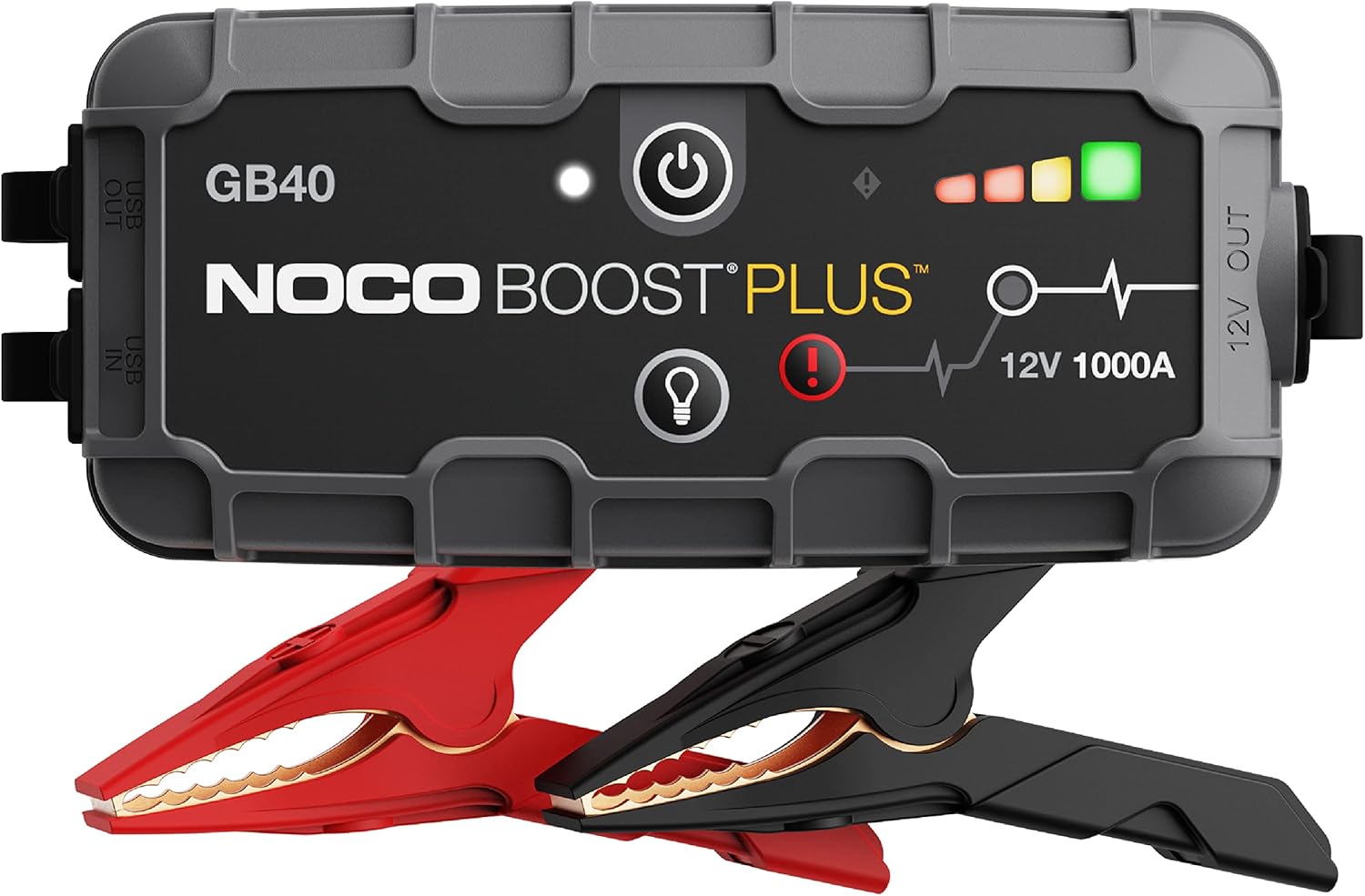
NOCO Boost Plus GB40 Jump Starter
A 1000A lithium jump starter that fits in your glovebox and works on any 12V battery. Your insurance against a dead 12V in a parking lot.
As an Amazon Associate, ThinkEV earns from qualifying purchases — at no extra cost to you.
Home charging: Both cars charge identically at home on a Level 2 (240V) EVSE. A 48-amp Level 2 charger delivers approximately 11.5 kW, which adds roughly 55-60 km of range per hour. Both cars will charge from near-empty to full overnight, approximately 8-10 hours for a full charge. Monthly home charging costs depend on your provincial electricity rate:
- British Columbia (BC Hydro Step 1): ~$0.10/kWh, approximately $30-$35/month for average driving
- Ontario (off-peak TOU): ~$0.076/kWh, approximately $25-$30/month
- Quebec (Hydro-Québec): ~$0.075/kWh, approximately $24-$28/month
- Alberta (regulated rate): ~$0.13-$0.17/kWh, approximately $40-$55/month
- Saskatchewan (SaskPower): ~$0.18/kWh, approximately $50-$60/month
A good Level 2 home charger costs $600-$900 installed. Ninety percent of charging happens at home, and home electricity is always cheaper than public charging. The Grizzl-E Level 2 is the top recommendation for Canadian conditions: built for -30°C operation, NEMA 4 rated for outdoor installation, and Canadian-designed.
Public charging costs: Supercharger pricing in Canada ranges from $0.39-$0.55/kWh depending on location. Electrify Canada charges $0.32-$0.49/kWh for DC fast charging, with membership discounts available. On a per-kilometre basis, the Model 3's superior efficiency means it costs slightly less to charge even at equivalent per-kWh pricing. Over a year of mixed home and public charging, expect to spend $600-$1,200 on electricity for either car, roughly $2,000-$2,500/year less than fuelling a comparable gas-powered luxury sedan like the BMW 3 Series.
The charging verdict: The Model 3's Supercharger advantage isn't just about speed, it's about reliability, coverage, and the confidence that comes from knowing you can drive anywhere in Canada without worrying about whether the charger at your next stop will actually work. The i4's CCS charging is adequate for daily use with home charging, but it's a genuine limitation for long-distance travel.
DRIVING
Winner: BMW i4, superior chassis tuning, steering feel, suspension calibration, and overall driving engagement that justifies the luxury sedan label.
This is where the i4 earns its price premium. BMW's rear-wheel-drive setup gives the i4 a precision and balance that the Model 3 simply doesn't match. On a winding stretch of highway, the Coquihalla, the 148 through the Laurentians, the i4 communicates through the wheel and chassis in a way that feels intentional and connected. The suspension is tuned for comfort without going numb. The steering wheel is a tactile, weighted instrument, not a screen-mounted afterthought.
The i4 eDrive35 hits 0–100 km/h in under 6 seconds. The Model 3 Long Range does it in around 4.4 seconds, it's quicker. But raw acceleration isn't the whole story. The Model 3's power delivery is smooth and strong; it's a fast car. The i4's strength is how that speed arrives, progressive, confidence-inspiring, with real chassis communication underneath.
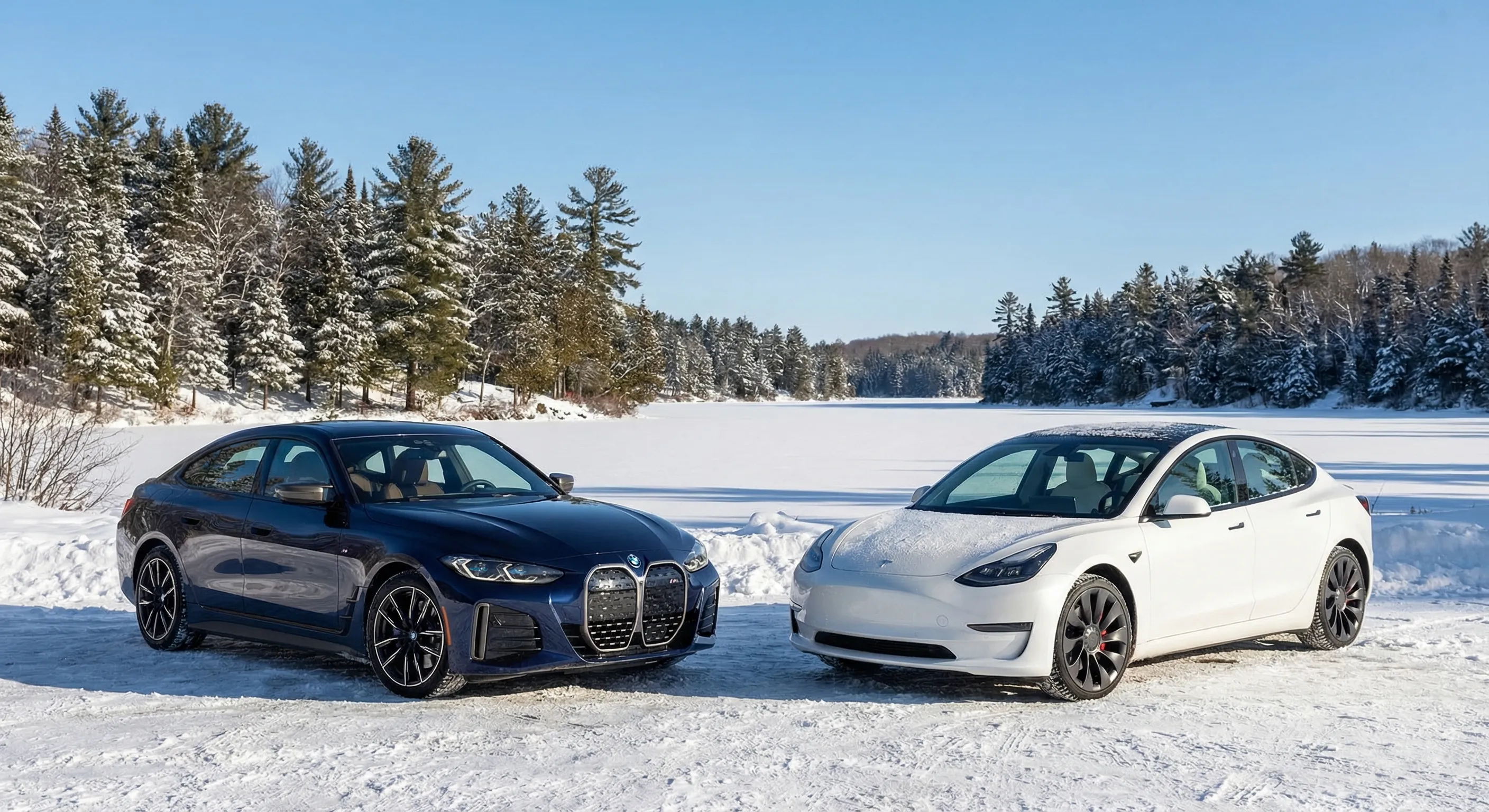
Steering feel: The i4's steering rack is beautifully calibrated. There's genuine weight and feedback at centre, and it builds progressively as you turn in. You can feel the front tires loading through the wheel rim. This is the BMW heritage, decades of engineering focused on the connection between your hands and the contact patch. The Model 3's steering is accurate and responsive, but it lacks that last layer of tactile communication. It tells you where the wheels are pointed; the i4 tells you what the road surface is doing under them.
Suspension and ride quality: BMW tuned the i4's suspension for the dual mandate of comfort and control. On smooth pavement, it absorbs imperfections quietly. Over rough Canadian surfaces, the frost-heaved secondary highways of northern Ontario, the potholed streets of Montreal, the i4 manages to stay composed without crashing through bumps. The Model 3 Highland improved ride quality significantly over the pre-refresh car, but it still transmits more road harshness into the cabin. On a scale of luxury comfort, the i4 sits half a notch above.
Cornering: Put both cars through a series of curves and the difference becomes undeniable. The i4 rotates around its centre of gravity with confidence. The rear-drive layout gives it a natural balance, turn-in is immediate, mid-corner grip is predictable, and the transition from braking to cornering to acceleration flows naturally. The Model 3 corners well, too, its low centre of gravity and rigid structure make it more capable than most sedans. But the BMW is involving in a way the Tesla isn't. It's the difference between a car that handles well and a car that communicates.
Highway comfort: Both cars are excellent highway cruisers. The i4 is quieter at 120 km/h, BMW's sound insulation is thicker and more comprehensive, with acoustic glass and additional cabin damping. Wind noise is minimal. Road noise is well-controlled. The Model 3 Highland improved NVH substantially, and it's no longer the noisy cabin that earlier versions were, but the i4 still wins on highway refinement. On a five-hour drive from Toronto to Sudbury, you'll arrive less fatigued in the i4.
Canadian road conditions: Canadian roads test a car's suspension in ways that European test tracks don't prepare for. Construction zones, seasonal frost damage, gravel shoulders, railway crossings, the i4 handles all of it with composure. Its adaptive suspension (available on higher trims) is particularly good at managing the transition between smooth highway and rough secondary road. The Model 3 is perfectly capable on Canadian roads, but it doesn't insulate you from the imperfections as effectively.
Regenerative braking: Both cars offer one-pedal driving with strong regenerative braking. The i4's regen is smooth and progressive; the Model 3's is slightly more aggressive in its default setting, though both can be adjusted. For winter driving, moderate regen is preferable, aggressive regen on ice can unsettle the rear wheels. Both cars allow you to dial it back.
In Canadian winter conditions, the i4's available all-wheel-drive trim is a genuine advantage on icy roads in Alberta or Quebec. The Model 3 Long Range also offers AWD, so neither car has a monopoly on winter capability, but BMW's chassis tuning gives the i4 more predictable behaviour at the limit.
If driving feel is your primary reason for buying a luxury sedan, the i4 is the right car. The Model 3 is faster in a straight line. The i4 is better in every other driving dimension. That's not marketing, it's engineering heritage versus engineering disruption, and in this specific category, heritage wins.
INTERIOR AND TECHNOLOGY
Winner: BMW i4, superior materials, physical controls, Apple CarPlay support, and a more driver-centric cabin layout.
The i4's interior is a place you want to spend time. BMW uses high-quality leather (or excellent synthetic alternatives), real metal trim, and soft-touch surfaces throughout the cabin. The seats are supportive and comfortable on long drives, bolstered enough for spirited driving, cushioned enough for a five-hour highway haul. The driving position is lower and more traditional than the Model 3's, which contributes to the connected feel.
Gear worth having
As an Amazon Associate, ThinkEV earns a small commission from qualifying purchases — at no extra cost to you.

Grizzl-E Classic Level 2 EV Charger (40A)
Canadian-made and rated for minus 40C winters. 40A / 9.6 kW, NEMA 14-50, indoor/outdoor, 24-ft cable. The charger built for Canadian weather.
As an Amazon Associate, ThinkEV earns from qualifying purchases — at no extra cost to you.
BMW iDrive 8.5 vs Tesla's UI: The i4 runs iDrive 8.5, displayed across a curved panel that combines a 14.9-inch infotainment screen with a 12.3-inch digital instrument cluster. The interface is clean, well-organized, and responsive. Voice control works well for navigation and media commands. Most importantly, BMW retained physical controls, there's a volume knob, climate buttons, and physical window switches. You can adjust the temperature without taking your eyes off the road. That matters in winter, when you're wearing gloves and touchscreen accuracy drops to zero.
The Model 3 Highland has a 15.4-inch centre screen and an 8-inch rear passenger screen. Everything goes through the touchscreen, climate, mirrors, glovebox, wiper speed, headlight adjustment. Tesla's UI is well-designed and responsive, and frequent OTA updates add features and refine the interface. But the fundamental choice to eliminate physical controls is divisive. Some drivers love the clean minimalism. Others find it distracting and occasionally dangerous when they need to adjust the defroster on the 401 in a blizzard while wearing winter gloves.
Apple CarPlay and Android Auto: The i4 supports both. Wireless CarPlay integration is smooth, plug in your phone once, and it connects automatically from then on. For Canadian drivers who rely on Waze for construction zone alerts, Apple Maps for speed camera warnings, or Spotify for entertainment, this is a significant convenience.
The Model 3 does not support Apple CarPlay or Android Auto, Tesla has its own navigation, its own music streaming integration, and its own app ecosystem. It works well within its own walls, but if your digital life is built around Apple or Google, the Tesla requires you to adapt to a parallel ecosystem rather than integrating with your existing one. This is a philosophical choice by Tesla, and it's a dealbreaker for some buyers.
Cargo space: The Model 3 has a slight edge here, approximately 682 litres of total cargo space (trunk plus frunk) versus the i4's 470-litre trunk with no frunk. The Model 3's flat trunk floor and deep well make it more versatile for hauling gear. The i4's trunk is adequate for luggage but less accommodating for bulky items. If you regularly haul hockey equipment, camping gear, or Costco runs, the Model 3's cargo flexibility is a practical advantage.
Seat comfort on long drives: The i4's front seats are excellent, firm support with good bolstering and adjustable lumbar. The Model 3 Highland seats improved over the previous generation, with better cushioning and perforated faux-leather surfaces. Both cars are comfortable for long drives, but the i4's seats edge ahead in the 3-to-5-hour range where lumbar support and thigh bolstering start to matter.
Rear seat space: Both cars offer adequate rear seat space for adults, though neither is spacious by sedan standards. Headroom is tighter in the i4 due to its roofline. Legroom is similar. The Model 3's rear screen is a nice touch for passengers. Neither car is ideal for three adults across the back seat.
Ambient lighting and cabin atmosphere: The i4 offers BMW's signature ambient lighting, customizable colours that run along the dash and doors. The Model 3's interior lighting is more functional than atmospheric. The i4 feels more like a premium space at night; the Model 3 feels more like a well-designed tech device.
WINTER PERFORMANCE
Winner: Tesla Model 3, AWD standard on the Long Range, more mature heat pump, better cold-weather range retention, and preconditioning integration with the Supercharger network.
Canadian winters are the ultimate EV stress test. At -25°C in Winnipeg or -30°C in Edmonton, an EV's cold-weather engineering determines whether it's a practical daily driver or a garage ornament. Both the i4 and Model 3 are genuinely winter-capable vehicles. But they handle the cold differently.
AWD availability: The Model 3 Long Range comes standard with AWD. The i4 eDrive40, the trim most directly comparable on price, is RWD only. To get AWD in the i4, you need the xDrive40 at ~$69,000, which is $14,000 more than the Model 3 Long Range. That's a significant premium for a feature the Model 3 includes at base price. If you live in British Columbia's Lower Mainland or southern Ontario where snow is intermittent, RWD with winter tires is perfectly adequate. If you live in Alberta, Saskatchewan, Manitoba, Quebec, or Atlantic Canada, AWD provides meaningful additional security on icy and snow-covered roads.
Heat pumps: Both cars use heat pump systems for cabin heating, which is critical for winter range. A heat pump moves heat rather than generating it, consuming roughly 50-60% less energy than a traditional resistive heater. Tesla's heat pump system has been refined through multiple iterations since its introduction in the 2021 Model Y, and the Highland-generation Model 3 benefits from that accumulated engineering. BMW's heat pump is effective but slightly less efficient in extreme cold, below -20°C, it supplements with resistive heating more aggressively, which draws more from the battery.
Range retention in cold weather: At -20°C with cabin heating active:
- Model 3 Long Range: retains approximately 60-70% of rated range (375-440 km)
- i4 eDrive40 (RWD): retains approximately 55-65% of rated range (325-385 km)
- i4 xDrive40 (AWD): retains approximately 50-60% of rated range (255-305 km)
The Model 3's advantage compounds in winter: better base efficiency + better heat pump + standard AWD without the associated range penalty of adding a second motor to a platform not originally designed for it (the i4's xDrive system adds weight and drivetrain losses that the Model 3's native dual-motor architecture handles more elegantly).
Preconditioning: Both cars allow you to preheat the cabin and battery while plugged in, using grid electricity instead of battery energy. This is essential winter practice, a warm battery charges faster, delivers more range, and performs regenerative braking more effectively. Tesla's app-based preconditioning is well-integrated: you can schedule departure times, and the car preconditions the battery automatically when you route to a Supercharger. The BMW app offers similar functionality, but the automatic battery preconditioning for DC fast charging is less sophisticated.
Traction control and stability: Both cars have modern traction control and stability systems. On ice and packed snow with proper winter tires, the Model 3's AWD system distributes power between front and rear axles effectively. The i4's RWD setup in the eDrive40 trim requires more respect on slippery surfaces, not because the car is dangerous, but because any RWD car demands a different driving technique in low-traction conditions. BMW's traction control intervenes smoothly and predictably.
Winter tire recommendations: Regardless of which car you choose, winter tires are mandatory for Canadian winter driving. Not recommended, mandatory. Both cars ride on similar tire sizes (18-19 inch), and a set of quality winter tires (Michelin X-Ice Snow, Bridgestone Blizzak WS90, or Nokian Hakkapeliitta R5) costs $800-$1,200 mounted. Budget for this as a non-negotiable ownership cost. Check your province's winter tire incentive, some provinces offer insurance discounts for running winters.
WARRANTY AND SERVICE
Winner: BMW i4, denser dealer network across Canada, especially outside major metro areas, and more traditional service experience.
Warranty comparison:
- BMW i4: 4-year / 80,000 km comprehensive warranty. 8-year / 160,000 km battery and electric drivetrain warranty. BMW also includes roadside assistance.
- Tesla Model 3: 4-year / 80,000 km basic vehicle warranty. 8-year / 160,000 km battery and drive unit warranty (with minimum 70% retention). Tesla offers roadside assistance through the app.
The warranty terms are virtually identical. Both manufacturers stand behind their batteries for 8 years and 160,000 km, which covers the most expensive component in the car. Tesla's explicit 70% minimum retention guarantee for the battery provides slightly more clarity on what constitutes a warranty claim.
Service network, BMW: BMW has approximately 50 dealerships across Canada, distributed from Victoria to Halifax and into smaller cities like Sudbury, Kingston, Kelowna, and Lethbridge. If your i4 needs service, there's likely a BMW dealer within a reasonable drive regardless of where you live in southern Canada. BMW dealers provide a traditional service experience, loaner cars, service advisors, waiting areas, that some buyers value. BMW's EV service training is mature; the i4 shares its platform with the 4 Series, so dealers are familiar with the vehicle's architecture.
Service network, Tesla: Tesla service centres are concentrated in major metro areas: Toronto (multiple locations), Vancouver, Calgary, Edmonton, Ottawa, Montreal, and a handful of other cities. If you live in one of these metros, Tesla service is convenient and efficient, mobile service rangers handle many tasks at your home or workplace. If you live in Courtenay, BC, or Thunder Bay, Ontario, or Fredericton, New Brunswick, the nearest Tesla service centre might be a 3-to-6-hour drive. Tesla's mobile service has expanded, but it can't replace a physical service centre for major repairs or body work.
Maintenance costs:
- BMW i4: approximately $800-$1,200/year. Higher than the Model 3 due to BMW's luxury service pricing, more complex suspension components, and BMW-proprietary parts. Brake fluid changes, cabin air filters, and tire rotations are the main recurring items. BMW's "Ultimate Care" prepaid maintenance plans can reduce per-visit costs.
- Tesla Model 3: approximately $500-$800/year. Tesla's maintenance schedule is minimal, tire rotations, cabin air filter replacement, and brake fluid changes are the primary items. The simpler drivetrain and fewer moving parts contribute to lower ongoing costs.
Over five years, the maintenance cost difference is approximately $1,500-$2,000 in the Model 3's favour. Not dramatic, but it adds to the cumulative ownership cost advantage.
The service verdict: BMW wins on service network accessibility, especially for Canadians outside major metros. Tesla wins on maintenance costs and convenience of mobile service. If you live in a major city, this category is close to a draw. If you live in a smaller city or rural area, BMW's dealer network is a meaningful advantage. That's why this round goes to BMW, in a country as geographically vast as Canada, service accessibility matters more than it does in the US or Europe.
TECHNOLOGY
Winner: Tesla Model 3, superior OTA updates, better driver-assist integration, and a charging network that functions as a technology ecosystem.
Over-the-air updates: Tesla's OTA update system is a genuine competitive advantage. New Autopilot capabilities, battery management improvements, UI changes, they appear on your car overnight, no service appointment needed. For drivers in remote parts of Canada where a BMW dealer might be 200 km away, this matters. The i4 receives software updates through a service centre, which means friction every time BMW pushes a meaningful software revision. BMW has improved its OTA capability, iDrive updates can now be pushed remotely, but the scope and frequency of Tesla's updates remain unmatched. Tesla pushes meaningful updates monthly; BMW pushes them quarterly at best.
The Tesla app is genuinely useful: real-time battery monitoring, remote climate pre-conditioning, scheduled charging, route planning with charging stops. It's the kind of integration that makes EV ownership feel modern rather than adapted from a gas-car mindset. The BMW Connected app is functional but less polished. It handles remote lock/unlock, climate preconditioning, and charging management, but it lacks the depth and responsiveness of Tesla's app ecosystem.
Driver assistance, Autopilot vs BMW Driving Assistant Professional: Tesla's Autopilot includes adaptive cruise control, lane centring, and automatic lane changes on highways. It works well on Canadian highways, the 401, the Trans-Canada through BC, the QEW corridor, and reduces driver fatigue on long drives. The camera-based system (Tesla removed radar and ultrasonic sensors) has matured substantially through software updates, and it handles most highway scenarios confidently. Full Self-Driving (FSD) is available as an add-on, though its value in Canada is debatable, regulatory approval for autonomous features lags behind the US.
BMW's Driving Assistant Professional offers similar highway functionality: adaptive cruise with stop-and-go, lane-keeping assist, and highway driving assist that can handle lane changes with driver confirmation. BMW's system uses a fusion of cameras, radar, and ultrasonic sensors, which provides redundancy that Tesla's camera-only approach lacks. In poor visibility conditions, heavy snow, fog, or the spray-drenched highways of a Maritime autumn, BMW's sensor fusion may inspire more confidence. Both systems require driver attention and hands on the wheel.
Navigation and route planning: Tesla's in-car navigation integrates charging stops automatically, preconditions the battery before arrival at a Supercharger, and provides real-time charger availability. It's smooth. BMW's navigation can route through CCS chargers, but the integration is less polished, charger availability data is less reliable, and automatic battery preconditioning for third-party chargers is inconsistent.
The bigger technology advantage, though, is infrastructure. Tesla's Supercharger network is the densest fast-charging network in Canada. In Toronto, Vancouver, Calgary, Montreal, and along the major corridors between them, Superchargers are available at a frequency that makes long-distance driving straightforward. The i4 uses CCS charging, which works on Electrify Canada and third-party networks, but coverage is thinner and reliability varies more.
The i4's iDrive infotainment system is well-executed, clean interface, good voice control, premium audio integration. It's not a bad tech experience. It's just not as far ahead of the field as it used to be, and it doesn't evolve the way Tesla's software does.
For tech and charging convenience, the Model 3 wins clearly. The Supercharger network alone justifies this advantage for anyone doing regular inter-city driving in Canada.
VERDICT
Overall winner: Tesla Model 3
The Model 3 wins on price, range, technology, charging infrastructure, and winter performance. That's five of the seven major comparison categories. The i4 wins on driving dynamics and interior quality, and takes the warranty/service round on the strength of BMW's dealer network. In a different market, one where the price gap was smaller, or where federal rebates applied to both cars equally, or where CCS charging infrastructure matched the Supercharger network, the i4 would be a much harder car to argue against. But we're buying cars in Canada in 2026, and the reality of this market favours the Model 3.
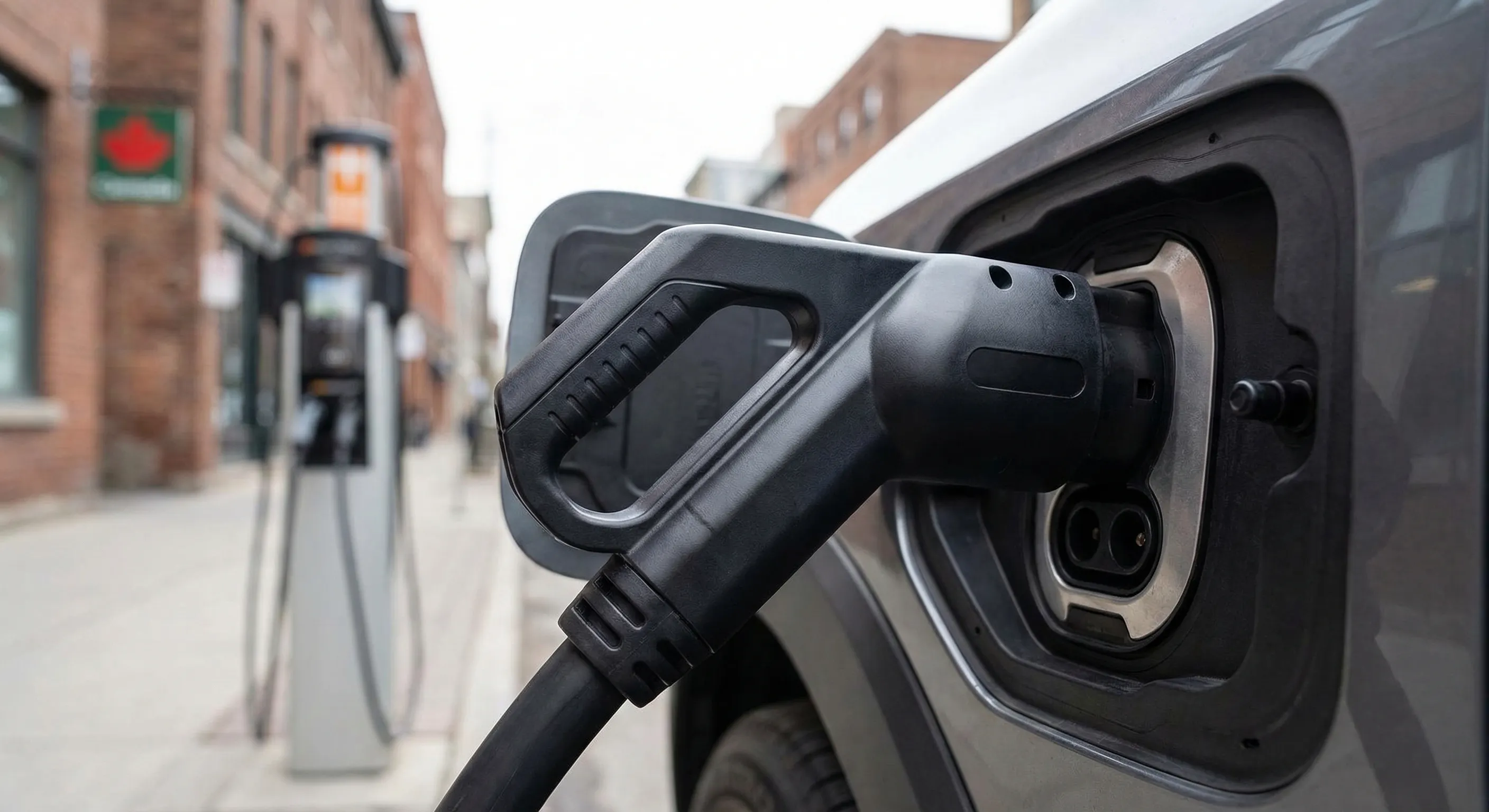
Choose the Model 3 if: You want the best balance of range, charging convenience, and value. You do regular long-distance drives across Canada. You want a car that improves itself over time without service appointments. You want AWD standard without a $14,000 upcharge. You're a pragmatic buyer who values what a car does over what a car says about you. This is the right car for 7 out of 10 Canadian buyers considering these two options.
Choose the i4 if: Driving feel is your primary criterion and you're willing to pay $11,000 more for it. You value BMW's interior craftsmanship and brand heritage. You rarely need to rely on public charging infrastructure, you charge at home and your daily driving is under 200 km. You live near a BMW dealer for convenient service. You want Apple CarPlay and physical climate controls. You're buying a luxury sedan because you want to feel luxury, not just own an efficient machine.
The i4 exception: If you're cross-shopping the i4 eDrive35 at ~$56,000 against the Model 3 Long Range at $54,990, the price gap shrinks to roughly $1,000, but so does the i4's range (435 km vs 629 km), and the eDrive35 is RWD only. The value proposition doesn't improve; it just changes shape.
The real question: Can you feel an $11,000 difference every time you drive? In the i4, yes. The steering, the chassis balance, the interior quality, they combine into a driving experience that the Model 3 doesn't replicate. Whether that feeling is worth $11,000 is a personal calculation that no comparison article can make for you. But the data is clear: the Model 3 is the smarter purchase. The i4 is the more satisfying drive. Choose accordingly.
The $11,000 gap with no rebate offset is hard to argue past for most buyers. The Model 3 is the rational choice. The i4 is the emotional one, and occasionally, the emotional choice is the right one. Just know what you're paying for.
For more context on how EVs stack up against gas-powered alternatives, read our full breakdown of EV vs gas total cost of ownership in Canada. If you're considering other Model 3 competitors, our Kia EV4 vs Tesla Model 3 and BYD Seal vs Tesla Model 3 comparisons cover the value and performance segments respectively.
Gear worth having
As an Amazon Associate, ThinkEV earns a small commission from qualifying purchases — at no extra cost to you.
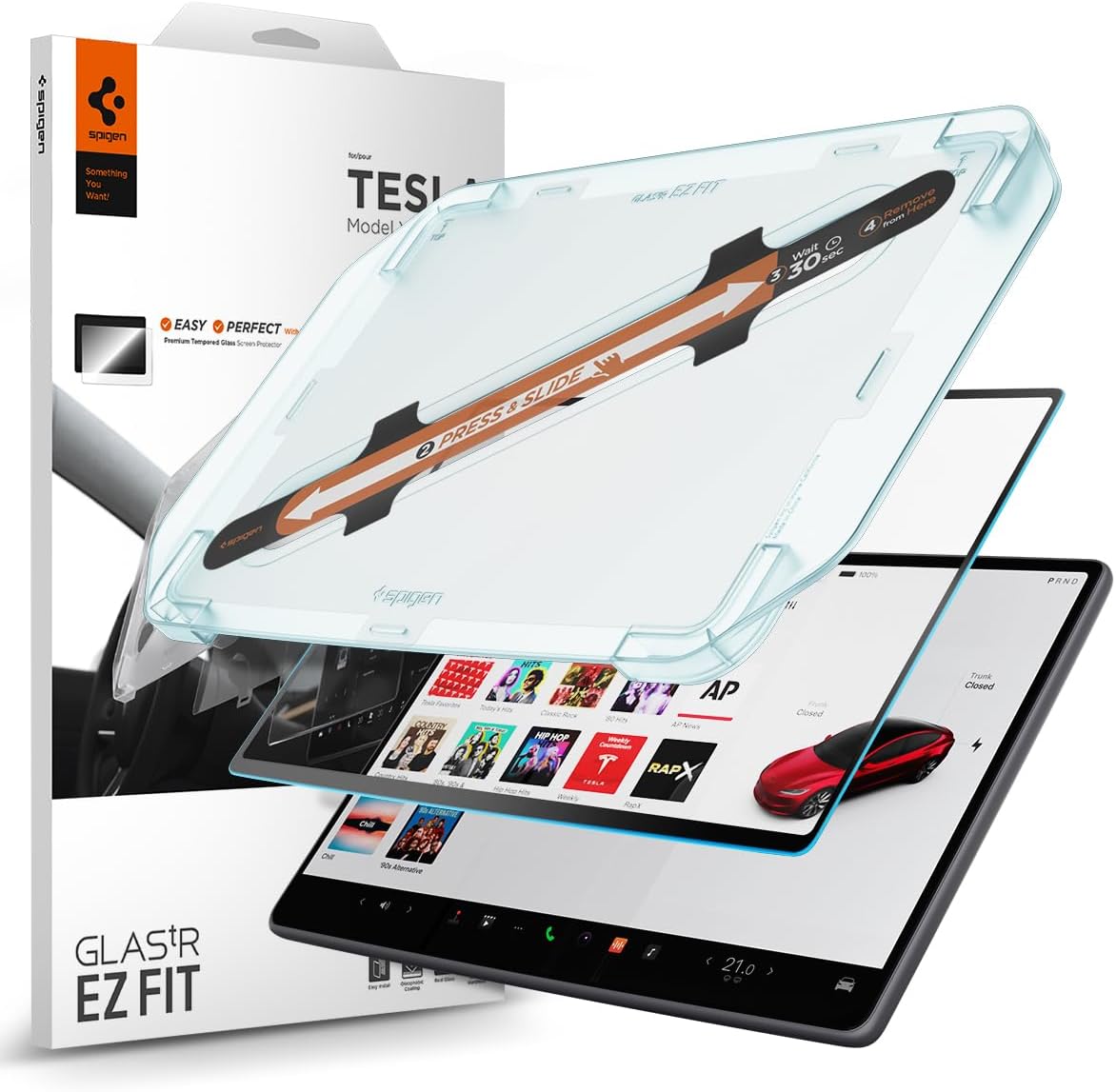
Spigen Tempered Glass for Tesla Model 3/Y
Tempered-glass protection for the touchscreen that kills fingerprints and scratches. Two minutes to install, lasts the life of the car.
As an Amazon Associate, ThinkEV earns from qualifying purchases — at no extra cost to you.
Gear worth having
As an Amazon Associate, ThinkEV earns a small commission from qualifying purchases — at no extra cost to you.

WeatherTech FloorLiner for Tesla Model 3
Deep-channel liners that trap every drop of slush and salt. The difference between a ruined interior and a showroom-fresh cabin after a Canadian winter.
As an Amazon Associate, ThinkEV earns from qualifying purchases — at no extra cost to you.
Related Reading
- Tesla Model 3 Highland Canada Review, Our full review of the refreshed Model 3 for Canadian roads.
- Kia EV4 vs Tesla Model 3, How Korea's value play stacks up against Tesla's benchmark.
- BYD Seal vs Tesla Model 3, The Chinese challenger that shakes up the sedan segment.
- EV vs Gas: Total Cost of Ownership in Canada, The numbers that settle the debate once and for all.
- EV Winter Range Test Canada, How EVs actually perform in Canadian winter conditions.
- Best Level 2 EV Chargers Canada, Our top picks for home charging, tested in Canadian winters.
Gear worth having
As an Amazon Associate, ThinkEV earns a small commission from qualifying purchases — at no extra cost to you.
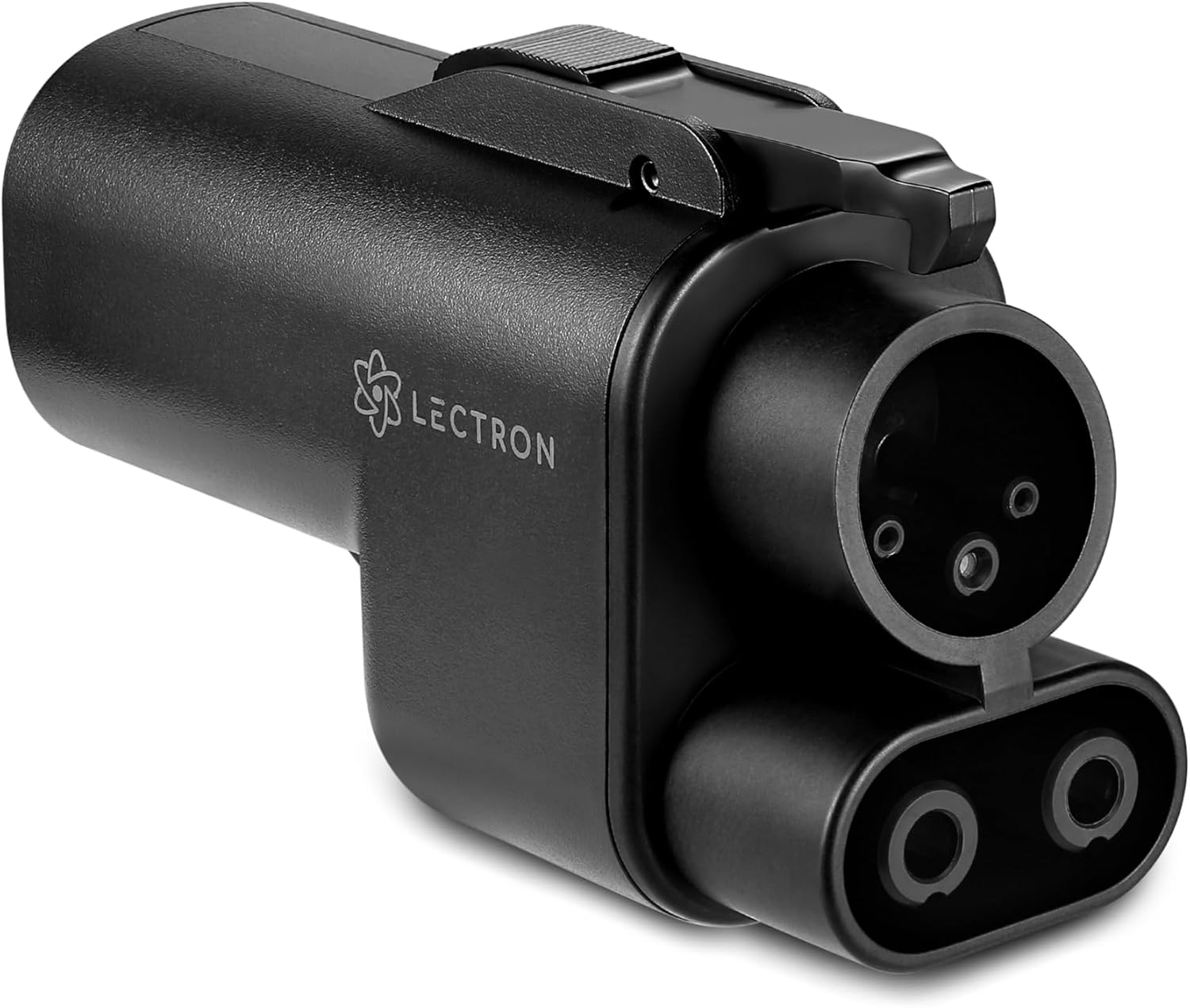
Lectron NACS to CCS Fast-Charge Adapter
Unlock every CCS fast charger for your Tesla, up to 500A DC. Never get stranded at a non-Tesla DC station again.
As an Amazon Associate, ThinkEV earns from qualifying purchases — at no extra cost to you.

Founder & Chief Editor
Vlad Pereira is the founder and chief editor of ThinkEV.ca, the Canadian electric-vehicle publication he writes and edits from Courtenay, British Columbia. He covers EV pricing, federal and provincial rebates, charging costs, and the Chinese manufacturers now entering Canada, from the buyer's side rather than the press-fleet side. ThinkEV is a venture of Vlad Pereira Online; his writing on health, income and the long game lives at vladpereira.com.
Frequently asked questions
How do the charging times compare between the BMW i4 and the Tesla Model 3?
What's the price difference between the two models, and how does the EVAP rebate affect it?
How do the driving experiences differ between the two cars?
Which car is better for Canadian winters?
Does the BMW i4 support Apple CarPlay?
What are the maintenance costs for each car?
How does Tesla service work in smaller Canadian cities?
Which car holds its value better in Canada?
Can I road trip across Canada in either of these cars?
More EV & road-trip finds
Affordable upgrades worth a look — tap any to check the price on Amazon.
 ★ 1,083
Crystal Push-Start Button Ring (2-Pack)
View on Amazon ★ 12,396
K KNODEL Car Trash Can with Lid
View on Amazon ★ 308
★ 308Coiled Lightning Car Cable for iPhone (2-Pack)
View on Amazon ★ 119
★ 119Foldable Waterproof Trunk Organizer
View on Amazon ★ 392
★ 392Large Cup Holder Adapter (32-40oz)
View on Amazon ★ 47,507
HOMEXCEL Microfiber Cloths (12-Pack)
View on Amazon ★ 314
★ 314Mini USB LED Ambient Lamps (4-Pack)
View on Amazon ★ 401
★ 401Crochet Daisy Rear-View Mirror Charm
View on AmazonRead, Plan, Then Stay Current
Explore our expert articles to understand incentives and ownership costs, use the map to pressure-test charging reality, then subscribe so new EV coverage comes straight to you.
Continue Reading
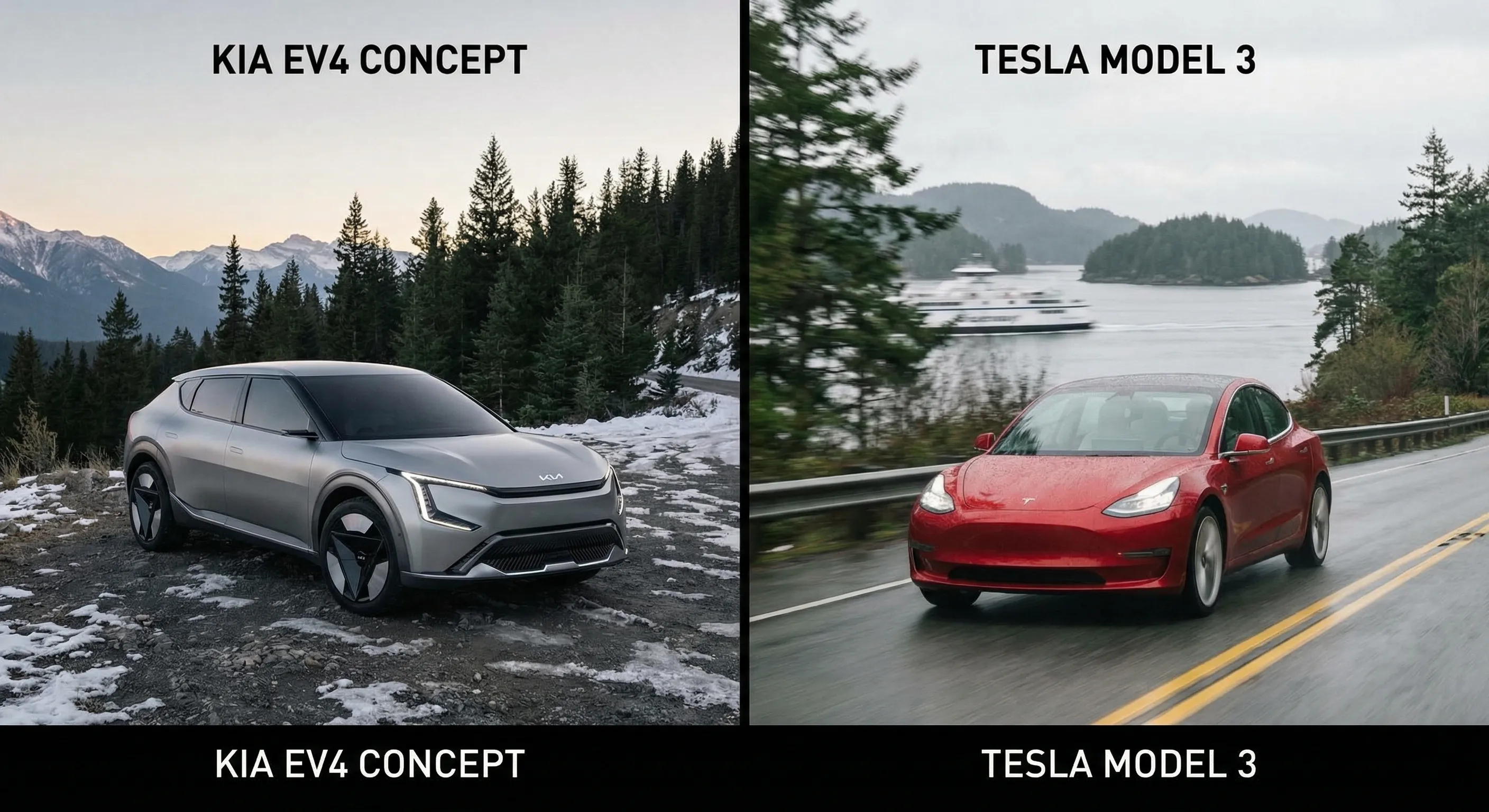
Kia EV4 vs Tesla Model 3 Canada: The $20K Gap
Rivian R1T vs F-150 Lightning: Canada 2026 Test
EV vs Gas: 5-Year Cost of Ownership in Canada
BYD Atto 3 vs Hyundai Kona EV: The $35K Comparison
BYD Dolphin vs Chevy Bolt 2027: Cheapest EVs