A plug-in hybrid pickup priced at roughly $45,000 to $55,000 CAD is about to land in a market where the cheapest electric F-150 starts at $84,000. That is not a rounding error. That is a thirty-thousand-dollar hole in the floor of the Canadian electric truck segment, and it is being drilled by a manufacturer most Canadian buyers could not have named eighteen months ago.
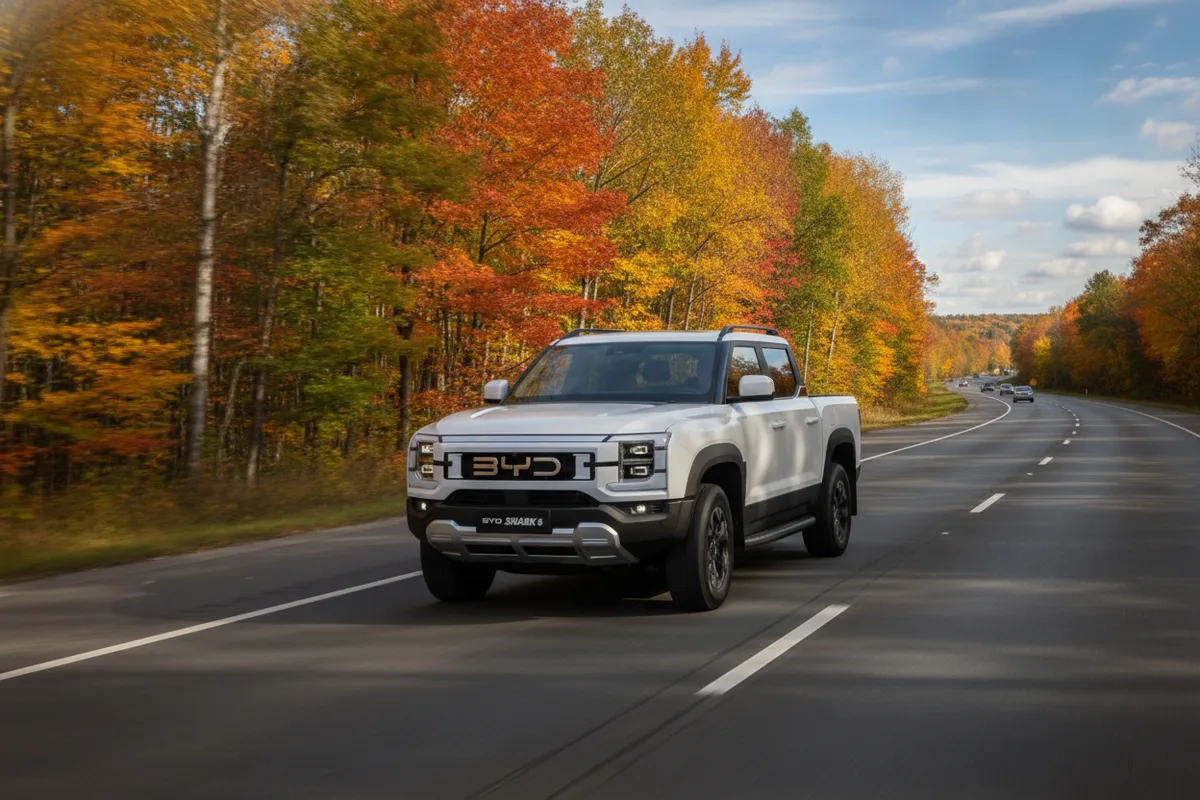
The BYD Shark 6 is the truck doing the drilling. And the question to put on the table, with the data attached, is whether Detroit's pricing posture in Canada survives contact with a $49,000 plug-in hybrid pickup from Shenzhen. My read: it doesn't. Not at current sticker, not under the new tariff regime, not against a manufacturer with a Shenzhen-headquartered conglomerate footprint that absorbs margin pressure the Detroit Three structurally cannot match.
The Shark's Canadian price isn't a curiosity to monitor. It is a pressure test the entire Canadian pickup market is about to fail or pass, and the next twelve months will tell us which. The spec sheet has its own post, linked below, and this piece stays on price.
Key takeaways
- BYD's Shark 6 PHEV is expected to land in Canada at $45,000–$55,000, roughly $30,000 below the F-150 Lightning's floor.
- BYD builds batteries, motors, and semiconductors in-house, while Ford and GM pay supplier margin at every component interface, a structural cost gap a tariff tweak does not close.
- Canada's Chinese EV tariff dropped from 100% to 6.1% in January 2026, paired with a 49,000-vehicle annual import quota.
- BYD plans 20 Canadian dealerships timed to the tariff window, a national distribution footprint rather than a two-city pilot.
- The Shark 6 PHEV is unlikely to qualify for Canada's $5,000 federal rebate, which requires Canadian or free-trade-country assembly.
The Number That Changes the Pickup Conversation
The headline number is the one that matters: $45,000 to $55,000 CAD, estimated, for a plug-in hybrid pickup truck that undercuts Ford's electric truck by roughly $30,000. Compare it to the Ford F-150 Lightning's Canadian floor of roughly $84,000, and the gap is not a discount. It is a different product category being priced into the same parking lot.
The Shark 6 is a PHEV, not a battery-electric. That distinction matters more than the spec-sheet readers usually give it credit for. The plug-in hybrid powertrain sidesteps the two anxieties that have kept Canadian pickup buyers cold on electric trucks: range degradation in winter, and charging infrastructure in rural and remote regions. The Shark uses electric for daily duty and gas for the long haul. For a buyer in Prince George or Thunder Bay, that is not a compromise, it is the answer to the question the F-150 Lightning has been ducking.
The case against my read is the obvious one: a Chinese-brand pickup with no service history in Canada is not the same product as an F-150, regardless of what the sticker says. Canadian pickup buyers are the most brand-loyal cohort in the entire automotive market. They buy the same badge their father bought. They distrust new entrants on principle, and a Shenzhen badge will trigger that distrust harder than a Korean or Japanese one ever did. I concede the point. What I don't concede is the scale of insulation it provides. Brand loyalty is a deferral mechanism, not a price-elasticity override. A thirty-thousand-dollar gap erodes loyalty faster than any incumbent marketing department in Canada is currently modelling. Hyundai proved it in sedans. Kia proved it in crossovers. The pickup segment is not exempt from the same arithmetic; it is just later in the curve.
The price gap is the editorial story. Thirty thousand dollars is not a number incumbents can close with a mid-cycle refresh or a year-end incentive package. It is a structural cost-base gap, and structural gaps require structural responses. So far, neither Ford nor GM has offered one. The Silverado EV and Lightning sit at their current Canadian price points. The marketing has not adjusted. The dealer conversations I'm hearing about have not adjusted. The product roadmap has not adjusted.
That is what makes the Shark interesting: not the truck itself, but the response, or the conspicuous absence of one.
For the spec-level detail on the Shark, battery configuration, range, towing, and charging, read the technical preview of the BYD Shark 6's Canadian launch specs.
Why the 100% Tariff Wall No Longer Fully Protects Detroit
For the last eighteen months, the Canadian pickup market has been protected by a single policy lever: the 100% federal surtax on Chinese-made EVs imposed in October 2024. That wall is now coming down. Effective January 16, 2026, the tariff dropped to 6.1%, paired with a 49,000-vehicle annual import quota for Chinese-made electric vehicles. The numbers are doing a different job now.
Even at the old tariff levels, BYD's cost structure absorbed margin pressure that the Detroit Three cannot match without a fundamental product redesign. BYD Company Limited is a Chinese multinational manufacturing conglomerate headquartered in Shenzhen, Guangdong, and that conglomerate structure means batteries, motors, semiconductors, and assembly all sit inside the same balance sheet. The auto subsidiary doesn't just sell its main BYD-branded vehicles either; BYD Auto sells under its main brand alongside high-end sub-brands and a full electric bus and electric truck portfolio, which means R&D cost is amortized across passenger cars, commercial vehicles, and battery cells in a way Ford and GM simply cannot replicate. Ford and GM buy most of those components from suppliers and pay margin at every interface. BYD doesn't. That is the cost-base advantage in one sentence, and it does not shrink with a tariff adjustment, it widens.
The counter-argument from Detroit's side is that vertical integration is overrated as a long-run advantage. The Big Three pointed to Tesla's gigafactory bet as the cautionary tale: vertical integration concentrates risk, ties capital to one chemistry, and breaks when the technology curve bends. There is a version of that critique that applies to BYD too, if solid-state batteries arrive at scale before 2030, BYD's LFP-cell investment becomes a stranded asset and the cost advantage compresses. I take the argument seriously. I just don't think it's relevant to the Canadian 2026-2028 window we're discussing. The Shark ships with current-generation cells. The price gap exists today. Whatever happens to battery chemistry in 2030 does not protect a Lightning sticker in 2027.
The 49,000-unit quota is itself a story worth reading carefully. It signals managed entry, not a flood. Ottawa wants Chinese EVs in the market enough to discipline incumbent pricing, but not so many that the domestic auto industry destabilizes. The cap is the policy instrument doing the disciplining. The unknown variable is demand.
On that question, the Canadian EV community has already voted. A widely-circulated thread on r/EVCanada asked directly whether 49,000 BYD EVs priced near $49,000 would sell out in minutes, hours, or days if BYD dropped them online at midnight. The consensus among respondents, who tend to skew toward early-adopter buyer profiles, was that the quota would be exhausted faster than the website could process the orders. That is not market research. But it is signal, and the signal is one-directional.
If demand absorbs the full 49,000-unit quota in 2026, three things happen in sequence. First, a second tranche becomes politically inevitable, no minister wants to be the one explaining to voters why they cannot buy an affordable EV. Second, the quota expansion gives BYD volume to justify Canadian-specific product investment, which lowers their per-unit cost further. Third, the gap between BYD's Canadian sticker and Detroit's Canadian sticker stops being a one-time pricing anomaly and becomes a structural feature of the market.
I'd watch the quota sell-through rate as the single most important data point in the Canadian EV market in 2026. Faster than incentive-eligibility decisions. Faster than dealer-network announcements. The quota tells us whether Canadian buyers actually wanted what the policy debate has been gating.
Gear worth having
As an Amazon Associate, ThinkEV earns a small commission from qualifying purchases — at no extra cost to you.

Lectron Level 2 J1772 Charger (40A, WiFi)
Smart WiFi charger with real-time energy monitoring. 40A / 9.6 kW, J1772 with a NEMA 14-50 plug, schedule charging right from your phone.
As an Amazon Associate, ThinkEV earns from qualifying purchases — at no extra cost to you.
What $17,600 Dolphins and $49K Trucks Tell Us About BYD's Canada Strategy
The Shark 6 is not the price story BYD is telling Canada. It is one chapter of a longer one.
The leaked Canadian pricing list, the one that surfaced via a Facebook post and was reported by Driving.ca, which noted that a Facebook post going around apparently shows pricing for the "2026 BYD Models Available for Canada," beginning with the Dolphin hatchback at an estimated landed price of $17,600 CAD, describes a full lineup, not a hero product. Dolphin at the entry level. Seal in the mid-segment, BYD's statement vehicle that matches the Tesla Model 3 on specifications while undercutting it by $10,000 to $15,000. Shark 6 at the top of the value-pickup segment. This is a staircase, deliberately constructed, with a price-anchor on every step that has no comparable competitor in the Canadian market.
The $17,600 Dolphin number is the one that should worry every other manufacturer most. There is no $17,600 EV in Canada. There is barely a $17,600 new car in Canada. If that landed price is even directionally accurate when official MSRP confirms, BYD has not just entered the Canadian EV market, it has redefined where the entry-level price floor sits, and forced every economy-segment competitor to explain why their product costs more than double.
Named comparison worth making: the closest analogue in current Canadian inventory is the Chevrolet Bolt EV, retired in 2023 at a final MSRP near $39,000 CAD, and the Nissan Leaf S, which sits around $42,000 CAD before incentives in 2026. The Dolphin at $17,600 lands more than fifty percent under either one. That is not "competitive entry-level pricing." That is the kind of gap that resets what buyers expect to pay for a new EV in this country, and once a buyer expectation moves, it does not move back.
The dealer-network strategy reinforces the read. Reporting indicates BYD plans to open 20 dealerships in Canada, with the rollout timed to the tariff window. Twenty dealerships is not a pilot. A pilot is two or three locations in Vancouver and Toronto to test market response. Twenty is national distribution intent, Ontario, Quebec, BC, Alberta, and likely some Atlantic and prairie coverage. BYD is building brand infrastructure before volume, which is the opposite of how most foreign entrants approach a market.
Gear worth having
As an Amazon Associate, ThinkEV earns a small commission from qualifying purchases — at no extra cost to you.

TP-Link Kasa Smart Plug with Energy Monitoring
Track exactly how much electricity your Level 1 charger uses and schedule it for off-peak hours. Know your real cost per kWh.
As an Amazon Associate, ThinkEV earns from qualifying purchases — at no extra cost to you.
The reason matters. Building infrastructure ahead of volume tells you the company is planning for a multi-year ramp, not a quota-window arbitrage play. It tells you they expect the 49,000-unit cap to be the floor of their Canadian business, not the ceiling. And it tells you the cost of those twenty dealerships is being amortized against a volume forecast that BYD's planners are comfortable with, which is a higher number than most Canadian analysts are publicly discussing.
For the full price ladder across the BYD lineup that's confirmed or estimated for Canada, the model-by-model breakdown of every BYD vehicle coming to Canadian dealerships covers the staircase in detail.
The Coverage Gap: What We Know, What's Still Unconfirmed
Here is where I want to be direct, because the failure mode in Canadian EV coverage right now is overconfidence about prices that aren't actually confirmed.
No official Canadian MSRP for the Shark 6 has been published by BYD as of May 2026. The $45,000 to $55,000 range is an estimate, sourced from a combination of cross-market pricing in Mexico and Latin America, the landed-cost calculation under the new tariff regime, and the leaked Facebook pricing sheet that Driving.ca surfaced. It is a defensible estimate. It is not a sticker.
If the confirmed MSRP lands above $58,000, the value thesis I've laid out in this piece weakens materially. The thirty-thousand-dollar gap with the F-150 Lightning becomes a twenty-five-thousand-dollar gap, which is still significant but no longer category-defining. I'd revisit my forecast on Detroit's competitive response if that happens.
The case for caution on the estimate range is fair. The Mexico sticker doesn't include the Canadian-specific homologation costs, the cold-weather battery conditioning package the Shark will likely need for Quebec and Prairie winters, or the dealer-margin overhead BYD has to build in to keep its twenty franchisees financially solvent. Stack those three line items and you can defend a sticker thirty-five hundred to seven thousand dollars above the Mexico-comparable. That is the upper-bound scenario in my range. The lower-bound scenario assumes BYD is willing to absorb most of those costs at the factory to buy market share in year one, which is consistent with how Chinese OEMs entered Australia, Brazil, and the UK. Both scenarios remain inside a defensible band. Neither breaks the editorial story.
Provincial rebate eligibility is the second unconfirmed variable, and it matters more than most coverage acknowledges. BC, Quebec, and the federal iZEV programme have historically distinguished between battery-electric and plug-in hybrid eligibility, with different cap structures and different qualifying ranges. The Shark 6 is a PHEV. Whether it qualifies for the full PHEV rebate under each programme, and whether that rebate stacks with provincial incentives in BC and Quebec, is unresolved. The difference is material: a fully-stacked rebate package could bring the Shark's net Canadian price below $40,000. A non-qualifying outcome leaves it at sticker.
Dealer-network timing is the third gap. Twenty dealerships planned is not twenty dealerships open. Service infrastructure, parts inventory, certified technicians, warranty fulfilment, takes longer to build than showroom presence. A buyer in Halifax in October 2026 may have a dealership two hours away and a parts order with a six-week lead time. That is the friction that converts a great price into a hesitant purchase decision.
The commercial-vehicle precedent is the data point I keep coming back to here. BYD has been selling electric buses, medium- and heavy-duty trucks, and forklifts into Canada through commercial channels for years, a route Canadian fleet operators have used to validate the company's product reliability and parts-fulfilment cadence well before any passenger-vehicle launch. The commercial-side track record is uneven but not catastrophic, and it gives BYD-Canada a baseline of service-network learning that, say, VinFast did not have when it stumbled into the US market. That precedent doesn't guarantee a smooth passenger rollout. It does mean the company is not starting from zero on Canadian logistics, and the friction estimates I made above are probably worst-case.
I'm naming these gaps explicitly because the editorial risk in this story is not the price, it is the gap between the price signal and the actual purchase experience. The price will get the headlines. The friction will determine whether the headlines convert.
Gear worth having
As an Amazon Associate, ThinkEV earns a small commission from qualifying purchases — at no extra cost to you.

Grizzl-E Classic Level 2 EV Charger (40A)
Canadian-made and rated for minus 40C winters. 40A / 9.6 kW, NEMA 14-50, indoor/outdoor, 24-ft cable. The charger built for Canadian weather.
As an Amazon Associate, ThinkEV earns from qualifying purchases — at no extra cost to you.
What Would Change My Read on This
I'd revise my thesis in four specific scenarios, and I want to name them so readers can hold this piece against the reality that unfolds.
If confirmed Canadian MSRP for the Shark 6 lands above $58,000, the value gap with the F-150 Lightning narrows from category-defining to merely significant, and the urgency of incumbent response drops. I'd reduce my forecast confidence on a Detroit price move by a full margin.
If the federal iZEV programme excludes the Shark 6 from PHEV eligibility, either on range grounds, manufacturer-origin grounds, or quota-management grounds, the net-of-incentive price gap narrows materially. The sticker stays low, but the out-the-door number gets closer to incumbent territory, and the buyer math changes.
If the 49,000-unit annual quota sells through in 2026 at the projected pace, expect a second tranche announcement and a corresponding pricing tier emerge at higher volumes. The BYD-Canada price story stops being a single-product narrative and becomes a market-share narrative.
If Ford or GM respond with actual Canadian-market price adjustments on the Lightning or Silverado EV, not press-release "competitiveness reviews," but real sticker changes on real trucks, the entire competitive landscape moves. I'd treat that as the most important signal of the year, more so than the BYD launch itself.
Five forecasts worth putting on record: official Shark 6 MSRP lands between $46,000 and $52,000 CAD; iZEV qualifies it at the reduced PHEV tier; BC and Quebec stack provincial incentives without fighting Ottawa over origin; quota sell-through hits 80% by Q3 2026; and Ford does not move on Lightning pricing in calendar 2026. If three of those five resolve as forecast, the thesis here holds. If four or five resolve, it understates the disruption. If only one or two resolve, the read needs a correction.
For context on what the Lightning currently delivers at its $84,000 starting point, the Ford F-150 Lightning Canadian review covering real-world range, towing, and electric-truck reality is the comparison piece readers should anchor against. And for buyers who want to understand what a premium-priced electric truck delivers when the price isn't a constraint, the Rivian R1T Canadian review on what 515 km of range actually buys you sets the upper bound of the segment.
Gear worth having
As an Amazon Associate, ThinkEV earns a small commission from qualifying purchases — at no extra cost to you.

PULIDIKI Car Cleaning Gel (Detailing Putty)
Press it into vents, buttons, and seams and it lifts out dust you did not know was there. Weirdly satisfying, genuinely useful.
As an Amazon Associate, ThinkEV earns from qualifying purchases — at no extra cost to you.
What the Data Actually Supports
The Shark's Canadian price point is real enough to take seriously before official confirmation lands. The estimate range is bracketed by multiple independent data points, the Mexico sticker, the leaked Canadian pricing list reported by Driving, the post-tariff landed-cost math, and they cluster tightly enough that the central estimate is unlikely to be wrong by more than a few thousand dollars in either direction.
The incumbent response so far has been rhetorical. Press releases about competitiveness. Marketing campaigns emphasizing made-in-North-America credentials. No matching product, no matching price, no Canadian-market sticker adjustment. The asymmetry between BYD's pricing posture and Detroit's pricing posture is what makes this story editorial rather than commercial: somebody is going to blink, and as of mid-May 2026, it is not BYD.
Canadian pickup buyers will have a credible electric or plug-in hybrid alternative at half the price of the incumbent options within eighteen months. The dealer network will be in place. The tariff regime is settled. The quota is set. The only remaining variables are official MSRP and rebate eligibility, and both of those resolve before the end of this calendar year.
The question is no longer whether BYD matters in the Canadian pickup segment. The question is how fast incumbents respond, and whether they respond with product, or only with talking points. I'd bet on talking points through end of 2026 and an actual Lightning price cut by mid-2027. If Ford moves earlier, it means they're seeing demand-side data Canadian buyers haven't seen yet. That would be the signal worth acting on.
Gear worth having
As an Amazon Associate, ThinkEV earns a small commission from qualifying purchases — at no extra cost to you.

WixGear Magnetic Air Vent Phone Mount (2-Pack)
A magnet strong enough that your phone never flinches over potholes or rail crossings. Two in the box, one for each car.
As an Amazon Associate, ThinkEV earns from qualifying purchases — at no extra cost to you.

Founder & Chief Editor
Vlad Pereira is the founder and chief editor of ThinkEV.ca, the Canadian electric-vehicle publication he writes and edits from Courtenay, British Columbia. He covers EV pricing, federal and provincial rebates, charging costs, and the Chinese manufacturers now entering Canada, from the buyer's side rather than the press-fleet side. ThinkEV is a venture of Vlad Pereira Online; his writing on health, income and the long game lives at vladpereira.com.
Frequently asked questions
Does the Shark 6 qualify for Canada's federal EV rebate?
What happens when the 49,000-unit quota runs out?
How cold-weather range works on the Shark 6 PHEV?
Will BYD actually have Canadian service centres at launch?
Could Ford or GM close the price gap with incentives?
More EV & road-trip finds
Affordable upgrades worth a look — tap any to check the price on Amazon.
 ★ 87
★ 87Car Window Sun Shades for Kids (4-Pack)
View on Amazon ★ 68
★ 68WeatherTech FloorLiner for Tesla Model 3
View on Amazon ★ 4,050
Touchscreen Mist Screen Cleaner Kit
View on Amazon ★ 419
★ 419RGB Car Interior LED Strip Light
View on Amazon ★ 4,626
HoogaLife Hanging Car Diffuser (2-Pack)
View on Amazon ★ 979
★ 979Leather Headrest Purse Hook
View on Amazon ★ 1,944
VIOFO A229 Pro 4K Dash Cam
View on Amazon ★ 121
★ 121Foldable Windshield Sun Umbrella
View on AmazonRead, Plan, Then Stay Current
Explore our expert articles to understand incentives and ownership costs, use the map to pressure-test charging reality, then subscribe so new EV coverage comes straight to you.
Continue Reading
BYD Truck Canada 2026: Shark 6 Specs, Price & What to Know
BYD Shark 6 Price in Canada: $55K–$62K Estimate, Explained

Are Canada's Repair Shops Ready for Chinese EVs?
BYD Shark 6 Canada: Specs, Price Band & 2026 Lineup Guide
BYD Atto 3 Price Canada 2026, The Real Number, Banded