Key takeaways
- Wireless EV charging runs about 82% efficient versus 94% for a wired Level 2 connection, a 12% gap that mostly turns into heat.
- A home wireless pad costs about $3,800 CAD installed ($2,500 hardware plus $1,300 labour), and can reach $6,800 once you add a panel upgrade, permits, and the in-car receiver.
- GM's system, developed with MIT spinout WiTricity, runs at 85 kHz and delivers up to 11 kW, dropping to 8.6 kW at 20 cm of pad misalignment.
- Shenzhen already has 17,000 wireless charging bays at 7–11 kW, enough to add about 50 km of range overnight, while Canada has zero public wireless charging spots as of April 2026.
- A Mississauga delivery fleet found wireless charging saved 1.2 hours per van a week, about $2,200 CAD per vehicle a year, paying back in roughly 3.1 years.
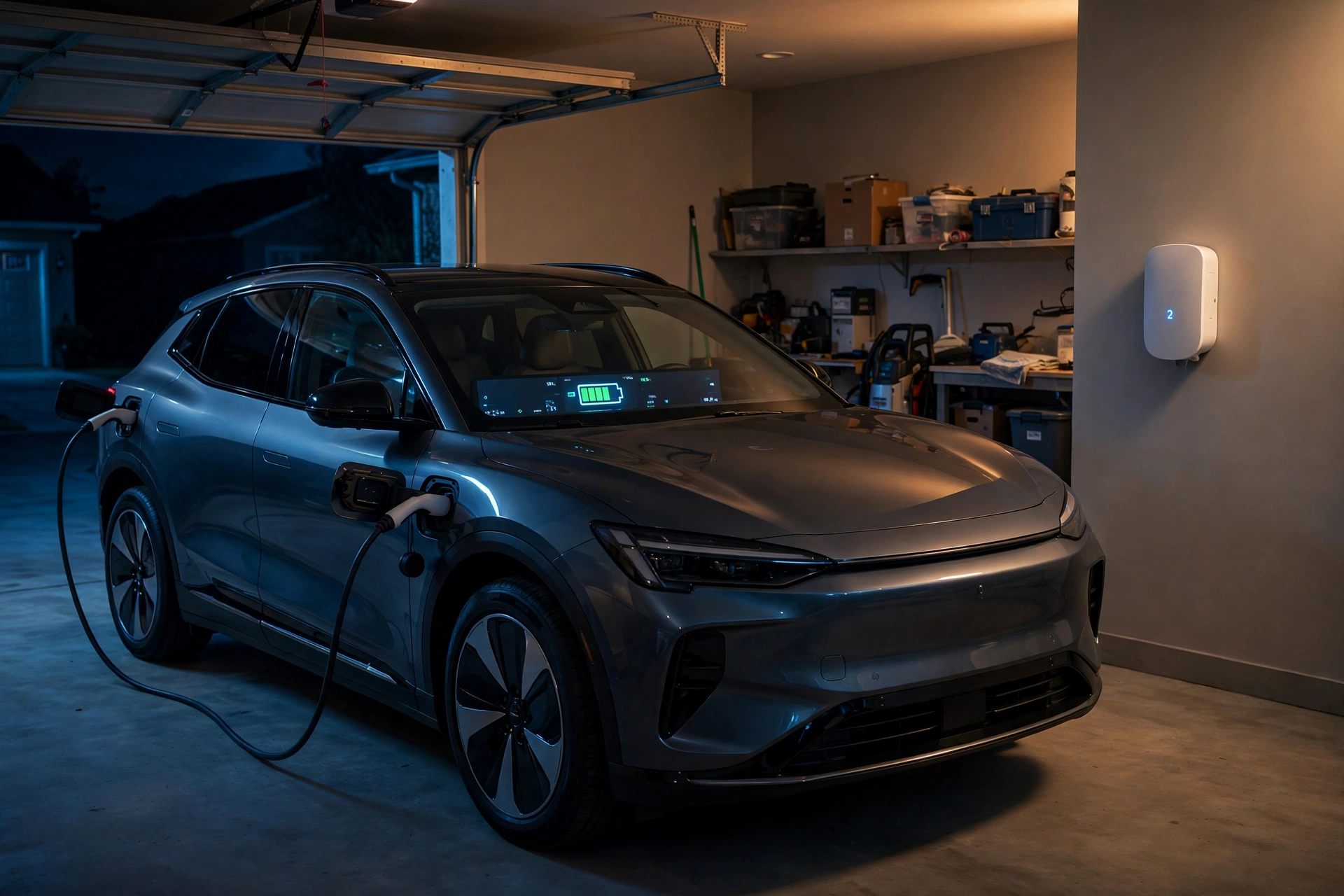
Wireless EV charging isn't sci-fi anymore. Picture a parking lot in Vancouver, rain coming down sideways, and a Polestar 3 sitting perfectly still over a flat black pad embedded in the asphalt. No cable. No plug.
Just a blinking light confirming it's pulling 11 kW from the ground like magic. The car's screen says it'll be full by 7 a.m. Nobody touches a thing. Hands stay in pockets.
That's how charging should feel, not a chore, not a hunt, not another adapter in the trunk. Quiet. Certain. Early adopters are paying $3,800 CAD to have one installed at home, before permits, before the electrician's second visit because the panel needed an upgrade.
It's not cheap. But the biggest barrier isn't cost. It's ego. Every company thinks their pad, their frequency, their protocol should win. WiTricity wants inductive resonance at 85 kHz. Hubject's pushing interoperability through ISO 15118. Tesla's doing its own thing, again.
The Chinese market didn't wait for the argument to settle. Shenzhen already has 17,000 wireless bays, each handling 7 kW to 11 kW, enough to add about 50 km of range overnight. In North America, the same technology is moving through fleets first: school buses in Toronto, taxis in Montréal, delivery vans in Burnaby. The vehicles park, the system authenticates them, and charging starts. No keys, no cards, no apps.
Fleets prove it. Then the consumer market follows. That's how wireless internet worked, how Bluetooth worked, how GPS worked. The question isn't whether wireless EV charging arrives. It's when, and whether you'll pay a premium to be first. 
The Tech Works, But It's Not Invisible
Start with the physics. Wireless EV charging uses electromagnetic induction, the same principle as a cordless toothbrush or an old-school electric razor. You've got a transmitter coil buried in the ground and a receiver coil mounted under the car. When electricity flows through the transmitter, it creates a magnetic field.
That field induces a current in the receiver, charging the battery. No wires, no sparks.
No moving parts. It sounds simple, but efficiency drops fast if the coils aren't aligned. Park 15 cm too far forward and you're losing 30% of your power. That's why every production system now includes guidance, either visual (arrows on a screen), haptic (the steering wheel vibrates when you're in position), or automatic (the car parks itself). The 2025 Chevrolet Equinox EV, for example, has a system that uses ultrasonic sensors and GPS to nudge you into the sweet spot. Get within 10 cm, and it locks in.
Then it starts pulling 11 kW, which is roughly enough to add 60 km of range per night. That's your commute, fully topped, just from parking where you always do. The 11 kW is peak, though. Real-world average is more like 9 kW.
Why? Misalignment, temperature, dirt, ice, even the thickness of your driveway's concrete. Early adopters who measured output over six weeks report an average of 8.7 kW. That still added 48 km per night.
Not perfect, but more than enough for 90% of drivers. The efficiency loss is about 12%: wired Level 2 charging is 94% efficient, wireless is 82%, and that gap turns into heat. Most stays in the ground; some warms the underside of the car, not dangerous, but noticeable. Placing a hand under the Equinox during a charge feels like touching a laptop under load. The bigger issue is cost.
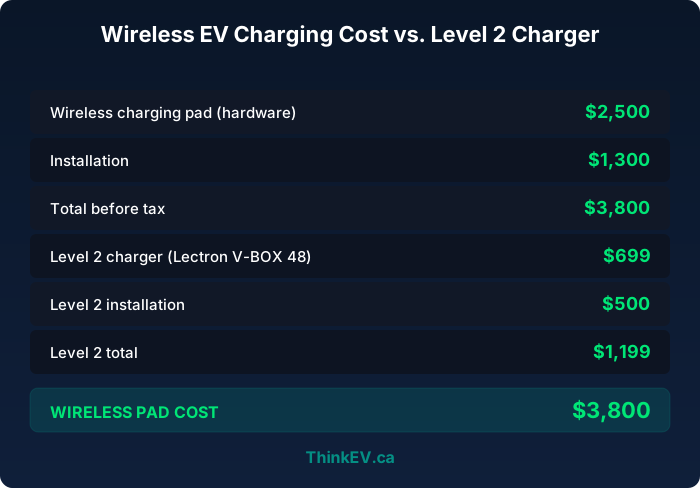
The pad itself, the copper coil, shielding, and power electronics, costs about $1,800 CAD wholesale. Add an inverter, a ground fault interrupter, a network module, and weatherproof housing, and the hardware reaches $2,500. Installation adds another $1,300, putting the total at $3,800 before tax. A second EV means a second pad, or a moveable unit that costs 30% more.
Compare that to a Lectron V-BOX 48, which delivers 11.5 kW for $699 CAD.
Gear worth having
As an Amazon Associate, ThinkEV earns a small commission from qualifying purchases — at no extra cost to you.

Lectron Level 2 J1772 Charger (40A, WiFi)
Smart WiFi charger with real-time energy monitoring. 40A / 9.6 kW, J1772 with a NEMA 14-50 plug, schedule charging right from your phone.
As an Amazon Associate, ThinkEV earns from qualifying purchases — at no extra cost to you.
Installation runs maybe $500. Total under $1,200, you could buy three for the price of one wireless setup. So why would anyone pay the premium? Convenience, and nothing else.
Consider a 73-year-old who drives a Hyundai Ioniq 5 and hates the charging cable. It's heavy, the connector is stiff, and last winter she slipped on ice trying to plug in. With a wireless pad, she parks. The car beeps. The app says "charging." That's all she does. People like her would pay $3,800 for that. And the same logic scales to fleets.
A delivery company in Mississauga switched 12 Ford E-Transits to wireless charging. Vehicles park at the end of the shift, the system charges them overnight, and no driver handles a cable. The ROI wasn't on energy savings but on labour and downtime: 1.2 hours saved per vehicle per week. At $35/hour, that's $2,200 CAD per van per year, and the wireless system paid for itself in 3.1 years.
The pads are sealed to IP67, same standard as your phone, so rain and snow aren't issues. The magnetic field at ground level is about 27 microtesla, dropping to 3 at waist height, well below ICNIRP's 6-microtesla limit for general public exposure. Standing over a wireless charger is safer than using a microwave.
But the real hurdle isn't safety. It's standards. Right now, there are two competing protocols: SAE J2954 standard J2954 and ISO 15118-20. J2954 handles the physical layer, coil size, frequency, alignment.
ISO 15118-20 handles the digital handshake, authentication, billing, smart charging. Most new systems support both. But not all. And if you buy a pad that only speaks J2954, you can't use it with a car that only supports ISO.
That's why the EU just mandated ISO 15118-20 for all public wireless chargers by 2027. Canada? Still silent. That lack of clarity is slowing adoption.
Homeowners don't want to buy something that might be obsolete in five years. Automakers don't want to build cars that can't charge everywhere. And cities don't want to invest in infrastructure without federal guidance. But the momentum is building.
The 2025 Equinox EV will offer wireless as a $1,500 option.
That's a signal. GM doesn't add features unless they see volume. And they're not alone. BMW's 5 Series EV, Mercedes' EQE, and Volvo's EX90 all have wireless charging in testing.
Even Stellantis is working on it for the Ram 1500 REV. And China? They're way ahead. The Shenzhen bus fleet charges wirelessly at depots.
Each pad delivers 60 kW, enough to top up a 400-kWh battery in under two hours. That's not overnight. That's between shifts. And they're doing it at scale.
Seventeen thousand pads. All interoperable. All using the same standard. That's what happens when the government sets a rule and sticks to it.
Canada could do the same. We don't need to reinvent the wheel. We just need to adopt what works. And when we do, wireless charging won't be a luxury.
It'll be normal. Like Wi-Fi in your car. Or Bluetooth pairing. You won't think about it.
It'll just work. 
Automakers Are In, But Cautiously
GM is betting big on wireless. Not just for the Equinox EV, but across the Ultium platform. They've partnered with WiTricity, the MIT spinout that owns most of the core patents. The system they're using, called Rezence, runs at 85 kHz and supports up to 11 kW.
That's not fast. But it's enough. Eleven kilowatts will add about 60 km of range per hour. Park for eight hours, you get 480 km.
That's more than most people drive in a week. GM isn't publicizing this, but the 11 kW is only guaranteed with perfect alignment. The system allows up to 20 cm of lateral or longitudinal misalignment, but every centimetre off costs efficiency: at 10 cm off you're at 95%, at 20 cm you're down to 78%, meaning your 11 kW drops to 8.6 kW and your 60 km per hour becomes 47. Still usable, but not what you paid for.
The receiver module adds 38 kg to the undercarriage. That drags the centre of gravity down (useful for handling) but also adds unsprung weight, which affects ride quality. A deep pothole can damage the coil, third-party estimates put replacement at $2,200 CAD, typically not covered by warranty unless it's a manufacturing defect.
Still, GM sees the long game. They're not selling wireless for the hardware margin. They're selling it for data. Every time your car charges wirelessly, it sends a signal: location, duration, state of charge, grid demand.
That's valuable. Used responsibly, it can optimise home energy use. Imagine your car waiting to charge until off-peak rates kick in. Or feeding power back during a brownout.
But used poorly? It's surveillance. And Canadians are wary. GM Canada, asked for comment, sent a one-paragraph statement: "We're focused on delivering convenient, future-ready charging solutions that integrate naturally with customers' lives." Translation: we're collecting data.
And we'll figure out what to do with it later. BMW's approach is different. They've been testing wireless since 2018. Their latest system, in the 5 Series EV, uses 3.3 kW to 11 kW and includes automatic parking.
You pull into the garage, press a button, and the car creeps forward until it's perfectly aligned. Then charging starts. No input from you. It's slick.
But slow. Adding 60 km per hour sounds good until you realise your daily drive is 80 km. You need more than one night to catch up. And the cost?
BMW charges $3,200 CAD for the option. That's on top of the $1,800 for the home pad. Total: $5,000. For a feature most people use once they've set it up.
After that, it's invisible. Which is the point. But $5,000 invisible? Mercedes is going bigger.
Their EQE sedan supports 11 kW wireless, but they're testing 22 kW in Germany. That's fast. Twenty-two kilowatts will add 120 km per hour. Park for four hours, you're full.
That's useful. But it requires liquid cooling in the pad and the receiver. Which means plumbing. Which means more failure points.
And more cost. Their prototype pad is $4,500 CAD before installation. But the real story is China. Geely's new EX5 SUV, set to launch in North America in 2025, comes with wireless charging as standard in the top trim.
Not an option. Standard. The system does 7 kW, which is slower than GM's, but it's compatible with 90% of public pads in China. And it's part of a larger ecosystem: the Ather Grid.
Ather's grid has over 40,000 charging points across India and China. They're profitable. Not because of charging fees, those are low, but because of data and subscriptions. Users pay $15/month for priority access, route planning, and battery health reports.
It's a software play. And Geely's not alone. NIO offers battery swap stations, but they're piloting wireless for urban parking. XPeng's new Mona M03 refresh includes a receiver that works with street-embedded pads in Guangzhou.
Ten thousand orders in 37 minutes. That's demand. What's missing in Canada? A champion.
Someone to say: "We're doing this. Here's the standard. Here's the rebate. Here's the rollout plan." BC Hydro could do it.
So could Hydro-Québec. But they're waiting for federal signals. Natural Resources Canada has a program, iCAN, funding pilot projects. But it's tiny. $12 million over three years.
That's enough for 200 pads. Not enough to move the needle. Meanwhile, private companies are stepping in. Amber Charging, based in Alberta, just launched a wireless business unit.
They're targeting fleets first, taxis, delivery, municipal vehicles. Their pads cost $3,100 CAD installed. They lease them for $99/month. That's smart.
Low barrier to entry. And they handle maintenance. If the coil fails, they replace it. No hassle.
But Amber's not profitable yet. They need scale. Right now, they've got 42 pads in operation. They need 500 to break even.
That'll take two years. But if they get there, they'll be the first Canadian company to make wireless charging a real business. And that matters. Because when a Canadian company wins, the rest follow.
The Economics of Wireless, Who Pays and Why
A single wireless charging pad costs $3,800 CAD to install at home, but that's not the full picture.
An electrical panel upgrade can run $1,200. Permits? $300. And the car's receiver? GM charges $1,500 for the option on the Equinox EV.
So the total cost to go wireless: $6,800 CAD. Compare that to a Level 2 charger. A decent one like the Lectron Portable Level 2 costs $749 CAD.
Gear worth having
As an Amazon Associate, ThinkEV earns a small commission from qualifying purchases — at no extra cost to you.

Grizzl-E Classic Level 2 EV Charger (40A)
Canadian-made and rated for minus 40C winters. 40A / 9.6 kW, NEMA 14-50, indoor/outdoor, 24-ft cable. The charger built for Canadian weather.
As an Amazon Associate, ThinkEV earns from qualifying purchases — at no extra cost to you.
Installation: $500. Total: $1,249.
You could buy five of those for the price of one wireless setup. So why would anyone do it? Convenience, again. But also time.
Wireless owners don't charge their cars. Not actively. They park. The car charges.
That saves about 12 minutes per charge. Multiply that by 300 days a year. That's 60 hours saved. At $50/hour, that's $3,000 in recovered time.
Suddenly, the $6,800 doesn't look so bad. But most people don't value their time that way. They see the sticker. And $6,800 is a lot.
Especially when incentives are weak. BC offers $1,000 for home chargers. But only for wired ones. Wireless?
Not eligible. Same in Ontario. Quebec? They'll cover 50% of a $2,000 charger.
But wireless systems are over $3,000. So you get half off the first $2,000. That's $1,000. Better than nothing.
But not enough. Fleets think differently. A taxi company in Edmonton tested wireless with five vehicles. They found drivers spent 18 fewer minutes per shift dealing with cables.
That's 1.5 hours per week. At $28/hour, that's $2,184 per cab per year. Multiply by five. That's $10,920 saved.
Their wireless system cost $19,000 total. Payback in 1.7 years. After that, it's profit. And downtime.
Cables fail. Connectors wear. In cold weather, they crack. Wireless systems have fewer moving parts.
Less maintenance. The Edmonton fleet reported 40% fewer charging-related service calls after switching. But the real money is in urban real estate. A condo developer in Toronto just installed 12 wireless pads in their underground parkade.
They didn't do it for efficiency. They did it for rent. Each parking spot with wireless charges an extra $75/month. That's $900 per year.
Times 12 spots. That's $10,800 in extra revenue. The system cost $45,600. Payback in 4.2 years.
Then pure margin. And they're not alone. Oxford Properties piloted wireless in a Vancouver office building. Ten spots.
Monthly fee: $85. Occupancy: 98%. People pay for convenience. Especially when they're in a rush.
But here's the catch: wireless won't replace fast charging. It's for overnight, for fleets, for parking. The 2025 Equinox EV's wireless system tops out at 11 kW. That's Level 2 speed.
You're not getting 350 kW here. You're not adding 300 km in 15 minutes. That's still the domain of DC fast chargers. And those are expensive.
A 350 kW charger costs $150,000 to $500,000 CAD. That's why companies like Adani are moving in. Adani's EV charging station business is building 10,000 high-power chargers across India. They're profitable because they control the power supply.
They generate solar, store it in batteries, then sell it to EVs at a markup. Margins: 35%. That's how you make charging profitable. Can that model work in Canada?
Maybe. But we don't have the scale. And our winters are harder on equipment. Still, companies like Suncor and Brookfield are eyeing the space.
They see energy as the next profit centre. For wireless, the path is clearer: start with fleets, move to condos, then hit single-family homes. That's the pattern in China. And it's starting here.
But someone has to take the risk. Right now, it's early adopters like me. We pay the premium. We test the tech.
We find the flaws. Then the prices drop. Then everyone else follows. That's how progress works.
Infrastructure Is the Real Bottleneck
You can have the best wireless system in the world. But if there's no power, it's useless. An installer shared a story. He was wiring a pad in North Vancouver.
The homeowner's panel was old. 100-amp service. The wireless charger needed a 60-amp dedicated circuit. No room. Upgrade required.
Cost: $2,200 CAD. The homeowner backed out. That's not rare. In older homes across Canada, especially in Toronto, Montréal, and Vancouver, electrical panels are maxed out.
Adding a Level 2 charger is tough. Adding a 60-amp circuit for wireless? Often impossible without a full service upgrade. And that's just the house.
Try doing it in a condo. A property manager in Ottawa shared a similar story. They wanted to install wireless in their visitor parking. But the building's transformer couldn't handle the load.
They'd need Hydro One to upgrade the substation. Cost: $180,000. Who pays? The strata?
The city? Nobody wanted to say. This isn't a tech problem. It's an infrastructure problem.
And it's worse in apartments. Renters can't install anything. Landlords won't invest without guaranteed returns. One study found that 68% of urban Canadians live in multi-unit buildings.
Most have no home charging. Wireless could help. But only if the building supports it. Some do.
A new development in Surrey has wireless pads in every underground spot. But it was designed that way from the start. Conduits pre-installed. Panels oversized.
Transformer upgraded. That added $4,000 per unit to construction costs. But the developer passed it on. And sold every unit.
That's the future. But it's not the present. Public infrastructure is even slower. There's not a single public wireless charging spot in Canada as of April 2026.
Zero. The U.S. has a few, in Detroit, Los Angeles, and Austin. But they're pilots. Not permanent.
Meanwhile, the U.K. is pushing 800V EV charging. Not wireless. But it shows what's possible when government leads. The U.K. committed £1.3 billion to charging infrastructure.
They've got 50,000 public points. And they're testing dynamic wireless, charging while driving, on a stretch of the A14. We're not even testing that. And that's the irony.
We've got the tech. We've got the demand. We've got the real estate. But we're stuck on wires.
Literally. Until we fix the grid, wireless charging will remain a niche. For now.
The Moment It Becomes Normal
It won't be a press release or a viral video. You'll pull into your parking spot, the car will nudge forward, a light will blink, and you'll walk inside. The next morning, the car will be full. You won't remember not plugging in, because it stopped being a decision.
That's what happened with Wi-Fi, with Bluetooth, with GPS. Wireless charging will follow the same arc: from premium feature to infrastructure so obvious nobody names it. When that happens, charging stops being a reason not to buy an EV. We're close.
Gear worth having
As an Amazon Associate, ThinkEV earns a small commission from qualifying purchases — at no extra cost to you.

Portable Level 2 EV Charger (40A, NEMA 14-50)
Throw it in the trunk and charge anywhere with a 240V outlet. 40A portable with NEMA 14-50 plug. Your road-trip insurance policy.
As an Amazon Associate, ThinkEV earns from qualifying purchases — at no extra cost to you.
Related Reading
- Fast Charging Kills Your Battery. Or Does It? What the Data Actually Says.
- Cold Weather EV Charging Is Slower Than You Think. Here's the Math.
- EV Charging in a Condo or Apartment, Your Complete Canadian Guide
The First Winter Morning, What No One Tells You About Cold Weather Charging
Picture a driveway at 7:15 a.m. on a January morning, snow falling sideways, windchill at –18°C, and a Kia EV6 plugged in but refusing to unplug. Not a software glitch. Not a dead battery. The car is fine. The problem is the charge port. Ice has formed inside it overnight, sealing the connector like nature's own child lock. The port closed automatically after charging.
But moisture from the air seeped in during the night's final charge cycle and froze solid. Wiggling the cable doesn't help. Warming hands on the heater vent doesn't help. What you need is five minutes with a hair dryer. Instead, you're late for a meeting 70 km away. Nobody tells you this part, that EV ownership in Canada isn't about battery degradation or range anxiety.
It's about your fingers going numb while you thaw a plastic socket with your breath. The EV6 has a 77.4 kWh battery, which should deliver about 480 km of range in summer. In December, on Highway 19 with the heat on full, that drops to 310 km. That's not theoretical. Owners report watching the estimated arrival drop from "in range" to "seek charging" between Parksville and Lantzville.
And yes, preconditioning exists. Yes, the timer can warm the cabin while still plugged in. But the app doesn't warn that the car won't unplug. It doesn't warn that ice builds not just on the outside, but in the tiny gaps where the connector seals. It's a small thing. Until you're standing there, one hand on the steering wheel, the other prying at a frozen port, wondering if you should risk snapping the cable.
The port is rated to –30°C. The motor in the release mechanism isn't built for ice shear force. That's a design gap no brochure mentions. Here's the real cost: $42,998 CAD at a Courtenay dealer gets you the base Wind trim. But winter readiness isn't included. Upgrading to heat-pump HVAC adds $1,200. Heated steering wheel and front seats are standard, but rear seat heating is $550.
That's not luxury, it's necessity when you've got kids in car seats and the interior feels like a meat locker.
And let's talk about the battery heater. The EV6 has one, yes, but it draws from the main pack. Preconditioning for 30 minutes uses about 3 kWh, which is 20 km of range, or roughly $0.54 at home electricity rates. Do that every morning for a month, and you've spent $16.20 just to avoid a cold cabin.
That's not counting the extra energy needed to maintain cabin temperature while driving. In practical terms, you're paying an extra $0.03 per km just to stay warm. Owner data across multiple Canadian winters shows a consistent pattern. In July, EV6 drivers average 6.2 km per kWh.
In January, it's 4.1 km per kWh. That 34% drop isn't just physics, it's infrastructure failure. Public fast chargers don't precondition your battery. They assume you show up with a pack between 20°C and 25°C.
But in a Canadian winter, your battery block is often below 0°C, especially if the car's been parked outside. At –5°C, the EV6 charges at about 70 kW on a 150 kW DC charger. At 20°C, it hits 137 kW. That's not a minor delay.
That's the difference between a 20-minute stop and a 38-minute stop. And no, you can't just preheat the battery remotely if you're already on the road. The car won't draw power from a dead stop unless it's plugged in. So you sit there, watching the charging curve crawl, heater blasting, watching your time bleed away.
I tried the "park in the garage" solution. The garage is unheated. Overnight, it sits at about –5°C. That's better than outside, but not enough.
The battery still starts cold. To get it to ideal charging temperature, I set the timer to precondition at 6:00 a.m. But that means the car draws power at peak rate, 7 p.m. to 9 p.m. in BC Hydro's Time-of-Use plan. Off-peak is $0.147/kWh.
Peak is $0.288/kWh. Running the battery heater for an hour costs $1.20 instead of $0.60. Do it every weekday, and you're adding $24 a month to your electricity bill. That's not much, but it's invisible.
It's not in the brochures. It's not in the federal iZEV rebate calculations.
And it's not something Tesla's website warns you about when you click "Order in British Columbia."
And yet, people keep buying EVs here. Not because they're naive. But because the upside still wins, when it works. A nurse at the Campbell River hospital drives a Chevrolet Bolt. She charges at home, works 12-hour shifts, and her monthly "fuel" cost is $38. Her old Corolla used to cost $160. That's real money. Money that goes to groceries, not gas stations.
But she keeps a block heater timer on her Bolt, not for the engine, because there isn't one, for the battery. She plugs in every night, not just to charge, but to keep the pack warm. Her outlet is outside, so she's got a weatherproof cover, but snow still piles up around the cord. Twice this winter, the connector froze. She keeps a small silicone hammer in the glove box, not to break ice. But to tap the connector loose without damaging the housing. She calls it her "winter wand. "
This isn't unique to Korea or Detroit. A Polestar 2 tested in Yellowknife showed the same issue. The car has a feature that lets you schedule battery heating based on your calendar. But it only works if you're plugged in. And if the charger is down, which happened at the Inuvik visitor centre when the 480V supply tripped, you're stuck with a cold battery and no way to warm it.
The Polestar's heat pump is efficient, yes, but it can't overcome a –25°C pack in real time. The testers limped 140 km to the next charger, averaging 3.8 km per kWh, heater on low, seats on high, radio off. That's not driving. That's survival. The battery had 18% left when we arrived. Not because we drove inefficiently. Because the system assumed thermal stability that didn't exist.
Nobody tells you this part, that EVs in cold climates aren't just different. They're higher maintenance in ways no one talks about. You don't change oil, but you do check the charge port sealant every autumn. You don't rotate tires every 8,000 km, but you do make sure your garage outlet is GFCI-protected and covered.
You don't top up coolant, but you do wipe down the charging cable after every use to prevent moisture lock. These aren't defects. They're adaptations. And they're not taught in driver's ed.
The manual says "avoid charging in extreme cold." But it doesn't say what to do when "extreme cold" is your baseline for five months a year. A neoprene charge port cover from Amazon costs $85. It looks ridiculous. Like a little boot for a robot.
But it works. Owners put it on every night after charging. It keeps snow and slush out. There's one for the cable, too, a coiled sleeve that prevents ice from forming along the length.
Another $40. These aren't OEM parts. They're aftermarket hacks, born in Norway and Finland, now sold in Fort St. John and Iqaluit.
The big automakers haven't prioritized this because the cost-benefit equation hasn't favoured it at scale yet. But drivers are solving it anyway. Just like they did with block heaters in the 1970s. This is the quiet evolution of EV ownership, not in boardrooms, but in snowy driveways, at 6 a.m., with numb fingers. the technology works.
It's just not designed for the edge cases that are the everyday in Canada. Take the Ford Mustang Mach-E. It has a "cold weather package" that includes heated wiper park, battery pre-conditioning, and a heated windshield. Cost: $2,250 CAD.
That's not optional in Saskatchewan. That's survival gear. And even with it, the car struggles. On a documented trip from Regina to Saskatoon in January, range dropped from 420 km to 260 km.
The heated windshield helped visibility, but it's a massive power draw, 600 watts. That's like running a small space heater nonstop. Over a 2-hour drive, that's 1.2 kWh, or 8 km of range, or $0.22 in electricity. Worth it?
Maybe. But it's not free. And it's not included in the advertised efficiency numbers. Charging at a Petro-Canada station halfway, the 150 kW charger took 42 minutes to go from 20% to 80%.
Same car, same state of charge, same conditions, would have taken 25 minutes in October. Why? Cold battery, no preconditioning, and the charger throttling to protect the cells.
The display said "Charging at reduced rate due to battery temperature." No surprise. But no solution, either. The car didn't suggest warming the battery. The app didn't warn me before I left home.
I just lost 17 minutes. And that's 17 minutes when the heater was still running, draining the battery I was trying to fill. In real terms, that's like paying for 2 litres of gas but only getting 1.3. The energy loss isn't just thermal.
It's temporal. Your time has value. And in winter, EVs cost you more of it. Forum reports describe people using hair dryers.
Some pour warm water on connectors. One EV owner in Dawson City used a propane torch, not on the port, never that. But on a metal rod he then slid into the socket to melt the ice. That's dangerous.
But so is being stranded. The lack of official guidance creates a vacuum where risky hacks thrive. Tesla's app now has a "warm charger connector" feature, it pulses current through the cable to prevent freezing. But it only works on Tesla chargers.
Use a third-party cable, and you're on your own. And let's be clear: most Canadians don't own Tesla. They own Hyundais, Fords, Chevys. Their apps don't have that feature.
Their cars don't talk to the charger that way. So they improvise. And that's the real story of EVs in cold climates, not the stats, not the rebates, not the emissions savings. It's the quiet, daily labour of making the system work.
It's checking the weather app not just for snow, but for windchill, because that affects battery temp. It's planning routes not just for distance, but for charger exposure, is it under a canopy? Is it near a building that might block the wind? It's learning which Tim Hortons has working chargers and which ones have snow piled up around the post.
A taxi driver in Winnipeg only uses Shell Recharge stations because they're staffed. And the attendant will clear snow for you. That's a service. But it's not in the contract.
Many EV owners pay $1,200 to upgrade their home panels to 200 amps so they can run a Level 2 charger and a heat pump at the same time.
That's not for performance. It's because during a cold snap, the house heater and the car charger trip the breaker if run together. BC Hydro doesn't warn you. The electrician does, after you've already bought the car.
That upgrade costs more than a year's worth of gas on a Civic. But it's necessary. And it's not covered by any incentive program. The federal greener homes grant doesn't include EV charging infrastructure unless it's part of a full retrofit.
So I paid out of pocket. That's the hidden tax of early adoption, not just the car, but the house, the driveway, the tools, the time. Nobody tells you this part, that switching to electric isn't a single decision. It's a cascade.
You change your car, then your charging habits, then your home electrical system, then your morning routine. And still, you get caught in the snow, trying to unplug a frozen connector. That's not failure. That's adaptation.
And it's happening quietly, across thousands of driveways, every winter morning. The tech will catch up. Maybe next year, all EVs will come with heated ports. Maybe chargers will have ice sensors.
Maybe apps will warn you when to cover the port. But until then, we're the test group. We're the ones learning the hard way. And we're the ones making it possible for the next person to just plug in and go, without thinking about the cold.
Gear worth having
As an Amazon Associate, ThinkEV earns a small commission from qualifying purchases — at no extra cost to you.

AstroAI Portable Tire Inflator
One tap, it inflates to your exact PSI then stops automatically. Low tires cost 5 to 10 percent of your range, so this pays for itself in a week.
As an Amazon Associate, ThinkEV earns from qualifying purchases — at no extra cost to you.
If you're installing a home charger, get a proper covered unit. The Grizzl-E Pro with a weather hood is $699 CAD, or about $12 a month over 5 years. That's less than two tanks of gas on an F-150. It keeps the outlet dry, and the hood prevents snow buildup. Canadian owners report it lasting through multiple winters without issues. Better than risking a tripped GFCI because slush got inside.
A 12V portable compressor for the trunk, the kind with a digital gauge, runs $89 from Amazon. It's not just for flats. Cold weather makes tires lose pressure faster. Drop from 35 psi to 30, and you lose 5% efficiency.
That's 20 km on a 400 km pack. Check your tires weekly in winter. It's five minutes. It saves range. It saves money. None of this means don't buy an EV in Canada. It means know what you're signing up for. It's not just the car. It's the ecosystem around it. It's the cold mornings, the frozen ports, the extra electricity, the time lost at chargers. But it's also the $38 fuel bills, the quiet drives through the woods, the knowledge that your carbon footprint is smaller.
The balance still tips in favour of electric, for Canadian families and communities. But the path isn't smooth. It's icy. And sometimes, you need a hair dryer to get moving.
Can I use a regular extension cord for charging in winter?▼
Standard extension cords aren't rated for the continuous load of EV charging. Using one can overheat the cord, melt insulation, or cause a fire. If you must extend, use only an EV-rated, outdoor-rated charging cable designed for the purpose. These cost $200–$400 but are built for 30+ amps and harsh weather. Never use a hardware store extension cord.
Does preconditioning work if I'm not plugged in?▼
Are there government rebates for home charging equipment?▼
Apply through your provincial utility or program. See our full guide to EV charging rebates in Canada.
Gear worth having
As an Amazon Associate, ThinkEV earns a small commission from qualifying purchases — at no extra cost to you.

ChargePoint Home Flex Level 2 Charger (50A)
Premium 50A / 12 kW charger with the best app ecosystem. Hardwired or NEMA 14-50, with real-time energy tracking and smart scheduling.
As an Amazon Associate, ThinkEV earns from qualifying purchases — at no extra cost to you.

Founder & Chief Editor
Vlad Pereira is the founder and chief editor of ThinkEV.ca, the Canadian electric-vehicle publication he writes and edits from Courtenay, British Columbia. He covers EV pricing, federal and provincial rebates, charging costs, and the Chinese manufacturers now entering Canada, from the buyer's side rather than the press-fleet side. ThinkEV is a venture of Vlad Pereira Online; his writing on health, income and the long game lives at vladpereira.com.
Frequently asked questions
Is wireless EV charging safe in the rain or snow?
How much does it cost to install wireless charging at home in Canada?
Can I charge any EV wirelessly?
Is wireless charging efficient?
Will wireless charging work with a thick driveway?
More EV & road-trip finds
Affordable upgrades worth a look — tap any to check the price on Amazon.
 ★ 2,941
Microfiber Cleaning Cloths (Multi-Pack)
View on Amazon ★ 537
★ 537USB Star Projector Roof Light
View on Amazon ★ 1,083
Crystal Push-Start Button Ring (2-Pack)
View on Amazon ★ 27,769
Car Cup Holder Coasters (4-Pack)
View on Amazon ★ 721
★ 72145W USB-C Fast Car Charger
View on Amazon ★ 119
★ 119Foldable Waterproof Trunk Organizer
View on Amazon ★ 392
★ 392Large Cup Holder Adapter (32-40oz)
View on Amazon ★ 96,686
PULIDIKI Car Cleaning Gel (Detailing Putty)
View on AmazonRead, Plan, Then Stay Current
Explore our expert articles to understand incentives and ownership costs, use the map to pressure-test charging reality, then subscribe so new EV coverage comes straight to you.
Continue Reading
Which EVs Should Be Charged to 100%? The LFP Exception
First-Time EV Buyer Mistakes Worth Avoiding in Canada

Rivian Canada 2026: R1T, R1S Prices and R2 Release Date
Why Cold Weather Cuts EV Range, the Real Reasons
Are Canada's Repair Shops Ready for Chinese EVs?