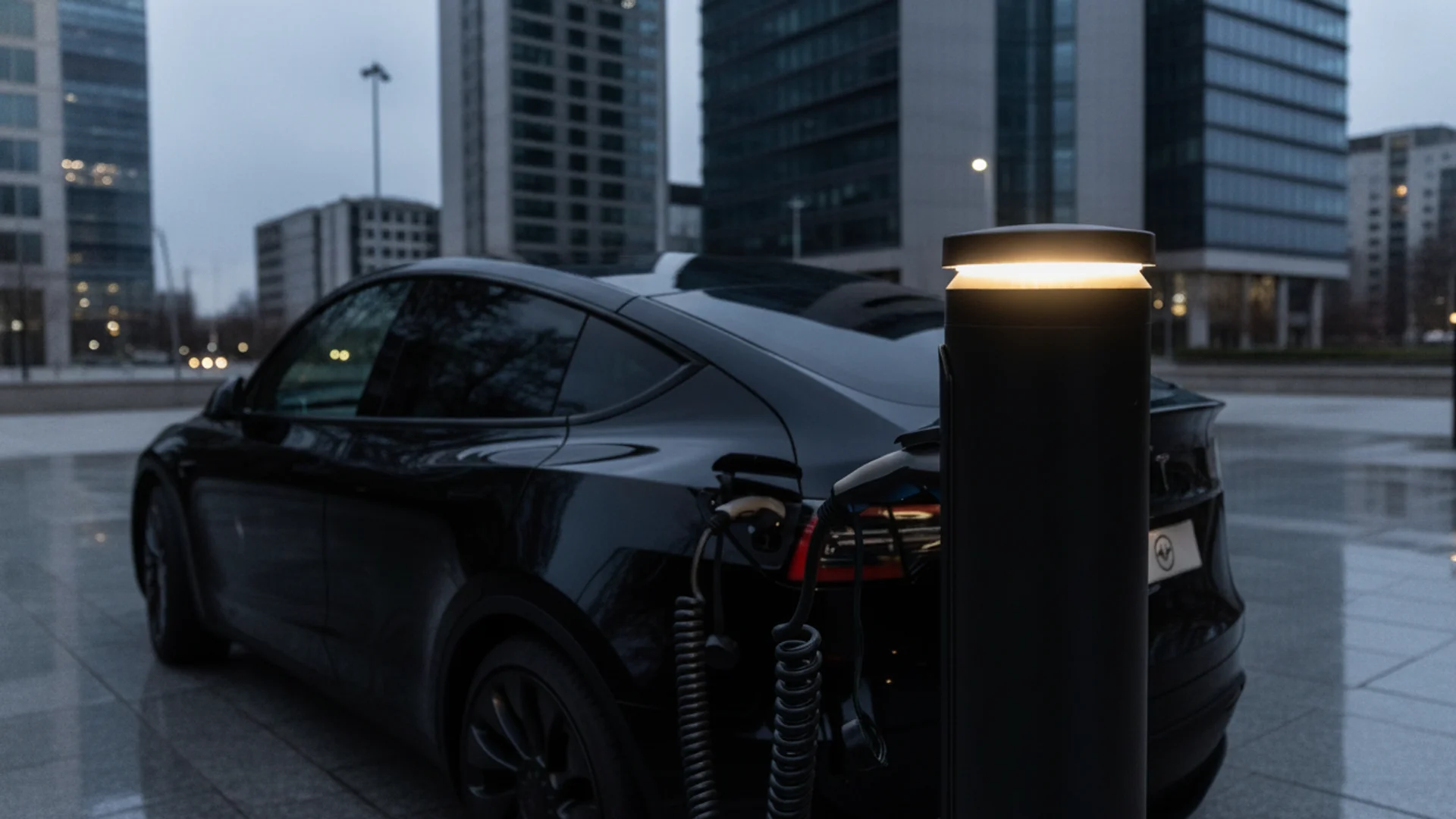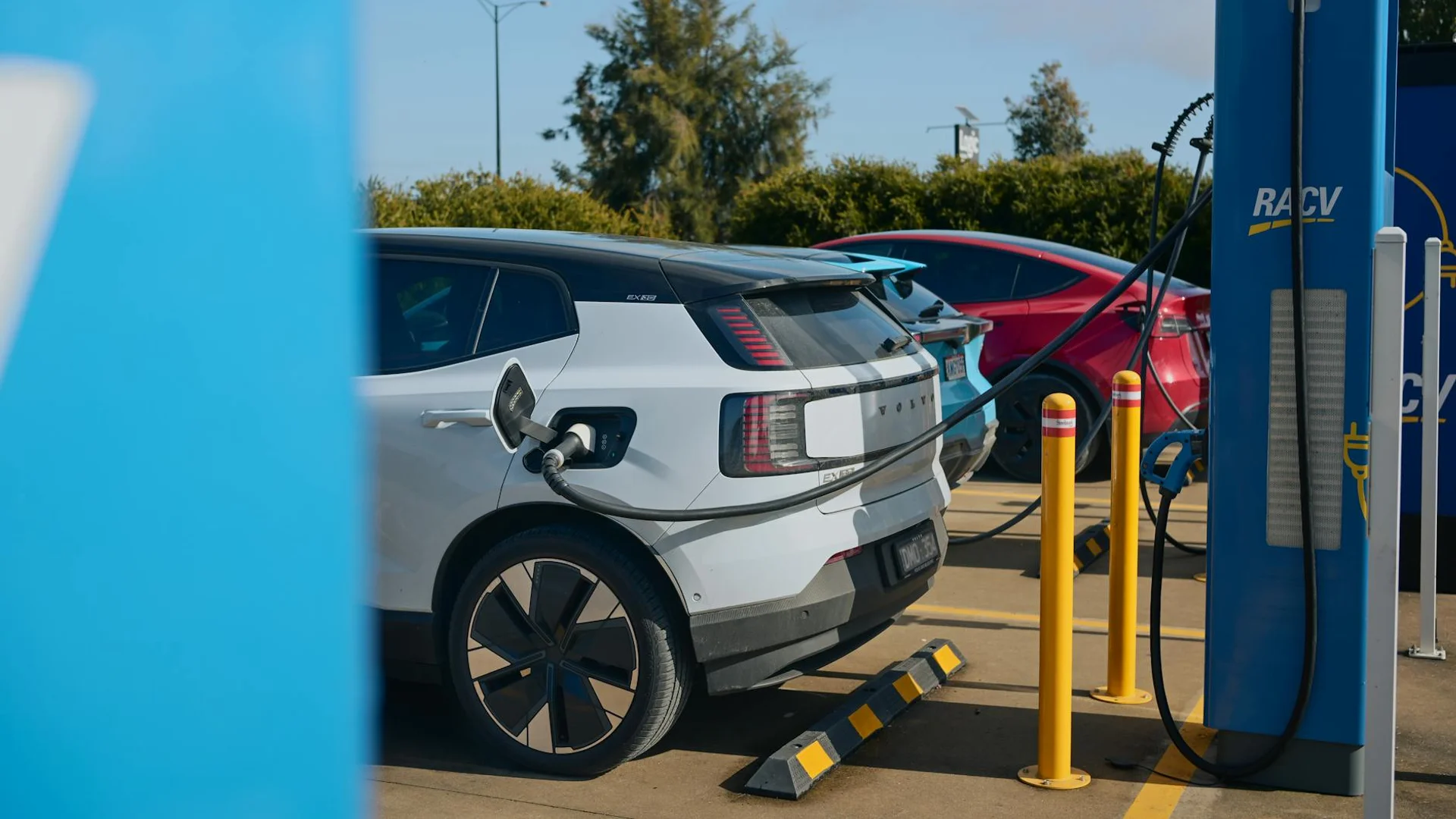
A 2025 Hyundai Ioniq 5 plugged into a campground 30A post should pull 3.6 kW. The owner saw 1.8 kW. No fault codes. No red lights. Just a car that decided, quietly and unilaterally, to ignore half the electricity the post was advertising.
That number, 1.8 kW, is not random. It is the precise output of a three-layer negotiation that the driver cannot see and the dashboard will not narrate. A campground breaker designed for a 1990s RV air conditioner. A Tesla Mobile Connector engineered around Tesla's own pilot-signal stack. A Hyundai onboard charger reading a J1772 handshake through two adapters and a TT-30 dongle. Three engineering lineages that were never meant to meet, meeting anyway, and one of them flinching first.
The story most owners tell themselves when this happens is that the car is broken. The car is not broken. The car is doing exactly what it was designed to do when it cannot trust what the wall is telling it. Understanding which layer flinched, and why, is the difference between buying a new charger you do not need and fixing a five-dollar adapter mismatch in your trunk.
Key takeaways
- A 30A campground post's usable ceiling is 2.88 kW, not 3.6 kW, due to the 80% continuous-load rule.
- A wrong or drifted resistor in a TT-30 adapter collapses J1772 pilot negotiation to the 6A safe fallback.
- The Ioniq 5 saw 1.8 kW because two adapters, Tesla Mobile Connector plus a NACS-to-J1772 dongle, broke the handshake.
- A Tesla Model 3 loses roughly 20% DC speed through a CCS adapter for the same architectural reason: untrusted protocol translation.
- Below about 5°C an NMC pack derates AC charge acceptance by 20–40% to protect the cells, and the car never tells you, a deliberate safety behaviour rather than a fault.
The Promise on the Label vs. What Actually Flows
A campground post rated for 30A at 120V is selling you 3.6 kW on paper. The arithmetic is honest, 30 amps multiplied by 120 volts equals 3,600 watts. The arithmetic is also, in a meaningful sense, a fiction. North American electrical code requires continuous loads to run at 80% of breaker capacity, which means a 30A circuit has a usable ceiling of 24A. That is 2.88 kW before any other variable enters the conversation. The label promised 3.6. The reality, with everything working correctly, was always 2.88.
This is the first place charging speed gets quietly compressed, and most owners do not know it is happening. RV parks publish the breaker rating. The car reports actual draw. The difference between the two is invisible unless you have done the math.
The case against worrying about this gap is straightforward: 2.88 kW is still 2.88 kW, the breaker derating is conservative for good reasons, and a campground charge is supplemental anyway. That argument holds until you realize the math the driver actually wants to do is "how many hours until I can leave," and the gap between 3.6 and 2.88 is the difference between a 25% overnight gain and a 20% one. On a 77.4 kWh Ioniq 5 pack, that is a one-stop versus two-stop morning. The derating is not a rounding error, it is a route-planning input that most owners have never been told to incorporate.
Now stack a TT-30-to-NEMA-14-50 adapter onto the post. The TT-30 plug is a 30A 120V RV connector, three prongs, one hot leg, no neutral split. The 14-50 receptacle the Tesla Mobile Connector expects is a 50A 240V dryer-style outlet, two hot legs and a neutral. The adapter is, in physical terms, a translator between two completely different electrical architectures. It cannot manufacture a second hot leg. It cannot turn 120V into 240V. What it can do, and what a properly built adapter does, is carry a small resistor that tells the Mobile Connector "the circuit downstream of me is rated for 24A on a single 120V leg."
When that resistor value is correct, the Mobile Connector advertises 24A to the car via the J1772 pilot signal. When the resistor is wrong, missing, or interpreted ambiguously, the Mobile Connector falls back to a defensive default. The car obeys that default. The dashboard shows the result without explanation.
The Ioniq 5's onboard charger can accept up to 11 kW on an appropriately wired 240V circuit. That capability is irrelevant at a 120V campground post. The onboard charger does not negotiate up; it negotiates down. It can never draw more than the EVSE advertises, and it will draw less if it has any reason to suspect the advertisement.
The 1.8 kW number is what happens when "any reason to suspect" gets triggered.
How Onboard Chargers Negotiate the Session
Every EV onboard charger reads two pieces of information from the EVSE before it allows current to flow: the J1772 pilot signal duty cycle and the proximity detection signal. The pilot signal is a 1 kHz square wave whose duty cycle encodes the maximum current the EVSE is offering. Ten percent duty cycle equals 6 amps. Fifty percent equals 30 amps. The relationship is linear, deterministic, and published, and it is also where most cross-vendor charging sessions quietly fail.
The Tesla Gen 2 Mobile Connector was engineered to broadcast a duty cycle that matches whatever physical adapter is connected to its head. Plugged into a 14-50 receptacle directly, it advertises 32A. Plugged into a 5-15 (standard household outlet) adapter, it advertises 12A. Plugged into a TT-30 adapter, it should advertise 24A. That "should" is doing real work in this sentence.
If the TT-30 adapter Tesla shipped is genuine and the Mobile Connector's firmware has the correct mapping for that adapter's resistor value, the chain works. If the adapter is third-party, if the resistor has drifted, or if a downstream adapter (Tesla NACS to J1772, in this case) introduces a different resistor value the Mobile Connector did not expect, the negotiation collapses to the safe fallback.
The safe fallback in the J1772 specification is 6 amps. That is the minimum current any compliant EVSE will offer when it cannot confidently identify the circuit downstream of it. Six amps at 120V is 720 watts of pilot-signal authorization, but the Ioniq 5's onboard charger has efficiency losses, the BMS has its own arbitration layer, and the actual current the pack accepts settles somewhere between 12A and 15A when the EVSE permits it.
Run that math the other direction and 1.8 kW becomes legible. At roughly 15A drawn × 120V × ~95% conversion efficiency, you get 1.71 kW. Round up for measurement tolerance and that is the number on the dashboard. The car is not slow. The car is doing exactly what a safety-conscious onboard charger does when it sees an EVSE it does not fully trust: it takes the minimum, holds steady, and waits for a clearer signal that never arrives.
Tesla's pilot-signal stack and Hyundai's onboard charger were not co-engineered. They were both designed to the same SAE J1772 standard, but standards leave room for interpretation, and adapters live entirely inside that room. A Tesla-to-Tesla session is clean because Tesla controls both ends of the conversation. A Tesla-to-Hyundai session through two adapters is an unrehearsed translation between two engineering teams that have never spoken to each other.
Compare this to a Tesla Model 3 in the inverse scenario, a Tesla pulling DC power through a CCS adapter at a non-Tesla fast charger. The breakdown of the CCS-to-NACS adapter problem documented that a Model 3 capable of 250 kW on a Supercharger may only achieve 180 kW through a CCS adapter, roughly 20% slower. The direction of the translation has changed; the architecture of the problem has not. Every time a vehicle from one ecosystem reaches into another through a third-party adapter, the protocol negotiates down to the floor that both sides can prove is safe. The 1.8 kW campground experience and the 180 kW CCS-adapter experience are the same engineering phenomenon at different scales.
The car defaulting to 6A is not a bug. It is the architectural feature that prevents an unrehearsed translation from setting your campground on fire.
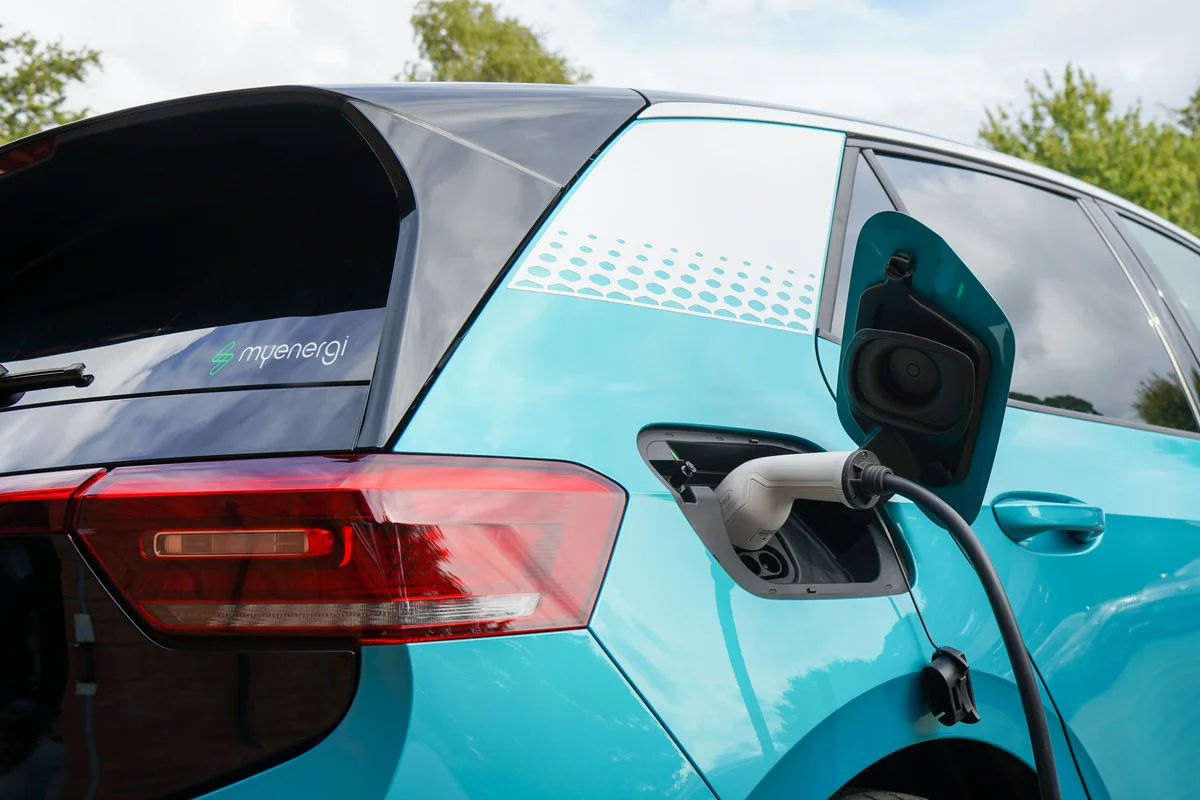
Gear worth having
As an Amazon Associate, ThinkEV earns a small commission from qualifying purchases — at no extra cost to you.

Portable Level 2 EV Charger (40A, NEMA 14-50)
Throw it in the trunk and charge anywhere with a 240V outlet. 40A portable with NEMA 14-50 plug. Your road-trip insurance policy.
As an Amazon Associate, ThinkEV earns from qualifying purchases — at no extra cost to you.
The Adapter Layer: Where Charging Philosophy Gets Lost in Translation
Tesla and Hyundai think differently about what an EVSE is supposed to communicate. Tesla's Mobile Connector treats the wall as a configuration to be probed, the connector identifies its own adapter, identifies the receptacle, and broadcasts a duty cycle calibrated to that combination. Hyundai's onboard charger treats the EVSE as an authority, whatever the pilot signal advertises is the offer, and the OBC accepts up to that ceiling without second-guessing the source.
This is a philosophical difference, not a technical one. Tesla wants vertical integration; the connector is part of the car's charging experience, and Tesla's engineers know what every adapter in their accessory catalogue does. Hyundai wants horizontal compatibility; the OBC should work with any J1772-compliant EVSE because the standard says it should. Both philosophies are defensible. Neither philosophy survives contact with the other when a third-party adapter chain enters the picture.
A correctly built NEMA 14-50 to J1772 adapter carries a resistor inside its body that tells the EVSE what the downstream connector is rated for. A correctly built TT-30 to 14-50 adapter does the same in the opposite direction, it tells the upstream EVSE what the receptacle is rated for. Stack both adapters and you have two resistor values in series, two pieces of metadata the Mobile Connector has to reconcile, and a real chance that the firmware will not have a clean rule for what to do.
There is a counter-argument worth taking seriously here: Tesla owners run TT-30 adapters at campgrounds every weekend without seeing 1.8 kW collapses, so the Mobile Connector's adapter logic is clearly not as fragile as this section implies. That objection is correct on its own terms, and it is also the point. A Tesla-to-Tesla TT-30 chain has one resistor in series, not two. The collapse happens specifically when a Tesla-to-J1772 adapter gets bolted onto a Mobile Connector that was already negotiating a TT-30 step-down. Add a third adapter to that chain and you do not get 1.8 kW; you get nothing at all, because some firmware revisions refuse to start the session. The fragility is real. It is also non-linear, and the Tesla-only owner never sees it because they have never asked the connector to translate twice in the same handshake.
When the firmware does not have a clean rule, it defaults down. Always down. The J1772 standard was written by engineers who knew exactly how owners would abuse it, and the safe fallback is the standard's gift to anyone who plugs a $14 adapter into a $400 connector and expects the result to be specified behaviour.
The 1.8 kW experience is the standard working correctly. Three engineering lineages, two adapters, one breaker rated for an RV air conditioner, and the system's response is to deliver less power than any single component is theoretically capable of providing. That is not a failure mode. That is the failure mode the standard was designed to produce.
The fix is not a better car. The fix is removing a layer from the translation chain. A direct 14-50 receptacle, an EVSE wired for the Ioniq 5's expected pilot-signal handling, or a J1772-native portable charger that does not require Tesla-to-J1772 conversion at all, any one of these collapses the negotiation back to a two-party conversation the OBC can trust. The adapter layer is the one most owners can fix without buying anything more expensive than the cable they already own; the next layer down is the one the car itself imposes, and it does not care what the wall is offering.
Battery State, Temperature, and the Car's Own Throttle
The wall is one throttle. The battery is another, and it is the one most owners forget exists on Level 1 and Level 2 sessions.
Most discussion of charging speed limits focuses on DC fast charging, the famous taper above 80% state of charge that turns a 30-minute Supercharger stop into a 45-minute one if you wait too long. ThinkEV has covered that taper in the public-charging-etiquette guide, and the curve is well documented; on a Tesla Model Y, charging speed tapers above 80% from 250 kW to under 50 kW, and on a Chevy Equinox EV the last 20% on a DC fast charger takes 30 minutes or more by itself. What is less well known is that AC charging has its own taper, smaller but real, and the battery management system enforces it whether the driver knows or not.
Above roughly 80% SOC on an NMC pack, the BMS begins requesting reduced current from the onboard charger. The reduction is gentler than the DC fast-charge taper, typically 10–15% rather than the 60–70% cliff a DC session sees, but it is enough to make a campground charging session that started at 1.8 kW finish at 1.4 kW without anything else changing. The car's own management of cell balance, calendar aging, and lithium plating risk takes priority over the driver's interest in a full battery by morning.
Gear worth having
As an Amazon Associate, ThinkEV earns a small commission from qualifying purchases — at no extra cost to you.

TP-Link Kasa Smart Plug with Energy Monitoring
Track exactly how much electricity your Level 1 charger uses and schedule it for off-peak hours. Know your real cost per kWh.
As an Amazon Associate, ThinkEV earns from qualifying purchases — at no extra cost to you.
Temperature is the second BMS throttle, and at a campground in spring or fall in Canada it is the one most likely to be invisibly active. The Ioniq 5's NMC chemistry performs better than LFP in cold weather, but "better than LFP" is not the same as "indifferent to temperature." Below roughly 5°C ambient, an NMC pack will derate AC charge acceptance by 20–40% to protect cell longevity. The car does not announce this. It simply asks for less current, and the onboard charger delivers what the BMS asks for.
The cold-weather charging math walks through the DC fast-charge version of this story. The AC version is gentler and more persistent, a 0°C overnight at a campground will give you a slower charge from the moment you plug in until the cells warm, which on a 1.8 kW trickle may take hours longer than the driver expects.
The implication is uncomfortable but useful: the 1.8 kW reading on a cold campground morning is the sum of an adapter-chain negotiation defaulting low and a BMS asking for less. If you fix only one of those throttles, the other remains. If you fix neither, the car will charge the way it is charging.
A useful comparison sits one model down the price ladder. The BYD Dolphin's onboard charger taps out at a maximum DC charging speed of 88 kW, with a 10-to-80% charge taking 30 to 35 minutes in summer, and the Dolphin Canadian review confirmed that same charge stretches to 40 to 50 minutes in cold weather. That is a 33% time penalty for ambient cold on a chemistry (LFP, in the Dolphin's case) explicitly chosen because it tolerates daily 100% charging. The Ioniq 5's NMC pack derates faster and recovers faster, but the architecture of the penalty is identical: pack temperature is a throttle the driver does not see, on a curve that varies by chemistry but never disappears. Anyone who tells you Level 1 charging at a Canadian campground in May will deliver the same kilowatt-hours overnight as a July session has not done the cell-temperature math.
Gear worth having
As an Amazon Associate, ThinkEV earns a small commission from qualifying purchases — at no extra cost to you.
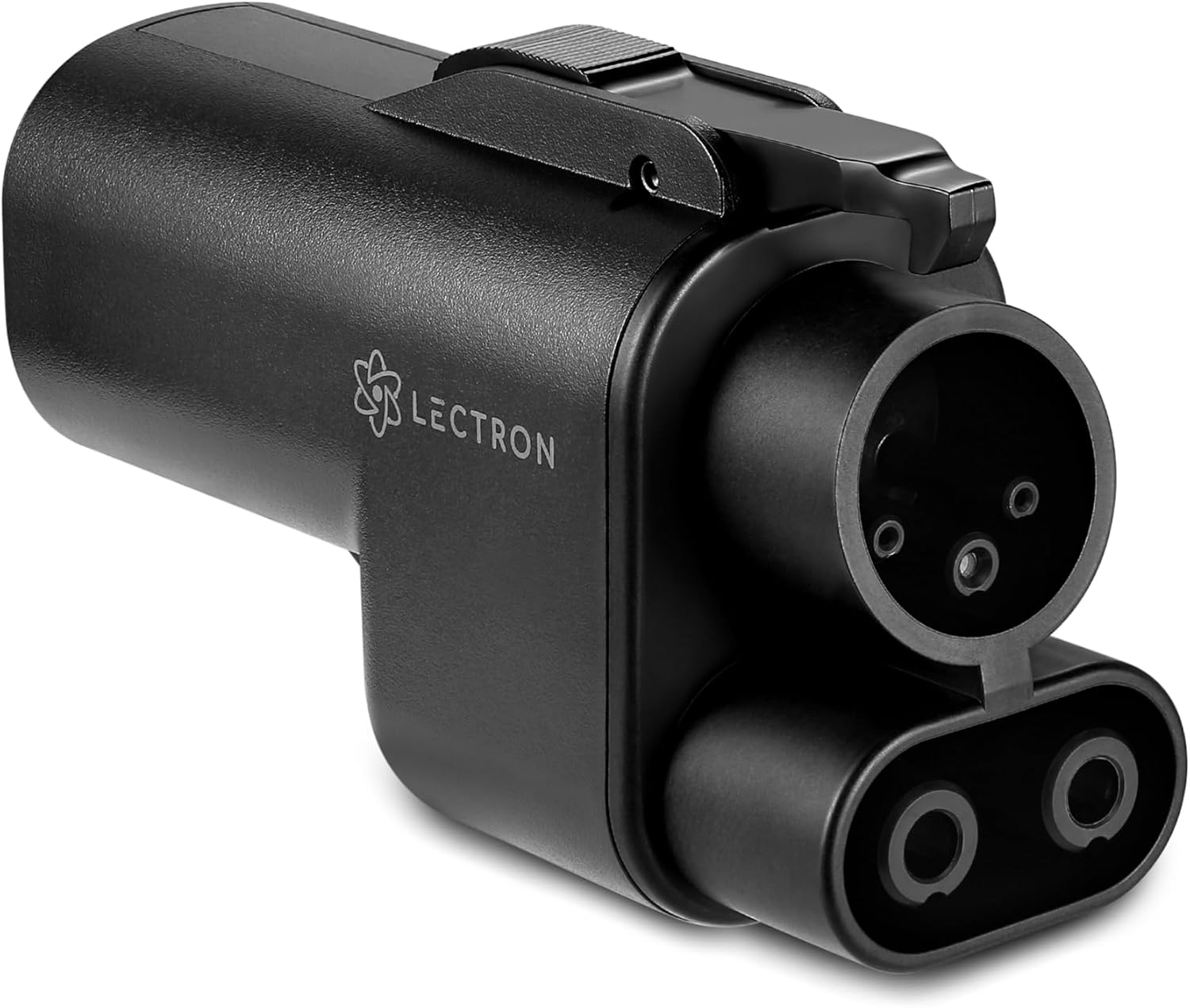
Lectron NACS to CCS Fast-Charge Adapter
Unlock every CCS fast charger for your Tesla, up to 500A DC. Never get stranded at a non-Tesla DC station again.
As an Amazon Associate, ThinkEV earns from qualifying purchases — at no extra cost to you.
What the Dashboard Isn't Telling You, and Why
A Hyundai Ioniq 5 dashboard shows charging power in kilowatts and estimated time to full. It does not show pilot-signal duty cycle. It does not show BMS-requested current. It does not show ambient cell temperature against the derating threshold. It does not show whether the EVSE upstream is offering 24A, 16A, or 6A. The driver sees the result of the negotiation, never the negotiation itself.
This is a design choice, and a defensible one. The vast majority of EV owners never plug into anything more exotic than their home Level 2 charger and the occasional public station. For that population, the negotiation is invisible because it is uneventful, the EVSE advertises its rated current, the OBC accepts it, and the dashboard reports the obvious result. Surfacing the protocol layer would clutter the UX for 99% of sessions to inform 1%.
The 1% who plug into campground posts through adapter chains pay the cost of that design choice. The cost is opacity, there is no factory-supplied way to know whether the 1.8 kW reading is a pilot-signal default, a BMS limit, or an adapter resistor mismatch. The car will charge. The car will not explain.
Third-party tools fill the gap. An OBD-II adapter paired with software like Car Scanner or the Hyundai-specific protocol decoders can surface the BMS's requested-current value in real time. A J1772 EVSE tester, a $40 device that plugs into the connector head and reports the advertised duty cycle, confirms what the EVSE is offering before the car ever sees it. Neither tool is intuitive. Neither tool is marketed to drivers. Both tools exist because the engineers who designed this protocol knew the diagnostic layer would be needed by someone, eventually, and decided that someone was not the average driver.
The defence of this opacity is that automakers who do surface protocol-layer diagnostics, some Tesla service-menu screens, some aftermarket Ford Lightning logging tools, get blamed by owners for charging sessions the car correctly throttled. A dashboard that says "BMS limiting current due to cell temperature below 5°C" is technically informative and practically a customer-service ticket, because the owner will read it as a malfunction rather than a feature. Hyundai's silence is rational. It is also the reason owner threads asking "why am I charging slow?" close with three sympathetic replies and no diagnosis, while the engineers who could explain the system in two paragraphs are behind a service-menu password the dealer will not share.
The absence of a diagnostic message on the Ioniq 5 dashboard does not mean nothing is wrong. It means the system is working exactly as designed, which is to deliver the minimum safe current under ambiguous conditions and not narrate the ambiguity to the driver. The narration is available. It is just not factory-installed.
Diagnosing Your Actual Bottleneck in Three Steps
Three steps isolate the three layers. Each step is independent of the other two, which means a clean test in any one of them eliminates that layer from the suspect list.
Step one: confirm what the EVSE is actually offering. A J1772 tester plugged into the connector head reports the advertised current, the pilot-signal duty cycle the EVSE is broadcasting before the car ever connects. A clamp meter on the cable during an active charge session reports the actual amperage flowing. The two instruments answer different questions. If the tester says 24A advertised and the clamp meter reads 24A drawn, the wall is not the problem. If the tester says 6A advertised, the adapter chain has already collapsed the negotiation and nothing downstream will recover it. If the tester says 24A but the clamp meter reads 15A, the EVSE is offering full current and the car is choosing to take less, which points at the BMS.
Step two: rule out BMS limiting with a clean baseline. Start a fresh session with the battery between 20% and 60% state of charge, in an ambient environment above 15°C, on a known-good Level 2 charger at home or a public station. If the car accepts full rated current under those conditions, the BMS is healthy and any limiting on the campground session was situational, not mechanical. If the car still draws low under clean conditions, the OBC or BMS itself needs a dealer diagnostic.
Step three: swap the adapter chain. A J1772-native portable EVSE, one designed to plug into a 14-50 or TT-30 receptacle directly and emit a J1772 pilot signal without Tesla in the middle, is the cleanest test. If the same campground post delivers 2.88 kW through a J1772-native EVSE and 1.8 kW through the Tesla Mobile Connector chain, the Tesla adapter is the bottleneck. The Mobile Connector is not defective; it is calibrated for a Tesla-to-Tesla world that the campground post is not part of.
The order matters. Test the wall first, the car second, the adapter third, because a problem in layer one will produce confusing results in tests two and three, and a problem in layer two will mask whatever the adapter is doing. Isolate cleanly. The 1.8 kW number stops being a mystery the moment you know which of the three layers is producing it.
Gear worth having
As an Amazon Associate, ThinkEV earns a small commission from qualifying purchases — at no extra cost to you.

Tesla Key Card Holder with AirTag Slot
Stop fishing the keycard out of your wallet, and slot an AirTag in case the car wanders off in a lot.
As an Amazon Associate, ThinkEV earns from qualifying purchases — at no extra cost to you.
The Bigger Picture: Charging Infrastructure Was Never Designed to Be Universal
The campground 30A post was installed for a 1990s RV. Its purpose was to power an air conditioner, a microwave, and a string of incandescent bulbs. It was wired to a code written before lithium-ion was a consumer technology, by electricians who had never heard of pilot signals, for vehicles whose only electrical demand was resistive heating and capacitor-start motors.
The Tesla Mobile Connector was designed for Tesla owners charging Tesla vehicles in driveways and garages, with Tesla's accessory adapters mediating between Tesla's pilot-signal stack and a handful of common North American receptacles. The Ioniq 5's onboard charger was designed for the SAE J1772 specification, with the assumption that whatever EVSE was upstream had been engineered for J1772 from the ground up.
Three engineering lineages. None of them designed to meet the other two. All of them, in this campground scenario, doing exactly what they were specified to do, and the specification's polite collision is 1.8 kW. The system did not fail. The system was never promised to succeed. The complete charging guide for Canada maps the network layer of this problem; the protocol layer is the part most owners never have to think about, until they do.
The lesson is small and useful. Slow charging is almost never a broken car. It is a system that worked exactly as designed, defaulting to the safest available behaviour when one of its inputs was ambiguous. Knowing which input flinched, wall, battery, or adapter, is the entire diagnosis. Everything else is buying hardware the owner did not need.
What I would bet on, and what would change my mind: portable EVSE manufacturers are starting to build J1772-native units with onboard pilot-signal logging and Bluetooth diagnostics. When that becomes standard rather than a $300 enthusiast purchase, the 1.8 kW mystery goes away, not because the protocol changes, but because the driver finally gets to see the protocol the engineers have been having behind the dashboard the entire time. I would watch two specific signals over the next 18 months. The first is whether any mainstream automaker, Hyundai, Ford, GM, ships a software update that surfaces BMS-requested current in a customer-facing screen. If one does and the resulting service-ticket volume is manageable, the rest will follow within a model year. The second is whether the next generation of Tesla Mobile Connector successors (now that NACS is the de facto North American standard) ship with logging hardware that records every pilot-signal handshake to a paired phone.
The hardware cost is trivial; the legal and warranty implications are not. The day a $200 portable charger ships with a "show me the handshake" button is the day this post becomes obsolete, and I will be relieved to retire it. Until then, the cars are not the problem. The translators between them are, and the translators are about to get a lot more honest about what they are translating.
Bottom line: the car is not slow. The system is doing what the system was designed to do. Fix the layer that flinched.
Gear worth having
As an Amazon Associate, ThinkEV earns a small commission from qualifying purchases — at no extra cost to you.
Spigen Tempered Glass for Tesla Model 3/Y
Tempered-glass protection for the touchscreen that kills fingerprints and scratches. Two minutes to install, lasts the life of the car.
As an Amazon Associate, ThinkEV earns from qualifying purchases — at no extra cost to you.

Founder & Chief Editor
Vlad Pereira is the founder and chief editor of ThinkEV.ca, the Canadian electric-vehicle publication he writes and edits from Courtenay, British Columbia. He covers EV pricing, federal and provincial rebates, charging costs, and the Chinese manufacturers now entering Canada, from the buyer's side rather than the press-fleet side. ThinkEV is a venture of Vlad Pereira Online; his writing on health, income and the long game lives at vladpereira.com.
Frequently asked questions
Does cold weather make this three-layer problem worse?
Will a dedicated Level 2 EVSE eliminate the adapter problem?
How do I know which layer is actually causing slow charging?
Can I safely pull more than 80% on a campground circuit?
Does buying a more expensive adapter actually help?
More EV & road-trip finds
Affordable upgrades worth a look — tap any to check the price on Amazon.
 ★ 401
★ 401Crochet Daisy Rear-View Mirror Charm
View on Amazon ★ 12,396
K KNODEL Car Trash Can with Lid
View on Amazon ★ 55,938
WixGear Magnetic Air Vent Phone Mount (2-Pack)
View on Amazon ★ 61
★ 61Toddler Car Seat Snack and Cup Tray
View on Amazon ★ 17,839
Qifutan Vent Phone Mount (Military-Grade Clip)
View on Amazon ★ 47,507
HOMEXCEL Microfiber Cloths (12-Pack)
View on Amazon ★ 419
★ 419RGB Car Interior LED Strip Light
View on Amazon ★ 900
★ 900Personalized Photo Car Air Freshener
View on AmazonRead, Plan, Then Stay Current
Explore our expert articles to understand incentives and ownership costs, use the map to pressure-test charging reality, then subscribe so new EV coverage comes straight to you.
Continue Reading
Which EVs Should Be Charged to 100%? The LFP Exception
EV Charging Connectors Explained: NACS, CCS, and J1772
NIO Battery Swap: How It Works and Why It Scales in China
Public EV Charging in Canada: Networks and Payment
Public EV Chargers in Canada: 33,000 Now, 447,000