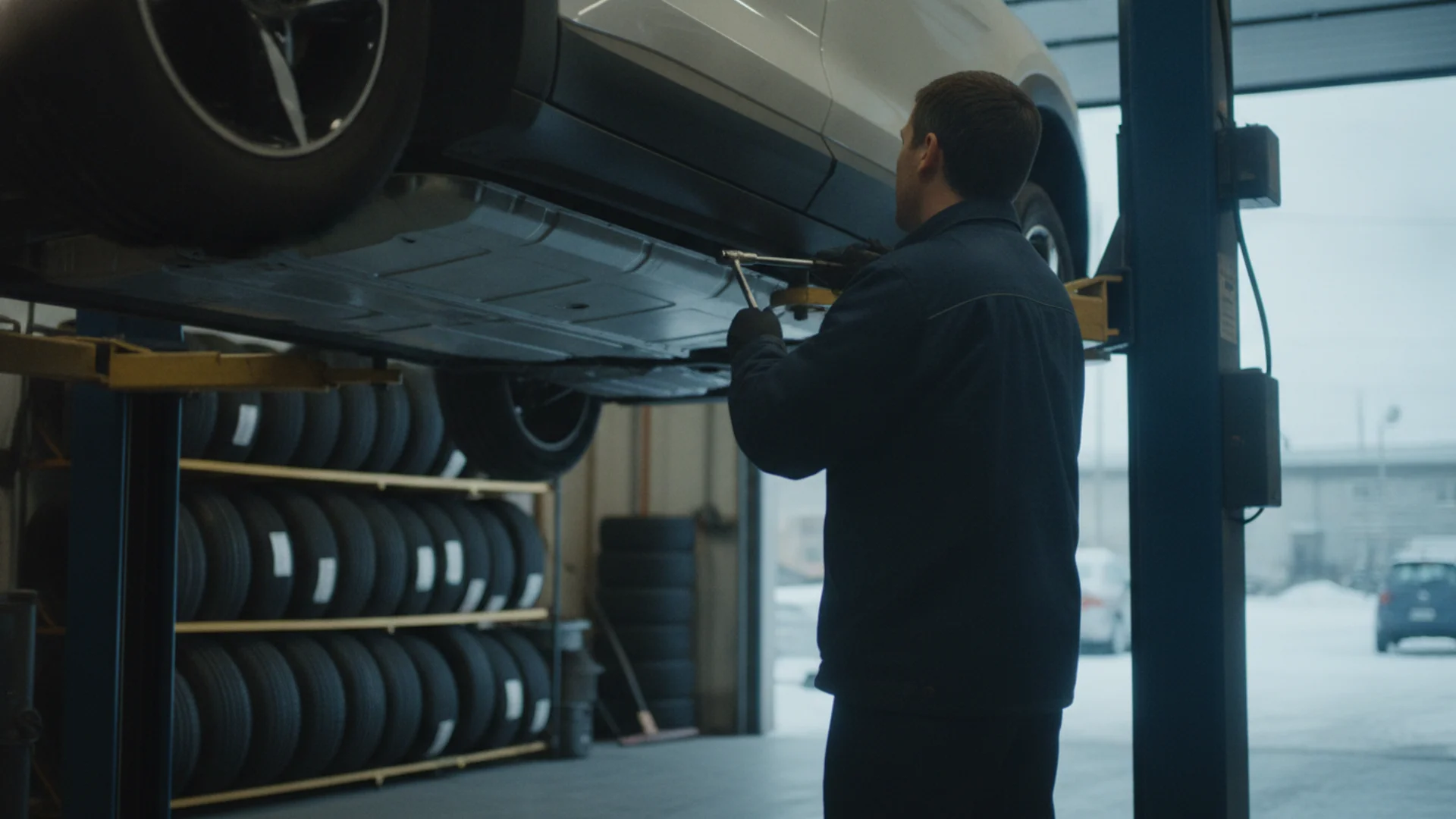
Your 2019 Honda Civic will never gain a new safety feature. A 2024 Tesla can. That gap has a name, and the name is doing a lot of quiet work in every EV buying decision made in Canada right now.
The term is software-defined vehicle. A software-defined vehicle is an automobile that implements core functions in software instead of hardware, and the practical consequence is that the car you take delivery of in July is not necessarily the car you drive in December. Capability has been separated from the metal it rides on.
Key takeaways
- Ford's BlueCruise hands-free geofence quietly expanded from 130,000 to over 210,000 miles via OTA alone.
- A legacy car spreads its brain across 70–150 ECUs; a true SDV consolidates onto three to five domain controllers.
- Lucid's Gravity SUV carried hands-free driving hardware for fourteen months before the software finally shipped via update.
- Transport Canada has no SDV-specific framework, so Canadian buyers get U.S. NHTSA disclosure rules by default, nothing more.
- Software support lifecycle is joining battery degradation as the second variable that will define used EV resale value.
Quick Answer: What Makes a Car Software-Defined
An SDV runs its core vehicle functions, braking behaviour, driver-assistance logic, infotainment, energy management, as software on a small number of central compute nodes, rather than as fixed logic burned into dozens of dedicated microcontrollers. The main features range from update capabilities to AI control on multiple levels.
Three properties define it:
- Central compute over distributed ECUs. A legacy car spreads its brain across 70 to 150 electronic control units, each hardwired to one function. An SDV consolidates onto three to five domain controllers.
- Over-the-air updates as a first-class capability. The car is designed from the wiring up to accept remote software changes, not retrofitted with a patch mechanism as an afterthought.
- Hardware as a platform, not a product. The sensors, motors, and battery are the substrate. The product, the driving experience, the feature set, the safety envelope, evolves after the sale.
That last point is where the industry actually splits. Every automaker now ships OTA updates for the infotainment stack. Very few have re-architected the vehicle so that a firmware push can retune the ADAS behaviour, expand a hands-free geofence, or change how the battery balances cells in cold weather. The SDV represents a paradigm shift in automotive engineering, and paradigm shifts don't finish on a press-release schedule.
Gear worth having
As an Amazon Associate, ThinkEV earns a small commission from qualifying purchases — at no extra cost to you.

Lectron Level 2 J1772 Charger (40A, WiFi)
Smart WiFi charger with real-time energy monitoring. 40A / 9.6 kW, J1772 with a NEMA 14-50 plug, schedule charging right from your phone.
As an Amazon Associate, ThinkEV earns from qualifying purchases — at no extra cost to you.
The Architecture Shift: From ECUs to Central Compute
A modern passenger car carries roughly 200 million lines of code, which is about 33 times what runs a Boeing 787. That number is not a vanity metric. It is the reason the old architecture, one small computer per function, all of them talking over a CAN bus that was designed in 1986, has run out of room.
The SDV answer is zonal architecture. Instead of 100-plus ECUs scattered across the vehicle, each with its own wiring loom, the car is divided into physical zones (front, rear, left, right, roof) with a zone controller in each, all reporting up to one or two high-performance compute nodes running something closer to a general-purpose operating system than to embedded firmware. The compute silicon is familiar if you've been paying attention to the broader industry, Nvidia's Orin family and Qualcomm's Snapdragon Ride are the two names doing most of the work at the platform level.
The consequences ripple outward. The wiring harness, historically the third-heaviest component in a car after the body and the powertrain, gets shorter and lighter. Supply chains simplify because five compute variants replace a hundred bespoke ECU designs. Diagnostics improve because the whole vehicle state lives in one place. And the software team, for the first time, can ship a feature without waiting on a hardware revision.
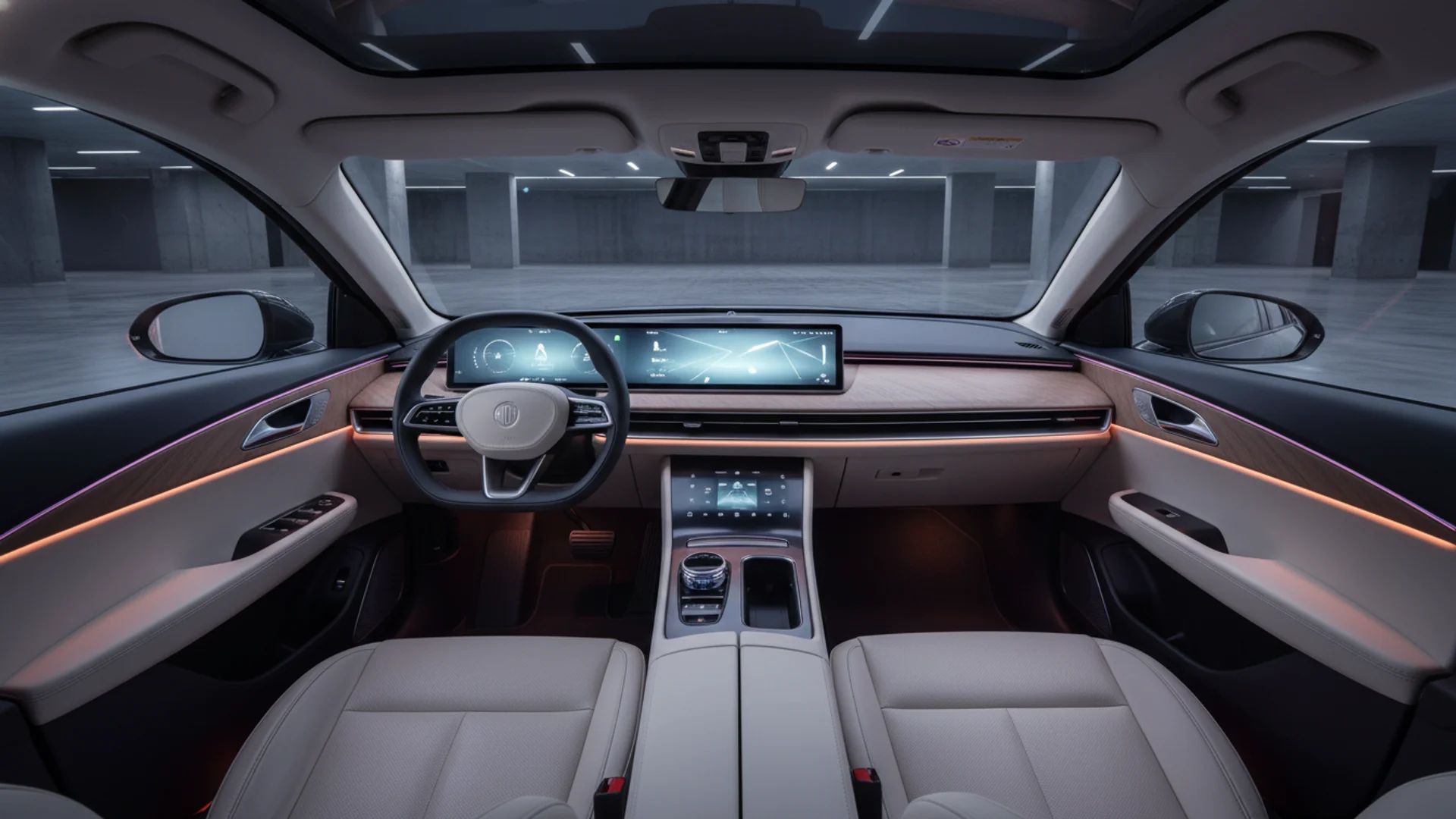
This is also why the small story of a Nintendo Switch running on a Nio Firefly's centre screen is really a manufacturing-philosophy story. Casting a game console to the infotainment is trivial. Doing it via a software update that reaches every car on the road within a week is the SDV thesis in miniature.
The transition is not free. Consolidating dozens of vendors' ECUs onto one compute platform means the automaker now owns integration risk it used to distribute. Volkswagen's CARIAD division and Stellantis's STLA Brain programme have both slipped multiple times for exactly this reason. Building a car is one problem. Building a computer that happens to be a car is a different one.
OTA Updates: What They Can and Cannot Change
The interesting question about over-the-air updates is not what they can do. It is what they cannot.
What OTA can change: ADAS calibration thresholds, torque maps, regenerative-braking curves, charging-curve behaviour, hands-free driving geofences, HMI layouts, driver-profile logic, and, increasingly, the tuning of the battery management system's cell-balancing routines. Tesla's Full Self-Driving behaviour changes push-to-push. Ford's BlueCruise geofence has quietly grown from 130,000 to over 210,000 miles of pre-mapped highway since launch. GM's Super Cruise map expansions arrive the same way. Lucid took fourteen months to bring hands-free driving to the Gravity SUV via UX 3.6, a feature the hardware was carrying the whole time, waiting on the software to ship.
What OTA cannot change: the sensor suite, the motors, the battery cells, the pack chemistry, the physical brake hardware, or anything else made of atoms. A car that shipped with a single front-facing camera will not get surround-view via Wi-Fi. A 400-volt architecture will not become 800-volt overnight. This is the honest ceiling on the SDV promise, and it is worth being clear about before a salesperson tells you the car will "get better forever."
Regulators are catching up unevenly. In the United States, NHTSA's Standing General Order on Crash Reporting explicitly captures OTA changes to safety-critical systems, and manufacturers must disclose when a push touches Level 2 driver assistance. Transport Canada has no SDV-specific framework and defers to the CMVSS-CFR harmonization treaty, which means Canadian buyers get the American disclosure regime by default, without a Canadian layer of oversight. That is not necessarily bad. It is worth knowing.
The subscription-model risk is the elephant in the room. BMW's heated-seat paywall was the canary, retracted after public backlash, but the architectural capability didn't go anywhere. Mercedes still charges an annual fee to unlock the EQS's rear-axle steering angle beyond a token amount. Once the car is software-defined, any feature the automaker chooses to gate becomes a recurring revenue line. This is not a technology problem. It is a business-model problem the technology enables.
Gear worth having
As an Amazon Associate, ThinkEV earns a small commission from qualifying purchases — at no extra cost to you.

USB-A to USB-C CarPlay Adapter (3-Pack)
Older car USB port, newer USB-C cable: this tiny bridge makes wired CarPlay just work. Three so you never lose the one.
As an Amazon Associate, ThinkEV earns from qualifying purchases — at no extra cost to you.
Gear worth having
As an Amazon Associate, ThinkEV earns a small commission from qualifying purchases — at no extra cost to you.

PULIDIKI Car Cleaning Gel (Detailing Putty)
Press it into vents, buttons, and seams and it lifts out dust you did not know was there. Weirdly satisfying, genuinely useful.
As an Amazon Associate, ThinkEV earns from qualifying purchases — at no extra cost to you.
What This Means for EV Buyers Right Now
Battery degradation used to be the single variable that determined an EV's five-year resale value. It is about to be joined by a second one: software support lifecycle.
A Tesla Model 3 built in 2019 still receives feature updates six years in. A 2019 Jaguar I-Pace does not, because the underlying architecture was never designed to accept them. Both cars have healthy batteries. Only one is still improving. The used-market gap between the two has widened accordingly, and it will keep widening for every model that shipped without a real OTA stack.
For a buyer walking into a Canadian dealership this year, the practical filter is this: do not compare sticker prices alone. Compare software roadmaps. Ask the salesperson to name the last three OTA updates the model received, and what they changed. If the answer is "the map data" and "a bug fix in the radio," the car is not software-defined in any meaningful sense, it's a conventional vehicle with a modem.
The manufacturer split, roughly, in mid-2026:
- SDV-native by default: Tesla, BYD, Xpeng, Nio, Rivian, Lucid, Zeekr. Central compute, real OTA, feature evolution as a product commitment.
- Mid-transition, credible roadmap: Hyundai-Kia (Pleos OS launching on E-GMP successor platforms), Ford (FNV3 in the next Explorer EV cycle), Mercedes (MB.OS on the new electric platform), Volvo (Superset stack on EX90/EX60).
- Mid-transition, slipping: Volkswagen Group (CARIAD reshuffles), Stellantis (STLA Brain delays), GM (Ultifi rollout uneven across nameplates).
The Chinese entrants are the story most Canadian buyers still under-index. BYD, Xpeng, Nio, and Zeekr shipped with full SDV architecture from launch, they never carried the legacy-ECU debt Western automakers are still paying down. When the January 2026 tariff cut opens the door to 49,000 Chinese-built EVs a year, the software-lifecycle gap between them and the mid-transition legacy competition will be one of the quieter reasons the market share moves. Not the only reason. One of them.
None of these cars qualify for EVAP, the country-of-origin exclusion is absolute, but resale, ownership experience, and total cost of ownership run on their own math. A car that improves for eight years holds value differently than a car that ships frozen.
Gear worth having
As an Amazon Associate, ThinkEV earns a small commission from qualifying purchases — at no extra cost to you.

WixGear Magnetic Air Vent Phone Mount (2-Pack)
A magnet strong enough that your phone never flinches over potholes or rail crossings. Two in the box, one for each car.
As an Amazon Associate, ThinkEV earns from qualifying purchases — at no extra cost to you.
The Canadian Wrinkle: Connectivity, Cold, and Regulation
SDV is a network-attached product. That is a design assumption that maps onto some countries better than others.
Canadian rural connectivity is the honest constraint. The CRTC's most recent Communications Monitoring Report puts fixed-broadband availability at the 50 Mbps download threshold at 93.5 percent nationally, but the rural figure is closer to 75 percent, and highway 4G coverage on the Trans-Canada between Thunder Bay and Kenora still has real dead zones. A car that expects to phone home for a firmware push does that fine in downtown Toronto and less fine on a service road in northern Manitoba. Most OTA stacks handle intermittent connectivity gracefully. Some do not.
Cold is the other constraint. SDV compute nodes run hot enough that they need active thermal management, and Canadian winter temperature swings put more thermal cycling on those chips than any other developed-market climate does. The offset is that OTA-delivered battery-management improvements, smarter cold-weather preconditioning, revised cell-balancing routines, updated charging curves at low state-of-charge in sub-zero conditions, matter more in Canada than they do in Portugal. This is one of the few places the SDV model demonstrably favours Canadian owners. Vehicle-to-load capability is a related payoff of software-defined power management, and one where the software layer meaningfully expands what the hardware can do.
The regulatory picture is thin. Transport Canada has not published an SDV-specific framework. The CMVSS references cybersecurity in the abstract and defers substantive safety-critical OTA oversight to the American NHTSA standing order via the shared-regulation approach. NRCan's EVAP eligibility criteria, vehicle price, country of origin, BEV/PHEV classification, do not score software lifecycle at all. A car that will receive updates for eight years is treated identically to one that will freeze at delivery. That is a gap in the incentive design, and worth watching as the program is reviewed against its 2030 declining-rebate schedule.
The band I would put on when Transport Canada publishes a real SDV framework: late 2027 to late 2028, and I'd label that as an estimate, not a forecast. It arrives once a domestic incident forces it, or once the American framework matures enough to import. Neither trigger is on a public timeline yet.
The buyer's checkpoint for the next twelve months is simple. When comparing two EVs of similar price and range, ask which manufacturer has committed, in writing, to a software support window. Tesla publishes no formal commitment and delivers roughly eight years of updates in practice. BYD's approach to battery and platform longevity, including where the solid-state programme actually sits, leans toward long support cycles as a competitive lever. Ford, GM, and Stellantis have committed to nothing specific for the models on sale in 2026. That silence is the answer.
The number to watch in March is not a spec-sheet figure. It's whether Transport Canada updates the CMVSS to reference software lifecycle as a consumer-disclosure item at point of sale. If that reference lands, the Canadian SDV era starts on a policy footing. If it doesn't, the buyer carries the disclosure burden alone for another year.
Gear worth having
As an Amazon Associate, ThinkEV earns a small commission from qualifying purchases — at no extra cost to you.

NOCO Boost Plus GB40 Jump Starter
A 1000A lithium jump starter that fits in your glovebox and works on any 12V battery. Your insurance against a dead 12V in a parking lot.
As an Amazon Associate, ThinkEV earns from qualifying purchases — at no extra cost to you.

Founder & Chief Editor
Vlad Pereira is the founder and chief editor of ThinkEV.ca, the Canadian electric-vehicle publication he writes and edits from Courtenay, British Columbia. He covers EV pricing, federal and provincial rebates, charging costs, and the Chinese manufacturers now entering Canada, from the buyer's side rather than the press-fleet side. ThinkEV is a venture of Vlad Pereira Online; his writing on health, income and the long game lives at vladpereira.com.
Frequently asked questions
Does a software-defined vehicle's OTA capability expire after a few years?
Can a Canadian buyer verify whether a car is genuinely software-defined?
Will Transport Canada regulate OTA updates the way the US does?
Are subscription-locked features something buyers can refuse or avoid?
Does SDV architecture affect resale value in ways depreciation guides miss?
More EV & road-trip finds
Affordable upgrades worth a look — tap any to check the price on Amazon.
 ★ 268
★ 268Anti-Slip Leather Steering Wheel Cover
View on Amazon ★ 9,349
Auto Detailing Brush Set (10-Piece)
View on Amazon ★ 537
★ 537USB Star Projector Roof Light
View on Amazon ★ 1,349
Cool Swinging Duck Dashboard Ornament
View on Amazon ★ 865
★ 865Collapsible Trunk Organizer
View on Amazon ★ 1,866
70mai A810 4K Dual Dash Cam
View on Amazon ★ 121
★ 121Foldable Windshield Sun Umbrella
View on Amazon ★ 392
★ 392Large Cup Holder Adapter (32-40oz)
View on AmazonRead, Plan, Then Stay Current
Explore our expert articles to understand incentives and ownership costs, use the map to pressure-test charging reality, then subscribe so new EV coverage comes straight to you.
Continue Reading

What Is One-Pedal Driving in an EV? A Canadian Guide

Volvo EX60 First Drive: The EV Volvo Should Have Led With
I Played Nintendo Switch In A Chinese EV

Rivian Canada 2026: R1T, R1S Prices and R2 Release Date
Why Cold Weather Cuts EV Range, the Real Reasons