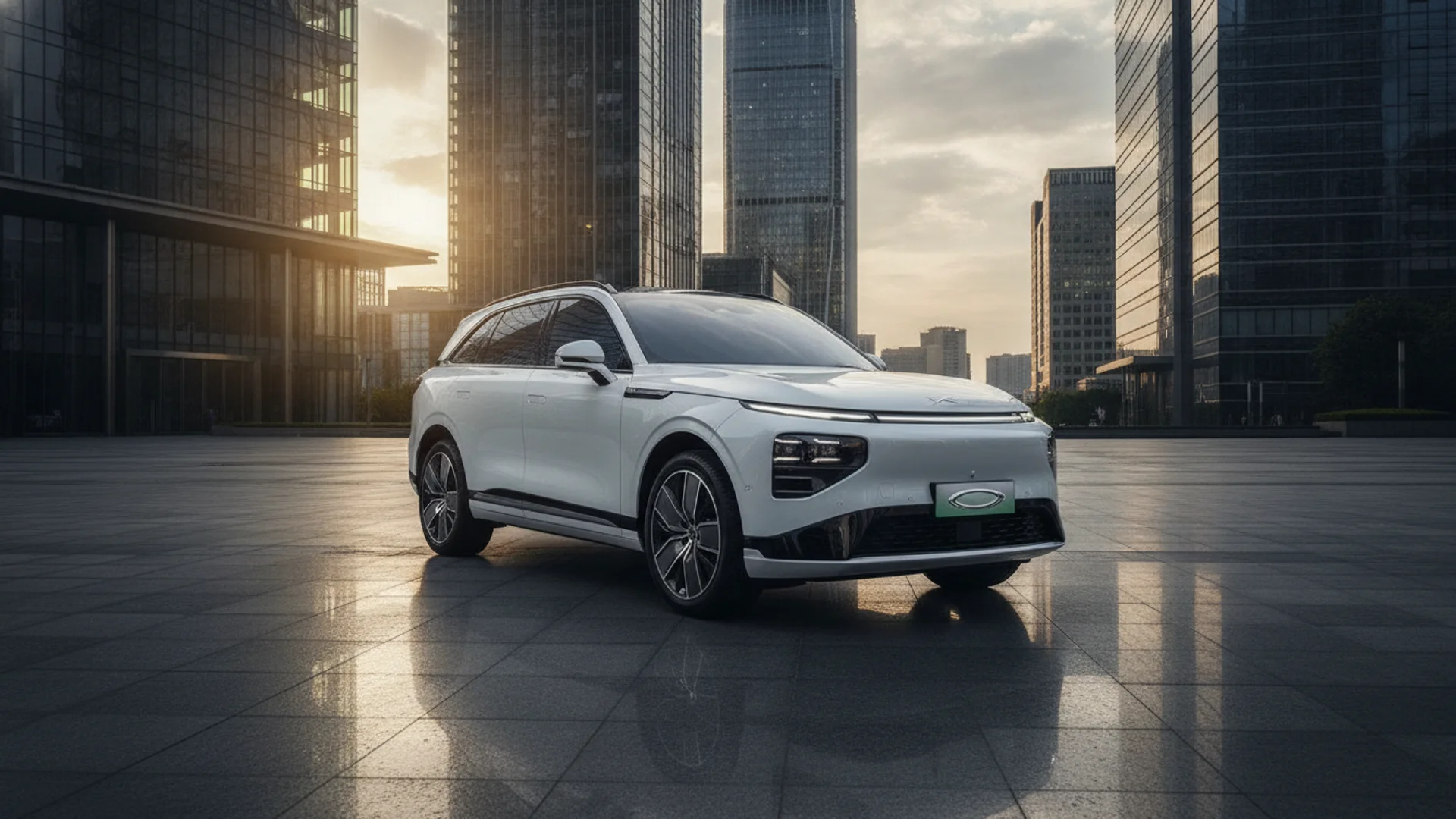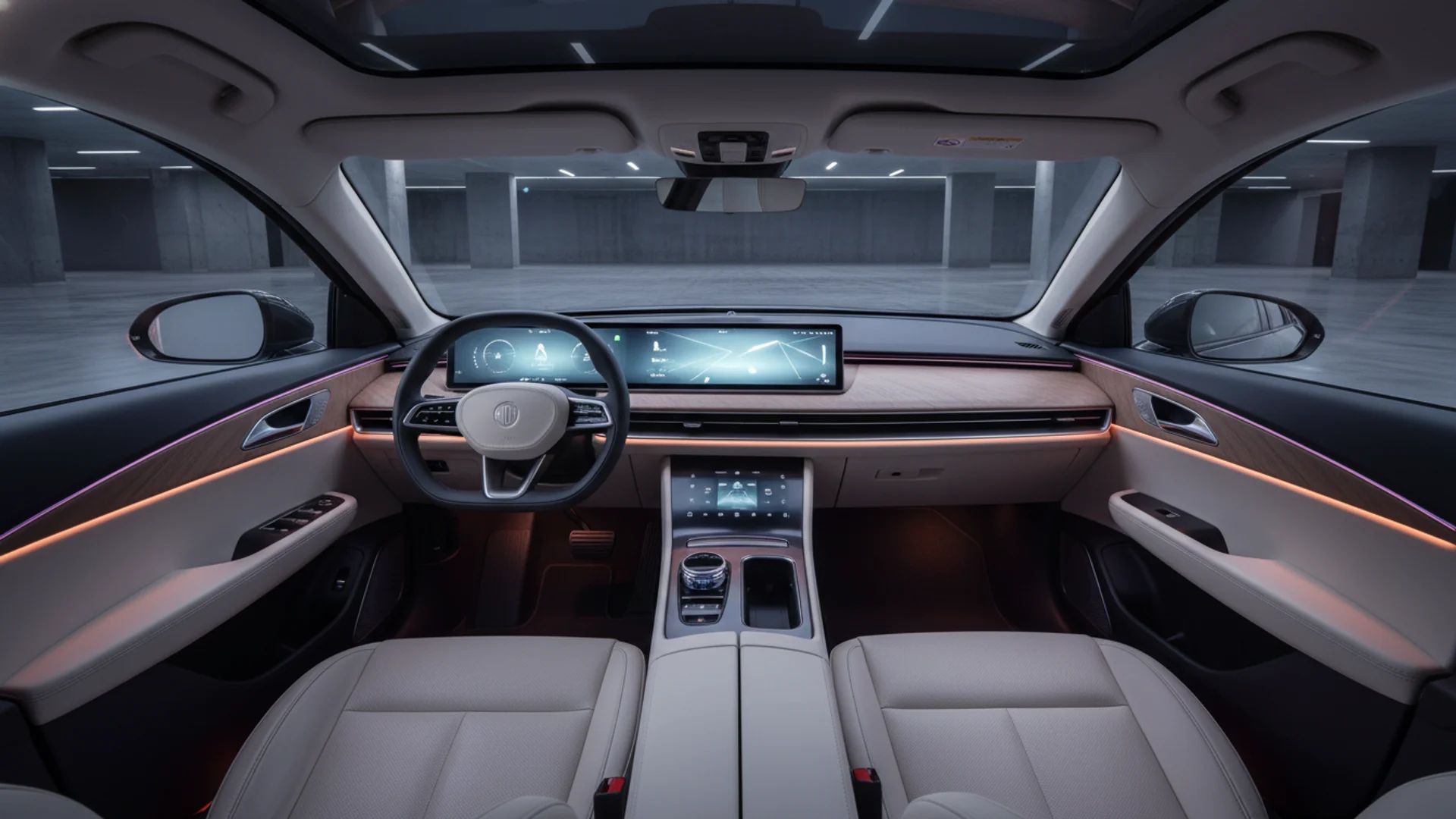
Somewhere on a Shanghai elevated expressway, a child in the back seat of a Nio Firefly is almost certainly playing Mario Kart. The Switch console sits on a lap. The screen the child is actually watching is the one built into the car. That sentence would not have made sense in a vehicle launched eighteen months ago, and it would not make sense in most vehicles launched today, anywhere outside China.
Key takeaways
- Nio's free Aster 1.4.0 over-the-air update added Nintendo Switch screen-casting to the Firefly's rear display with no new hardware, and also raised peak motor output to 120 kW.
- The Switch feature only works with the Tencent-licensed Chinese version of the console, so it can't be replicated in Europe without a separate Nintendo agreement.
- Nio runs three brands on two operating systems, Aster on the entry Firefly and Banyan on its flagship sedans, with a cabin-software team reportedly hundreds of engineers strong.
- Canada's tariff on Chinese EVs dropped from 100% to 6.1% on January 16, 2026, turning Chinese EV arrivals here from an "if" into a "when," though there's no Firefly Canadian date yet.
The feature arrived quietly. Nio pushed an over-the-air software update, Aster 1.4.0, to its smallest car, and one of the items in the release notes was Nintendo Switch screen casting to the rear infotainment display. No press conference. No new hardware. A patch.
Western automotive coverage tends to file stories like this under "quirky China feature." That's the wrong filing cabinet. The Switch-casting feature is small. The thing the feature reveals about how Chinese automakers build cars, and how that differs from how Stuttgart, Detroit, Tokyo, and Munich build cars, is not small. It's the entire story of the next decade of the global auto market, compressed into a software changelog.
This piece is about that compression. Not whether you should buy a Firefly. Not whether Nintendo licensed the integration. About what it means that a sub-luxury city EV from a five-year-old brand can ship a feature like this in a Tuesday-afternoon patch, while a German flagship costing four times as much can't ship CarPlay without a model-year rollover.
The Feature Nobody Expected From a City Car
Start with the object. The Nio Firefly is not the car you'd predict would headline a software story. It's a subcompact urban EV, roughly Mini Cooper footprint, designed for dense Chinese cities and the kind of European narrow-street markets where parking sensors matter more than 0-to-100 times. Nio positions it below the main Nio brand and below Onvo, the family-SUV sub-brand. Firefly is the entry point.
Entry-point cars are where automakers traditionally cut features. Cloth seats, halogen lights, single-zone climate, basic infotainment with the cheaper processor. The Firefly's spec sheet, on paper, follows that script, modest battery, modest motor, modest dimensions. It looks like a car designed to a price.
Then the patch dropped. The Aster 1.4.0 release added band-style ambient ring lighting through the cabin, an ADAS-status blue light cue on the exterior, and the Nintendo Switch casting capability for the rear screen. Hardware-wise, the same update accompanies a refresh that pushes peak motor output to 120 kW.
The combination is what's strange. A car at the Firefly's price point shipping a feature most luxury cabins don't ship is a category violation. BMW's iX, at roughly four times the Firefly's price, doesn't cast Nintendo Switch. Neither does the EQS. Neither does the Lucid Air. Neither does the Model X. The feature isn't in those cars not because the engineering is hard, it isn't, but because nobody at those companies thought to put it there.
That last sentence is the one worth sitting with. Engineering capability is not the constraint. Product imagination is. The Firefly's team looked at a small car for digitally-native buyers, asked what those buyers actually do with screens, and shipped the answer. The premium brands looked at the same buyer demographic and shipped a wireless charging pad and a sub-tier of Spotify integration.
The case against this read is straightforward: a child playing Mario Kart on a rear screen is a novelty, not a product. German engineering culture would say the cabin's job is to insulate, not entertain, and that conflating gaming with mobility is exactly the category error that produced the Pontiac Aztek's centre-console tent. Concede the point on the specific feature, a single child, a single game, a single drive, and the rebuttal is still stronger. The novelty is the proof of capability, not the capability itself. A cabin OS that can low-latency cast a console can also, in the next patch, host a dispatcher tool for a rideshare driver, a homework surface for a school run, or a videoconference for a parent stuck at curbside pickup. The Switch is the demo. The platform is the asset.
The gap between what's possible and what's chosen is where this story lives. And the choice, to put gaming connectivity into the cheapest car in the lineup, not the most expensive, is itself a manufacturing philosophy statement. It says: software features are not luxury upcharges. They're table stakes, and the entry-level buyer gets them first because the entry-level buyer is the most digitally fluent and the most likely to notice.
What the Firefly Actually Is Under the Skin
To understand why Nio shipped this feature, in this car, at this price point, you have to understand Nio's brand architecture, which does not map onto any Western automaker's structure.
Nio operates three distinct brands. The flagship Nio nameplate covers ET-series sedans and ES/EC-series SUVs in the premium tier, the cars that compete with BMW and Mercedes in the Chinese market and that Nio has been quietly selling in Norway since 2021, as we've covered in Nio's premium-EV positioning against Tesla. Onvo, launched in 2024, targets the family-SUV middle of the market, think Honda CR-V buyers with EV budgets. Firefly is the third leg: small, urban, software-forward, designed for the under-30 buyer who treats a car the way they treat a phone.
The three brands share a platform philosophy but not a chassis. Each gets its own engineering team, its own design language, and, critically, its own software target. Aster, the operating system on the Firefly, is not the same OS as Banyan on the flagship Nio sedans, even though both come from the same parent company. They diverge because the buyer diverges.
This is a kind of organizational discipline that's rare in Western auto. Volkswagen Group runs Audi, Porsche, Cupra, and SEAT on increasingly shared electrical architectures because shared architectures save money. Stellantis is consolidating Jeep, Ram, Chrysler, Peugeot, and Citroën onto common platforms for the same reason. The financial logic is sound. The product consequence is that an Audi infotainment experience and a SEAT infotainment experience feel like skins on the same software, because they are.
Nio's approach inverts the priority. Yes, there are shared components, the 900V architecture, the swap-battery interface, the motor families. But the cabin experience is rebuilt for each brand, because Nio's product leadership decided that a 22-year-old buyer's relationship with a screen is fundamentally different from a 45-year-old buyer's relationship with a screen. So you don't ship them the same software and let marketing handle the rest.
The 120 kW motor in the refreshed Firefly is honest hardware, enough to make the car feel quick in city traffic without being absurd. In the same urban-EV bracket, the Mini Cooper SE shipped with a 135 kW motor and a single-screen cabin running BMW's Operating System 7; the Renault 5 E-Tech arrived with a 110 kW motor and OpenR Link on Android Automotive. Both are credible cars. Neither has a software roadmap that lets a buyer who took delivery last spring meaningfully expect a new capability this autumn. Within the Firefly's pricing band, no buyer is choosing it for peak power. They're choosing it for the daily texture of using it: the way the screens behave, what the car can do that their friend's car can't, what the next over-the-air update might bring.
That last variable, what the next update might bring, is where the real product differentiation now lives. And it's a variable Western OEMs have barely begun to price into their offerings.
Software as Product, Not Afterthought
There's a tell in how an automaker talks about software updates. Western brands describe them in the language of maintenance: "improves performance," "addresses minor issues," "enhances stability." Chinese brands describe them in the language of release notes: here's what's new, here's what you can do now that you couldn't yesterday.
The difference is not cosmetic. It reflects two different theories of what a car is.
In the Western theory, a car is a piece of hardware sold once, with software bolted on top to manage the hardware. Updates are corrections. The car is finished when it leaves the factory; updates fix the things that turned out not to be finished. The model-year cycle is the unit of meaningful change. You buy the 2026 car or you wait for the 2027.
In the Chinese theory, at least the one Nio, Xpeng, Li Auto, Zeekr, and increasingly BYD have converged on, a car is a hardware platform that runs software, and the software is the product. The hardware is finished when it leaves the factory. The product is never finished. The model-year cycle is replaced by the patch cycle, which runs on a phone-firmware cadence: monthly minors, quarterly majors, the occasional headline drop.
Aster 1.4.0 is a quarterly major. The Switch-casting feature in it is a headline drop. The point is not just that the feature exists; the point is that the customer who bought a Firefly six months ago now has it, for free, on the car they already own. The car got more valuable in their driveway overnight.
That mechanism, the car getting better while it sits in your driveway, is the thing Detroit and Wolfsburg have struggled most to internalize. Tesla figured it out a decade ago and built an entire brand on the principle. Most legacy OEMs paid lip service, shipped a handful of OTA updates focused on bug fixes, and moved on. The infrastructure investment required to ship new features post-sale is enormous: secure update pipelines, hardware overprovisioned enough to run software that didn't exist at launch, organizational structures that treat the customer relationship as ongoing rather than transactional.
Nio built that infrastructure from year one. So did Xpeng. So did Li Auto. They built it because they were structurally new companies competing against incumbents with century-old hardware advantages; software cadence was the only ground where they could plausibly win. Now the ground has shifted enough that the incumbents need to compete back on cadence, and the muscle takes years to grow.
The Nintendo Switch casting is a fingerprint of that organizational muscle. To deliver it, Nio had to: have a low-latency wireless display stack already running on the cabin SoC; have an update pipeline that could push a feature like this without breaking the rest of the cabin OS; have a hardware spec from launch that was overprovisioned enough to run the wireless casting workload; and have a product team empowered to ship feature ideas this specific to a small subset of the buyer base. Any one of those is achievable in isolation. The four together are organizational, not technical.
The counter is that Tesla has been doing exactly this for a decade and the legacy industry has not collapsed. Mercedes still sells S-Classes. BMW still sells 7-Series. The argument that cadence eats badge has been made before, and the badge has held up better than the cadence prophets predicted. Fair, but the comparison flatters the incumbents. Tesla was one company. The Chinese cadence cohort is now a dozen, shipping into the same buyer demographic at once, at price points the Germans cannot match. One Tesla was a margin pressure. Ten Nios, Xpengs, Li Autos, Zeekrs, Denzas, and Avatrs is a category redefinition. The defenders of the badge are not wrong that the badge has held. They are wrong about the size of the army on the other side of the wall.
The Gaming Console as Cultural Signal
There's a separate layer to the Switch-casting story that's easy to miss from outside China: the Nintendo Switch is not the same product in China that it is everywhere else.
In every other market, the Switch is sold and supported by Nintendo directly. In China, it's sold and supported by Tencent under a 2019 licensing deal, a separate eShop, a Chinese-only game catalog, a different account system. Sony's original entry into the console business came in much the same partner-mediated way: a Super Nintendo Entertainment System that would play CD-ROMs, announced by Sony in 1991 as both an add-on and a dedicated console known as the "Play Station" before that partnership famously collapsed and Sony went independent. The analogy is loose, the 1991 SNES-Sony deal cratered on licensing terms, not regulatory structure, but the rhyme is there: global console maker, local partner, market-shaped product.
Gear worth having
As an Amazon Associate, ThinkEV earns a small commission from qualifying purchases — at no extra cost to you.

First Alert Auto Fire Extinguisher
A compact extinguisher sized for vehicles and bracket-mounted under the seat. Peace of mind for the price of lunch.
As an Amazon Associate, ThinkEV earns from qualifying purchases — at no extra cost to you.
What it means in practice is that when Nio enabled Switch casting on the Firefly, the integration target was the Tencent variant of the Switch ecosystem. The buyer's Switch is almost certainly running Tencent firmware, downloading from a Tencent storefront, playing a curated game list that's been cleared through Chinese regulatory channels. The car-and-console handshake is a Chinese-domestic handshake, end to end.
That detail matters because it explains why this feature can ship in China and not, easily, anywhere else. Nio can build to Tencent's Switch stack inside China. To replicate the feature in Europe, where Nio is actively selling cars and where the Firefly is European-bound, Nio would need to build to global Nintendo's stack, which it has no commercial relationship with. The feature is not just regionally available; it's regionally possible.
But strip out the licensing geometry and look at the cultural choice underneath. The Firefly's product team picked Nintendo Switch as the integration partner, not PlayStation Portal, not Steam Deck, not iPad. They picked Switch because it's the console the Firefly's target buyer, urban, under 30, Chinese, on the move, actually carries. That's not a feature decision; that's an ethnographic decision. Somebody at Nio looked at how this buyer demographic spends Tuesday evenings and built backward from there.
Compare that to the dominant Western infotainment story of the last five years, which has been the religious war between Apple CarPlay and Android Auto. Every meaningful automaker has had to pick a side, both sides, or in Tesla's and now GM's case, neither. The war is between two phone ecosystems for whose mirror gets to live on the car's centre screen. The car is a passive surface; the phone is the product. The contrast is sharpest inside individual model lineups: the Tesla Model Y does not support Apple CarPlay or Android Auto at all, while the BYD Seal ships native CarPlay and Android Auto integration, and the Firefly does neither, because Nio's bet is that the cabin OS is the product and the phone is the accessory.
Nio's choice is different. The car isn't a passive surface. The car has its own screens, its own OS, its own product identity, and it's choosing to integrate with the specific device the buyer brings into the cabin. CarPlay-versus-Android-Auto is a question about which phone gets to take over the car. Switch-casting-on-the-Firefly is a question about what the car offers that the phone alone can't.
Two different philosophical starting points. One treats the car's software as a host for somebody else's ecosystem. The other treats the car's software as its own ecosystem that selectively connects to others.
What Detroit and Munich Are Actually Competing Against
Here's the part that should worry product leadership at every legacy automaker:
The Firefly is not benchmarking against an Audi A3 or a BMW 1-Series or a Mini Electric. The Firefly is benchmarking against an iPad. The product question its team asks is not "what does the cheapest premium-brand hatchback offer?" The product question is: "what does the device this buyer would otherwise spend two hours a day with offer, and how do we match or exceed that on the only surfaces the car owns?"
That's a different mental model. The competitive set isn't other small EVs. The competitive set is consumer electronics, phones, tablets, handheld gaming, smart-home interfaces. The Firefly cabin is competing for the same attention budget that Apple, Samsung, ByteDance, and Tencent are competing for. The band-style ambient ring lighting is not there because BMW does ambient lighting. It's there because every flagship phone is now sold partly on its always-on display animations and its lock-screen customization. The cabin is borrowing the language of phone product design because the buyer was trained on phones.
This is where the asymmetry gets uncomfortable for Western OEMs. Munich and Wolfsburg and Detroit have spent the last twenty years getting better at things that are no longer the things the most digitally-native segment of the global buying population cares about most. Steering feel. Engine note synthesis. The exact tactile response of a turn-signal stalk. Material quality on the dashboard topper. All of these matter, the Firefly does not have a great dashboard topper, but they matter less, relative to software experience, than they did a decade ago, and they will matter even less a decade from now.
Toyota's own EV journey illustrates the conservative posture. The company announced plans to build a production version of the car called the Toyota iQ EV (Scion iQ EV in the US, Toyota eQ in Japan), but production was held to a small number of units distributed mostly to fleet partners, a hardware-first, cautious-deployment posture that's representative of how legacy makers approached early EVs. The product was real. The commitment to making it a software-defined experience was not. A decade later, Toyota is still catching up on cabin software, and not just Toyota.
Meanwhile, in the same window of time, Chinese automakers built cabin-software organizations the size and capability of small consumer-electronics companies. Nio's Aster team is reportedly hundreds of engineers strong, on a product surface, the cabin OS, that BMW assigns to a much smaller group inside a much larger organizational chart. Headcount is not destiny, but headcount is signal. You can read where a company believes its differentiation will come from by looking at where it puts its software engineers.
Western brands are competing against each other. Chinese brands are competing against the entire consumer-electronics industry for the attention of the same buyer. The bar is set in different places. The market-share consequence is already visible in the segments where Chinese brands have arrived: Tesla's grip on the Canadian EV market loosened the moment domestic and European rivals shipped credible alternatives at the Ford Mustang Mach-E price point, and the Chinese cohort hasn't even fully landed yet. When it does, and Canada's tariff reset from 100% to 6.1% on January 16, 2026, makes "when" the operative word, the buyer will be choosing between a refreshed Firefly with quarterly feature drops and a Bolt successor with a model-year cadence. That's not a comparison most legacy product planners have stress-tested.
Gear worth having
As an Amazon Associate, ThinkEV earns a small commission from qualifying purchases — at no extra cost to you.
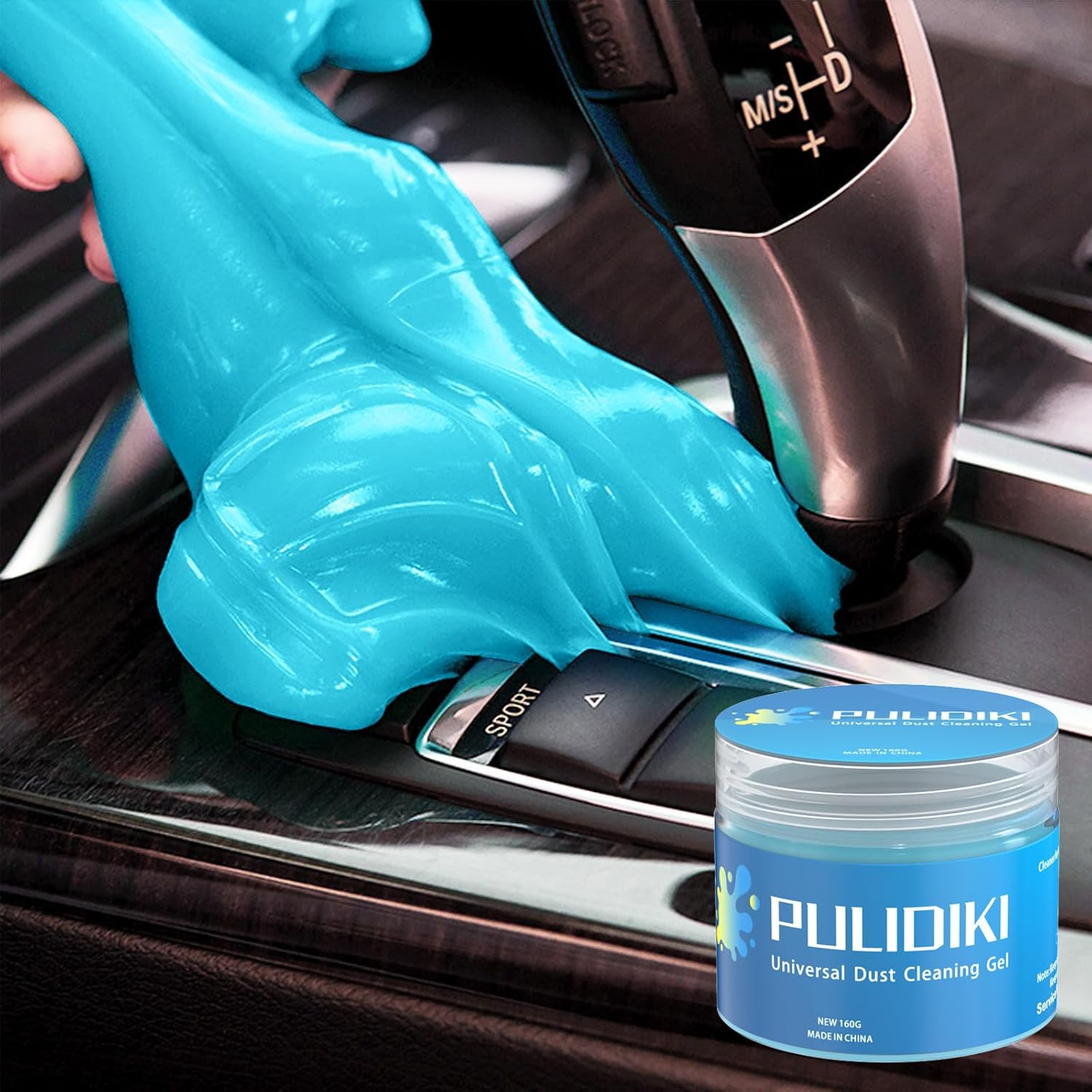
PULIDIKI Car Cleaning Gel (Detailing Putty)
Press it into vents, buttons, and seams and it lifts out dust you did not know was there. Weirdly satisfying, genuinely useful.
As an Amazon Associate, ThinkEV earns from qualifying purchases — at no extra cost to you.
The Asymmetry That Should Concern Legacy Automakers
If the Firefly's story were just "Chinese car gets fun feature," it would be a curiosity. The deeper story is what the feature does to the economics of car ownership and the psychology of resale.
Consider the buyer who took delivery of a Firefly six months ago. That car shipped without Switch casting. The buyer paid the sticker price for what was on the spec sheet at the time. Today, with Aster 1.4.0, the buyer has a car that does something it didn't do at purchase, and that capability arrived for free, through an over-the-air pipe, while the car sat in the parking lot overnight.
What does that do to the resale value of that Firefly? Probably nothing dramatic in either direction, used-EV pricing is driven by battery state, range, and brand reputation more than by feature creep. But what does it do to the buyer's relationship with Nio? It changes the shape of it. The relationship is no longer "I bought a car from this company." The relationship is "I have an ongoing service relationship with this company, and they keep making my car better." That's the relationship Apple has with iPhone owners. It's the relationship Sony has with PlayStation owners. It's not, traditionally, the relationship Volkswagen has with Golf owners.
Layer on top of this Nio's swap-battery infrastructure, which we examined more closely in Nio's expansion into CCS-compatible charging markets. Battery swap means the buyer interacts with Nio infrastructure routinely, not just at point of sale. Each swap is another touchpoint. Combine recurring swap touchpoints with quarterly OTA feature drops and you get something closer to a subscription-style relationship than a one-time transaction. The car becomes a platform for ongoing engagement. The brand becomes something you have an account with, not just a logo on the hood.
This is the part of the Chinese-EV story that's hardest for Western automakers to copy because it's not a feature; it's an organizational structure. You can't ship "swap-battery infrastructure plus quarterly software cadence plus consumer-electronics-grade product imagination" as a model-year refresh. It has to be built into the company. And the companies that have it, Nio, Xpeng, Li Auto, BYD's premium sub-brands, built it from a clean sheet, because they didn't have a 90-year-old dealer network and a 60-year-old engineering culture to renovate around it.
Price is the door, the production-cost and currency dynamics behind Chinese EV stickers are their own argument, but the software-cadence story is why those cars, once on the road, keep getting better while their Western counterparts age in place. Price is the door. Cadence is what keeps the buyer in the room.
The Nintendo Switch casting feature is, in this frame, almost the perfect signal. It cost Nio very little to add. It carries enormous perceived value with the specific buyer Nio cares about. It demonstrates institutional capability, the OTA pipeline, the cabin OS overprovisioning, the product imagination, without requiring expensive new hardware. And it shifts the buyer's mental model from "I bought a car" to "I subscribed to a car that keeps surprising me."
That's not a feature war. That's a different game entirely.
What I'd watch from here: how quickly Aster 1.4.0-equivalent features appear in Nio's European Firefly rollout, and whether Nintendo (global), not Tencent, will license the casting integration for that market. If the answer is yes, the Switch feature crosses out of China and becomes a genuine competitive vector against European city EVs from Renault, Stellantis, and Volkswagen. If the answer is no, the feature stays a Chinese-domestic flourish, and the larger question becomes which equivalent integration Nio picks for Europe, Steam Deck? iPad? A bespoke streaming service? The choice will tell you whom Nio thinks the European Firefly is competing against.
What would change my mind on the broader thesis: a credible OTA feature drop from a legacy German or American OEM in the next twelve months that adds a genuinely new use-case, not a bug fix, not a UI refresh, but a capability the car didn't have at launch, to a sub-€40,000 vehicle already in customers' hands. Until that happens, the asymmetry stands. Chinese brands keep adding capability to cars that are already sold. Western brands keep telling their customers to trade in for next year's model.
I'd bet on the cadence over the badge. Not because the badge doesn't matter, it still does, and it will for a while, but because cadence compounds and badges depreciate. The Firefly buyer in Shanghai tonight is playing Mario Kart in a car that didn't do that last week. That's the new baseline. Everything else is catching up.
Gear worth having
As an Amazon Associate, ThinkEV earns a small commission from qualifying purchases — at no extra cost to you.

WixGear Magnetic Air Vent Phone Mount (2-Pack)
A magnet strong enough that your phone never flinches over potholes or rail crossings. Two in the box, one for each car.
As an Amazon Associate, ThinkEV earns from qualifying purchases — at no extra cost to you.

Founder & Chief Editor
Vlad Pereira is the founder and chief editor of ThinkEV.ca, the Canadian electric-vehicle publication he writes and edits from Courtenay, British Columbia. He covers EV pricing, federal and provincial rebates, charging costs, and the Chinese manufacturers now entering Canada, from the buyer's side rather than the press-fleet side. ThinkEV is a venture of Vlad Pereira Online; his writing on health, income and the long game lives at vladpereira.com.
Frequently asked questions
Will the Nintendo Switch casting feature work on Nio Fireflies sold outside China?
What did the Aster 1.4.0 update actually add?
Is the Nio Firefly confirmed for Canada?
Why does the Firefly run different software than Nio's flagship sedans?
More EV & road-trip finds
Affordable upgrades worth a look — tap any to check the price on Amazon.
 ★ 1,866
70mai A810 4K Dual Dash Cam
View on Amazon ★ 121
★ 121Foldable Windshield Sun Umbrella
View on Amazon ★ 268
★ 268Anti-Slip Leather Steering Wheel Cover
View on Amazon ★ 2,941
Microfiber Cleaning Cloths (Multi-Pack)
View on Amazon ★ 55
★ 55LED Car Door Logo Projector Light
View on Amazon ★ 1,349
Cool Swinging Duck Dashboard Ornament
View on Amazon ★ 4,424
Sun Visor Card and Document Organizer
View on Amazon ★ 15,014
Spigen Tempered Glass for Tesla Model 3/Y
View on AmazonRead, Plan, Then Stay Current
Explore our expert articles to understand incentives and ownership costs, use the map to pressure-test charging reality, then subscribe so new EV coverage comes straight to you.
Continue Reading

Chinese EVs in Canada: 15,603 In, Still No BYD
BYD Great Seagull: A Bigger $10,000 EV Hatch Is Coming

10–97% in 9 Min: Sunwoda Joins the Flash Charging Race

BYD Denza Z9 GT Adds $50K Tri-Motor Trim to China's Top GT
Xiaomi's Xring D100 Chip Targets 2027 Driver-Assist Debut