Key takeaways
- The hardest case for the EV: the Hyundai Ioniq 6 at $47,549 versus a $30,805 Honda Civic, an $11,744 gap that survives even after the $5,000 EVAP rebate drops the Ioniq 6 to $42,549.
- Fuelling that Ioniq 6 costs $384 a year versus $2,325 for the Civic, 83% less to drive at 20,000 km a year.
- The Equinox EV starts at $42,999, drops to $37,999 after EVAP.
- The Dolphin at $28,000 doesn't qualify for EVAP since it's manufactured in China, so there's no rebate to soften the blow.
- Over ten years, the EVs modelled here save between $14,700 and $22,300 against their gas equivalents, and the Equinox EV breaks even on a RAV4 in about five months.
I'm going to settle this debate with actual numbers. Not vibes. Not "EVs are the future" platitudes. Not "gas cars are cheaper" gut feelings. Math.
I've modelled the total cost of ownership for three real matchups that Canadian buyers actually face, over 5 and 10 years, using 2026 Canadian prices, insurance rates, fuel costs, and maintenance data. Every number below is sourced from manufacturer MSRPs, Natural Resources Canada fuel data, and real-world owner reports.
Let's go.
The Three Matchups
I picked these because they represent the actual decisions Canadians are making at dealerships right now. Not fantasy supercar comparisons, real cars at real prices.
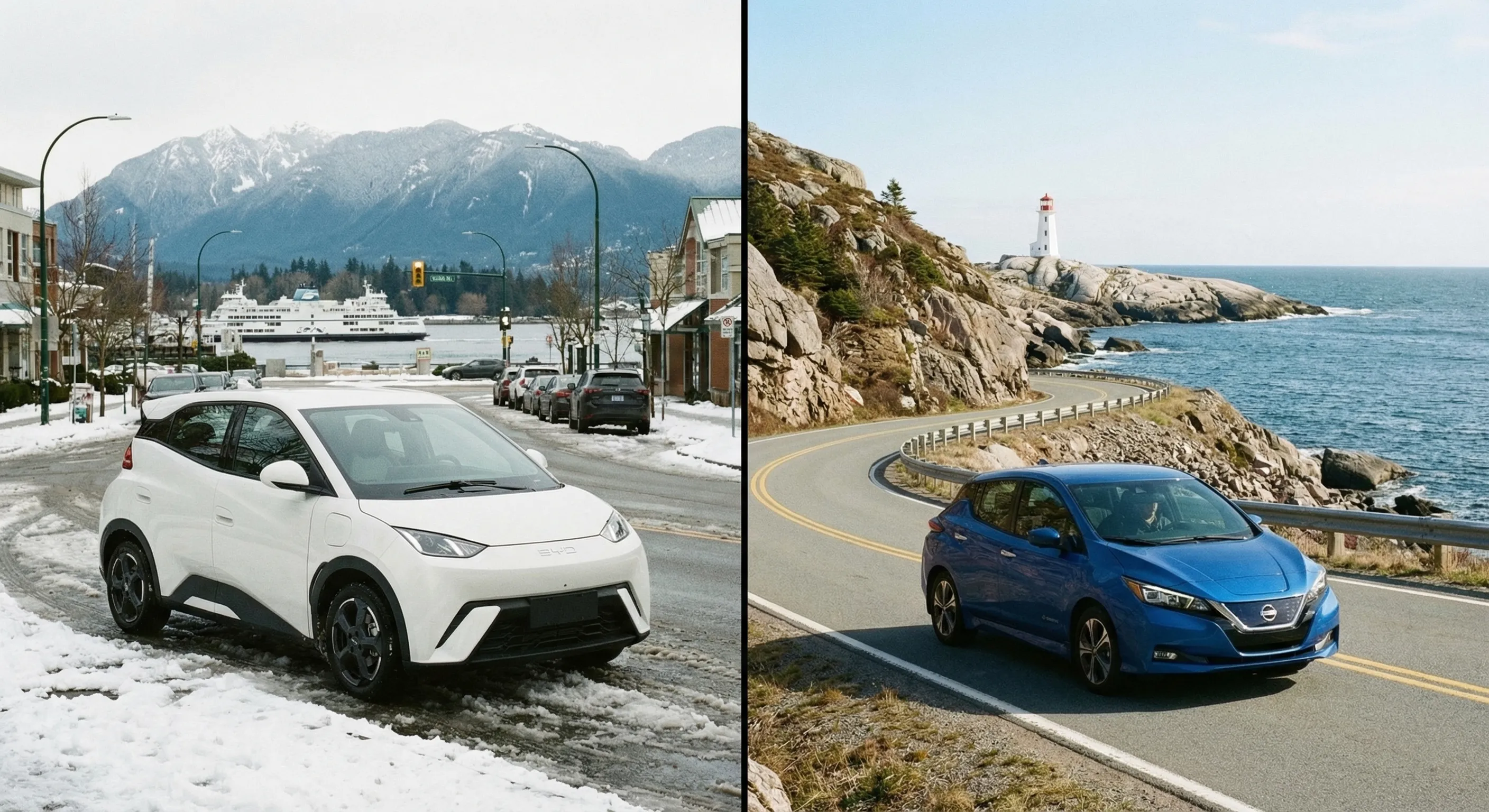
Compact sedan: the Hyundai Ioniq 6 against the Honda Civic. This is the hardest test for the EV because the Civic is cheap, $30,805 to the Ioniq 6's $47,549. Even after the $5,000 EVAP rebate brings the Ioniq 6 down to $42,549, there's still an $11,744 gap. That's a lot of ground to make up.
Compact SUV: the Chevrolet Equinox EV against the Toyota RAV4. The Equinox EV starts at $42,999, drops to $37,999 after EVAP. The RAV4 sits at $36,790. That's a price gap of just $1,209. Practically nothing.
Budget option: the BYD Dolphin against the Hyundai Elantra. The Dolphin at $28,000 doesn't qualify for EVAP since it's manufactured in China, so there's no rebate to soften the blow. The Elantra comes in at $24,599. That's a $3,401 gap, and the Dolphin has to close it on operating costs alone.
Each comparison assumes 20,000 km per year (the Canadian average), home charging 90% of the time, and base model at MSRP. No cherry-picking.
What You Pay at the Pump vs. the Plug
This is where the EV story starts to get compelling, and it's not even close.
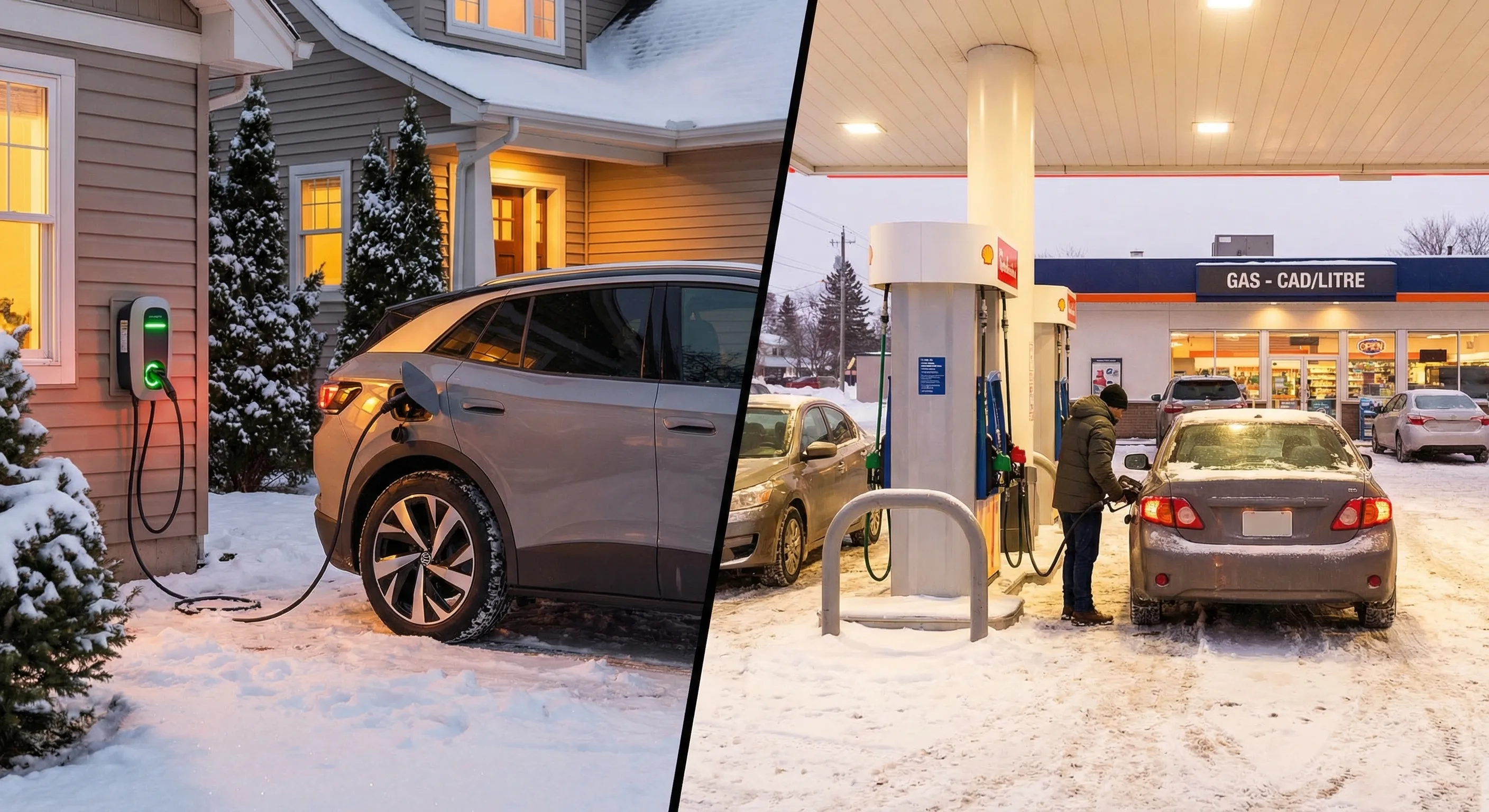
Gasoline in Canada averaged $1.55 per litre in March 2026. Home electricity averaged $0.12 per kWh nationally, though that ranges wildly from $0.07 in Quebec to $0.18 during Ontario peak hours. A typical EV uses about 16 kWh per 100 km. A compact gas car burns about 7.5 litres, and an SUV closer to 8.5.
Run those numbers across 20,000 km and the Ioniq 6 costs $384 per year to "fuel." The Civic costs $2,325. That's not a marginal difference, the EV costs 83% less to drive. The Equinox EV runs $416 per year against the RAV4's $2,635. The Dolphin comes in at $352 versus the Elantra's $2,170.
In dollars you actually feel: that's $146 to $185 back in your pocket every month. Over five years, fuel savings alone range from $8,770 to $11,095. If you drive more than the average, the savings scale linearly. At 30,000 km per year, you're looking at $13,000-$16,500 over five years just on fuel.
Maintenance: The Quiet Savings
Fuel gets all the headlines, but maintenance savings are the part that catches people off guard. An EV has no engine oil, no transmission fluid, no timing belt, no spark plugs, and no exhaust system. Regenerative braking means your brake pads last two to three times longer than a gas car's. The main recurring costs are tires (EVs are heavier, so tires wear slightly faster) and cabin air filters.
Based on manufacturer service schedules and data from Canadian EV owner communities, here's what the annual maintenance picture looks like: the Ioniq 6 and Equinox EV run about $650 per year, while their gas counterparts, the Civic and RAV4, cost $1,150 and $1,200 respectively. The budget Dolphin is even cheaper at $550 per year, compared to the Elantra's $1,050.
That's $400 to $550 per year in maintenance savings. It doesn't sound dramatic until you realize it's $2,000 to $2,750 over five years, and the gap widens as gas cars age and need bigger repairs. By year seven or eight, gas cars start needing transmission work, catalytic converter replacements, and alternator swaps. EVs just keep rolling.
Insurance: The One Category Where EVs Lose
Insurance premiums run 5-15% higher for EVs in Canada, primarily because repair costs are steeper. A fender bender on an EV can involve battery pack inspection and specialized labour that gas cars simply don't need.
Using average Ontario rates, the Ioniq 6 runs $2,100 per year versus the Civic's $1,850. The Equinox EV costs $2,000 against the RAV4's $1,900. The Dolphin sits at $1,750 compared to the Elantra's $1,600.
That's an extra $100 to $250 per year for the EV. Over five years, you're paying $500 to $1,250 more in insurance. It's real money, but it's completely dwarfed by the fuel and maintenance savings running in the opposite direction. And this gap is shrinking, as more body shops train on EV repair and insurers accumulate better claims data, premiums are coming down.
Gear worth having
As an Amazon Associate, ThinkEV earns a small commission from qualifying purchases — at no extra cost to you.

Grizzl-E Classic Level 2 EV Charger (40A)
Canadian-made and rated for minus 40C winters. 40A / 9.6 kW, NEMA 14-50, indoor/outdoor, 24-ft cable. The charger built for Canadian weather.
As an Amazon Associate, ThinkEV earns from qualifying purchases — at no extra cost to you.
Depreciation: The Wildcard
Here's where the analysis gets uncomfortable for everyone. Depreciation is the single largest cost of car ownership, bigger than fuel, maintenance, and insurance combined, and it's the one nobody wants to talk about.
EVs have historically depreciated faster than gas cars. But that trend is reversing as EV demand matures and the used market develops. For this analysis, I'm using conservative estimates that still favour gas cars on depreciation.
The Ioniq 6 loses roughly 45% of its value over five years, about $21,400, leaving a residual of $26,152. The Civic depreciates 38%, losing $11,706 for a residual of $19,099. Hondas hold value well. That's a $9,700 depreciation advantage for the Civic, and it partially offsets the fuel and maintenance savings.
The Equinox EV depreciates 42% ($18,060 lost, $24,939 residual) against the RAV4's 32% ($11,773 lost, $25,017 residual). Toyota's legendary resale value shows here, the RAV4 has a $6,300 depreciation advantage.
The BYD Dolphin takes the biggest depreciation hit at 50% ($14,000 lost, $14,000 residual). Brand newness in Canada means uncertain resale. The Elantra depreciates 42% ($10,332 lost, $14,267 residual). As BYD establishes dealer networks and brand recognition in Canada, expect that 50% to normalize closer to 40%.
Five Years: The Full Picture
Now let's add everything up and see who actually wins.
Ioniq 6 vs. Civic, The Ioniq 6's five-year costs add up to $58,219 (purchase, fuel, maintenance, insurance). Subtract the $26,152 residual value and the true net cost is $32,067. The Civic totals $57,430, but its lower residual of $19,099 means a net cost of $38,331. The EV saves $6,264 despite costing $11,744 more at the dealership. The higher sticker price is a mirage, the Civic is actually the more expensive car to own.
Equinox EV vs. RAV4, This is the one that should make every Canadian SUV buyer sit up. The Equinox EV's five-year total is $53,329, netting down to $28,390 after residual. The RAV4 hits $65,465, netting $40,448. The EV saves $12,058 over five years. Read that again, twelve thousand dollars. On an upfront price gap of just $1,209. The Equinox EV pays for itself in about five months and then just keeps saving. This is the strongest case for going electric that exists in the Canadian market right now.
Gear worth having
As an Amazon Associate, ThinkEV earns a small commission from qualifying purchases — at no extra cost to you.
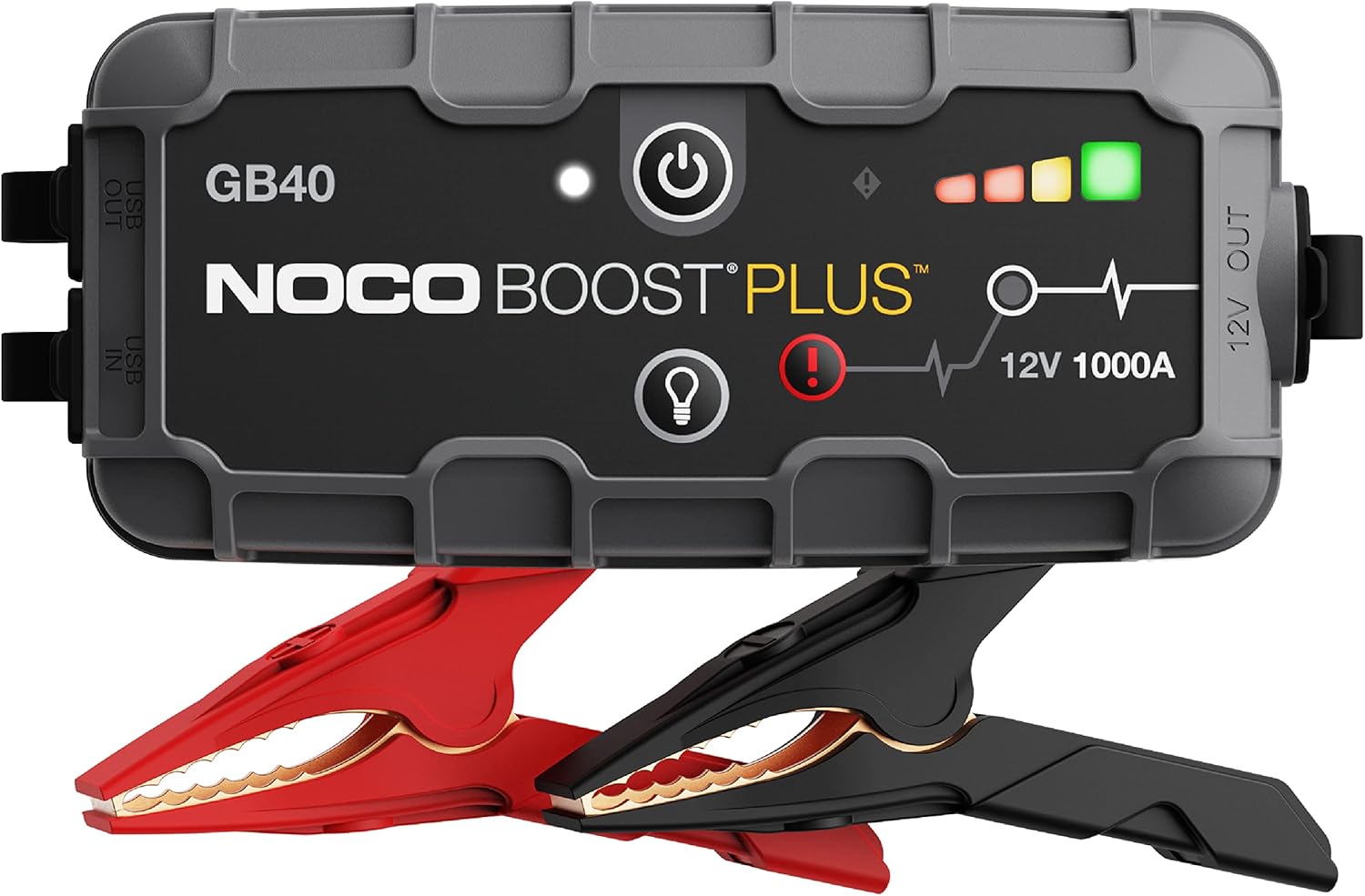
NOCO Boost Plus GB40 Jump Starter
A 1000A lithium jump starter that fits in your glovebox and works on any 12V battery. Your insurance against a dead 12V in a parking lot.
As an Amazon Associate, ThinkEV earns from qualifying purchases — at no extra cost to you.
BYD Dolphin vs. Elantra, The Dolphin's five-year total is $41,260, netting $27,260. The Elantra totals $48,699, netting $34,432. Even without any federal rebate and carrying a steep 50% depreciation penalty, the Dolphin saves $7,172 over five years. A Chinese EV with no government help still beats the gas equivalent on cost. That should tell you something about where the economics of transportation are heading.
Ten Years: The Gap Becomes a Canyon
At ten years, the EV advantage grows dramatically because fuel and maintenance savings keep compounding while the purchase price stays fixed.
The Ioniq 6 nets $41,500 over a decade against the Civic's $56,200. That's $14,700 in EV savings. The Equinox EV drops to $36,800 versus the RAV4's $59,100, a staggering $22,300 saved. The Dolphin nets $34,400 against the Elantra's $50,800, saving $16,400.
Over ten years, EVs save between $14,700 and $22,300 compared to gas equivalents. That's not ideology. That's not environmentalism. That's arithmetic.
When Does the EV Pay for Itself?
The break-even question is the one I get asked most, and the answer depends entirely on the price gap.
The Equinox EV breaks even against the RAV4 in about five months. The upfront gap is only $1,209, and the monthly fuel and maintenance savings blow past that almost immediately. If you're cross-shopping compact SUVs in Canada, the Equinox EV isn't just the better long-term investment, it's cheaper from practically day one.
The BYD Dolphin takes about 18 months to catch the Elantra. The $3,401 price gap gets eaten by roughly $2,318 per year in combined fuel and maintenance savings. By the middle of your second year, every dollar you save is pure profit.
The Ioniq 6 is the patience play. The $11,744 gap against the Civic is significant, and it takes roughly five years of $2,441 per year in savings to fully close. If you're keeping the car long-term, the math works decisively in the EV's favour. If you're a lease-and-trade-every-three-years buyer, the Civic is probably the better financial play.
If you drive more than 20,000 km per year, all these break-even points come sooner. If gas prices rise above $1.55 per litre, which, historically, they always do, sooner still.
Your Province Changes Everything
Where you live in Canada dramatically changes the math, and most people don't realize how much.
Quebec is the EV ownership paradise. Electricity costs $0.07 per kWh, the cheapest in Canada by a wide margin, while gas runs $1.60 per litre. That combination produces annual fuel savings north of $2,275. Add Roulez vert's $2,000 provincial rebate on top of the federal EVAP and you've got the best deal in the country.
British Columbia is almost as good, with electricity at $0.10 per kWh and gas at an eye-watering $1.75 per litre. Annual fuel savings hit $2,330, the highest of any province. The catch is that BC's CleanBC passenger vehicle rebate has been paused since late 2024, so there's no provincial rebate to stack.
Manitoba benefits from cheap hydro power at $0.09 per kWh and relatively moderate gas prices at $1.45 per litre. Annual savings clock in at $1,930, solidly above the national average.
Ontario, with electricity at $0.13 per kWh (and remember, that's the average, time-of-use rates can push evening charging below $0.10) and gas at $1.55 per litre, delivers $1,780 per year in savings. Not the best, not the worst. Most Ontarians who charge overnight on off-peak rates do significantly better than this average suggests.
Alberta has the most challenging math for EVs: electricity at $0.14 per kWh (deregulated market means prices fluctuate) and relatively cheap gas at $1.42 per litre. Annual savings are $1,580, still meaningful, but the slimmest margin in the country. Alberta also has no provincial EV rebate. The federal EVAP carries the weight here.
Gear worth having
As an Amazon Associate, ThinkEV earns a small commission from qualifying purchases — at no extra cost to you.

TP-Link Kasa Smart Plug with Energy Monitoring
Track exactly how much electricity your Level 1 charger uses and schedule it for off-peak hours. Know your real cost per kWh.
As an Amazon Associate, ThinkEV earns from qualifying purchases — at no extra cost to you.
What I Deliberately Left Out
I want to be transparent about the factors this analysis doesn't include, because they cut both ways.
I didn't include the one-time cost of a Level 2 home charger, typically $500 to $2,000 installed, partially offset by utility rebates in some provinces. For a homeowner, this is a cost you pay once and benefit from for the life of the car and every EV after it.
I didn't include DC fast charging costs for road trips. Public fast charging runs 2-3 times home rates, but for most owners it represents less than 10% of total charging. If you road trip frequently and rely heavily on public charging, your fuel savings will be somewhat lower than what I've modelled.
I didn't include carbon tax savings. Gas cars pay carbon tax embedded in the pump price. EVs don't. This is a real and growing financial advantage for EVs that only gets bigger as the federal carbon levy increases.
And I didn't include the time value of money, financing a higher purchase price means paying interest. At current Canadian rates, financing an extra $8,000 at 6% over 5 years adds about $1,500 in interest costs. That shaves the EV advantage but doesn't eliminate it.
Even factoring all of these in, the EV still comes out ahead in every matchup by year three or four. The conclusion doesn't change, the margin just shifts a bit.
The Ownership Math Is Unambiguous
The math is unambiguous. In every price segment, compact sedan, compact SUV, budget car, EVs cost less to own over five and ten years than equivalent gas cars in Canada. The combination of $1,750 to $2,200 per year in fuel savings, $400 to $550 per year in maintenance savings, and the federal EVAP rebate overwhelms the higher purchase price.
The Equinox EV versus the RAV4 is the headline result: $12,058 saved over five years on an upfront premium of $1,209. That's a return on investment that would make a hedge fund blush.
The question isn't whether you can afford an EV. It's whether you can afford to keep paying for gas.
Gear worth having
As an Amazon Associate, ThinkEV earns a small commission from qualifying purchases — at no extra cost to you.

P3 Kill A Watt Electricity Usage Monitor
Plug in your charger and see exactly what you spend in kWh, cost, and watts. Settle the is-my-EV-really-cheaper debate with data.
As an Amazon Associate, ThinkEV earns from qualifying purchases — at no extra cost to you.
Related Reading
- EV Maintenance Costs in Canada: What You Actually Pay, Detailed maintenance breakdown
- Every Dollar You Can Save on an EV in Canada, Federal and provincial rebates
- Best Level 2 EV Chargers for Canadians in 2026, Save more by charging at home
Gear worth having
As an Amazon Associate, ThinkEV earns a small commission from qualifying purchases — at no extra cost to you.

PULIDIKI Car Cleaning Gel (Detailing Putty)
Press it into vents, buttons, and seams and it lifts out dust you did not know was there. Weirdly satisfying, genuinely useful.
As an Amazon Associate, ThinkEV earns from qualifying purchases — at no extra cost to you.

Founder & Chief Editor
Vlad Pereira is the founder and chief editor of ThinkEV.ca, the Canadian electric-vehicle publication he writes and edits from Courtenay, British Columbia. He covers EV pricing, federal and provincial rebates, charging costs, and the Chinese manufacturers now entering Canada, from the buyer's side rather than the press-fleet side. ThinkEV is a venture of Vlad Pereira Online; his writing on health, income and the long game lives at vladpereira.com.
Frequently asked questions
Are electric cars cheaper than gas cars in Canada?
How much does it cost to charge an EV at home in Canada?
How long until an EV pays for itself vs. a gas car?
Is EV insurance more expensive in Canada?
Which province is cheapest for EV ownership?
More EV & road-trip finds
Affordable upgrades worth a look — tap any to check the price on Amazon.
 ★ 1,340
Car Seat Gap Filler (Universal)
View on Amazon ★ 1,944
VIOFO A229 Pro 4K Dash Cam
View on Amazon ★ 119
★ 119Foldable Waterproof Trunk Organizer
View on Amazon ★ 392
★ 392Large Cup Holder Adapter (32-40oz)
View on Amazon ★ 47,507
HOMEXCEL Microfiber Cloths (12-Pack)
View on Amazon ★ 314
★ 314Mini USB LED Ambient Lamps (4-Pack)
View on Amazon ★ 1,083
Crystal Push-Start Button Ring (2-Pack)
View on Amazon ★ 4,424
Sun Visor Card and Document Organizer
View on AmazonRead, Plan, Then Stay Current
Explore our expert articles to understand incentives and ownership costs, use the map to pressure-test charging reality, then subscribe so new EV coverage comes straight to you.
Continue Reading
Tesla Model Y vs Toyota RAV4: 5-Year Cost Canada
Rivian R1T vs F-150 Lightning: Canada 2026 Test
BMW i4 vs Tesla Model 3: Is the $11K Premium Worth It?
BYD Atto 3 vs Hyundai Kona EV: The $35K Comparison
BYD Dolphin vs Chevy Bolt 2027: Cheapest EVs