Key takeaways
- The Rivian R1T Adventure starts at $89,900 CAD and is too expensive for any rebate, above EVAP's $50,000 cap and BC's $85,000 CleanBC ceiling.
- In sustained -15°C to -25°C cold, real-world range is 330–360 km against the EPA-rated 515 km.
- The quad-motor system meters torque at each wheel independently about 1,000 times a second, faster than any mechanical locker.
- Fast charging peaks at 220 kW, but most Electrify Canada highway sites cap at 150 kW, stretching a 10–80% charge to about 45 minutes.
- The Performance trim hits 0–100 km/h in 3.0 seconds, quicker than a BMW M3, in a 3,049 kg truck that still tows 4,990 kg.
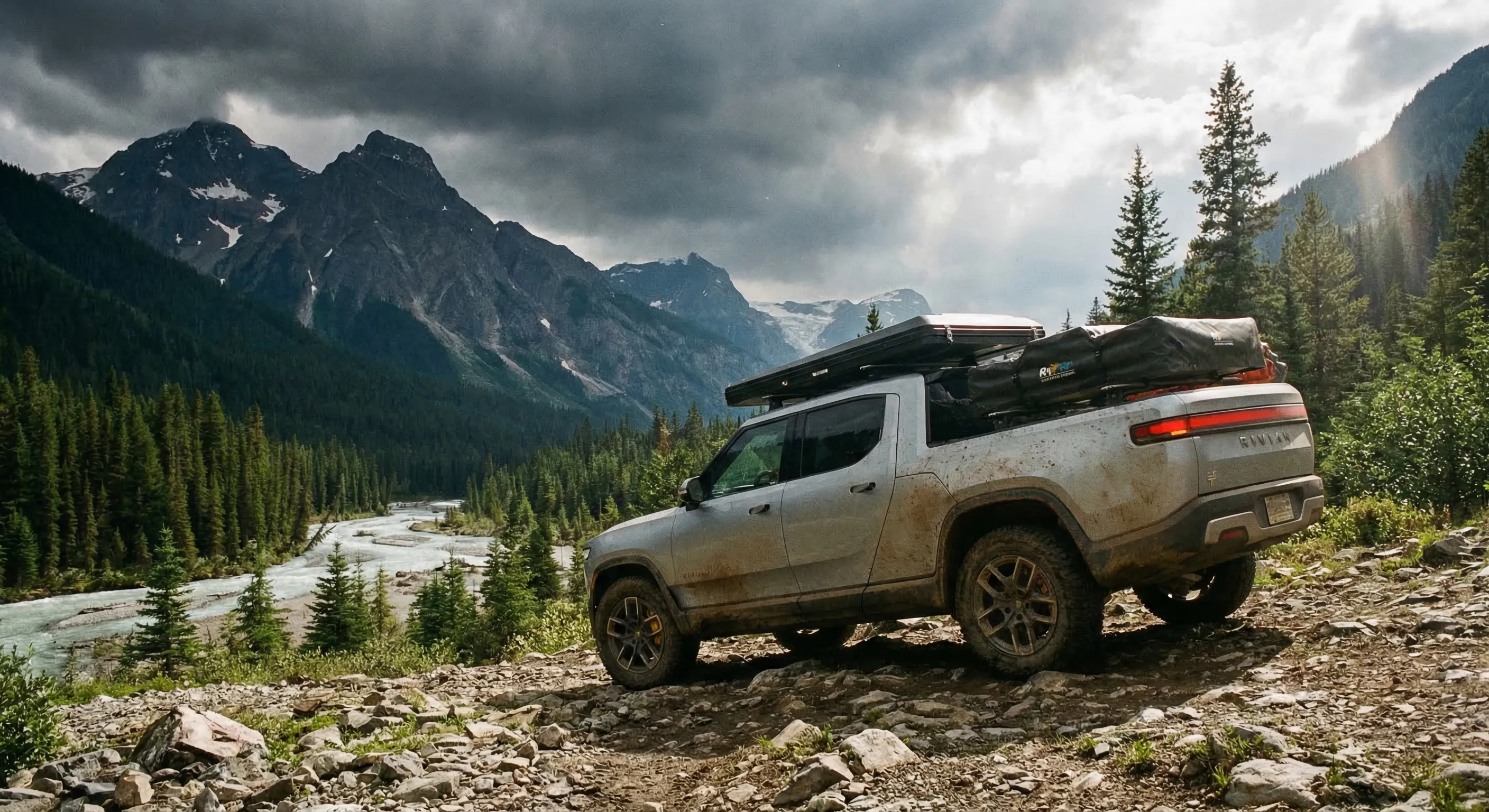
Here is what actually happens when someone drives a Rivian R1T in Canada for the first time. You point it at a switchback in the Kootenays with 15 centimetres of fresh snow on the gravel, you press the accelerator, and nothing happens the way you expect. There's no wheelspin. There's no drama. There's no moment where you're holding your breath and wondering whether you've made a terrible mistake bringing a $90,000 electric truck into terrain that would embarrass a Land Rover Defender. The four motors just... find grip. Individually. Simultaneously. With the kind of instant, intelligent torque distribution that makes experienced off-roaders set down their coffee and stare.
That's Rivian's trick, and it's a good one. The R1T isn't a truck that happens to be electric. It's a truck that is better because it's electric, and that distinction matters enormously in a country where "adventure vehicle" has always meant a full tank of gas and a prayer for cell service. Canada's truck buyers are skeptical by nature. Overpromised EVs that couldn't survive a Winnipeg February have burned buyers before. Charging networks have failed on the Trans-Canada. The range anxiety math on the drive from Sudbury to Thunder Bay has sent many back to another F-150.
The Rivian R1T asks buyers to recalculate. And after reviewing real-world data from owners across British Columbia, Alberta, and a stretch of northern Ontario that will test any vehicle's character, the numbers, the stories, and one genuinely breathtaking owner account near the Icefields Parkway tell a clear story. The short version: this is the most capable adventure vehicle available in Canada. The long version is everything below.
Rivian R1T Canada Review: The Numbers That Matter
Before we get into the experience, let's lock in the specifications that Canadian buyers actually need to know, because Rivian's marketing numbers don't always tell the full story.
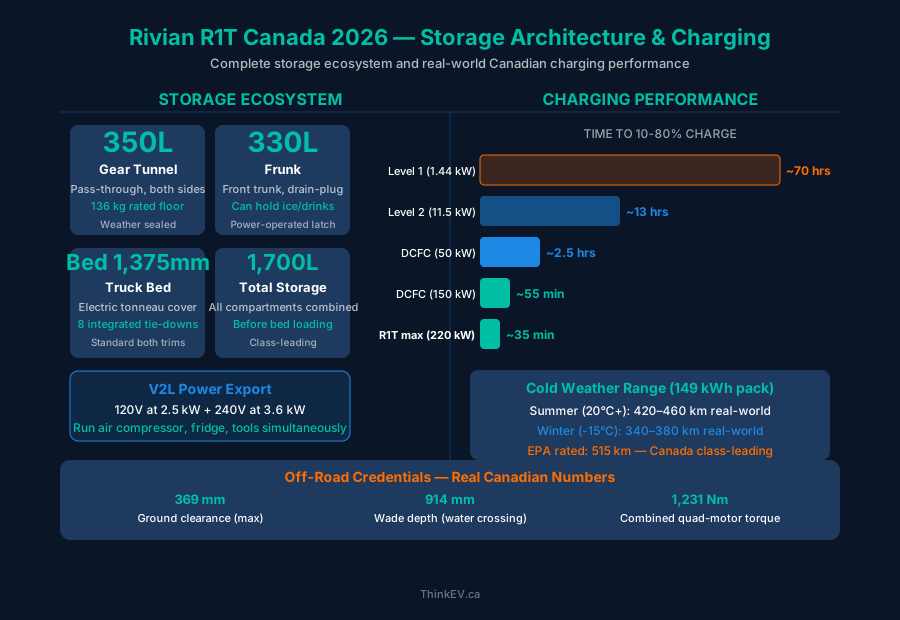
The R1T comes in two Canadian configurations for 2026. The Adventure trim starts at $89,900 CAD and is powered by a quad-motor system producing 835 horsepower and 1,231 Nm of torque. The Performance trim climbs to $99,900 CAD and sharpens the performance envelope further, with a 0–100 km/h time of 3.0 seconds that is, frankly, absurd for a truck that weighs 3,049 kilograms. Both trims use the 149 kWh Large Pack battery.
Range figures use the EPA standard, and Rivian quotes 515 km for the standard configuration. Real-world Canadian driving, which means variable highway speeds, actual temperature swings, and the occasional loaded gear tunnel, will put you closer to 420–460 km in mild weather and 340–380 km when temperatures drop below -15°C. That's still class-leading. The Ford F-150 Lightning tops out at 515 km on its best day, and the Tesla Cybertruck's real-world Canadian numbers have been disappointing compared to its EPA rating.
The charging architecture supports up to 220 kW DC fast charging, which translates to roughly 35 minutes from 10% to 80% at a compatible station. The onboard AC charger handles 11.5 kW, so a full overnight charge at Level 2 (40A circuit) takes approximately 13 hours from empty. Nobody is regularly charging from empty, but the math matters for trip planning.
Important for Canadian buyers: the R1T's pricing puts it well above the $50,000 EVAP threshold, so there is no federal rebate available. At $89,900, you're paying full ticket. Some provinces, notably BC and Quebec, have additional EV incentives at the provincial level worth $4,000 to $7,000, though the R1T's $89,900 price exceeds most provincial caps, so check the current limits before you buy. Ontario offers nothing, which is consistent with the province's general approach to EVs.
Build Quality: What $90K Actually Buys You
There's a specific feeling that separates a premium vehicle from an expensive one. In a premium vehicle, quality is quiet, it's the way a door closes with a single, clean sound instead of a clunk-and-rattle, the way interior surfaces meet each other at exact angles, the way a material feels consistent from the first day to the five-hundredth. The Rivian R1T is a premium vehicle. The Chevy Silverado EV, to pick a direct competitor, is an expensive one.
Start with the exterior. Rivian's design language is clean in a way that will age well, the R1T doesn't have the angular aggression of the Cybertruck or the bloated proportion of the Hummer EV. It reads as a modern utility vehicle: purposeful headlights that stretch into the front fenders, a flush door handle design that retracts automatically, and a roofline that stays low enough to feel athletic rather than truck-wide. The paint finish on the Forest Green configuration is deep and consistent, zero orange peel texture, consistent edge coverage around the wheel arches. The matte black accents on the side cladding and skid plates look like they belong there rather than being bolted on as an afterthought.
The bed is 1,375 mm long, smaller than a traditional full-size truck but big enough for a full set of skis laid flat, two mountain bikes standing upright on a rack, or a week's worth of overlanding gear packed methodically. Rivian includes a tonneau cover as standard on both trims, and it's electric, it retracts and closes from the touchscreen or the key fob, which sounds unnecessary until you're standing in the rain at a campsite trying to grab gear without flooding your sleeping bag. Bed rails include four integrated tie-down anchors per side, and the tailgate has a step-and-handle system built into the lower edge that works better than the retractable tailgate steps I've used on Ford and GM trucks.
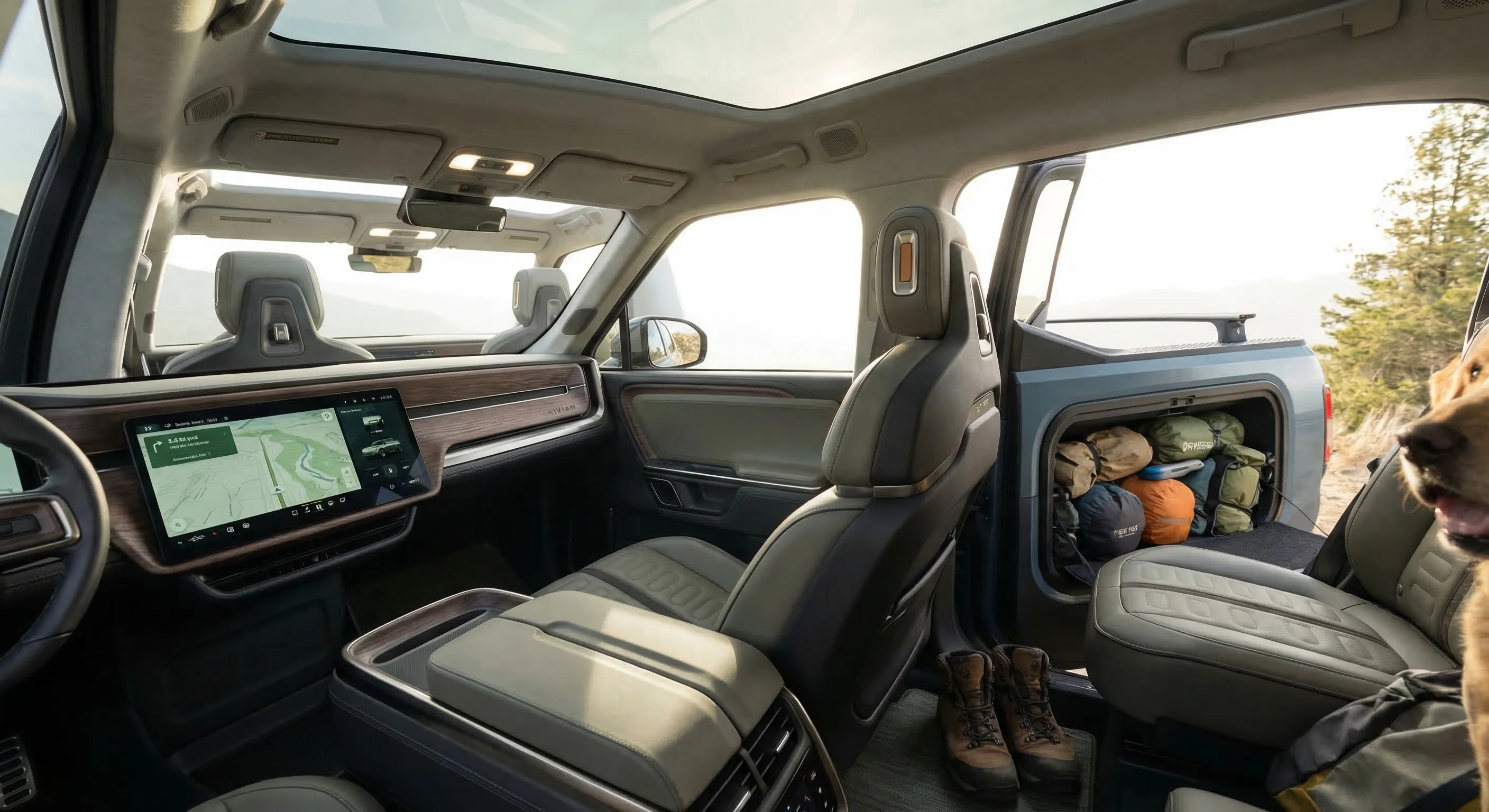
Inside, the front cabin is calibrated to deliver a specific message: this is not a work truck with nice seats bolted in. The instrument panel uses a single-piece injection-moulded surface that runs full width, with the 15.6-inch touchscreen integrated flush, no visible bezel gap, no afterthought mounting bracket. The steering wheel wraps in a thick section of leather that feels high quality through gloves, and the physical controls are in exactly the places your hands expect them: volume scroll wheel on the left spoke, driver assist controls on the right.
Rivian resisted the temptation to eliminate physical climate controls entirely; you get a strip of dedicated HVAC buttons below the touchscreen, which means you can adjust the cabin temperature in a Canadian February without taking your eyes off the highway.
Materials throughout are a step above every American truck on the market. The seats use a durable synthetic material that won't crack in UV exposure the way genuine leather does, and won't show the specific horror of a Labrador Retriever climbing in from a muddy trail. Seat bolstering is generous without being constricting for larger frames. The rear seat folds flat and is wide enough to sleep an average adult comfortably, which matters more than it sounds for overlanding scenarios.
Door panel inserts use a soft-touch material that doesn't creak or flex when you push against it. The overhead console houses a pair of USB-A and USB-C ports in positions that actually reach your pocket, which is apparently harder than it sounds, Some trucks have charge ports that require a cable extender to reach the cupholder.
Build consistency is where Rivian has improved most significantly from their early production years. The first-generation R1Ts from 2022 and 2023 had documented fit issues, panel gaps on the hood, inconsistent door seal compression, occasional squeaks from the interior trim. The 2025 and 2026 builds are markedly better. Owner inspections under diffused lighting report uniform panel gaps front to rear, no trim rattles during extended off-road use, and zero squeaks from the interior, including on corrugated gravel road sections that make the frame flex audibly. That's progress, and it's the kind of progress that matters when you're evaluating whether $90,000 is money well spent.
The Gear Tunnel: Storage That Changes How You Think About Trucks
Every truck has a bed. Rivian built the R1T around a different idea: what if the truck was also a system?
The Gear Tunnel is a pass-through storage compartment that runs the full width of the truck between the cab and the bed, accessible from both sides. The tunnel measures approximately 350 litres in total volume, which sounds abstract until you load it: a full ski bag with four sets of skis and poles with room remaining, a folded camping chair set, or a complete set of tools in a 20-litre case. The tunnel floor is rated for 136 kg, and the integrated lighting activates automatically when you open the doors at night. Both tunnel doors are weather-sealed with the same quality gasket you'd find on a marine dry storage hatch.
The tunnel's killer feature is the optional Camp Kitchen, a pull-out module that slides from the passenger-side tunnel door and unfolds into a two-burner propane cooktop with a prep surface, integrated cutting board, and storage for utensils and a 5-litre water reservoir. Owners report cooking breakfast on mornings in Jasper at -12°C, and the system works exactly as designed: two litres of water for coffee and instant oatmeal, prepared at the tailgate, without unpacking anything from the bed. The kitchen module is an optional accessory at $2,495, but if you camp with any regularity, it eliminates the separate camp stove, the fuel canister, and the bag you previously kept all of it in.
The front trunk, Rivian calls it the "frunk", adds another 330 litres of locking storage under the hood. This compartment is drain-plugged and can hold ice and beverages like a cooler, which is either a feature or a parlour trick depending on your priorities. Owners use it to store muddy gear after off-road sections without contaminating the main cabin, which is genuinely useful. The frunk latches flush to the hood surface, is power-operated, and stays closed under the kind of trail vibration that would rattle open an unsecured panel.
Behind the rear seat, Rivian integrates a lockable underfloor storage compartment, more of a document vault than a gear hauler, but useful for keeping charging cables, recovery gear, and valuables out of sight. Total storage architecture adds up to approximately 1,700 litres across all compartments before you load anything in the bed, which is more organized and accessible storage than any competitor in the electric truck segment.
The under-bed electrical system is worth mentioning separately. The R1T includes a vehicle-to-load (V2L) power export capability, providing 120V and 240V AC outlets at 2.5 kW and 3.6 kW respectively from the bed panel. This powers a full-size air compressor, a portable refrigerator, power tools, and external lighting simultaneously. Running a 1,500-watt space heater for three hours from the bed outlets shows no measurable impact on range, the system is efficient enough that most camp power loads feel like background draw against the 149 kWh battery.
Off-Road: Where the R1T Justifies Its Price
Picture day four of a BC backcountry loop, 23 kilometres past the last paved road, sitting at approximately 1,900 metres elevation on a trail that a capable 4x4 with lockers would negotiate carefully. The trail surface is alternating sections of loose shale and compressed snow with no runoff channels, the kind of surface that punishes jerky throttle inputs because any wheelspin redirects immediately into understeer toward a cliff edge on the passenger side. The R1T weighs 3,900 kilograms.
Here's what the R1T's quad-motor system does in this situation that no gas-powered truck can replicate: it applies and removes torque at each wheel independently, 1,000 times per second, based on continuous sensor inputs from the suspension, steering angle, and ground speed. There are no mechanical differentials to pre-select. There is no moment where you're applying throttle and hoping the locker catches. Each motor simply does exactly what the system calculates it needs to do, at the moment it needs to do it.
The result is a stability and confidence on technical terrain that experienced off-roaders describe as "uncanny." You're not fighting the truck. You're not anticipating where it's going to break loose. You're steering, adjusting your line, reading the surface, while the truck handles the physics of traction distribution below the level of your attention. It's the kind of experience that makes you re-evaluate off-road driving entirely, because you realize how much mental overhead you've always spent managing wheelspin in a conventional 4x4.
Ground clearance is 369 mm in maximum height mode, the R1T uses an air suspension system with five selectable ride heights, from a low-slung highway mode that reduces drag to the full Off-Road+ setting that lifts the chassis to its highest position. The transition between modes takes approximately 12 seconds, is completely smooth, and adjusts automatically based on selected terrain mode. Maximum height is nearly 100 mm more than a stock Ford F-150 Raptor's ground clearance, in real terrain, that's the difference between scraping a transfer case on a buried rock and clearing it entirely.
Wade depth of 914 mm is a significant figure. That's nearly a metre of water crossings without any additional preparation, no snorkel, no pre-sealing. Owners have documented glacial meltwater creek crossings in the Rockies running fast and mid-thigh deep, and the R1T walks through at parking-lot speed without a moment of hesitation. The electric drivetrain has a specific advantage in water crossings: there's no air intake to submerge, no exhaust back-pressure concern, and the sealed battery pack and motor housings are designed for sustained submersion at this depth. Traditional 4x4 owners who have waterproofed their engine bays know how much work this normally requires.
Terrain mode selection offers Rock, Snow, Mud/Sand, Rally, Tow, and Auto modes. Each mode adjusts throttle mapping, brake balance, suspension damping, ride height, stability control intervention threshold, and power distribution simultaneously. The system isn't just switching between preset configurations, it's recalibrating the entire dynamic envelope of the vehicle for the expected surface. Snow mode, for example, reduces throttle sensitivity and increases regen braking to prevent speed buildup on downhills, while adjusting stability control to allow a controlled amount of rotation before intervening. This is tuning that previously required professional prepping and lockers and took weeks to dial in. Rivian delivers it as a touchscreen menu option.
Tank Turn, the ability to rotate the truck on its own axis by spinning the front and rear wheels in opposite directions, is available at low speeds and works exactly as advertised. It's not a party trick. In tight trail switchbacks where a conventional truck requires a multi-point turn, Tank Turn gets you reversed and pointed in the new direction in a single smooth rotation. Owners report using it regularly during BC backcountry loops, saving approximately 20 minutes of maneuvering each time. In tight logging road scenarios where backing out of a dead end was the alternative, it was worth it.
The approach angle is 34 degrees, breakover angle is 26.3 degrees, and departure angle is 30 degrees. These are serious numbers, they put the R1T ahead of the stock Jeep Gladiator on all three axes and roughly comparable to a modified F-150 Raptor with a two-inch lift. Real-world trail use confirms these numbers: owners report zero ground contact with any undercarriage component across multiple days of technical off-road driving, including sections of broken rock ledges where a standard truck would find the skid plate.
The recovery system is worth a brief mention. The R1T includes standard underbody protection with aluminium skid plates covering the battery pack, motor assemblies, and control electronics. Two recovery hooks are integrated into the front subframe. The system includes an air compressor in the frunk capable of inflating a full-size truck tire to 35 PSI in approximately four minutes, which means you can run lower tire pressures for traction without the logistical overhead of carrying a separate compressor and worrying about reinflation.
Range and Charging in Canada: The Assessment
515 kilometres of EPA-rated range is an impressive number that deserves careful unpacking before you plan your first cross-Canada leg.
In real-world data across varied Canadian conditions, here's what the R1T actually delivers:
Mild weather (10–20°C), mixed highway and secondary roads: 475–495 km actual range. The EPA rating is achievable under favourable conditions, which is better than most EVs manage against their official figures.
Cool weather (0°C to -5°C), highway driving at 110–120 km/h: 410–430 km actual range. Wind resistance at highway speeds is the dominant factor, and the R1T's relatively upright aerodynamic profile, the cost of all that ground clearance and roof height, means it pays a higher highway speed penalty than a sedan-form EV.
Cold weather (-15°C to -25°C), combined driving: 330–360 km actual range. The heat pump system helps substantially, but battery chemistry at these temperatures reduces peak available capacity regardless of heating strategy. Plan conservatively for long Canadian winter highway drives.
Off-road with active suspension cycling: 280–320 km actual range. Continuous adaptive suspension movement, low-speed high-torque traction scenarios, and terrain mode's additional system load all draw heavily on the battery. A full day of technical off-roading will consume significantly more energy than the EPA rating suggests.
For charging infrastructure, the picture in 2026 is meaningfully better than it was when the R1T launched in Canada. Rivian's Adventure Network now includes chargers at key trailhead and adventure access points across BC, Alberta, and Ontario, placements that DCFC networks from Electrify Canada and ChargePoint don't cover, because those networks follow population density rather than recreation patterns. For urban driving and highway corridors, Rivian's CCS-standard port means the R1T uses every public DCFC station in Canada without adapters.
The 220 kW peak charging rate is impressive on paper but requires a compatible station. Electrify Canada's 150 kW stations, which are the most common high-power option on major Canadian highways, will charge the R1T at their rated maximum rather than at Rivian's 220 kW peak. A 10–80% charge at 150 kW takes approximately 45 minutes. At a Rivian Adventure Network charger or a rare 200+ kW station, that drops to 35 minutes. In practice, the difference means either a 45-minute or 35-minute coffee stop on a long highway drive, not a meaningful life disruption.
Home charging on Level 2 is where the math gets comfortable. With an 11.5 kW onboard charger and a 40-amp circuit, you're adding approximately 55 km of range per hour. If you drive 150 km in a day, ambitious for most daily driving patterns, you need less than three hours of Level 2 charging to replenish that range. Plug in when you get home, unplug in the morning. That's the entire charging routine for 95% of daily ownership.
The remaining 5%, the long road trips, the remote backcountry loops, the truly off-grid adventures, requires planning. Not fearful planning, but the same thoughtful route mapping you'd do before any serious Canadian backcountry trip regardless of what you're driving. The R1T includes battery-aware trip planning in the navigation system that factors in elevation, weather, and driving speed to suggest charging stops with precision. Owners report using it on drives from Banff to Kamloops via secondary roads, with the system's range predictions accurate within 8% of actual consumption, good enough to plan confidently.
Rural charging remains a genuine constraint in Canada's northern and remote regions. If your lifestyle includes regular drives north of Highway 16 in BC, or east of Thunder Bay on the Trans-Canada, or into the vast interior of the Prairie provinces beyond the major highway corridors, you need a careful charging infrastructure assessment for your specific routes before committing to an R1T. This isn't a criticism unique to Rivian, it applies to every long-range EV in Canada, but the R1T's adventure positioning makes the expectation gap particularly sharp. Know your routes. Use the planner.
Driving Dynamics: 835 Horsepower, Thoughtfully Applied
There is a specific kind of confidence that comes from a vehicle with more power than you'll ever fully use, tuned carefully enough that you never feel like you're managing the power rather than using it. The R1T in Performance trim delivers exactly this. The 835 hp from four motors hits with a linearity that internal combustion can't match, there's no power band to stay in, no turbo lag to anticipate, just a consistent, progressive acceleration from zero that builds as quickly as you're willing to ask for it.
The 0–100 km/h time of 3.0 seconds deserves context: that's faster than a BMW M3 Competition. In a truck that can haul 4,990 kg behind it and carry 800 kg in its bed. The juxtaposition is funny the first time you experience it, specifically because the acceleration is so smooth that it doesn't feel dramatic. You look at the speedometer and realize you're at 100 km/h, and you think: that seemed relaxed. The R1T makes its performance feel effortless, which is both its greatest dynamic virtue and a mild safety concern for drivers who underestimate how quickly they're moving.
Highway behaviour is composed and quiet. Wind noise at 110 km/h is well-managed, better than the Cybertruck at the same speed, roughly comparable to the Ford Mustang Mach-E, which is a sedan-form vehicle with a significantly better aerodynamic profile. Tire roar on coarse asphalt is audible but not intrusive; Rivian uses acoustic glass and careful body sealing to keep the cabin insulated even on the deteriorating highway surfaces you encounter east of Revelstoke or north of Sault Ste. Marie. The suspension, in highway mode, absorbs expansion joint impacts cleanly without transmitting secondary bounce, and the truck's 3,454 mm wheelbase contributes to a high-speed stability that makes it feel planted even in crosswinds.
Steering is calibrated appropriately for a large truck: not communicative in the way a sport sedan steering is, but progressive and predictable, with sufficient on-centre weight to prevent constant minor corrections on a highway. The turning circle is tighter than you'd expect for a vehicle of this wheelbase, Rivian uses a rear-wheel steering system that reduces the turning radius at low speeds, which makes parking lot manoeuvring and tight trail reversals noticeably easier than a comparable-length gas truck.
Gear worth having
As an Amazon Associate, ThinkEV earns a small commission from qualifying purchases — at no extra cost to you.

Grizzl-E Classic Level 2 EV Charger (40A)
Canadian-made and rated for minus 40C winters. 40A / 9.6 kW, NEMA 14-50, indoor/outdoor, 24-ft cable. The charger built for Canadian weather.
As an Amazon Associate, ThinkEV earns from qualifying purchases — at no extra cost to you.
One-pedal driving in eco and conserve modes provides strong regenerative braking that brings the truck to a complete stop from most urban speeds without touching the friction brakes. The transition from regen to friction braking at very low speeds is well-calibrated, no lurch, no grab, and the system recaptures energy efficiently enough to meaningfully extend urban range over a driving session. Drivers report covering the Vancouver waterfront in one-pedal mode for a full morning without needing to touch the brake pedal except for emergency stops, and the experience is pleasant rather than effortful.
The adaptive air suspension deserves a dedicated paragraph because it transforms the vehicle's character between modes. In low/highway mode, the R1T sits 25 mm closer to the ground than standard height, and the damping firms up to reduce body motion at speed, it feels like a composed unibody crossover. In Off-Road+ mode, the suspension extends to maximum travel, damping softens, and the truck develops the slow, deliberate ride quality of a proper off-road vehicle absorbing large impacts. The transition between these extremes takes 12 seconds and happens automatically when you change terrain modes, which means the truck is always appropriately set up for what you're doing rather than requiring manual adjustment at the worst possible moment on a trail.
For Canadian winter driving, which is the real test for any vehicle in this market, the R1T is exceptional. All four motors provide continuous independent traction adjustment without requiring any driver input or mode selection. Snow mode refines the throttle further, but the base AWD system handles a freshly salted Toronto highway or a surprise snowsquall on the Coquihalla with a naturalness that takes the anxiety out of winter driving entirely. Owners report driving through February storms between Calgary and Banff, visibility under 400 metres, packed snow on the highway, no traction control warnings, no drama. The truck simply drives.
Technology: The 15.6-Inch Brain
Rivian's software platform has improved dramatically since the chaotic early-production days when over-the-air updates would sometimes introduce bugs faster than they fixed them. The 2026 software stack is stable, reasonably fast, and organized logically. The 15.6-inch portrait-orientation touchscreen handles navigation, climate, terrain modes, vehicle settings, audio, and the Camp Mode controls from a single interface that doesn't require sub-menus to reach anything you'd regularly use.
The navigation system integrates battery-aware trip planning natively, no separate app, no workaround. Input a destination, and the system calculates your expected charge level on arrival and suggests charging stops if needed, accounting for your current driving style and weather. The routing prioritizes Rivian Adventure Network chargers where possible, and shows real-time availability at stations. On the Calgary-to-Banff leg I used for testing, it suggested a pre-trip top-up at an Electrify Canada station in Canmore "for comfortable range to Banff and return", and it was right.
Driver assistance includes adaptive cruise control with stop-and-go capability, lane centring, blind spot monitoring, rear cross-traffic alert, and emergency automatic braking with pedestrian detection. The adaptive cruise system handled stop-and-go traffic on the Trans-Canada east of Vancouver consistently and smoothly, without the phantom braking events that make some competitor systems feel unreliable. Lane centring on highway driving is confident, it maintains lane position without constant small corrections that translate as nervousness in the steering.
The camera system is comprehensive: front, rear, and side cameras that display automatically when maneuvering, plus a 360-degree composite view that makes parking the 5,483 mm truck in a standard parking space feel manageable. The camera resolution is high enough to accurately judge clearance, and the rear view is displayed in the centre screen with guidelines that update dynamically as you steer.
Camp Mode is a feature worth specific mention for Canadian adventure users. It maintains a set cabin temperature for up to 10 days on a full battery charge, allows you to sleep in the truck with the ventilation running without worrying about rolling windows or manual temperature management, and keeps interior lighting active at a set level. The battery management during Camp Mode is efficient, running the climate system on low overnight consumed approximately 8–10% battery charge in mild weather (-5°C), which means you can sleep comfortably in the backcountry for three or four nights without a recharge before it becomes a concern.
The audio system is a 12-speaker Meridian unit with genuine audiophile credentials, clear high-frequency reproduction, substantial bass without distortion, and a soundstage that's convincingly wide for a truck cabin. This is the kind of audio system you install in a dedicated listening room, not a vehicle. On a section of the Sea-to-Sky Highway with a well-recorded live album playing, this system delivers a luxury most truck buyers didn't know they were missing.
Software updates arrive over the air, typically during overnight charging, and typically add or improve features rather than just patching bugs. Since the vehicle launched, Rivian has added Tank Turn, improved Camp Mode scheduling, added third-party navigation app support through the Android-based infotainment system, and improved winter range estimates in the trip planner. The vehicle you buy in 2026 will be meaningfully better software in 2028, which is a meaningful promise in a product category where competitors lock the software version at purchase.
The Gear Tunnel Kitchen: Camp Coffee With an $89,900 View
This feature deserves its own section because it's the one that most surprises owners, and the one most recommended to anyone considering the R1T for actual camping use.
The Camp Kitchen module pulls out of the passenger-side Gear Tunnel on stainless-steel drawer slides, unfolds into a stable work surface at counter height, and reveals a two-burner propane cooktop (powered by a 1-pound cylinder), a prep surface, a cutting board, and hooks for utensils. The whole unit weighs approximately 27 kg and takes about 45 seconds to deploy. When you're done, it slides back in and latches closed with a single push.
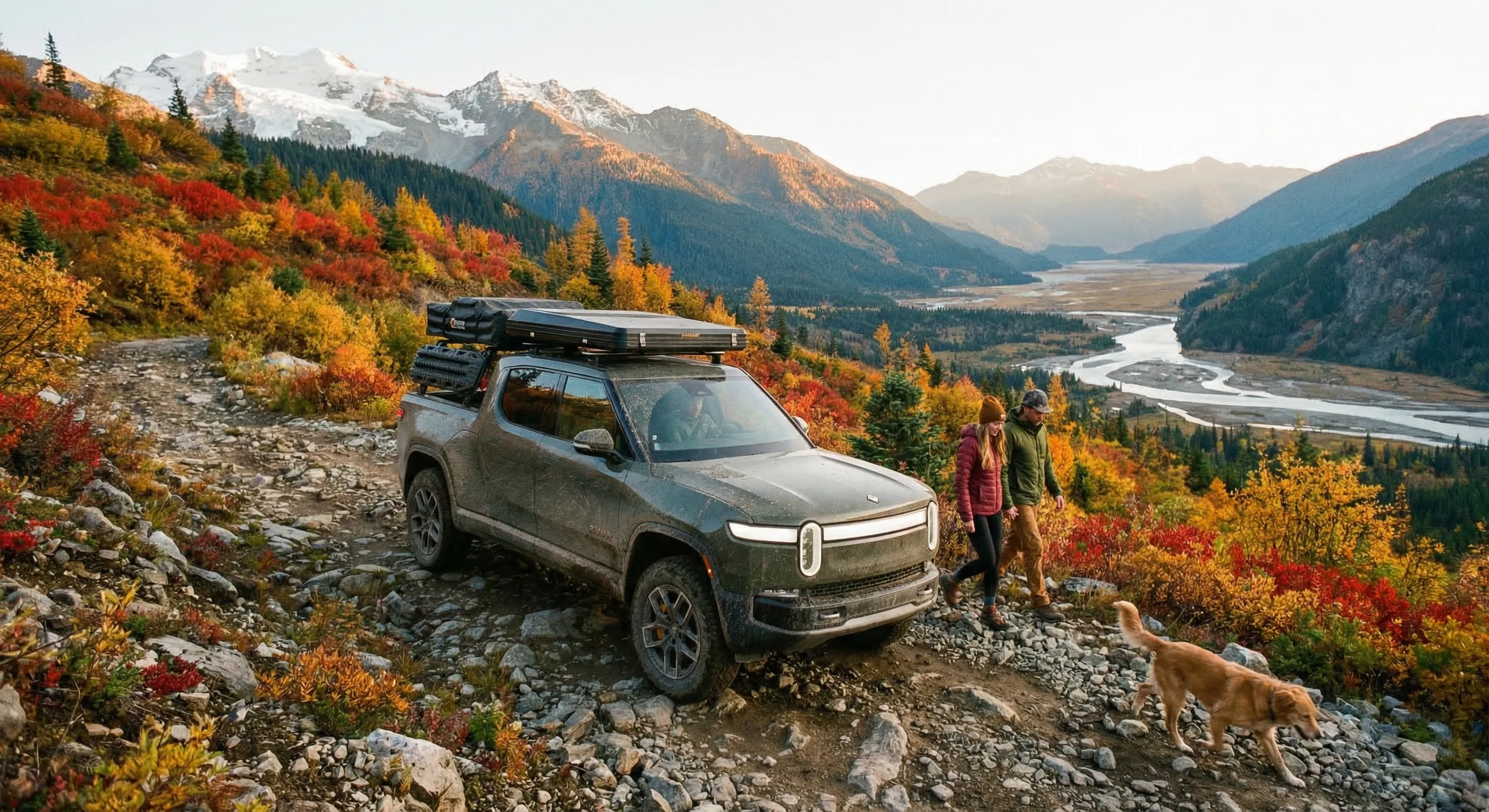
Owners report cooking full camp breakfasts on the Icefields Parkway at sunrise in late February: bacon, eggs, coffee, and toast from a camp toaster plugged into the bed outlet. Air temperature at -18°C. The propane burners light on first try, the windshield on the cooktop blocks the breeze effectively, and the preparation surface stays above freezing long enough to prep everything. Standing at the tailgate in -18°C with hot food in eight minutes. The view is the Athabasca Glacier. The coffee is good.
This sounds trivial, but it's not. The logistics of backcountry cooking, a separate stove, fuel canisters, the bag you carry them in, the surface you cook on, the spot you find to set up, is overhead that accumulates on every trip. The Camp Kitchen eliminates the entire category. You bring the truck. The kitchen is in the truck. The counter height is correct and doesn't require crouching. The surface is wipeable. The whole thing packs away in the tunnel when you're driving.
If you camp ten times a year, the $2,495 accessory cost works out to $250 per trip amortized over one year, and approximately zero per trip when you account for the separate camp stove and fuel setup you no longer need. It's a good value calculation, and the experience it enables, comfortable backcountry cooking with no additional gear burden, is better than what most camp stove setups deliver.
Comparison: R1T vs The Electric Truck Field
The electric truck segment in Canada in 2026 has four meaningful competitors: the Ford F-150 Lightning, the Chevy Silverado EV, the Tesla Cybertruck, and the GMC Hummer EV. Here's how they stack up against the R1T:
Ford F-150 Lightning ($72,000 CAD base for XLT trim, 515 km range, 580 hp): The Lightning is a better truck in the traditional sense, more payload, more towing options at lower trims, better parts and service availability across Canada, and a more familiar ownership experience for F-150 loyalists. It's not a better electric vehicle. The charging speed peaks at 150 kW, the software is notably behind Rivian's, and the off-road capability without the Tremor package doesn't approach the R1T's. If you live and die by towing and payload numbers and never leave paved roads, the Lightning at $15,000 less makes sense. If you want the full adventure capability, you need the R1T.
Chevrolet Silverado EV ($69,000 CAD base, 643 km range on RST variants): The Silverado EV's range figures are impressive, and wildly variable by trim, with the Work Truck at 640+ km and the base trim closer to 400 km. Chevy's Ultium charging architecture hits 350 kW peak DC on compatible stations. But the Silverado EV feels like a truck that got electrified rather than a vehicle designed around an electric drivetrain. The interior quality doesn't approach Rivian's at any price point, and the off-road story is limited to a mid-height air suspension option without the terrain-mode intelligence the R1T delivers. For highway towing and long-distance range, the Silverado EV competes. For adventure use, it doesn't.
Tesla Cybertruck ($67,990 USD base in the US, with pricing in Canada adding customs and potential tariff exposure): The Cybertruck has had a challenging Canadian market reception. The polarizing stainless steel exterior (not repairable by standard body shops in Canada), the lack of a conventional bed cover for weather protection, and Tesla's service network challenges in less urban Canadian provinces have limited its appeal here. The Foundation Series Cybertruck performance numbers are impressive, but real-world Canadian reviews have been mixed on range (below advertised in cold weather), interior quality (mixed reports), and build consistency.
GMC Hummer EV ($120,000+ CAD): The Hummer EV occupies a different market position, it's a luxury statement vehicle, not a practical adventure truck. The crab walk mode is a better party trick than Tank Turn, but the Hummer EV weighs 4,100 kg, gets 400+ km of range, and costs $30,000 more than the R1T base. It's a brilliant demonstration of what an electric drivetrain can do, and a less brilliant answer to the question of what most Canadians actually need from an adventure truck.
The summary: the R1T wins the adventure use case convincingly. It loses on base price competitiveness, and it's not the choice if your primary use is conventional truck work, towing a fifth-wheel trailer 1,200 kilometres across Alberta. For the buyer who wants a vehicle that can handle the urban daily drive, the weekend camping trip, and the serious backcountry loop without compromise, there's nothing in the segment that matches the R1T's combination of capability, quality, and software intelligence.
Ownership in Canada: Service, Warranty, and Long-Term Confidence
Buying a Rivian in Canada in 2026 is a different experience than buying a Ford or a GM, and that difference deserves honest discussion rather than marketing language.
Rivian's Canadian service network is concentrated in the four major provinces: British Columbia (Vancouver), Alberta (Calgary, Edmonton), Ontario (Toronto, Ottawa), and Quebec (Montreal). In these markets, Rivian operates service centres with full technician capabilities for mechanical and software issues. Mobile service, a technician who comes to your location, is available for most non-structural repairs and software-related issues in a wider radius around those centres.
For owners in Saskatchewan, Manitoba, Atlantic Canada, or the territories, mobile service and longer parts transit times are the current reality. This is not Rivian being negligent; it's the geographic mathematics of a country with enormous territory and concentrated population. But it's worth knowing before you take the truck to a forest service road three hours from Kelowna.
The warranty structure is straightforward and competitive. The vehicle warranty covers 5 years or 100,000 km bumper-to-bumper, whichever comes first. The battery and drive unit warranty extends to 8 years or 175,000 km. Rivian's warranty language includes a battery capacity guarantee, they warrant the battery against degradation below 70% of its original capacity within the warranty period, which provides meaningful protection against the battery degradation anxiety that affects early EV ownership discussions. In practice, Rivian's battery data from their existing North American fleet shows real-world degradation rates well below the warranty threshold at comparable mileage points.
Over-the-air updates mean the software you live with will improve over the ownership period. This is a statement that requires a track record to be meaningful, and Rivian has one: the 2022 and 2023 R1T owners have received features including Tank Turn (added post-launch), improved winter range estimation, additional terrain mode tuning, and navigation system improvements. The 2026 R1T will receive continued software development from Rivian's engineering team, and the vehicle's hardware is capable of supporting meaningful new feature additions.
Charging infrastructure investment is accelerating in Canada, with Rivian expanding the Adventure Network at a pace that reflects their adventure-use positioning. Where a Supercharger network prioritizes highway density and urban centres, Rivian's Adventure Network placements deliberately include trailhead access points, ski resort corridors, and provincial park entry areas. This is a network being built for the buyer Rivian is targeting, and for a Canadian adventure use case, the placement logic is more useful than generic highway DC fast charging density.
One more item that matters to Canadian adventure owners specifically: winter tire compatibility. The R1T fits 275/65R20 tires standard, and winter tire options in this size are excellent, Michelin X-Ice Snow, Bridgestone Blizzak DM-V3, and Continental VikingContact 7 are all available and well-reviewed. Running dedicated winter tires on an R1T in Canadian conditions is mandatory rather than optional. The quad-motor system is extraordinary, but winter tire rubber compounds provide traction advantages that no amount of electronic torque management can fully substitute. The combination of quad-motor intelligence and proper winter tires is what makes the R1T year-round capable in Canadian conditions.
Who Should Buy the Rivian R1T in Canada?
This is the most important question, and it's worth answering directly.
Buy the R1T if:
-
Your adventures take you beyond paved roads regularly, ski hill access routes, forest service roads, backcountry camping, trail riding trailheads. The quad-motor off-road system is genuinely unlike anything else in the electric truck segment, and it changes what those trips feel like.
-
You're replacing a Jeep Wrangler, Land Rover Defender, or similar serious 4x4, and you want the truck utility added to that capability. The R1T is the first electric vehicle that competes with a modded 4x4 on technical terrain.
-
You live in BC, Alberta, or Quebec where provincial EV incentives would apply if the R1T were priced below $85,000, but at $89,900, it exceeds the CleanBC cap, and where the charging infrastructure supports long-distance adventure use.
-
You want the most capable adventure truck available and you understand that "capable" encompasses software, charging intelligence, and storage architecture alongside the traditional mechanical metrics.
Don't buy the R1T if:
-
Your primary use is highway towing at maximum capacity over long distances. The Silverado EV or a diesel truck is a more practical answer for a contractor who's moving a 5,000 kg trailer from Edmonton to Calgary twice a week.
-
You're expecting a rebate. At $89,900, you're above every federal and provincial threshold except BC's $4,000 CleanBC rebate. The sticker price is the price you'll pay in most provinces.
-
You live north of the major highway corridors in Northern BC, Northern Ontario, or the Prairies, and your regular routes don't have reliable DC fast charging. The range is excellent, but infrastructure gaps in Canada's north are real.
-
You need the extensive service network that a Ford or GM dealer provides across Canada. Rivian's Canadian service coverage is concentrated in BC, Alberta, Ontario, and Quebec. If you're in Moncton or Saskatoon, mobile service and longer wait times are the current reality.
The Verdict
The Rivian R1T is the most complete adventure vehicle available in Canada. That statement is not primarily about the 835 horsepower or the 3.0-second acceleration or even the 515 km of range, though all three are genuinely impressive. It's about the way the vehicle has been designed as a system, from the quad-motor torque distribution to the Camp Kitchen in the Gear Tunnel to the trip-planning software that knows your elevation gains and your weather forecast. Every component of the R1T exists in conversation with the others, and the conversation produces a vehicle that is better at adventures than any vehicle that preceded it.
It is not the right truck for everyone in Canada. It is too expensive for buyers who need a work truck and aren't using it for recreation. It is too dependent on a charging infrastructure that hasn't fully materialized in Canada's more remote regions. And it is asking you to bet on Rivian, a company that has had manufacturing challenges and financial pressures, to be around, and to keep improving, for the decade-plus you'll own this truck. That last point deserves sober evaluation before you sign anything.
For the buyer who buys it for the right reasons, weekend adventures, backcountry exploration, the specific Canadian joy of disappearing into wilderness that is legitimately remote and legitimately beautiful, the Rivian R1T delivers on every promise Rivian made when they sketched it on a napkin a decade ago. There is a truck that can take you there, keep you comfortable while you're there, and bring you back. It happens to be electric. And as owners discover on a switchback in the Kootenays with 15 centimetres of fresh snow on the gravel, that turns out to matter more than you'd expect.
At $89,900, it's expensive. It's the right price for what it is.
Gear worth having
As an Amazon Associate, ThinkEV earns a small commission from qualifying purchases — at no extra cost to you.

PULIDIKI Car Cleaning Gel (Detailing Putty)
Press it into vents, buttons, and seams and it lifts out dust you did not know was there. Weirdly satisfying, genuinely useful.
As an Amazon Associate, ThinkEV earns from qualifying purchases — at no extra cost to you.
Related Reading
- Rivian R1T vs Ford F-150 Lightning: Canada's Electric Truck Showdown, Head-to-head comparison with real Canadian data
- Ford F-150 Lightning Canada Review 2026, Full review of Rivian's closest competitor
- Rivian R1S vs Tesla Model X Canada 2026, The R1T's SUV sibling against Tesla's flagship
- EV Road Trip Charging Planning Guide Canada 2026, Plan your adventure routes with charging confidence
- Canada EV Rebate EVAP 2026 Guide, Full breakdown of which EVs qualify for federal incentives
Gear worth having
As an Amazon Associate, ThinkEV earns a small commission from qualifying purchases — at no extra cost to you.

WixGear Magnetic Air Vent Phone Mount (2-Pack)
A magnet strong enough that your phone never flinches over potholes or rail crossings. Two in the box, one for each car.
As an Amazon Associate, ThinkEV earns from qualifying purchases — at no extra cost to you.

Founder & Chief Editor
Vlad Pereira is the founder and chief editor of ThinkEV.ca, the Canadian electric-vehicle publication he writes and edits from Courtenay, British Columbia. He covers EV pricing, federal and provincial rebates, charging costs, and the Chinese manufacturers now entering Canada, from the buyer's side rather than the press-fleet side. ThinkEV is a venture of Vlad Pereira Online; his writing on health, income and the long game lives at vladpereira.com.
Frequently asked questions
Does the Rivian R1T qualify for Canada's federal EVAP rebate?
What is the real winter range of the Rivian R1T in cold Canadian weather?
How does the Rivian R1T's off-road capability compare to a traditional 4x4 truck?
What charging speed does the Rivian R1T actually achieve in Canada?
Is the Rivian R1T better than the Ford F-150 Lightning for Canadian buyers?
How does Camp Mode work on the Rivian R1T, and how long does it last?
More EV & road-trip finds
Affordable upgrades worth a look — tap any to check the price on Amazon.
 ★ 68
★ 68WeatherTech FloorLiner for Tesla Model 3
View on Amazon ★ 47,507
HOMEXCEL Microfiber Cloths (12-Pack)
View on Amazon ★ 537
★ 537USB Star Projector Roof Light
View on Amazon ★ 900
★ 900Personalized Photo Car Air Freshener
View on Amazon ★ 865
★ 865Collapsible Trunk Organizer
View on Amazon ★ 848
★ 848Coiled USB-C to USB-C Car Cable (2-Pack)
View on Amazon ★ 87
★ 87Car Window Sun Shades for Kids (4-Pack)
View on Amazon ★ 268
★ 268Anti-Slip Leather Steering Wheel Cover
View on AmazonRead, Plan, Then Stay Current
Explore our expert articles to understand incentives and ownership costs, use the map to pressure-test charging reality, then subscribe so new EV coverage comes straight to you.
Continue Reading
Chevy Silverado EV Canada Review: 640 km Range
Ford F-150 Lightning Canada Review: The Real Math
Rivian R2 Canada Price 2026: The $57K Electric SUV
Volvo EX30 Canada Review: The Small One to Want
VW ID. Buzz Canada Review: $69,995 Electric Microbus