Key takeaways
- First: you'll charge at home 90% of the time.
- You plug in when you get home, you wake up with a full battery, about 40-65 km of range per hour of charging, depending on your specific charger and vehicle.
- For a BYD Seal with an 82.5 kWh battery, home charging costs about $8 for a full charge at typical rates.
- 150-350 kW speeds means 10-80% in 20-40 minutes depending on the charger and your car's capability.
Most EV owners charge at home 90% of the time, and a full charge on a BYD Seal's 82.5 kWh battery costs about $8 at typical Canadian electricity rates. Public charging is for road trips, not daily life, and once that's clear, the rest of how charging works in Canada falls into place quickly.
First: you'll charge at home 90% of the time. This is the most important thing to understand. Public charging is for road trips and emergencies, not daily life. Second: all modern EVs (except some Teslas) use the same plug, CCS is the standard, so whether you buy a BYD, a Hyundai, or a Volkswagen, you plug into the same chargers. Third: it costs about $8 to fill an EV at home versus $30+ at a public fast charger. Home charging isn't just convenient, it's dramatically cheaper.
Now let me explain everything else.
The Three Types of Charging
Level 2 is what you'll install at home. It's a 240-volt outlet (like your dryer uses) connected to a dedicated charger. You plug in when you get home, you wake up with a full battery, about 40-65 km of range per hour of charging, depending on your specific charger and vehicle. For a BYD Seal with an 82.5 kWh battery, home charging costs about $8 for a full charge at typical rates. That's $0.10-$0.15 per kWh, your regular electricity rate.
DC fast charging is what you use on road trips. High-powered stations at malls, gas stations, and highway rest stops. 150-350 kW speeds means 10-80% in 20-40 minutes depending on the charger and your car's capability. Cost is higher: $0.40-$0.55 per kWh. For a BYD Seal, that's about $25-$35 from 10-80%.
Destination charging is Level 2 at hotels, restaurants, workplaces, and parking garages. Slower (7-22 kW), often free or cheap. Useful for topping up while you're doing something else anyway.
Setting Up Home Charging
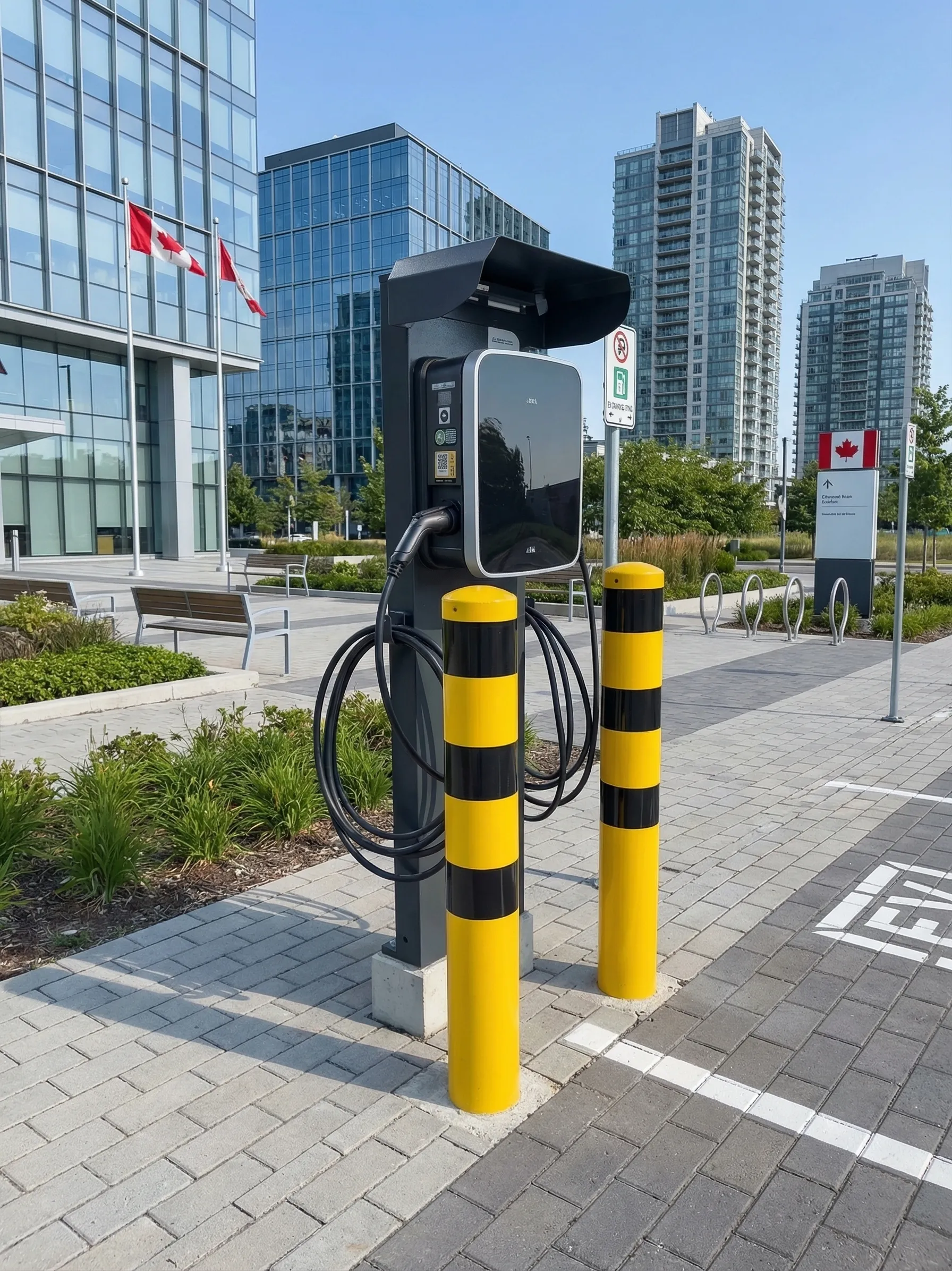
Start with the charger decision. The Grizzl-E costs $600-$700 and is Canadian-made, reliable, and simple. No WiFi features, but you probably don't need them. It adds about 50 km of range per hour.
The ChargePoint Home Flex costs $800-$1,000 and has WiFi connectivity, app scheduling, and works with most utility programs. About 65 km per hour.
The FLO G5 costs $900-$1,100 and is made by a Canadian company with the best app experience and cellular backup. About 60 km per hour.
For most people, the Grizzl-E is all you need. The fancy features on more expensive chargers rarely matter in practice. Second, hire an electrician. Get quotes from 2-3 licensed electricians. Tell them you need a 240-volt, 40-50 amp circuit for an EV charger. Point to where you park your car. Decide whether you want it hardwired or with a NEMA 14-50 outlet.
Expect to pay $500-$1,500 depending on the distance from your electrical panel and whether you need a panel upgrade. Older homes sometimes require panel work.
Third, check for rebates. Some provinces and utilities offer rebates for home charger installation, typically up to $600, though amounts vary by program and region. The federal $5,000 EVAP rebate is for the vehicle purchase, not for charger installation. Check NRCan and your provincial utility for current charger-specific incentives. Keep your receipts.
The math still works in your favour. Charger at $900 plus installation at $1,200 equals $2,100, a one-time cost that pays for itself within a year or two through fuel savings versus gasoline.
Road Trip Planning
The charging network in Canada is adequate for most travel. Here's how I'd think about specific routes.
Toronto to Montreal (540 km) in a BYD Seal (480 km range): Leave with a full charge. Make one stop at Kingston or Cornwall for 20-25 minutes. Arrive with a comfortable buffer. Total trip time is about 5.5-6 hours versus 5 hours without charging. Electrify Canada at Kingston has 250 kW chargers.
Toronto to Ottawa (450 km) in a BYD Atto 3 (420 km range): Leave with a full charge. One stop recommended at Belleville or Brockville for 20-30 minutes. Or push through if you're comfortable arriving at 15-20% battery.
Vancouver to Calgary (970 km) in any EV with 400+ km range: 2-3 charging stops. Use Petro-Canada Electric Highway stations at Revelstoke and Golden. About 60-90 minutes total charging time across the trip.
Vancouver to Toronto (4,400 km): Feasible but requires planning. 10-15 charging stops, 4-5 hours total charging time spread across the trip. Use Tesla Superchargers with an adapter for best coverage across the prairies.
Gear worth having
As an Amazon Associate, ThinkEV earns a small commission from qualifying purchases — at no extra cost to you.

Grizzl-E Classic Level 2 EV Charger (40A)
Canadian-made and rated for minus 40C winters. 40A / 9.6 kW, NEMA 14-50, indoor/outdoor, 24-ft cable. The charger built for Canadian weather.
As an Amazon Associate, ThinkEV earns from qualifying purchases — at no extra cost to you.
Gear worth having
As an Amazon Associate, ThinkEV earns a small commission from qualifying purchases — at no extra cost to you.

ChargePoint Home Flex Level 2 Charger (50A)
Premium 50A / 12 kW charger with the best app ecosystem. Hardwired or NEMA 14-50, with real-time energy tracking and smart scheduling.
As an Amazon Associate, ThinkEV earns from qualifying purchases — at no extra cost to you.
The Charging Networks
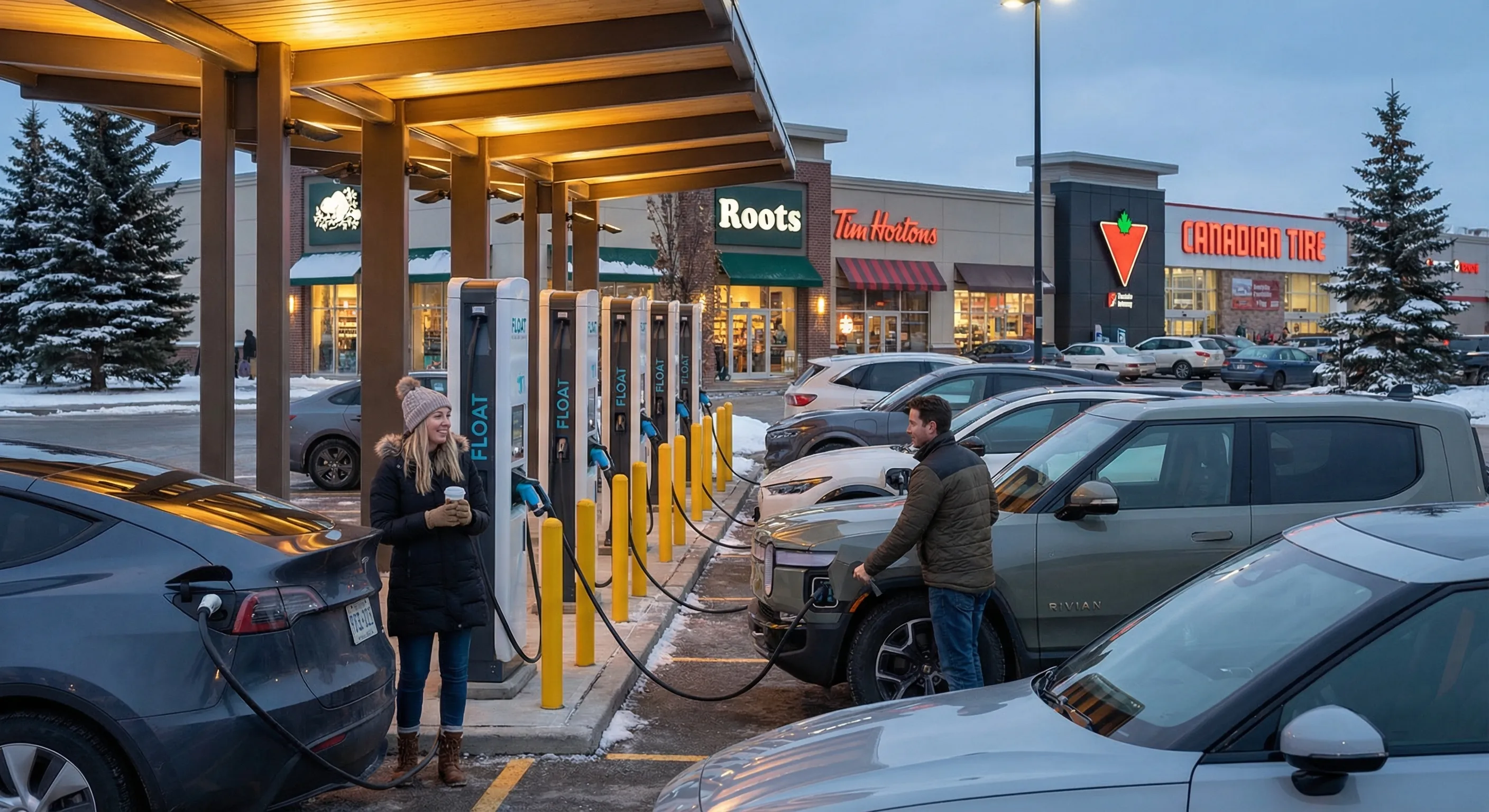
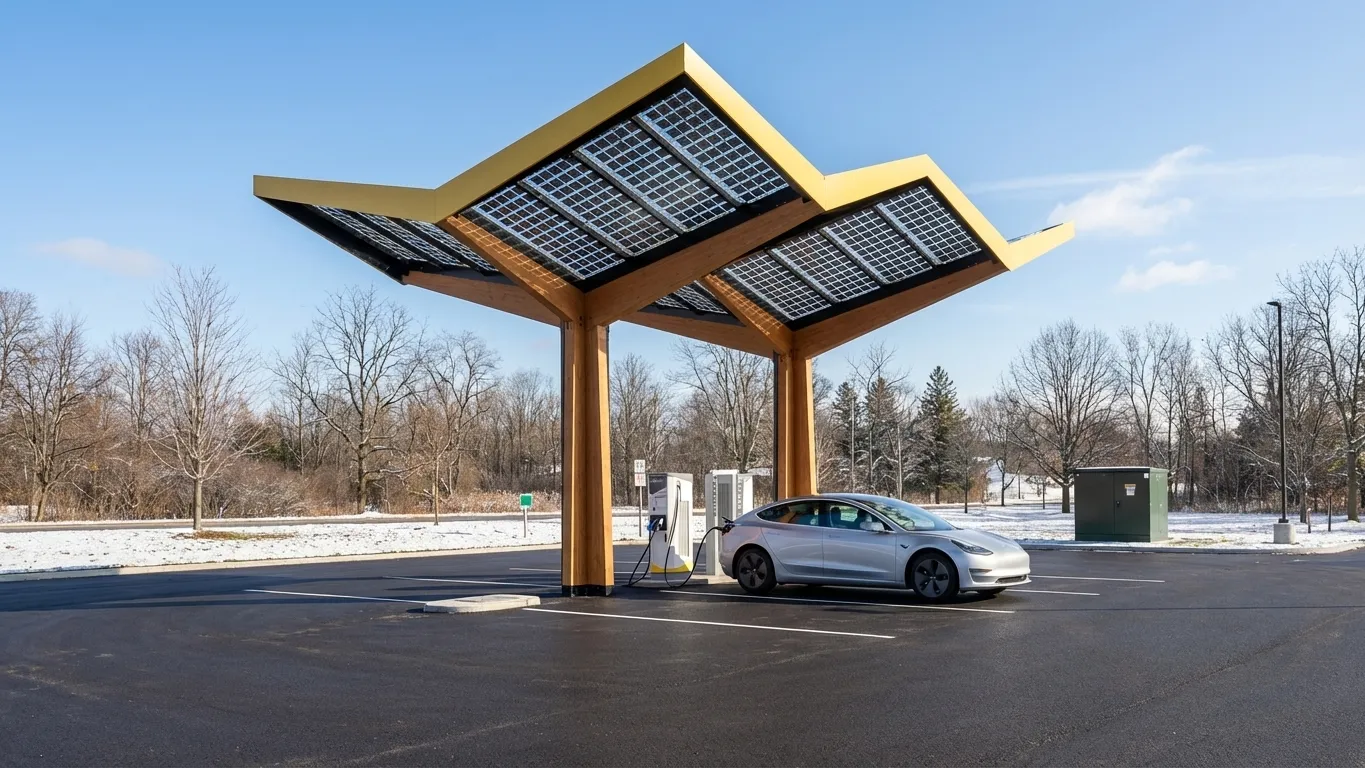
Tesla Supercharger is the most extensive network with 500+ stalls across Canada. Speeds of 150-250 kW. Costs $0.45-$0.55 per kWh. For non-Tesla EVs, you need a $250 adapter. Buy it, the network is worth accessing. Electrify Canada has 200+ stalls at 50+ locations with the fastest chargers in Canada (350 kW capable, though your car's limit matters more) at $0.43/kWh or $4/month for $0.31/kWh. Petro-Canada Electric Highway covers 50+ locations along the Trans-Canada at 50-200 kW speeds, usually at gas stations, so food and bathrooms are available. FLO is the biggest overall network with 20,000+ Level 2 chargers and growing DC fast charging. ChargePoint has 100+ DC fast locations, common at hotels, workplaces, and retail.
A critical point most guides skip: you get the lower of the charger's speed or your car's limit. A BYD Atto 3 charges at up to 80 kW. At a 350 kW Electrify Canada station, you'll charge at 80 kW. A BYD Seal charges at up to 150 kW, so it maxes out at 150 kW regardless of charger speed. A Hyundai Ioniq 5 at up to 350 kW can actually get close to that speed at a matched station. The car matters more than the charger for most people. Rough charging times from 10-80%: BYD Dolphin (60 kW) 45-50 minutes; BYD Atto 3 (80 kW) 40-45 minutes; BYD Seal (150 kW) 25-30 minutes; Tesla Model 3 (250 kW) 20-25 minutes; Hyundai Ioniq 5 (350 kW) 18-22 minutes.
For apps, you need four. Download PlugShare (free), it shows all stations across all networks with user reviews telling you which ones are broken, busy, or excellent. Download the Tesla app if you plan to use Superchargers, as it's required for payment. Download Electrify Canada and consider the $4/month membership if you'll road trip often. Download FLO for destination charging. That's it. You don't need fifteen apps.
The Cost Comparison
Real numbers for a typical Canadian driver doing 20,000 km per year in a BYD Seal (16 kWh per 100 km efficiency):
Charging exclusively at home during off-peak rates: $1.60 per 100 km, $320 per year.
Gear worth having
As an Amazon Associate, ThinkEV earns a small commission from qualifying purchases — at no extra cost to you.

Lectron Level 2 J1772 Charger (40A, WiFi)
Smart WiFi charger with real-time energy monitoring. 40A / 9.6 kW, J1772 with a NEMA 14-50 plug, schedule charging right from your phone.
As an Amazon Associate, ThinkEV earns from qualifying purchases — at no extra cost to you.
Charging at home during average rates: $2.00 per 100 km, $400 per year.
Charging exclusively at public DC fast chargers: $7.00 per 100 km, $1,400 per year.
Realistic mix (80% home, 20% DC fast): $2.60 per 100 km, $520 per year.
For comparison, a gas car getting 8L per 100 km at $1.60 per liter costs $2,560 per year.
Even with some public charging, you're saving over $2,000 annually in fuel costs.
What You Actually Need to Know
Cold weather affects charging speed, batteries charge more slowly when cold. If you're arriving at a DC fast charger on a -20°C day without preconditioning, expect longer charging times. Use your car's battery preconditioning feature: most EVs can warm the battery en route to a charger if you work through using the car's built-in system. Home charging in winter is mostly unaffected. You might need slightly more energy because the car warms the battery while charging, but the convenience is unchanged.
For daily life: install a Level 2 charger at home, plug in when you get home, wake up with a full battery. Don't think about it. For road trips: download PlugShare, plan your route, and stop for 20-40 minutes every 300-400 km. It's not as smooth as gas stations, but it's workable. On major corridors you'll find chargers without issue. In rural areas, plan more carefully.
The technology is evolving. More chargers are being installed. Battery swap might arrive via NIO. But right now, today, you can drive an EV across Canada without running out of charge if you plan appropriately. That's the reality. Not as scary as people make it sound.
Gear worth having
As an Amazon Associate, ThinkEV earns a small commission from qualifying purchases — at no extra cost to you.

Magnetic EV Charger Plug Cover
A magnetic cap that keeps rain, road salt, and grit out of your home charger handle between sessions.
As an Amazon Associate, ThinkEV earns from qualifying purchases — at no extra cost to you.
Related Reading
- How to Install a Level 2 EV Charger at Home, Complete home charger installation guide.
- EV Charging Costs by Province, What you'll pay to charge in every province.
- Best Level 2 EV Chargers Canada 2026, Top home chargers compared.
Gear worth having
As an Amazon Associate, ThinkEV earns a small commission from qualifying purchases — at no extra cost to you.

MECMO J1772 Charger Holster (Wall Mount)
A weatherproof dock for the J1772 nozzle so your charging handle has a home instead of the garage floor.
As an Amazon Associate, ThinkEV earns from qualifying purchases — at no extra cost to you.

Founder & Chief Editor
Vlad Pereira is the founder and chief editor of ThinkEV.ca, the Canadian electric-vehicle publication he writes and edits from Courtenay, British Columbia. He covers EV pricing, federal and provincial rebates, charging costs, and the Chinese manufacturers now entering Canada, from the buyer's side rather than the press-fleet side. ThinkEV is a venture of Vlad Pereira Online; his writing on health, income and the long game lives at vladpereira.com.
Frequently asked questions
How many public EV chargers are in Canada?
Can I drive across Canada in an EV?
Is home charging or public charging cheaper?
More EV & road-trip finds
Affordable upgrades worth a look — tap any to check the price on Amazon.
 ★ 4,055
6-Speed Manual Shift Knob Display
View on Amazon ★ 12,396
K KNODEL Car Trash Can with Lid
View on Amazon ★ 1,866
70mai A810 4K Dual Dash Cam
View on Amazon ★ 61
★ 61Toddler Car Seat Snack and Cup Tray
View on Amazon ★ 17,839
Qifutan Vent Phone Mount (Military-Grade Clip)
View on Amazon ★ 47,507
HOMEXCEL Microfiber Cloths (12-Pack)
View on Amazon ★ 419
★ 419RGB Car Interior LED Strip Light
View on Amazon ★ 4,626
HoogaLife Hanging Car Diffuser (2-Pack)
View on AmazonRead, Plan, Then Stay Current
Explore our expert articles to understand incentives and ownership costs, use the map to pressure-test charging reality, then subscribe so new EV coverage comes straight to you.
Continue Reading
Ontario EV Charging in 2026: Where It Stands
EV Charging in a Condo or Apartment in Canada
EV Charging Costs Canada 2026: Home vs Public

EV Road Trip Canada: How to Plan the Charging

Nova Scotia EV Rebates 2026: $3,000 Off + EV Tax Reality Check