Key takeaways
- The headline number is 1,000 km of range.
- The 1,000 km claim is based on their own projections about how this cell would perform in a vehicle that doesn't yet exist.
- Mass-market solid-state EVs are unlikely to reach accessible price points before 2033–2035, based on current manufacturing cost trajectories.
Solid-state batteries have been "five years away" for the better part of two decades. In early 2026, two separate announcements landed within weeks of each other and made that joke obsolete. CALB, one of China's largest battery manufacturers, publicly demonstrated a 60Ah solid-state cell the size of a desk calendar that they claim can push an EV to 1,000 km on a single charge. Meanwhile, a team called Donut Lab released results from their third consecutive successful test showing a solid-state battery retaining 97.7% of its charge after sitting idle for 10 full days.
These aren't renderings. They aren't concept videos. They're tested, measured, publicly documented results from physical hardware.
So what does this actually mean? How close are we, really? And if you're a Canadian driver weighing an EV purchase in 2026, should any of this change your thinking?
Both announcements are real. Neither means you should wait to buy an EV. What follows is a technically honest read of where the technology actually stands.
What CALB Just Showed the World
CALB, Contemporary Amperex Technology's main Chinese rival, and one of the most credible battery manufacturers operating outside of CATL's shadow, didn't issue a press release with vague promises. They physically demonstrated a cell.
The headline number is 1,000 km of range. That's the figure being circulated, and it's roughly equivalent to driving from Toronto to Quebec City without stopping to charge. The figure is presented as a WLTP-equivalent estimate based on the cell's energy density, not a real-world drive test on a specific vehicle. That distinction matters and I'll come back to it.
What's more immediately significant than the range figure is the form factor. The cell is described as "desk-calendar sized", which is a deliberately evocative comparison. Current EV battery cells are not tiny, but the engineering challenge with any new battery chemistry is not just energy density in a lab sample. It's whether you can manufacture it in a form factor that makes engineering sense for a vehicle. A cell that delivers extraordinary energy density but is the size of a washing machine is not a product. A cell that fits in a form factor engineers can work with is the beginning of something real.
The 60Ah capacity is a meaningful spec. Ampere-hours measure how much charge a cell can hold. Current production lithium-ion pouch cells for automotive applications typically run in similar ranges, the CALB figure is not wild on its face, but the energy density (energy per kilogram and per litre of volume) is where solid-state cells are supposed to dramatically outperform liquid-electrolyte batteries, and that's the engineering story behind the 1,000 km claim.
Here's the caveat: CALB has not disclosed full cycle-life data for this cell. They have not released independent third-party test results. The 1,000 km claim is based on their own projections about how this cell would perform in a vehicle that doesn't yet exist. All of that is normal for a technology demonstration, but it does mean we're not yet at the stage where you can say "this cell is production-ready." What we can say is that a major, credible manufacturer with serious manufacturing infrastructure has a physical cell that appears to validate the theoretical energy density projections for solid-state chemistry.
That is genuinely significant. It means the physics is working. The remaining questions are engineering, manufacturing, and cost, and those are solvable problems, even if they're not solved yet.
Donut Lab and the Self-Discharge Problem
The second announcement is quieter but arguably more practically important for everyday drivers.
Self-discharge is the phenomenon where a battery loses charge even when it isn't being used. Every battery does this. It's a fundamental electrochemical reality. The question is how fast.
Current lithium-ion batteries, the kind in every EV you can buy right now, typically self-discharge at a rate of somewhere between 2% and 5% per month under normal storage conditions. That doesn't sound like much, but it adds up. If you leave an EV sitting for a month without driving it, you're going to come back to meaningfully less charge than you left. Leave it for three months and you might come back to a battery that needs to be carefully recharged from a low state of charge, which is not ideal for long-term cell health.
Cold weather makes this worse. In Canada, this is not a theoretical concern. Batteries in a cold garage lose charge faster, and they also require thermal management energy just to maintain operating temperature, which further drains charge even when the vehicle is parked.
Donut Lab's result, 97.7% charge retention after 10 days, translates to a self-discharge rate of roughly 0.23% over 10 days, or approximately 0.7% per month. Compare that to the 2-5% monthly rate of conventional lithium-ion and you're looking at a meaningful real-world difference.
What makes the Donut Lab result notable is the context: this was their third test. Not the first promising fluke. The third consistent data point. In experimental battery research, a single impressive result can be noise, measurement error, or a lucky sample. Three consecutive positive results across separate test runs is the beginning of reproducibility, and reproducibility is what separates a laboratory curiosity from a technology you can actually build a product around.
The practical implications for Canadian drivers are significant. A car that loses almost no charge sitting in a cold garage over a week is a fundamentally different proposition than one that loses 3-4% in the same period. Long-term storage (think cottage season, or a car left at an airport for two weeks) becomes nearly a non-issue.
Why Solid-State Is Different: The Actual Science
I want to spend time here because I think a lot of the coverage of solid-state batteries treats it as a magical upgrade without explaining why the chemistry is different. The "why" matters, because it tells you which of the claimed benefits are real and which are theoretically plausible but unproven.
Every battery, every single one, has three core components: an anode (negative electrode), a cathode (positive electrode), and an electrolyte that sits between them. The electrolyte is the medium through which lithium ions travel when the battery charges and discharges. In every EV battery on the road today, that electrolyte is a liquid, specifically a lithium salt dissolved in an organic solvent.
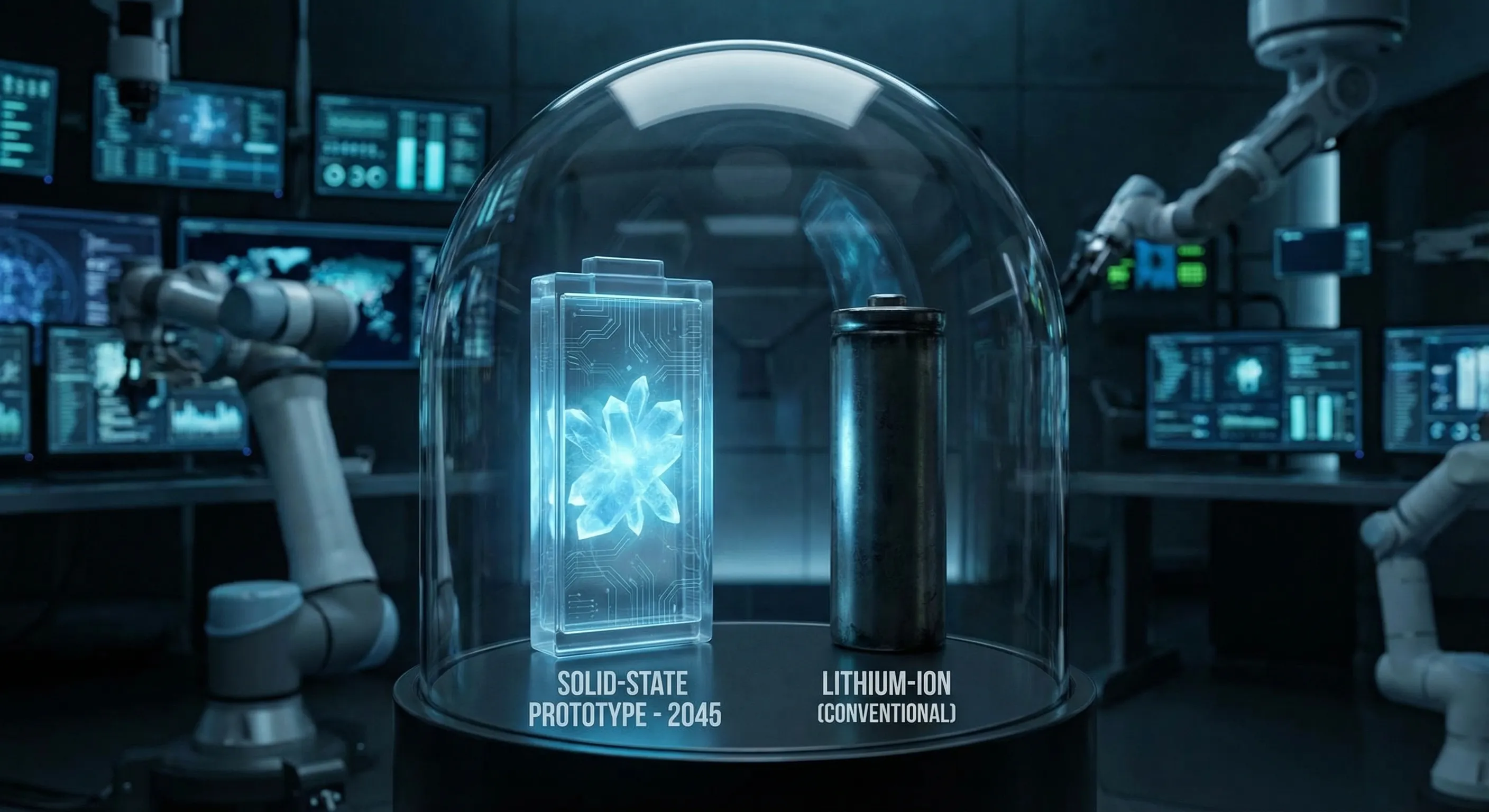
Solid-state batteries replace that liquid electrolyte with a solid material. The solid can be ceramic, glass, polymer, or a sulphide compound depending on the approach. This seemingly simple substitution has cascading effects on basically every performance characteristic of the battery.
Energy density improves because solid electrolytes are denser and can be made thinner than liquid electrolyte systems, which allows more active material to be packed into the same volume. Additionally, solid-state batteries can use lithium metal anodes, something that's extremely problematic with liquid electrolytes because metallic lithium reacts aggressively with organic solvents and creates dangerous dendrites (needle-like lithium growths that can pierce the separator and cause a short circuit). With a solid electrolyte, lithium metal anodes become viable, and a lithium metal anode stores significantly more energy per kilogram than the graphite anodes used in current lithium-ion cells.
The theoretical energy density ceiling for a solid-state lithium metal battery is around 500-700 Wh/kg. Today's best production EV batteries (NMC chemistry, high-nickel cathodes) are in the 250-300 Wh/kg range. LFP (lithium iron phosphate) batteries, favoured for their longevity and lower cost, are typically in the 150-180 Wh/kg range.
Safety improves substantially because the liquid organic electrolyte in current batteries is flammable. The thermal runaway events that produce dramatic EV fire videos are almost always initiated by a failure that ignites that liquid electrolyte. Solid electrolytes are non-flammable. A solid-state battery can still fail, and failure is still unpleasant, but the catastrophic fire propagation that makes EV battery fires so difficult to extinguish becomes far less likely.
Cold weather performance improves because one of the core problems with current EV batteries in cold temperatures is that the liquid electrolyte becomes more viscous, which slows ion transport and reduces both power delivery and available capacity. Solid electrolytes don't become viscous. Their ion transport characteristics in cold conditions are more predictable and generally superior. This is specifically relevant for Canada, where a battery that works well at -20°C is not a nice-to-have, it's a market requirement.
Cycle life improves because many of the degradation mechanisms in liquid electrolyte batteries involve reactions between the electrolyte and the electrodes over time. The solid electrolyte is more chemically stable, and without the dendrite risk that limits lithium metal anodes, solid-state batteries are projected to achieve 5,000+ charge cycles before significant degradation, compared to roughly 1,500-2,000 cycles for current high-end NMC batteries and perhaps 3,000+ cycles for LFP.
Charging speed is more complicated. The theoretical ceiling for charging speed in solid-state batteries is higher, ions can move rapidly through certain solid electrolyte materials, but the practical reality is that the interface between the solid electrolyte and the electrode materials creates its own resistance. Different solid electrolyte chemistries handle this differently, and the jury is still genuinely out on which approach achieves the best combination of fast charging and long cycle life.
Where Every Major Player Actually Stands
The CALB and Donut Lab announcements didn't happen in a vacuum. The entire battery industry is racing toward solid-state with varying degrees of progress and honesty about where they actually are. Let me walk through the competitive field as it stands in early 2026.
CATL is the world's largest EV battery manufacturer and the company against which all others are measured. CATL has been notably quiet about true solid-state batteries, and the reason is instructive: they've invested heavily in a "semi-solid" chemistry they call Condensed Battery that uses a partially gelled electrolyte rather than a fully solid one.
This is a genuine technology, CATL is already producing condensed batteries at commercial scale, but it's an intermediate step rather than the full solid-state transition. The energy density of CATL's condensed battery is estimated at around 500 Wh/kg, which is in solid-state territory even if the chemistry is different. The business reality is that CATL's financial position (they reported approximately 10 billion USD net profit in 2025) gives them the resources to pursue multiple technology paths simultaneously, but their public statements suggest their "true" solid-state timeline is 2027 at the earliest for initial production.
Toyota has the longest and most prominent solid-state battery programme of any traditional automaker. They hold more solid-state battery patents than any other company in the world, and they've been public about targeting 2027-2028 for their first vehicle with a solid-state battery. Toyota's target specs, 1,200 km range, 10-minute charge time, have attracted both excitement and scepticism. The scepticism is warranted because Toyota has been announcing these timelines for over five years and has repeatedly pushed them back. The most recent credible reporting suggests they are genuinely making progress on manufacturing scalability, but the 2027 date represents a best-case scenario rather than a guarantee.
Samsung SDI is one of the most credible players outside China. They've been quietly publishing solid results, both literally and figuratively, and their timeline projections have been more conservative and more consistently met than Toyota's. Samsung SDI has been vocal about targeting 2027 for pilot production and 2030 for volume production.
QuantumScape, the Silicon Valley startup backed by Volkswagen, is publicly traded and therefore required to be more transparent than most. Their results have been impressive at the cell level, they published verified data showing a lithium metal solid-state cell achieving over 1,000 charge cycles with minimal degradation, but they've also been honest about the manufacturing challenges. Going from a single test cell to a prismatic cell suitable for automotive applications has taken longer than projected. Their current public guidance suggests automotive samples in 2026, with production intent for 2028+.
Solid Power, another publicly traded startup, works with BMW and Ford. They've moved from coin cells to full-size automotive format cells and handed off cells to both automakers for their own validation testing, a significant milestone that most solid-state startups have not reached.
BYD is an interesting case. While their competitors race toward solid-state, BYD has been doubling down on their Blade LFP technology and pushing the boundaries of what's possible with existing chemistry. Their Blade 2.0 battery and 1.5MW charging capability demonstrate that there's still significant headroom in current technology, which is relevant context for understanding why solid-state has not simply rendered everything else obsolete overnight.
The Manufacturing Problem Nobody Talks About Enough
The CALB demonstration is exciting. The Donut Lab results are encouraging. But the conversation that doesn't happen enough is the manufacturing gap between "working in the lab" and "available at a dealership."
Building a single solid-state battery cell in a laboratory is hard. Building ten million of them per year, each one meeting the same specification, each one performing reliably over thousands of charge cycles, in a factory that is profitable to operate, that is an entirely different order of engineering problem.
The specific manufacturing challenges for solid-state batteries are significant enough that I think they deserve explicit attention.
Interface stability is the core challenge. When a solid electrolyte sits against a solid electrode and lithium ions move back and forth through that interface during charging and discharging, the physical contact at that interface changes over time. Electrodes expand and contract as they absorb and release lithium. In a liquid electrolyte system, the liquid conforms to the electrode surface and maintains contact. In a solid-state system, gaps can form at the interface, increasing resistance and reducing performance. Managing this requires either very high manufacturing precision, mechanical compression of the cell stack, or electrolyte materials that are soft enough to maintain contact (which creates their own problems).
Sulphide electrolytes vs. oxide electrolytes is a choice that different manufacturers have made differently, and both have real trade-offs. Sulphide electrolytes (favoured by Toyota, Samsung, and others) have better ionic conductivity, meaning lithium ions move through them faster, but they're chemically sensitive. They react with moisture and even with some electrode materials, which makes manufacturing in ambient air impossible. Oxide electrolytes (like LLZO, a lithium lanthanum zirconium oxide ceramic) are more chemically stable but harder to make thin and flexible. Polymer electrolytes work at lower temperatures than ceramics but have lower ionic conductivity.
Scale and cost are the honest stoppers for right now. Best current estimates put solid-state battery production costs at three to five times the cost of equivalent lithium-ion capacity. At current lithium-ion pack costs of roughly $100-120 USD per kWh (and falling), that puts solid-state at $300-600 USD per kWh, which would add $15,000-30,000 to the cost of a typical 60-80 kWh EV pack. No volume EV manufacturer can absorb that cost difference and sell a mass-market vehicle. Premium applications, the first solid-state EVs will almost certainly be expensive vehicles, can justify the premium, but mass-market availability requires cost reduction that will take years.
What 1,000 km Range Actually Means for Real Drivers
Let me engage with the 1,000 km range figure honestly, because I think it's simultaneously exciting and somewhat misunderstood.
First, the number itself: 1,000 km is a WLTP-equivalent projection based on the CALB cell's energy density. WLTP (Worldwide Harmonised Light Vehicle Test Procedure) is a standardized test cycle. Real-world range in Canada, particularly in winter, at highway speeds, with the heating system running, typically comes in at 70-85% of WLTP figures for current EVs. Apply that to 1,000 km and you're looking at 700-850 km of real-world range in good conditions, and perhaps 500-600 km on a cold Saskatchewan January day.
That is still a transformational improvement.
The range anxiety conversation that currently surrounds EVs in Canada is almost entirely about the interplay of range, charging infrastructure availability, and cold weather performance degradation. We have a piece on EV winter range in Canada that covers this in detail, the short version is that cold weather can reduce range by 20-40% in current EVs, which turns a 400 km range vehicle into a 240-320 km vehicle on a cold day.
A vehicle with 700-850 km of summer range that retains 80% of that in winter still has 560-680 km of cold-weather range. That covers virtually every intercity drive in Canada without a charging stop. Toronto to Ottawa is 450 km. Calgary to Edmonton is 300 km. Vancouver to Kelowna is 390 km. A vehicle with 560+ km of cold-weather range covers all of those without a charge.
The implications for charging infrastructure are also interesting. If range is no longer a meaningful constraint for most trips, the pressure on fast-charging networks shifts. You no longer need a fast charger at every 200 km on the Trans-Canada for road trips, you need overnight destination charging and fast chargers at major stops. That's a fundamentally different (and easier) infrastructure problem.
There's also the secondary question of what this does to EV resale values for current-generation vehicles. I'll come back to this.
The Solid-State Battery Timeline: Confirmed vs.
Projected
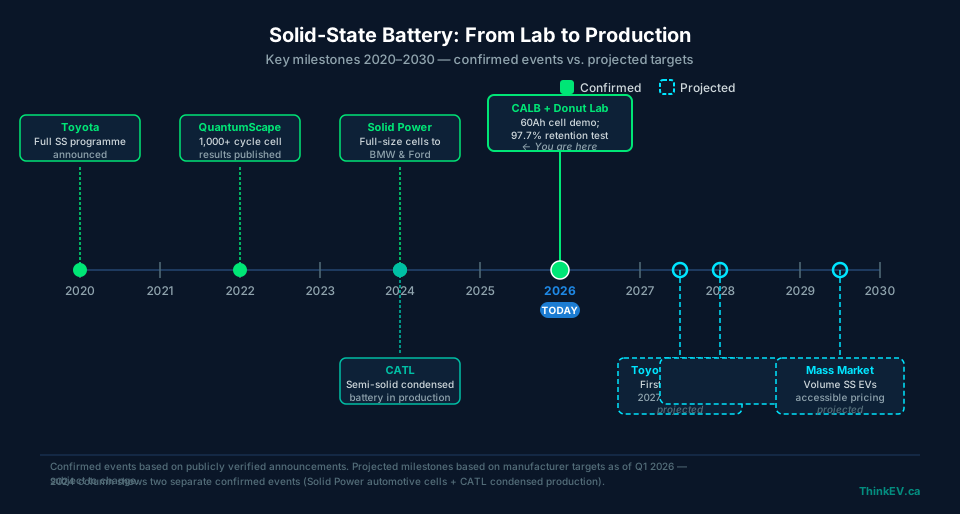
What is confirmed and already happened:
- Toyota has been developing solid-state batteries since at least 2010 and holds thousands of related patents (confirmed fact)
- QuantumScape demonstrated 1,000+ cycle performance in single-layer test cells (published and verified, 2022-2023)
- CATL launched semi-solid condensed battery production for aviation applications in 2024 (confirmed)
- Solid Power delivered full-size automotive cells to BMW and Ford for testing (confirmed, 2024)
- CALB demonstrated a 60Ah solid-state cell with projected 1,000 km range (confirmed demonstration, Q1 2026)
- Donut Lab published third consecutive positive test showing 97.7% retention over 10 days (confirmed, 2026)
What is announced but not confirmed:
- Toyota targeting a solid-state vehicle by 2027-2028 (announced, repeatedly delayed before)
- Samsung SDI targeting pilot production for 2027, volume for 2030 (announced)
- QuantumScape targeting automotive sample delivery in 2026, production intent 2028+ (guidance)
- CATL targeting true solid-state production for 2027 (speculated from industry sources, not officially announced)
What is pure projection:
- Mass-market solid-state EVs available at mainstream price points: 2030-2033 is the realistic range based on technology and cost trajectories
- Canadian dealership availability: 2028 for first premium solid-state vehicles, 2031-2033 for broadly accessible price points
The read: if you're planning to buy an EV in 2026, solid-state is not your battery. If you're planning to buy one in 2029-2030 and can wait, the picture will look meaningfully different. If you're planning to buy in 2027-2028 and want early access, watch Toyota and Samsung SDI announcements very closely, those are the most credible near-term pathways to production vehicles.
Cold Weather and Canada: Why This Matters More Here Than Anywhere
I want to be direct about something that gets glossed over in international EV coverage: Canada has a cold weather problem with current EV technology that other markets don't have to the same degree.
Battery degradation in cold temperatures is real and measurable. At -10°C, a lithium-ion battery can lose 20-30% of its available capacity. At -20°C, the loss can reach 40% in some vehicles. This is not permanent degradation, the capacity comes back when the battery warms up, but it's a real range reduction on cold days, and cold days in most of Canada are not rare events.
The mechanism is the liquid electrolyte. At low temperatures, the viscosity of the liquid increases, which slows the movement of lithium ions through the electrolyte. The battery still works, but it can't deliver or accept charge as quickly, and some of its stored energy becomes temporarily inaccessible because the internal resistance rises faster than the battery management system can compensate.
Solid-state batteries solve this at a fundamental level. Solid electrolytes don't become viscous. Ceramic electrolytes in particular have ion conductivity characteristics that are relatively stable across a wide temperature range. The exact cold-weather performance advantage of solid-state batteries is still being quantified, it will vary by specific chemistry and cell design, but the theoretical basis for significant improvement is solid.
There are still thermal management considerations. Battery cells (solid or liquid) perform better when they're at operating temperature, and in Canadian winters, thermal management systems will still consume some energy to heat the pack. But the underlying capacity loss mechanism, slow ion transport through viscous electrolyte, would be substantially reduced.
For a Canadian driver, this is probably the single most compelling benefit of solid-state batteries. Not the range headline, not the reduced fire risk, not the longer cycle life, though all of those matter, but the prospect of a battery that behaves predictably and delivers most of its rated capacity even in a Winnipeg January.
The CATL Financial Context: Why It Matters for Battery Development
CATL reported approximately 10 billion USD in net profit for 2025. That number is important context for understanding the competitive dynamics of battery development.
Battery manufacturing is capital-intensive in ways that are hard to overstate. A new gigafactory costs billions of dollars to build. New battery chemistry development requires years of research and development investment before any revenue. The companies that will win the solid-state race are not necessarily the ones with the best chemistry today, they're the ones with the resources to scale the best chemistry to production volumes.
Gear worth having
As an Amazon Associate, ThinkEV earns a small commission from qualifying purchases — at no extra cost to you.

Grizzl-E Classic Level 2 EV Charger (40A)
Canadian-made and rated for minus 40C winters. 40A / 9.6 kW, NEMA 14-50, indoor/outdoor, 24-ft cable. The charger built for Canadian weather.
As an Amazon Associate, ThinkEV earns from qualifying purchases — at no extra cost to you.
CATL's financial position means they can run multiple technology development tracks simultaneously, absorb years of pre-revenue R&D spending on solid-state, and build production capacity before they've proven they can sell every cell they manufacture. That's an enormous structural advantage.
It also means that CATL's current semi-solid condensed battery, already in production, is not an admission that solid-state is too hard. It's a product that generates revenue today, at scale, with superior performance to conventional lithium-ion, while the true solid-state programme continues in the background. It's a rational sequencing of commercialization rather than an abandonment of solid-state ambitions.
The financial health of the battery industry matters for Canadian EV buyers for a less obvious reason: it funds the cost-reduction curve. Battery prices have fallen approximately 90% over the past decade, and most of that cost reduction came from scale, manufacturing efficiency improvements, and the competitive pressure of a healthy, well-funded industry. A battery industry generating healthy profits reinvests those profits into the R&D and manufacturing scale that drives the next generation of cost reduction. The fact that CATL is highly profitable in 2025 is good news for solid-state adoption timelines, paradoxically.
What This Means for EV Buyers Right Now
If you're in the market for an EV in 2026, I want to give you the advice that the data supports, not the advice that's convenient.
Buying now is still a smart decision. The EVs available today are genuinely good products. The range of new EVs coming to Canada in 2026-2027 includes vehicles with real-world range above 450 km, mature charging networks, and proven reliability. The total cost of ownership case for EVs in Canada is positive even with current battery technology.
The technology obsolescence risk is real but often overstated. Yes, solid-state batteries will eventually be better in meaningful ways. But the window between "solid-state exists" and "solid-state is affordable in a mainstream vehicle" is likely 5-8 years from now. Over the same period, the EV you buy today will have delivered years of lower fuel and maintenance costs. The net financial picture of waiting for solid-state while paying gasoline prices is not obviously better than buying now.
If range and cold-weather performance are your primary concerns, wait. If you're in northern Manitoba, regularly drive 400+ km intercity routes without convenient fast charger access, and find yourself unconvinced by current EV range margins, the advice is that your specific use case is genuinely better served by solid-state technology. For you, waiting two to three years to see what the 2028-2029 market looks like is defensible.
If range and cold weather are manageable with current tech, buy now. For most Canadians in urban and suburban settings, the majority of the Canadian population, current EVs handle the actual use case well. A 350-450 km range vehicle covers the vast majority of driving without charging anxiety if there's charging available at home or work. In that situation, the cost savings from buying a current-generation EV compound over the years you wait for solid-state.
Watch the used market carefully. The arrival of solid-state EVs will almost certainly accelerate depreciation of current-generation vehicles, particularly at the higher end of the range spectrum where solid-state advantages are most directly comparable. EV resale values in Canada are already complex; they'll get more complicated when solid-state vehicles arrive. This isn't necessarily a reason not to buy a current EV, but it's a factor in financial planning.
Safety: Addressing the Fire Concern Honestly
One of the persistent concerns about EVs among Canadian buyers, especially those considering their overall EV safety picture, is the fire risk from lithium-ion batteries. I want to address this honestly in the context of solid-state.
First, the current reality: EV battery fires are rare. Per vehicle-kilometre driven, EVs are not more likely to catch fire than gasoline vehicles. Gasoline is an extraordinarily flammable substance stored in large quantities in every conventional car, and gasoline vehicle fires happen regularly. The EV fire stories that make news are more visible partly because they're novel and partly because, when they do occur, they're dramatic and difficult to extinguish with conventional methods.
That said, the difficulty of extinguishing a lithium-ion battery fire, the thermal runaway propagation, the need for massive amounts of water over extended periods, is a real operational challenge for fire services and a real concern for underground parking, ferries, and other enclosed spaces. The risk is low but the consequence is severe, and that combination correctly attracts attention.
Solid-state batteries substantially improve the safety picture. Without a liquid organic electrolyte, there's no flammable substance to ignite. Thermal runaway propagation, the "one cell fails and causes the adjacent cells to fail in a cascade" phenomenon, is significantly reduced because the solid electrolyte acts as a barrier rather than as fuel. Solid-state batteries can still fail and can still release energy in a failure event, but the mechanism is different and the worst-case scenarios are less severe.
This improvement won't be invisible to insurers, regulators, or public perception. Expect that solid-state EVs will be received differently from a safety narrative perspective than current EVs, and that this will matter for broader adoption.
The Companies to Watch in 2026 and Beyond
If you want to track solid-state progress in real time, here are the specific datapoints and companies worth following.
Toyota, specifically their statements about the Lexus RZ and the next-generation bZ platform. Any announcement of a solid-state test fleet or pilot production run is significant. Their target of 2027-2028 for a first vehicle remains credible if not guaranteed.
Samsung SDI, less public-facing than Toyota but more consistently reliable in hitting milestones. Their partnership with Stellantis for solid-state cell supply is worth tracking. Any news about pilot production timelines from Samsung SDI is meaningful.
QuantumScape, publicly traded (QS on NYSE), required to disclose progress through quarterly reports. Their quarterly letters to shareholders are unusually transparent about the actual state of their technology and manufacturing challenges. Read them directly rather than filtered through press releases.
CALB, the company behind the 60Ah demo. They're less covered by English-language media than their technology merit warrants. Chinese-language reporting on their production plans will be the leading indicator; translated summaries appear on EV-focused forums and communities within days of major announcements.
Solid Power, their relationships with BMW and Ford mean their technology development directly affects vehicles those manufacturers might bring to Canada. BMW in particular has been vocal about solid-state as a key technology for their next platform generation.
Donut Lab, smaller, less prominent, but their systematic testing approach is exactly what the field needs. Consistent, reproducible results from a third party are more valuable for establishing confidence than single-company demonstrations.
The Broader EV Technology Moment
The solid-state announcements belong in a broader context: the battery industry is not standing still while waiting for solid-state to arrive.
The battery industry is not standing still on current technology while waiting for solid-state. BYD's Blade 2.0, CATL's condensed battery, and advances in cell-to-pack and cell-to-body integration are pushing the limits of what's possible with existing chemistry. The top EV trends shaping Canada in 2026 include improvements in current-generation battery management, charging speed, and thermal efficiency that will continue to improve the EV ownership experience even before solid-state arrives.
BYD's 1.5MW charging capability is a good example. That figure, 1.5 megawatts of charging power, is extraordinary. For reference, most current fast chargers operate at 50-350 kW. 1.5 MW isn't just faster, it's a different category. It means that even with current-generation battery chemistry, charge times approaching the refuelling time of a conventional car become physically achievable. Couple that with a solid-state battery's theoretical ability to accept charge even faster, and the charging time objection to EVs largely evaporates.
The competitive pressure is also doing something important for Canadian consumers specifically. BYD's potential entry into the Canadian market and the general intensification of global EV competition is forcing all manufacturers to improve their products faster. The solid-state announcements from CALB and Donut Lab create pressure on every other battery manufacturer to demonstrate their own progress or cede the technology narrative.
That competitive pressure ultimately benefits buyers. Manufacturers who can't demonstrate a credible solid-state roadmap will face harder questions from automotive partners about long-term supply relationships. That drives more investment, faster development, and, eventually, faster cost reduction.
Manufacturing Scale: The Real Timeline Driver
I've talked about the manufacturing challenges, but I want to come back to manufacturing scale because it's the most direct determinant of when solid-state EVs actually reach Canadian buyers at accessible prices.
The cost reduction curve for batteries has historically followed something close to Wright's Law, for every doubling of cumulative production volume, costs decline by a roughly fixed percentage (around 20-25% for lithium-ion batteries). That relationship has held remarkably well for three decades.
Solid-state batteries are starting from a higher baseline cost, but there's no reason to believe Wright's Law won't apply to them as well. The question is how long it takes to accumulate enough production volume to drive meaningful cost reduction. That depends on:
- How many manufacturers can successfully scale solid-state production
- How quickly automotive manufacturers incorporate solid-state into high-volume vehicles
- Whether any solid-state chemistry proves clearly superior to competitors, concentrating production volume on a single winner
The early production will go into premium vehicles, think luxury SUVs and performance sedans where buyers are paying $80,000-150,000 and the premium for solid-state is a smaller proportion of the total cost. That volume seeds the cost reduction curve. By the time the technology migrates to mainstream vehicle segments, the cost premium should be substantially lower than the current 3-5x estimate.
The most optimistic credible timeline I've seen for solid-state at near-parity cost with current lithium-ion: 2032-2035. The most pessimistic credible timeline from analysts who are not trying to raise venture capital: 2040+. My read of the evidence, with the CALB demonstration and QuantumScape's published data both pointing to faster progress than many expected, puts the central estimate around 2030-2033 for meaningful volume at premium prices, 2035-2038 for genuine mass-market accessibility.
What Happens to Current EVs When Solid-State Arrives?
This is the question I get most often when I talk to EV owners about solid-state batteries, and I want to give it a direct, honest answer rather than a hedge.
Current EVs will continue to work exactly as they do now. A 2026 EV with a lithium-ion battery will not suddenly perform worse because solid-state batteries exist. The battery chemistry does not degrade in response to better chemistry becoming available elsewhere.
What will change is the relative desirability of current-generation EVs in the used market. This is already a trend, used EV prices have been volatile partly because the technology is improving rapidly enough that buyers can see meaningful performance gaps between model years. When solid-state EVs arrive with 700-1,000 km real-world range, faster charging, and superior cold-weather performance, the used-market appeal of current 350-450 km range EVs will weaken.
This is not unique to EVs. A used 2020 smartphone is less valuable because 2026 smartphones exist. A used 2015 laptop is less valuable because better laptops are available. Technology markets work this way. The question is the magnitude and timing of the depreciation effect.
My honest assessment: for EVs purchased in 2026 with a 5-7 year ownership horizon, the solid-state transition will happen during that ownership period and will affect resale value when you go to sell. Buyers planning to keep their EV for 10+ years and not focus heavily on resale value are less affected. Buyers who flip vehicles every 3-4 years should be thoughtful about the timing.
The financial offset is that current EVs deliver cost savings in fuel and maintenance today. Those savings are real and compound over time. A vehicle that saves $3,000-5,000 per year in operating costs (relative to a comparable gasoline vehicle, see our TCO analysis) generates meaningful total value even if its resale value is softer in 2030 than you might hope.
Solid-State Just Crossed A Real Milestone
Solid-state batteries crossed a meaningful milestone in early 2026. The CALB 60Ah cell demonstration and Donut Lab's third consecutive positive test are not hype, they're measured, documented evidence that the chemistry works at a scale and form factor that matters for automotive applications.
The gap between "the chemistry works" and "you can buy it in a vehicle in Canada" is still real, still measured in years, and still primarily driven by manufacturing scale and cost rather than fundamental physics. But that gap closed meaningfully in the first quarter of 2026.
For Canadian drivers: solid-state batteries are particularly exciting because the two most significant improvements, cold weather performance and reduced self-discharge, address the two most significant weaknesses of current EV technology in the Canadian context. A solid-state battery that holds nearly all its charge over a winter week in a cold garage, and loses minimal range at -25°C, is a qualitatively different product than what's currently available.
The realistic window for first-generation solid-state EVs in Canada is 2028-2030, at premium price points. Mass-market accessibility is 2033-2035 at the optimistic end. If you're making a 2026 EV purchasing decision, solid-state is relevant context but probably not a reason to wait. If you're planning to buy in 2029-2030 and can wait comfortably, the market will look meaningfully different.
The battery science is working. The manufacturing science is catching up. For the first time in my coverage of this technology, "coming soon" actually means something.
What Canadian Policy Should Do Differently, And Probably Won't
I want to spend a few paragraphs on a topic that rarely gets covered in battery technology posts: the policy and incentive implications of this transition, and how Canada's current approach is misaligned with where the technology is heading.
Canada's federal iZEV programme and most provincial EV incentives are structured around a simple binary: does the vehicle run on electricity? If yes, it qualifies. The technology inside the battery pack is invisible to the programme. A vehicle with a 2016-era battery architecture qualifies the same as one with a 2026-era cell chemistry.
That's understandable, the programmes were designed to accelerate EV adoption broadly, not to discriminate between battery chemistries. But as we enter a period where the gap between current-generation and next-generation batteries becomes meaningful in cold-weather performance terms specifically, there's a case for Canadian policy to evolve.
Consider the cold weather context more carefully. A significant portion of the Canadian population lives in climates where winter temperatures regularly drop below -15°C. The incentive programmes that were designed to put more EVs on the road in those climates are, inadvertently, putting technology into those hands that underperforms meaningfully in the conditions those buyers face most of the year.
A policy approach that anticipated the solid-state transition might look like this: keep current incentive levels for all EVs, but provide enhanced incentives for vehicles meeting a cold-weather performance standard. Not a battery chemistry standard, a performance outcome standard. A vehicle that demonstrates less than 15% range degradation at -20°C (tested under a standardised protocol) would qualify for an enhanced incentive. That would naturally favour solid-state and advanced-chemistry vehicles without requiring the government to pick a specific technology.
This kind of outcome-based approach is how good technology policy works. It doesn't pick winners, it defines the result it wants and lets manufacturers compete to deliver it.
The more politically uncomfortable truth is that the Canadian government has been slow to develop any EV policy that looks more than two years forward. The 2026 EV incentive programmes look remarkably similar to the 2020 ones, with modest adjustments to the income caps and price thresholds. There is no federal programme that specifically prepares Canada's charging infrastructure or fleet for the solid-state transition, for the reality that a 2030 EV might have 800 km of real-world range and require peak charging rates in excess of 500 kW.
Our charging infrastructure planning, such as it is, is based on current vehicle performance. A network designed around 400 km range vehicles with 150-350 kW peak charging rates is partially obsolete by the time it's fully built, if solid-state timelines hold.
None of this is a reason to panic, and none of it diminishes the value of the current incentive programmes. It's a reason to pay attention to the regulatory and policy environment as a Canadian EV buyer, because the incentives available to you in 2028-2030, when first-generation solid-state vehicles arrive, will depend on whether the policy conversation catches up to the technology conversation in the next two years.
The good news is that policy follows evidence, and the evidence from CALB and Donut Lab is exactly the kind of concrete, dateable milestone that gives policymakers something to respond to. The solid-state battery conversation is no longer speculative enough to be safely ignored by a civil servant designing a five-year incentive programme. That's a change from even 12 months ago, and it matters.
Gear worth having
As an Amazon Associate, ThinkEV earns a small commission from qualifying purchases — at no extra cost to you.

PULIDIKI Car Cleaning Gel (Detailing Putty)
Press it into vents, buttons, and seams and it lifts out dust you did not know was there. Weirdly satisfying, genuinely useful.
As an Amazon Associate, ThinkEV earns from qualifying purchases — at no extra cost to you.
Related Reading
Gear worth having
As an Amazon Associate, ThinkEV earns a small commission from qualifying purchases — at no extra cost to you.

WixGear Magnetic Air Vent Phone Mount (2-Pack)
A magnet strong enough that your phone never flinches over potholes or rail crossings. Two in the box, one for each car.
As an Amazon Associate, ThinkEV earns from qualifying purchases — at no extra cost to you.

Founder & Chief Editor
Vlad Pereira is the founder and chief editor of ThinkEV.ca, the Canadian electric-vehicle publication he writes and edits from Courtenay, British Columbia. He covers EV pricing, federal and provincial rebates, charging costs, and the Chinese manufacturers now entering Canada, from the buyer's side rather than the press-fleet side. ThinkEV is a venture of Vlad Pereira Online; his writing on health, income and the long game lives at vladpereira.com.
Frequently asked questions
When will I actually be able to buy a solid-state EV in Canada?
Does the CALB 1,000 km range mean real-world 1,000 km range?
Are solid-state batteries completely fireproof?
Will solid-state batteries be much better in Canadian winters?
Should I wait for solid-state before buying an EV?
What is the difference between CATL's semi-solid battery and a true solid-state battery?
How does Donut Lab's 97.7% retention result compare to current batteries?
Will solid-state batteries make current EVs obsolete?
More EV & road-trip finds
Affordable upgrades worth a look — tap any to check the price on Amazon.
 ★ 68
★ 68WeatherTech FloorLiner for Tesla Model 3
View on Amazon ★ 8,681
Chemical Guys Complete Car Wash Kit
View on Amazon ★ 55
★ 55LED Car Door Logo Projector Light
View on Amazon ★ 4,626
HoogaLife Hanging Car Diffuser (2-Pack)
View on Amazon ★ 865
★ 865Collapsible Trunk Organizer
View on Amazon ★ 1,944
VIOFO A229 Pro 4K Dash Cam
View on Amazon ★ 87
★ 87Car Window Sun Shades for Kids (4-Pack)
View on Amazon ★ 268
★ 268Anti-Slip Leather Steering Wheel Cover
View on AmazonRead, Plan, Then Stay Current
Explore our expert articles to understand incentives and ownership costs, use the map to pressure-test charging reality, then subscribe so new EV coverage comes straight to you.
Continue Reading
BYD Canada Lineup: The Four Models Coming First
Chery EVs Coming to Canada: Models and Prices
Who Got Canada's First Chinese EV Import Permits
EV Rentals in Canada 2026: Where to Try One First
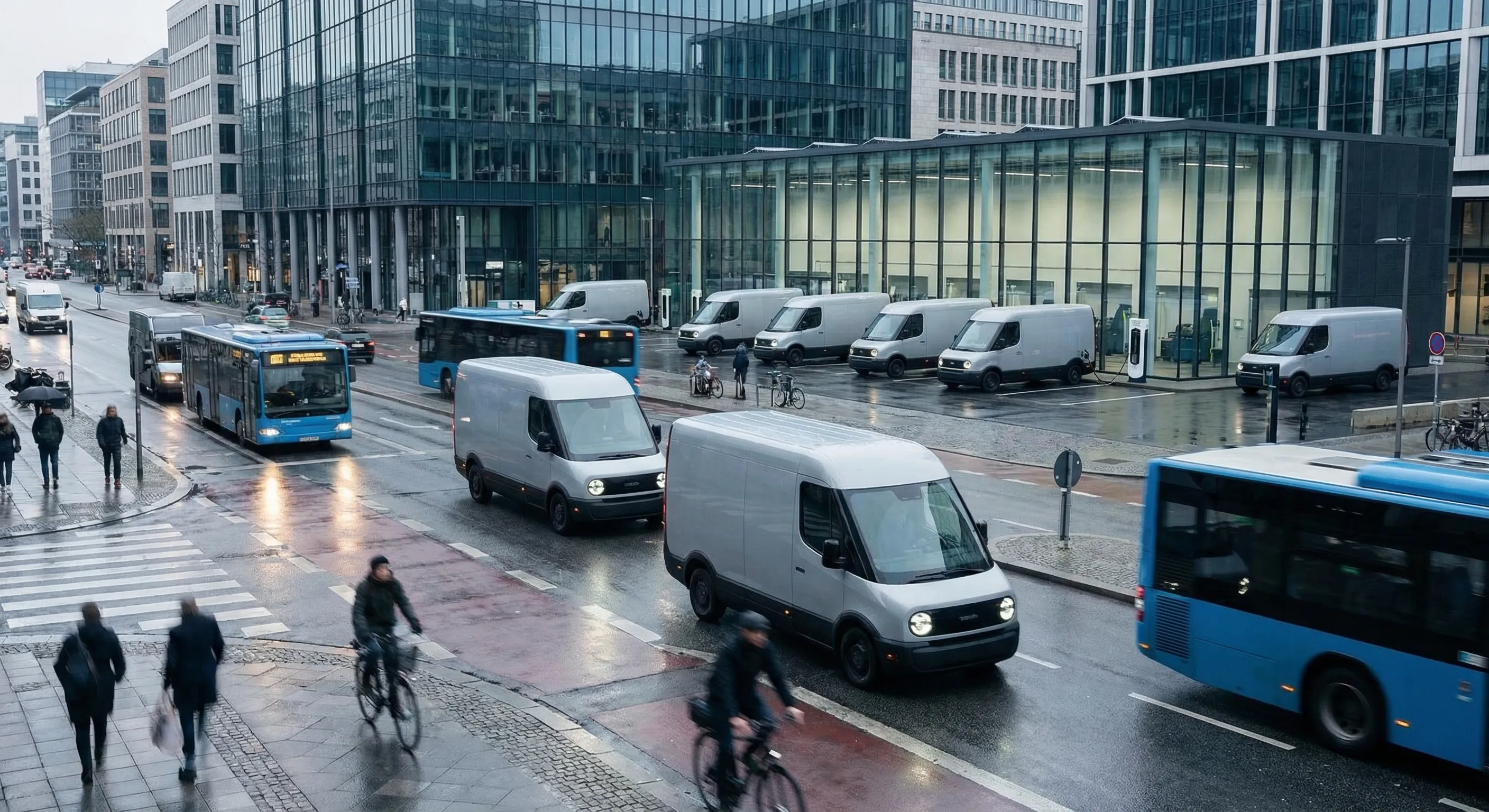
Canadian Fleet Electrification 2026: The Real Data