Key takeaways
- In 2022 and 2023, some EVs were losing 30-40% of their value in the first year.
- A $55,000 car was worth $33,000 twelve months later.
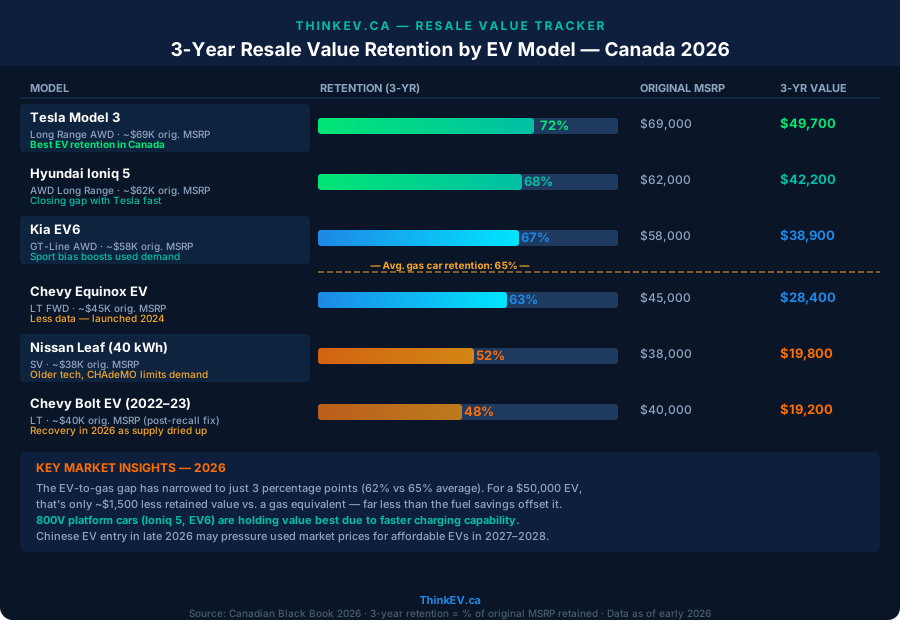
- According to Canadian Black Book data, the average three-year-old EV in Canada retains approximately 62% of its original MSRP in early 2026, compared to 58% in 2024.
- The average three-year-old gas vehicle retains about 65%.
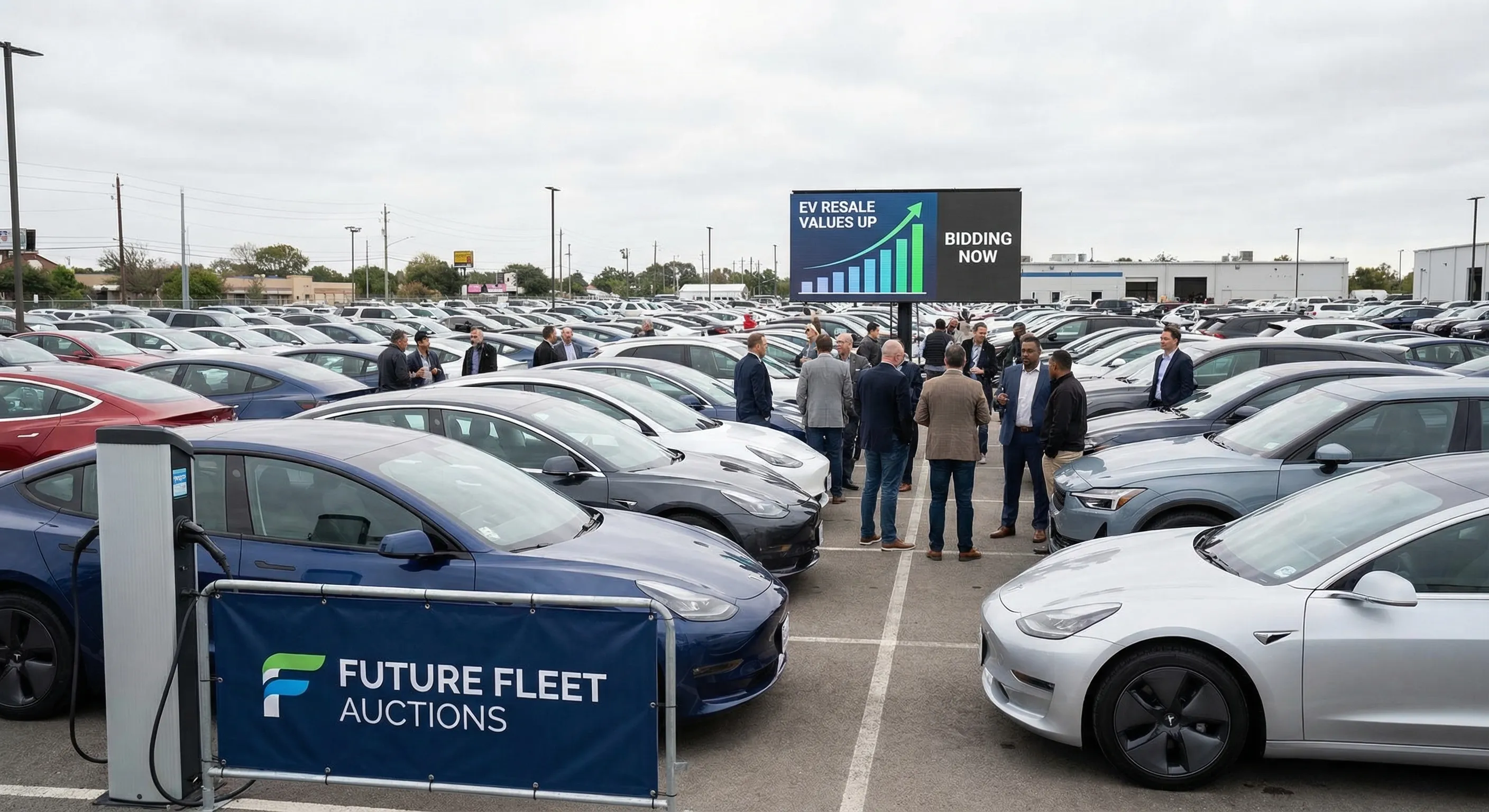
In 2022 and 2023, a $55,000 EV could be worth $33,000 twelve months after purchase, a 40% loss that made EV depreciation one of the most-cited arguments against buying electric. By early 2026, Canadian Black Book data tells a different story: the average three-year-old EV retains 62% of its original MSRP, just three percentage points behind the equivalent gas vehicle. On a $50,000 purchase, that gap is $1,500, roughly the cost of two oil changes and a brake job the EV never needed. The wild-west phase of EV resale is over.
According to Canadian Black Book data, the average three-year-old EV in Canada retains approximately 62% of its original MSRP in early 2026, compared to 58% in 2024. The average three-year-old gas vehicle retains about 65%. That gap, three percentage points, is the narrowest it has ever been. For a $50,000 EV, the difference between 62% and 65% retention is $1,500. That's not nothing, but it's no longer the $5,000-$8,000 penalty it was two years ago.
This article digs deep into the numbers. We'll cover which brands and models hold value, what drives resale prices, where the sweet spot is for used buyers, how leasing versus buying affects your bottom line, what warranty transfers mean for used EV prices, and where things are headed through 2030. If you're thinking about buying, selling, or trading an EV in Canada, this is the data you need.
DEPRECIATION NORMALIZATION, THE BIG PICTURE
To understand where we are in 2026, you need to understand how we got here. EV depreciation in Canada has gone through three distinct phases.
Phase one (2019-2021) was the era of limited supply and inflated demand. New EV inventory was scarce, and used EVs sometimes sold above their original MSRP. A used 2021 Tesla Model 3 Long Range was selling for $52,000 when the original sticker was $49,990. This was unsustainable and driven entirely by semiconductor shortages and pandemic-era supply constraints.
Phase two (2022-2023) was the crash. Tesla slashed new vehicle prices by 15-25% across the lineup, and every other manufacturer followed with incentives, lease deals, and inventory clearance programs. When a brand-new Model Y dropped from $65,990 to $54,990, every used Model Y on the market instantly lost value. This is when the horror stories emerged, people who bought a new EV in 2022 and watched it lose $15,000-$20,000 in twelve months. The average three-year-old EV retained only 52% of MSRP in late 2023. It was brutal.
Phase three (2024-2026) is the normalization. New EV prices stabilized. The market absorbed the inventory glut. Used EV demand increased as more Canadians became comfortable with the technology. And the retention numbers have climbed steadily, from 52% in late 2023 to 58% in 2024 to 62% in early 2026.
That 62% number deserves context. In 2020, the average three-year-old gas vehicle in Canada retained about 68% of MSRP. In 2026, that number is 65%, gas cars have also depreciated more than they used to, partly because of economic uncertainty and partly because the used car market overall has softened from its pandemic highs. So the EV-gas gap hasn't just narrowed because EVs improved, it's also because gas cars came down slightly.
The practical takeaway: if you bought a $50,000 EV in 2023, it's worth approximately $31,000 in 2026. If you bought a $50,000 gas SUV in 2023, it's worth approximately $32,500. That's a $1,500 difference, roughly the cost of two oil changes and a brake job that the EV never needed. When you factor in total cost of ownership, the depreciation gap essentially disappears.
THE BRAND HIERARCHY
Not all EVs depreciate equally. The brand you buy matters more for resale value than almost any other factor, and the hierarchy in Canada is clear.

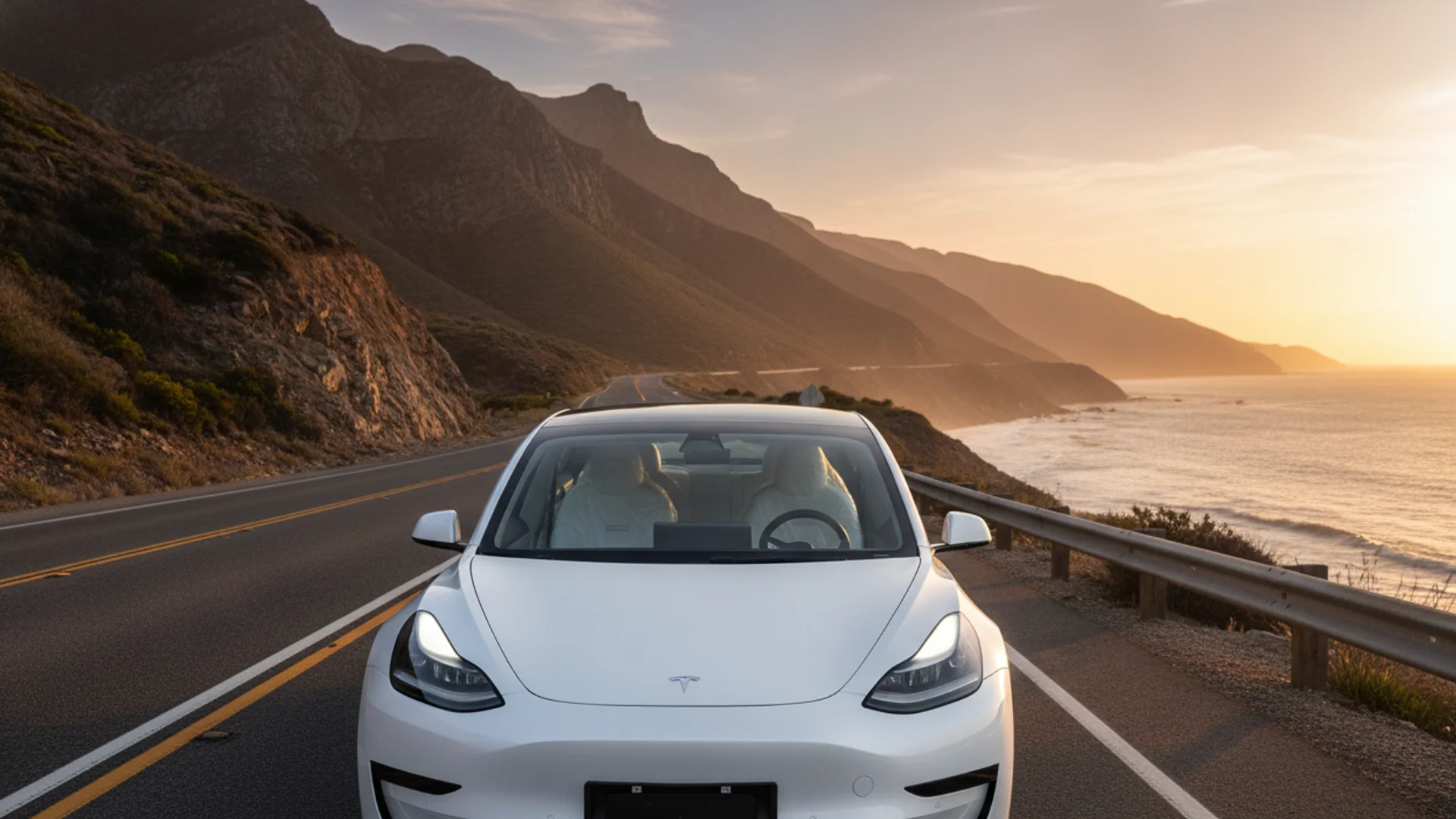
Tesla still leads. A 2023 Model Y Long Range with 60,000 km retains approximately 70-75% of its original MSRP, making it the best-holding EV in the Canadian market. The reasons are straightforward: the Supercharger network creates lock-in, Tesla's brand recognition is unmatched, and demand for used Teslas remains strong. The Model 3 holds similarly well, though slightly below the Model Y due to higher supply.
Tesla's resale advantage comes from several reinforcing factors. First, over-the-air updates mean that a 2023 Model Y has received meaningful software improvements since delivery, better Autopilot, improved efficiency, new features. The car is literally better than when the first owner bought it. Second, Tesla has the largest service network of any EV brand in Canada, which reduces buyer anxiety about maintenance. Third, the Supercharger network remains the gold standard, with over 600 Supercharger stalls across Canada and growing. When a used buyer is choosing between two EVs at similar prices, knowing they'll have reliable fast charging tips the scale.
The Model Y specifically benefits from the SUV/crossover body style, which is the most popular vehicle segment in Canada. It's the same reason a used RAV4 holds value better than a used Camry, Canadians want SUVs, and they'll pay more for them on the used market.
Hyundai and Kia are the surprise performers. The Ioniq 5, Ioniq 6, EV6, and EV9 are all retaining value better than expected, approximately 63-68% after three years. The 800V charging architecture, which future-proofs these vehicles against slower-charging competitors, is a selling point even in the used market. Buyers are willing to pay more for a used EV that charges in 18 minutes than one that takes 45.
The Ioniq 5's resale strength is particularly impressive because Hyundai doesn't have the brand cachet that Tesla does. What Hyundai has instead is substance, the E-GMP platform delivers 10-80% charging in 18 minutes, vehicle-to-load capability (you can power tools and appliances from the car), and a practical interior with a flat floor and adjustable centre console. Used Ioniq 5 buyers are often repeat Hyundai owners who had a positive experience with the brand, or Tesla cross-shoppers who tried an Ioniq 5 and found they preferred the interior quality and driving dynamics.
The Kia EV6 tracks very closely to the Ioniq 5 in resale, which makes sense, they share the same platform, battery, and charging architecture. The EV6 gets a slight edge in some markets because of its sportier styling and the GT performance trim, which has developed a small cult following.
The EV9, Kia's three-row electric SUV, is too new to have reliable three-year data, but early indications from one-to-two-year-old trade-ins suggest it will hold value exceptionally well. There are very few three-row electric SUVs on the market, and the EV9 effectively has no direct competition in the used market.
Ford and GM sit in the middle of the pack. The Mach-E retains approximately 58-63% after three years, and the Chevrolet Bolt (now discontinued as new) has actually seen used prices stabilize as supply dwindled. Used Bolts at $18,000-$22,000 are hot sellers because nothing else offers that range at that price. The Bolt's resale story is unusual, a discontinued car that's holding value because nothing has replaced it in the budget segment.
The Mach-E's middling resale performance is somewhat surprising for a vehicle that reviews very well. The issue is twofold. Ford's dealer experience for EVs has been inconsistent, some dealers are knowledgeable and supportive, others treat EV buyers as an afterthought. And the Mach-E's 400V charging architecture means it charges significantly slower than the Hyundai/Kia 800V competitors, which used buyers increasingly care about.
The Bolt, on the other hand, has become the budget king of the used EV market. Despite being discontinued, the Bolt has a large and devoted community, replacement parts are readily available through GM's network, and the LFP battery chemistry in later models is proving extremely durable. A 2022 Bolt EUV with 50,000 km and good battery health is one of the smartest used EV purchases available in Canada in 2026. You're looking at a practical EV with 350+ km of real-world range for under $20,000. Check out our guide to the most affordable EVs in Canada for more budget options.
Volkswagen is the underperformer. The ID.4 retains approximately 55-60% after three years, which is below the segment average. The combination of early software issues (which hurt the model's reputation), competition from cheaper alternatives like the Equinox EV, and VW's smaller dealer network in Canada have all contributed. The ID.4 is a fine car, but the market hasn't rewarded it with strong resale values.
VW's problem is largely one of perception. The ID.4's infotainment system was buggy at launch, and while subsequent over-the-air updates have fixed most issues, the reputation stuck. Used car buyers research online before purchasing, and the first-generation ID.4 reviews are mixed. VW also lacks the charging speed advantage of Hyundai/Kia (the ID.4 maxes out at around 135 kW) and doesn't have Tesla's ecosystem lock-in. It's stuck in no-man's land, not cheap enough to compete on value, not differentiated enough to command a premium.
Nissan Leaf is at the bottom. Older Leafs with the 40 kWh battery are selling for $12,000-$16,000 for 2019-2021 models, which represents steep depreciation. The limited range and lack of DC fast charging on some trims make these harder to sell as buyer expectations increase.
The Leaf's depreciation tells an important cautionary tale about technology obsolescence. When the Leaf launched, 240 km of range and CHAdeMO fast charging were competitive. By 2026, 240 km is below the threshold most buyers consider acceptable, and CHAdeMO charging stations are being decommissioned across Canada in favour of CCS and NACS. A used Leaf is still a perfectly functional commuter car, but the combination of range anxiety and charging uncertainty pushes prices down. For budget buyers who have home charging and don't need highway fast charging, a used Leaf under $15,000 is actually excellent value, but the market is small.
MODEL-SPECIFIC DEPRECIATION CURVES
Let's get granular. Here's how specific models depreciate year by year, based on Canadian Black Book and AutoTrader.ca transaction data.
Tesla Model Y Long Range (2023 MSRP: $59,990)
- Year 1 (2024): ~$52,000-87% retention
- Year 2 (2025): ~$46,000-77% retention
- Year 3 (2026): ~$42,000-70% retention
The Model Y's curve is remarkably flat after year one. The biggest hit comes in the first twelve months, and then the curve flattens significantly. This is the same pattern as the most popular gas SUVs (RAV4, CR-V), which is a sign of market maturity.
Hyundai Ioniq 5 Preferred Long Range AWD (2023 MSRP: $54,999)
- Year 1 (2024): ~$46,000-84% retention
- Year 2 (2025): ~$40,000-73% retention
- Year 3 (2026): ~$36,000-65% retention
The Ioniq 5 takes a slightly larger hit in year one than the Model Y, but the year-two-to-year-three curve is flatter. This suggests that Ioniq 5 values are stabilizing as the model builds a reputation in the used market.
Ford Mustang Mach-E Premium AWD (2023 MSRP: $59,995)
- Year 1 (2024): ~$48,000-80% retention
- Year 2 (2025): ~$40,500-68% retention
- Year 3 (2026): ~$36,000-60% retention
The Mach-E's curve is steeper than the Model Y or Ioniq 5, particularly in year two. The year-two drop is driven partly by Ford's aggressive new vehicle incentives, which pull used prices down.
Chevrolet Bolt EUV (2023 MSRP: $38,998)
- Year 1 (2024): ~$30,000-77% retention
- Year 2 (2025): ~$24,000-62% retention
- Year 3 (2026): ~$21,000-54% retention
The Bolt's percentage retention looks worse than the premium models, but the dollar amounts tell a different story. A $38,998 car that's worth $21,000 after three years has lost $18,000 in depreciation. A $59,990 Model Y that's worth $42,000 has lost $18,000 too. The absolute dollar depreciation is almost identical, the percentages just look different because of the lower starting price.
Volkswagen ID.4 Pro S AWD (2023 MSRP: $52,995)
- Year 1 (2024): ~$42,000-79% retention
- Year 2 (2025): ~$34,500-65% retention
- Year 3 (2026): ~$30,000-57% retention
The ID.4's year-two drop is the steepest of any mainstream EV, and it hasn't recovered. This is the model where brand perception has the biggest negative impact on resale.
WHAT DRIVES RESALE VALUE
Three factors dominate EV resale values in Canada more than any other considerations.
Gear worth having
As an Amazon Associate, ThinkEV earns a small commission from qualifying purchases — at no extra cost to you.
NOCO Boost Plus GB40 Jump Starter
A 1000A lithium jump starter that fits in your glovebox and works on any 12V battery. Your insurance against a dead 12V in a parking lot.
As an Amazon Associate, ThinkEV earns from qualifying purchases — at no extra cost to you.
Battery health is number one. A used EV with 92% battery health is worth meaningfully more than an identical vehicle with 82% battery health. According to Geotab's fleet data, the price difference between a "good" and "fair" battery can be 10-15% of the vehicle's value. This is why getting a battery health report before buying a used EV is essential, it's the single most important variable in the transaction.
To put dollar figures on it: a 2023 Tesla Model 3 with 93% battery health might sell for $31,000 in early 2026. The same car with 84% battery health might sell for $27,000. That's a $4,000 difference driven entirely by battery condition. For the seller, maintaining battery health is the single most important thing you can do to protect your resale value. For the buyer, a battery health report is the most important document you can request, more important than the CarFax, more important than the maintenance records.
Battery health is measured as State of Health (SoH), which represents the battery's current maximum capacity as a percentage of its original capacity. Most EVs don't display SoH natively, but third-party tools like Recurrent, Geotab, or brand-specific apps can provide this data. Tesla shows estimated range in the app, which can be used as a rough proxy, but a proper SoH reading from a diagnostic tool is more accurate.
For a detailed look at how battery degradation works and what drives it, see EV battery degradation.
The good news for Canadian EVs: cold climates are actually better for long-term battery health than hot climates. Heat is the primary driver of battery degradation, and Canadian vehicles spend most of their life below the temperatures that cause rapid capacity loss. A used EV that spent three years in Edmonton will typically have better battery health than an identical car from Phoenix. Geotab's data shows that EVs in northern climates retain 2-4% more battery capacity after five years compared to those in southern US states.
This is a genuine competitive advantage for the Canadian used EV market. Canadian-market EVs with demonstrably good battery health should command a premium, and increasingly they do. If you're selling a used EV in Canada, getting a battery health report and including it in your listing is probably worth $2,000-$3,000 in additional sale price.
Charging speed is the second factor. EVs with 800V architecture (Hyundai, Kia, Porsche) command a premium on the used market because they charge dramatically faster than 400V competitors. A used Ioniq 5 that charges to 80% in 18 minutes is more desirable than a used Mach-E that takes 38 minutes, even if the Mach-E has more range. Fast charging is becoming a resale value differentiator in the same way that fuel efficiency is for gas cars.
The charging speed premium is largest among buyers who plan to use their EV for road trips or who don't have home charging. For a commuter with a garage and a Level 2 charger, DC fast charging speed barely matters, they plug in every night and wake up to a full battery. But for a condo dweller who relies on public charging, or a family that takes regular highway trips, the difference between 18 minutes and 45 minutes at a fast charger is the difference between a coffee stop and a frustrating wait.
In the Canadian used market, this translates to roughly a 5-8% resale premium for 800V vehicles compared to equivalent 400V vehicles, controlling for other factors. That premium has been growing since 2024 as more fast chargers are deployed and more buyers understand the significance.
Brand and ecosystem is the third factor. Tesla's Supercharger network creates a stickiness that translates directly to resale value. Buyers are willing to pay more for a used Tesla because they know they'll have access to the best charging network in Canada. As other manufacturers gain Supercharger access through NACS adapters, this advantage will erode, but it hasn't happened yet.
Beyond charging, Tesla's ecosystem includes over-the-air software updates, a dedicated mobile app for vehicle management, a proprietary insurance product (not yet in Canada but coming), and a network of service centres and mobile service technicians. This integrated experience creates buyer confidence that translates to resale value. Used Tesla buyers know what they're getting into, the ownership experience is well-documented, the community is large, and support resources are abundant.
Range is a fourth factor that deserves mention, though it's less dominant than the top three. EVs with over 400 km of rated range hold value better than those with 250-300 km of range, all else being equal. The threshold seems to be around 350 km of real-world winter range, below that, used buyers start applying a discount for range anxiety. This disproportionately affects older EVs (2019-2021 models) that were designed for an era when 250 km was considered acceptable.
THE USED EV SWEET SPOT, THE 2-3 YEAR WINDOW
The best value in the Canadian used EV market right now sits in the two-to-three-year-old, 40,000-60,000 km range. At this age, the initial depreciation hit has already been absorbed by the first owner, battery degradation is typically minimal (90%+ health), and the vehicles still have years of warranty remaining.
Let's break down why this window is so attractive.
Depreciation absorption. As the model-specific curves above show, EVs lose 13-23% of their value in year one. By the time a vehicle is two years old, the steepest part of the depreciation curve is behind it. You're essentially letting the first owner pay the "new car premium", the price difference between a new vehicle and a one-year-old used one, while you benefit from a vehicle that's mechanically almost identical to new.
Battery health is still excellent. According to Geotab's analysis of over 10,000 EV batteries, the average EV retains 95% or more of its battery capacity at 40,000 km, and 92% or more at 60,000 km. At two-to-three years old, the battery is barely broken in. Most lithium-ion batteries are designed for 300,000+ km of use before hitting the 80% threshold, so a car at 50,000 km is at roughly 15-20% of its battery lifespan.
Warranty coverage remains. Most EV manufacturers offer 8-year/160,000 km battery and electric drivetrain warranties. A three-year-old vehicle with 50,000 km still has five years and 110,000 km of warranty coverage remaining. That's more remaining warranty than most new gas cars come with. This is a powerful reassurance for used buyers, especially those who are new to EVs and worried about expensive battery replacements.
Technology is current. A 2023 or 2024 model-year EV has the same fundamental technology as a 2026 model. Battery chemistry, charging standards, and software platforms haven't changed dramatically in that window. Compare this to buying a 2019 EV in 2026, a seven-year-old car might have outdated charging standards (CHAdeMO), significantly less range, and missing features that buyers now consider essential.
The sweet-spot vehicles in early 2026 are: the 2023 Chevrolet Bolt at $18,000-$22,000 (best budget pick), the 2023 Hyundai Kona Electric at $24,000-$27,000 (best all-rounder), the 2023 Tesla Model 3 Standard Range at $28,000-$32,000 (best ecosystem), and the 2023 Hyundai Ioniq 5 at $32,000-$38,000 (best charging speed). All of these offer genuine daily-driver capability with enough range for Canadian commutes and moderate battery degradation.
For a broader look at why the used EV market is booming and what's driving prices, check our analysis of the used EV market explosion in Canada.
Gear worth having
As an Amazon Associate, ThinkEV earns a small commission from qualifying purchases — at no extra cost to you.

Grizzl-E Classic Level 2 EV Charger (40A)
Canadian-made and rated for minus 40C winters. 40A / 9.6 kW, NEMA 14-50, indoor/outdoor, 24-ft cable. The charger built for Canadian weather.
As an Amazon Associate, ThinkEV earns from qualifying purchases — at no extra cost to you.
LEASE VS. BUY, THE FINANCIAL ANALYSIS
This is where the math gets interesting, and where a lot of Canadian EV buyers make expensive mistakes.
The case for leasing. When a vehicle class is still experiencing significant depreciation uncertainty, leasing transfers the depreciation risk to the manufacturer. The lease residual, the predicted value of the car at lease end, is set by the manufacturer's captive finance arm. If the car depreciates more than predicted, that's the manufacturer's problem, not yours. In 2022 and 2023, EV lessees got lucky, the actual depreciation was worse than the lease residuals predicted, meaning they walked away at lease end without the loss that purchasers ate.
Leasing also provides a natural upgrade cycle. EV technology is still improving rapidly, battery density, charging speed, software, and range all get meaningfully better every two-to-three years. A three-year lease lets you hand back a vehicle with older technology and step into the latest model.
In Canada, leasing has an additional advantage for business owners. Lease payments on a vehicle used for business are fully deductible as an operating expense (up to prescribed limits), whereas a purchased vehicle can only be depreciated under CCA rules, which are more restrictive and slower.
The case for buying. If you plan to keep the vehicle for five or more years, buying almost always wins financially. The reason is simple: lease payments include a profit margin for the leasing company, plus interest charges, plus mileage restrictions that limit your flexibility. Once you've paid off a purchased EV, your monthly transportation cost drops to insurance and electricity, no more payments.
Here's a concrete example. A 2026 Hyundai Ioniq 5 Preferred LR AWD with an MSRP of $56,999:
Lease scenario (3-year, 20,000 km/year):
- Monthly payment: approximately $620/month (estimated at 5.49% with 60% residual)
- Total lease cost over 3 years: $22,320
- Vehicle returned at lease end, no equity
Purchase scenario (6-year finance at 4.99%):
Gear worth having
As an Amazon Associate, ThinkEV earns a small commission from qualifying purchases — at no extra cost to you.

PULIDIKI Car Cleaning Gel (Detailing Putty)
Press it into vents, buttons, and seams and it lifts out dust you did not know was there. Weirdly satisfying, genuinely useful.
As an Amazon Associate, ThinkEV earns from qualifying purchases — at no extra cost to you.
- Monthly payment: approximately $920/month
- Total finance cost over 6 years: $66,240 (including interest)
- Vehicle value at year 6 (estimated 45% retention): ~$25,650
- Net cost after sale: $40,590 over 6 years, $6,765/year
Purchase scenario (keep for 10 years):
- Same finance cost: $66,240
- No payments for years 7-10
- Vehicle value at year 10 (estimated 25% retention): ~$14,250
- Net cost after sale: $51,990 over 10 years, $5,199/year
The longer you keep a purchased EV, the lower your annual cost of ownership becomes. And since EVs have far fewer mechanical components than gas cars, no transmission, no exhaust system, no timing belt, no engine oil, the maintenance cost of keeping an EV for 10+ years is substantially lower. For a full breakdown of the ownership cost comparison, read our analysis of EV vs. gas total cost of ownership.
The break-even point. For most EVs in the current Canadian market, buying beats leasing if you plan to keep the vehicle for more than four years. Below four years, leasing typically wins because the depreciation risk transfer outweighs the leasing company's profit margin. This break-even point will shift as EV depreciation continues to normalize, once EV depreciation is truly predictable, the leasing advantage shrinks because there's less risk to transfer.
The sweet move for budget buyers. Instead of leasing a new EV, consider buying a two-to-three-year-old off-lease EV. These vehicles have already absorbed the steepest depreciation, they still have substantial warranty remaining, and you get the benefits of ownership (no mileage limits, equity building, no end-of-lease fees) at a much lower entry price. A 2023 Ioniq 5 at $35,000 financed over five years will cost less per month than leasing a new 2026 Ioniq 5, and you'll own the car at the end.
WARRANTY TRANSFER AND ITS IMPACT ON RESALE
Warranty transferability is one of the most underappreciated factors in EV resale values, and it varies significantly by manufacturer.
Full warranty transfer (Hyundai, Kia, Tesla, Ford, GM): These manufacturers transfer the full battery and drivetrain warranty to subsequent owners. When you buy a 2023 Hyundai Ioniq 5 in 2026, you get the remaining 5 years and 110,000 km of the original 8-year/160,000 km battery warranty. This is a powerful confidence booster for used buyers and directly supports resale values.
Partial or conditional transfer (some European brands): Some manufacturers have conditions on warranty transfer, requiring service at authorized dealers, requiring notification of ownership change, or limiting certain warranty components to the original owner. These conditions create uncertainty for used buyers and are reflected in lower resale prices.
The warranty premium. In the Canadian used EV market, vehicles with remaining manufacturer warranty consistently sell for 8-12% more than comparable vehicles with expired warranty. For a $30,000 used EV, that's a $2,400-$3,600 premium. This makes warranty transfer one of the clearest value drivers in the market.
The warranty factor also creates a pricing cliff at the 8-year mark. An EV at 7 years and 11 months with one month of battery warranty remaining is worth meaningfully more than an identical EV at 8 years and 1 month with no battery warranty. Smart sellers time their sales to stay within the warranty window, and smart buyers look for vehicles with maximum remaining coverage.
For used buyers, this means that a three-year-old EV with transferable warranty is a fundamentally different proposition than a nine-year-old EV with expired warranty. The three-year-old car carries almost no battery replacement risk because the manufacturer is on the hook. The nine-year-old car carries meaningful risk, a battery replacement can cost $8,000-$15,000 depending on the vehicle, and without warranty coverage, that's entirely the owner's responsibility.
MILEAGE-BASED DEPRECIATION, HOW KILOMETRES AFFECT VALUE
Traditional gas car depreciation follows a relatively predictable mileage curve, roughly $0.05-$0.08 per kilometre of depreciation for a mid-range vehicle. EV depreciation works differently because the drivetrain has so few wear components.
The EV mileage discount is smaller than gas. A gas car with 100,000 km has worn brakes, a transmission that's approaching its halfway point, and an engine with significant wear. An EV with 100,000 km has slightly degraded battery health, but the motor, single-speed transmission, and regenerative braking system are barely broken in. As a result, high-mileage EVs retain a higher percentage of their value compared to high-mileage gas cars.
Here's how mileage affects used EV pricing in the Canadian market, using a 2023 Tesla Model 3 Standard Range (original MSRP $49,990) as an example:
- 20,000 km: ~$33,000 (66% retention)
- 40,000 km: ~$31,500 (63% retention)
- 60,000 km: ~$30,000 (60% retention)
- 80,000 km: ~$28,500 (57% retention)
- 100,000 km: ~$27,000 (54% retention)
Each 20,000 km increment costs approximately $1,500 in depreciation. Compare this to a similarly-priced gas sedan, where each 20,000 km increment costs approximately $2,000-$2,500 in depreciation. The EV advantage grows with mileage, at 100,000 km, the EV has retained 54% while a comparable gas car would retain approximately 48%.
The exception: battery degradation outliers. While most EVs at 100,000 km retain 88-92% battery health, some will be lower due to frequent DC fast charging, exposure to extreme heat, or manufacturing variation. A high-mileage EV with poor battery health depreciates much more steeply than average. This is why battery health reports become more important as mileage increases, at 30,000 km, you can reasonably assume good battery health; at 100,000 km, you need to verify it.
The practical advice for sellers: If you're planning to sell your EV, the mileage sweet spot is before 60,000 km. Below 60,000 km, most buyers won't discount heavily for mileage because battery degradation is minimal and the car feels "low mileage." Above 60,000 km, the mileage discount accelerates slightly, and you start encountering buyers who are nervous about long-term battery health.
REGIONAL MARKET VARIATIONS ACROSS CANADA
EV resale values vary significantly by region within Canada, and understanding these variations can save you thousands of dollars.
British Columbia has the strongest used EV market in Canada. BC's combination of early EV adoption (highest per-capita EV ownership in the country), cheap electricity ($0.09-$0.12/kWh), mild winter temperatures on the coast, and strong provincial incentives has created a deep and liquid used EV market. Used EVs in BC typically sell for 5-8% more than the national average.
Quebec is the second-strongest market, driven by the province's aggressive EV incentives and low electricity prices ($0.07-$0.09/kWh). Quebec also benefits from a large population base and a cultural affinity for EVs, Quebec has the second-highest EV adoption rate in Canada. Used EV prices in Quebec are roughly at the national average.
Ontario is the largest market by volume but not by per-capita adoption. Ontario's lack of provincial EV incentives (since the Ford government cancelled them in 2018) has meant slower adoption, but the large population creates significant used EV inventory. Used EV prices in Ontario tend to run 2-4% below the national average due to higher supply relative to demand.
Alberta is the most interesting regional story. Alberta has historically been the weakest EV market in Canada, cold winters, a cultural attachment to trucks and SUVs, the oil and gas industry's influence, and limited public charging infrastructure all suppressed EV adoption. But Alberta's used EV prices have been rising faster than any other province since 2024, as more Albertans recognize the economic benefits of EVs (cheap overnight electricity, zero fuel cost, minimal maintenance). A used EV that's $2,000-$3,000 cheaper in Alberta than in BC is attracting cross-province buyers who are willing to travel for a deal.
The Prairies and Atlantic Canada have the smallest EV markets and the lowest used EV prices. Limited public charging infrastructure, extreme cold (which reduces winter range), and lower population density all suppress demand. For used EV buyers willing to travel, these regions offer the best prices, a used Ioniq 5 that sells for $36,000 in Vancouver might sell for $32,000 in Winnipeg or $31,000 in Halifax.
The arbitrage opportunity. Some savvy used EV buyers are purchasing vehicles in lower-demand provinces (Manitoba, Saskatchewan, New Brunswick) and driving or shipping them to higher-demand provinces (BC, Quebec). The price difference can cover the shipping cost and still leave savings. This is the kind of market inefficiency that existed in the gas car market 20 years ago and has since been arbitraged away, in the EV market, it still exists because the market is relatively new and less liquid.
CHINESE EV RESALE, THE BIG UNCERTAINTY
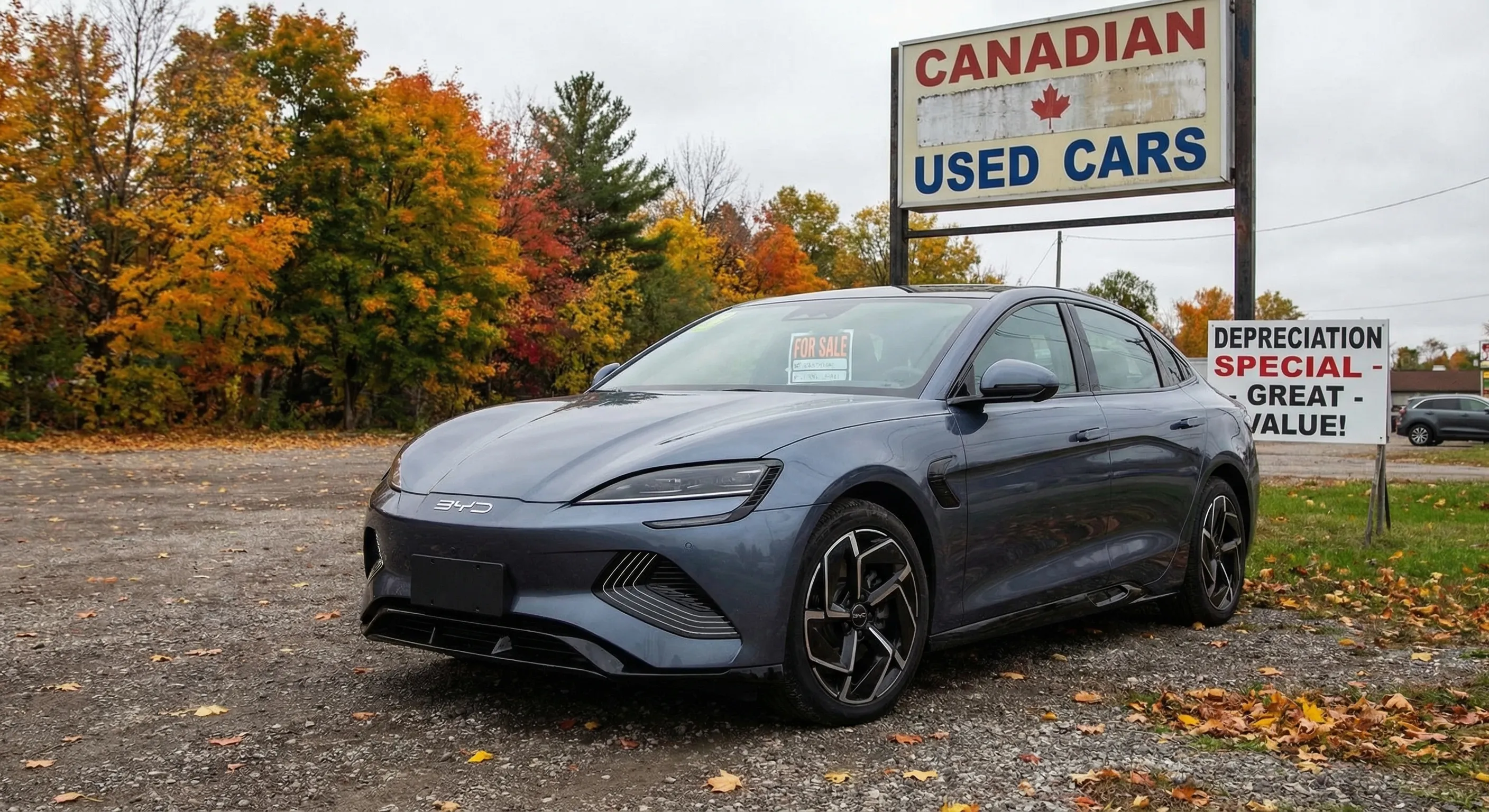
The BYD Dolphin arrived in Canada in late 2025 at a price point of approximately $28,000, and the BYD Seal is expected in 2026. These vehicles represent genuine value, competitive range, modern features, and aggressive pricing. But their resale trajectory is the biggest unknown in the Canadian EV market.
Arguments for poor resale. Chinese EVs face several headwinds in the Canadian used market. First, the 100% tariff imposed in October 2024 was reduced to 6.1% in January 2026 with a 49,000-vehicle quota, but tariff uncertainty persists, future policy changes could make Chinese EVs more or less expensive, creating resale unpredictability. Second, Chinese EVs are excluded from the federal Electric Vehicle Availability Payment (EVAP), which means used buyers can't benefit from any residual incentive advantage. Third, brand recognition is low, most Canadian used car buyers have never heard of BYD, and unfamiliar brands suffer in resale. Fourth, the dealer and service network is minimal, which creates anxiety about long-term ownership.
Arguments for decent resale. The BYD Dolphin's $28,000 price point is so aggressive that even steep depreciation leaves a used Dolphin at a competitive price. If a Dolphin depreciates 45% in three years (worse than average), it's worth about $15,400, still a functional EV with modern battery technology for under $16,000. That price point has almost no competition. The Dolphin also uses BYD's Blade Battery (LFP chemistry), which is exceptionally durable and heat-resistant, meaning battery health should be excellent even after several years.
The realistic prediction. Chinese EVs will likely depreciate faster than established brands for the first generation, approximately 40-50% in three years versus 35-38% for comparable established-brand EVs. But the absolute dollar depreciation may be manageable due to the low starting price. The real risk isn't the car, it's the political and trade environment. If tariffs increase again, or if China-Canada relations deteriorate, the resale floor could drop further as buyers worry about parts availability and service support.
For used buyers, Chinese EVs represent a high-risk, potentially high-reward proposition. If you're comfortable with brand uncertainty and can handle basic EV maintenance yourself, a two-year-old BYD Dolphin at $18,000-$20,000 could be the best value EV in Canada. If you want predictability and peace of mind, stick with established brands.
WHAT PROTECTS YOUR EV'S VALUE
If you currently own an EV or are planning to buy one, here's what you can do to maximize resale value.
Maintain battery health above 90%. This is the single most impactful thing you can do. Practical steps: avoid frequent DC fast charging when possible (charge at home on Level 2 instead), don't regularly charge above 80% or below 20% unless you need the range, and avoid leaving the car fully charged or fully depleted for extended periods. Battery management systems handle most of this automatically, but giving them good conditions to work with helps.
Keep detailed service records. Even though EVs require less maintenance than gas cars, documented service history (brake fluid changes, cabin air filter replacements, tire rotations, coolant service) signals a well-maintained vehicle and supports higher resale prices. Digital service records through the manufacturer's app are ideal.
Preserve the original range. This is closely related to battery health, but it's worth stating explicitly. Buyers shop used EVs partly based on range, and a car that was rated for 425 km new but now shows 380 km in the display will concern buyers. This is another reason to maintain battery health, it preserves the range number that buyers see.
Choose popular colours and trims. White, black, and grey/silver are the easiest colours to resell in Canada. Unusual colours (bright green, orange, unusual blues) may take longer to sell and often require a price discount. Similarly, mid-to-upper trims (Preferred, Premium, Long Range) hold value better than base trims, while the most expensive performance trims (GT, Performance) depreciate more in absolute dollars.
Keep mileage reasonable. While EVs depreciate less per kilometre than gas cars, lower mileage still commands a premium. If you have multiple vehicles, putting fewer kilometres on your EV will protect its value. The ideal resale window is 15,000-20,000 km per year, which is the average for Canadian drivers.
Don't modify extensively. Aftermarket modifications, wraps, lowering springs, aftermarket wheels, performance tuning, can reduce resale value. The used EV market is still conservative, and buyers generally want stock vehicles. The exception is Level 2 charger installation, which adds value if it's included in the sale of a home.
PREDICTIVE MODELS, WHERE EV RESALE IS HEADED (2027-2030)
Predicting resale values four years out is inherently uncertain, but several trends are visible enough to project.
2027 prediction: average three-year EV retention reaches 64-66%. The narrowing gap between EV and gas depreciation will continue as the market matures. By 2027, three-year-old EVs will retain essentially the same percentage as gas cars. The primary drivers: more used EV demand (as first-time EV buyers enter the market through used purchases), better battery longevity data (which reduces buyer anxiety), and broader charging infrastructure.
2028 prediction: brand hierarchy narrows. Tesla's resale premium will shrink as NACS becomes standard across all manufacturers and Supercharger access is universal. Hyundai/Kia's 800V advantage will also shrink as more manufacturers adopt 800V architecture. The brand premium will shift from charging capability to overall vehicle quality, software experience, and customer service. Check the current EV market share by brand to see where manufacturers stand today.
2029-2030 prediction: battery health standardization. By 2029, standardized battery health reporting will likely be mandatory for used EV sales in Canada, similar to the odometer disclosure requirement for used car sales. This will eliminate the information asymmetry that currently exists in the market and will benefit sellers with well-maintained batteries while penalizing those with degraded packs. The overall effect will be more efficient pricing, fewer "lemon" surprises for buyers and fairer prices for sellers.
2030 prediction: first-generation EVs hit the value floor. By 2030, the oldest mainstream EVs (2019-2021 models) will be 9-11 years old with potentially degraded batteries, outdated charging standards, and technology that feels dated. These vehicles will hit a value floor, probably $5,000-$10,000 for most models, where they're priced as basic transportation rather than as competitive EVs. This isn't unique to EVs, gas cars follow the same pattern, just with engine and transmission concerns instead of battery degradation.
The wild card: solid-state batteries. If Toyota, Samsung SDI, or another manufacturer brings a solid-state battery to market before 2030 (which is possible but not certain), it could disrupt used EV values across the board. A new EV with a solid-state battery offering 1,000+ km range, 10-minute charging, and minimal degradation would make current lithium-ion EVs feel obsolete, similar to how smartphones made flip phones obsolete. The likelihood of this happening before 2030 is maybe 20-30%, but the impact would be significant.
The more likely trajectory. EV resale values will continue to normalize. The dramatic depreciation of 2022-2023 was a one-time correction caused by new vehicle price cuts, and it won't repeat. Going forward, EVs will depreciate at roughly the same rate as gas cars, with brand, condition, and battery health being the primary differentiators, just as brand, condition, and mechanical health differentiate gas cars today.
EV Resale Values Are Normalizing Toward Gas Parity
EV resale values in Canada are normalizing. The panic-inducing depreciation of 2022-2023 is giving way to predictable, manageable value retention that's approaching parity with gas vehicles.
If you're buying a new EV, choose a model with strong brand recognition, fast charging, and a good battery warranty, your future self will thank you when it's time to sell or trade. Tesla and Hyundai/Kia are the safest bets for resale value. Finance rather than lease if you plan to keep the vehicle for more than four years.
If you're buying used, get a battery health report, check the remaining warranty, and look for vehicles in the two-to-three-year sweet spot where the value proposition is strongest. Consider shopping in lower-demand provinces for better prices. And don't overlook the Chevrolet Bolt, it's discontinued, but it's the best value in the used EV market right now.
If you're selling, document your battery health, keep your service records, and time your sale while the manufacturer warranty is still active. A battery health report showing 92%+ SoH is worth thousands of dollars in your asking price.
The era of unpredictable EV depreciation is ending. What's replacing it is a mature, data-driven used EV market that rewards informed buyers and penalizes those who don't do their homework. The data is all here, use it.
Gear worth having
As an Amazon Associate, ThinkEV earns a small commission from qualifying purchases — at no extra cost to you.

WixGear Magnetic Air Vent Phone Mount (2-Pack)
A magnet strong enough that your phone never flinches over potholes or rail crossings. Two in the box, one for each car.
As an Amazon Associate, ThinkEV earns from qualifying purchases — at no extra cost to you.
Related Reading
- Used EV Market Explosion Canada 2026, Why the used EV market doubled and what it means for buyers.
- EV Battery Degradation: How Long Do EV Batteries Last?, Battery health, longevity, and what affects degradation.
- EV vs Gas Total Cost of Ownership Canada 2026, The full financial picture beyond just depreciation.
- EV Market Share by Brand Canada 2026, Which brands are gaining and losing ground in Canada.
- Most Affordable EVs Canada 2026, New EVs that compete on price with the used market.
- Used EV Buying Guide: What to Check Before You Buy, Practical checklist for used EV purchases in Canada.
Gear worth having
As an Amazon Associate, ThinkEV earns a small commission from qualifying purchases — at no extra cost to you.

Car Cup Holder Coasters (4-Pack)
Drop-in coasters that catch spills and crumbs so your cup holders stay clean. Rinse and reuse forever.
As an Amazon Associate, ThinkEV earns from qualifying purchases — at no extra cost to you.

Founder & Chief Editor
Vlad Pereira is the founder and chief editor of ThinkEV.ca, the Canadian electric-vehicle publication he writes and edits from Courtenay, British Columbia. He covers EV pricing, federal and provincial rebates, charging costs, and the Chinese manufacturers now entering Canada, from the buyer's side rather than the press-fleet side. ThinkEV is a venture of Vlad Pereira Online; his writing on health, income and the long game lives at vladpereira.com.
Frequently asked questions
Which EV holds its value best in Canada?
Do EVs depreciate faster than gas cars?
Does cold weather affect EV resale value?
Should I buy a used EV or a new affordable one?
How does battery health affect EV resale value?
Is it better to lease or buy an EV in Canada?
Does EV warranty transfer to second owners in Canada?
Where are used EVs cheapest in Canada?
Will Chinese EVs hold their value in Canada?
More EV & road-trip finds
Affordable upgrades worth a look — tap any to check the price on Amazon.
 ★ 119
★ 119Foldable Waterproof Trunk Organizer
View on Amazon ★ 392
★ 392Large Cup Holder Adapter (32-40oz)
View on Amazon ★ 4,050
Touchscreen Mist Screen Cleaner Kit
View on Amazon ★ 419
★ 419RGB Car Interior LED Strip Light
View on Amazon ★ 546
★ 546Funny Headrest Face Covers (2-Pack)
View on Amazon ★ 4,424
Sun Visor Card and Document Organizer
View on Amazon ★ 308
★ 308Coiled Lightning Car Cable for iPhone (2-Pack)
View on Amazon ★ 61
★ 61Toddler Car Seat Snack and Cup Tray
View on AmazonRead, Plan, Then Stay Current
Explore our expert articles to understand incentives and ownership costs, use the map to pressure-test charging reality, then subscribe so new EV coverage comes straight to you.
Continue Reading
EV Depreciation Explained: Why It Differs From Gas Cars
EV Depreciation Canada 2026: Which Brands Hold Value
Chinese EV Resale Value in Canada: What to Expect
MG Motors Philippines Launches S5 EV at ₱1.4M

Tesla Confirms Next-Gen Roadster Reveal October 1 in Waco