
Key takeaways
- Drive across the Confederation Bridge to PEI and you can stack $9,000 in combined federal and provincial incentives on a new EV purchase.
- That is $4,000 more than a Nova Scotian gets, and PEI will not charge you an annual surcharge for the privilege of driving electric.
- The $5,000 federal EVAP rebate is still available.
- Over five years, a Nova Scotia EV owner still saves roughly $8,600 compared to a gas equivalent.
Nova Scotia is the worst province in Canada for EV incentives in 2026. That is not hyperbole. It is a straightforward assessment of the policy picture. The province killed its EV rebate program in April 2025, declined to replace it with anything, and then, in a move that would be darkly funny if it were not real policy, announced a $500 biennial surcharge on zero-emission vehicles starting October 2026. You read that correctly. Nova Scotia is not just refusing to help you buy an EV. It is actively punishing you for owning one.
This is a province that claims to care about climate change. A province that has legislated emissions reduction targets. And yet, when it comes to the single most impactful consumer decision that reduces transportation emissions, buying an electric vehicle, Nova Scotia's message to its residents is unmistakable: we do not care, and we would like you to pay extra for caring.
The contrast with neighbouring provinces is painful. Drive across the Confederation Bridge to PEI and you can stack $9,000 in combined federal and provincial incentives on a new EV purchase. That is $4,000 more than a Nova Scotian gets, and PEI will not charge you an annual surcharge for the privilege of driving electric. New Brunswick's rebate ended in July 2025, which is unfortunate, but at least they are not charging EV owners extra. Newfoundland and Labrador still offers a provincial program. Nova Scotia stands alone in Atlantic Canada as the province that has managed to create the most hostile incentive environment for EV buyers.
The saving grace, and it is a real one, is that the economics of EV ownership still work in Nova Scotia's favour despite the province's best efforts to undermine them. The $5,000 federal EVAP rebate is still available. Electricity, even at Nova Scotia Power's elevated rates, is still dramatically cheaper than gasoline. Maintenance savings are substantial. Over five years, a Nova Scotia EV owner still saves roughly $8,600 compared to a gas equivalent. The math works. It just works in spite of provincial policy, not because of it.
This guide covers everything a Nova Scotia EV buyer needs to know in 2026, the only incentive you can actually get, the surcharge you will have to pay, what happened to the provincial rebate, charging infrastructure, winter performance, total cost of ownership, the best vehicles for Maritime buyers, the used EV market, and what this province should be doing differently. It is comprehensive because Nova Scotia EV buyers deserve better information than they are getting from their own government.
THE FEDERAL EVAP
The $5,000 federal Electric Vehicle Availability Program rebate is the only purchase incentive available to Nova Scotia EV buyers in 2026. That is it. No provincial stacking. No municipal bonuses. Five thousand dollars from Ottawa and a bill from Halifax. Welcome to Nova Scotia.
The EVAP applies to new battery-electric and plug-in hybrid vehicles purchased or leased from participating dealers in Canada. For battery-electric vehicles, which is what most buyers should be looking at, the rebate is $5,000. For plug-in hybrids with a battery capacity of at least 15 kWh, the rebate is $2,500. The full rebate details are covered in our comprehensive EVAP guide, but here is what Nova Scotia buyers specifically need to know.
Eligibility requirements. The vehicle must have a final transaction value, that is the base MSRP plus all factory-installed options, dealer-installed accessories, and dealer fees, under $50,000 before taxes and freight. There is an important exception: vehicles manufactured in Canada have no price cap, a provision designed to support domestic manufacturing.
The vehicle must be made in Canada or in a country with a free trade agreement with Canada. This effectively excludes Chinese-manufactured vehicles, which means BYD models are not eligible even if they arrive on Canadian lots (they have not as of March 2026). For Tesla, eligibility is now partial: the Tesla Model Y RWD base ($49,990) is on Transport Canada's official EVAP eligible vehicle list and qualifies provided dealer fees do not push the final transaction value over $50,000.
Higher Tesla trims, the Long Range AWD ($59,990) and Performance ($69,990), exceed the cap and do not qualify. The Model 3 Long Range ($54,990) does not qualify.
How it works. The rebate is applied at the point of sale by participating dealerships. You do not need to file a separate application or wait for a cheque. The dealer deducts the $5,000 from your purchase price and then claims it back from the federal government. This is straightforward, which is about the only positive thing you can say about the Nova Scotia EV incentive picture.
Popular models and their after-EVAP prices in Nova Scotia. These are the vehicles Nova Scotia buyers should be looking at most seriously:
- Chevrolet Equinox EV: MSRP $44,995, after EVAP $39,995. Canadian-made, so it qualifies regardless of trim level. This is arguably the best value EV in Canada right now, spacious, good range, and built in Ingersoll, Ontario
- Hyundai Kona Electric: MSRP $42,999, after EVAP $37,999. Excellent winter range retention, compact SUV form factor popular with Maritime buyers
- Kia EV4: early Canadian pricing in the high-$30,000 range has been discussed, which would put it in the low-to-mid-$30,000s after EVAP if pricing and eligibility hold.
Treat it as a plausible budget-sedan watchlist entry, not a fully settled Nova Scotia retail fact
- Chevrolet Equinox EV LT RWD: MSRP $42,995, after EVAP $37,995. The base Equinox EV trim, still loaded with features, still Canadian-made
- Hyundai Ioniq 5: MSRP $49,999, after EVAP $44,999. Tight under the cap, but qualifies. Fast charging capability is among the best in the industry
These prices are reasonable. But here is the context that should frustrate every Nova Scotian EV buyer: in PEI, those same buyers would save an additional $4,000 through the provincial program, bringing total incentives to $9,000. In Quebec, they would save an additional $2,000 through Roulez vert, bringing total incentives to $7,000. In Manitoba, the provincial rebate adds $4,000 for a total of $9,000. Nova Scotia's decision to end its provincial rebate and layer on a surcharge instead puts its residents at a significant and entirely unnecessary financial disadvantage.
The federal EVAP has been extended through March 2027, and there is political discussion about making it permanent or increasing the amount. But for Nova Scotia buyers, the federal rebate is doing all the heavy lifting, and the province is making that job harder, not easier.
THE EV SURCHARGE
This is the policy decision that crystallizes everything wrong with Nova Scotia's approach to EV adoption. The province announced a $500 biennial registration surcharge on zero-emission vehicles, effective October 1, 2026. That works out to $250 per year, charged every two years when you renew your vehicle registration.
The stated rationale is straightforward: EV drivers use the roads but do not pay fuel tax, so the province wants to recoup that lost revenue. On the surface, this sounds reasonable. Provincial fuel taxes fund road maintenance and infrastructure, and if EV drivers are not buying gasoline, they are not contributing to that fund. The government frames this as a fairness issue.
But let us examine this argument honestly, because it falls apart under scrutiny.
The "lost revenue" is minuscule. Nova Scotia has roughly 6,000 registered zero-emission vehicles as of early 2026. Even if every one of those vehicles would otherwise generate $400-500 per year in provincial fuel tax (which is roughly what the average driver pays), the total "lost" revenue is approximately $2.4 to $3 million annually. That is a rounding error in a provincial budget that exceeds $13 billion. Nova Scotia is penalizing early adopters of clean technology to recoup an amount of revenue that would not cover the cost of repaving a single highway interchange.
The signal matters more than the money. The EV surcharge communicates something specific to Nova Scotians considering an EV purchase: this government does not support your choice. For a buyer weighing the decision between a $40,000 EV and a $38,000 gas car, the surcharge itself is not going to tip the scales, $250 per year is modest. But the psychological signal is significant. It tells buyers that the province sees EVs as a revenue problem, not a climate solution. It tells prospective buyers that the government may increase the surcharge in the future. And it tells the rest of Canada that Nova Scotia is not serious about transportation electrification.
The long-term cost adds up. Over a typical 10-year ownership period, a Nova Scotia EV owner will pay $2,500 in surcharges. Over 15 years, $3,750. This is money that EV owners in Ontario, Quebec, BC, Manitoba, and most other provinces simply do not pay. Combined with the absence of a provincial purchase rebate, it creates a cumulative disadvantage that grows with every year of ownership.
No other province does both. Some provinces charge EV registration surcharges. Some provinces lack EV rebates. But Nova Scotia is essentially unique in doing both, killing its rebate program AND adding a surcharge. It is the anti-incentive double feature. Even Alberta, which has never offered a provincial EV rebate, does not charge an EV-specific surcharge. Nova Scotia has managed to create a policy environment that is worse for EV buyers than Alberta's. Think about that for a moment.
The comparison to other Atlantic provinces is damning. PEI offers a $4,000 provincial rebate (Tesla excluded) and charges no EV surcharge. That is a $4,250 annual swing in PEI's favour compared to Nova Scotia when you factor the rebate and surcharge together. New Brunswick ended its rebate in July 2025, which is disappointing, but at least it does not charge extra. Newfoundland and Labrador still maintains a provincial program. Nova Scotia is the worst of the four Atlantic provinces for EV buyers, and it is not close.
What $250 per year really means. Let us put this in practical terms. At $250 per year, the EV surcharge costs a Nova Scotia EV owner approximately $0.0125 per kilometre over 20,000 km of annual driving. That barely registers against the fuel savings of roughly $0.047 per kilometre that EVs provide even at Nova Scotia's elevated electricity rates. The surcharge reduces the fuel savings advantage from roughly 75% to roughly 73%. It is not financially devastating. But it is symbolically devastating, and symbols matter in public policy, because they shape behaviour.
WHAT HAPPENED TO ELECTRIFY NOVA SCOTIA
Understanding the current situation requires understanding the history. The Electrify Nova Scotia program was the province's first and, so far, only dedicated EV purchase incentive. It launched as part of a broader climate plan and offered rebates on new zero-emission vehicle purchases for Nova Scotia residents.
The program provided rebates that made Nova Scotia competitive with other provinces at the time. Combined with the federal iZEV (the predecessor to EVAP), Nova Scotia buyers could access meaningful incentive stacking that made EV purchases significantly more affordable. The program helped drive early adoption in a province where higher electricity costs and a coal-heavy grid made the environmental and economic case slightly more complicated than in hydro-rich provinces.
Then, in April 2025, the program ended. The province did not announce a successor program. There was no transition plan, no phase-out period, no commitment to revisit the policy. Electrify Nova Scotia simply stopped, and Nova Scotia EV buyers were left with only the federal rebate.
The political context matters. The decision to end the program came during a period of fiscal tightening, with the provincial government citing budget pressures. But the cost of the program was modest, EV rebate programs are among the most cost-effective climate interventions a government can make, because they leverage private spending (the vehicle purchase) to achieve emissions reductions that would cost far more through other means. The decision to cut the program was a signal about priorities, not fiscal necessity.
What followed was worse. Instead of replacing the rebate with a revised or reduced program, the government introduced the EV surcharge. The policy direction reversed entirely, from subsidizing EV adoption to taxing it. This is the kind of policy whiplash that undermines consumer confidence and slows adoption. Prospective buyers who were waiting for the right time to switch now have to contend with a government that has demonstrated it views EVs as a revenue target rather than a climate priority.
There has been no indication from the current government that a new provincial rebate is forthcoming. Advocacy groups and environmental organizations have called for a reinstatement, but the province has not committed to anything. For planning purposes, Nova Scotia EV buyers should assume that the $5,000 federal EVAP is the only incentive they will receive.
ELECTRICITY COSTS

This is where Nova Scotia falls further behind, and the reason is structural. Nova Scotia Power's residential electricity rate of approximately $0.17 to $0.18 per kWh is among the highest in Canada. This is not a pricing decision, it is a consequence of the province's electricity generation mix, which remains heavily dependent on coal and natural gas. Unlike Quebec ($0.07/kWh), Manitoba ($0.09/kWh), or BC ($0.09-0.10/kWh), which generate the vast majority of their electricity from hydroelectric dams built decades ago, Nova Scotia has underinvested in renewable generation capacity and is paying for it, literally, through higher consumer rates.
The implications for EV owners are direct. At $0.17/kWh, charging a typical EV that consumes 18 kWh per 100 km costs approximately $3.06 per 100 km. That is roughly double what a Quebec EV owner pays ($1.26 per 100 km) and nearly double what Manitoba and BC owners pay. Nova Scotia EV owners are getting squeezed on electricity costs on top of getting squeezed on incentives.
But here is the critical context: $3.06 per 100 km is still dramatically cheaper than gasoline. At $1.55 per litre with a car consuming 8 litres per 100 km, gasoline costs $12.40 per 100 km. The EV advantage is 75%, you are paying one-quarter of what the gas driver pays, even at Nova Scotia's elevated rates. In Quebec, that advantage is closer to 90%, and in Manitoba, it is about 88%. But 75% is still enormous. You are still saving roughly $9.34 on every 100 km you drive.
Monthly and annual math. For a Nova Scotia driver covering 20,000 km per year, roughly the Canadian average, the fuel cost comparison breaks down like this:
- EV electricity cost: $3.06 x 200 (units of 100 km) = $612 per year, or $51 per month
- Gasoline cost: $12.40 x 200 = $2,480 per year, or $207 per month
- Annual savings: $1,868, or $156 per month
Over five years, that is $9,340 in fuel savings before accounting for the surcharge. After the surcharge ($1,250 over five years), net fuel savings are $8,090. After the EVAP rebate, the five-year net financial advantage is approximately $13,090 compared to owning a comparable gas car. This calculation includes the surcharge, Nova Scotia is actively working against you, and the math still favours the EV.
Why electricity costs matter for home charging economics. Most Nova Scotia EV owners will do 80-90% of their charging at home, overnight, using a Level 2 charger. Nova Scotia Power does not currently offer a dedicated EV time-of-use rate, which is a missed opportunity. Provinces and utilities that offer overnight charging rates of $0.08-0.10/kWh give EV owners a meaningful cost reduction. If Nova Scotia Power introduced a similar program, the charging cost per 100 km would drop to roughly $1.62, nearly halving the current cost and putting Nova Scotia EV owners closer to parity with their Quebec and Manitoba counterparts. This is the kind of low-cost, high-impact policy that the province and the utility should be pursuing but are not.
Public charging costs more. Level 3 DC fast charging at public stations typically costs $0.35 to $0.55 per kWh in Nova Scotia, depending on the network. At $0.45/kWh, a fast charge costs approximately $8.10 per 100 km, still cheaper than gas, but substantially more than home charging. This is why home charging infrastructure is so important, and why the absence of a provincial charger installation rebate is another policy gap.
Gear worth having
As an Amazon Associate, ThinkEV earns a small commission from qualifying purchases — at no extra cost to you.

Grizzl-E Classic Level 2 EV Charger (40A)
Canadian-made and rated for minus 40C winters. 40A / 9.6 kW, NEMA 14-50, indoor/outdoor, 24-ft cable. The charger built for Canadian weather.
As an Amazon Associate, ThinkEV earns from qualifying purchases — at no extra cost to you.
CHARGING INFRASTRUCTURE
Nova Scotia's public charging network has been steadily improving, but it remains uneven. The province's geography, a peninsula with a long coastline and a population concentrated in the Halifax Regional Municipality, creates natural challenges for network coverage. Here is the current state of charging infrastructure across the province.
Halifax-Dartmouth Metro. This is where charging infrastructure is most developed, and it should be. The Halifax Regional Municipality accounts for nearly half of Nova Scotia's population, and the majority of the province's registered EVs are here. Level 2 chargers are available at shopping centres, hotels, parking garages, and municipal facilities throughout Halifax and Dartmouth. DC fast chargers (Level 3) are available at several locations, including along key commercial corridors. For Halifax-area EV owners, public charging availability is generally adequate, though not exceptional by national standards.
Highway 102 Corridor (Halifax to Truro). This is one of the most-travelled routes in the province, and it is reasonably well served with charging stations. Multiple Level 2 and fast charging stations are available along the roughly 100-km corridor, making the Halifax-to-Truro drive straightforward for any modern EV. Most current-generation EVs have sufficient range to make this trip on a single charge regardless of conditions.
Highway 104 (Trans-Canada through Nova Scotia). The Trans-Canada corridor connecting Nova Scotia to New Brunswick is critical for interprovincial travel, and charging stations have been installed along this route. The Amherst area, near the New Brunswick border, has charging infrastructure, as does the Truro area at the junction with Highway 102. However, gaps remain, and winter range reduction can make some segments tight for vehicles with smaller batteries. Planning is advisable for winter travel on this route.
South Shore and Annapolis Valley. The South Shore route from Halifax through Lunenburg, Bridgewater, and Yarmouth has seen some charging infrastructure development, but coverage is spottier than the major highway corridors. The Annapolis Valley, Wolfville, Kentville, and the agricultural heartland, has charging stations, but fewer fast charging options. These areas are generally within comfortable round-trip range of Halifax for modern EVs, but longer loops may require planning.
Cape Breton. This is the least-served region of the province for EV charging, which is unfortunate because the Cabot Trail is one of the most popular driving routes in Atlantic Canada. Charging infrastructure has expanded in the Sydney area and along the trail corridor, but the options remain limited compared to the mainland. Cape Breton EV drivers, and tourists driving EVs, need to plan their routes more carefully. The good news is that the Cabot Trail loop is approximately 300 km, which is within the range of most modern EVs even in winter conditions, provided you start with a full charge.
The Atlantic Corridor. The broader Atlantic charging corridor connecting Nova Scotia to New Brunswick, PEI (via the Confederation Bridge and ferry), and onward is an ongoing infrastructure project. Natural Resources Canada has funded charging station installations along interprovincial routes, and the network has improved considerably over the past two years. That said, the corridor is not yet smooth. Winter travellers should identify charging stops in advance and build buffer time into road trip plans.
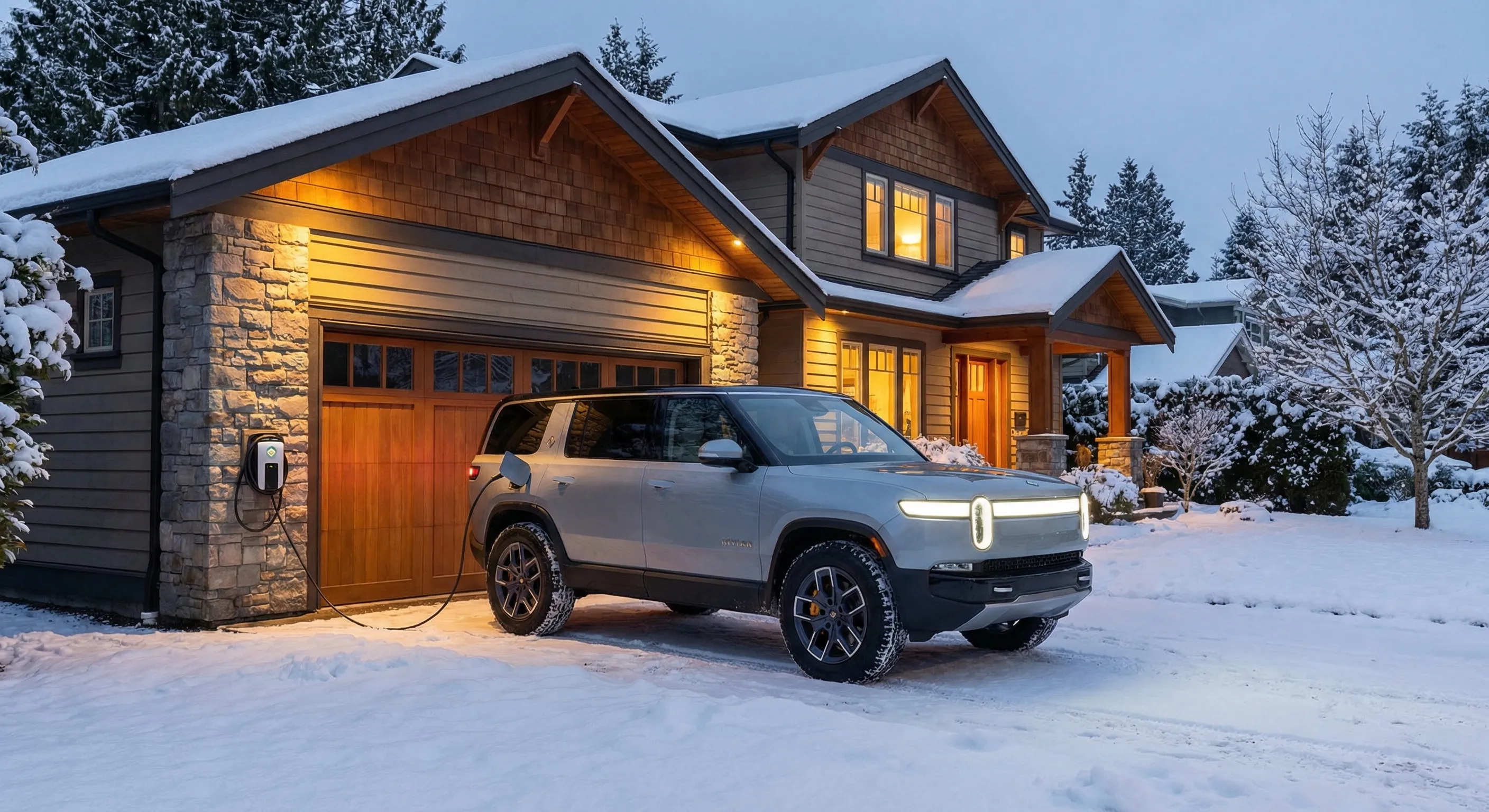
Home charging is the real solution. For the vast majority of Nova Scotia EV owners, 80-90% of charging will happen at home. A Level 2 home charger (240V, typically 32-48 amps) fully charges most EVs overnight, which means you start every morning with a full battery. This eliminates range anxiety for daily driving, commuting, errands, school runs, and most local travel are fully covered by overnight charging. Budget $1,500 to $2,500 for a Level 2 charger and professional installation, including any electrical panel upgrades. Nova Scotia does not currently offer a provincial rebate for home charger installation, which is yet another gap in its EV support framework.
WINTER IN NOVA SCOTIA
Winter performance is a legitimate concern for Maritime EV buyers, and it deserves an honest discussion. Nova Scotia has a maritime climate, milder than the Prairies or northern Ontario, but still genuinely cold, wet, and challenging for batteries.
Temperature range. Nova Scotia winters typically see temperatures between -5 and -15 degrees Celsius, with occasional dips to -20 or below. Halifax is milder than inland areas like Amherst or Truro, and Cape Breton's coastal areas moderate somewhat, but exposed highland areas can be harsh. Compared to Winnipeg (-25 to -35 degrees Celsius regularly) or Edmonton (-20 to -30 degrees Celsius), Nova Scotia winters are moderate. But they are cold enough to meaningfully affect EV range.
Range loss. In cold conditions, EV batteries produce and accept energy less efficiently. Heating the cabin draws significant power. The net effect is a range reduction of approximately 20-30% in typical Nova Scotia winter conditions, with the higher end of that range occurring during the coldest days or on highway driving. A vehicle rated at 400 km of range might deliver 280-320 km in deep winter. For a vehicle rated at 300 km, expect 210-240 km in cold weather.
Gear worth having
As an Amazon Associate, ThinkEV earns a small commission from qualifying purchases — at no extra cost to you.
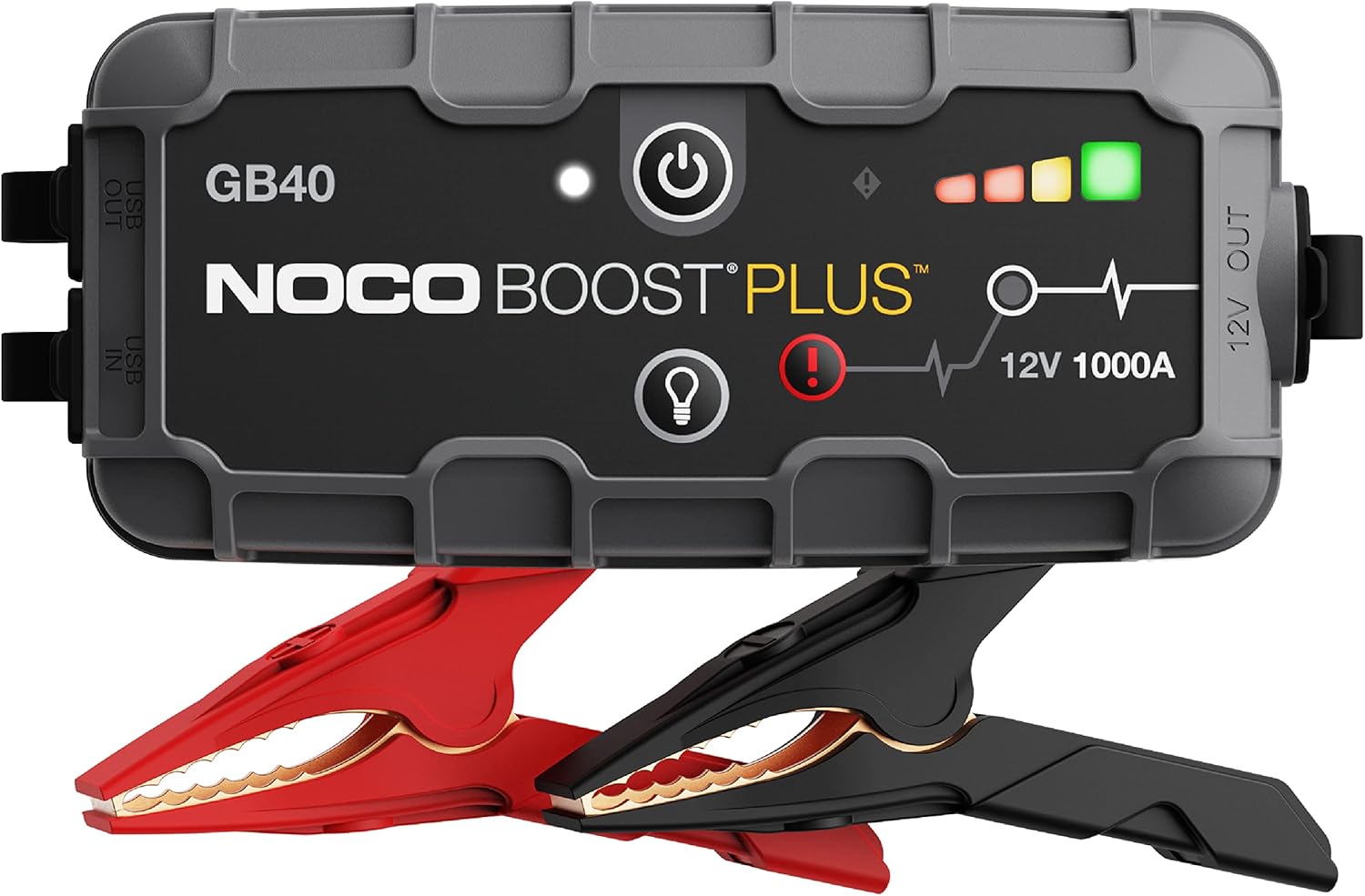
NOCO Boost Plus GB40 Jump Starter
A 1000A lithium jump starter that fits in your glovebox and works on any 12V battery. Your insurance against a dead 12V in a parking lot.
As an Amazon Associate, ThinkEV earns from qualifying purchases — at no extra cost to you.
This sounds concerning, but it needs to be put in practical context. The average Nova Scotia daily commute is approximately 30-40 km round trip. Even with a 30% range reduction, a vehicle with a rated range of 300 km delivers 210 km in the worst conditions, more than five times the average daily driving requirement. Unless you are regularly driving 200 or more kilometres per day in the middle of January without access to charging, winter range loss is a non-issue for daily driving.
Preconditioning is your best friend. Most modern EVs allow you to precondition the cabin and battery while the vehicle is still plugged into your home charger. This means you can heat the cabin to your desired temperature and warm the battery to optimal operating temperature using grid electricity rather than battery power. The result is that you leave home with a warm cabin, a fully charged battery, and a battery that is operating at peak efficiency. Preconditioning can recover most of the cold-weather range loss for the initial portion of your drive. Set it on a timer or activate it from your phone 20-30 minutes before departure.
Salt and corrosion. This is an underappreciated advantage of EVs in Maritime provinces. Nova Scotia roads are heavily salted in winter, and salt corrosion is a major contributor to vehicle deterioration and the premature death of exhaust systems, brake lines, and undercarriage components on gas vehicles. EVs have a significant structural advantage here: they have no exhaust system to corrode, and their undercarriage is typically sealed with a flat battery pack that provides physical protection. Brake wear is also dramatically reduced because EVs use regenerative braking for most deceleration, meaning the physical brake pads and rotors see far less use and less exposure to salt-laden road spray.
Winter tires are strongly recommended. They are not legally mandatory in Nova Scotia the way they are in Quebec, but they are essential for safe winter driving. Budget $800 to $1,200 for a set of winter tires for most EVs. Some EV owners mount winter tires on smaller-diameter rims, which can slightly improve winter range by reducing rolling resistance from larger all-season setups.
Heat pump vs resistive heating. When shopping for an EV in Nova Scotia, look for models with heat pump cabin heating rather than resistive heating. Heat pumps are roughly two to three times more efficient at heating the cabin, which directly translates to better winter range. Most modern EVs in the $35,000-plus range include heat pumps, but verify before purchasing, it makes a meaningful difference in Maritime winters.
THE MATH STILL WORKS
Despite zero provincial support and the EV surcharge, buying an EV in Nova Scotia still saves money over a gas car. The savings are smaller than in provinces with better policies, but they are real and they compound over time. Let us run the numbers in detail.
Five-year TCO: Chevrolet Equinox EV vs Toyota RAV4.
This is an apples-to-apples comparison of two similarly sized compact SUVs, the category that dominates Canadian sales.
Equinox EV (after $5,000 EVAP): $39,995 purchase price
- Electricity: $612/year x 5 = $3,060
- Insurance: $1,600/year x 5 = $8,000
- Maintenance: $400/year x 5 = $2,000
- EV Surcharge: $250/year x 5 = $1,250
- Five-year total cost: approximately $54,305
Toyota RAV4: $38,000 purchase price
- Gasoline: $2,480/year x 5 = $12,400
- Insurance: $1,500/year x 5 = $7,500
- Maintenance: $1,000/year x 5 = $5,000
- Five-year total cost: approximately $62,900
The Equinox EV saves approximately $8,595 over five years despite costing $1,995 more at purchase, including the surcharge, and charging at Nova Scotia's elevated electricity rates. The savings come from three sources: fuel ($9,340), maintenance ($3,000), and the EVAP rebate ($5,000), minus the surcharge ($1,250) and higher purchase price ($1,995) and slightly higher insurance ($500).
Five-year TCO: compact electric sedan scenario vs Honda Civic.
For sedan buyers, the comparison is equally compelling.
A compact electric sedan priced around $33,995 after EVAP:
- Electricity: $571/year x 5 = $2,855 (slightly more efficient than the Equinox)
- Insurance: $1,450/year x 5 = $7,250
- Maintenance: $400/year x 5 = $2,000
- EV Surcharge: $250/year x 5 = $1,250
- Five-year total cost: approximately $47,350
Honda Civic: $30,000 purchase price
- Gasoline: $2,170/year x 5 = $10,850 (Civic is efficient for a gas car)
- Insurance: $1,400/year x 5 = $7,000
- Maintenance: $900/year x 5 = $4,500
- Five-year total cost: approximately $52,350
The EV saves approximately $5,000 over five years in this scenario. The gap is smaller because the Civic is a fuel-efficient gas car with a lower purchase price, but the EV still wins on total cost of ownership. And unlike the Civic, the EV produces zero tailpipe emissions.
Maintenance savings deserve emphasis. The $600/year maintenance advantage for EVs is conservative. EVs have no oil changes, no transmission fluid, no spark plugs, no timing belts, no exhaust system, dramatically less brake wear (regenerative braking), and fewer moving parts overall. In a province where road salt accelerates wear on exhaust systems, brake lines, and undercarriage components, the EV maintenance advantage is arguably larger than the national average. Budget $300-500 per year for EV maintenance (tire rotations, cabin air filter, brake fluid, wiper blades) compared to $800-1,200 for a comparable gas vehicle.
The 10-year picture. Over 10 years, the advantages compound further. Total fuel savings approach $18,680. Total maintenance savings approach $6,000. The EV surcharge costs $2,500. Net savings over a gas car over 10 years: approximately $17,180. That is real money, money that stays in the pockets of Nova Scotia families instead of flowing to oil companies and repair shops.
Gear worth having
As an Amazon Associate, ThinkEV earns a small commission from qualifying purchases — at no extra cost to you.

Lectron Level 2 J1772 Charger (40A, WiFi)
Smart WiFi charger with real-time energy monitoring. 40A / 9.6 kW, J1772 with a NEMA 14-50 plug, schedule charging right from your phone.
As an Amazon Associate, ThinkEV earns from qualifying purchases — at no extra cost to you.
BEST EVS FOR NOVA SCOTIA BUYERS
Given Nova Scotia's specific challenges, no provincial rebate, the EV surcharge, higher electricity costs, Maritime winters, and a developing charging network, certain vehicles are better suited than others. Here are the top picks for Nova Scotia buyers in 2026, all EVAP-eligible.
1. Chevrolet Equinox EV ($39,995 after EVAP). The best overall value for Nova Scotia buyers. Built in Canada, so it qualifies for EVAP regardless of options. Rated range of approximately 500 km means roughly 350-400 km in winter, more than enough for any daily driving and most road trips within the Maritimes. The compact SUV form factor is the most popular segment in Canada. GM's Ultium platform has proven reliable, and the vehicle comes standard with a heat pump for efficient winter heating.
2. Hyundai Kona Electric ($37,999 after EVAP). The Kona has been one of the most popular EVs in Atlantic Canada, and for good reason. It is compact enough for city driving in Halifax but capable enough for highway trips. Range is approximately 415 km rated, delivering roughly 290-330 km in winter. The Kona has an excellent reputation for winter range retention among owners in cold climates. Well-suited to Nova Scotia's mix of urban and rural driving.
3. Watchlist: compact electric sedans in the low-$30,000s after EVAP. If Kia Canada lands EV4 pricing where early reporting suggests and the qualifying trim remains EVAP-eligible, this class could become one of the most affordable new-EV entry points for Nova Scotia buyers. Sedan form factor will not appeal to everyone, but a lower purchase price materially improves break-even against a gas equivalent.
4. Hyundai Ioniq 5 ($44,999 after EVAP). If budget allows, the Ioniq 5 is one of the best EVs sold in Canada. Its 800-volt architecture allows incredibly fast DC charging, 10% to 80% in approximately 18 minutes on a 350 kW charger. This matters for road trips through the Maritimes and for topping up during longer winter drives. Range is approximately 480 km rated. The available AWD option is worth considering for Nova Scotia winters, particularly for Cape Breton and rural areas.
5. Chevrolet Equinox EV LT AWD ($43,995 after EVAP, Canadian-made no cap). For buyers who want AWD capability for Nova Scotia's winter roads, the AWD version of the Equinox EV is worth the premium. Dual-motor AWD provides better traction on snow and ice, which is valuable during December through March. Still qualifies for the full EVAP rebate because it is Canadian-manufactured.
A note on AWD vs RWD. Many Nova Scotia buyers assume they need AWD for winter driving. Modern EVs with good winter tires are remarkably capable in RWD configuration, the heavy battery provides excellent traction weight over the drive wheels. AWD is a nice-to-have for severe winter conditions, not a necessity. If choosing between RWD and AWD means the difference between a $37,000 purchase and a $44,000 purchase, the RWD version with good winter tires is likely the smarter financial decision.
USED EVS IN NOVA SCOTIA
The used EV market is an increasingly important option for Nova Scotia buyers, particularly because there is no provincial rebate to offset the cost of a new purchase. Used EVs do not qualify for the federal EVAP (it applies to new vehicles only), but the lower purchase price can make the total cost of ownership extremely competitive.
Popular used EVs in the Nova Scotia market. The most commonly available used EVs in the Maritimes include the Nissan Leaf (earlier generations with smaller range, later generations with 240-360 km range), the Chevrolet Bolt EV and Bolt EUV (excellent value, 400-plus km range on 2022-plus models), the Hyundai Kona Electric (strong cold-weather performer), and the Tesla Model 3 (largest used inventory of any EV, but no EVAP on new units means the used price reflects that).
Pricing. Used EV prices have come down substantially as more new models enter the market and lease returns increase. A 2022-2023 Chevrolet Bolt EV with 400-plus km of range can be found for $22,000 to $28,000, less than half the price of a new EVAP-eligible EV. At that price point, the total cost of ownership case against a used gas car is overwhelming, even without any purchase incentive and even with the EV surcharge.
Battery health. Prospective used EV buyers should ask about battery state of health (SOH). Most modern EVs retain 85-95% of their original battery capacity after five years of normal use. Battery degradation is a real but manageable consideration, you are not going to wake up one morning to find your battery dead. Degradation is gradual, and most manufacturers warranty the battery for 8 years or 160,000 km. For a used EV in Nova Scotia, prioritize models with strong battery warranty coverage and check whether the warranty transfers to second owners (it usually does).
No provincial rebate for used EVs. Some provinces, notably BC and Quebec, offer purchase incentives for used EVs. Nova Scotia does not. The absence of a used EV incentive is another policy gap that disproportionately affects lower-income buyers who could benefit most from the ongoing operational savings of electric vehicles. A $2,000 to $3,000 used EV rebate would be one of the most cost-effective climate policies the province could implement, because it would bring EV ownership within reach of buyers who cannot afford new vehicle prices.
WHAT NOVA SCOTIA SHOULD DO DIFFERENTLY
I am going to use this section to say what needs to be said, because policy criticism is part of my job. Nova Scotia's approach to EV policy is not just inadequate, it is counterproductive. The province is actively making it harder for its residents to adopt the single most impactful consumer technology for reducing transportation emissions. Here is what a competent, climate-aware EV policy would look like.
Reinstate a provincial purchase rebate. Even a modest $2,000 to $3,000 provincial rebate would transform the incentive picture. Combined with the $5,000 EVAP, a $3,000 provincial rebate would give Nova Scotia buyers $8,000 in total incentives, competitive with PEI's $9,000 and better than most provinces. The cost to the province would be minimal. With roughly 3,000-4,000 new EV sales per year in Nova Scotia, a $3,000 rebate would cost $9 to $12 million annually, a fraction of one percent of the provincial budget.
Eliminate or defer the EV surcharge. The surcharge should not exist while EV market share is below 20%. When EVs represent a substantial portion of the vehicle fleet, a road-use funding mechanism is reasonable. When they represent 5-7% of new sales, a surcharge is premature and counterproductive. Ontario, Quebec, BC, Manitoba, provinces with the highest EV adoption rates, do not charge EV surcharges. There is a reason for that: they understand that the long-term fiscal benefits of EV adoption (reduced healthcare costs from air pollution, reduced climate adaptation costs, economic development in the EV supply chain) far outweigh the short-term fuel tax revenue loss.
Introduce time-of-use electricity rates for EV charging. Nova Scotia Power should offer a dedicated overnight charging rate, $0.08 to $0.10 per kWh between 11 p.m. and 7 a.m., for EV owners. This would reduce charging costs by roughly 50%, improve the financial case for EV ownership, and benefit the grid by shifting charging demand to off-peak hours when electricity is cheapest to generate. BC Hydro, Hydro-Quebec, and several Ontario utilities already offer similar programs. Nova Scotia Power has the infrastructure to implement this. The question is whether the province will push them to do it.
Offer a home charger installation rebate. A $500 to $1,000 rebate toward Level 2 home charger installation would remove a barrier for apartment and condo dwellers and reduce the upfront cost of EV ownership. Several provinces and utilities offer this. Nova Scotia does not.
Accelerate grid decarbonization. Nova Scotia's high electricity costs and coal-heavy generation mix are connected problems. The province needs to invest aggressively in wind, solar, and battery storage, and potentially in a transmission link to hydro power from Newfoundland and Labrador or Quebec, to bring electricity costs down and make the environmental case for EVs even stronger. An EV charged on Nova Scotia's current grid is cleaner than a gas car, but the margin is smaller than in hydro-rich provinces. Greening the grid would simultaneously reduce electricity costs and improve the lifecycle emissions of every EV on Nova Scotia's roads.
Look at what PEI is doing. PEI is a smaller province with a smaller budget, and it manages to offer a $4,000 provincial rebate (Tesla excluded) with no EV surcharge. PEI has invested in charging infrastructure across the island. PEI's EV adoption rate is growing faster than Nova Scotia's, which means PEI is building the consumer base and the infrastructure simultaneously while Nova Scotia is falling behind. Nova Scotia has no excuse for doing less than PEI. If the smallest Atlantic province can support EV adoption, the largest one certainly can.
COMPARISON TO NEIGHBOURING PROVINCES
Nova Scotia does not exist in a vacuum. EV buyers in Atlantic Canada have options, if not in terms of where they buy, at least in terms of understanding how their province stacks up. Here is the comparison.
PEI: The Atlantic leader. PEI offers $9,000 in combined federal and provincial incentives ($5,000 EVAP plus $4,000 provincial, Tesla excluded). No EV surcharge. Electricity rates are moderate and declining as the province expands wind generation. The island's compact geography means range anxiety is essentially a non-issue, you can drive from one end of PEI to the other on a fraction of a battery charge. PEI is proof that a small province with limited resources can still support EV adoption effectively.
New Brunswick: Better than Nova Scotia, but slipping. New Brunswick's provincial rebate ended in July 2025, leaving only the $5,000 federal EVAP. However, New Brunswick does not charge an EV surcharge, and NB Power's electricity rates are lower than Nova Scotia Power's. New Brunswick also benefits from a higher proportion of hydroelectric and nuclear generation, which keeps rates more stable. The policy environment is not great, but it is better than Nova Scotia's.
Newfoundland and Labrador: Still trying. Newfoundland and Labrador maintains a provincial EV program, which puts it ahead of Nova Scotia on that measure alone. The province also has the potential for very low electricity costs as the Muskrat Falls project, despite its cost overruns and controversies, begins delivering hydro power. Long-term, Newfoundland and Labrador could have some of the cheapest electricity in the country, which would make it an excellent province for EV ownership. The province's vast distances and sparse charging infrastructure present challenges, but the policy direction is supportive.
The Atlantic Canada ranking for EV buyers:
- 1st: PEI, $9,000 total incentives, no surcharge, compact geography, growing infrastructure
- 2nd: Newfoundland and Labrador, Provincial program active, potential for cheap hydro power
- 3rd: New Brunswick, No provincial rebate, but no surcharge and lower electricity costs
- 4th: Nova Scotia, No provincial rebate, EV surcharge, highest electricity costs in Atlantic Canada
Nova Scotia is last. Not by a slim margin. By a wide one. The province that should be leading Atlantic Canada in EV adoption, it has the largest population, the largest economy, and the most urbanized population, is instead bringing up the rear. This is a failure of political will, not of economic capacity.
For a broader comparison of how Nova Scotia fits into the national picture, see our complete EV rebates by province guide.
Gear worth having
As an Amazon Associate, ThinkEV earns a small commission from qualifying purchases — at no extra cost to you.

ChargePoint Home Flex Level 2 Charger (50A)
Premium 50A / 12 kW charger with the best app ecosystem. Hardwired or NEMA 14-50, with real-time energy tracking and smart scheduling.
As an Amazon Associate, ThinkEV earns from qualifying purchases — at no extra cost to you.
FAQ
Related Reading
- EV Rebates by Province Canada 2026, How Nova Scotia compares to every other province for EV incentives.
- PEI EV Rebates and Incentives 2026, Nova Scotia's neighbour shows how it should be done, with $9,000 in total incentives.
- Canada EVAP Rebate Guide 2026, Complete guide to the $5,000 federal incentive that is your only help in Nova Scotia.
- EV Charging Costs by Province Canada 2026, Nova Scotia's electricity rates versus the rest of Canada.
- EV vs Gas Total Cost of Ownership Canada 2026, The full financial comparison, including provinces with surcharges.
- Most Affordable EVs in Canada 2026, Best budget-friendly EVs that qualify for EVAP.
Gear worth having
As an Amazon Associate, ThinkEV earns a small commission from qualifying purchases — at no extra cost to you.

Magnetic EV Charger Plug Cover
A magnetic cap that keeps rain, road salt, and grit out of your home charger handle between sessions.
As an Amazon Associate, ThinkEV earns from qualifying purchases — at no extra cost to you.

Founder & Chief Editor
Vlad Pereira is the founder and chief editor of ThinkEV.ca, the Canadian electric-vehicle publication he writes and edits from Courtenay, British Columbia. He covers EV pricing, federal and provincial rebates, charging costs, and the Chinese manufacturers now entering Canada, from the buyer's side rather than the press-fleet side. ThinkEV is a venture of Vlad Pereira Online; his writing on health, income and the long game lives at vladpereira.com.
Frequently asked questions
Does Nova Scotia offer any provincial EV rebates in 2026?
What is the Nova Scotia EV surcharge and when does it start?
How much does it cost to charge an EV in Nova Scotia?
Is it still worth buying an EV in Nova Scotia without provincial incentives?
How do EVs handle Nova Scotia winters?
Does Tesla qualify for any rebates in Nova Scotia?
Can I buy a used EV and get any rebates in Nova Scotia?
What is the cheapest EVAP-eligible EV for Nova Scotia buyers?
How does Nova Scotia compare to other provinces for EV incentives?
More EV & road-trip finds
Affordable upgrades worth a look — tap any to check the price on Amazon.
 ★ 268
★ 268Anti-Slip Leather Steering Wheel Cover
View on Amazon ★ 8,681
Chemical Guys Complete Car Wash Kit
View on Amazon ★ 314
★ 314Mini USB LED Ambient Lamps (4-Pack)
View on Amazon ★ 1,349
Cool Swinging Duck Dashboard Ornament
View on Amazon ★ 865
★ 865Collapsible Trunk Organizer
View on Amazon ★ 55,938
WixGear Magnetic Air Vent Phone Mount (2-Pack)
View on Amazon ★ 121
★ 121Foldable Windshield Sun Umbrella
View on Amazon ★ 392
★ 392Large Cup Holder Adapter (32-40oz)
View on AmazonRead, Plan, Then Stay Current
Explore our expert articles to understand incentives and ownership costs, use the map to pressure-test charging reality, then subscribe so new EV coverage comes straight to you.
Continue Reading
Ontario EV Charging in 2026: Where It Stands
EV Charging in a Condo or Apartment in Canada

Alberta EV Rebates 2026: What You Actually Get

BC EV Rebates 2026: What's Left After the Cuts
EV Charging Costs Canada 2026: Home vs Public