Key takeaways
- If you are shopping for an electric vehicle in New Brunswick right now, the $5,000 federal Electric Vehicle Affordability Program (EVAP) is your one and only purchase incentive.
- a $5,000 federal rebate on a qualifying vehicle still moves the needle when you run the math across five years of ownership.
- The headline number is $5,000 off a new battery-electric vehicle, or $2,500 off a qualifying plug-in hybrid.
- The program uses a "final transaction value" cap of $55,000 for most vehicles, and $60,000 for vehicles with higher ground clearance or seating for seven or more.
New Brunswick has no provincial EV rebate in 2026. The provincial program ended and the province has not announced a replacement. If you are shopping for an electric vehicle in New Brunswick right now, the $5,000 federal Electric Vehicle Affordability Program (EVAP) is your one and only purchase incentive. That's the whole stack.
The internet is still full of outdated articles referencing programs that no longer exist, and dealer websites sometimes gesture vaguely at "available rebates" without clarifying that the provincial piece is gone. The province ended its program and has said nothing publicly about restoring it.
Is it still worth buying an EV in New Brunswick? Yes, and the case is more compelling than a single missing rebate would suggest. NB Power's electricity rates are among the cheapest in Atlantic Canada. The Trans-Canada corridor is genuinely well-served by charging infrastructure. A $5,000 federal rebate on a qualifying vehicle still moves the needle when you run the math across five years of ownership. The incentive stack isn't impressive, but the fundamentals of EV ownership here hold up.
THE FEDERAL EVAP, YOUR ONLY PURCHASE INCENTIVE
The Electric Vehicle Affordability Program is the rebate that replaced the old iZEV program. The headline number is $5,000 off a new battery-electric vehicle, or $2,500 off a qualifying plug-in hybrid. The rebate is applied at the dealership at the point of sale, the dealer reduces your purchase price and then recoups the money from Transport Canada. You don't claim anything through the CRA. You just pay less on the day you buy.
In practice, this means you need to buy from a participating dealer. The vast majority of authorized dealerships for major brands are registered participants, so this is rarely an issue, but worth confirming before you get too far into negotiations.
The eligibility rules are where things get specific, and where a lot of buyers get tripped up.
The program uses a "final transaction value" cap of $55,000 for most vehicles, and $60,000 for vehicles with higher ground clearance or seating for seven or more. That final transaction value is calculated from the base price plus options plus dealer fees, before taxes and freight charges.
If your vehicle's final transaction value exceeds the applicable cap, the vehicle does not qualify. One important carve-out: vehicles manufactured in Canada have no price cap. A Canadian-assembled EV at any price point qualifies for EVAP. That matters for certain domestic models.
The country-of-manufacture exclusion is equally critical. Chinese-manufactured vehicles do not qualify for EVAP, regardless of price. That means every BYD model is excluded, not because of what they cost, but because of where they're built. Canada imposed 100% tariffs on Chinese EVs in October 2024, which were subsequently reduced to 6.1% for a 49,000-vehicle quota starting January 16, 2026, but the EVAP country-of-origin exclusion remains regardless of tariff status. If the vehicle comes off a Chinese production line, it doesn't qualify for the rebate.
Tesla's EVAP eligibility is now partial. The Tesla Model Y RWD base ($49,990) is on Transport Canada's official EVAP eligible vehicle list and qualifies for the $5,000 rebate, provided the final transaction value (base price plus options plus dealer fees) stays under the cap. Watch dealer-added fees carefully on any Tesla. The Model Y Long Range AWD ($59,990), Model Y Performance ($69,990), and all Model 3 trims ($54,990+) exceed the cap and do not qualify. The base Model Y RWD is the one Tesla configuration that now qualifies for EVAP; all others remain excluded. Tesla buyers in New Brunswick should confirm their specific trim before counting on the rebate.
The practical effect of these exclusions is that EVAP is primarily useful for mainstream Korean and North American EVs. Hyundai, Kia, Chevrolet, Ford, Volkswagen, and Volvo all have models that qualify. For some of the most popular choices in the current market:
The 2026 Chevrolet Equinox EV at $44,995 drops to $39,995 after rebate. That's a mid-size electric crossover with roughly 480 km of EPA-rated range, and the Equinox EV is assembled in Ingersoll, Ontario, so it qualifies without any price cap constraint. The Hyundai Kona Electric at $42,999 comes to $37,999 after rebate. The Kia EV4 at approximately $38,995 would drop to $33,995 if it qualifies. The VW ID.4 at around $44,995 comes to $39,995 post-rebate. These are real vehicles at prices that compete directly with equivalent gas crossovers.

One administrative note: the EVAP is a once-per-person rebate for the duration of the program. If you claimed it before on a previous purchase, you cannot claim it again. For most buyers this isn't yet a constraint, but it becomes relevant as the program matures. One person, one rebate.
Leased vehicles qualify under the same rules. The rebate is applied at lease inception, reducing the capitalized cost and therefore your monthly payments. Leasing is a legitimate way to access the EVAP, and for buyers who prefer shorter ownership cycles, it's worth structuring.
WHY NEW BRUNSWICK HAS NO PROVINCIAL REBATE
New Brunswick ran a provincial EV incentive program until . Its cancellation generated almost no public attention, which tells you something about how electrification is being prioritized at the provincial level.
The argument the government has made, implicitly, through inaction rather than explicit policy statements, is that the federal program provides adequate support. The EVAP delivers $5,000. The province doesn't need to top it up. For a province with tight fiscal constraints, a consistently challenged budget position, and no vocal constituency demanding EV subsidies, this is a politically easy line to hold. New Brunswick has a smaller tax base than Ontario or Quebec, and discretionary spending on EV incentives is simple to defer when there's no political cost to deferring it.
The counterargument is that provincial incentives work. The provinces with active provincial programs right now, PEI, Quebec, and Manitoba through the end of March 2026, are seeing meaningfully faster EV adoption rates than provinces that have stepped back. Incentive stacking is not subtle. When you take a qualifying vehicle from $44,995 to $35,995 through combined federal and provincial programs, you're competing on price directly with conventional gas alternatives. That's the inflection point where hesitant buyers become EV buyers. Removing the provincial piece means staying above that threshold for more people.
Compare New Brunswick to PEI right now. An Islander buying a Chevy Equinox EV pays $35,995 after $9,000 in combined rebates. A New Brunswicker buying the same vehicle pays $39,995. That $4,000 gap isn't catastrophic, but it's real, and it reflects a deliberate provincial policy choice about whether the government wants to actively accelerate electrification or simply not impede it.
New Brunswick has a stated target of for EV market share. Reaching that target without any provincial financial incentive means the market has to do most of the heavy lifting, through falling vehicle prices, expanding supply, and growing consumer familiarity with EVs. It's achievable. It would happen faster with a provincial rebate.
NB POWER AND THE ELECTRICITY COST ADVANTAGE
This is where New Brunswick's EV ownership economics genuinely improve. NB Power's residential electricity rate sits at approximately per kilowatt-hour, one of the lowest in Atlantic Canada and substantially below what Nova Scotia Power or Maritime Electric customers pay. That rate matters enormously because it determines your per-kilometre fuel cost every single day you own the car.
Run the numbers. A typical modern EV consumes approximately 18 kilowatt-hours per 100 kilometres in moderate weather. At NB Power's residential rate of roughly $0.11/kWh, that works out to about $1.98 per 100 kilometres. Now compare that to a conventional gas vehicle averaging 9 litres per 100 kilometres at $1.60 per litre, a realistic New Brunswick pump price in 2026, which costs $14.40 per 100 kilometres. That's a cost-per-kilometre gap of more than 7:1 in favour of the EV.
For most people driving 20,000 kilometres a year, that math produces roughly $396 in annual electricity costs for home charging versus $2,880 in annual gasoline costs for a comparable gas car. Annual fuel savings: approximately $2,484. That's not a rounding error. That's meaningful household budget relief that shows up in your bank account every month.
Over five years and 100,000 kilometres, those fuel savings accumulate to roughly $12,420. Add the $5,000 EVAP rebate and you're at $17,420 in total savings relative to buying a comparable gas vehicle, before accounting for maintenance cost differences, which also favour the EV. Electric motors have fewer moving parts than combustion engines, require no oil changes, and put far less stress on brake systems through regenerative braking. CAA and Natural Resources Canada analyses consistently show $1,500 to $2,000 in annual maintenance cost advantages for EVs over comparable gas vehicles. Over five years, that's another $7,500 to $10,000 in avoided costs.
The combined effect, rebate plus fuel savings plus maintenance savings, puts the five-year total cost of ownership advantage for an EV in New Brunswick at roughly $24,000 to $27,000 compared to a comparable gas vehicle. That number is lower than what a Manitoba or Quebec buyer gets (those provinces have both stacked rebates and different electricity rates), but it's substantial and it doesn't require optimistic assumptions.
NB Power's relatively low rates exist partly because of the province's generation mix. The Point Lepreau Nuclear Generating Station provides baseload power, and the grid also draws on hydroelectric generation from the Saint John River system plus transmission interconnections with Hydro-Québec's hydro-heavy grid. The result is electricity that is both cheaper and lower in carbon intensity than what Nova Scotia customers get from a grid still substantially dependent on fossil fuels.
That matters for the environmental case. The "but electricity comes from coal" argument, which gets deployed to dismiss EVs in certain markets, has less force in New Brunswick than in provinces like Nova Scotia or Alberta. When you charge an EV on NB Power's grid, you're drawing from a system with meaningfully lower embedded carbon than the Atlantic Canada average.
HOME CHARGING IN NEW BRUNSWICK, THE PRACTICAL SETUP
Most New Brunswick EV owners will do 80 to 90 percent of their charging at home. That's the national pattern and there's no structural reason New Brunswick should deviate from it. Understanding what home charging costs and what it requires is more useful for most buyers than obsessing over public fast-charging networks.
A Level 1 charger, the standard 120-volt cord that comes packaged with most new EVs, delivers roughly 8 to 12 kilometres of range per hour of charging. If your daily commute is 40 to 60 kilometres, plugging a Level 1 cord into an ordinary household outlet overnight is technically sufficient. Your battery won't be full every morning, but if your driving is modest and predictable, Level 1 works without any equipment purchase beyond what came in the box.
For most people, though, a Level 2 home charger is a reasonable investment and eventually the right move. A Level 2 EVSE operates on a 240-volt circuit, the same voltage as your electric dryer or stove, and delivers 25 to 60 kilometres of range per hour depending on amperage and your vehicle's onboard charger capacity. A typical Level 2 setup fully replenishes most EVs in four to eight hours. Plug in when you get home, wake up to a full battery.
Gear worth having
As an Amazon Associate, ThinkEV earns a small commission from qualifying purchases — at no extra cost to you.

Grizzl-E Classic Level 2 EV Charger (40A)
Canadian-made and rated for minus 40C winters. 40A / 9.6 kW, NEMA 14-50, indoor/outdoor, 24-ft cable. The charger built for Canadian weather.
As an Amazon Associate, ThinkEV earns from qualifying purchases — at no extra cost to you.
The Grizzl-E Classic is one of the more sensible Level 2 charger choices for Canadian buyers. It's built in Canada, it's designed for the temperature swings that Atlantic winters produce, and it delivers up to 40 amps of charging power. At NB Power's approximate $0.11/kWh rate, replenishing 40 kWh overnight costs about $4.40. That's a full charge for a typical mid-range EV. Less than a medium coffee at most places.
New Brunswick does not currently offer a provincial rebate for Level 2 home charger installation. The federal Greener Homes rebate that previously covered some of this cost has been wound down. So the full cost of charger hardware and installation falls on the buyer. Budget $600 to $1,200 for the charger unit depending on brand and amperage, plus $400 to $1,000 for licensed electrical installation including any panel upgrades your service box requires. Total outlay: $1,000 to $2,200 in most cases. That upfront cost gets amortized over years of $4 overnight charges.
If you live in an apartment or condo in Fredericton, Moncton, or Saint John and don't have access to private parking with an outlet, home charging is harder. Multi-unit dwelling charging is a genuine infrastructure gap across Canada, and New Brunswick is no exception. Some buildings in the province have installed Level 2 stations in parking garages, but coverage is inconsistent. If you're a condo owner or tenant considering an EV, find out what charging access exists at your building before you buy, this isn't automatically a deal-breaker, but it requires a concrete plan.
CHARGING INFRASTRUCTURE, THE TRANS-CANADA CORRIDOR AND BEYOND
New Brunswick's geography actually works in your favour as an EV driver, if you understand how the province is laid out. The three main population centres, Moncton, Fredericton, and Saint John, form a triangle connected by Route 2, the Trans-Canada Highway. That corridor is now reasonably well-served by public charging, which means driving between New Brunswick's major cities has become a practical, well-supported use case.
The Trans-Canada through New Brunswick carries significant traffic between Nova Scotia and Quebec, and charging infrastructure investment has followed that traffic pattern. DC fast chargers are positioned along Route 2 at intervals that allow EVs with 350 to 500 km of rated range to travel the province's length without anxiety. The Moncton-to-Fredericton run is approximately 175 kilometres. Fredericton to the Quebec border near Edmundston is roughly 230 kilometres. Moncton to the Nova Scotia border at Amherst is under 50 kilometres. Modern EVs cover any of these legs comfortably on a single charge.
Natural Resources Canada data has cited substantial growth in the Atlantic charging network over the past two years, and the growth has been targeted at the gaps that matter most: highway corridors, rural communities on main travel routes, and destination charging at accommodation and retail locations.
Moncton has the province's densest concentration of public charging, which makes sense, it's the largest city, sits at the intersection of the major highway routes, and is geographically positioned as the hub for Atlantic Canada road travel. Fredericton has solid coverage near the University of New Brunswick and along Prospect Street. Saint John has lagged somewhat on charging density, partly due to its particular geography, but the city centre and the Highway 1 corridor approaching the city have improved.
The Miramichi corridor deserves specific mention because it comes up frequently as a potential weak point. If you're taking Route 11 through Miramichi toward Bathurst or Campbellton rather than the direct Trans-Canada route between Moncton and Fredericton, public charging options are more limited. The Miramichi area functions as a waypoint to the northern communities, but coverage is not as dense as the Trans-Canada spine. If you're planning a trip along the province's northeastern coast, check PlugShare or ChargeHub for current network status before departing, don't rely on anything published more than a few months ago, because the network is actively developing.
The New Brunswick-Nova Scotia connection past Amherst is well-supported. The NB-Quebec connection through Edmundston has improved. The Confederation Bridge crossing to PEI needs some planning: charging is available on the PEI side at Borden-Carleton, but the NB side near Cape Tormentine has more limited infrastructure. If you make regular trips to PEI, plan your departure state of charge accordingly rather than expecting to top up just before the bridge.
NB WINTERS AND WHAT THEY ACTUALLY MEAN FOR YOUR EV
New Brunswick winters are serious. Fredericton regularly sees overnight temperatures of -15°C to -25°C from December through February. Moncton's proximity to the Bay of Fundy moderates temperatures slightly but adds wind and humidity that can feel equally brutal. Saint John is notorious for fog and damp cold. This is not mild-winter territory.
The short answer on winter performance: cold weather costs you range, typically 20 to 40 percent depending on temperature and driving conditions, and adds some operational complexity that gas car drivers don't encounter. The longer answer is that these are manageable variables, not dealbreakers, once you understand the mechanics behind them.
Battery chemistry is the underlying reason. Lithium-ion cells operate less efficiently at low temperatures. Cold slows the electrochemical reactions that produce usable power, which reduces both usable capacity and the rate at which the battery accepts a charge. Below -10°C, most EVs will show meaningfully lower range estimates than their rated figures. A vehicle with a 480 km EPA rating might display 300 to 360 km available on a cold January morning in Fredericton. That reduced figure is real, plan accordingly on longer trips, but it's still more than enough for typical daily driving.
CAA conducted real-condition winter range testing in Canada and found losses ranging from 14 percent to 39 percent across tested models at temperatures between -7°C and -15°C. The best performers, vehicles with heat pumps, well-insulated battery packs, and battery preconditioning systems, retained 85 to 86 percent of rated range. The worst performers were older designs that rely on resistive cabin heating, which is significantly less efficient than a heat pump.
When you're choosing an EV for New Brunswick, heat pump availability should be a real checkbox on your criteria list. Heat pumps extract thermal energy from outside air to warm the cabin, rather than converting electrical energy directly to heat. The efficiency advantage in cold weather is roughly 2 to 3 times: a heat pump produces 2 to 3 units of heat per unit of electrical energy consumed, while a resistive heater produces exactly 1 unit. That efficiency gap is why heat pump-equipped EVs hold onto their range much better when temperatures drop. The Hyundai Kona Electric, Kia EV6, VW ID.4, and Chevy Equinox EV all include heat pumps as standard or available equipment.
Pre-conditioning is the other technique that makes winter EV ownership noticeably more comfortable. Most modern EVs allow you to schedule cabin and battery pre-heating while the car is still plugged in at home. You tell the app to have the car warm and ready at 7:45 AM. The energy used to heat the cabin and bring the battery to optimal operating temperature comes from the grid, not from your battery pack, which means you drive away with full range and a warm interior. People who use pre-conditioning consistently report much lower winter range anxiety than those who don't. It's a habit change, not a hardware limitation.
For the cold-weather anxiety some buyers carry over from gas car experience, the fear of being stranded with a dead battery in January, the reality of EV ownership is different. An EV battery at very low charge in -20°C weather will show degraded performance, but the vehicle's battery management system is designed to protect the pack. You're not going to find yourself completely unable to start the car the way you might with a gas vehicle that won't crank. What you might find is reduced available range if you consistently let the battery get critically low and park outside overnight in deep cold. Most EV drivers develop the habit of plugging in whenever they park at home, a habit that costs almost nothing at NB Power rates and eliminates this concern entirely.
Gear worth having
As an Amazon Associate, ThinkEV earns a small commission from qualifying purchases — at no extra cost to you.
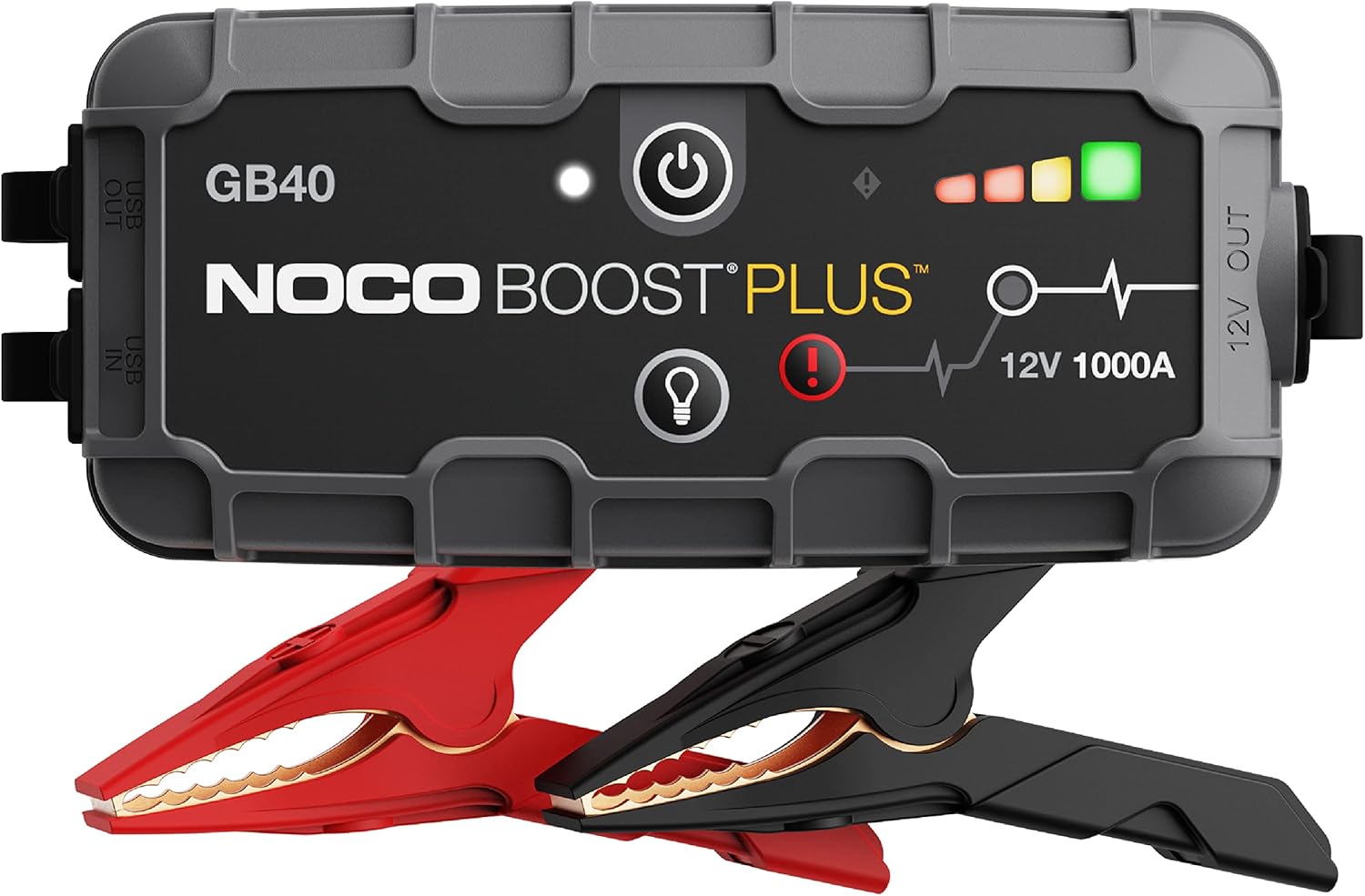
NOCO Boost Plus GB40 Jump Starter
A 1000A lithium jump starter that fits in your glovebox and works on any 12V battery. Your insurance against a dead 12V in a parking lot.
As an Amazon Associate, ThinkEV earns from qualifying purchases — at no extra cost to you.
A portable jump starter like the NOCO Boost GB40 is still worth keeping in your winter emergency kit. Not because your EV is likely to need it, it won't, but because you might encounter a stranded gas car driver who does, and because a preparedness mindset is generally sound in rural New Brunswick winter conditions. Your EV's 12-volt accessory battery, which powers door locks, interior lights, and other accessories, can theoretically need attention after years of ownership, though this is uncommon in well-maintained vehicles.
WHICH EVS ACTUALLY MAKE SENSE FOR NEW BRUNSWICK IN 2026
The ideal EV for New Brunswick checks several province-specific boxes: it qualifies for the federal EVAP (transaction value under the applicable cap, non-Chinese manufacture), it has a heat pump for winter efficiency, it has enough real-world range to handle the province's geography with confidence, and it has accessible dealer and service support within the province. Here are the credible contenders.
The Chevrolet Equinox EV is probably the most compelling overall package for NB buyers right now. At $44,995 before rebate ($39,995 after EVAP), it delivers up to 480 km of EPA-rated range in its longer-range configuration, roughly 340 to 380 km in realistic Atlantic Canada winter conditions. That's more than enough for any intra-provincial trip and makes intercity travel between Moncton, Fredericton, and Saint John straightforward.
Gear worth having
As an Amazon Associate, ThinkEV earns a small commission from qualifying purchases — at no extra cost to you.

PULIDIKI Car Cleaning Gel (Detailing Putty)
Press it into vents, buttons, and seams and it lifts out dust you did not know was there. Weirdly satisfying, genuinely useful.
As an Amazon Associate, ThinkEV earns from qualifying purchases — at no extra cost to you.
GM's dealer network in New Brunswick is mature, with Chevrolet service available in all three major cities. And the Equinox EV is assembled in Ingersoll, Ontario, which means it qualifies for EVAP without the price cap constraint, a useful insurance policy if you add options. It's a practical crossover at a price point that now competes directly with equivalent gas models.
The Hyundai Kona Electric at $42,999 ($37,999 after EVAP) is the value leader for buyers who want proven reliability, a standard heat pump, and a vehicle size that suits most New Brunswick households without being oversized. The Kona Electric's approximately 400 km of EPA range comes down to roughly 280 to 320 km in Atlantic Canada winters, enough to cover the Moncton-to-Fredericton corridor with margin. Hyundai has dealership presence in the province's major cities, and the Kona Electric has been in the Canadian market long enough that service technicians have genuine hands-on experience with it.
The VW ID.4 at approximately $44,995 ($39,995 after EVAP) is worth considering for buyers who want European engineering, a spacious interior, and strong winter capability. The ID.4 comes with a heat pump standard, and VW's dealer network in New Brunswick covers Moncton and Fredericton. Range is rated at roughly 400 km EPA, which translates to 280 to 330 km in cold conditions.
For buyers with larger families or cargo requirements, the Kia EV9 and Hyundai Ioniq 9 both exceed the EVAP transaction cap, but they're legitimate choices for buyers who don't need the rebate to make the ownership math work. Both are seven-passenger electric SUVs with serious range figures and heat pump systems designed for cold climates.
Ford's F-150 Lightning deserves mention because pickup truck ownership is deeply embedded in New Brunswick culture. The Lightning starts above the EVAP transaction cap after options, and Ford's production timelines have been inconsistent, but if you're a truck buyer who wants to go electric, the Lightning remains the most practical full-size truck option. Payload capacity and towing specs are real, just know that pulling a loaded trailer cuts into range substantially.
What to avoid: older EV designs without heat pumps (they struggle more than necessary in NB winters), anything manufactured in China (EVAP exclusion plus ongoing tariff uncertainty), and any Tesla configuration that you're trying to justify by removing features. You're not going to make a Tesla qualify for EVAP by deleting the sound system or the cargo cover. The service and support network for Tesla in Atlantic Canada is also thinner than what you get from the established Hyundai/Kia/GM/Ford dealer networks, an important consideration when your nearest Tesla Service Centre might be a significant drive away.
THE PHEV CASE, $2,500 AND A PRACTICAL SAFETY NET FOR RURAL BUYERS
The EVAP program includes a $2,500 rebate for plug-in hybrid electric vehicles. That's half the BEV amount, reflecting the government's preference for full electrification, but it's still real money, and the PHEV case for certain buyer profiles in New Brunswick is genuinely sound.
The short answer: if you live in rural New Brunswick and have genuine range concerns, or drive routes where public charging is sparse, a PHEV is a reasonable answer to a real problem. You're not solving the whole challenge, but you're solving the 80 percent of it that matters, the daily fuel cost.
The longer answer is that the plug-in hybrid argument in New Brunswick has more merit than it gets credit for in EV advocacy circles. If you're farming outside Woodstock, running a business between Sussex and St. Martins, or living in a community where the nearest DC fast charger is a meaningful detour from your regular routes, a PHEV gives you the electric cost advantage for local driving while eliminating the logistical anxiety of longer or unpredictable trips.
The most credible PHEVs in the Canadian market for 2026 include the Toyota RAV4 Prime, Ford Escape PHEV, Hyundai Tucson PHEV, and Kia Sportage PHEV. All qualify for the $2,500 EVAP rebate provided they meet the transaction value cap. The RAV4 Prime is particularly relevant for New Brunswick buyers, it's a nameplate that sells extremely well in the province, it has strong dealer and service support at Toyota locations in Moncton, Fredericton, and Saint John, and its electric-only range of approximately 68 km covers the daily commuting pattern for most New Brunswick households. Drive to work and back on electricity, use gasoline for the longer weekend trip to the regional centre. That's the PHEV value proposition, and New Brunswick's geography suits it well.
The fuel cost calculus for a RAV4 Prime at NB Power's $0.11/kWh rate is worth running. A RAV4 Prime driven 15,000 km per year, with 70 percent of those kilometres on electricity, consumes roughly 1,800 kWh of electricity annually (about $198 at NB rates) and approximately 450 litres of gasoline (about $720 at $1.60/L). Total annual fuel cost: roughly $918. A conventional RAV4 at 9L/100 km over 15,000 km burns 1,350 litres of gasoline ($2,160). Annual fuel savings for the PHEV over the conventional version: approximately $1,242. Combined with the $2,500 EVAP rebate, the RAV4 Prime's price premium over the conventional RAV4 becomes much easier to absorb, and you get the daily electric driving routine without committing to full battery-electric logistics.
Full electrification is better for emissions, better for long-run operating costs, and better for grid integration. But for specific buyer profiles in New Brunswick, rural households, buyers with high annual mileage, buyers who regularly tow, the PHEV case is genuinely solid. Don't dismiss it because it's not a full BEV.
DEALER EXPERIENCE, REGISTRATION, AND RESALE IN NEW BRUNSWICK
Buying and owning an EV in New Brunswick involves some province-specific details that national guides written for Ontario or BC audiences tend to skip over.
On dealer access: New Brunswick has a smaller dealer footprint than larger provinces, which means your choices for brands like Hyundai, Kia, and Chevrolet may be concentrated in Moncton, Fredericton, or Saint John. If you live in Campbellton, Bathurst, or Miramichi, you may need to travel to a larger centre to find the EV model you want in inventory. That's a logistical inconvenience rather than a fundamental barrier, but it's worth factoring in. Service matters more than purchase location: where your car goes for warranty work, software updates, and repairs over the years is the more important question. Verify that your preferred brand has trained EV technicians at a dealership within reasonable distance of where you live.
The EVAP rebate is applied by the dealer at point of sale, and the dealer recoups it from Transport Canada. This process works smoothly at dealerships experienced with EVs. Some smaller rural dealerships that sell very few EVs may be less familiar with the paperwork. If you encounter confusion or resistance, Transport Canada's EVAP documentation is publicly available, and you have the right to the rebate on any qualifying vehicle. The rebate is not at the dealer's discretion, if the vehicle qualifies, the dealer must apply it.
Vehicle registration in New Brunswick does not include any EV-specific surcharge as of 2026. This is a meaningful contrast to Nova Scotia, which is implementing a surcharge on zero-emission vehicles. In New Brunswick, your annual registration cost for an EV is the same as for a comparable gas vehicle, typically $100 to $150 per year depending on vehicle weight. No penalty for going electric. Registration parity is actually an advantage over what Nova Scotia EV owners will face going forward.
HST applies to EV purchases in New Brunswick at the provincial rate. The EVAP rebate is applied before tax is calculated, which means the rebate reduces your taxable base. In practice, this adds approximately $650 in effective additional value to the nominal $5,000 rebate, your total tax-adjusted benefit from the federal EVAP in New Brunswick works out to roughly $5,650 rather than exactly $5,000.
On resale values: EVs in Canada have faced resale pressure over the past two years, driven largely by Tesla's aggressive price reductions that pulled down used market values across the broader segment. The resale picture is more nuanced for non-Tesla EVs and has been stabilising in 2025 and 2026 as the market absorbs those earlier price adjustments.
For New Brunswick specifically, the used EV market is thinner than in major metropolitan markets, which means prices can be more volatile. A well-maintained Kona Electric in Moncton may take longer to sell than the same car in Toronto because the buyer pool is smaller. But as EV adoption increases and buyer familiarity grows, that liquidity gap is closing. Buying mainstream models, Kona Electric, Equinox EV, proven Kia and VW platforms, gives you better resale prospects than something obscure. The used EV buyer in New Brunswick is still primarily someone who did their research, and they'll be looking for brands and models they recognise.
THE USED EV MARKET, WHERE NB BUYERS MIGHT FIND THE BEST DEALS
The federal EVAP applies only to new vehicles. Used EVs don't qualify for any federal or provincial purchase rebate in New Brunswick. But the used EV market has been producing buying opportunities that deserve serious consideration for price-sensitive buyers who don't need the rebate to make the numbers work.
The 2022 and 2023 Chevrolet Bolt EUV, a vehicle that went through a large-scale battery recall, was repaired under warranty, and then saw its production ended when GM paused the Bolt line before the next-generation model, has been selling in the used market at $20,000 to $27,000 depending on mileage and condition. A battery-replaced 2022 Bolt EUV at $22,000 is a very different proposition from its pre-recall state. You're getting real-world range of 330 to 380 km from a battery that was replaced under warranty, at a price that competes with any used compact crossover.
The 2021 to 2023 Hyundai Kona Electric is another used market opportunity. These vehicles have strong reliability records, their batteries have held up well according to degradation data, and the heat pump variants available from 2022 onward manage Atlantic Canadian winters effectively. Used Kona Electrics have been trading in the $25,000 to $32,000 range, strong value for a vehicle that will cost approximately $0.11/kWh to run on NB Power.
For most people, the economics of used EV ownership in New Brunswick are actually quite compelling. You're not capturing the $5,000 EVAP at purchase, but you're potentially saving $10,000 to $15,000 versus new on the same platform. And you're still charging at NB Power rates, which is the daily operating cost advantage that compounds over every kilometre you drive. The fuel savings case for EVs in this province is not dependent on the EVAP, it's driven by NB Power's electricity rates, and those apply whether your car rolled off the line in 2026 or 2021.
If you're in the used market, the most important pre-purchase checks are battery state of health and charging history. Most EVs have a battery health screen accessible through the infotainment system, or a dealer can pull it with diagnostic software. Vehicles that have been charged predominantly on DC fast chargers without regular balancing on Level 2 may show more degradation than those primarily home-charged. A used EV with 90 to 95 percent battery state of health after three to four years of ownership is normal and healthy. Anything below 80 percent warrants either meaningful negotiation on price or avoidance.
THE FIVE-YEAR OWNERSHIP MATH FOR A NEW BRUNSWICK EV BUYER
Here are the actual numbers.
Scenario: You buy a 2026 Chevy Equinox EV at $44,995. The $5,000 EVAP rebate applies at the dealer, so your effective purchase price is $39,995. You drive 20,000 km per year and do 85 percent of charging at home at NB Power's approximate $0.11/kWh, with the remaining 15 percent on public networks at an average of $0.30/kWh (a reasonable estimate for the Atlantic Canada public charging mix of Level 2 and DC fast chargers).
Annual electricity cost: roughly 3,600 kWh of home charging at $0.11 equals $396, plus roughly 636 kWh of public charging at $0.30 equals $191. Total annual electricity cost: approximately $587.
Compare that to a 2026 Toyota RAV4 XLE at $38,000 averaging 9 litres per 100 km at $1.60/L. Annual fuel cost: 20,000 divided by 100, multiplied by 9 litres, multiplied by $1.60 equals $2,880. Annual fuel savings for the EV over the gas car: approximately $2,293.
Annual maintenance: EVs average $600 to $900 per year (tires, brake fluid intervals, wiper blades, cabin filter). The RAV4 averages $1,500 to $1,800 factoring in oil changes every 6,000 km, transmission fluid services, air filters, and conventional brake wear. Annual maintenance savings: approximately $800 to $900.
Insurance: roughly comparable for equivalent vehicles in New Brunswick, maybe $100 per year higher for the EV given its higher replacement value, call it $100 against the EV.
Five-year totals:
Equinox EV over five years: $39,995 purchase, plus $2,935 in electricity ($587 times 5), plus $3,750 in maintenance ($750 average times 5), plus $500 insurance difference. Total: approximately $47,180.
RAV4 over five years: $38,000 purchase, plus $14,400 in gasoline ($2,880 times 5), plus $8,250 in maintenance ($1,650 average times 5). Total: approximately $60,650.
Five-year total cost of ownership advantage for the EV: approximately $13,470.
That figure doesn't require optimistic assumptions. It uses conservative NB Power rates, a realistic pump price, and normal maintenance cost differentials. It doesn't factor in potential gasoline price increases over the period, which would improve the EV case further, or potential electricity rate changes, which could move in either direction. But the directional advantage is strong, you'd need a substantial and sustained drop in gasoline prices, or a substantial rise in electricity rates, to flip the five-year calculus toward the gas car.
For buyers financing: the monthly payment on the Equinox EV at $39,995 with $5,000 down and a five-year loan at 7.5 percent is approximately $698 per month. The RAV4 at $38,000 on the same terms is approximately $662 per month. The EV's monthly payment is about $36 higher. But the combined monthly fuel and maintenance savings for the EV over the RAV4 run approximately $265. Net monthly advantage for the EV after accounting for the higher loan payment: roughly $229 per month. The EV costs less to live with from the first month, even though its sticker price is higher.

WHAT WOULD ACTUALLY HELP, AND WHAT'S LIKELY TO HAPPEN
New Brunswick's EV trajectory is going to be driven primarily by federal policy and market forces rather than provincial initiative, at least in the near term. The province has no announced plans to reinstate a purchase rebate. The current fiscal and political environment doesn't suggest that's changing soon.
What the province has been doing, and what deserves acknowledgement, is continuing to support charging infrastructure expansion along key corridors. Investments from NB Power, federal charging infrastructure grants, and private sector deployments from networks like FLO and ChargePoint have collectively made New Brunswick more viable for EV ownership than the incentive picture alone would suggest. Infrastructure spending isn't as visible as a rebate at point of sale, but it compounds over time in a way that matters for every EV owner in the province.
A provincial rebate reinstatement in the $2,000 to $4,000 range would meaningfully change the competitive position for NB buyers relative to neighbouring provinces. PEI is essentially a case study in what happens when one of Atlantic Canada's smaller provinces actively supports residents through the transition, adoption rates have improved faster, the political momentum behind electrification is stronger, and the province has built a public narrative around clean transportation.
New Brunswick could achieve similar outcomes without enormous fiscal commitment. A modest $2,000 provincial top-up targeted at vehicles under the EVAP cap would cost the provincial treasury perhaps $3 million to $5 million annually at current adoption rates, a negligible line item against the province's total transportation spending, while meaningfully moving the economics for buyers currently on the fence.
Whether that happens is a political question, not a technical one. The economics of EVs in New Brunswick already work without provincial support. A provincial rebate would make them work faster and for more people.
There's also the federal ZEV mandate to consider. The federal government's zero-emission vehicle sales requirements are creating structural pressure on automakers that will flow through to buyers. These mandates require increasing percentages of new passenger vehicle sales to be zero-emission, The targets apply to manufacturers, not provinces, but they structurally increase EV supply and push automakers to prioritise EV availability in all markets, including New Brunswick. More supply, more model variety, and continued downward pressure on prices.
Battery costs have declined roughly 90 percent over the past decade. At the trajectory of the past three years, mainstream EV platforms should approach sticker-price parity with equivalent gas vehicles within three to four model years. When that happens, the provincial rebate question becomes less decisive for buyers, because the fundamental economics shift regardless of what the province does.
New Brunswick's inaction on provincial incentives is, in that context, a short-term policy gap rather than a permanent structural problem. The province will eventually reach meaningful EV adoption levels with or without provincial support. The question is whether it gets there on schedule or a few years late, and whether residents who could have benefited from provincial support during the transition had to do without.
In the meantime: the EVAP delivers $5,000. NB Power's rates deliver compelling operating economics. The charging network along the Trans-Canada corridor supports practical daily use. And the vehicles available at the $34,000 to $40,000 price point after rebate are genuinely good. This isn't the best EV incentive environment in Canada. But it's not a reason to wait.
Gear worth having
As an Amazon Associate, ThinkEV earns a small commission from qualifying purchases — at no extra cost to you.

WixGear Magnetic Air Vent Phone Mount (2-Pack)
A magnet strong enough that your phone never flinches over potholes or rail crossings. Two in the box, one for each car.
As an Amazon Associate, ThinkEV earns from qualifying purchases — at no extra cost to you.
Related Reading
- EV vs Gas: Total Cost of Ownership in Canada, The real numbers on fuel, maintenance, and long-term savings.
- Home EV Charger Installation Guide, Costs, permits, and what to expect from start to finish.
- EV Charging Costs by Province, What you will actually pay to charge at home and on the road.
Gear worth having
As an Amazon Associate, ThinkEV earns a small commission from qualifying purchases — at no extra cost to you.

Car Cup Holder Coasters (4-Pack)
Drop-in coasters that catch spills and crumbs so your cup holders stay clean. Rinse and reuse forever.
As an Amazon Associate, ThinkEV earns from qualifying purchases — at no extra cost to you.

Founder & Chief Editor
Vlad Pereira is the founder and chief editor of ThinkEV.ca, the Canadian electric-vehicle publication he writes and edits from Courtenay, British Columbia. He covers EV pricing, federal and provincial rebates, charging costs, and the Chinese manufacturers now entering Canada, from the buyer's side rather than the press-fleet side. ThinkEV is a venture of Vlad Pereira Online; his writing on health, income and the long game lives at vladpereira.com.
Frequently asked questions
Does New Brunswick offer a provincial EV rebate in 2026?
What is the federal EVAP and how does it work in New Brunswick?
How much does it cost to charge an EV at home in New Brunswick?
Can I get the EVAP rebate on a used EV in New Brunswick?
Do EVs perform well in New Brunswick winters?
Is the EVAP rebate available for leased EVs in New Brunswick?
How does New Brunswick compare to other Atlantic provinces for EV incentives?
More EV & road-trip finds
Affordable upgrades worth a look — tap any to check the price on Amazon.
 ★ 392
★ 392Large Cup Holder Adapter (32-40oz)
View on Amazon ★ 8,681
Chemical Guys Complete Car Wash Kit
View on Amazon ★ 537
★ 537USB Star Projector Roof Light
View on Amazon ★ 546
★ 546Funny Headrest Face Covers (2-Pack)
View on Amazon ★ 865
★ 865Collapsible Trunk Organizer
View on Amazon ★ 721
★ 72145W USB-C Fast Car Charger
View on Amazon ★ 119
★ 119Foldable Waterproof Trunk Organizer
View on Amazon ★ 17,839
Qifutan Vent Phone Mount (Military-Grade Clip)
View on AmazonRead, Plan, Then Stay Current
Explore our expert articles to understand incentives and ownership costs, use the map to pressure-test charging reality, then subscribe so new EV coverage comes straight to you.
Continue Reading
NWT EV Incentives 2026: Driving Electric at -40C

Ontario EV Incentives 2026: The Complete Picture
Every Dollar You Can Save on an EV in Canada (2026 Guide)

Alberta EV Rebates 2026: What You Actually Get

BC EV Rebates 2026: What's Left After the Cuts