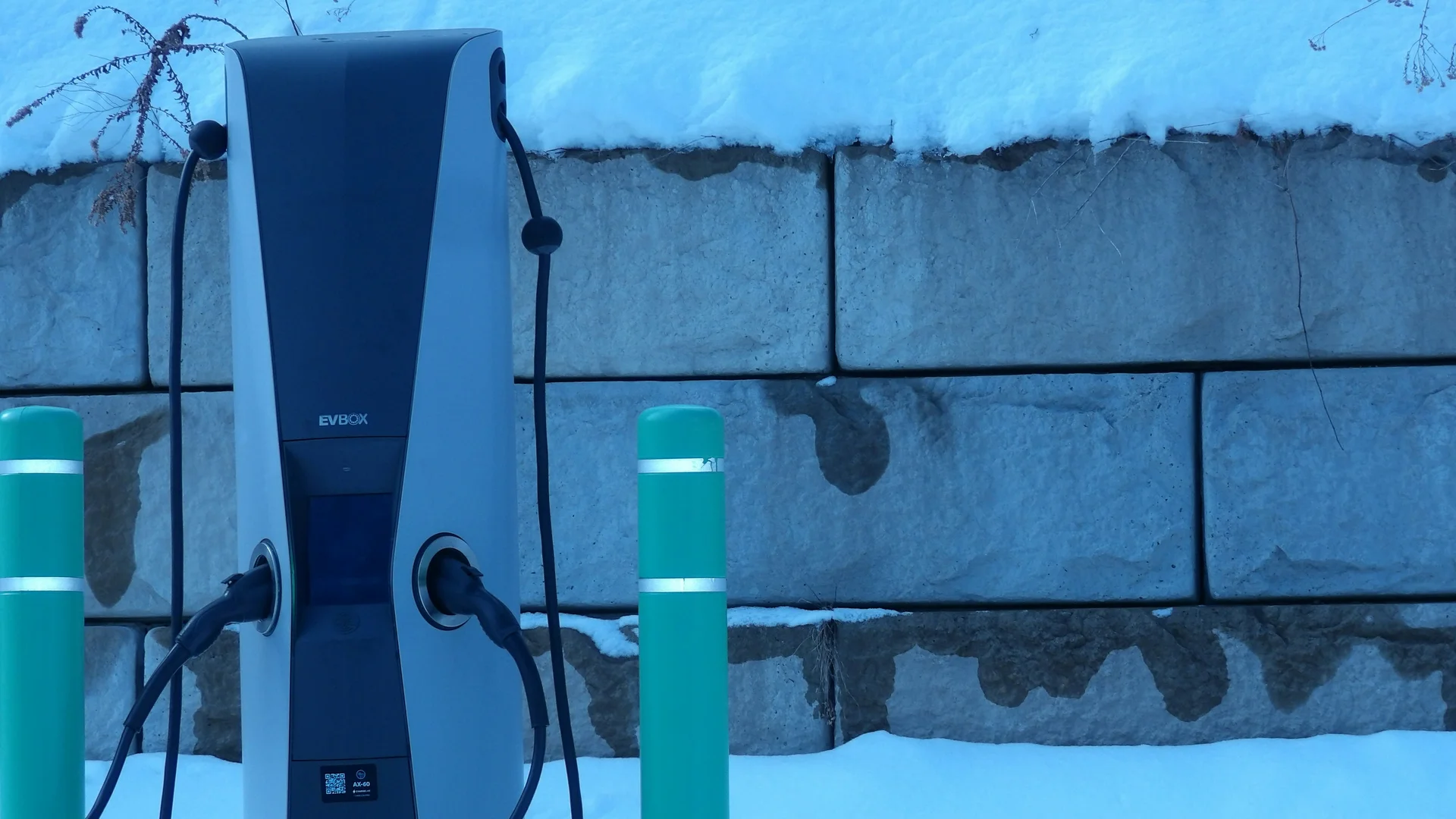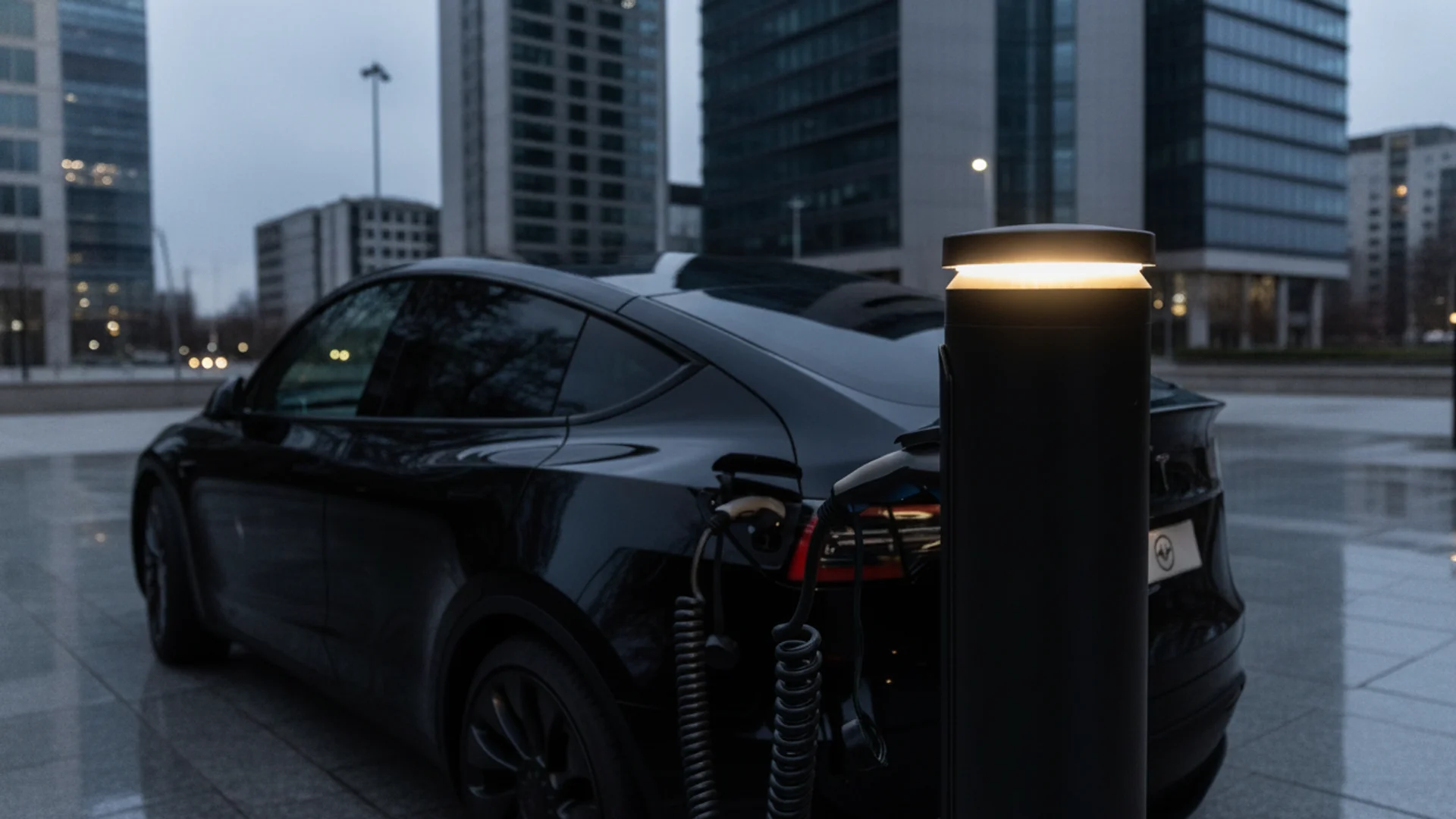
The charger that came in the box with your EV will technically work. Whether it will keep up with your life is a different question.
Level 1 charging, the portable EVSE most automakers include with a new vehicle, pulls from a standard 120V household outlet and adds roughly 40 kilometres of range over an eight-hour overnight. Level 2 uses the same 240V circuit that runs your clothes dryer and adds 40 to 60 kilometres per hour. The gap between "works" and "keeps up" is the gap between those two numbers, and the decision hinges on one input: how far you actually drive in a day.
Key takeaways
- Level 1 adds ~64 km overnight from a standard outlet; Level 2 adds 40–60 km per hour on a 240V circuit.
- Canadians driving under 40 km daily in a PHEV or small BEV can skip the $700–$1,700 Level 2 install entirely.
- One missed Level 1 plug-in creates a deficit the outlet can't recover before your next morning departure.
- A 100-amp service panel, standard in older Canadian homes, may need a $2,500–$4,500 upgrade before Level 2 is viable.
- Load management hardware ($200–$400) can throttle the charger dynamically, avoiding a full panel upgrade for homes near their service ceiling.
Quick Answer: Which Level Do You Actually Need?
If you drive under 40 kilometres a day, park at home overnight, and own a plug-in hybrid or a small-battery BEV, Level 1 is defensible. Skip the installation and pocket the money.
If you drive more than 60 kilometres a day, own a full BEV with a 60-kWh-plus pack, or share the car with a second driver, Level 2 is not optional. It is the arithmetic.
The middle band, 40 to 60 kilometres of daily driving, is where most Canadian households land, and where the answer depends on how often you can afford to lose a night. A single missed charge on Level 1 creates a deficit that a Level 1 outlet cannot dig you out of before the next morning. Level 2 absorbs the miss without noticing. At home, only the first two tiers matter, Level 3 is a road-trip decision, not a driveway decision.
Gear worth having
As an Amazon Associate, ThinkEV earns a small commission from qualifying purchases — at no extra cost to you.

Portable Level 2 EV Charger (40A, NEMA 14-50)
Throw it in the trunk and charge anywhere with a 240V outlet. 40A portable with NEMA 14-50 plug. Your road-trip insurance policy.
As an Amazon Associate, ThinkEV earns from qualifying purchases — at no extra cost to you.
Level 1: What a Standard Outlet Actually Delivers
Level 1 charging plugs into a standard 120V NEMA 5-15 outlet, the same outlet powering your toaster. The portable EVSE draws about 12 amps continuous, which works out to roughly 1.4 to 1.9 kilowatts of delivered power. The U.S. Department of Energy's public benchmark is concrete: eight hours of Level 1 charging replenishes about 40 miles, call it 64 kilometres, of range on a mid-size EV.
That number is not a speed. It is a philosophy.
The philosophy works if your driving pattern respects it. A commute under 30 kilometres each way, a car that sleeps in a garage or driveway every night, and a battery small enough that a full recovery over a weekend is realistic, Level 1 handles this without complaint. Plug-in hybrids, whose battery packs are typically 10 to 18 kilowatt-hours, are Level 1's natural constituency. So are second vehicles: the car that runs the school pickup and the grocery loop while the primary vehicle handles the highway miles.
The cost story is the argument's strongest leg. Level 1 charging costs nothing to install because the outlet already exists. The EVSE ships in the trunk. There is no electrician, no permit, no panel inspection. For a household whose daily distance sits comfortably under 40 kilometres, spending $1,200 to $2,000 on a Level 2 install is money that solves a problem the household does not have.
The skeptic's version: Level 1 is a false economy, any BEV owner keeping the car five years will eventually need Level 2, and paying for the install upfront avoids a second round of electrician trips and permit fees. That objection assumes the driving pattern that justifies Level 2 is inevitable. It is not. A retiree who bought a Chevy Bolt EUV for grocery runs and grandchildren pickups is not going to grow into a 100-kilometre commute. Buying capacity you will never use is not thrift; it is a subscription to a problem you do not have.
The constraint is the ceiling. Forty kilometres of overnight recovery leaves no margin. Miss a plug-in, one dinner out, one late arrival, one forgotten cable, and the deficit carries into the next day. Two nights of misses and you are booking a public Level 3 session you did not plan for. Level 1 works when it works, and it stops working the moment the routine breaks.
Level 2: The 240V Upgrade Most Owners Eventually Make
Level 2 charging runs on a dedicated 240V circuit, the same voltage your dryer uses, the same voltage your oven uses. Power delivery ranges from 7.2 kilowatts on the low end to 19.2 kilowatts on the high end, depending on the hardware and the size of the breaker feeding it. The SAE J1772 conductive coupler is the standard that governs almost every Level 2 unit sold in North America, which means the plug on the wall in your neighbour's garage is the same plug on the wall in yours, regardless of brand.
The two circuit sizes that matter for most homes are 40 amp and 48 amp:
- 40-amp circuit: approximately 9.6 kilowatts of continuous power, 40 to 50 kilometres of range recovery per hour, 40-amp breaker.
- 48-amp circuit: approximately 11.5 kilowatts, 50 to 60 kilometres per hour, 60-amp breaker (the National Electrical Code derating for continuous loads takes the nameplate down from breaker to delivered current).
Level 2 AC charging is not lossless. The onboard vehicle charger and the EVSE cable together run at roughly 94 percent efficiency; the remaining six percent converts to heat. For further reading on the efficiency comparison against emerging alternatives, see the wireless-charging efficiency breakdown for driveway installations.
Hardware pricing in Canada has stabilized. A quality Level 2 unit, Grizzl-E, Wallbox, ChargePoint, EVIQO, FLO, runs $400 to $900 CAD. Installation adds another $300 to $800 depending on how far the unit sits from the panel, whether trenching is involved, and whether the panel itself has capacity headroom. Call the total install-ready cost $700 to $1,700 for a straightforward job in a home with a modern panel. The ranked comparison of Canadian Level 2 chargers walks through the trade-offs at each price point.
The question is never whether Level 2 is faster. It obviously is. The question is whether the speed is worth the install cost, and the answer depends entirely on the driving math from the previous section. One thing makes this decision feel harder than it should. BYD's Super e-Platform, enabling a peak charging power of 1,000 kW (1 MW), first appeared in production on the Han L EV and Tang L EV, which can add hundreds of kilometres in five minutes at a public pillar. That headline number bleeds into home-charging expectations even though the two contexts share almost nothing. A megawatt-class DC pillar is grid infrastructure. A home charger is a wire from your panel to your parking spot. Comparing them is a category error, but it is the comparison many first-time buyers arrive at the dealership already making.
Gear worth having
As an Amazon Associate, ThinkEV earns a small commission from qualifying purchases — at no extra cost to you.

TP-Link Kasa Smart Plug with Energy Monitoring
Track exactly how much electricity your Level 1 charger uses and schedule it for off-peak hours. Know your real cost per kWh.
As an Amazon Associate, ThinkEV earns from qualifying purchases — at no extra cost to you.
Installation, Panels, and the Canadian Winter Variable
A 40-amp breaker requires panel capacity that older Canadian homes may not have. A 100-amp service was standard for decades; a house heated by natural gas with an electric range, dryer, and hot water tank is already running close to that ceiling before an EV charger asks for another 40 to 60 amps continuous.
The panel upgrade, going from 100-amp to 200-amp service, runs $2,500 to $4,500 CAD in most Canadian markets, depending on the utility's connection fees and whether the mast and meter base need replacing. That number turns the Level 2 decision from a $1,500 conversation into a $6,000 conversation, and it is worth pricing before committing to an EV that assumes home charging.
Gear worth having
As an Amazon Associate, ThinkEV earns a small commission from qualifying purchases — at no extra cost to you.

Grizzl-E Classic Level 2 EV Charger (40A)
Canadian-made and rated for minus 40C winters. 40A / 9.6 kW, NEMA 14-50, indoor/outdoor, 24-ft cable. The charger built for Canadian weather.
As an Amazon Associate, ThinkEV earns from qualifying purchases — at no extra cost to you.
Load management hardware, devices that dynamically throttle the EV charger based on total household demand, is the workaround. A load-shedding unit typically adds $200 to $400 to the install but avoids the panel upgrade entirely. For a house near its service ceiling, load management is often the difference between a viable Level 2 install and a stalled one.
Winter is the variable that separates Canadian specifications from American ones. Cold degrades charging acceptance at the battery level, and it degrades EVSE performance at the hardware level. A Level 1 outlet in an unheated garage in Manitoba in February is not delivering 1.4 kilowatts consistently, thermal management on the vehicle side eats into the trickle. Level 2's higher wattage buffers this; there is enough headroom in a 9.6-kilowatt feed to lose 15 percent to cold and still recover a full day's driving overnight. Level 1 has no such headroom.
Canadian-built hardware matters here. The Grizzl-E Classic is rated to operate from minus 40 Celsius upward, a specification American-market units rarely publish because they do not need to. If the charger lives in an unheated garage or on an exterior wall, the cold rating on the hardware is a real number, not a marketing flourish. A compact Wallbox unit that thrives in a San Diego garage will spend three months a year running out of spec in Winnipeg, and no rebate program will refund a cracked enclosure.
The federal EVAP rebate replaced iZEV in February 2026 and applies to the vehicle purchase, not the EVSE. Provincial programmes are where the charger money lives: British Columbia's Go Electric EV Charger Rebate, Quebec's Roulez vert home-charging rebate, and Ontario's utility-specific programmes may offset $250 to $600 of hardware cost. Installation labour is almost always excluded, the rebate covers the box on the wall, not the electrician who mounted it.
One connector-standard point to settle before you order hardware. The industry-wide transition to the North American Charging Standard, cited as a major factor by charging network operators and equipment manufacturers announcing plans, is happening at the DC-fast-charging end of the market, not at the home Level 2 end. Your driveway charger will keep the J1772 connector for years, and Tesla-owner households already use a J1772-to-NACS adapter without incident. If a salesperson tells you your Level 2 unit will be obsolete when NACS rolls out, ask them to name the model year that will not include a J1772 inlet or adapter. There will not be one this decade.
Gear worth having
As an Amazon Associate, ThinkEV earns a small commission from qualifying purchases — at no extra cost to you.

Lectron Level 2 J1772 Charger (40A, WiFi)
Smart WiFi charger with real-time energy monitoring. 40A / 9.6 kW, J1772 with a NEMA 14-50 plug, schedule charging right from your phone.
As an Amazon Associate, ThinkEV earns from qualifying purchases — at no extra cost to you.
How to Choose: A Decision Framework by Driving Pattern
Start with the daily kilometres, not the charger.
Under 40 km/day, PHEV or small-battery BEV, home parking every night. Level 1 is the correct answer. The install cost solves a problem you do not have, and the eight-hour overnight recovery matches your consumption. Bank the money against a future battery replacement or a Level 2 upgrade if your driving pattern changes.
40 to 60 km/day, full BEV, single-driver household. Level 2 if you value the margin, Level 1 if you value the money. This band is where the decision is genuinely a preference, not a calculation. A driver who is disciplined about plugging in every night can run Level 1 indefinitely. A driver whose schedule is unpredictable will regret the choice within a month.
Over 60 km/day, or two drivers sharing a BEV, or a battery over 60 kWh. Level 2 is not a preference. It is the arithmetic. Recovering 60-plus kilometres of daily use on a 40-kilometre overnight ceiling means running down the battery week over week, then covering the deficit with public DC fast charging at three to four times the residential kilowatt-hour rate. The install cost pays itself back in a year on the fast-charge fees alone.
Renters and condo owners. Check the strata rules and the building's electrical capacity before signing any purchase agreement. Some Canadian condo boards have blanket prohibitions on EV chargers in common-property garages; others have approved installations with dedicated sub-metering. The building's main service panel is the ceiling nobody talks about, a 30-unit building with three existing Level 2 installs may not have headroom for a fourth without a service upgrade the whole building splits. This constraint is not a reason to avoid EVs; it is a reason to price the charging solution before you price the car.
Vehicle onboard charger caps. The number on the wall is not the number your car accepts. A vehicle with a 7.2-kilowatt onboard AC charger will pull 7.2 kilowatts from a 48-amp EVSE, and the extra hardware capacity is wasted. Many mid-market EVs cap AC input at 7.2 or 11 kilowatts even when DC fast charging supports 150 kilowatts or more. The Equinox EV and ID.4 comparison for Canadian buyers documents where the AC ceilings land on two common picks, the Equinox lands at 11.5 kW AC and the ID.4 at 11 kW AC, close enough that neither one justifies the jump from a 40-amp to a 48-amp circuit. Check the spec sheet for your model before buying more EVSE than the car can use.
The limitation. I have not personally installed a Level 2 charger. The framework above draws on published DOE benchmarks, Canadian installer pricing collected across BC, Ontario, and Quebec markets, and the winter-derating data from Canadian utility EV charging studies. The math is defensible; the on-the-wall experience is not mine to narrate.
The checkpoint to watch through the rest of 2026 is provincial rebate coverage. British Columbia's Go Electric EV Charger Rebate is scheduled for a mid-year budget review, and if the per-household cap holds at the current $350 while installer labour costs continue climbing, the effective subsidy shrinks even without a formal cut. Watch the BC Hydro announcement page in September; a quiet cap freeze during an installer-wage inflation year is a de facto reduction, and it will change the payback math for the 40-to-60-kilometre middle band by a measurable margin.
The number to check before ordering hardware is the daily-driving one. Everything else, the panel size, the breaker rating, the winter derate, the rebate math, is downstream of it. Get that number right and the charger choice makes itself.
Gear worth having
As an Amazon Associate, ThinkEV earns a small commission from qualifying purchases — at no extra cost to you.

ChargePoint Home Flex Level 2 Charger (50A)
Premium 50A / 12 kW charger with the best app ecosystem. Hardwired or NEMA 14-50, with real-time energy tracking and smart scheduling.
As an Amazon Associate, ThinkEV earns from qualifying purchases — at no extra cost to you.

Founder & Chief Editor
Vlad Pereira is the founder and chief editor of ThinkEV.ca, the Canadian electric-vehicle publication he writes and edits from Courtenay, British Columbia. He covers EV pricing, federal and provincial rebates, charging costs, and the Chinese manufacturers now entering Canada, from the buyer's side rather than the press-fleet side. ThinkEV is a venture of Vlad Pereira Online; his writing on health, income and the long game lives at vladpereira.com.
Frequently asked questions
Can a Level 1 outlet handle a full BEV long-term?
What does a Level 2 install actually cost in Canada?
Does cold weather change which charging level makes sense?
What is load management hardware and do I need it?
Should I install Level 2 even if Level 1 works today?
More EV & road-trip finds
Affordable upgrades worth a look — tap any to check the price on Amazon.
 ★ 61
★ 61Toddler Car Seat Snack and Cup Tray
View on Amazon ★ 17,839
Qifutan Vent Phone Mount (Military-Grade Clip)
View on Amazon ★ 12,051
Windex Electronics Screen Wipes
View on Amazon ★ 537
★ 537USB Star Projector Roof Light
View on Amazon ★ 401
★ 401Crochet Daisy Rear-View Mirror Charm
View on Amazon ★ 979
★ 979Leather Headrest Purse Hook
View on Amazon ★ 17,242
LISEN Mini USB-C Car Charger (54W)
View on Amazon ★ 87
★ 87Car Window Sun Shades for Kids (4-Pack)
View on AmazonRead, Plan, Then Stay Current
Explore our expert articles to understand incentives and ownership costs, use the map to pressure-test charging reality, then subscribe so new EV coverage comes straight to you.
Continue Reading
Level 2 Plug-and-Charge: J1772 vs CCS Data Explained

EV Battery Replacement: What a Failed Pack Actually Costs

EREVs Explained: The Backup Engine Comeback for 2026

What Driver-Assist Features Actually Do, and What They Don't
How Long to Charge an EV: The Three Numbers That Matter