Key takeaways
- Canada's federal EVAP rebate gives you $5,000 off a new battery-electric vehicle with a final price at or below $50,000, one dollar over and it drops to zero.
- The 2026 VW ID.4 Pro S starts at $52,495, exceeding the EVAP cap by $2,495 and qualifying for zero federal rebate.
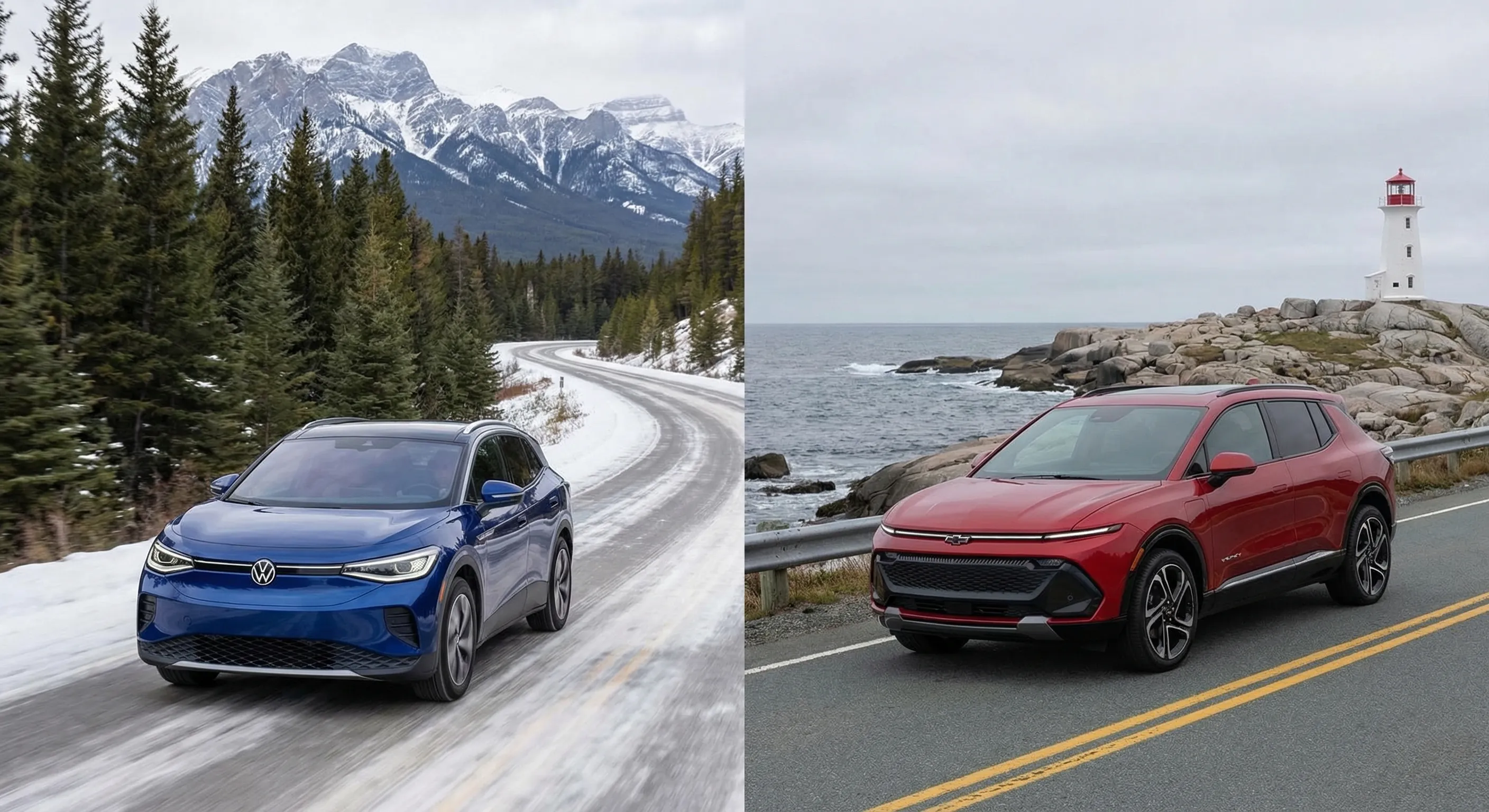
- The 2026 Chevrolet Equinox EV 2LT starts at $49,995, qualifies for the full $5,000 EVAP rebate, and lands at an effective $44,995.
- After federal rebates the Equinox EV 2LT costs $7,500 less than the ID.4 Pro S, while also beating it by 70 km of range and 205 litres of cargo space.
- The VW ID.4 Pro base trim starts at $47,495 and does qualify for the EVAP rebate, it's the popular Pro S trim that crosses the cap.
The Verdict Before We Begin
The Equinox EV is the right choice for the vast majority of Canadians considering these two vehicles in 2026.
The Chevrolet Equinox EV beats the VW ID.4 on range by 70 km, on price by up to $12,500 after federal rebates, on cargo space by 205 litres, and on dealer proximity for anyone who doesn't live in a major city. The ID.4 wins on suspension tuning, interior feel, and bumper-to-bumper warranty length. Those are real wins. They're just not enough.
The ID.4 feels better to sit in and drive. The Equinox EV costs less, carries more, goes farther, and is easier to get serviced when something needs attention. For a primary family vehicle in Canada, the second set of wins matters more.
I'll lay out exactly why below, and I'll tell you the one specific scenario where the ID.4 is the right call.
The Federal Rebate Trap VW Built For Itself
Start here, because this is the single most important number in this entire comparison.
Canada's federal EVAP rebate gives you $5,000 off a new battery-electric vehicle with a final price at or below $50,000. That cap is not a suggestion, it's a hard cutoff. Not one dollar over $50,000 and you get the full amount. One dollar over and you get nothing.
The 2026 VW ID.4 Pro starts at $47,495. That qualifies. The problem is that the Pro is not the car most people want when they test-drive an ID.4. The trim that showrooms stock, the trim that sales staff gravitate toward, the trim with the panoramic roof and the better seats and the matrix headlights, that's the Pro S, and it starts at $52,495. It misses the federal rebate cap by $2,495. You are paying $52,495 and receiving zero federal support.
The 2026 Chevrolet Equinox EV 1LT starts at $44,995 and qualifies for the full $5,000 federal rebate, bringing your out-of-pocket to $39,995. The 2LT, which adds the power liftgate, 22-inch wheels, upgraded interior trim, and Sport mode, starts at $49,995 and still qualifies. Effective price with federal rebate: $44,995. That's the number I want you to hold in your head.
Now compare: Equinox EV 2LT after federal rebate at $44,995 versus ID.4 Pro S without federal rebate at $52,495. That's a $7,500 gap in the Equinox's favour. And the Equinox goes 70 km farther on a charge. We haven't even started the comparison yet and the ID.4 is already in a hole.
The only configuration where the price comparison tightens is ID.4 Pro at $47,495 (rebate-eligible, effective $42,495) versus Equinox EV 1LT at $44,995 (effective $39,995). There the gap narrows to $2,500. At that spread, with two vehicles in the same segment, the ID.4's ride quality and interior feel can make a reasonable argument. But you have to specifically buy the base Pro, which means negotiating against dealership stock incentives and accepting 10-inch infotainment instead of the 12.9-inch screen. Most buyers don't do that in practice.
The ID.4 Pro S AWD, which is what performance-conscious Canadian buyers gravitate toward, sits at $57,495, no federal rebate eligible. At that price you're looking directly at a Tesla Model Y Long Range AWD at around $57,990. The Model Y has a vastly superior charging network, stronger resale value, and a more mature software ecosystem. VW doesn't have a good answer to that cross-shop, which means the ID.4 loses from below (Equinox) and from above (Model Y) simultaneously.
Range: 70 Kilometres You Will Feel Every Canadian Winter
The 2026 Chevrolet Equinox EV is NRCan-rated at 513 km in rear-wheel-drive 1LT configuration. The 2026 VW ID.4 Pro RWD is NRCan-rated at 443 km. That 70 km difference is not a rounding error and it's not a test-cycle artefact, it's structural, rooted in a combination of battery size and powertrain efficiency.
The Equinox EV uses an 85 kWh usable pack. The ID.4 Pro uses a 77 kWh usable pack. But the Equinox also extracts more range per kilowatt-hour, its rated efficiency of approximately 16.5 kWh/100 km versus the ID.4's 17.4 kWh/100 km means GM's Ultium platform is doing real engineering work, not just padding numbers with a bigger battery.
Here's why 70 km matters specifically in Canada.
Toronto to Ottawa is approximately 450 km. At consistent highway speeds, real-world range typically runs 85-90% of the NRCan rating. That puts the Equinox EV at roughly 435-461 km of actual highway range, enough to complete the trip with a buffer. The ID.4 lands at 376-399 km. It needs a stop. Not a long one, 15-20 minutes at a 150 kW DC fast charger, but a stop you're planning around, a stop that means pulling off the 401 in Belleville or Kingston and hunting for a working charger.
In winter, both vehicles lose range, all EVs do. Sustained cold (below -15°C) combined with cabin heating typically cuts real-world range to 60-70% of the rated figure. At 65% of rated range, the Equinox EV delivers approximately 333 km. The ID.4 delivers approximately 288 km. That 45 km gap in a January cold snap is the difference between comfortably reaching your destination and white-knuckling it watching the battery percentage tick down.
The Equinox EV's 85 kWh pack also means a larger absolute reserve to work with when the car degrades over time. Battery packs in well-managed lithium vehicles typically lose 15-20% of capacity over 10 years of ownership. A decade-old Equinox EV with 20% degradation retains approximately 410 km of rated range. A decade-old ID.4 retains approximately 354 km. If you plan to own this car for 8-10 years, which is the economically smart approach to a major EV purchase, the Equinox's range advantage compounds rather than closes.
On DC fast charging, the Equinox EV accepts up to 150 kW and the ID.4 Pro accepts up to 135 kW. The practical difference at current public charger output levels is minimal, most Canadian DC fast chargers on public corridors peak at 100-150 kW regardless. Level 2 AC charging is nearly identical: the Equinox does 11.5 kW and the ID.4 does 11 kW. Both fill overnight from a typical daily depletion without issue. The charging speeds are essentially a draw.
Interior and Technology: Where VW Earns Its Reputation
The ID.4 is a better car to sit in. I'm going to say that plainly because it's true and because pretending otherwise would waste your time.
The materials throughout the ID.4 cabin are a step above the Equinox EV. The seats, particularly in Pro S trim, have better bolstering and more support across the seat back for longer drives. The panoramic fixed-glass roof in the Pro (sliding in the Pro S) genuinely transforms the cabin: it's airy in a way that photographs don't capture and that you feel immediately when you climb in. VW also gets credit for the ID.4's suspension-interior combination: the way the car softens at speed, combined with the quietness of the electric drivetrain, produces a sense of composed, planted calm that the Equinox simply doesn't replicate.
The ID.4 Pro S runs a 12.9-inch infotainment display alongside a separate 5.3-inch driver information cluster. The base Pro uses a 10-inch unit. VW's software has improved substantially since the disastrous early ID.4 launches, 2021 and 2022 cars were genuinely troubled, with persistent glitches in the energy management system and connectivity stack. The 2026 ID.4 runs a stable, responsive system that no longer embarrasses itself in a showroom comparison. It's not Tesla-level integrated, but it's a functional, modern interface.
The Equinox EV runs a 17.7-inch diagonal infotainment display that every passenger immediately comments on. It's enormous. It runs Google built-in, native Google Maps with live traffic, native Google Assistant, native YouTube for rear-seat passengers. Wireless Apple CarPlay and Android Auto are both standard. The screen itself is bright, responsive, and intuitive. The Equinox's infotainment is unambiguously better than the ID.4's in terms of sheer functionality and the richness of the Google integration.
Where the Equinox falls short is atmosphere. The cabin is well-built and well-equipped, but it doesn't feel like an event. Compared to the ID.4's considered cabin, the Equinox feels like what it is: a practical American crossover that happens to be electric. That matters to buyers upgrading from a base trim vehicle who want the car to announce that it's a different category of thing. The ID.4 delivers that feeling. The Equinox delivers utility.
Cargo space is not close. The Equinox EV offers 748 litres behind the rear seats. The ID.4 offers 543 litres. That 205-litre gap is the difference between fitting two large hockey bags and fitting one, between a family camping weekend with all the gear and a camping weekend where you leave something behind, between a Costco run where everything fits and one where you strap water boxes to the roof. For families, that gap is felt weekly.
Neither vehicle offers a frunk, disappointing at this segment and price point for both of them. Charge cables live under the rear cargo floor in both cases.
The 12-speaker Harman Kardon audio system in the ID.4 Pro is excellent, noticeably better than the Equinox EV's Bose unit at similar trim levels. For buyers who care about cabin audio, this is a genuine ID.4 win. For buyers who stream podcasts and don't notice speaker brand distinctions, it means nothing.
Ride Quality and Driving Dynamics: VW's Clearest and Most Honest Win
The ID.4 rides better than the Equinox EV. This is not subjective. It is not "well, some people prefer the Equinox." The ID.4's suspension calibration is in a different class, and Canadian roads make this distinction matter every single day.
The ID.4 Pro uses a multi-link rear suspension developed with a German engineering philosophy that prioritises absorptive compliance at low speeds without sacrificing composure at highway speeds. When you drive over Montreal's spring potholes, which are, as any Montrealer will confirm, essentially geological features at this point, the ID.4 handles them with a low-frequency float. The impact arrives in the cabin as a distant thud. In the Equinox, the same pothole produces a distinct knock that you feel through the seat. Highway 17 north of Sudbury is relentless rough pavement. Toronto's downtown grid hasn't been resurfaced consistently in years. Regina's streets cycle through freeze-thaw damage every spring. In all of these conditions, the ID.4 is simply more pleasant to be inside.
Gear worth having
As an Amazon Associate, ThinkEV earns a small commission from qualifying purchases — at no extra cost to you.
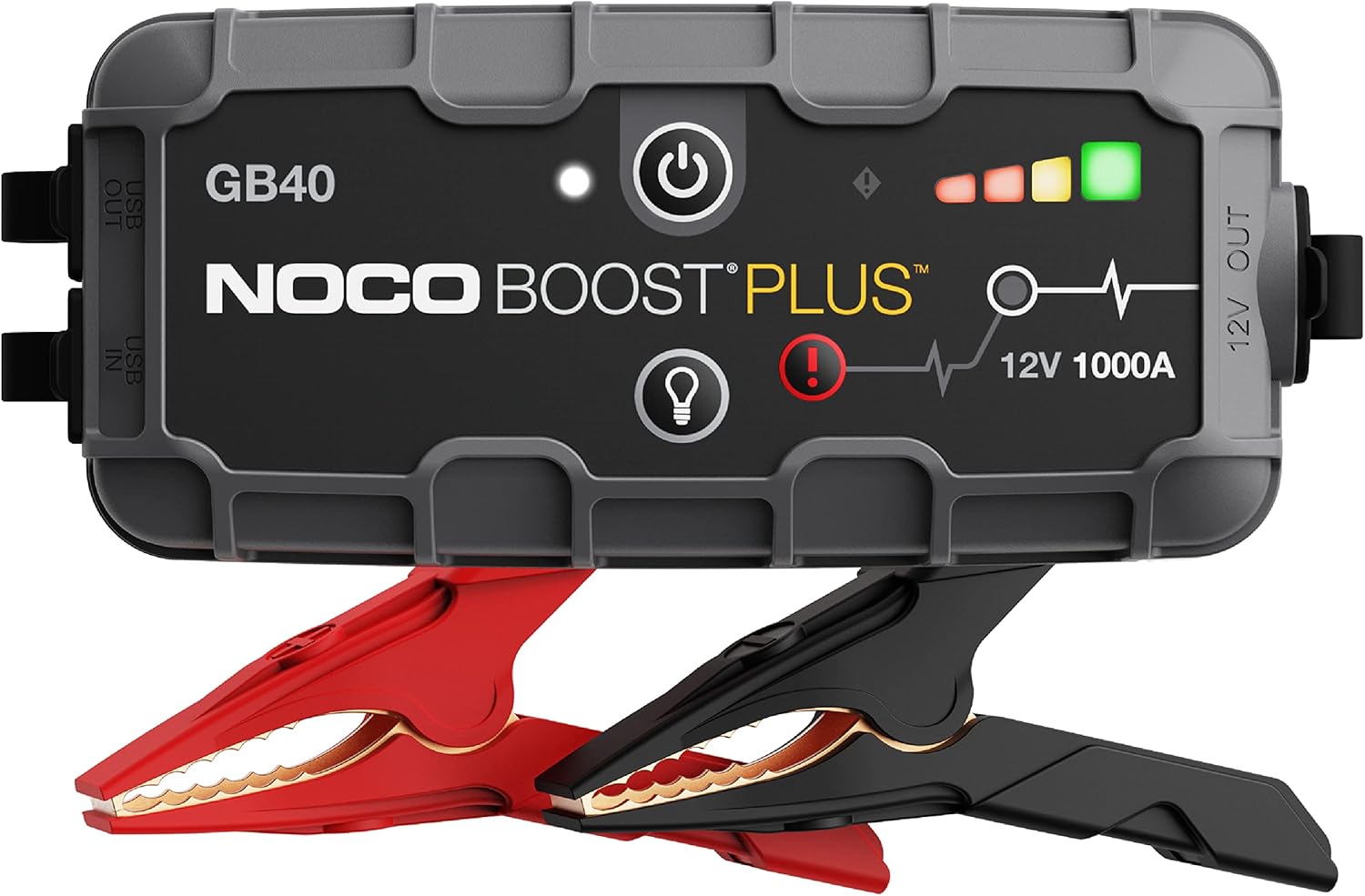
NOCO Boost Plus GB40 Jump Starter
A 1000A lithium jump starter that fits in your glovebox and works on any 12V battery. Your insurance against a dead 12V in a parking lot.
As an Amazon Associate, ThinkEV earns from qualifying purchases — at no extra cost to you.
Steering feedback is also better in the ID.4. The Equinox's steering is light and accurate, it turns where you point it, but it's artificially weighted and communicates nothing about what the front tyres are doing. The ID.4's variable-ratio steering builds in enough genuine feedback that you can actually feel the car's relationship with the road surface, which makes twisty routes genuinely enjoyable rather than merely navigable.
The ID.4 Pro AWD uses a more sophisticated four-corner suspension that improves this further. With motors on both axles, it also enables real torque vectoring, you feel the car actively managing traction through corners rather than passively correcting after the fact. In winter driving on ice or packed snow, that active composure in corners is not a performance feature. It's a safety feature.
The Equinox EV is not uncomfortable. It's a competent, well-tuned commuter crossover. Its suspension was calibrated for a cost target, and that shows, but the average 15,000 km-per-year urban driver who parks in a garage and drives primarily on paved city streets will not feel robbed. The gap narrows significantly on smooth pavement. What I'm describing is a difference that matters on bad roads, which in Canada is a meaningful portion of total road distance.
The 2LT Equinox EV adds a Sport mode that tightens throttle response and increases steering weight. It closes the feel gap somewhat. But suspension character, the fundamental absorbency of the spring-and-damper setup, doesn't change between drive modes. The Equinox's bones are what they are.
The real-world implication: if your driving is primarily urban neighbourhood routes, underground parking, and occasional highway segments, you may never notice the difference. If you commute on rough suburban arterials, take regional highway trips regularly, or live in any prairie city where frost heave has turned the road grid into a jigsaw puzzle, you'll notice the ID.4 advantage every day you're in the car.
AWD Configurations and What the Numbers Actually Show
Both vehicles offer dual-motor all-wheel-drive variants, and the AWD comparison is where the Equinox EV's efficiency advantage becomes structurally decisive.
The ID.4 Pro AWD produces 295 horsepower and 460 Nm of torque. It runs 0-100 km/h in approximately 5.4 seconds, genuinely quick for a family SUV. But the AWD penalty is severe: NRCan range drops from 443 km (RWD) to 395 km. That's a 48 km reduction for adding the second motor.
The Equinox EV 2RS AWD produces 290 horsepower in a similar dual-motor configuration. Its AWD range penalty is less punishing: it drops from 513 km (RWD) to 460 km. That's a 53 km reduction, slightly worse in absolute terms than the ID.4's drop, but the starting point is so much higher that the AWD Equinox still beats the AWD ID.4 by 65 km of rated range.
At identical pricing, both the Equinox EV 2RS and the ID.4 Pro AWD sit around $54,995, the AWD Equinox gives you 65 more kilometres of range. There is no argument for the ID.4 AWD at that price point on value terms. The only argument is driving feel, and the suspension gap between the RWD and AWD versions of each vehicle is more significant for the Equinox (AWD adds a rear axle that somewhat transforms the handling balance) than for the ID.4 (which was already well-tuned).
Both AWD variants include a heat pump standard across all 2026 trims, as do the RWD versions. The heat pump is not optional, not a trim-specific add-on, not something you have to research on spec sheets. Both vehicles include it. This is important for Canadian buyers in cold climates: a heat pump extracts heat from ambient outside air using refrigerant-cycle thermodynamics, which requires dramatically less battery energy than resistive electrical heating. In sustained -20°C temperatures, a heat-pump-equipped EV loses significantly less range to cabin heating than a resistive-heat-only EV. Both cars check this box completely.
Both vehicles use the CCS1 connector standard, which works at the majority of Canadian public DC fast chargers: Petro-Canada EV stations on highway corridors, ChargePoint at parking structures and retail destinations, and an increasing number of independent network operators. Neither vehicle natively accesses Tesla Superchargers without an adapter, and as of early 2026 the adapter compatibility story at some Tesla locations is still inconsistent. If your road trip planning depends heavily on Supercharger access, this is a meaningful limitation for both vehicles equally.

Safety, Reliability, and Five Years of Real-World ID.4 Data
The ID.4 launched in Canada in 2021. That's five years of real-world ownership data, which is genuinely valuable, and the picture is mixed in instructive ways.
Early 2021 and 2022 ID.4 production had serious software reliability problems. The infotainment and energy management systems required multiple over-the-air updates, and some vehicles needed dealer intervention for persistent glitches that OTA patches couldn't resolve. VW acknowledged these issues publicly. By model year 2024, the software maturity had improved substantially. The 2026 ID.4 is a meaningfully more stable product than what first-generation buyers experienced. If you're buying new today, you are buying the post-debug version of the ID.4. That matters.
The Equinox EV is newer to market, with its first retail deliveries in 2023. GM's Ultium platform had some early production running on the GMC Hummer EV and Cadillac Lyriq before the Equinox arrived, so there's partial platform history, but the Equinox EV specifically is still accumulating its long-term reliability dataset. Early 2024 production required software updates in the first year of ownership. Nothing catastrophic, but buyers who want a fully de-risked product may prefer the ID.4's longer track record. That's a legitimate preference.
Structural safety is strong on both vehicles. The ID.4 is five-star NHTSA rated and has received IIHS Top Safety Pick recognition. The Equinox EV is also five-star NHTSA rated and carries IIHS recognition for its standard safety equipment suite. Neither vehicle has a meaningful safety disadvantage.
On warranty: VW offers 4 years/80,000 km bumper-to-bumper with 8 years/160,000 km battery coverage. Chevrolet offers 3 years/60,000 km bumper-to-bumper with 8 years/160,000 km battery coverage. The extra year of bumper-to-bumper warranty on the VW is a real advantage, covered repairs in year four matter, particularly for vehicles that are still maturing their electronics stack. Battery coverage is identical and reassuring: both manufacturers are confident enough in their chemistry to offer the same long-term protection.
The dealer network gap is significant and underappreciated. VW has 69 Canadian dealers with EV-certified service technicians. Chevrolet has approximately 450 Canadian dealerships, the vast majority of which are EV-capable. This asymmetry matters enormously outside of major metropolitan areas. If you're in Kelowna, the nearest VW-certified EV technician may be 30-45 minutes away on a good day. If you're in Lethbridge, Sault Ste. Marie, or Prince George, the picture is worse. Chevrolet is in those communities. VW often isn't. When your car needs a firmware update or a warranty claim requires a physical inspection, proximity to a service centre isn't an abstract advantage, it's a practical factor in your weekly calendar.
How the Trim Ladders Work and Where the Value Lives
Walking each brand's trim structure reveals where the real purchase decisions happen.
The ID.4 Pro at $47,495 includes the 77 kWh battery, 201 hp single motor, a 12.9-inch infotainment display, three-zone climate control, heated front seats, wireless CarPlay and Android Auto, and a 12-speaker Harman Kardon audio system. It's a decently equipped vehicle. The catch is availability: dealers overwhelmingly stock the Pro S, and buying a specifically configured Pro may require a factory order with a wait. In a market where inventory has normalised, that's less of a problem than it was in 2022-2023, but it's still a real-world friction point.
The ID.4 Pro S at $52,495 adds the panoramic fixed-glass roof, premium Nappa leather seating, matrix LED headlights with dynamic sequential turn indicators, an upgraded 15-speaker audio system, and park assist with surround-view cameras. This is the trim most buyers fall in love with during a test drive. And it's the trim that puts you $2,495 over the federal rebate cap, costing you the full $5,000. The people who buy the Pro S and later learn they missed the rebate threshold by under 5% of the car's price feel that acutely.
The Equinox EV 1LT at $44,995 includes the 85 kWh battery, 210 hp rear motor, the 17.7-inch infotainment with Google built-in, heated front seats, remote start, and a solid set of driver assistance tech. Federal rebate eligible. Effective price in most provinces: $39,995.
The 2LT at $49,995 adds a power liftgate, 22-inch wheels, upgraded interior trim, and the Sport mode option. Still under the federal cap. Effective price with rebate: $44,995. This is the sweet spot of the Equinox lineup, it has nearly everything a buyer wants without requiring a trade-off on rebate eligibility.
The comparison that settles the debate: Equinox EV 2LT at effective $44,995 (after federal rebate) versus ID.4 Pro S at $52,495 (no rebate). $7,500 difference. Equinox goes 70 km farther on a charge. Equinox has 205 more litres of cargo space. ID.4 has a better ride and a nicer interior. At $7,500 and 70 km, the ID.4's advantages are not worth the premium for most buyers. The math doesn't close.
Total Cost of Ownership Over Five and Ten Years
The sticker price and federal rebate are the most visible numbers, but the complete ownership cost picture across five or ten years changes the calculus further in the Equinox's favour.
Electricity costs compound over time. The Equinox EV's rated efficiency of 16.5 kWh/100 km versus the ID.4's 17.4 kWh/100 km represents a difference of approximately 0.9 kWh per 100 km. At a national average residential electricity rate of $0.14/kWh, that's roughly $1.26 saved per 100 km driven in the Equinox. Over 200,000 km of ownership, a reasonable target for a well-maintained EV, that's $2,520 in electricity savings. Not enormous on its own, but it stacks with the purchase price advantage.
Insurance costs track closely with MSRP and repair cost data. You should budget for modestly higher annual premiums on the ID.4 Pro S at $52,495 than the Equinox EV 2LT at $49,995, likely $300-500 annually depending on insurer and coverage level. Over five years, that's $1,500-2,500 in additional insurance cost for the ID.4.
EV maintenance costs are low for both vehicles relative to combustion counterparts. No oil changes, no exhaust system work, dramatically reduced brake wear due to regenerative braking. Primary maintenance items are cabin air filter replacement, annual tyre rotation, windshield wiper replacement, and periodic software updates. The VW warranty's extra year of bumper-to-bumper coverage means that any repairs in year four are covered at the dealer under warranty, a real financial cushion if an electronics issue emerges between 3 and 4 years of ownership.
Gear worth having
As an Amazon Associate, ThinkEV earns a small commission from qualifying purchases — at no extra cost to you.

Grizzl-E Classic Level 2 EV Charger (40A)
Canadian-made and rated for minus 40C winters. 40A / 9.6 kW, NEMA 14-50, indoor/outdoor, 24-ft cable. The charger built for Canadian weather.
As an Amazon Associate, ThinkEV earns from qualifying purchases — at no extra cost to you.
Resale value is the one dimension where the ID.4 has historically outperformed. VW products tend to depreciate less aggressively than equivalent GM products in the used market. Early resale projections on the Equinox EV are less favourable than the ID.4, which is consistent with historical brand depreciation patterns even when the underlying product is strong. If you're buying the Equinox EV with a three-year sell-and-replace plan, the resale gap may partially eat into the purchase advantage. If you're buying to own for eight years or more, resale projections matter far less than the ongoing cost of ownership, and the Equinox wins that calculation clearly.
The battery warranty parity, 8 years/160,000 km on both vehicles, is reassuring for long-term owners. Both manufacturers are backing their chemistry with identical long-term protection, which is the right signal for a buyer planning a decade of ownership.
How Provincial Incentives Stack, And Why Quebec Buyers Have the Clearest Decision
Canada's incentive structure varies significantly by province, and the interaction between federal and provincial programs is where the Equinox EV's price advantage can reach remarkable levels.
In Quebec, the provincial rebate for new EVs under $65,000 is $4,000. Stacked with the $5,000 federal iZEV rebate: an Equinox EV 1LT buyer in Quebec pays an effective $35,995. That is a 513 km range electric SUV, priced like a mid-tier compact crossover. The ID.4 Pro at $47,495 also qualifies for both rebates, $9,000 total, landing at $38,495 in Quebec. But the ID.4 Pro S at $52,495 gets only Quebec's $4,000 provincial rebate (no federal eligibility), landing at $48,495. The spread between an Equinox EV 1LT and an ID.4 Pro S in Quebec is $12,500. That's a first-year lease payment difference.
In British Columbia, the CleanBC Go Electric rebate offers up to $4,000 for EVs under $55,000. Both the Equinox EV 1LT and the ID.4 Pro qualify for $5,000 federal plus $4,000 provincial, $9,000 total. The ID.4 Pro S at $52,495 misses the federal rebate but qualifies for BC's $4,000 provincial support only. Effective prices in BC: Equinox EV 1LT at $35,995, ID.4 Pro at $38,495, ID.4 Pro S at $48,495.
Ontario has discontinued its provincial EV rebate, so Ontario buyers work with the federal $5,000 only. Equinox EV 1LT effective price in Ontario: $39,995. ID.4 Pro effective price in Ontario: $42,495. ID.4 Pro S effective price in Ontario: $52,495, no federal rebate, no provincial rebate.
Alberta has no provincial EV program. Both vehicles are full MSRP less federal iZEV for eligible trims. Equinox EV 1LT in Alberta: $39,995. ID.4 Pro in Alberta: $42,495. ID.4 Pro S in Alberta: $52,495.
The federal rebate eligibility is the single biggest variable in this comparison. The moment a buyer test-drives an ID.4, likes it, and gets steered toward the Pro S by a well-meaning salesperson, they forfeit $5,000. That $5,000 doesn't get mentioned in the excitement of signing. It gets noticed three weeks later when the refund doesn't arrive. Equinox EV buyers in the 1LT and 2LT trims don't have that problem.
Charging at Home and on the Road
Every Canadian EV owner should have a Level 2 home charger. The math is straightforward: Level 1 charging (standard 120V wall outlet) adds 6-8 km of range per hour. Filling a 85 kWh Equinox EV from near-empty on Level 1 takes approximately 55-60 hours. For daily top-up charging from a typical 60-80 km daily depletion, Level 1 technically restores range overnight, but you lose all flexibility for higher-use days, long weekend departures, and the occasional day when you forget to plug in.
Gear worth having
As an Amazon Associate, ThinkEV earns a small commission from qualifying purchases — at no extra cost to you.

TP-Link Kasa Smart Plug with Energy Monitoring
Track exactly how much electricity your Level 1 charger uses and schedule it for off-peak hours. Know your real cost per kWh.
As an Amazon Associate, ThinkEV earns from qualifying purchases — at no extra cost to you.
A Level 2 charger on a 240V circuit adds 30-50 km of range per hour depending on the charger's output rating. An 11 kW Level 2 unit fully charges either the Equinox EV or the ID.4 from near-empty in 7-8 hours, overnight, every night, with the car ready in the morning regardless of what the previous day's driving looked like. A 7.2 kW unit takes 10-12 hours, still comfortably overnight for most users.
Installation cost for a Level 2 home circuit in Canada runs approximately $800-1,500 depending on panel capacity, distance from panel to garage, and whether the panel requires upgrade. BC offers up to $350 in charger installation rebates. Hydro-Québec offers up to $600. Check Natural Resources Canada for current federal program availability, as these programs change annually.
On the road, both vehicles work through the same Canadian public DC fast charging network. Petro-Canada's EV network covers major Trans-Canada highway corridors and is the most consistently maintained network for road tripping. ChargePoint covers urban parking structures and retail destinations in most major cities. Coverage on less-travelled provincial routes, particularly in northern Ontario, rural Quebec, and the Maritime provinces, remains inconsistent. Both vehicles come with the same CCS1 plug, and the practical road trip experience is similar: use PlugShare to find the next working charger, plan your stops in advance on longer routes, and build more time buffer than you think you need in winter.
The VW ID.4 includes a two-year We Charge subscription for access to third-party charging networks at a flat monthly rate. Useful primarily for urban users who charge regularly at shopping destinations and workplaces. Not a significant advantage for road-tripping across Canada. The Equinox EV's charging offer, three complimentary EVgo sessions, is almost entirely meaningless given EVgo's minimal Canadian footprint.
The Environmental Picture Beyond Tailpipe Emissions
Both vehicles produce zero direct tailpipe emissions. Their well-to-wheel environmental impact depends entirely on the grid that charges them.
In Quebec, approximately 99% hydroelectric power, both vehicles are effectively zero-emission during their operational phase. The manufacturing footprint of the battery pack is the dominant environmental impact, and both vehicles use comparable lithium-ion chemistry manufactured at similar energy intensities. A Quebec-charged Equinox EV or ID.4 is about as clean as a passenger vehicle can currently be.
In Alberta, where natural gas generates a substantial portion of grid electricity, the picture is different. An Alberta-charged EV produces lower lifecycle emissions than a comparable combustion vehicle, typically 40-60% lower depending on the specific combustion vehicle being compared, but not negligibly low. The Equinox EV's greater efficiency means it produces slightly fewer indirect emissions per kilometre driven on an emissions-intensive grid. Over 200,000 km, that compounds.
Canada's national grid continues to decarbonise. An EV purchased in 2026 will produce progressively lower lifecycle emissions as its charging mix shifts toward renewables and nuclear over its operational lifetime. A combustion vehicle purchased in 2026 does not benefit from this trend, its emissions are fixed by its engineering at manufacture. The environmental investment in an EV appreciates over time in a way that a combustion vehicle purchase fundamentally cannot.
The Dealership Experience: What to Expect Before You Sign
The buying experience differs meaningfully between these two brands, and it's worth setting expectations before you walk into a showroom.
VW dealers in Canada have spent five years training staff on the ID.4. Most urban VW dealers now have salespeople who can speak fluently about rebate eligibility, charging infrastructure requirements, and the vehicle's software capabilities. Early adopters reported that early-2021 sales staff were sometimes less informed than the cars themselves, that era is largely over. A 2026 buyer at a major-city VW dealer should get a competent, informed buying experience.
Chevrolet dealerships vary more broadly, and the range is wider than VW's. A large urban Chevrolet dealer, say, a multi-brand group in the GTA, Metro Vancouver, or Montreal, will have dedicated EV specialists and an Equinox EV on the floor for extended test drives. A smaller rural Chevrolet dealer may have staff who are less fluent on the specifics of the iZEV rebate, the Ultium platform's behaviour in cold weather, and the correct way to set up scheduled charging for off-peak electricity rates. If you're buying from a smaller dealer, come prepared. Don't assume you'll be guided through the EV ownership fundamentals. Know them yourself.
The VW We Connect app and the myChevrolet app both handle remote vehicle monitoring, scheduled charging, and climate preconditioning. Both apps work reliably. Neither matches the polish of the Tesla app, which remains the industry reference for EV remote integration, but neither is a source of daily frustration. They're adequate.
Software update delivery is worth noting: the Equinox EV receives over-the-air updates for both infotainment and vehicle systems without requiring a dealer visit. The ID.4 also supports OTA updates, though some deeper firmware changes still require dealer involvement. In practice, both vehicles receive new features and refinements without significant owner action beyond accepting prompts.
Who Should Actually Buy the ID.4
The real buyer for the ID.4 is specific.
You should buy the ID.4 if: you have a legitimate preference for driving feel that goes beyond test-drive novelty, you drive a lot of imperfect pavement, you notice suspension quality in your daily driving, and you've thought about this enough to know it matters to you. You should also be specifically targeting the Pro trim at $47,495 to preserve rebate eligibility, and you should have a VW dealer with solid EV service within reasonable distance of your home. In that specific configuration, with that specific dealer situation, the ID.4 Pro represents a genuine choice at approximately $2,500 of real-money premium over the Equinox 1LT after both rebates are applied.
The ID.4 also makes stronger sense for lease buyers, particularly in Quebec. Residuals on VW products at lease termination tend to be more favourable than on GM products, and the monthly payment gap between an ID.4 Pro lease and an Equinox 1LT lease may be narrower than the purchase price gap suggests. If you're planning a 3-year lease with a return at the end, not a 10-year ownership scenario, the resale and depreciation picture changes the comparison somewhat.
Buy the ID.4 if the driving experience is genuinely your priority, if you're staying in the Pro trim, and if you've verified that your closest VW dealer has competent EV service. Those conditions together produce a buyer who will be happy with the ID.4 for the life of the vehicle.
Who Should Buy the Equinox EV
The Equinox EV is the right answer for most people reading this comparison. That's not a lazy conclusion, it follows from what most Canadian buyers actually need from their primary vehicle.
If you drive more than 300 km in any single stretch regularly, road trips, visiting family across provincial borders, ski season highway runs, the Equinox's range buffer is the asset that matters most. Its 513 km rated range gives you practical safety margin that the ID.4 can't match.
If you're in Quebec or BC and stacking provincial rebates, the effective price difference between the Equinox and the ID.4 Pro S reaches $12,500. That is not a rounding error. That's a year of lease payments on a second vehicle.
If you have a family and you regularly haul cargo, hockey bags, camping gear, dog crates, Costco quantities, the 205-litre cargo advantage is felt weekly. The ID.4 is fine for this. The Equinox is better.
If you're outside a major metropolitan centre, Chevrolet's service network density means that warranty claims, software updates, and routine service are accessible without major inconvenience. VW's 69 EV-certified Canadian dealers are concentrated in urban centres.
If you plan to own for eight or more years, the Equinox's larger battery pack means you'll have meaningfully more range left at the end of that ownership period as the pack ages. The starting advantage compounds rather than closing.
The Equinox EV pairs well with a home Level 2 charger, its 11.5 kW AC charging capability means that from a typical 60-80 km daily depletion, you're fully recharged in under three hours on a 240V outlet. Most owners won't notice the difference between the Equinox's 11.5 kW and the ID.4's 11 kW in practice, both fill overnight. But in edge cases (two EVs sharing one charger, limited charging window in a condo building), every tenth of a kW helps.
The AWD Decision Broken Down by Canadian City
This question is Canadian-specific enough to deserve its own clear framework.
In Vancouver, Victoria, and the Lower Mainland, where temperatures rarely sustain below -10°C and the city deploys snowplows within hours of accumulation, single-motor RWD on quality winter tyres is entirely adequate. The range penalty of AWD is genuinely not worth the cost for year-round mild-weather driving in the Lower Mainland. Buy the RWD Equinox EV 1LT or 2LT, equip it with proper winter tyres (Nokian Hakkapeliitta R5 SUV, Michelin X-Ice Snow SUV, both widely available in BC), and you have a complete winter solution.
In Calgary, Edmonton, Red Deer, Saskatoon, and Regina, where sustained cold from October through April is the norm, where black ice appears without warning on arterial roads, and where temperatures regularly reach -25°C or colder, AWD is a meaningful safety upgrade. At equal pricing around $54,995, the Equinox EV 2RS AWD at 460 km of range beats the ID.4 Pro AWD at 395 km by 65 km. There's no defensible argument for the ID.4 AWD at that price comparison.
In Toronto, Ottawa, London, and other Ontario cities, where plowing is inconsistent, where you park outdoors regularly, and where the worst 20-30 days of winter involve genuinely variable and sometimes treacherous conditions, AWD is a real quality-of-life upgrade. The Equinox 2RS versus the ID.4 Pro AWD at equivalent prices still favours the Equinox by 65 km of range. The driving dynamics difference between AWD versions of both vehicles is less pronounced than the RWD-versus-RWD comparison because the AWD Equinox handles its extra axle more confidently.
In Halifax, Saint John, Charlottetown, and St. John's, where snow is consistent but temperatures are milder and the Atlantic Maritime climate keeps sustained cold less frequent than the Prairies, the RWD Equinox EV with winter tyres is a perfectly functional solution. AWD is nice to have but not significant.
The Charging Network Reality for Road Trips
Planning a long-distance Canadian road trip in either of these vehicles requires understanding where the infrastructure is and where it isn't.
The Trans-Canada from Vancouver to Calgary is well-served by Petro-Canada EV stations, with gaps manageable for both vehicles. The Equinox's range advantage means fewer mandatory stops on high-elevation segments where cold weather and accessory load hit range hard. Calgary to Edmonton, approximately 300 km, is a single-charge route for both vehicles even in winter. Medicine Hat to Swift Current, roughly 285 km with limited charging options, is a moderate-anxiety run in the ID.4 in February and a comfortable run in the Equinox.
The Highway 17 North Bay to Sudbury corridor in Ontario is beautiful and has limited DCFC coverage. Both vehicles can handle the roughly 160 km segment, but the buffer matters when charger availability at the destination is uncertain.
Quebec's Route 132 coastal Gaspésie loop, popular for summer road-trippers, has improving but still sparse DCFC coverage. The Equinox EV's extra range provides genuine peace of mind on stretches where the next charger is 200+ km away.
The real practical tool for both vehicles is PlugShare. Download it before you need it. Use it to verify charger status before committing to a route. DCFC maintenance varies by network and by location; a reported charger on a map app is not the same as a confirmed working charger when you pull in at 10% battery in January.
Final Recommendation
The Equinox EV wins this comparison, and it wins it clearly enough that I'm comfortable saying it without qualifications for most buyers.
At $44,995 (1LT) or $49,995 (2LT), fully eligible for the $5,000 federal iZEV rebate, with 513 km of NRCan-rated range, 748 litres of cargo space, and access to 450 Chevrolet dealers across Canada, the Equinox EV delivers a package that the ID.4 cannot match at any equivalent price point. The Equinox is the answer for daily drivers, families hauling gear, road-trippers, buyers stacking provincial incentives, and anyone outside a major city who needs service access without a four-hour drive.
The ID.4's wins are genuine: better suspension, more premium interior feel, a longer bumper-to-bumper warranty, and stronger resale value projections. For the buyer who is buying the base Pro trim at $47,495 (preserving rebate eligibility), has a VW dealer nearby with competent EV service, and genuinely cares about driving feel on imperfect pavement, the ID.4 Pro is worth the $2,500 effective premium. That's a reasonable trade for noticeably better ride quality and a cabin that feels like it was designed with intention.
But that buyer needs discipline. The moment you walk into a VW dealership and agree to the Pro S because the seats are better and the roof is bigger, you've surrendered $5,000 in federal rebate and added $5,000 in MSRP. At that point you're paying $12,500 more than an Equinox EV 2LT after rebates, for 70 fewer kilometres of range. That comparison doesn't close.
Equinox EV 1LT or 2LT for the mainstream buyer.
ID.4 Pro RWD for the driver who values the feel of the road, stays in the base trim, and has verified good VW service coverage nearby.
Gear worth having
As an Amazon Associate, ThinkEV earns a small commission from qualifying purchases — at no extra cost to you.

P3 Kill A Watt Electricity Usage Monitor
Plug in your charger and see exactly what you spend in kWh, cost, and watts. Settle the is-my-EV-really-cheaper debate with data.
As an Amazon Associate, ThinkEV earns from qualifying purchases — at no extra cost to you.
Related Reading
- Best EVs Under $50,000 in Canada, Budget-friendly EVs compared head to head.
- EV vs Gas: Total Cost of Ownership in Canada, The numbers that settle the debate once and for all.
- Every New EV Coming to Canada in 2026, What is arriving on Canadian roads this year.
Gear worth having
As an Amazon Associate, ThinkEV earns a small commission from qualifying purchases — at no extra cost to you.

PULIDIKI Car Cleaning Gel (Detailing Putty)
Press it into vents, buttons, and seams and it lifts out dust you did not know was there. Weirdly satisfying, genuinely useful.
As an Amazon Associate, ThinkEV earns from qualifying purchases — at no extra cost to you.

Founder & Chief Editor
Vlad Pereira is the founder and chief editor of ThinkEV.ca, the Canadian electric-vehicle publication he writes and edits from Courtenay, British Columbia. He covers EV pricing, federal and provincial rebates, charging costs, and the Chinese manufacturers now entering Canada, from the buyer's side rather than the press-fleet side. ThinkEV is a venture of Vlad Pereira Online; his writing on health, income and the long game lives at vladpereira.com.
Frequently asked questions
Which car is better for long-distance travel in Canada?
Does the VW ID.4 qualify for Canada's federal iZEV rebate in 2026?
Which EV handles Canadian winter driving better?
Is the ID.4 more expensive to maintain than the Equinox EV?
Which car is better for daily commuting in Canadian cities?
What is the effective price difference between the ID.4 Pro S and Equinox EV 2LT in Quebec?
More EV & road-trip finds
Affordable upgrades worth a look — tap any to check the price on Amazon.
 ★ 392
★ 392Large Cup Holder Adapter (32-40oz)
View on Amazon ★ 4,050
Touchscreen Mist Screen Cleaner Kit
View on Amazon ★ 55
★ 55LED Car Door Logo Projector Light
View on Amazon ★ 1,083
Crystal Push-Start Button Ring (2-Pack)
View on Amazon ★ 865
★ 865Collapsible Trunk Organizer
View on Amazon ★ 297
★ 297360-Degree One-Hand Dashboard Phone Mount
View on Amazon ★ 119
★ 119Foldable Waterproof Trunk Organizer
View on Amazon ★ 17,839
Qifutan Vent Phone Mount (Military-Grade Clip)
View on AmazonRead, Plan, Then Stay Current
Explore our expert articles to understand incentives and ownership costs, use the map to pressure-test charging reality, then subscribe so new EV coverage comes straight to you.
Continue Reading
Chevy Equinox EV vs Tesla Model Y: $15K Cheaper
Rivian R1T vs F-150 Lightning: Canada 2026 Test
EV vs Gas: 5-Year Cost of Ownership in Canada
BMW i4 vs Tesla Model 3: Is the $11K Premium Worth It?
BYD Atto 3 vs Hyundai Kona EV: The $35K Comparison