Key takeaways
- With 581 km of range from a 77.4 kWh battery, it squeezes more kilometres per kilowatt-hour than anything else on the market.
- At $54,999 CAD for the Long Range RWD, the Ioniq 6 exceeds the EVAP program's $50,000 final transaction value cap, so it doesn't qualify for the $5,000 federal rebate.
- The AWD model at $58,999 is even further out.
- Provincial rebates like Quebec's Roulez vert ($2,000, $60,000 MSRP cap) still apply to the RWD model.
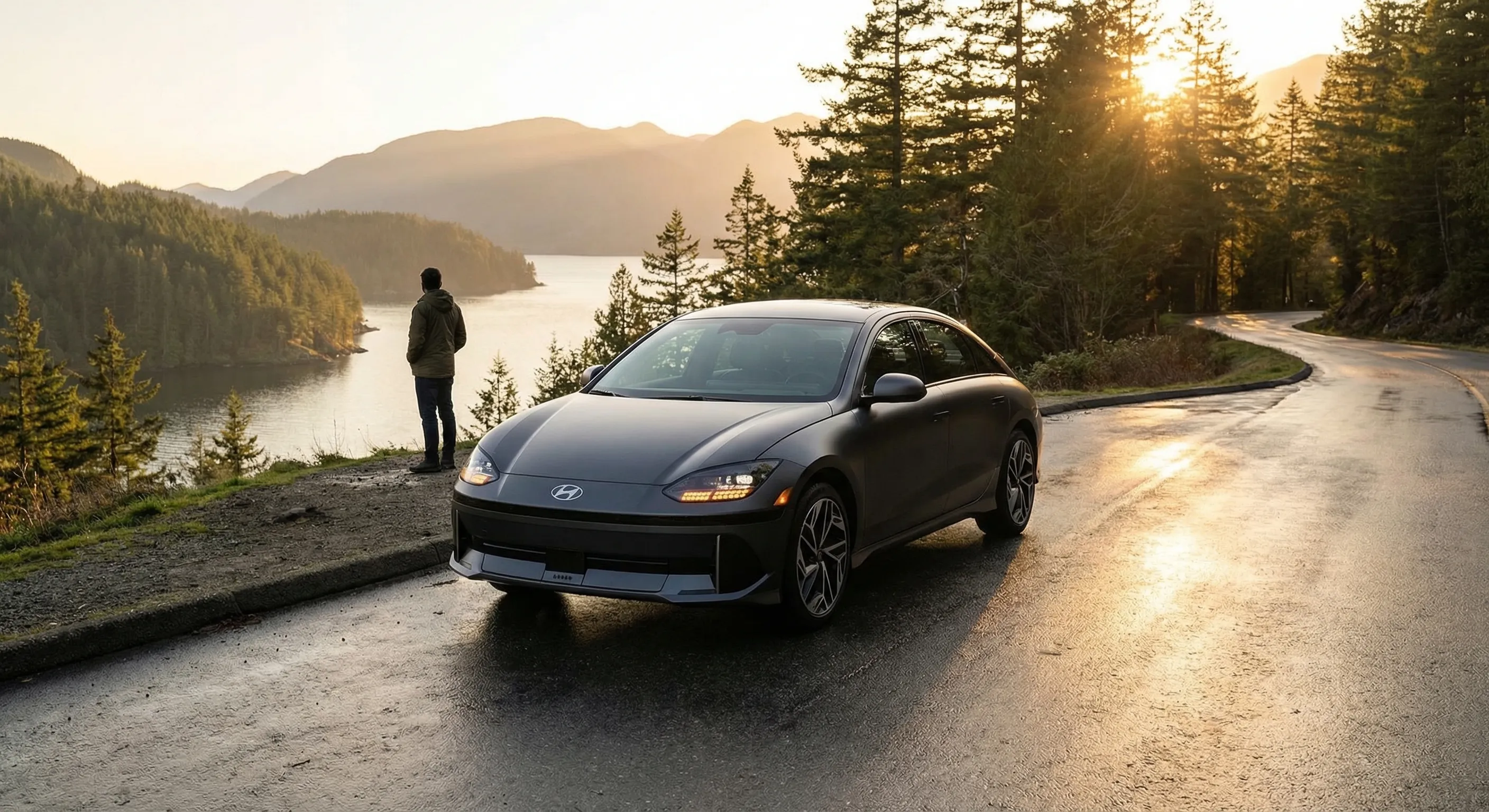
The Ioniq 6 is the most efficient electric car you can buy in Canada, and it's not particularly close. With 581 km of range from a 77.4 kWh battery, it squeezes more kilometres per kilowatt-hour than anything else on the market. The secret is a drag coefficient of 0.21, lower than a Tesla Model 3, lower than a Lucid Air, and low enough to make aerodynamics engineers weep with joy. The car slips through the air like it was designed in a wind tunnel. Which, of course, it was.
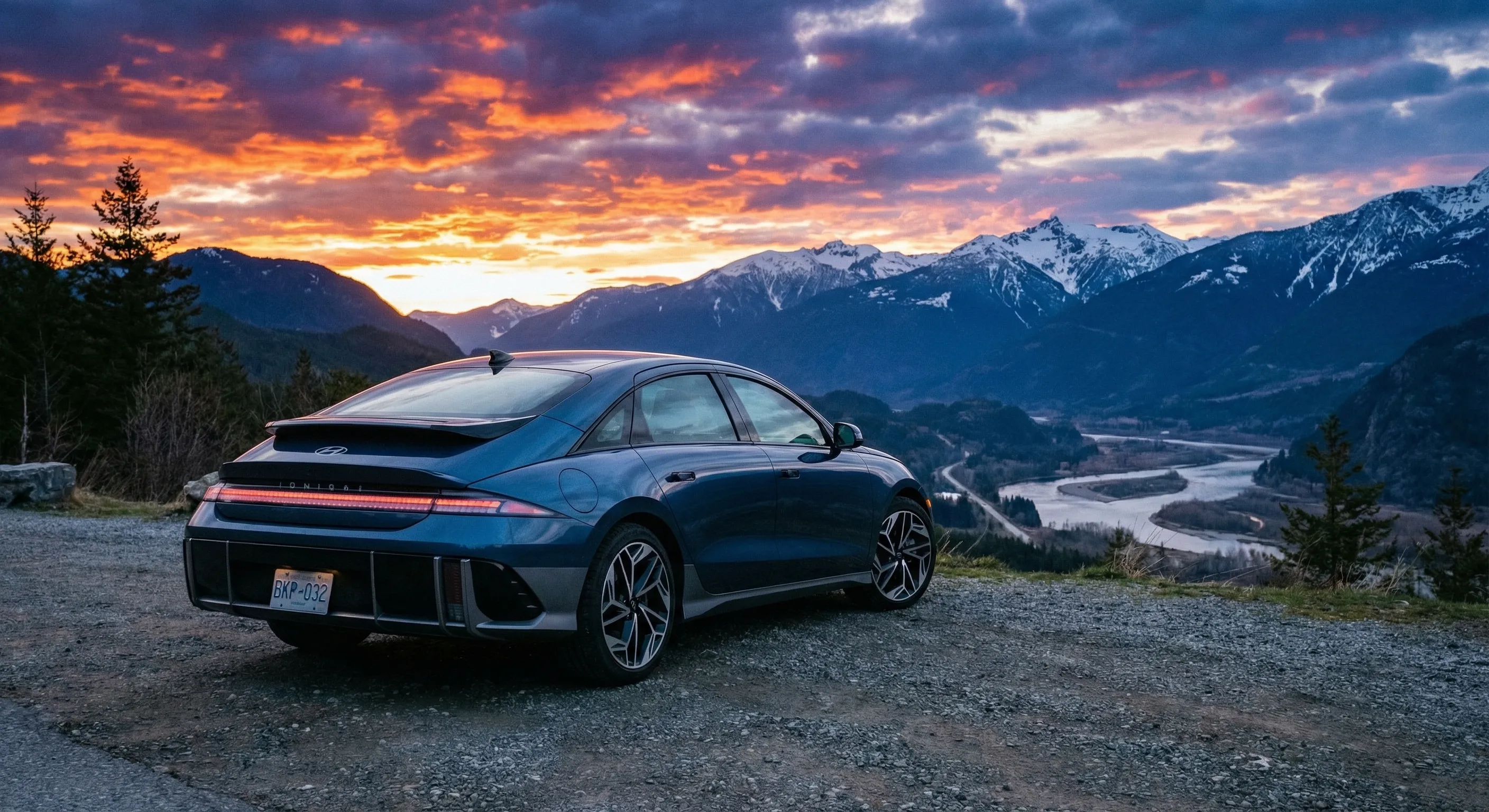
It's also one of the most polarizing designs on Canadian roads. The Ioniq 6 looks like a 1930s streamliner that time-travelled to 2026. The roofline curves down in a single, unbroken arc. The rear haunches are smooth and bulbous. There are pixel-style LED lights front and rear, and a light bar that spans the entire width of the car. Some people see it and think it's beautiful. Others think it looks like a bar of soap. There's no middle ground.
At $54,999 CAD for the Long Range RWD, the Ioniq 6 exceeds the EVAP program's $50,000 final transaction value cap, so it doesn't qualify for the $5,000 federal rebate. The AWD model at $58,999 is even further out. Neither trim qualifies for EVAP, which means no federal rebate on any Ioniq 6. Provincial rebates like Quebec's Roulez vert ($2,000, $60,000 MSRP cap) still apply to the RWD model.
Stop comparing sticker prices and start comparing what it costs to actually live with an EV day to day, and the Ioniq 6's efficiency advantage becomes its most persuasive financial argument. Efficiency is the gift that keeps compounding. Every kilometre you drive costs less. Every charge takes you further. Over five years, that efficiency gap translates into thousands of dollars of real savings, and the Ioniq 6 is in a class of one on that metric. No other EV available in Canada today extracts this much usable range from this little battery. That's not marketing language. That's physics, shaped by aerodynamics, and it matters more than most people realize when they're standing on a dealer lot comparing window stickers.
THE EFFICIENCY STORY
The 0.21 drag coefficient isn't just a spec-sheet number, it translates directly into real-world range. On a moderate Canadian highway at 110 km/h, the Ioniq 6 RWD delivers roughly 500 km on a full charge in summer conditions. That's better than a Tesla Model 3 Long Range, better than a BMW i4, and dramatically better than the Ioniq 5 on the same platform.
The efficiency comes from the shape. Most EVs are crossovers or SUVs with blunt fronts and tall profiles that fight the air. The Ioniq 6 is low, narrow, and shaped like a teardrop. Every panel, every crease, every gap has been optimized to reduce drag. The flush door handles, the underbody panels, the rear diffuser, all of it serves the aerodynamics.
Let me put the efficiency in comparative terms that actually matter. The Ioniq 6 RWD consumes roughly 13.9 kWh per 100 km under NRCan's combined test cycle. The Tesla Model 3 Long Range, the closest efficiency rival, sits around 14.4 kWh per 100 km. The Ioniq 5, built on the same E-GMP platform, sharing the same 77.4 kWh battery, uses approximately 17.5 kWh per 100 km. That's a 26% efficiency penalty for the Ioniq 5, and the entire difference comes down to aerodynamics. Same battery chemistry, same motor technology, same thermal management. The shape of the car accounts for everything.
In practical terms, this means lower electricity costs per kilometre. At Ontario's average residential rate of $0.13/kWh, the Ioniq 6 costs roughly $1.50 per 100 km. A comparable gas sedan costs $12-$15 per 100 km. Over 20,000 km per year, that's $2,100-$2,700 in annual fuel savings. The Ioniq 6's efficiency is its most compelling financial argument.
The efficiency advantage also shows up in charging behaviour. Because the car uses less energy per kilometre, every kilowatt-hour you add at a charger gets you further down the road. A 20-minute fast-charging session that adds 40 kWh to the battery gives the Ioniq 6 roughly 288 km of additional range. The same 40 kWh in an Ioniq 5 delivers approximately 229 km. You're spending the same time at the charger, paying the same charging fee, and getting 59 more kilometres of driving. Over a year of road trips, that efficiency margin means fewer charging stops, less time waiting, and lower total charging costs. It is, in a very literal sense, free range, extracted not from a bigger battery but from a better shape.
DESIGN DEEP-DIVE
The Ioniq 6's design requires a longer conversation than "love it or hate it," even though that binary is where most reviews begin and end. Hyundai's design team, led by SangYup Lee, explicitly referenced the 1930s streamliner era, an automotive period defined by the first serious attempts to make cars slip through air rather than bludgeon through it. The Porsche Type 64 of 1939. The Tatra T87. The Chrysler Airflow. These were cars designed around the principle that the shape of a vehicle should serve its movement through space, not just accommodate its passengers. The Ioniq 6 is the modern realization of that philosophy, executed with contemporary manufacturing precision and informed by computational fluid dynamics that those 1930s designers couldn't have imagined.
The silhouette is the defining element. Viewed from the side, the roofline begins its descent almost immediately past the B-pillar, curving in a single unbroken arc all the way to the truncated rear deck. This "four-door coupe" profile is dramatically more committed than, say, a BMW i4's fastback, the Ioniq 6 doesn't just hint at aerodynamic purpose, it announces it. The resulting shape is lower than virtually every competitor: 1,495 mm tall versus the Model 3's 1,443 mm and the Ioniq 5's 1,635 mm. It's wide too, at 1,880 mm, which gives the car a planted, spread stance when viewed from the front or rear.
The length, at 4,855 mm, places it firmly in mid-size sedan territory, longer than a Tesla Model 3 (4,694 mm) but shorter than a Lucid Air (4,975 mm). The wheelbase stretches to 2,950 mm, which is extraordinarily long for the car's exterior dimensions and explains the generous front and rear legroom. The short overhangs front and rear are a direct consequence of the E-GMP platform's packaging: no engine up front, no fuel tank or exhaust in the rear, so the body can be shaped purely around aerodynamic and passenger-space priorities.
The parametric pixel lights are perhaps the most distinctive design element up close. At the front, individual LED cells create a pattern that's immediately recognizable even in a parking garage, it's the Ioniq 6's visual fingerprint, and nothing else on the road looks like it. The rear extends this language across a full-width light bar that spans the entire tail, broken into individual pixel segments that create running patterns when the car is locked and unlocked. At night, the effect is genuinely striking. During the day, it reads as modern and deliberately different from the generic C-shaped or L-shaped taillight designs that every other manufacturer seems to converge on.
Colour options for the 2026 Canadian market include Biophilic Blue, Gravity Gold, Curated Silver, Abyss Black, Atlas White, Transmission Red, and Digital Green. The lighter colours, particularly Atlas White and Curated Silver, emphasize the car's curves and make the sculptural detailing in the lower body panels more visible. The darker colours absorb those details and make the car read as a single smooth shape, which some buyers will prefer. Biophilic Blue is the "hero colour" that Hyundai uses in most marketing, and it's an attractive medium-blue metallic that photographs well and hides road grime better than white or silver.
The active air flaps in the lower front fascia are a detail worth noting because they represent how seriously Hyundai took the aerodynamic mission. At highway speed, the flaps close to smooth airflow under the car. When the battery or motor needs additional cooling, they open to allow airflow to the thermal management system. It's a dynamic compromise between aerodynamic efficiency and thermal needs that most drivers will never notice, which is exactly how good engineering should work.
The flush door handles retract into the body panels and pop out when you approach with the key. They're not just an aesthetic choice, protruding handles create measurable drag at highway speed. Mercedes, Tesla, and Porsche have all adopted similar solutions on their efficiency-focused models, and the Ioniq 6's version works reliably even in Canadian winter conditions, with heating elements that prevent ice binding. This was a genuine concern when the car launched, and Hyundai addressed it effectively.
The underbody is almost entirely flat, covered with aerodynamic panels that smooth airflow from front to rear. The rear diffuser channels air upward in a controlled fashion that reduces turbulent wake behind the car. The wheel arch liners are sealed. The side mirrors are shaped to minimize vortex shedding. Every component has been scrutinized for its contribution to or detraction from the 0.21 Cd target, and Hyundai achieved it, making the Ioniq 6 the production car with the lowest drag coefficient available in Canada.
The practical consequences of this design commitment are real and sometimes inconvenient. The sloping roofline cuts into rear headroom, adults over 183 cm (6 feet) will feel the ceiling brushing their hair in the back seat. The trunk opening is narrow despite decent cargo volume (401 litres), which makes loading large items awkward. The rear window is small and raked, limiting rearward visibility (though the standard rear camera and parking sensors compensate). If you regularly carry tall passengers or bulky cargo, the Ioniq 5's boxier shape is more practical. But the Ioniq 6's shape is not arbitrary styling, it is the direct and measurable reason this car goes further on less energy than any other EV you can buy.
Gear worth having
As an Amazon Associate, ThinkEV earns a small commission from qualifying purchases — at no extra cost to you.
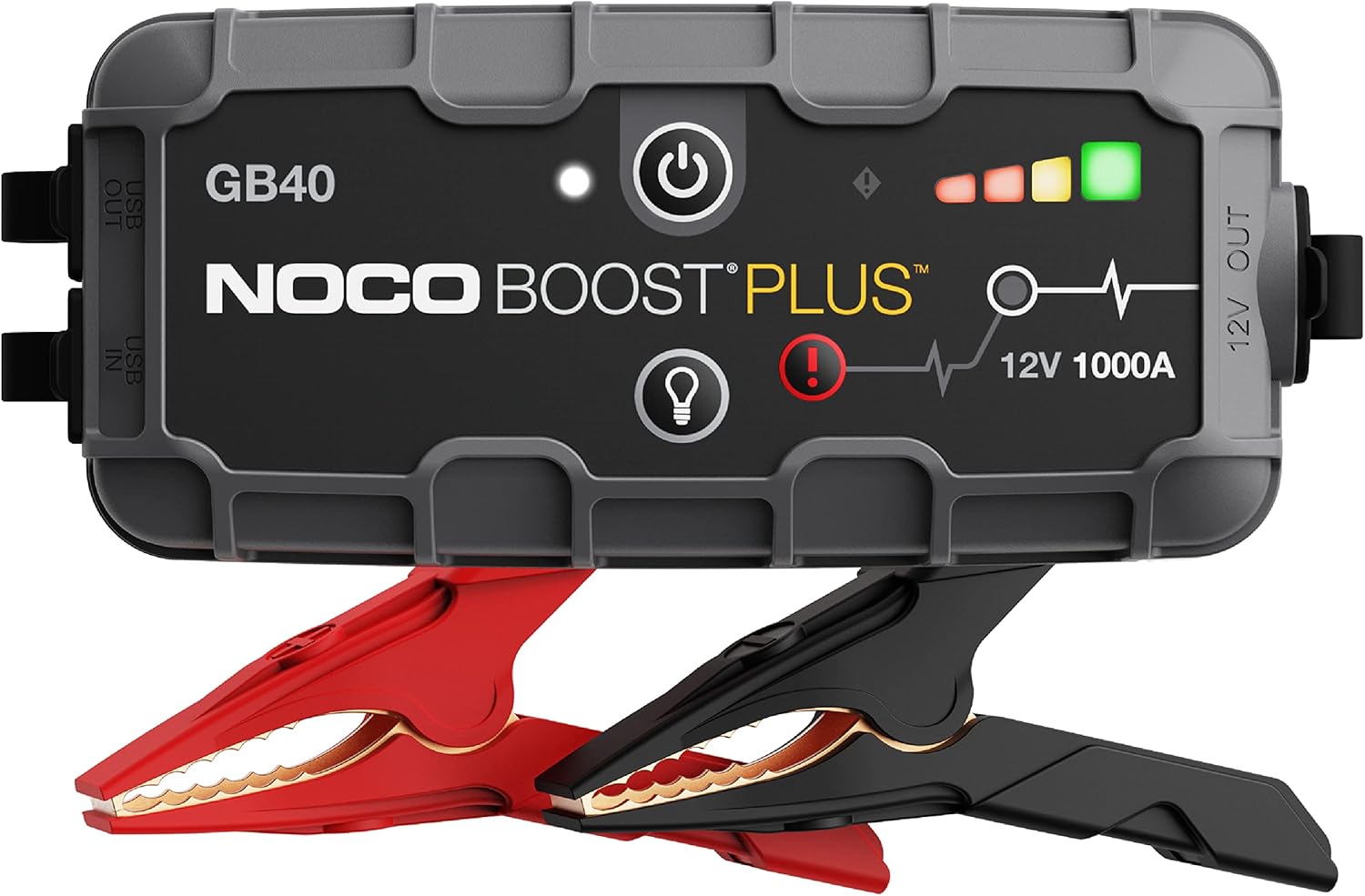
NOCO Boost Plus GB40 Jump Starter
A 1000A lithium jump starter that fits in your glovebox and works on any 12V battery. Your insurance against a dead 12V in a parking lot.
As an Amazon Associate, ThinkEV earns from qualifying purchases — at no extra cost to you.
RANGE AND BATTERY
The 77.4 kWh battery pack in the Ioniq 6 uses nickel-manganese-cobalt (NMC) chemistry, which is the same fundamental cell type found in the Ioniq 5, the Kia EV6, and the Genesis GV60. What differs is how far the Ioniq 6 stretches that energy. The Long Range RWD model is rated at 581 km by NRCan, the highest official range of any non-luxury EV sold in Canada and higher than several luxury models that cost twice as much.
That 581 km number deserves context, because no one drives a government test cycle in real life. In moderate summer conditions, 15 to 25 degrees, mixed city and highway driving, climate control set to a comfortable temperature, Canadian owners consistently report 480 to 530 km of real-world range from the RWD model. That's a 10 to 18% reduction from the rated figure, which is normal for any EV and represents the gap between laboratory conditions and actual Canadian roads with actual Canadian drivers making actual Canadian stops at Tim Hortons.
On pure highway driving at 110 km/h, the prevailing speed on the 401, the Trans-Canada through BC, and most interprovincial corridors, expect 440 to 500 km in summer from the RWD. Highway speed is where aerodynamic drag dominates, and even with the Ioniq 6's class-leading Cd, sustained 110 km/h driving uses more energy than the mixed-cycle rating suggests. Still, 450+ km of highway range in summer conditions is enough to drive from Toronto to Ottawa (roughly 450 km) on a single charge with a thin but real buffer. The Model 3 Long Range can do the same run, but with less margin. The Ioniq 5 cannot, it'll need a fast-charge stop somewhere around Kingston.
The AWD model sacrifices range for traction. Rated at approximately 500 km by NRCan, the dual-motor setup adds the weight and friction of a second motor and its associated drivetrain components. Real-world summer range for the AWD falls in the 420 to 470 km corridor. That's still excellent by any standard, better than the base Model Y, better than the Kia EV6 AWD, and dramatically better than the Ford Mustang Mach-E's 402 km on a larger battery.
The battery's thermal management system uses a liquid-cooled plate system that keeps cells within their optimal temperature window during both fast charging and aggressive driving. Hyundai's battery management system (BMS) is conservative in a way I appreciate: it prioritizes long-term cell health over momentary peak performance, which shows up in the battery degradation data. Early Ioniq 6 owners, the car has been on sale since late 2023 in Canada, are reporting 96 to 98% state of health after two years of regular use, including frequent DC fast charging. That's better than the industry average and suggests the BMS is doing its job effectively.
The efficiency numbers vary meaningfully by province, and this matters because electricity costs vary dramatically across the country. In British Columbia, where residential rates average approximately $0.10/kWh thanks to abundant hydroelectric generation, the Ioniq 6 costs roughly $1.15 per 100 km. In Ontario at $0.13/kWh on time-of-use off-peak, it's about $1.50.
In Alberta, where rates can reach $0.18/kWh or higher depending on the retailer, it's closer to $2.10 per 100 km. Quebec, with the lowest residential electricity rates in the country at around $0.075/kWh, delivers the best deal: approximately $0.90 per 100 km. Even at Alberta's higher rates, the Ioniq 6 costs a fraction of what a comparable gas sedan demands, a Toyota Camry at current fuel prices runs $12 to $15 per 100 km regardless of province. The efficiency advantage is universal. The magnitude varies.
For a full breakdown of what it costs to charge an EV across Canada, see our EV Charging Costs by Province guide.
800V CHARGING
The Ioniq 6 shares the same 800V E-GMP platform as the Ioniq 5, which means charging is exceptionally fast. On a 350 kW Electrify Canada station, the car goes from 10% to 80% in about 18 minutes. That's a coffee stop, not a lunch break. Even on a 150 kW charger, which is more common across Canada, 10% to 80% takes about 30 minutes.
The 800V architecture is a genuine engineering advantage that deserves more explanation than it typically gets. Most EVs on the market, the Ford Mustang Mach-E, the Tesla Model Y, the Chevrolet Equinox EV, operate on 400V electrical systems. The Ioniq 6's 800V system doubles the voltage, which means it can deliver the same power at half the current. Lower current means less heat generation in the cables, connectors, and battery cells during fast charging. Less heat means the battery can accept higher charging rates for longer before thermal throttling kicks in. It's the same principle that makes high-voltage power transmission lines more efficient than low-voltage ones, you lose less energy as waste heat.
In practical charging terms, the 800V advantage shows up most clearly on long trips. When you arrive at a fast charger with 10% battery after a long highway stint, the Ioniq 6's charging curve ramps quickly to peak power and holds it longer than 400V competitors. The curve tapers as the battery fills, physics demands this regardless of voltage, but the 10 to 80% window is where the 800V architecture delivers its time savings. Eighteen minutes from 10 to 80% means you can add roughly 400 km of range in the time it takes to use the washroom, buy a coffee, and check your phone. That's not quite the refuelling experience of a gas car, but it's close enough that range anxiety becomes a non-issue for anyone willing to plan even minimally.
The 800V architecture also supports vehicle-to-load (V2L), letting you use the car as a mobile power source. It outputs 3.6 kW through a port in the rear bumper or through the interior 120V outlet. That's enough to run a portable heater, a small microwave, power tools, or an entire campsite's worth of lighting and electronics. During the BC ice storms of early 2025, Ioniq 5 and Ioniq 6 owners reported running space heaters and phone chargers from their cars during multi-day power outages. V2L transforms the EV from a vehicle into a rolling power station, and in a country where winter power outages are a genuine concern, that capability has value beyond novelty.
For home charging, a Level 2 charger on a 48A circuit fully charges the 77.4 kWh battery in about 7 hours. Plug in after dinner, wake up to a full battery. The Ioniq 6 also supports Plug and Charge, which means it authenticates automatically at compatible stations, no app, no card, just plug in and go. In a charging scene where fumbling with three different apps and two RFID cards is still the norm for many Canadian EV drivers, Plug and Charge is a genuine quality-of-life improvement that reduces friction at exactly the moment where friction is most irritating.
INTERIOR AND TECH
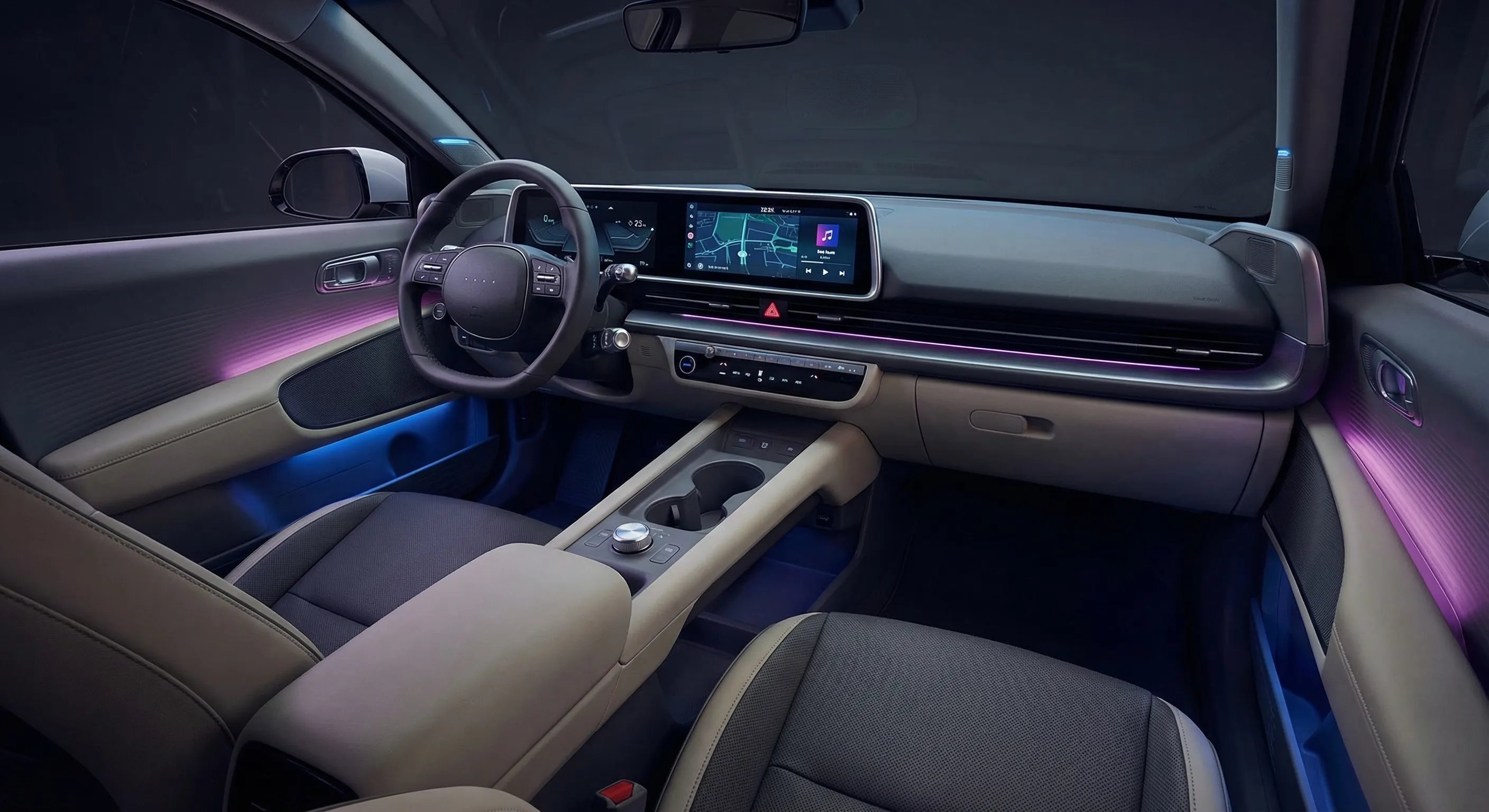
The cabin is clean and modern, with a twin 12.3-inch screen setup spanning the dashboard. The screens are crisp, the infotainment responds quickly, and Apple CarPlay/Android Auto work wirelessly. The ambient lighting is customizable with 64 colours and creates a genuinely pleasant atmosphere at night. The twin-screen layout is shared with the Ioniq 5 and Kia EV6, but the Ioniq 6's implementation feels more cohesive because the screens integrate into the dashboard's horizontal theme rather than floating above it.
Materials quality is good but not exceptional. The upper dash is soft-touch, the door panels are padded, but some of the lower trim pieces are hard plastic. At $55,000, that's acceptable. It's nicer than a Tesla Model 3 interior but not as premium as a BMW i4.
The physical controls deserve specific praise. Hyundai kept a dedicated climate control bar below the main screen with real, tactile buttons and knobs. This is a design decision that becomes more obviously correct with every week you own the car. Adjusting fan speed or temperature while driving at highway speeds, without looking away from the road, without working through a touchscreen menu, that's not a luxury, that's basic ergonomic competence. It's remarkable that this needs to be praised in 2026, but enough manufacturers have eliminated physical controls in pursuit of minimalist aesthetics that Hyundai's retention of them counts as a genuine feature.
The front seats are comfortable and supportive with heating, ventilation, and a relaxation mode that reclines the seat and plays soothing sounds. The driving position is low, sedan low, not crossover high, which some drivers love and others find uncomfortable after years of sitting up in SUVs. The transition from an SUV seating position to the Ioniq 6's lower hip point takes about a week of adjustment. After that week, most drivers report the sedan position feels more natural for long highway drives, your legs are extended forward rather than bent downward, which reduces lower back fatigue on multi-hour trips.
Heated rear seats and a heated steering wheel are standard, as they should be for any car sold in Canada at this price. The head-up display, available on higher trims, projects speed, navigation directions, and driver assistance information directly onto the windshield, which reduces the number of times you need to glance down at the instrument cluster. It's a small convenience that adds up over thousands of kilometres of highway driving.
The Bose premium audio system, available on upper trims, is genuinely good, not revelatory, but satisfying in the way that a well-tuned system should be. Eight speakers produce clear, balanced sound at all volume levels, and the cabin's inherent quietness (a benefit of both aerodynamic design and electric propulsion) means you can listen at lower volumes and still hear detail that would be lost in a noisier vehicle. The base audio system is adequate but noticeably thinner in the low end.
Cargo space at 401 litres is competitive for a sedan but underwhelming compared to crossover alternatives. The real limitation isn't volume, it's the trunk opening. The sloping roofline creates a narrow, shallow opening that makes it difficult to load anything bulkier than a suitcase. Hockey bags, strollers, large boxes, all require some manipulation to fit through the gap. The trunk floor is deep, and once items are inside, there's reasonable space. But the loading experience is where the car's aerodynamic priorities most obviously conflict with daily practicality. A 60/40 split-folding rear seat expands cargo capacity for longer items, though the pass-through is narrower than in most competitors.
Gear worth having
As an Amazon Associate, ThinkEV earns a small commission from qualifying purchases — at no extra cost to you.

VIOFO A229 Pro 4K Dash Cam
4K front plus 2K rear with parking mode and GPS. Your silent witness for insurance claims, with always-on sentry recording while parked.
As an Amazon Associate, ThinkEV earns from qualifying purchases — at no extra cost to you.
DRIVING
The Ioniq 6 is not a sports car. The RWD Long Range model makes 225 hp, which is adequate but not exciting. Zero to 100 km/h takes approximately 7.4 seconds, brisk by conventional sedan standards, unremarkable by EV standards. The power delivery is smooth and linear, with none of the lag or gear-hunting that characterizes internal combustion drivetrains. You press the accelerator, the car goes. The response is immediate and proportional, which makes the Ioniq 6 feel quicker in daily driving than the 7.4-second number suggests. Merging onto the 401, passing a transport on a two-lane highway, accelerating from a light, these are all accomplished with a quiet effortlessness that makes the car feel competent rather than urgent.
The AWD model bumps power to 320 hp and drops the zero to 100 time to approximately 5.1 seconds, which is genuinely quick. Both versions ride smoothly, with a well-damped suspension that absorbs bumps without bouncing. Highway cruising is the Ioniq 6's natural habitat, it's quiet, stable, and remarkably relaxed at speed. The combination of aerodynamic refinement, good sound insulation, and a well-tuned suspension creates a highway experience that borders on serene. Road noise from the tires is the primary intrusion, and even that is well-controlled by the standards of the segment.
Steering is light and accurate, which makes parking and city driving easy. It doesn't have the engaging weight of a BMW i4 or the darty response of a Tesla Model 3, but it's perfectly competent. For a car designed to go far on minimal energy, the prioritization of comfort over sportiness makes sense. The steering feel is consistent and predictable, it's a tool for placing the car where you want it, not a feedback channel for road-surface information. Some enthusiast drivers will find this unsatisfying. Most commuters will find it exactly right.
The regenerative braking system offers multiple levels of intensity, adjustable through the steering-wheel paddles. At the strongest setting, one-pedal driving is fully achievable, lift off the accelerator and the car decelerates aggressively enough to bring it to a complete stop without touching the brake pedal. This driving style takes a day or two to internalize, but once you've adapted, it becomes second nature.
The energy recovery from regenerative braking is a meaningful contributor to the car's overall efficiency, particularly in stop-and-go urban driving where a conventional car would waste all that kinetic energy as heat through brake friction. In city driving, I've observed the Ioniq 6 recovering 15 to 20% of its energy consumption through regenerative braking, that's free range, recaptured from deceleration events that would otherwise be pure loss.
Gear worth having
As an Amazon Associate, ThinkEV earns a small commission from qualifying purchases — at no extra cost to you.

Grizzl-E Classic Level 2 EV Charger (40A)
Canadian-made and rated for minus 40C winters. 40A / 9.6 kW, NEMA 14-50, indoor/outdoor, 24-ft cable. The charger built for Canadian weather.
As an Amazon Associate, ThinkEV earns from qualifying purchases — at no extra cost to you.
The i-Pedal mode, Hyundai's one-pedal driving brand name, brings the car to a complete stop and holds it on hills. That last detail matters more than it sounds. Some competitors' one-pedal modes decelerate aggressively but don't hold the car at a stop, requiring you to apply the brake pedal on inclines. The Ioniq 6 holds. It's a small thing that becomes a large convenience in hilly cities like Halifax, Montreal, or anywhere in BC's interior.
Highway Driving Assist 2 (HDA 2) is Hyundai's Level 2 driver-assistance system. It combines adaptive cruise control with lane-centring and offers lane-change assist on highways. It's not hands-free, your hands must remain on the wheel, but it significantly reduces the cognitive load of long highway drives. On a three-hour run down the 401, the difference between managing speed and lane position yourself versus letting HDA 2 handle the moment-to-moment adjustments is measurable in how tired you feel at your destination. It's not autonomy. It's assistance. And it's good assistance.
WINTER PERFORMANCE
Winter is the great equalizer for EVs in Canada, and any review written for Canadian readers that doesn't dedicate serious space to cold-weather performance is doing its audience a disservice. The Ioniq 6 handles winter better than most EVs, and the reasons are worth understanding in detail.
The aerodynamic advantage that delivers 581 km of range in summer doesn't disappear when the temperature drops. Cold air is denser than warm air, which means aerodynamic drag actually increases in winter, but because the Ioniq 6's baseline drag is so low, the percentage increase still leaves it in a better absolute position than less aerodynamic competitors.
A car with a 0.21 Cd experiencing a 5% winter drag increase is still slipperier than a car with a 0.28 Cd experiencing the same increase. The physics works in the Ioniq 6's favour year-round, and the efficiency advantage is proportionally larger in winter than in summer because every other range-reducing factor (heating, cold battery chemistry, tire rolling resistance) is the same for every EV while the aero advantage is unique to the Ioniq 6.
Real-world winter range for the RWD model falls to approximately 400 to 430 km in typical Canadian winter conditions, temperatures of -10 to -20 degrees, climate control set to 21 degrees, mix of city and highway driving. That's a 25 to 30% reduction from the 581 km rated range, which is typical for modern EVs in Canadian cold. For the AWD model, winter range drops to 360 to 390 km. These are still among the best winter ranges in the segment. The Tesla Model 3 Long Range delivers approximately 370 to 400 km in similar conditions. The Ioniq 5 manages 330 to 370 km. The Mustang Mach-E Standard Range drops to 282 to 322 km in deep cold. The Ioniq 6's winter range advantage is real and significant.
For a comprehensive look at how Canadian EVs perform in cold weather, see our Winter Range Test results.
The heat pump is standard on all Ioniq 6 trims sold in Canada, and it's the single most important cold-weather feature after the battery itself. A heat pump extracts thermal energy from ambient air, even cold ambient air, and uses it to warm the cabin, which is dramatically more energy-efficient than the resistive heating elements used by some competitors.
The Ioniq 6's heat pump operates effectively down to approximately -15 to -20 degrees Celsius. Below that threshold, the system supplements with resistive heating, which consumes more battery energy. In the populated corridors of southern Ontario, the Lower Mainland of BC, and southern Quebec, where the majority of Canadian EV owners live, winter temperatures above -20 are the norm, and the heat pump handles cabin heating without severe range impact.
The AWD model earns its $4,000 premium most convincingly in winter. Dual-motor torque distribution provides confident traction on snow-covered roads, and the ability to send power independently to front and rear axles means the car recovers from wheel slip quickly and predictably. On good winter tires, which are mandatory in Quebec, strongly recommended everywhere else, and arguably essential for any sedan, the AWD Ioniq 6 is a composed and trustworthy winter vehicle. The RWD model is perfectly manageable on winter tires, but there's an undeniable confidence gap when pulling away from a stop on packed snow or working through an unplowed residential street.
Battery preconditioning is the winter ownership habit that separates informed EV owners from frustrated ones. The Bluelink app allows you to schedule departure times, and the car will warm both the cabin and the battery pack while still plugged into your home charger. You leave with a warm cabin and a warm battery, the warm cabin means you don't immediately blast the climate system at full power, and the warm battery means you start your drive with full power availability and full regenerative braking capability.
Cold batteries throttle both discharge and regen, so preconditioning directly improves the first 20 to 30 minutes of your drive. On a -15 degree morning, the difference between a preconditioned and a cold-soaked Ioniq 6 is roughly 30 to 50 km of additional usable range. That's free energy, drawn from your home charger rather than the battery, at residential electricity rates.
Ground clearance at 150 mm is lower than most crossover EVs. After a heavy snowfall, the Ioniq 6 will benefit from plowed roads. It's a sedan, it doesn't pretend to be anything else. If you live in rural areas with unpredictable snow clearing, the Ioniq 5 or Kia EV6 offer more ground clearance (160 mm and 178 mm respectively) and are better suited to those conditions.
OWNERSHIP AND COSTS
The Ioniq 6 does not qualify for the federal EVAP rebate on any trim. This is worth repeating because it's the single most consequential financial fact about buying this car in Canada. The EVAP program uses a $50,000 final transaction value cap. The base Long Range RWD at $54,999 exceeds that threshold by nearly $5,000. The AWD at $58,999 is $9,000 over. There is no Ioniq 6 configuration that qualifies for the $5,000 federal rebate.
Provincial rebates are more nuanced. Quebec's Roulez vert program offers $2,000 on vehicles with an MSRP up to $60,000, which means the RWD model qualifies. The AWD model, at $58,999, also falls under the cap. British Columbia's CleanBC Go Electric program currently does not include the Ioniq 6 on its eligible vehicles list due to the base price exceeding provincial thresholds. Nova Scotia's program has similar restrictions. For a complete accounting of which EVs qualify for which rebates in each province, our EV Rebates by Province guide covers every active program.
The five-year total cost of ownership (TCO) comparison is where the Ioniq 6 makes its most persuasive financial case, despite the lack of federal rebate. Let me walk through the real numbers against a comparable gas sedan, a Toyota Camry XLE, which sits at approximately $41,000 and is arguably the most direct gas-powered alternative for a buyer cross-shopping in this segment.
Purchase price over five years, assuming a $10,000 down payment and 7.5% financing: the Ioniq 6 RWD costs approximately $54,999 plus roughly $10,500 in financing costs. The Camry costs approximately $41,000 plus roughly $7,900 in financing costs. The Ioniq 6 has a roughly $16,600 acquisition premium.
Fuel costs over five years at 20,000 km per year: the Ioniq 6 at $1.50 per 100 km costs $1,500 per year, or $7,500 over five years. The Camry at $13.00 per 100 km costs $13,000 per year, or $65,000 over five years, At $1.55/L fuel cost and 7.5L/100km combined, the Camry costs approximately $11.60 per 100 km, or $2,325 per year, or $11,625 over five years. The Ioniq 6 saves $825 per year in fuel, or $4,125 over five years.
Maintenance over five years: the Ioniq 6's maintenance costs are dramatically lower than a gas sedan's. No oil changes ($100-$150 each, typically 2-3 per year). No transmission fluid changes. No timing belt. No exhaust system corrosion repairs. Brake pads last far longer due to regenerative braking doing most of the deceleration work. Realistic maintenance budget for the Ioniq 6 over five years: approximately $2,500 (tire rotations, cabin air filters, brake fluid changes, wiper blades, coolant inspection). For the Camry: approximately $5,500. Savings: $3,000 over five years.
Insurance is a genuine additional cost for the Ioniq 6. EV insurance premiums in Canada run 10 to 20% higher than comparable gas vehicles, driven by higher repair costs (battery packs), specialized labour requirements, and the general newness of the technology in the insurance industry's actuarial models. On a $55,000 vehicle, expect insurance premiums of $2,200 to $3,000 per year depending on province, driving record, and coverage levels. The Camry, at $41,000 with a longer repair history and more available parts, will run $1,600 to $2,200. The insurance premium difference adds approximately $3,000 to $4,000 over five years.
Depreciation is the wildcard. EVs have historically depreciated faster than gas vehicles, though the gap is narrowing as the used EV market matures. Estimated five-year depreciation on the Ioniq 6: 50 to 55%, leaving a residual value of approximately $24,750 to $27,500. The Camry's legendary reliability gives it a five-year depreciation rate of approximately 40 to 45%, leaving a residual of approximately $22,550 to $24,600. Surprisingly, the absolute dollar depreciation is similar, the Ioniq 6 loses roughly $27,500 to $30,250 while the Camry loses roughly $16,400 to $18,450. The Ioniq 6 depreciates more in absolute terms, but this is offset substantially by the fuel and maintenance savings.
For a detailed deep-dive into these numbers across multiple vehicle categories, see our EV vs Gas Total Cost of Ownership comparison.
Net five-year TCO comparison: the Ioniq 6 is approximately $5,000 to $8,000 more expensive than the Camry over five years when you factor everything in. That's the real premium for going electric with this specific car. Not the $14,000 sticker gap. Not the "EV savings pay for themselves" marketing claim. About $5,000 to $8,000 over five years, or roughly $85 to $135 per month. Whether that premium is worth it depends on whether you value the driving experience, the environmental considerations, and the daily convenience of never visiting a gas station. For many buyers, it clearly is. For those on tight budgets, it's an honest premium that deserves acknowledgment rather than handwaving.
WHO SHOULD BUY THIS CAR
The Ioniq 6 is not for everyone, and being specific about its ideal buyer is more useful than pretending it's universally appealing. So here's who I think should genuinely consider this car.
The efficiency-focused buyer. If you care about getting the most range from every kilowatt-hour, if the idea of driving further on less energy appeals to you on both an economic and philosophical level, the Ioniq 6 is your car. There is no more efficient EV available in Canada. Period. This buyer is often an engineer, an environmentalist, or simply someone who appreciates elegant solutions to physical problems. The Ioniq 6's aerodynamic efficiency is an elegant solution, and driving it feels like operating a well-designed tool.
The long-distance commuter. If your daily commute is 80 km or more round trip, or if you regularly drive interprovincial corridors for work, the Ioniq 6's combination of range, fast charging, and low per-kilometre costs makes it exceptionally well-suited to high-mileage use. The math gets better the more you drive. A buyer driving 30,000 km per year saves more on fuel than one driving 15,000 km per year. The Ioniq 6 rewards heavy use rather than punishing it.
The design-conscious buyer. Some people want a car that looks like nothing else on the road. The Ioniq 6 delivers that emphatically. If visual distinction matters to you, if you actively dislike the sameness of modern crossovers and want something that makes a statement, this is one of the strongest design choices in the EV market. You have to genuinely like the way it looks, because it's not subtle.
The tech-forward buyer. The 800V architecture, V2L capability, Plug and Charge support, and comprehensive driver-assistance suite make the Ioniq 6 one of the most technologically advanced EVs in its price bracket. If being on the leading edge of EV technology matters to you, the Ioniq 6 delivers genuine substance behind the spec sheet.
Who should not buy this car: families who need cargo flexibility (the trunk opening is genuinely limiting), anyone over 183 cm who regularly carries rear passengers, buyers who need EVAP eligibility to make the purchase work financially, people who prefer an elevated driving position, and anyone who wants an exciting driving experience from the accelerator pedal rather than a comfortable one. The Ioniq 6 is excellent at what it does. What it does is not everything.
THE COMPROMISES
Every car makes trade-offs. The Ioniq 6 makes specific ones that are worth enumerating honestly, because any review that avoids them isn't giving you the information you need to make a purchase decision.
Rear headroom. The sloping roofline is beautiful and aerodynamically essential. It also makes the back seat uncomfortable for tall adults. At 183 cm (6 feet), your hair touches the headliner. At 188 cm (6'2"), you're ducking. This isn't a nuance, it's a binary: if you regularly carry tall rear passengers, the Ioniq 6 is not your car. The Ioniq 5, on the same platform with the same range and charging architecture, offers dramatically more rear headroom and should be your consideration instead.
Trunk opening. 401 litres of cargo volume is adequate for a sedan. But the opening through which you access that volume is narrow and shallow, constrained by the sloping rear glass and the high rear deck. Suitcases slide in. Golf bags slide in. A large box from Costco requires angular negotiation. A stroller requires folding and strategic placement. This is not a hatchback, and the loading experience is meaningfully less convenient than what you'd get from any crossover or from the Tesla Model 3's wider trunk opening.
Styling polarization. You need to be at peace with this car's appearance. People will comment. Some will ask what it is with genuine curiosity. Others will make soap and jelly bean comparisons. If exterior aesthetics are important to you, make absolutely sure you're in the "love it" camp before signing. The design grows on some people; it grows on others in the way that a persistent acquaintance grows on you, eventually tolerated, never embraced. That's a $55,000 risk.
No EVAP on any trim. The lack of federal rebate eligibility is a genuine financial disadvantage in a market where competitors like the Kia EV4, Chevrolet Equinox EV, and Hyundai Kona Electric all qualify for the $5,000 EVAP rebate. That's $5,000 the Ioniq 6 needs to justify through other merits. It does justify it, in my opinion, through efficiency and range and charging speed, but the absence is real and should factor into your calculation.
Driving dynamics. The Ioniq 6 is comfortable. It is not engaging. If your definition of a good driver's car involves steering feedback, chassis communication, and the sense that the car wants to play, the BMW i4 and even the Tesla Model 3 are better choices. The Ioniq 6 wants to transport you in calm, quiet, efficient comfort. If that aligns with your priorities, it's perfect. If it doesn't, no amount of efficiency will compensate.
Visibility. The small rear window and thick C-pillars create larger blind spots than a traditional sedan. The standard backup camera and blind-spot monitoring mitigate this effectively, but drivers who rely on over-the-shoulder checks will notice the limitation, particularly when changing lanes on busy highways.
VERDICT
The Ioniq 6 is the rational choice. It goes further on less energy than any other EV in Canada. It charges in 18 minutes. It costs roughly $1.50 per 100 km to run. And it looks like nothing else on the road.
The compromises are real: limited rear headroom, a narrow trunk opening, polarizing styling, no EVAP rebate eligibility (all trims exceed the $50,000 cap), and a driving experience that prioritizes comfort over excitement. If you want a practical family EV, the Ioniq 5 is better. If you want a thrilling drive, the Ioniq 5 N is the answer. But if you want the most efficient, most affordable-to-run electric sedan in the country, the Ioniq 6 is in a class of one.
What makes the Ioniq 6 special isn't any single number or feature, it's the coherence of the design philosophy. Every decision Hyundai made on this car serves a unified purpose: go further on less energy. The shape serves that purpose. The battery management serves it. The 800V charging architecture serves it. Even the compromises serve it, the rear headroom exists because the roofline curves for aerodynamics, not because Hyundai forgot that people sit in back seats. When a car's trade-offs are the direct and logical consequences of its primary engineering goal, the result feels honest rather than half-finished. The Ioniq 6 knows exactly what it is. The question is whether what it is matches what you need.
For most Canadian commuters, people who drive 40 to 100 km per day, who charge at home overnight, who value low running costs and long range over cargo flexibility and driving excitement, the Ioniq 6 is the best EV for the money. Not the cheapest to buy. Not the most practical to live with. But the most efficient to operate, the fastest to charge, and over five years, one of the most affordable EVs to own once you factor in fuel and maintenance savings that compound every month.
At $54,999 for the RWD and $58,999 for the AWD, the Ioniq 6 asks you to pay a premium for aerodynamic engineering that no other manufacturer has matched. It delivers on that premium with 581 km of range, 18-minute fast charging, and the lowest per-kilometre operating cost of any car, gas or electric, sold in Canada. That's a genuine accomplishment, wrapped in a shape that some people love and others can't look at. Whatever side of that aesthetic divide you fall on, the engineering underneath is unarguable.
Gear worth having
As an Amazon Associate, ThinkEV earns a small commission from qualifying purchases — at no extra cost to you.

AstroAI Portable Tire Inflator
One tap, it inflates to your exact PSI then stops automatically. Low tires cost 5 to 10 percent of your range, so this pays for itself in a week.
As an Amazon Associate, ThinkEV earns from qualifying purchases — at no extra cost to you.
Related Reading
- Hyundai Ioniq 5 N Canada Review 2026, The performance version of Hyundai's EV lineup, same platform, completely different mission.
- BMW i4 vs Tesla Model 3 Canada 2026, Two other premium electric sedans compared head-to-head.
- EV Rebates by Province Canada 2026, Every provincial and federal rebate program explained, with eligibility thresholds.
- EV Charging Costs by Province Canada 2026, What it actually costs to charge at home and on the road across Canada.
- EV vs Gas Total Cost of Ownership Canada 2026, The complete five-year financial comparison.
- EV Winter Range Test Canada 2026, Real-world cold weather range data for the most popular EVs in Canada.
Gear worth having
As an Amazon Associate, ThinkEV earns a small commission from qualifying purchases — at no extra cost to you.

Digital Tire Pressure Gauge
Low tires quietly cost 5 to 10 percent of your range. A 10-second check with an accurate digital gauge keeps every kWh on the road.
As an Amazon Associate, ThinkEV earns from qualifying purchases — at no extra cost to you.

Founder & Chief Editor
Vlad Pereira is the founder and chief editor of ThinkEV.ca, the Canadian electric-vehicle publication he writes and edits from Courtenay, British Columbia. He covers EV pricing, federal and provincial rebates, charging costs, and the Chinese manufacturers now entering Canada, from the buyer's side rather than the press-fleet side. ThinkEV is a venture of Vlad Pereira Online; his writing on health, income and the long game lives at vladpereira.com.
Frequently asked questions
Does the Ioniq 6 qualify for the EVAP rebate?
How far does the Ioniq 6 go in Canadian winter?
How does the Ioniq 6 compare to the Tesla Model 3?
Is the back seat comfortable for adults?
What does it cost to charge the Ioniq 6 at home?
Is the Ioniq 6 RWD or AWD better for Canada?
How does V2L work on the Ioniq 6?
What warranty does Hyundai offer on the Ioniq 6 battery?
How does the Ioniq 6 compare to the Ioniq 5?
More EV & road-trip finds
Affordable upgrades worth a look — tap any to check the price on Amazon.
 ★ 268
★ 268Anti-Slip Leather Steering Wheel Cover
View on Amazon ★ 8,681
Chemical Guys Complete Car Wash Kit
View on Amazon ★ 164
★ 164Solar-Powered LED Ambient Light
View on Amazon ★ 568
★ 568Personalized Photo and Text Keychain
View on Amazon ★ 865
★ 865Collapsible Trunk Organizer
View on Amazon ★ 721
★ 72145W USB-C Fast Car Charger
View on Amazon ★ 121
★ 121Foldable Windshield Sun Umbrella
View on Amazon ★ 392
★ 392Large Cup Holder Adapter (32-40oz)
View on AmazonRead, Plan, Then Stay Current
Explore our expert articles to understand incentives and ownership costs, use the map to pressure-test charging reality, then subscribe so new EV coverage comes straight to you.
Continue Reading
Hyundai Ioniq 5 N Canada Review: 601 hp Tested
Hyundai Kona Electric Canada Review: Under $45K
Volvo EX30 Canada Review: The Small One to Want

Rivian R1T Canada Review 2026: 515 km Quad-Motor
Rivian R2 Canada Price 2026: The $57K Electric SUV