
Your power goes out at 2 a.m. in January. Your EcoFlow Delta Pro Ultra is fully charged and your EV is sitting in the driveway, and yes, that combination can keep your fridge, furnace fan, and lights running through a Canadian winter night. But only if you bought the right EV, the right EcoFlow, and the right panel between them.
That's the framing most YouTube reviews skip. The hardware exists. The Canadian inventory is real. The question worth your time is which version of this setup actually fits your house, your vehicle, and your budget, and where the math quietly stops working.
This guide answers the practical questions: what hardware you need, which EVs in Canada actually export power back to your home, what it all costs in CAD, what you can realistically run for how long, and whether the whole thing is worth it versus a propane generator.
Key takeaways
- Ford F-150 Lightning exports up to 9.6kW, enough for three to five days of Canadian winter essentials.
- EcoFlow Delta Pro Ultra's 6,144Wh covers roughly 9–12 hours at essentials load, not a 72-hour ice storm.
- Cold kills LFP capacity 15–20 percent; keep your Delta Pro Ultra indoors, not in a detached garage.
- The Delta Pro Ultra X can recharge from a Level 2 EV charging station, useful when one circuit stays live during an outage.
- CHAdeMO-based Nissan Leaf V2H gear has largely vanished from the Canadian market, making that path a sourcing project not a purchase.
What "Home Backup Power" Actually Means in Practice
There are two completely different setups people call "home backup," and confusing them is the fastest way to overspend.
The first is portable backup. You have an EcoFlow sitting in the garage or basement. When the power dies, you drag it to the kitchen, plug your fridge into one outlet, your modem into another, run an extension cord to a lamp. It works. It's also a lot of fumbling with cords at 2 a.m. in the dark.
The second is whole-home backup with automatic transfer. The EcoFlow is permanently wired into your electrical panel through a Smart Home Panel. When the grid drops, selected circuits cut over to battery in under 20 milliseconds. Your fridge never noticed. Your furnace keeps cycling. You sleep through it.
The Delta Pro Ultra base unit holds 6,144Wh. The EcoFlow DELTA Pro Ultra features a 6144Wh capacity and X-Boost technology to power 99% of essential household appliances for hours or even days. Translation in plain numbers: a typical essentials-only load, fridge, gas-furnace fan, a few LEDs, your router, pulls roughly 600 to 700 watts continuous. That gives you somewhere between 9 and 12 hours on a single base unit.
Push the load up to 1,500 watts (add a microwave run, a kettle, a space heater on low) and you're down to about 4 hours. The battery doesn't care about your good intentions; it cares about wattage and time.
The case against trusting these runtime numbers: manufacturer specs assume 25°C laboratory conditions and a fresh battery. Real Canadian use means two compounding penalties. First, lithium iron phosphate batteries lose roughly 15 to 20 percent of usable capacity once they drop below 0°C, and a detached garage in Sudbury in January is not a friendly storage environment. Keep the unit indoors. Second, ice storms in Quebec and Ontario routinely knock out power for 48 to 72 hours. A 6,144Wh base unit alone won't cover that, you either expand it, or you bring your EV into the loop.
The rebuttal is partial. Indoor placement recovers most of the cold-weather loss. Expansion batteries scale the runtime linearly. But the 72-hour scenario is the one where standalone EcoFlow setups quietly fail, and it's the scenario buyers should plan against, not the four-hour summer thunderstorm outage.
That second option, pulling the EV into the system, is where the real Canadian use case lives.
EcoFlow Delta Pro vs. Delta Pro Ultra vs. Delta Pro Ultra X, Which One Do You Need?
EcoFlow's lineup confuses people because the names sound nearly identical and the price gaps are enormous. Here's the honest separation.
Delta Pro (the original), 3,600Wh, around CAD $3,500–$4,000 on Amazon.ca and direct. Good for camping, RV use, partial backup of a small apartment. It can technically power a fridge for a day, but it cannot meaningfully cover a Canadian home through a winter outage. Skip it unless your use case is genuinely mobile.
Delta Pro Ultra, the 6,144Wh base unit, around CAD $5,499 direct from EcoFlow Canada. The reliable LifePO4 battery technology lasts 4,000+ charge cycles before reaching 80% capacity. At one full discharge per month, which is far more than most backup systems see, that's over 300 years of cycle life. The cycle count is not what fails first. The electronics will outlive the battery.
The Ultra is the one that makes sense for whole-home essentials backup. It also pairs with the Smart Home Panel 2, which is the piece that turns it from a portable into a real backup system.
Delta Pro Ultra X, the newer, bigger sibling. Expand capacity from 3.6kWh up to 25kWh with Smart Extra Batteries, recharge fast with up to 6,500W MultiCharge (as little as 2.7 hours via AC), and even top up at thousands of EV charging stations, powered by a long-lasting LFP battery designed to support up to 10 years of use. The 2.7-hour AC recharge is the headline spec. It also adds compatibility with the larger Smart Home Panel 3.
The Ultra X is compatible with third-party 3–7.2kW/12kW generators, charging piles, and EV charging guns, plus the EcoFlow Smart Home Panel 3 (32 Circuits) or Smart Gateway intelligent distribution box. That "EV charging guns" line is the key one for this article, the Ultra X can take a charge from a Level 2 EV charging station, which opens up an unusual recharge path during multi-day outages where one circuit somewhere is still live.
For most Canadian homeowners, the Delta Pro Ultra hits the sweet spot. The Ultra X is overkill unless you're powering a 32-circuit panel or you have a specific reason to need the 6,500W multi-charge speed. The naming pattern also hints at what comes next: EcoFlow's release cadence suggests a "Pro Ultra X Plus" or comparable iteration within 12–18 months, with bidirectional EV-charging-gun support (i.e. powering the battery from any public DC fast charger). If that ships, the math changes again, your nearest Electrify Canada or Petro-Canada Electric Highway station becomes an emergency refuel point for the EcoFlow itself.
One distinction worth pinning down before you spend any money: V2L (vehicle-to-load) is your EV's built-in 120V or 240V outlet, useful, common, limited to whatever the outlet can deliver. V2H (vehicle-to-home) is true bidirectional export through your electrical panel, requires specific vehicles, and is rare in Canada. The next section is where that distinction starts mattering in dollars.
V2V and V2H Charging: Which EVs Actually Work With This Setup in Canada?
This is where the buying decision gets specific. The phrase "V2V" gets thrown around loosely, most of what people call V2V is really V2L into another battery. True bidirectional integration with your home panel is a much shorter list.
The genuine V2H-capable EVs available in Canada:
- Ford F-150 Lightning, the gold standard for Canadian home-backup integration. Pro Power Onboard exports up to 9.6kW with the optional Ford Charge Station Pro and Home Integration System. With the Lightning's 131kWh extended-range battery, you can deliver roughly 60–70kWh to your home before you'd want to stop and preserve enough for driving. That's three to five days of essentials at typical Canadian winter loads.
- Chevy Silverado EV, similar capability, similar export wattage, with GM's PowerShift bundle. The Max Range version's roughly 200-kWh-class pack is the largest mobile battery sitting in Canadian driveways today.
- Nissan Leaf (CHAdeMO generation), the original V2H vehicle. The hardware works. The catch: CHAdeMO V2H adapters and supporting electronics have largely disappeared from the Canadian market. If you don't already own the equipment, sourcing it is a project.
- Nissan Ariya, Nissan has confirmed V2H capability on the CCS platform, but the rollout in Canada has been slow, and dealer-supplied integration kits are not widely available as of mid-2026.
The much longer list of V2L-only EVs: Tesla Model Y and Model 3 (no native V2L on most trims), Hyundai Ioniq 5 and 6 (V2L outlet, 1.9kW), Kia EV6 and EV9 (V2L, similar wattage), most BYD models entering Canada under the post-tariff-cut quota window, Polestar, BMW iX, and effectively every other EV currently sold here.
The named comparison worth running: a Lightning Extended Range owner versus an Ioniq 5 owner using the 800V E-GMP platform's V2L outlet. The Lightning delivers 9.6kW into the panel automatically. The Ioniq 5 delivers 1.9kW through an extension cord to your EcoFlow's AC input. The Lightning covers an electric stove during dinner; the Ioniq 5 covers the fridge and asks you to choose between the kettle and the microwave. Both work as backup. Only one of them is a genuine whole-home solution.
The counter-argument worth taking seriously: V2L-only EVs paired with an EcoFlow are arguably the smarter buy for a typical Canadian household. The Lightning's V2H setup is locked to one vehicle in one driveway. The EcoFlow plus V2L combination is portable, it goes to the cottage, the campsite, the in-laws' house during their outage. The capability ceiling is lower, but the utility floor is higher. For a household that loses power four hours at a time twice a year, that flexibility matters more than panel-level integration.
For panel-level whole-home backup with automatic transfer, the Lightning and Silverado EV are the realistic picks in Canada today. If you already own one, the math gets dramatically more interesting.
Gear worth having
As an Amazon Associate, ThinkEV earns a small commission from qualifying purchases — at no extra cost to you.

Lectron Level 2 J1772 Charger (40A, WiFi)
Smart WiFi charger with real-time energy monitoring. 40A / 9.6 kW, J1772 with a NEMA 14-50 plug, schedule charging right from your phone.
As an Amazon Associate, ThinkEV earns from qualifying purchases — at no extra cost to you.
The Real Setup: Connecting an EV to Your EcoFlow for Extended Outage Coverage
Here's where the abstract becomes practical. The hardware chain for a working setup looks like this.
The base scenario, most Canadian homeowners. You own an EV with V2L (Ioniq 5, EV6, BYD Atto 3, an Equinox EV or VW ID.4). Power goes out. You run an extension cord from your EV's V2L outlet to your Delta Pro Ultra's AC input. EcoFlow Canada's product page notes the Delta Pro Ultra can be powered up using a gas generator or even your EV charging pile, on top of all the usual methods like solar and the grid.
The Delta Pro Ultra accepts up to 3,000W on AC input, so your 1.9kW Ioniq 5 V2L outlet feeds it at near-full rate. That's near-full input rate. The EcoFlow stays topped up; you keep cycling your essentials through it. Your EV battery drops perhaps 8–10kWh per day in this configuration, meaning a fully charged Ioniq 5 buys you roughly a week of essentials coverage before the EV itself needs a charge.
The premium scenario, F-150 Lightning + Smart Home Panel 2. With Ford's Home Integration System wired in, the Lightning becomes a 9.6kW generator that connects directly into your panel. The EcoFlow Delta Pro Ultra sits as a buffer battery, it covers instant load spikes, smooths the transition, and runs the house for the hours when you've unplugged the truck to drive somewhere. Owner walkthroughs of the Smart Home Panel 2 plus Delta Pro Ultra inverter combination confirm the buffer-battery pattern is how the system is meant to work in practice, not just in marketing.
The triple-source scenario. Solar panels on the roof, EcoFlow in the garage, EV in the driveway. During an extended outage you prioritise solar first (free, daylight-bound), the EcoFlow second (instant response, finite capacity), the EV third (largest reserve, but you might need it to drive). The Delta Pro Ultra accepts up to 2,600W solar input across two PV ports with both high-volt and low-volt options, with a high conversion efficiency rating that ensures faster solar charging. A modest 2.5kW rooftop array can fully recharge the base unit in a single sunny winter day even at degraded panel output. This is overbuilt for most situations and the right answer for cottage country or rural BC where outages routinely run beyond 48 hours.
Gear worth having
As an Amazon Associate, ThinkEV earns a small commission from qualifying purchases — at no extra cost to you.
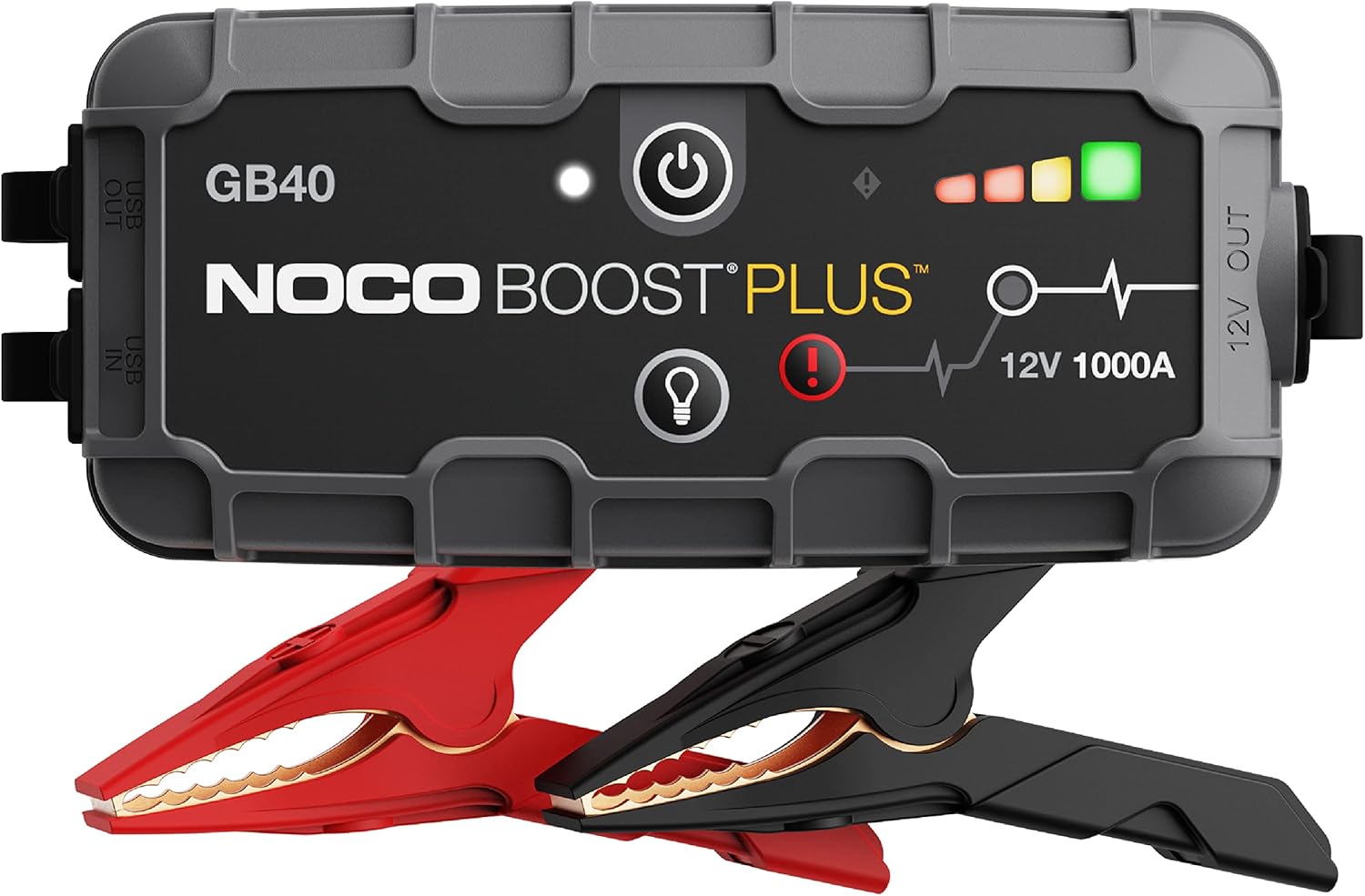
NOCO Boost Plus GB40 Jump Starter
A 1000A lithium jump starter that fits in your glovebox and works on any 12V battery. Your insurance against a dead 12V in a parking lot.
As an Amazon Associate, ThinkEV earns from qualifying purchases — at no extra cost to you.
The piece that turns any of these into automatic whole-home backup is the EcoFlow Smart Home Panel 2. Without it, you're physically swapping cords, deciding what to power, watching your phone for grid restoration. With it, the cutover is silent and the management happens in the app.
There's one more recharge path worth knowing about. The Delta Pro Ultra X accepts input from a Level 2 EV charging station. If you have a Level 2 home charger on a circuit that survived the outage, say, one fed from a different transformer than your main panel, you can use it to recharge the EcoFlow. Edge case, but in some rural setups with separate outbuildings, it's a real option.
What Does This Cost in Canada, and Are There Rebates?
The numbers in CAD, current pricing:
- EcoFlow Delta Pro Ultra (base unit): ~$5,499 direct from ca.ecoflow.com
- Smart Home Panel 2: ~$1,299
- Smart Extra Battery (6,144Wh expansion): ~$3,999 each
- Electrician installation (panel wiring, permit, inspection): $1,500–$2,500 depending on province and panel complexity
- Ford Charge Station Pro + Home Integration System (Lightning V2H): ~$1,300 USD plus install
- Total for a working V2L + EcoFlow + Smart Home Panel setup: roughly $8,500–$9,500 CAD installed
Compare that against the alternative: a permanently installed propane or natural-gas standby generator runs $8,000–$15,000 CAD installed in most Canadian markets. The EcoFlow path is competitive on capital cost, dramatically quieter, doesn't require fuel deliveries, and integrates with solar if you ever add it.
The case against the EcoFlow path is fuel autonomy. A 500-gallon propane tank running a 14kW Generac will hold a typical Canadian home, full HVAC, hot water, oven, the works, for five to seven days. The EcoFlow setup, even expanded to 25kWh and paired with an EV, runs essentials only and depends on either solar recovery or a still-driveable car. For homes on well water with electric pumps, septic systems with electric ejectors, or electric heating, the propane case remains stronger despite the noise and fuel-delivery overhead. The EcoFlow setup wins on quiet operation, daily TOU arbitrage value, and zero standing fuel cost, but it loses on raw multi-day endurance during a deep freeze with no sun.
Rebates are less generous than buyers hope. The federal iZEV programme covers vehicles, not home batteries. NRCan's Greener Homes Grant was wound down in 2024 and doesn't apply to battery storage. There is no federal Canadian incentive specifically for a Delta Pro Ultra installation.
Where the math improves:
- BC Hydro runs demand-response and time-of-use programs that pay homeowners with battery storage to discharge during peak grid demand. Enrolment is utility-specific; check your account portal.
- Ontario's Ultra-Low Overnight rate (3.0¢/kWh off-peak versus 28.6¢/kWh on-peak under the new tier) makes time-of-use arbitrage genuinely profitable for battery owners. Charge at 3 a.m., discharge during dinner, capture the spread daily. Over a year, the spread can return 8–12 percent of the battery's purchase price.
- Alberta's deregulated market offers similar arbitrage opportunities with retailers like Sponsor Energy and Encor by EPCOR.
- Quebec Hydro does not currently offer residential battery incentives, but the province's grid is so reliable that the backup case is weaker there anyway.
For most Canadian homeowners, the right way to think about the cost is: roughly $9,000 buys you a real backup system that pays a small dividend through TOU arbitrage. It does not pencil out as an investment. It pencils out as insurance against an increasing number of ice storms, wildfire-related shutoffs, and aging-grid outages.
What You Can and Can't Run During an Outage (Honest Load Math)
Where most reviews oversell EcoFlow setups: they show you the X-Boost spec sheet and let you assume you can power your whole house. You can't. Here's what 6,144Wh actually buys you in real Canadian winter conditions.
What runs comfortably on a single base unit:
- Refrigerator (150W average, cycling): 30–40 hours
- Gas furnace fan (400W when running): keeps cycling through a full overnight outage
- LED lighting throughout the house: 100–150W combined, effectively unlimited within the EcoFlow's runtime
- Router, modem, laptop charging, phone charging: under 50W total, days of runtime
- Microwave (1,000W intermittent), kettle (1,500W intermittent): yes, but each use costs you serious runtime
- A small space heater on low (750W): yes, but you're now running down the battery in 6–8 hours
What requires you to expand or rethink:
- Electric stove or oven (3,000–5,000W): too large for sustained use; brief microwave use only
- Central air conditioning (3,500W startup): X-Boost might handle the surge, but sustained operation drains the battery in 90 minutes
- Electric water heater (4,500W): drains a base unit in roughly 80 minutes
- Electric clothes dryer: not realistic on battery; skip until grid returns
The expansion math: Pair the Delta Pro Ultra with two Smart Extra Batteries (18kWh total) and you're at three to four days of essentials-only Canadian winter coverage. Add the EV in the loop and you stretch that to a week or more.
The thing most buyers don't plan for: how you use the battery matters as much as how big it is. A household that drops to 400W of true essentials (fridge cycling, furnace fan, two LED bulbs, one laptop) lasts roughly three times longer on the same hardware than a household that keeps the kitchen running normally. The single best upgrade most Canadian homes can make before buying any battery at all is a $40 plug-in wattmeter (Kill A Watt or equivalent) and an hour spent measuring what their actual continuous load looks like. Buyers consistently overestimate fridge wattage by 2–3× and underestimate the cumulative draw of always-on devices (cable boxes, smart speakers, gaming consoles in standby) by similar margins.
A practical sizing rule: take your "essentials" wattage, multiply by the hours you want covered, add 20 percent for cold-weather battery degradation, and that's your minimum kWh target. Most Canadian homes land at 12–18kWh for genuine 72-hour confidence.

Gear worth having
As an Amazon Associate, ThinkEV earns a small commission from qualifying purchases — at no extra cost to you.

Grizzl-E Classic Level 2 EV Charger (40A)
Canadian-made and rated for minus 40C winters. 40A / 9.6 kW, NEMA 14-50, indoor/outdoor, 24-ft cable. The charger built for Canadian weather.
As an Amazon Associate, ThinkEV earns from qualifying purchases — at no extra cost to you.
Is This Setup Right for You? A Canadian Buyer's Checklist
Walk through these questions before spending anything.
Do you already own an F-150 Lightning, Silverado EV, or older Nissan Leaf? The V2H math is excellent. Price out the Smart Home Panel 2 and the Ford or GM integration kit; the marginal cost of adding real whole-home backup is around $3,000–$4,000 if you've already got the truck.
Do you own any other EV? V2L into an EcoFlow still works as manual backup. Skip the Smart Home Panel; buy the Delta Pro Ultra standalone for around $5,500. You'll lose automatic transfer, but you'll gain a backup system you can also take camping or to the cottage.
Are you a renter or condo owner? Smart Home Panel installation isn't an option, you can't modify a panel you don't own. The Delta Pro Ultra standalone is your realistic ceiling. That's fine; it covers essentials for the typical Canadian urban outage of 4–12 hours.
Do you live in rural BC, Ontario cottage country, or a Quebec ice-storm zone? Backup ROI is highest here. Prioritise expandable capacity over fancy panel integration, two Smart Extra Batteries beat a Smart Home Panel for these use cases.
Are you on time-of-use electricity rates? The daily arbitrage case adds 8–12 percent annual return on the battery's purchase price. It doesn't change the buy/wait/skip call, but it shortens the payback window meaningfully.
Buy / Wait / Skip:
- Buy the Delta Pro Ultra + Smart Home Panel 2 if you own a Lightning or Silverado EV, live in an outage-prone area, and have $9,000 of capital that you'd otherwise spend on a propane generator.
- Buy the Delta Pro Ultra standalone if you own any EV with V2L, want backup without the panel install, and can tolerate manual cord-management during outages.
- Wait on the Delta Pro Ultra X unless you specifically need 32-circuit coverage or the 6,500W multi-charge speed. The standard Ultra is the better-value pick for now.
- Skip the original Delta Pro for home backup. Use that money toward the Ultra instead.
The flip condition, what would change the call: if Honda, Toyota, or Hyundai brings genuine V2H to Canada in the 2027 model year (the spec exists, the products are pending), and if Ontario or BC introduces a home-battery rebate matching what California currently offers under SGIP, this whole calculation shifts toward standalone EVs without separate batteries. Three signals are worth watching through 2026 and into 2027: Hyundai's E-GMP V2H pilot announcements in Korea and Europe (typically a 6–9 month lead before Canadian availability), the Ontario IESO's next residential battery storage consultation (the policy framework currently lags BC by about 18 months), and the Canadian launch of bidirectional CCS chargers from Wallbox or dcbel under $8,000 installed. Any two of those three shifting in the same six-month window and the buy/wait line moves materially toward "wait."
Gear worth having
As an Amazon Associate, ThinkEV earns a small commission from qualifying purchases — at no extra cost to you.

EcoNour 27-inch Snow Brush and Ice Scraper
An aluminum brush and scraper combo that clears a windshield fast without scratching. Non-negotiable for Canadian mornings.
As an Amazon Associate, ThinkEV earns from qualifying purchases — at no extra cost to you.
FAQ: Quick Answers for Canadian Buyers
The Delta Pro Ultra Is The Whole-Home Sweet Spot
For most Canadian homeowners, the Delta Pro Ultra plus Smart Home Panel 2 is the sweet spot for genuine whole-home essentials backup at around $9,000 installed. Lightning and Silverado EV owners get the strongest setup, true V2H plus a buffer battery that turns a multi-day outage into a non-event. Everyone else gets a flexible backup system that pairs with V2L when it matters and pays for itself slowly through time-of-use arbitrage.
What to watch next: whether the 2027 model year brings native V2H to mass-market EVs like the Ioniq 5, EV6, and the BYD lineup now entering Canada under the reduced tariff. If that happens, and if provincial battery rebates catch up to what California already offers, the price-to-capability ratio on this whole category drops by a third within 18 months. The hardware works today. The economics get materially better in the near future.
For an outage tonight, though, the answer hasn't changed: buy the Ultra, wire in the panel if you can, and stop worrying about January at 2 a.m.
Gear worth having
As an Amazon Associate, ThinkEV earns a small commission from qualifying purchases — at no extra cost to you.

Magnetic Windshield Snow Cover
Skip the scraping. Magnets hold it on, peel it off with the snow, and your defroster stops draining range on cold mornings.
As an Amazon Associate, ThinkEV earns from qualifying purchases — at no extra cost to you.

Founder & Chief Editor
Vlad Pereira is the founder and chief editor of ThinkEV.ca, the Canadian electric-vehicle publication he writes and edits from Courtenay, British Columbia. He covers EV pricing, federal and provincial rebates, charging costs, and the Chinese manufacturers now entering Canada, from the buyer's side rather than the press-fleet side. ThinkEV is a venture of Vlad Pereira Online; his writing on health, income and the long game lives at vladpereira.com.
Frequently asked questions
Does the Delta Pro Ultra actually recharge from an EV during an outage?
Which Canadian provinces have incentives covering EcoFlow or home batteries?
Can a rented home use this setup without panel modifications?
How does the Lightning's V2H compare to a propane generator on cost?
Will cold storage in an unheated garage destroy the Delta Pro Ultra's battery?
More EV & road-trip finds
Affordable upgrades worth a look — tap any to check the price on Amazon.
 ★ 537
★ 537USB Star Projector Roof Light
View on Amazon ★ 4,626
HoogaLife Hanging Car Diffuser (2-Pack)
View on Amazon ★ 21,304
Car Headrest Hooks (4-Pack)
View on Amazon ★ 1,944
VIOFO A229 Pro 4K Dash Cam
View on Amazon ★ 87
★ 87Car Window Sun Shades for Kids (4-Pack)
View on Amazon ★ 68
★ 68WeatherTech FloorLiner for Tesla Model 3
View on Amazon ★ 96,686
PULIDIKI Car Cleaning Gel (Detailing Putty)
View on Amazon ★ 314
★ 314Mini USB LED Ambient Lamps (4-Pack)
View on AmazonRead, Plan, Then Stay Current
Explore our expert articles to understand incentives and ownership costs, use the map to pressure-test charging reality, then subscribe so new EV coverage comes straight to you.
Continue Reading
Rivian R1T vs F-150 Lightning: Canada 2026 Test
Which EVs Should Be Charged to 100%? The LFP Exception

First-Time EV Buyer Mistakes Worth Avoiding in Canada

Rivian Canada 2026: R1T, R1S Prices and R2 Release Date
Why Cold Weather Cuts EV Range, the Real Reasons