Key takeaways
- At $77,495 for the Work Truck trim, this is not a casual purchase.
- The overall length sits at approximately 5,900 mm (232 inches), with a wheelbase of about 3,700 mm (146 inches).
- The Work Truck (WT) starts at $77,495 and exists for people who use a truck as a tool.
- What you get instead is the full 640+ km range, the full 10,000 lb towing capacity, the full 350 kW DC charging speed, CrabWalk, and V2H capability.
Canada has 3.5 million registered pickup trucks, more than one in five vehicles on the road, and the Silverado EV is the first full-size electric truck to take that market seriously on its own terms. A 200+ kWh battery pack (the largest in any production vehicle), 640+ km of rated range, 10,000 lb towing capacity, 350 kW DC charging. At $77,495 for the Work Truck, it starts above the EVAP rebate threshold, so most buyers won't see the $5,000 federal incentive. That's the entry price for what GM is calling a replacement for the diesel rigs that show up at job sites in Red Deer, haul lumber in Timmins, and pull boats to the cottage in Muskoka.
Now Chevrolet is asking a different question: what if you could keep everything a Silverado does, the towing, the hauling, the sheer physical presence of a truck that doesn't apologize for being large, and replace the combustion engine with something that's faster, quieter, and costs a fraction per kilometre to operate? The Silverado EV is GM's answer. And it's not a tentative one. With a 200+ kWh battery pack, the largest in any production vehicle, a range of 640+ kilometres, 10,000 lb towing capacity, and the fastest DC charging speed in the class at 350 kW, this is not a concept exercise or a compliance car. It's a full-size electric truck built to replace gas trucks in the lives of people who actually use trucks.
That matters specifically for Canada. This country has roughly 3.5 million registered pickup trucks. More than one in five vehicles on Canadian roads is a pickup. The pickup segment consumes more fuel annually than any other vehicle category in the country, and it's not even close. If full-size electric trucks work, actually work, not just for commuters who bought a truck because they liked the look, but for contractors and farmers and fleet operators who need the bed and the towing every single week, the downstream impact on Canadian fuel consumption is enormous. The Silverado EV is GM's bet that they do work. After spending serious time with this truck, I think GM is mostly right. With some honest caveats.
But first, the price. At $77,495 for the Work Truck trim, this is not a casual purchase. It exceeds the federal EVAP program's $50,000 final transaction value cap, so the $5,000 federal rebate does not apply unless the Silverado EV qualifies as Canadian-made, which would remove the price cap entirely. GM does manufacture some Silverado variants in North America, so check Transport Canada's current EVAP vehicle list before assuming you're ineligible, the rules here are more nuanced than the sticker price would suggest. Regardless, you're making a serious financial commitment. The question throughout this review is whether the truck justifies that commitment.
Design and Exterior
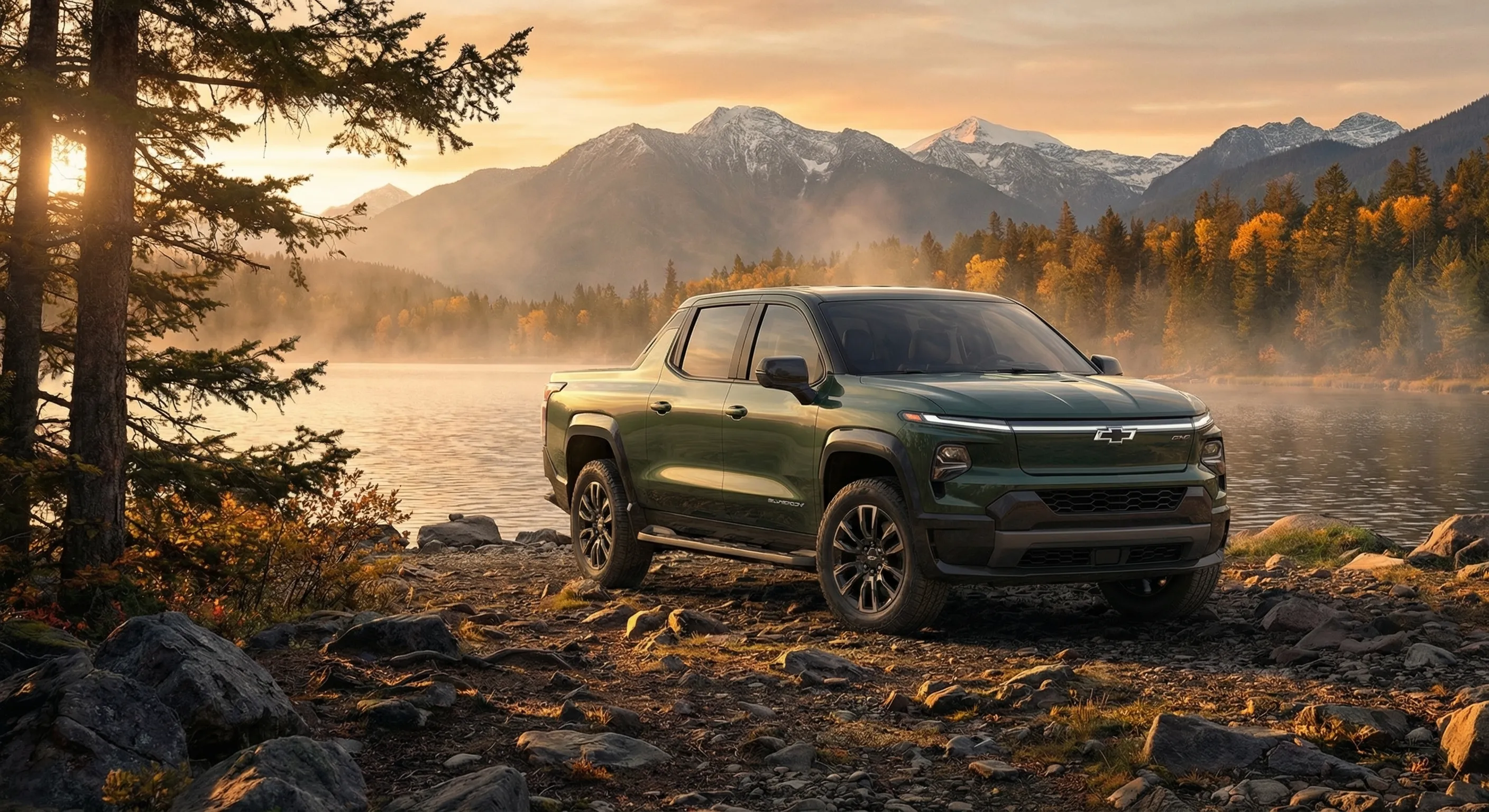
The Silverado EV is immediately, visually different from the gas Silverado. The front end is a sealed fascia, no grille, because there's no engine behind it that needs airflow. Instead, you get a smooth, aerodynamic face with LED signature lighting that spans the full width of the truck. It looks modern without looking like it's trying too hard, which is a balance that not every electric truck has managed. The Hummer EV, GM's other electric truck, leans into aggression. The Silverado EV leans into competence. It looks like a tool designed to work, not a toy designed to impress.
Dimensionally, this is a genuine full-size truck. The crew cab configuration is the only option, there's no regular cab or extended cab variant, which means GM is targeting the segment of truck buyers who need rear passenger space as well as cargo capability. The overall length sits at approximately 5,900 mm (232 inches), with a wheelbase of about 3,700 mm (146 inches). That wheelbase is noticeably longer than the gas Silverado's, and it's there for a reason: the battery pack sits in the floor between the axles, and a longer wheelbase means more battery without raising the floor height. The centre of gravity is substantially lower than a gas Silverado's as a result, which matters for handling and stability when loaded.
The bed is a 5-foot-11 standard configuration, shorter than the 6.5-foot or 8-foot beds available on gas Silverados. For buyers who need maximum bed length, that's a genuine concession. But the Silverado EV compensates with the Multi-Flex Midgate, which is one of the most practically clever features on any truck, electric or otherwise. The midgate is a pass-through between the cab and the bed.
Open it, fold down the rear seats, and you create a continuous load floor that extends the effective cargo length to over 9 feet. That's long enough to lay full sheets of 4x8 plywood flat, or carry 10-foot lumber without it hanging over the tailgate. The midgate doesn't replace an 8-foot bed for every use case, you can't fill it with gravel with the cabin open, but for dimensional cargo like building materials, piping, or long equipment, it solves the problem elegantly.
The Multi-Flex Tailgate is a separate feature, a six-way tailgate that folds and configures into different positions for different loading scenarios. It can serve as a step, a standing workstation, a load stop, or a traditional dropped tailgate. On a job site, the workstation position is genuinely useful: it creates a flat surface at a comfortable height with integrated rulers and tie-down points. Small detail, but the kind of thing that shows GM talked to actual tradespeople during the design process rather than just engineers.
Then there's CrabWalk. This is GM's four-wheel steering system, shared with the Hummer EV, that allows the rear wheels to turn up to 10 degrees in the same direction as the fronts. The result is diagonal movement at low speeds, the truck can move sideways. It sounds like a novelty until you try parallel parking a vehicle that's nearly 6 metres long on a narrow residential street in Toronto's Annex neighbourhood or backing a trailer into a tight boat launch at Cultus Lake. CrabWalk reduces the turning radius to something approaching a midsize sedan's, which transforms the experience of manoeuvring a full-size truck in spaces that weren't designed for full-size trucks. Every Canadian city has those spaces. CrabWalk is genuinely useful in every single one of them.
Work Truck vs RST
The Silverado EV comes in two main trims, and understanding who each one serves is essential to evaluating whether this truck works for you. They share a platform, a battery architecture, and the same fundamental engineering. But they're aimed at fundamentally different buyers, and the price gap between them reflects that.
The Work Truck (WT) starts at $77,495 and exists for people who use a truck as a tool. The interior is durable, functional, and deliberately not luxurious. The seats are cloth, the kind that can handle muddy boots, sawdust, and the general abuse that a working truck interior absorbs over years of daily use. The infotainment is an 11-inch touchscreen running Google Built-In, functional, responsive, and not over-designed. Climate control is straightforward. There's no ambient lighting or massage seats. What you get instead is the full 640+ km range, the full 10,000 lb towing capacity, the full 350 kW DC charging speed, CrabWalk, and V2H capability. Nothing about the capability is compromised by choosing the WT. You're paying $77,495 for one of the most capable trucks ever built.
For fleet operators, the WT is the obvious choice. A plumbing company in Brampton running six trucks, a construction outfit in Kelowna that needs reliable daily transportation plus job site power, a municipal utility fleet in Ottawa, the WT gives these buyers everything they need and nothing they'll pay to replace when an apprentice spills coffee on the centre console. The operating cost savings over diesel trucks (which we'll get to in the Ownership section) are the primary financial argument, and the WT's lower entry price makes the payback period shorter.
The RST is the lifestyle truck. It starts above $100,000 and pushes the range to 724 km, the longest of any electric pickup on the market in 2026. The interior steps up substantially: leather-appointed seating, a larger 17-inch infotainment display, a premium Bose audio system, ventilated front seats, and a cabin that feels closer to a Cadillac than a job site vehicle. The suspension is adaptive, tuned for ride comfort rather than pure load-carrying stiffness. The RST is the truck you buy when you want the capability of a full-size pickup, the towing, the bed, the V2H, the CrabWalk, but your primary use case is driving to the cottage on weekends, taking the family to Whistler, or commuting in comfort on Highway 2 between Calgary and Edmonton.
The RST also gets Super Cruise, GM's hands-free highway driving system. More on that in the Interior and Technology section, but the short version is that Super Cruise is genuinely excellent and represents a real quality-of-life improvement on long highway drives.
The pricing gap between WT and RST is significant, roughly $25,000 to $30,000 depending on configuration. That's not a trivial upsell. But the range difference alone (640 km vs 724 km) translates to approximately 13% more range per charge, which compounds over years of ownership. For a buyer who does regular 500+ km drives, Ottawa to Toronto, Calgary to Edmonton and back, Vancouver to Kamloops, the RST's additional range means fewer charging stops over the life of the truck.
Both trims get CrabWalk. Both get V2H. Both get 350 kW DC charging. Both get 10,000 lb towing. The capability floor is the same. The question is whether you want that capability wrapped in work-grade durability or premium comfort.
For most Canadian truck buyers: if the truck is primarily a work tool and the $77,495 WT price already stretches your budget, the WT gives you everything that matters. If the truck is your daily driver, your family vehicle, and your weekend recreation vehicle rolled into one, and you can absorb the RST's price, the comfort and range upgrades are worth the premium. Neither choice is wrong. They're just serving different lives.
Interior and Technology
The Silverado EV's interior is built around screens, connectivity, and the assumption that a truck in 2026 should be as technologically capable as any sedan or SUV on the market. GM has not held back here.
The WT gets an 11-inch diagonal infotainment touchscreen running Google Built-In, not Android Auto mirroring your phone, but native Google Maps, Google Assistant, and the Google Play Store running directly on the truck's hardware. The practical difference is significant: you don't need your phone connected for navigation, voice commands, or app access.
Google Maps updates in real-time with traffic, charging station data, and route optimization. Google Assistant handles voice commands for climate, navigation, and media with the responsiveness you'd expect from Google's own hardware rather than the lag that characterizes many automotive voice systems. The Google Play Store means you can install apps directly, Spotify, podcast apps, and in Canada, the CBC Listen app for those long highway drives through Saskatchewan where FM stations are 200 km apart.
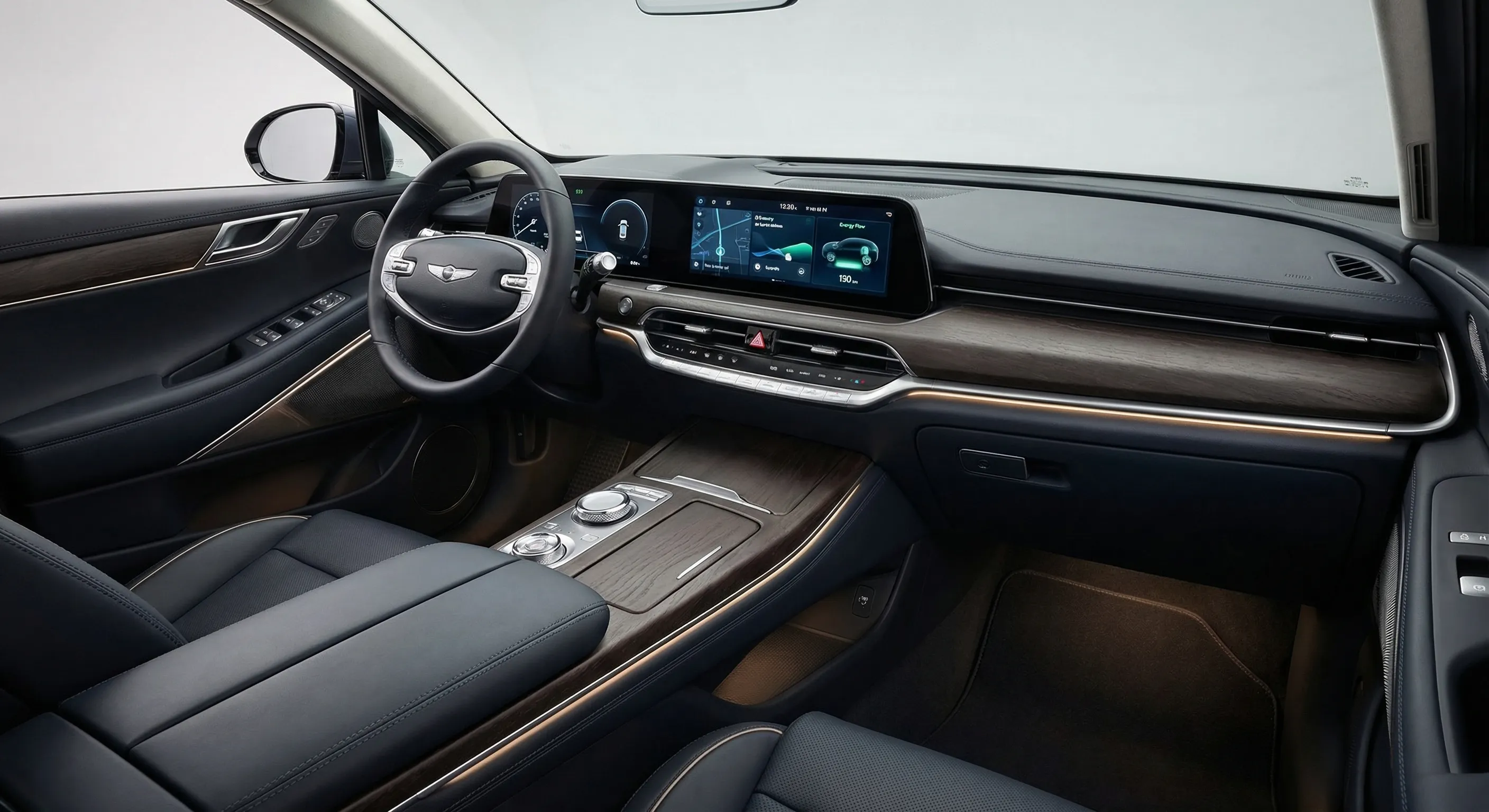
The RST steps up to a 17-inch freestanding touchscreen, one of the largest in any production vehicle. It's angled toward the driver and positioned centrally. The display is sharp, responsive, and handles split-screen views well. You can have navigation on one side and your charging status or energy flow diagram on the other. The Bose premium audio system in the RST is genuinely good, 14 speakers, including a subwoofer that makes highway driving more immersive and long-distance drives less fatiguing. Audio quality in a truck cab is challenging because of the upright glass, flat surfaces, and road noise. Bose has tuned this system specifically for the Silverado EV's cabin geometry, and the result is noticeably better than the standard system.
Super Cruise, available on the RST, is GM's hands-free highway driving system and arguably the best driver assistance technology available on any vehicle in 2026. It works on pre-mapped divided highways across Canada, including major sections of the Trans-Canada, the 400-series highways in Ontario, the QEW, and major corridors in BC and Alberta. The system uses LiDAR mapping data, GPS, cameras, and a driver-facing attention monitor. When engaged, you can take your hands off the wheel completely. The truck handles lane-keeping, speed management, and following distance. You must keep your eyes on the road, the driver-facing camera monitors your gaze and will alert you if you look away, but removing the physical task of steering on a 6-hour highway drive is a genuine fatigue reducer.
For Canadian buyers specifically, Super Cruise coverage on the Trans-Canada through Ontario and across the Prairies is where it delivers the most value. These are long, straight, well-maintained divided highways where the cognitive load of manual driving is low but the physical fatigue of gripping the wheel for hours is real. Super Cruise handles those stretches gracefully. On the drive from Sudbury to Thunder Bay, one of the longest stretches of highway in Canada with relatively little variation, the difference between hands-on and hands-free driving over 8 hours is the difference between arriving tired and arriving comfortable.
Storage in the crew cab is generous. The rear seats fold flat to create a continuous surface, and the under-seat storage bins are large enough for tools, cables, and the kind of miscellaneous equipment that accumulates in any working truck. The front centre console includes a deep storage bin and multiple USB-C charging ports. The WT's interior is deliberately straightforward, everything you need, nothing you don't, while the RST adds details like ambient lighting, leather-wrapped surfaces, and soft-touch materials on the dash and door panels.
One feature that deserves specific mention: the Silverado EV has a fixed glass roof on the RST that floods the cabin with natural light. It doesn't open, it's a fixed panel, but the effect on the interior feel is dramatic. The cab feels larger and more open than any previous Silverado. In a country where winter daylight is short and grey, that extra light in the cabin during a December commute is a small quality-of-life improvement that adds up over months.
Gear worth having
As an Amazon Associate, ThinkEV earns a small commission from qualifying purchases — at no extra cost to you.

Portable Level 2 EV Charger (40A, NEMA 14-50)
Throw it in the trunk and charge anywhere with a 240V outlet. 40A portable with NEMA 14-50 plug. Your road-trip insurance policy.
As an Amazon Associate, ThinkEV earns from qualifying purchases — at no extra cost to you.
Range and Battery
The Silverado EV's battery is the single most impressive specification on the truck, and it deserves detailed treatment because it's the foundation that every other capability depends on.
The Ultium battery platform uses a 200+ kWh nickel-cobalt-manganese-aluminium (NCMA) chemistry arranged in a flat, skateboard-style configuration between the frame rails. This is the largest battery pack in any production vehicle as of 2026. For context, a Tesla Model 3 uses approximately 75 kWh. A Ford F-150 Lightning Extended Range uses 131 kWh. The Silverado EV's pack is roughly 50% larger than the Lightning's and nearly three times the capacity of a Model 3. That's not a marginal difference, it's a category difference.
The WT delivers 640+ km of Natural Resources Canada-rated range. The RST pushes that to 724 km. These are NRCan figures, which use a combined city/highway test cycle that's more conservative than the American EPA cycle. In real-world Canadian driving, a mix of city, suburban, and highway, expect to see numbers close to the rated range in spring and autumn conditions. Highway-only driving at 110 km/h with climate control running will pull the number down somewhat, because aerodynamic drag at sustained highway speed is the biggest single energy consumer. City driving with frequent stops actually favours EVs because regenerative braking recovers energy during deceleration, so urban range can exceed the rated figure.
To put 640 km in practical Canadian terms: that's Toronto to Montreal (541 km) with 100 km to spare. It's Calgary to Edmonton (299 km) and back without charging. It's Vancouver to Kamloops (355 km) with enough range left for a full day of driving around the Thompson Valley. It's Ottawa to Sudbury (484 km) with a comfortable margin. For the overwhelming majority of Canadian daily driving patterns, the average Canadian drives 47 km per day, you're charging this truck once a week at most.
The RST's 724 km range is the longest of any electric pickup in 2026, and it pushes into territory where range anxiety becomes largely irrelevant for any single-day driving scenario that doesn't involve towing. Toronto to Ottawa (449 km) and back starts to become plausible on a single charge with careful driving. That's a psychological milestone for truck buyers coming from gas vehicles where refuelling is a 5-minute inconvenience rather than a 30-minute charging stop.
The Ultium platform's modular architecture is worth understanding because it has implications for the truck's long-term value. GM designed Ultium with battery health in mind, sophisticated thermal management keeps the cells in their optimal temperature range during charging, discharging, and storage. GM warranties the battery for 8 years or 160,000 km, whichever comes first, with a guaranteed minimum of 70% original capacity. Based on early data from Ultium-equipped vehicles, real-world degradation appears to be tracking well below the warranty threshold, suggesting that a well-maintained Silverado EV at 200,000 km should retain significant battery capacity.
For buyers concerned about battery replacement costs, a legitimate concern, the Ultium pack's modular design means individual modules can be replaced rather than the entire pack. A full pack replacement at current pricing would be expensive (in the $20,000-$30,000 range), but module-level repairs for a degraded section are significantly less. The battery is also warranted under EVAP requirements for any province with zero-emission vehicle mandates, providing additional consumer protection.
Charging
The Silverado EV's 350 kW DC fast charging capability is the fastest in the electric truck segment, and it's faster than most electric vehicles of any type. At a 350 kW station, available at select Electrify Canada locations and some newer third-party installations, the Silverado EV can charge from 10% to 80% in approximately 28 to 32 minutes under ideal conditions with a warm battery. That's roughly 450 km of range added in half an hour. It's faster than the average Tim Hortons drive-through at lunch hour, and it's meaningfully faster than the Ford F-150 Lightning's 150 kW peak, which takes approximately 41 minutes for the same state-of-charge window.
A few caveats on that 350 kW number, because honesty matters more than headline specs. The truck doesn't sustain 350 kW for the entire charging session. Battery chemistry and thermal limits mean the charge rate starts high and tapers as the battery fills. The fastest charging happens in the 10% to 50% range. Above 50%, the rate begins to slow, and above 80%, it slows dramatically, which is why most EV charging guidance recommends charging to 80% for road trips rather than waiting for 100%. The real-world experience is that you pull in, plug in, walk inside for coffee and a washroom break, and come back to a truck with enough range for the next 400+ km. That's the target experience, and the Silverado EV delivers it consistently.
The Silverado EV uses the NACS (North American Charging Standard) connector, which means direct access to Tesla's Supercharger network, over 200 locations across Canada and growing. This is a significant practical advantage. Tesla Superchargers are consistently the most reliable, most available, and best-maintained charging stations in the country. Third-party networks (Electrify Canada, Flo, ChargePoint, Petro-Canada) are expanding, but uptime and reliability vary. Having Supercharger access as a default rather than requiring an adapter expands the real-world usable charging network substantially, particularly outside major urban centres.
For Canadian truck buyers, the charging network situation breaks down geographically. In Ontario, Quebec, and BC's Lower Mainland and Okanagan, DC fast charging coverage is dense enough that road trips require minimal planning beyond what the truck's built-in route planner handles. The corridor between Windsor and Quebec City is well-served. BC's Highway 1 and Highway 97 have reasonable coverage. Alberta's Highway 2 corridor between Calgary and Edmonton is solid.
Where gaps remain: northern Alberta beyond Edmonton, northwestern Ontario between Sault Ste. Marie and Thunder Bay (coverage exists but is thin), rural Saskatchewan outside the Regina-Saskatoon corridor, and much of Atlantic Canada outside Halifax and Moncton. If your regular driving includes these areas, you'll need to plan around home charging and potentially carry a portable Level 2 charger for emergency top-ups at any 240V outlet. The infrastructure is building out rapidly, NRCan's Zero Emission Vehicle Infrastructure Program is funding new stations, but in 2026, gaps still exist for remote and rural routes.
Home charging is where the Silverado EV's daily economics become compelling, and it's worth spending time on because for most buyers, 90% or more of all charging happens at home. A Level 2 home charger on a 240V circuit, typically a 48-amp unit drawing about 11.5 kW, adds approximately 50 to 55 km of range per hour. That means a truck that comes home at 50% charge (roughly 320 km of range used) will be back to full in about 6 hours. Plug in at 10 PM, wake up at 6 AM to a full truck. Every night. No gas stations, no detours, no waiting.
For truck buyers specifically, the electrical panel consideration is worth addressing directly. A 48-amp Level 2 charger requires a dedicated 60-amp circuit on your home's electrical panel. Many Canadian homes, particularly older ones, have 100-amp or 200-amp main panels. A 100-amp panel may not have room for a 60-amp circuit alongside existing loads (electric stove, dryer, AC).
If you're in a newer home with a 200-amp panel, installation is straightforward, typically $700 to $1,500 for the charger, wiring, and installation. If you need a panel upgrade to 200 amps, that adds $2,000 to $4,000 depending on your utility and municipality. This is a real cost that should be factored into the purchase decision, but it's a one-time cost that serves you for the life of the truck and any future EVs.
For contractors specifically, the charging cost math is straightforward. At a Canadian average residential electricity rate of $0.15 per kWh, a full charge of the 200+ kWh battery costs approximately $30 to $32. That full charge gives you 640+ km of range. Compare that to fuelling a gas Silverado with the 6.2L V8, which costs roughly $180 to fill at current prices and delivers approximately 500 km of mixed driving range. You're looking at roughly $30 versus $180 for comparable distance. That's not a rounding error. That's a structural change in operating costs.
Gear worth having
As an Amazon Associate, ThinkEV earns a small commission from qualifying purchases — at no extra cost to you.
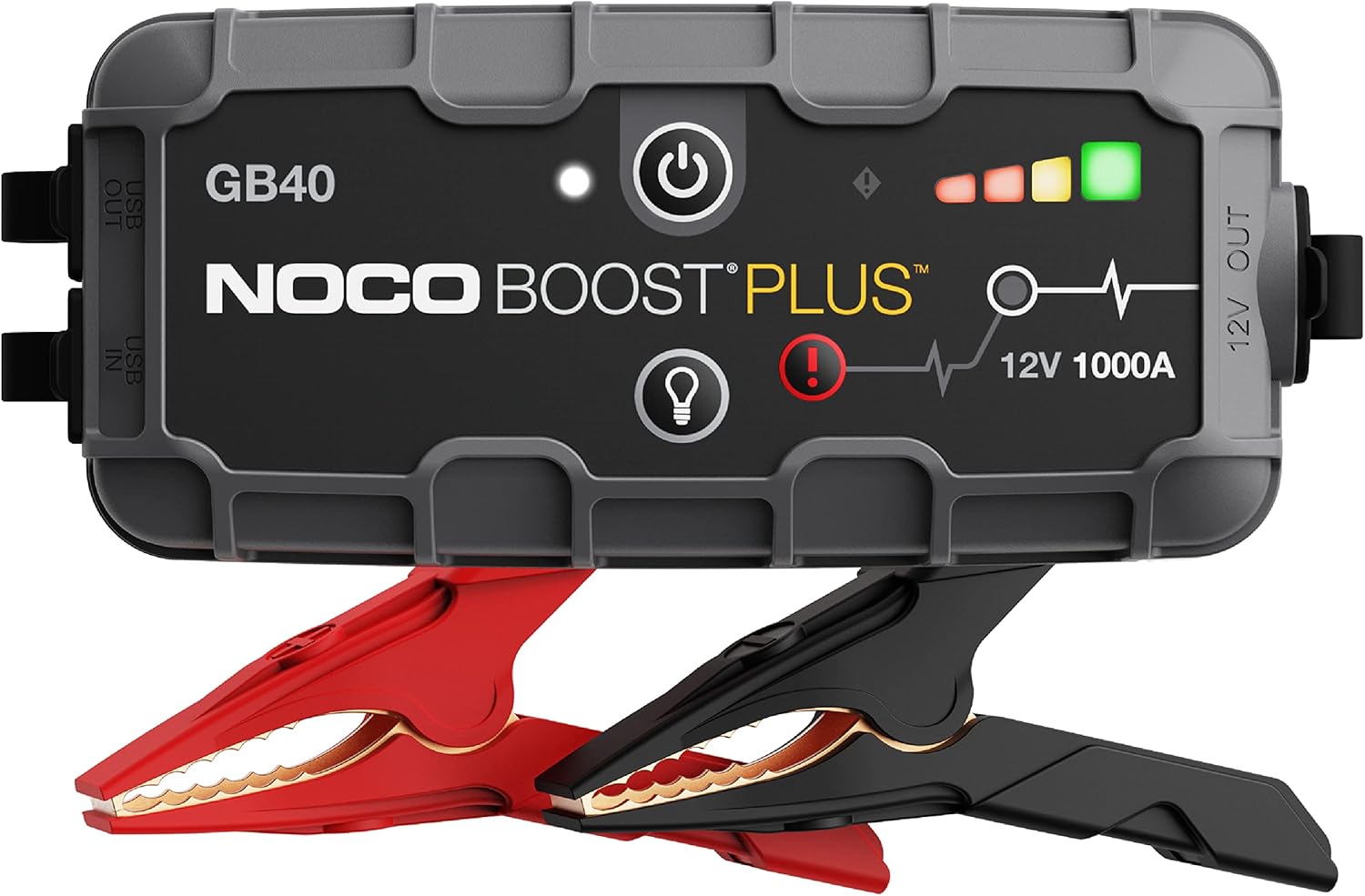
NOCO Boost Plus GB40 Jump Starter
A 1000A lithium jump starter that fits in your glovebox and works on any 12V battery. Your insurance against a dead 12V in a parking lot.
As an Amazon Associate, ThinkEV earns from qualifying purchases — at no extra cost to you.
At current provincial electricity rates, the per-kilometre cost varies: Quebec is the cheapest at roughly $0.03 per km, Ontario sits around $0.05 per km, BC is approximately $0.04 per km, and Alberta varies with market rates but averages around $0.06 per km. All of these are dramatically lower than gasoline at $0.20 to $0.28 per km depending on the gas truck's fuel economy and provincial fuel prices.
Winter and Towing Reality
Towing is where every electric truck faces its hardest test, and towing range takes a real penalty. The Silverado EV's 10,000 lb towing rating is legitimate, it pulls a loaded boat trailer, a construction equipment flatbed, or a travel trailer without hesitation. The instant torque delivery from the electric motors means the truck doesn't need to downshift, build RPM, or wait for power to arrive. You press the accelerator and the torque is there immediately, at full force, from zero RPM. On a boat launch, on a steep grade, pulling away from a traffic light with a loaded trailer, the experience is genuinely superior to any gas truck.
Range under towing load drops significantly. The numbers:
At 5,000 lbs of towing (a mid-sized boat trailer, a loaded utility trailer, or a small travel trailer), expect the WT's 640 km range to drop to approximately 350 to 400 km. That's a 38% to 45% reduction. The physics here is straightforward: aerodynamic drag from the trailer scales with the square of velocity, and at 100 km/h on a Canadian highway, a trailer creates substantial additional load that the battery must overcome continuously. Regenerative braking recovers some energy during deceleration, but at sustained highway speed, you're not decelerating enough for regen to make a meaningful dent.
At the full 10,000 lb rating (a large boat, a loaded construction trailer, or a substantial travel trailer), range drops to approximately 280 to 320 km. That's roughly half the rated range. This is consistent with what every electric truck experiences under maximum tow load, and it's important to plan around it honestly rather than discovering it mid-trip.
What do these numbers mean in practical Canadian terms? At 5,000 lbs, you can tow from Calgary to Banff (130 km) and back with range to spare. You can tow from Toronto to Wasaga Beach (150 km) and back comfortably. You can handle daily contractor runs within a 100 to 150 km radius of home base without charging during the workday. The 350 to 400 km towing range covers the vast majority of Canadian towing scenarios that don't involve multi-day road trips.
At 10,000 lbs, the math tightens. Calgary to Edmonton (299 km) becomes a one-way trip with a charging stop needed before the return. Toronto to Sudbury (390 km) requires a charging stop. You're planning your route around DC fast chargers in a way that a gas truck driver never has to. The Silverado EV's 350 kW charging speed helps here, a 20 to 25 minute top-up at a DC fast charger adds enough range for the next 150 to 200 km of towing, but it's still planning you wouldn't need with a gas truck.
For the specific buyer who tows 10,000 lbs regularly over 400+ km stretches, the kind of hauling that defines some Canadian commercial operations, the charging infrastructure gaps in rural areas create genuine friction. If your route includes DC fast chargers every 150 to 200 km, the experience is manageable: you stop, you charge, you continue. If your route crosses northern Alberta, rural Saskatchewan, or the northern Ontario stretch between Sault Ste. Marie and Sudbury with limited charging infrastructure, you need to plan meticulously. This will improve as the network expands, but in 2026, it's a limitation.
Winter adds a second layer to the towing reality. At -20C without towing, the WT's 640 km rated range drops to approximately 450 to 500 km. That's a 22% to 30% reduction, which is actually quite good by EV standards, the Silverado EV's massive battery and GM's sophisticated thermal management system keep it toward the better end of cold-weather performance. The battery thermal management uses liquid cooling and heating to maintain the cells in their optimal temperature window, and the heat pump (standard on both trims) reduces the energy cost of cabin heating compared to resistive heaters.
Combine winter and towing, and the math compounds. At -20C with 5,000 lbs, expect roughly 280 to 330 km. At -20C with 10,000 lbs, plan for 220 to 270 km. These are the real numbers, and they matter for planning. A contractor in Saskatoon towing equipment to a job site 100 km away in January can do the round trip with margin. A boat owner towing from Barrie to Parry Sound (150 km) in October is completely fine. But a 300 km winter haul at full load requires a charging stop, and you need to know that before you leave.
The Silverado EV handles cold starts better than most EVs because the battery's sheer size provides thermal inertia, a 200+ kWh pack takes longer to cold-soak than a 75 kWh pack, which means overnight in a garage at -15C, the pack retains more of its operating temperature than a smaller battery would. Preconditioning while plugged in, starting the battery and cabin warming 20 to 30 minutes before departure, makes a measurable difference: you leave with a warm battery at full rated capacity and a warm cabin that doesn't need to draw heavily from the battery for heating. Canadian truck owners already understand the concept of plugging in overnight, block heaters have been standard Canadian winter practice for decades. The Silverado EV just uses that plug for more things.
For the comprehensive picture of how electric trucks perform in Canadian winters, including testing methodology and real-world data across multiple vehicles, check our EV winter range test.

Gear worth having
As an Amazon Associate, ThinkEV earns a small commission from qualifying purchases — at no extra cost to you.

Grizzl-E Classic Level 2 EV Charger (40A)
Canadian-made and rated for minus 40C winters. 40A / 9.6 kW, NEMA 14-50, indoor/outdoor, 24-ft cable. The charger built for Canadian weather.
As an Amazon Associate, ThinkEV earns from qualifying purchases — at no extra cost to you.
V2H: Vehicle-to-Home
The Silverado EV's Vehicle-to-Home capability is not a party trick. In a country where ice storms knock out power for days, where rural grid infrastructure is aging, and where winter blackouts can be genuinely dangerous, V2H is a feature that could be the single most compelling reason to buy this truck over a gas Silverado. It deserves its own section because the implications are that significant.
Here's how it works. The Silverado EV can export up to 10.2 kW of power from its battery to your home through a compatible bidirectional charger and home integration panel. The setup requires a GM-approved bidirectional charger (installed in your garage or on an exterior wall) and a transfer switch installed in your home's electrical panel. The transfer switch is what allows the truck's power to flow into your home circuits while disconnecting from the grid, a safety requirement that prevents the truck from backfeeding power into downed utility lines. Total installation cost for the charger and transfer switch runs approximately $5,000 to $8,000 depending on your home's electrical configuration and local electrician rates.
What 10.2 kW actually powers is worth spelling out concretely, because the number means nothing in the abstract. A typical Canadian home in winter survival mode, gas furnace blower motor (400 to 600 watts), refrigerator (150 watts), essential lighting (300 to 500 watts), phone and device charging (200 watts), and a sump pump if you have one (400 watts intermittently), draws approximately 1,200 to 1,800 watts steady-state. At 1,500 watts average draw, the Silverado EV's 200+ kWh battery provides approximately 130 to 140 hours of backup power. That's nearly six days. Most Canadian ice storm power outages are measured in hours, not days. For the vast majority of outage scenarios, the Silverado EV is functionally inexhaustible.
Run the home more normally during an outage, television, microwave, electric kettle, more lighting, a space heater for a room without gas heat, and you're averaging 3,000 to 4,000 watts. That still gives you 50 to 70 hours of power. Two to three full days of comfortable living while your neighbours are lighting candles and checking their phones for hydro restoration updates.
The 10.2 kW output is also higher than the F-150 Lightning's 9.6 kW V2H system, and the Silverado EV's larger battery means substantially longer runtime at equivalent power draw. Both trucks can power a home during an outage. The Silverado EV can do it for longer.
For rural Canadians, and Canada has a lot of rural, this capability replaces or supplements standalone generators. A whole-home natural gas standby generator costs $8,000 to $15,000 installed, requires annual servicing at $150 to $300 per visit, depends on continued gas supply during an outage, and runs at 70 to 80 decibels. A propane generator has similar costs plus fuel storage requirements. A portable gas generator runs at 60 to 75 decibels and requires manual setup in potentially dangerous weather conditions. The Silverado EV's V2H operates silently, requires no fuel, requires no maintenance beyond the truck's own service schedule, and activates by plugging in the truck and pressing a button.
For Canadians in areas with unreliable grid infrastructure, parts of rural Newfoundland and Labrador, northern BC, pockets of Nova Scotia and New Brunswick, northern Ontario communities, V2H isn't a nice-to-have. It's a functional upgrade to their home's resilience that happens to also be their daily transportation. The dual-use value proposition is compelling in a way that few vehicle features ever are.
One practical consideration: using V2H power during an extended outage will deplete the truck's battery, which means reduced driving range when power is restored. If you draw 2,000 watts for 24 hours, that's 48 kWh, roughly 25% of the battery, or about 160 km of driving range consumed. For most outage scenarios, this is an acceptable trade-off. For a multi-day outage where you also need to drive, you'd manage the battery between home power and transportation needs. The truck's display shows the current state of charge and estimated remaining power duration, so you can make informed decisions.
Ownership and Costs
The financial case for the Silverado EV is not about the sticker price. If you look at the $77,495 WT price tag and compare it to a $55,000 gas Silverado WT, the electric version looks expensive. And it is, upfront. But trucks are owned for years, driven for hundreds of thousands of kilometres, and fuelled continuously throughout. The ownership cost calculation is where the Silverado EV's case becomes genuinely compelling.
Start with fuel savings. A gas Silverado with the 5.3L V8 in real-world Canadian mixed driving consumes approximately 14 to 16 litres per 100 km. With the 6.2L V8 that many WT and LT buyers spec, it's 15 to 18 litres per 100 km. Diesel variants run 12 to 14 litres per 100 km but use more expensive fuel. At current Canadian fuel prices of $1.60 to $1.70 per litre for regular gasoline and $1.75 to $1.85 for diesel, the annual fuel cost for a gas Silverado driven 25,000 km per year (common for a working truck) is $5,600 to $7,650 for gasoline, or $5,250 to $6,475 for diesel.
The Silverado EV at the same 25,000 km per year, charged at home at an average of $0.15 per kWh, consuming approximately 25 to 28 kWh per 100 km in mixed driving, costs $938 to $1,050 in electricity per year. The annual fuel savings range from $4,200 to $6,600 depending on what you're comparing against.
For contractors who drive more, 35,000 to 50,000 km per year is common for trades vehicles, the savings scale linearly. A contractor driving 40,000 km per year saves roughly $7,000 to $10,000 annually in fuel compared to a gas equivalent. Over a five-year ownership period, that's $35,000 to $50,000 in fuel savings alone. That doesn't just close the price premium, it can exceed it.
Maintenance costs compound the savings further. No oil changes (a gas Silverado gets serviced every 7,500 to 12,000 km, call it three to four times per year at $80 to $120 each for a working truck). No transmission fluid services. No spark plugs. No exhaust system repairs. No belt replacements. No fuel filter changes. The Silverado EV's main maintenance items are tire rotations and replacements, brake pad inspection (which last dramatically longer because regenerative braking handles most deceleration), cabin air filter replacement, and coolant checks for the battery thermal management system.
Conservative estimates put annual maintenance at $400 to $600 for the Silverado EV versus $1,200 to $2,000 for a gas Silverado doing equivalent work. That's $600 to $1,400 per year in maintenance savings.
The total five-year cost of ownership comparison for a WT Silverado EV versus a gas Silverado WT, assuming 25,000 km per year:
-
Silverado EV WT purchase: $77,495
-
Five-year electricity: $4,690 to $5,250
-
Five-year maintenance: $2,000 to $3,000
-
Five-year total: $84,185 to $85,745
-
Gas Silverado WT purchase: $55,000 to $60,000
-
Five-year fuel: $28,000 to $38,250
-
Five-year maintenance: $6,000 to $10,000
-
Five-year total: $89,000 to $108,250
The Silverado EV is cheaper to own over five years than the gas equivalent in most scenarios, and the gap widens with higher annual mileage. For fleet operators running multiple trucks at 40,000+ km per year, the economics are overwhelming.
Now, EVAP eligibility. The federal Electric Vehicle Availability Program provides a $5,000 rebate for eligible zero-emission vehicles. The standard eligibility requires a final transaction price under $50,000, which the Silverado EV exceeds by a wide margin. However, vehicles manufactured in Canada have no price cap under EVAP. GM manufactures Silverado variants at the Oshawa Assembly Plant in Ontario, and if the Silverado EV qualifies as Canadian-made under EVAP rules, the $5,000 rebate applies regardless of price. Check Transport Canada's current EVAP vehicle list for the latest eligibility status, this is a detail worth confirming with your dealer before purchase, as it's $5,000 that either applies or doesn't based on manufacturing classification.
Provincial incentives vary. BC's CleanBC Go Electric program and Quebec's Roulez vert program both have their own price caps and eligibility criteria. Some provinces offer additional workplace or commercial fleet incentives that may apply to the Silverado EV. Check your province's current programs, they change frequently and the specific vehicle eligibility matters.
Insurance costs for the Silverado EV run approximately 10 to 20% higher than a gas Silverado in most Canadian provinces, reflecting the higher vehicle value and higher repair costs for EV-specific components. This adds roughly $200 to $500 per year to insurance premiums. It's a real cost, but it doesn't materially change the five-year economics when fuel and maintenance savings are factored in.
The Verdict
The Silverado EV is the electric truck that takes itself seriously. It doesn't apologize for being big. It doesn't compromise on capability to hit a lower price point. It doesn't pretend that the transition from gas to electric is trivial. Instead, it delivers the specifications that truck buyers actually care about, range, towing, charging speed, and durability, at levels that make the electric transition genuinely practical rather than aspirational.
The 640+ km range is the most important number on the spec sheet, because it's the one that determines whether this truck can replace a gas Silverado in your actual life. For the vast majority of Canadian truck owners, the ones driving daily routes under 200 km, towing within a 150 km radius, and parking in a driveway where a Level 2 charger can live, the answer is yes. The range is sufficient, the charging is fast enough, and the daily convenience of waking up to a full "tank" every morning without visiting a gas station is a quality-of-life improvement that's hard to appreciate until you've experienced it for a few weeks.
The 10,000 lb towing is real, and the instant torque delivery makes towing feel better than any gas truck. The range penalty under load is also real, and buyers who tow at or near maximum capacity over long distances need to plan around charging infrastructure in a way that gas truck owners don't. The infrastructure is catching up, GM's own charging network investments and the expanding Supercharger access are genuine improvements, but in 2026, gaps remain in rural and northern Canada.
The V2H capability is a genuine differentiator. In a country where power outages are not hypothetical, where ice storms and windstorms knock out power to hundreds of thousands of homes every winter, having 200+ kWh of battery backup that can power your home for days is not a marketing feature. It's practical resilience. For rural buyers, for anyone who's ever lost power for 48 hours in January, the V2H alone might justify the premium over a gas truck.
The price is steep. At $77,495 for the Work Truck, this is not an impulse buy. But if you're spending $150 to $200 a week on diesel for a gas Silverado, the math starts to work in your favour within 3 to 4 years. Fleet operators are going to love this truck, the operating cost savings at scale are significant. Individual buyers will need to run the numbers for their specific driving patterns, electricity rates, and financing terms. If the math works, and for many Canadian truck buyers, it will, there's nothing else on the market that matches what the Silverado EV delivers.
The Silverado has been a Canadian institution for decades. The electric version doesn't abandon that identity. It just powers it differently, with more torque, less noise, lower operating costs, and a battery that can keep your house warm when the grid can't. That is an upgrade, not a compromise.
For home charging setup guidance, including Level 2 charger recommendations and installation considerations specific to truck ownership, see our best Level 2 EV chargers guide.
Gear worth having
As an Amazon Associate, ThinkEV earns a small commission from qualifying purchases — at no extra cost to you.

AstroAI Portable Tire Inflator
One tap, it inflates to your exact PSI then stops automatically. Low tires cost 5 to 10 percent of your range, so this pays for itself in a week.
As an Amazon Associate, ThinkEV earns from qualifying purchases — at no extra cost to you.
Related Reading
- Ford F-150 Lightning Canada Review 2026, Ford's electric pickup reviewed head-to-head
- GM Overtakes Tesla in Canada: What It Means, GM's EV strategy is working, and the Silverado is a big reason why
- Best Level 2 EV Chargers Canada 2026, Home charging setup for any EV, including trucks
- EV vs Gas: Total Cost of Ownership Canada 2026, The full financial breakdown for Canadian buyers
- EV Winter Range Test Canada 2026, Real-world cold weather range data across multiple EVs
- EV Charging Costs by Province Canada 2026, What you'll actually pay to charge in every province
Gear worth having
As an Amazon Associate, ThinkEV earns a small commission from qualifying purchases — at no extra cost to you.

Digital Tire Pressure Gauge
Low tires quietly cost 5 to 10 percent of your range. A 10-second check with an accurate digital gauge keeps every kWh on the road.
As an Amazon Associate, ThinkEV earns from qualifying purchases — at no extra cost to you.

Founder & Chief Editor
Vlad Pereira is the founder and chief editor of ThinkEV.ca, the Canadian electric-vehicle publication he writes and edits from Courtenay, British Columbia. He covers EV pricing, federal and provincial rebates, charging costs, and the Chinese manufacturers now entering Canada, from the buyer's side rather than the press-fleet side. ThinkEV is a venture of Vlad Pereira Online; his writing on health, income and the long game lives at vladpereira.com.
Frequently asked questions
What is the real-world range of the Silverado EV when towing?
Does the Silverado EV qualify for Canada's $5,000 EVAP rebate?
Can the Silverado EV power my house during a blackout?
How does the Silverado EV compare to the F-150 Lightning?
How much does it cost to charge the Silverado EV at home?
How does the Silverado EV handle Canadian winters?
What is CrabWalk and is it actually useful?
What is the Multi-Flex Midgate?
How long does it take to charge the Silverado EV on a road trip?
More EV & road-trip finds
Affordable upgrades worth a look — tap any to check the price on Amazon.
 ★ 297
★ 297360-Degree One-Hand Dashboard Phone Mount
View on Amazon ★ 87
★ 87Car Window Sun Shades for Kids (4-Pack)
View on Amazon ★ 68
★ 68WeatherTech FloorLiner for Tesla Model 3
View on Amazon ★ 4,050
Touchscreen Mist Screen Cleaner Kit
View on Amazon ★ 314
★ 314Mini USB LED Ambient Lamps (4-Pack)
View on Amazon ★ 900
★ 900Personalized Photo Car Air Freshener
View on Amazon ★ 4,424
Sun Visor Card and Document Organizer
View on Amazon ★ 1,944
VIOFO A229 Pro 4K Dash Cam
View on AmazonRead, Plan, Then Stay Current
Explore our expert articles to understand incentives and ownership costs, use the map to pressure-test charging reality, then subscribe so new EV coverage comes straight to you.
Continue Reading
Rivian R1T Canada Review 2026: 515 km Quad-Motor
Ford F-150 Lightning Canada Review: The Real Math
Chevy Blazer EV Canada Review: Style Over Substance?
Chevy Equinox EV Canada Review: $45K, 513 km
Volvo EX30 Canada Review: The Small One to Want