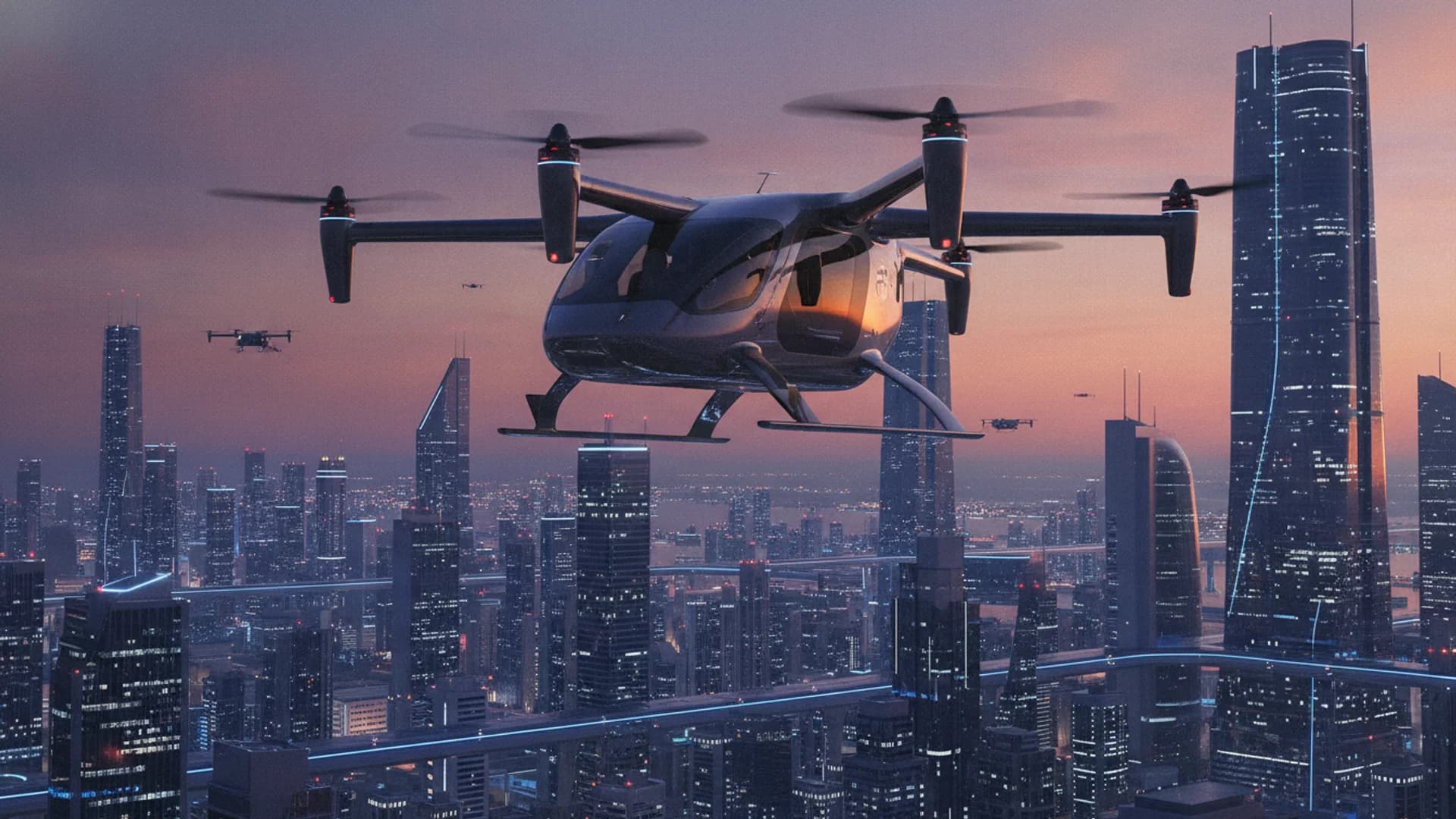
A $248,000 CAD flying taxi just rolled off a production line in Guangzhou. Not a concept. Not a render. An actual aircraft you can theoretically pre-order, with a battery that recharges in 25 minutes and a cabin that drives itself through the air.
GAC's Govy AirCab was first unveiled in June 2025 with an official guide price set at no more than 1.68 million yuan ($248,250), and the first units are now off the line. The story isn't the sticker, it's what the sticker buys you in Canada, which is currently nothing.
For Canadian readers, the question isn't whether the AirCab exists. It does. The question is whether any of this matters if you live in Burnaby, Mississauga, or Halifax. My verdict up front: for anyone outside a small set of Chinese pilot cities, the AirCab is irrelevant for at least three years, and possibly permanent given Canada's regulatory vacuum. But the technical milestone is real, and the policy gap it exposes in Canada is worth understanding before the next eVTOL announcement lands.
Key takeaways
- GAC's Govy AirCab hit production in May 2026, just under a year after pre-sales opened at 1.68 million yuan.
- The AirCab's two-seat cabin flies itself autonomously, covers roughly 30 km, and recharges in 25 minutes.
- Canadian buyers face zero legal path to ownership: no Transport Canada eVTOL certification framework exists yet.
- At $248,000 USD base, the AirCab costs 3.3 times a Rivian R1T, for 30 km of flight instead of 400 km of road.
- No Canadian rebate program covers aircraft; iZEV and all provincial incentives are defined around motor vehicles only.
What Exactly Is the GAC Govy AirCab?
The AirCab is an eVTOL, electric vertical takeoff and landing aircraft. Govy is a GAC subsidiary created to pursue China's state-backed low-altitude economy push, the policy framework for commercial airspace below roughly 1,000 metres. GAC's Govy rolled off its first AirCab flying car to target the low-altitude economy in May 2026, less than a year after pre-sales opened.
The specs are modest, and that's important. Roughly 30 km range, Fox News pegs it at an 18.6-mile range, which translates to about 30 km. Two seats. Autonomous routing, no pilot's seat, no yoke, no human in the loop once the route is set. Those are the actual specs: modest enough that GAC isn't positioning this as a regional transport solution, but meaningful enough to cover the use cases operators actually care about.
The headline technical claim is the battery. The Carscoops report on production startup notes the Govy AirCab uses high-density cylindrical batteries that take 25 minutes to fully recharge. That's fast-charging territory familiar to anyone who has used a 150 kW DC charger on a Hyundai Ioniq 5, except the energy is going into rotor lift, not wheels.
The unveiling-to-production timeline tells you what Chinese industrial policy can accelerate when it wants to. China's GAC started taking pre-orders for the GOVY AirCab at a price tag of RMB 1.68 million ($234,000) in June 2025. One year from reveal to first vehicles rolling off the line. That's faster than most ground-EV programmes manage, and faster than any Western eVTOL competitor has moved.
What Does $248,000 CAD Actually Buy You?
A two-seat aircraft with a roughly 30 km range and a 25-minute recharge. That's it. No road-going dual-mode, no extended-range battery option, no over-the-air range upgrades.
The price point is where things get interesting for a Canadian buyer doing comparison math. As you'd expect from anything that flies itself, the AirCab isn't cheap, prices start at 1.68 million yuan, or roughly $248,000. A Rivian R1T Dual-Motor with the Standard Pack lists around $75,000 CAD, meaning the AirCab costs roughly 3.3 times what a flagship Canadian electric pickup does, and you trade a 400 km range and the ability to use it on actual roads for 30 km of supervised flight. The way Rivian solves the "premium electric vehicle" problem is range, payload, and road legality. The way the AirCab solves it is the novelty of leaving the ground for fifteen minutes.
Here's the cost stack a Canadian buyer would actually face, before any regulatory work:
- Base guide price: $248,250 USD (~$340,000 CAD at June 2026 rates)
- Pre-sale-to-production drift: the June 2025 pre-sale figure landed at $234,000 USD, call it currency drift, not a price hike
- Shipping + import broker handling: $15,000–$25,000 CAD estimated
- Tariff exposure: undefined (more below)
- Certification engineering to meet Canadian airworthiness: $50,000+ if it's even possible
- Approved maintenance scheme setup: undefined, because no AMO is configured for this airframe
Canada's 100% tariff on Chinese-made EVs, in effect from October 2024, dropped to 6.1% in January 2026 under the new 49,000-unit quota framework, but that quota framework was written for passenger automobiles, not aircraft. Whether the AirCab falls under the same surtax regime, under aircraft-import duties, or under a category that doesn't yet exist is a question Finance Canada hasn't answered because nobody has asked it formally.
The short version: $248,000 is the sticker. The Canadian out-the-door number, if it ever exists, is meaningfully higher.
Gear worth having
As an Amazon Associate, ThinkEV earns a small commission from qualifying purchases — at no extra cost to you.

Lectron Level 2 J1772 Charger (40A, WiFi)
Smart WiFi charger with real-time energy monitoring. 40A / 9.6 kW, J1772 with a NEMA 14-50 plug, schedule charging right from your phone.
As an Amazon Associate, ThinkEV earns from qualifying purchases — at no extra cost to you.
Can You Actually Buy One in Canada Right Now?
No. And the reasons matter more than the answer.
Transport Canada has no certification framework for passenger-carrying eVTOLs. The agency has been consulting on Remotely Piloted Aircraft Systems rules for years, and it has begun engaging with Advanced Air Mobility stakeholders, but the regulatory architecture that would let a citizen take delivery of a Govy AirCab and legally fly it from a Toronto rooftop to Pearson doesn't exist. The FAA in the United States is further along on the certification pathway, and even there the skeptic's point holds, flying is hard, gravity is a cruel mistress, and putting battery-powered vehicles above a megacity requires a level of air traffic control that currently only exists in science fiction movies.
There is also no Canadian distributor. GAC sells the AirCab through Govy's domestic Chinese channels. No dealer, no service centre, no parts inventory, no approved maintenance organisation in Canada is set up for this airframe. You couldn't get a propeller replaced legally.
The import path is equally undefined. Chinese-built passenger vehicles fall under the federal surtax framework. Chinese-built aircraft fall under Transport Canada certification rules that the AirCab does not currently meet. Even a wealthy buyer who wanted to land one as a static display would be navigating customs paperwork no broker has written a template for.
Compare this to the ground-EV picture. The BYD Atto 3 and BYD Dolphin sit in the $28,000–$45,000 CAD range and still face dealer-network and certification questions before they reach Canadian driveways at scale. The AirCab is multiple steps behind that. I'd bet a coffee the first legal Canadian eVTOL flight happens under a commercial charter operator's licence, not a private buyer's.
Realistic Canadian availability window: 2028 at the earliest, 2030 more likely, and only if Transport Canada moves on an AAM certification framework in parallel with the FAA. If you're shopping a flying car in 2026, you're shopping a press release.
Are There Any Rebates or Tax Credits for Flying Cars?
Zero. None. Not a dollar.
Gear worth having
As an Amazon Associate, ThinkEV earns a small commission from qualifying purchases — at no extra cost to you.

TP-Link Kasa Smart Plug with Energy Monitoring
Track exactly how much electricity your Level 1 charger uses and schedule it for off-peak hours. Know your real cost per kWh.
As an Amazon Associate, ThinkEV earns from qualifying purchases — at no extra cost to you.
The federal iZEV programme covers light-duty zero-emission vehicles, cars, SUVs, and pickups. Aircraft are not vehicles for iZEV purposes. The programme's vehicle eligibility list is built from Transport Canada's motor vehicle safety standards database, and an eVTOL is not in that database.
Provincial programmes follow the same logic. British Columbia's CleanBC Go Electric rebate, Quebec's Roulez vert, and the now-paused Ontario incentives all defined eligible vehicles in motor-vehicle terms. No province has added aircraft of any kind.
There is a federal capital cost allowance class for aircraft used in a business, Class 9 at 25% per year. But CCA requires the asset to be in use earning income in Canada, and using an aircraft to earn income in Canada requires Transport Canada certification of both the aircraft and the operator. The AirCab clears neither bar today.
Bottom line: a Canadian buyer faces the full $248,000 USD sticker, plus whatever duty regime ends up applying, with no offsetting federal or provincial financial assistance. Compare that to the iZEV's $5,000 federal rebate that still applies to most sub-$55K ground EVs, a rebate explicitly designed to lower a barrier the AirCab faces in much higher form, with no corresponding programme. The math doesn't bend, and it isn't going to.
Gear worth having
As an Amazon Associate, ThinkEV earns a small commission from qualifying purchases — at no extra cost to you.

Grizzl-E Classic Level 2 EV Charger (40A)
Canadian-made and rated for minus 40C winters. 40A / 9.6 kW, NEMA 14-50, indoor/outdoor, 24-ft cable. The charger built for Canadian weather.
As an Amazon Associate, ThinkEV earns from qualifying purchases — at no extra cost to you.
Where Would You Even Charge or Land This Thing?
A vertiport. That's the answer, and almost no one outside the Gulf has built one for paying passengers.
Dubai has completed its first flying taxi station, with commercial operations expected to begin by the end of the year, authorities in the Gulf emirate announced on Thursday. That's the global benchmark right now. Canada has nothing equivalent, not in planning, not in environmental assessment, not in municipal zoning approval. Transport Canada has been studying urban low-altitude airspace integration, but a Canadian vertiport network is years of policy work away from a foundation pour.
The 25-minute fast-charge spec is genuinely impressive on paper. Standard 350 kW DC fast chargers across Canada's growing Petro-Canada and FLO networks can refill most modern ground EVs to 80% in 18–25 minutes. The AirCab is operating in that same charge-time bracket, with a pack designed for the energy density an aircraft demands. The hard part isn't the electrons. It's where you plug in and take off from.
A residential garage doesn't work. A standard NEMA 14-50 outlet doesn't deliver fast-charge power, and a private home doesn't carry the airspace approval to launch an aircraft. Commercial vertiports require coordination with NAV CANADA, Transport Canada, the local municipality, and, in most Canadian cities, Indigenous consultation on the airspace and landing sites. None of that scaffolding exists.
The infrastructure gap is the binding constraint here, not the aircraft. Canada doesn't need 100,000 vertiports, it needs ten and the rule book to operate them. That's still a decade-scale build, not a 12-month one.
Who Is the Real Customer Here, and Is It You?
Almost certainly not you, and that's by design.
The Govy AirCab's target market reads like the eVTOL playbook every Western competitor is also chasing: corporate shuttle operators moving executives between airports and downtown towers, luxury resort transfers, urban mobility pilot programmes run by municipal partnerships. The vehicle is priced and specced for operators, not commuters. A 30 km range covers a Pearson-to-Bay-Street hop with a margin; it does not cover a Vancouver-to-Whistler weekend trip.
Private ownership in Canada wouldn't look like buying a Kia EV9. It would look like buying a Cessna. An aircraft registration, an airworthiness certificate, ongoing maintenance under an approved scheme, and, depending on how Transport Canada writes the rules, either a pilot's licence or a remote operator's certificate, plus an air operator certificate if you carry passengers for hire. None of that is a car-licence-and-go arrangement.
The competitive global landscape is informative. Archer Aviation is targeting US urban routes in 2026 through the FAA's eVTOL Integration Pilot Program. Joby and Beta are running similar plays. None of them are selling to private owners on day one. The economics only work for operators flying high-frequency routes, and even then, the unit economics depend on charging cycle costs, vertiport access fees, and pilot or autonomy approvals that vary by jurisdiction.
The realistic Canadian use case in the near term isn't ownership. It's the chartered experience flight, paying a few hundred dollars for a 15-minute hop over the Toronto waterfront in 2028 or so, operated by a licensed Canadian charter company that imported a small fleet under whatever framework Transport Canada writes. Even that is an optimistic timeline.
Gear worth having
As an Amazon Associate, ThinkEV earns a small commission from qualifying purchases — at no extra cost to you.

PULIDIKI Car Cleaning Gel (Detailing Putty)
Press it into vents, buttons, and seams and it lifts out dust you did not know was there. Weirdly satisfying, genuinely useful.
As an Amazon Associate, ThinkEV earns from qualifying purchases — at no extra cost to you.
Buy, Wait, or Skip?
Skip if you're shopping for personal transportation. There is no Canadian regulatory path, no infrastructure, no rebate, and no servicing. The vehicle isn't the constraint, Canada is. Put the $340,000 CAD against a Kia EV9 Wind AWD at $74,995 and a decade of charging, and the comparison stops being interesting.
Watch if you operate a premium transport business with a three-to-five-year planning horizon. The 25-minute charge, autonomous flight, and the production-line milestone are real competitive signals. A Canadian charter or resort operator thinking about 2028–2030 fleet composition should be tracking GAC, Archer, Joby, and Beta in parallel.
Revisit in 2028. That's the realistic window for Transport Canada to publish a passenger-eVTOL certification framework, for the first Canadian vertiport to break ground, and for the second-generation AirCab and its competitors to extend range beyond 30 km. The first generation of any aircraft is rarely the one buyers actually fly.
Three signals to track:
- The first Transport Canada notice of proposed amendment for Advanced Air Mobility certification
- The first Canadian municipal vertiport zoning application
- The first AOC application for an eVTOL airframe filed by a Canadian operator
Until one of those lands, the AirCab is China's milestone, not Canada's.
Gear worth having
As an Amazon Associate, ThinkEV earns a small commission from qualifying purchases — at no extra cost to you.

WixGear Magnetic Air Vent Phone Mount (2-Pack)
A magnet strong enough that your phone never flinches over potholes or rail crossings. Two in the box, one for each car.
As an Amazon Associate, ThinkEV earns from qualifying purchases — at no extra cost to you.

Founder & Chief Editor
Vlad Pereira is the founder and chief editor of ThinkEV.ca, the Canadian electric-vehicle publication he writes and edits from Courtenay, British Columbia. He covers EV pricing, federal and provincial rebates, charging costs, and the Chinese manufacturers now entering Canada, from the buyer's side rather than the press-fleet side. ThinkEV is a venture of Vlad Pereira Online; his writing on health, income and the long game lives at vladpereira.com.
Frequently asked questions
Does the AirCab require a pilot's licence to operate?
Which Canadian cities are most likely to see eVTOLs first?
How does the 30 km range hold up in a Canadian winter?
Is GAC the only automaker building a flying car right now?
Could a Canadian business import one as a charter aircraft?
More EV & road-trip finds
Affordable upgrades worth a look — tap any to check the price on Amazon.
 ★ 2,941
Microfiber Cleaning Cloths (Multi-Pack)
View on Amazon ★ 55
★ 55LED Car Door Logo Projector Light
View on Amazon ★ 1,349
Cool Swinging Duck Dashboard Ornament
View on Amazon ★ 27,769
Car Cup Holder Coasters (4-Pack)
View on Amazon ★ 21,310
Magnetic Car Phone Mount
View on Amazon ★ 121
★ 121Foldable Windshield Sun Umbrella
View on Amazon ★ 268
★ 268Anti-Slip Leather Steering Wheel Cover
View on Amazon ★ 47,507
HOMEXCEL Microfiber Cloths (12-Pack)
View on AmazonRead, Plan, Then Stay Current
Explore our expert articles to understand incentives and ownership costs, use the map to pressure-test charging reality, then subscribe so new EV coverage comes straight to you.
Continue Reading
Jaecoo J5 EV Uber Discount: $31,500 Fleet Math Changes
Tesla Pauses Model 3 Premium Orders in Canada, Blames the Quota. The Numbers Tell a Different Story

Chinese EVs in Canada: 15,603 In, Still No BYD
GM Recalls 2016–2017 Silverado, Sierra Over Airbag Defect
BYD Great Seagull: A Bigger $10,000 EV Hatch Is Coming