Key takeaways
- Underneath, they are the same vehicle: a 99.8 kWh battery, 800-volt E-GMP platform, 233 kW fast charging, and identical 5-year/100,000 km and 8-year/160,000 km warranties. The choice is about personality, not quality.
- The Hyundai Ioniq 9 travels about 30 km farther on the same battery, roughly 520 km versus 490 km for the Kia EV9, thanks to its more aerodynamic shape, and it keeps that edge in winter.
- The Kia EV9 is the bolder, sportier vehicle to drive, and its available second-row swivel captain's chairs are a genuine feature the Ioniq 9 does not offer.
- Pricing is nearly identical, the EV9 starts at $64,995 CAD, the Ioniq 9 at about $65,000, and neither qualifies for the $5,000 federal EVAP rebate. Price will not make this decision for you.
DECISION FRAME
The Kia EV9 and Hyundai Ioniq 9 are the only two three-row electric SUVs available in Canada at anything close to a mainstream price. That sentence does about 90% of the work in explaining why this comparison matters more than any other EV comparison I've written. If your family needs six or seven seats and you want to do it electrically, these are your two options, the Tesla Model X costs $120,000 and up. The Rivian R1S starts at $95,900. Everything else in the EV space maxes out at five seats. The EV9 and Ioniq 9 are the accessible door into electric family hauling for Canadian families, and the fact that they share a platform makes the choice between them simultaneously easier and harder to make.
Easier, because you cannot go wrong. The underlying engineering is identical. The same 99.8 kWh battery. The same 800-volt E-GMP architecture. The same ultra-fast DC charging at up to 233 kW. The same 5-year/100,000 km comprehensive warranty and 8-year/160,000 km battery warranty. The same Hyundai Motor Group parts ecosystem, which means service availability across Canada is excellent for both. If someone put a blindfold on you and drove you over a smooth highway in either vehicle, you would struggle to tell them apart by feel alone.
Harder, because the differences between them are entirely about personality, priorities, and what you want your daily family vehicle to feel like. The EV9 is the bolder, more distinctive vehicle with a sportier driving character. The Ioniq 9 is the more refined, more aerodynamic vehicle with better range and a softer ride. Same bones, different personalities. And since the pricing is nearly identical, the EV9 starts at $64,995 CAD, the Ioniq 9 at approximately $65,000 CAD, price will not make this decision for you. You actually have to think about what you want.
Neither qualifies for the federal EVAP rebate. EVAP uses a $50,000 final transaction value cap, that is base price plus options plus dealer fees, excluding taxes and freight, and both vehicles exceed that threshold at every trim level by a significant margin. There is no trim configuration of either the EV9 or Ioniq 9 that sneaks under the EVAP cap. Stop looking for one. These are premium family vehicles priced like premium family vehicles, and the federal government has drawn its line well below where these two sit.
Some provinces offer their own incentives that may apply depending on your trim and your province's eligibility rules. Quebec's Roulez Vert programme has a higher cap. British Columbia's CleanBC Go Electric programme has its own criteria. But at the federal level, you are on your own for both of these vehicles. Check the complete provincial rebate guide for your specific situation.
So with price essentially equal and the platform identical, the question becomes: which personality fits your family? That is what the next 25 minutes will answer. And I will pick a winner in every category, because "it depends" is not helpful when you are spending $65,000.
DESIGN: BOXY VS ROUNDED
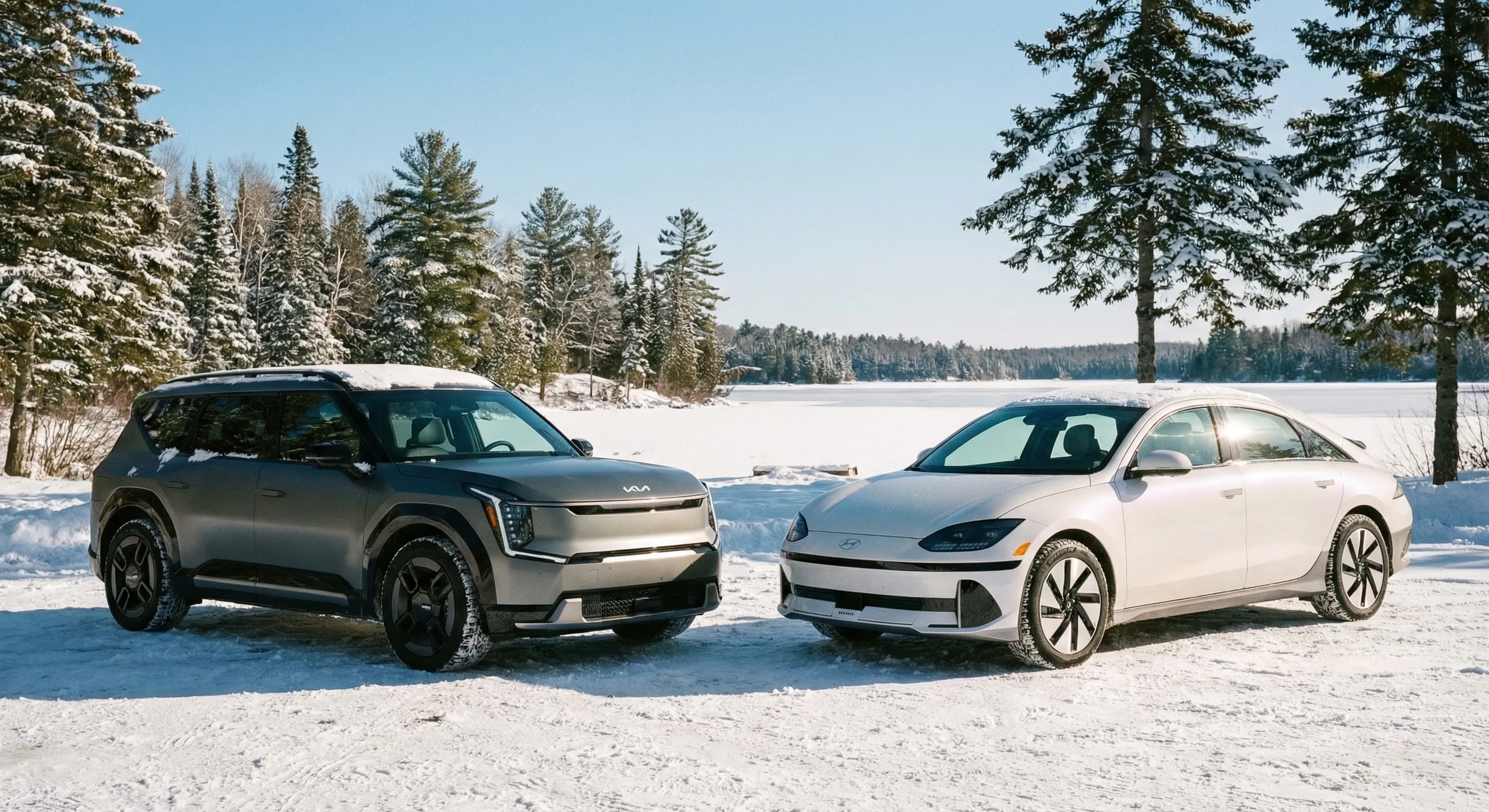
The EV9 and Ioniq 9 could not look more different, which is remarkable given they share virtually the same mechanical package. Standing next to each other in a dealership lot, they look like they came from different manufacturers, different eras, different design philosophies entirely. The shared E-GMP platform gives both vehicles a long wheelbase, a flat floor, and similar proportions from the side profile, but everything the design teams did on top of that shared architecture is in direct opposition.
The EV9 is angular and boxy, with flat panels, sharp edges, and a vertical rear end that makes it look like a futuristic minivan crossed with a Land Rover Defender. It has enormous presence on the road, people notice the EV9. The pixel-style headlights, borrowed and scaled up from the EV6's design language, create a distinctive face that reads as modern and intentional rather than retro.
The vertical taillights span the full height of the rear end and connect through a light bar that makes the EV9 unmistakable in your rearview mirror at night. The body sides are deliberately flat, almost industrial, and the wheel arches are squared off rather than rounded. It is a vehicle that commits fully to its design direction, and the result is polarizing in the best possible way, people either love it or they find it too much. Nobody is indifferent to the EV9.
The Ioniq 9 takes the opposite approach. It is rounded, aerodynamic, and smooth, with flowing lines that make it look like a scaled-up Ioniq 5 rather than a boxy SUV. Where the EV9 uses flat planes and sharp creases, the Ioniq 9 uses gentle curves and flowing surfaces. The front end is softer, with Hyundai's parametric pixel headlights set into a rounded face that is more approachable than aggressive. The roofline curves gently downward toward the rear, which is part of the reason the Ioniq 9 slips through the air more efficiently than the EV9. The rear end is rounded and tapered rather than vertical and flat, which gives the Ioniq 9 a more conventional SUV silhouette from behind.
The aerodynamic difference between these two designs is not cosmetic. The Ioniq 9's smoother shape gives it a meaningfully lower drag coefficient, and that translates directly to approximately 30 km more range from the same battery. We will get into the numbers in the range section, but the design choice here has a functional consequence that matters to every owner on every drive. The EV9 pays for its bold styling with slightly higher energy consumption at highway speeds.
From a practical standpoint, the EV9's boxy design has its own advantages. The squared-off rear end maximizes interior volume and makes loading cargo more intuitive, you can slide boxes and luggage straight in without working through around a curved roofline that cuts into the cargo area. The flat body sides are easier to judge in tight parking spots. The vertical rear glass gives the third-row passengers a sense of more headroom than the Ioniq 9's curved rear, even though the actual measured headroom is similar.
Design preference is entirely personal, and I am not going to tell you which one looks better. But I will say this: the EV9 is the more interesting vehicle to look at. The Ioniq 9 is the more conventionally handsome one. If you want your family SUV to make a statement, the EV9 does that. If you want it to look elegant and age gracefully, the Ioniq 9 does that. Both are well-executed, both are recognizable on the road, and both look like vehicles that cost what they cost.
Winner: EV9 for presence and boldness, Ioniq 9 for aerodynamic efficiency and timelessness. If you care about range, the Ioniq 9's design gives it a measurable advantage. If you care about turning heads, the EV9 wins that without contest.
INTERIOR AND THIRD ROW
This is where these vehicles earn their price tags, and this is where the choice between them becomes most personal. Both offer three rows of seating with genuine usability in the third row, not the token, knees-to-chest third row you find in most crossovers. Adults up to about 175 cm can sit in the third row of either vehicle without serious complaint, which makes these legitimate seven-passenger vehicles for real families making real trips.
The flat floor enabled by the E-GMP platform is the reason both vehicles can deliver a usable third row at this price point. There is no transmission tunnel, no exhaust routing, no driveshaft, just a flat battery pack underneath a flat floor, which means every row has genuine foot space. Walk through from the first row to the third in either vehicle and you will notice how naturally the floor stays level. This is not a small thing. It is the single biggest advantage of a purpose-built EV platform over an ICE conversion, and it is the reason these two vehicles can offer genuine three-row seating that a comparably priced gas SUV like the Hyundai Palisade or Kia Telluride, which share their own platform, cannot match in third-row comfort despite having similar exterior dimensions.
The EV9's interior is the more adventurous design. The dashboard layout uses Kia's dual 12.3-inch screen configuration, one for the instrument cluster and one for the infotainment system, mounted side by side under a single pane of glass. The screens are clean and modern, with a physical volume knob between them that Kia wisely retained while competitors were eliminating every physical control. Below the screens, the centre console is minimal and open, creating a sense of spaciousness that makes the EV9 feel larger inside than its exterior dimensions suggest.
But the EV9's signature interior feature is the second-row captain's chairs available on the GT-Line trim. These chairs swivel 180 degrees to face the third row, creating a lounge-like configuration when the vehicle is parked. It sounds like a gimmick until you actually use it. Say you are at your kid's hockey tournament in Sudbury, it is -20 outside, and you have 90 minutes between games.
Swivel the second-row seats around, turn on the heat pump, and you have a heated living room on wheels where four people can sit facing each other comfortably. Or you are camping at a provincial park, the rain starts, and suddenly the EV9 becomes a sheltered hangout space that no conventional SUV can replicate. For families who spend significant time in their vehicles, waiting at practices, on road trips, at camping sites, the swivel seats transform the EV9 from a transport vehicle into a living space.
The second-row captain's chairs in the EV9 also slide and recline, and the gap between them provides a walk-through to the third row that is wider and more accessible than most competitors. When the chairs are in their forward-facing position, legroom in the second row is generous, tall parents can sit behind tall drivers without knee contact, which is not something every three-row SUV can claim.
The Ioniq 9's interior is more conventional but equally spacious and arguably more refined in its material choices. The second row offers both bench and captain's chair configurations depending on trim. The bench configuration seats three across, giving you a seven-seat total, useful for families with three children or for the occasional extra passenger. The captain's chair configuration drops to six seats but adds a centre console with armrests and storage, creating a more premium feel for the second row.
The Ioniq 9's material quality is where Hyundai has made a deliberate push upmarket. The surfaces are softer, the leather (or vegan leather, depending on trim) feels thicker and more substantial, and the overall interior ambience reads as more luxurious than the EV9's more functional approach. The Ioniq 9's dashboard uses Hyundai's latest curved dual-screen layout, where two 12-inch displays sweep across the dash in a continuous arc. It is elegant and easy to use, though functionally similar to the EV9's side-by-side arrangement.
Third-row access is good in both vehicles, but the approach differs. The EV9's second-row chairs tilt and slide forward with a one-touch mechanism that opens a gap wide enough for adults to climb through without gymnastics. The Ioniq 9 uses a similar tilt-and-slide mechanism, and the second-row bench version has a centre seat that can fold independently, creating a walk-through path. In practice, getting into the third row of either vehicle is easier than any three-row crossover on the market, including their gas-powered siblings.
Third-row comfort itself is comparable. Both offer heated seats in the third row, a detail that matters in Canada and that many competitors skip. Both have dedicated climate vents for the third row. Both have USB-C charging ports in the third row. The legroom is adequate for adults on trips under two hours; for longer journeys, anyone over 175 cm will prefer the second row. For children, the passengers who most commonly occupy third rows in family vehicles, both are comfortable enough for all-day road trips.
For families with young children specifically, there are practical differences worth noting. Car seat installation is straightforward in the second row of both vehicles thanks to accessible LATCH anchors and the flat floor. The EV9's captain's chair configuration means car seats are isolated with a gap between them, which some parents prefer because it prevents one child from reaching across to antagonize a sibling. The Ioniq 9's bench configuration allows a centre seat installation, which can be useful for families with three car seats or for having an adult sit between two children.
Cargo space is generous in both, approximately 828 litres behind the third row in the EV9 and similar in the Ioniq 9, expanding to over 2,300 litres with the second and third rows folded. Both vehicles have flat cargo floors and wide rear openings. The EV9's boxy rear end means the cargo area is more uniformly shaped, rectangular rather than tapered, which makes packing suitcases and hockey bags more intuitive. The Ioniq 9's slightly curved roofline cuts into the top of the cargo area marginally, but not enough to matter for anything except the tallest items. Both vehicles offer power-operated tailgates with adjustable opening heights, and both have underfloor storage compartments in the cargo area for hiding valuables or stashing charging cables.
Winner: EV9 for the swivel seats and more functional cargo shape. Ioniq 9 for material refinement and the seven-seat bench option. If the swivel seat feature appeals to your family's lifestyle, road trips, camping, sports sidelines, the EV9 wins this category decisively. If you prioritize a quieter, more luxurious cabin feel and need seven seats, the Ioniq 9 takes it.
RANGE AND CHARGING
Both vehicles share the same 99.8 kWh battery and 800V E-GMP architecture. This is the same proven platform that powers the Ioniq 5 and EV6, scaled up for a larger, heavier vehicle. The battery chemistry, the thermal management system, the charging electronics, all identical between the EV9 and Ioniq 9. What is not identical is how far that energy takes you, and that difference comes down entirely to aerodynamics and weight.
The EV9 Long Range RWD is rated at approximately 490 km by Transport Canada. The Ioniq 9 Long Range RWD is rated at approximately 520 km. That 30 km gap is real and consistent, it shows up in lab testing, in real-world driving data, and in the experiences of Canadian owners who have driven both. It exists because the Ioniq 9's smoother, more aerodynamic body slips through the air with less resistance than the EV9's flat-panelled, boxy shape. At 100 km/h, the difference is modest. At 110 km/h on Highway 1, it becomes more pronounced because aerodynamic drag increases with the square of speed. The faster you drive, the more the EV9's boxier shape costs you.
In real-world Canadian summer driving, mixed highway and city, air conditioning running, realistic speeds, expect roughly 400 to 430 km from the EV9 and 420 to 460 km from the Ioniq 9. Those are honest numbers that account for the gap between Transport Canada ratings and how people actually drive. Both are more than sufficient for a full week of urban and suburban family driving without charging, assuming you have a Level 2 home charger and plug in overnight.
Gear worth having
As an Amazon Associate, ThinkEV earns a small commission from qualifying purchases — at no extra cost to you.
NOCO Boost Plus GB40 Jump Starter
A 1000A lithium jump starter that fits in your glovebox and works on any 12V battery. Your insurance against a dead 12V in a parking lot.
As an Amazon Associate, ThinkEV earns from qualifying purchases — at no extra cost to you.
AWD versions of both vehicles sacrifice approximately 30 to 40 km of range compared to their RWD counterparts. The additional front motor adds weight and parasitic losses even when it is not actively driving the front wheels. The EV9 AWD Long Range comes in at approximately 450 to 460 km rated, and the Ioniq 9 AWD Long Range at approximately 480 to 490 km. The same proportional gap persists, the Ioniq 9 consistently delivers about 6% more range from the same battery.
For road trips, the range difference matters more than the numbers suggest at first glance. On a 500 km drive from Toronto to Ottawa, the Ioniq 9 RWD can make it on a single charge in summer with careful driving. The EV9 RWD needs a brief charging stop. That is the practical impact of 30 km of additional range, it does not change whether you can own the car, but it does occasionally change whether you need to stop.
Over a year of ownership, those occasional extra stops add up to a meaningful difference in convenience, especially for families who are already managing kids, snacks, washroom breaks, and the general chaos of travelling with children. For detailed charging stop planning, the EV road trip charging guide walks through how to optimize stops on Canadian routes.
The charging experience itself is identical because the architecture is identical. Both charge from 10% to 80% in approximately 24 minutes on a 350 kW DC fast charger. Both support peak charging at approximately 233 kW, which is what you will actually see on most Canadian fast chargers, the theoretical 350 kW maximum requires a charger that can deliver that full power, and most Electrify Canada and Petro-Canada stations max out below that. At 233 kW, both vehicles are among the fastest-charging vehicles in any segment, and the charging experience on a road trip is genuinely pleasant rather than frustrating.
Both support Plug and Charge on compatible networks, which means you pull up, plug in, and charging starts automatically without apps, cards, or fumbling with your phone. On Electrify Canada's network, the largest high-power CCS network in Canada, Plug and Charge works reliably on both vehicles and eliminates one of the most annoying aspects of public charging.
Home charging on Level 2 (240V, 48A) takes approximately 11 to 12 hours for either vehicle from empty to full. That sounds like a long time, but the context matters: you will almost never charge from truly empty. A typical overnight charge from 20-30% to 80% takes 6 to 8 hours, which fits perfectly within a sleep cycle. If you are considering a home charger, a reliable Level 2 unit is the single best investment in EV ownership convenience, it transforms your daily charging experience from something you plan around to something that happens invisibly overnight. The Kia EV9 standalone review covers the home charging setup in more detail.
Winner: Ioniq 9. Same battery, same charging, but 30 km more range from better aerodynamics. The charging experience is a tie, but range is not, and the Ioniq 9 wins it clearly. If range is your primary concern, and for Canadian families making regular long drives, it reasonably could be, this is a meaningful advantage.
DRIVING
Both vehicles drive well for their size, and both will surprise you with how competent a 2,400+ kg electric SUV can feel on the road. But the engineers at Kia and Hyundai made distinctly different tuning choices on top of the shared platform, and those choices create two genuinely different driving experiences.
The EV9 is the more engaging vehicle to drive. The suspension is firmer, the steering is more direct and more heavily weighted, and the body roll through corners is better controlled. It is not a sports car, no 2,400 kg three-row SUV is a sports car, and anyone who tells you otherwise is selling something, but it feels more connected and more responsive than you expect.
On a winding two-lane highway through the Rockies or along the Sea-to-Sky, the EV9 rewards the driver who is paying attention. The steering communicates road texture, the suspension settles quickly after bumps, and the front end changes direction with a crispness that belies the vehicle's weight. Kia has always leaned toward a sportier tuning philosophy than Hyundai, and the EV9 is a clear expression of that philosophy at the full-size SUV scale.
The Ioniq 9 prioritizes comfort over engagement. The ride is softer, the steering is lighter, and the overall experience is more relaxed. The suspension absorbs road imperfections more thoroughly than the EV9's firmer setup, cracks, frost heaves, expansion joints, and the general deterioration of Canadian roads in spring are all filtered more effectively. On a long highway drive with the family, the Ioniq 9 is the quieter, more comfortable choice. If you are driving four hours to the cottage with kids in the back, movies playing on their tablets, and you just want the kilometres to pass smoothly and silently, you will appreciate the Ioniq 9's more insulated approach to the road.
The comfort advantage extends to noise isolation. Both vehicles are quiet for their class, but the Ioniq 9 is measurably quieter. Hyundai used more sound-deadening material in the Ioniq 9, particularly around the wheel wells and the rear cargo area, which reduces both road noise and wind noise at highway speeds. The Ioniq 9's more aerodynamic shape also contributes, less air turbulence around the body means less wind noise at speed. In the EV9, you can hear more tire noise and wind noise at 110 km/h, though neither vehicle is loud by any reasonable standard.
Both vehicles offer RWD and AWD configurations. The RWD models produce approximately 215 hp from the single rear motor, which is adequate for normal driving but not what anyone would call quick in a vehicle this heavy. Merging onto the 401 or passing a transport truck on a two-lane highway requires planning and patience in RWD form. The AWD models add a front motor for a combined approximately 283 hp and noticeably improved acceleration. The 0-100 km/h time drops from the high 8-second range in RWD to the low 6-second range in AWD, not sports car territory, but genuinely brisk for a family hauler.
For Canadian driving specifically, the AWD versus RWD decision is more consequential than it might be in a milder climate. Both the EV9 and Ioniq 9 in RWD send all power to the rear wheels, which is the architecturally correct choice for efficiency and driving dynamics on dry roads. But on snow and ice, a rear-wheel-drive vehicle this heavy requires excellent winter tires and careful throttle management. The weight distribution helps, the battery pack spreads mass evenly across the floor, which gives these vehicles better traction than a traditional rear-drive vehicle, but AWD with good winter tires is the recommended setup for a family vehicle this size in any province that gets real winter.
One-pedal driving is available on both vehicles and works identically, using regenerative braking to slow the car when you lift off the accelerator. Both offer adjustable regeneration levels through paddle shifters behind the steering wheel. The strongest regeneration setting in both vehicles is aggressive enough to drive in most situations without touching the brake pedal. For city driving, school drop-offs, grocery runs, the stop-and-go of urban Canadian life, one-pedal driving is a genuinely significant feature that makes the vehicle feel more responsive and recovers energy that would otherwise be lost as heat through the brake pads.
Winner: EV9 for driving engagement, Ioniq 9 for comfort and refinement. If you enjoy driving and want the vehicle to feel responsive, the EV9 is the better driver's car. If you want the most comfortable family cruiser possible and value silence over sportiness, the Ioniq 9 is the pick. For most families, the Ioniq 9's comfort tuning is probably the more relevant advantage, because a family vehicle spends most of its life on highways and in traffic rather than on winding mountain roads.
TECHNOLOGY AND DRIVER ASSIST
Both the EV9 and Ioniq 9 run Hyundai Motor Group's latest technology stack, and both are equipped with Highway Driving Assist 2 (HDA2) as standard equipment on higher trims. HDA2 is a Level 2 driver assistance system that combines adaptive cruise control with lane centring, lane change assist, and highway merge assist. In practical terms, it handles highway driving well enough that long stretches of the Trans-Canada become significantly less fatiguing. The system manages acceleration, braking, and steering within a lane, and can execute hands-free lane changes when you activate the turn signal.
HDA2 performs identically in both vehicles because it uses the same hardware, the same forward-facing cameras, the same radar sensors, the same ultrasonic sensors, and the same processing unit. The software calibration is also shared. If you have driven one, you have driven both. It is a competent system that sits in the middle of the pack among Level 2 ADAS offerings in 2026, more refined than Toyota's Safety Sense, comparable to Ford's BlueCruise, and behind GM's Super Cruise in terms of hands-free capability on mapped highways.
For Canadian highway driving, it works well on divided highways with clear lane markings and handles gentle curves and hills without drama. It gets hesitant on poorly marked roads, in heavy construction zones, and in blowing snow, which is reasonable, because those are conditions where a human driver should be more engaged anyway.
Gear worth having
As an Amazon Associate, ThinkEV earns a small commission from qualifying purchases — at no extra cost to you.

Grizzl-E Classic Level 2 EV Charger (40A)
Canadian-made and rated for minus 40C winters. 40A / 9.6 kW, NEMA 14-50, indoor/outdoor, 24-ft cable. The charger built for Canadian weather.
As an Amazon Associate, ThinkEV earns from qualifying purchases — at no extra cost to you.
The infotainment systems diverge more than you might expect given the shared corporate parentage. The EV9 uses Kia's ccNC (connected car Navigation Cockpit) system on dual 12.3-inch screens. The interface is clean and modern, with a tile-based home screen that can be customized to show your most-used features. Wireless Apple CarPlay and Android Auto are standard. The built-in navigation integrates with the vehicle's route planning to suggest charging stops with estimated state of charge at each stop, useful for road trip planning without pulling out your phone.
The Ioniq 9 uses Hyundai's latest infotainment system on curved 12-inch displays. The interface is similar in functionality but different in design, Hyundai's layout favours a more traditional menu structure rather than Kia's tile approach. Both support the same connectivity features: wireless phone projection, over-the-air software updates, remote climate control through smartphone apps, and digital key functionality that lets you share vehicle access through your phone.
Both vehicles offer a heads-up display on their upper trims. The EV9's HUD is available on the GT-Line and projects speed, navigation arrows, and ADAS status onto the windshield. The Ioniq 9's HUD is available on the top trim and offers similar information. Neither HUD is augmented reality, they project a flat image rather than overlaying graphics on the road ahead, as some newer vehicles from Mercedes and BMW do. For practical purposes, both HUDs work well and reduce the need to look away from the road for basic driving information.
Over-the-air (OTA) updates are supported on both vehicles, and Hyundai Motor Group has been reasonably good about delivering meaningful updates through this channel. Battery management optimizations, infotainment improvements, and ADAS refinements have all been delivered OTA to Ioniq 5 and EV6 owners, and the same pipeline applies to the EV9 and Ioniq 9. This is not Tesla-level frequency of updates, nobody matches Tesla's OTA cadence, but it is meaningfully better than what most traditional automakers deliver.
Rear-seat entertainment is an area where both vehicles cater to families. Both offer USB-C ports in every row, and the second-row passengers in both vehicles have their own climate controls. Neither vehicle comes with built-in rear screens, you will need to supply your own tablets for movie time, but the USB-C ports and the available Wi-Fi hotspot make that straightforward.
The surround-view camera system, available on upper trims of both vehicles, is particularly useful given the size of these SUVs. Both use a four-camera setup to create a 360-degree overhead view on the infotainment screen, which makes parking in a tight urban garage significantly less stressful. The image quality and stitching are good on both, Hyundai Motor Group's surround-view implementation is among the better ones in the industry.
Winner: Tie. The technology suites are functionally identical with cosmetic differences in presentation. Kia's tile interface versus Hyundai's menu interface is a preference, not an advantage. HDA2 is the same system in both vehicles. If you have a strong preference for one infotainment design style over the other, that is the only differentiator here.
Gear worth having
As an Amazon Associate, ThinkEV earns a small commission from qualifying purchases — at no extra cost to you.

Cool Swinging Duck Dashboard Ornament
The internet-famous duck that bobs and swings as you drive. Pure joy on the dash, conversation starter at every light.
As an Amazon Associate, ThinkEV earns from qualifying purchases — at no extra cost to you.
WINTER PERFORMANCE
Canadian winters are the real test for any electric vehicle, and it is the question I get asked more than any other: how do these hold up when it is -25 in Winnipeg? The answer for both the EV9 and Ioniq 9 is "very well," and the shared platform is the reason. Both vehicles use the same heat pump system for cabin heating, the same battery thermal management with liquid cooling and heating, and the same preconditioning capability that lets you warm the battery before a DC fast charge in cold weather.
The heat pump is the critical component. Rather than generating heat through resistive elements alone, which is how a space heater works and which draws enormous energy, the heat pump extracts ambient thermal energy from outside air and uses it to warm the cabin. Between 0 degrees and -10 degrees, the heat pump operates efficiently and significantly reduces the energy penalty of running the heater. Below -15 degrees, the heat pump's efficiency drops and the system increasingly relies on supplemental resistive heating, which draws more energy from the battery. This is physics, not a flaw, and every EV with a heat pump, including Teslas, BMWs, and Volkswagens, handles cold extremes the same way.
In winter, both vehicles lose 25 to 35% of their rated range. The specific number depends on temperature, driving pattern, heater usage, and tire choice. The EV9 drops to approximately 310 to 360 km in winter conditions, and the Ioniq 9 to approximately 330 to 380 km. The Ioniq 9 maintains its aerodynamic range advantage in winter because lower drag at highway speed is just as relevant at -20 as it is at +20. For detailed winter range data across multiple EVs, the EV winter range test covers this extensively.
Battery preconditioning is essential for winter charging and is handled identically in both vehicles. When you set a DC fast charger as your navigation destination, both the EV9 and Ioniq 9 will automatically begin warming the battery as you approach the station. A preconditioned battery at -15 degrees charges almost as fast as one at +15 degrees. A cold battery at -15 degrees might charge at half the rate. This is the single most important winter EV tip: always work through to the charger rather than just driving there, so the car knows to warm the battery. Both vehicles handle this automatically and do it well.
Heated seats are available in all three rows of both vehicles. Heated steering wheels are standard on upper trims of both. These are not luxury features in Canada, they are essential features that let you reduce heater usage and preserve range. Running heated seats at full blast and the cabin heater at a moderate 19 degrees rather than a toasty 23 degrees can recover 15 to 20 km of winter range on a full charge. Over a week of commuting, that adds up.
Both vehicles come with standard cold-weather features that matter: heated side mirrors, heated windshield washer nozzles (on equipped trims), and automatic climate preconditioning through their smartphone apps. That last feature is significant in a Canadian winter. Set a departure time in the app, and the vehicle warms the cabin and defrosts the windows while still plugged into your home charger, drawing from the wall rather than the battery. You walk out to a warm, clear car every morning without losing a single kilometre of range to warming up.
Traction in winter conditions is good for both vehicles in AWD form. The low centre of gravity from the battery pack helps both vehicles feel planted and stable on snow and ice, and the instantaneous torque delivery of the electric motors means no lag between requesting power and getting it, which is actually an advantage over gas SUVs in slippery conditions, where a turbocharged engine's power delivery can be less predictable. On good winter tires, which are mandatory equipment in Quebec and absolutely should be on any vehicle this size anywhere in Canada, both the EV9 and Ioniq 9 AWD handle winter confidently.
Ground clearance is approximately 178 mm for both vehicles, which is adequate for plowed Canadian roads and light snow but not sufficient for deep, unplowed conditions. These are not off-road vehicles. If your driveway or cottage road regularly has more than 15 cm of unplowed snow, you need to plan accordingly regardless of which one you choose.
Winner: Ioniq 9 by a small margin, due to the persistent aerodynamic range advantage in cold weather. The 20 km difference in winter range matters more when range is already reduced. All other winter features are identical.
V2L AND PRACTICAL FEATURES
Both the EV9 and Ioniq 9 support vehicle-to-load (V2L) at 3.6 kW, which turns the car into a mobile power source. This is not a gimmick feature for a family vehicle, it is genuinely useful in ways that become apparent only after you start using it. The 3.6 kW output is enough to run a portable coffee maker, charge multiple laptops and phones simultaneously, power a portable projector for outdoor movie night, run a portable heater in a tent, or keep a refrigerator running during a power outage.
For camping families, and Canada has some of the best provincial park camping in the world, V2L transforms the EV9 or Ioniq 9 into a base station. Park at your campsite, plug in a power bar, and you have electricity for lights, cooking appliances, phone charging, and a Bluetooth speaker. No generator noise, no gas cans, no fumes. The 99.8 kWh battery has enough capacity to run moderate loads for days before you need to find a charger. At 500 watts of continuous draw, lights, phone charging, a small heater, you could theoretically power a campsite for nearly 200 hours before depleting the battery. In practice, you would leave yourself plenty of reserve for driving, but the point is that V2L is not a marginal feature on a battery this large. It is a genuinely useful capability.
Both vehicles have the V2L outlet inside the vehicle and can also use a V2L adapter cable that plugs into the charge port for external power delivery. The interior outlet is more convenient for charging devices while driving. The exterior outlet is better for camping and emergency power scenarios where you want to keep the cable run outside the vehicle.
Emergency power during outages is the V2L use case that gets the most attention, and reasonably so. Ice storms in Ontario, windstorms in the Maritimes, and winter storms across the Prairies have caused multi-day power outages in recent years. A 99.8 kWh battery running at 3.6 kW can theoretically power essential home loads, refrigerator, sump pump, phone chargers, a few lights, for over 24 hours. That is a meaningful backup capability that no gas SUV offers without a separate generator.
Towing is rated at approximately 2,500 kg (5,500 lbs) for both vehicles, which is enough for a small camping trailer, a jet ski, or a small utility trailer. It is not enough for a large travel trailer or boat. Towing reduces range significantly, expect a 30 to 40% range penalty depending on the trailer's weight and aerodynamic profile, so trips with a trailer require more charging stop planning. Both vehicles have trailer wiring provisions, and both have a tow hitch receiver available as an accessory.
Roof rails are standard on upper trims of both vehicles, supporting roof boxes and roof-mounted cargo carriers for ski gear, camping equipment, or extra luggage. The load ratings are similar, approximately 80 to 100 kg on the roof, and both vehicles' rooflines can accommodate standard crossbar systems. Note that anything on the roof increases aerodynamic drag and will reduce range, with the Ioniq 9's lower drag coefficient meaning it is proportionally less affected by roof-mounted accessories than the EV9.
The front trunk (frunk) is modest in both vehicles, these are not Rivian R1S or Tesla Model Y-scale frunks. Both have a small storage area under the front hood that can hold a charging cable, a first aid kit, and a few small items. It is useful for keeping the charging cable accessible without digging through the rear cargo area, but it is not a meaningful cargo space.
Both vehicles have powered sliding second-row seats, power-operated tailgate, proximity key entry, push-button start, and automatic LED headlights. Both offer a power-adjustable driver's seat with memory settings. These are expected features at this price point, and neither vehicle omits anything important.
Winner: Tie. V2L, towing, roof rails, and practical features are functionally identical. The V2L capability on both vehicles is genuinely excellent and is one of the strongest arguments for either vehicle over a gas-powered SUV.
OWNERSHIP AND VALUE
Neither the EV9 nor the Ioniq 9 qualifies for the $5,000 federal EVAP rebate. I have said this already and I will say it one more time because people keep asking: both vehicles exceed the $50,000 final transaction value cap at every trim level. No trim, no configuration, no negotiation will get either vehicle under the EVAP cap. This is out-of-pocket territory.
The warranty is identical for both vehicles because Hyundai Motor Group applies the same warranty structure across its brands. Both come with 5 years or 100,000 km comprehensive coverage, whichever comes first. Both come with 8 years or 160,000 km battery and electric powertrain warranty. The battery warranty guarantees a minimum state of health, typically 70% of original capacity, at the end of the 8-year period. This warranty is among the most comprehensive in the industry and matches or exceeds what Tesla, Volkswagen, Ford, and GM offer on their electric vehicles.
The total cost of ownership comparison against gas-powered three-row SUVs is where these vehicles start to make their financial case. The most direct gas competitors are the Kia Telluride ($49,995 to $65,995) and Hyundai Palisade ($49,999 to $65,999), siblings from the same corporate family, sharing a platform in exactly the same way the EV9 and Ioniq 9 share theirs. The gas SUVs are cheaper to buy at the lower trims, but the ownership cost equation shifts over time.
Fuel savings are substantial. A Telluride or Palisade with the 3.8L V6 averages approximately 11 to 12 litres per 100 km in mixed Canadian driving. At $1.60 per litre, a reasonable Canadian average in 2026, that is $17.60 to $19.20 per 100 km in fuel cost. The EV9 and Ioniq 9 average approximately 20 to 22 kWh per 100 km. At $0.12 per kWh, a reasonable off-peak residential rate in most Canadian provinces, that is $2.40 to $2.64 per 100 km.
The EV costs roughly one-seventh as much to fuel. On 20,000 km of annual driving, that is approximately $3,000 to $3,400 per year saved on fuel alone. Over a five-year ownership period, fuel savings alone recover $15,000 to $17,000 of the price premium. For a deeper dive on these numbers, the EV vs gas total cost of ownership analysis breaks down every line item.
Maintenance costs are lower for EVs because there are fewer wear components. No oil changes. No transmission fluid. No spark plugs. No exhaust system. No timing belt. Brake pads last significantly longer because regenerative braking handles most deceleration. Both the EV9 and Ioniq 9 need tire rotations, cabin air filter replacements, coolant changes (less frequently than ICE vehicles), and brake fluid replacement. Over five years, expect to spend roughly $1,500 to $2,500 less on maintenance compared to the Telluride or Palisade.
Insurance costs for the EV9 and Ioniq 9 are comparable to each other and to their gas-powered siblings. Both are classified in similar insurance groups. Insurance for any of these vehicles, EV or gas, will vary significantly by province, by driver, and by insurer, so there is no universal answer. In Ontario, expect annual premiums in the $2,000 to $3,000 range for a family with a clean driving record. In BC, ICBC rates will depend on your coverage level and claims history. The EV premium that existed a few years ago, where EVs cost noticeably more to insure than equivalent gas vehicles, has largely disappeared as insurers have accumulated more data on EV repair costs.
The dealer experience differs by brand but varies more by individual dealership than by badge. Kia and Hyundai both have extensive dealer networks across Canada, with representation in most cities above 50,000 people and many smaller towns. Both brands have invested in EV training for their service departments, though the quality of that training varies by dealer. Some Kia and Hyundai dealers have enthusiastic, knowledgeable EV teams. Others still treat EVs as an unfamiliar product. Before buying either vehicle, visit the dealer, ask about their EV service capabilities, and see if they have a Level 2 charger on the lot. A dealer that has invested in charging infrastructure has almost certainly invested in service training.
Parts availability is good for both vehicles. They share many components with the high-volume Ioniq 5, Ioniq 6, EV6, and EV9 on the same E-GMP platform, which means the parts pipeline is strong and well-established. Body panels and vehicle-specific components may take longer to source after a collision, but mechanical and electrical components are generally available quickly.
Depreciation is the biggest unknown for both vehicles. Three-row electric SUVs are a new category, and there is not enough resale data to predict five-year residual values with confidence. What we know from the broader EV market is that Hyundai Motor Group vehicles have depreciated less aggressively than the industry average for EVs, partly because of the strong 800V charging advantage and partly because of the brand perception improvement both Kia and Hyundai have achieved in recent years. Neither vehicle is likely to hold value as well as a Toyota or Lexus, but neither is likely to depreciate as aggressively as some early EVs did.
Winner: Tie. Same warranty, same ownership costs, same dealer network depth, same insurance classification. The TCO advantage over gas SUVs is identical for both vehicles. Neither has a structural ownership cost advantage over the other.
VERDICT
I have been through every section of this comparison looking for a clear, unambiguous winner. There is not one, and I think that is actually the correct conclusion, not a cop-out. These are two excellent vehicles built on the same excellent platform, and the differences between them are genuine differences of character rather than differences of quality. Neither is the better vehicle. They are different vehicles that happen to share their bones.
But different does not mean interchangeable, and the right choice for your family depends on what you value. Here is the framework:
Buy the Kia EV9 if:
- You want a vehicle that stands out visually. The EV9's boxy, angular design is distinctive and memorable. It is the more interesting-looking vehicle.
- You value driving engagement. The EV9 is the sportier, more connected vehicle to drive. If you enjoy the act of driving and want the vehicle to feel responsive, the EV9 rewards that.
- The swivel seats matter to your lifestyle. If your family spends significant time waiting in the vehicle, at sports practices, on camping trips, during road trip stops, the EV9's swivel second-row chairs are a genuine differentiator that no other vehicle offers.
- You want a more functional cargo area. The boxy rear end creates a more uniformly shaped cargo space that is easier to pack.
Buy the Hyundai Ioniq 9 if:
- You prioritize range. The Ioniq 9 delivers approximately 30 km more range from the same battery, and that advantage persists in all conditions including winter. For families that regularly drive long distances, this matters.
- You prioritize comfort. The Ioniq 9 has softer suspension, better sound insulation, and a more relaxed driving character. On long family drives, it is the more comfortable vehicle.
- You want a seven-seat configuration. The bench second row gives you a seventh seat for families that need it.
- You want the more premium interior. The Ioniq 9's materials and interior ambience are a step above the EV9's more functional approach.
Both vehicles are among the best EVs for families in Canada in 2026. Both offer the only genuinely usable three-row electric seating available at a non-luxury price. Both share 800V ultra-fast charging, V2L capability, comprehensive warranties, and a proven platform. The real winner is the Canadian family that finally has two excellent options for electric family hauling, and the only way to make a wrong choice is to not drive both before deciding.
Go drive them. Both of them. Back to back, same day, same dealer group if possible. The right one will be obvious within the first five minutes.
Gear worth having
As an Amazon Associate, ThinkEV earns a small commission from qualifying purchases — at no extra cost to you.

HoogaLife Hanging Car Diffuser (2-Pack)
A refillable wood-and-felt diffuser that beats the cheap cardboard trees and lasts months on a few drops of oil.
As an Amazon Associate, ThinkEV earns from qualifying purchases — at no extra cost to you.
Related Reading
- Kia EV9 Canada Review 2026, Full standalone review of the EV9 covering every trim, feature, and real-world ownership detail.
- Best EVs for Families in Canada 2026, How the EV9 and Ioniq 9 stack up against every other family-friendly EV on the market.
- EV Rebates by Province Canada 2026, Every provincial and federal rebate compared, including which vehicles qualify.
- EV Road Trip Charging Planning Guide, How to plan charging stops on Canadian routes, including with a trailer.
- EV vs Gas Total Cost of Ownership Canada 2026, Full five-year cost breakdown comparing EVs to gas vehicles.
- EV Winter Range Test Canada 2026, Real-world winter range data for the EV9, Ioniq 9, and other Canadian EVs.
Gear worth having
As an Amazon Associate, ThinkEV earns a small commission from qualifying purchases — at no extra cost to you.

Personalized Photo and Text Keychain
Put a face and a few words on a keychain that rides along on every drive. A five-minute gift that lands.
As an Amazon Associate, ThinkEV earns from qualifying purchases — at no extra cost to you.

Founder & Chief Editor
Vlad Pereira is the founder and chief editor of ThinkEV.ca, the Canadian electric-vehicle publication he writes and edits from Courtenay, British Columbia. He covers EV pricing, federal and provincial rebates, charging costs, and the Chinese manufacturers now entering Canada, from the buyer's side rather than the press-fleet side. ThinkEV is a venture of Vlad Pereira Online; his writing on health, income and the long game lives at vladpereira.com.
Frequently asked questions
Do either the Kia EV9 or Hyundai Ioniq 9 qualify for the $5,000 EVAP rebate?
Can adults actually sit in the third row?
How fast do they charge on a road trip?
Which is better for Canadian winters?
What is V2L and is it actually useful for families?
How do the EV9 and Ioniq 9 compare to gas SUVs like the Telluride and Palisade on total cost?
Do the swivel seats in the EV9 work well in practice?
Which one should I buy if I can only test drive one?
Can the EV9 or Ioniq 9 tow a trailer?
More EV & road-trip finds
Affordable upgrades worth a look — tap any to check the price on Amazon.
 ★ 55
★ 55LED Car Door Logo Projector Light
View on Amazon ★ 546
★ 546Funny Headrest Face Covers (2-Pack)
View on Amazon ★ 21,304
Car Headrest Hooks (4-Pack)
View on Amazon ★ 55,938
WixGear Magnetic Air Vent Phone Mount (2-Pack)
View on Amazon ★ 119
★ 119Foldable Waterproof Trunk Organizer
View on Amazon ★ 392
★ 392Large Cup Holder Adapter (32-40oz)
View on Amazon ★ 96,686
PULIDIKI Car Cleaning Gel (Detailing Putty)
View on Amazon ★ 164
★ 164Solar-Powered LED Ambient Light
View on AmazonRead, Plan, Then Stay Current
Explore our expert articles to understand incentives and ownership costs, use the map to pressure-test charging reality, then subscribe so new EV coverage comes straight to you.
Continue Reading
Rivian R1T vs F-150 Lightning: Canada 2026 Test
EV vs Gas: 5-Year Cost of Ownership in Canada
BMW i4 vs Tesla Model 3: Is the $11K Premium Worth It?
BYD Atto 3 vs Hyundai Kona EV: The $35K Comparison
BYD Dolphin vs Chevy Bolt 2027: Cheapest EVs