Key takeaways
- After twenty minutes on the Rivian website, Sitting back and thought about what $130,000 could buy: two years of mortgage payments, a kid's university fund, a very nice cottage.
- The F-150 Lightning Pro, Ford's base work-truck trim, starts at approximately $59,999 CAD before any applicable rebates.
- The Lightning Lariat, which is the trim most buyers actually consider, sits around $85,000.
- The Rivian R1T Adventure, the standard configuration you can actually order today in Canada, starts at approximately $90,000 CAD.
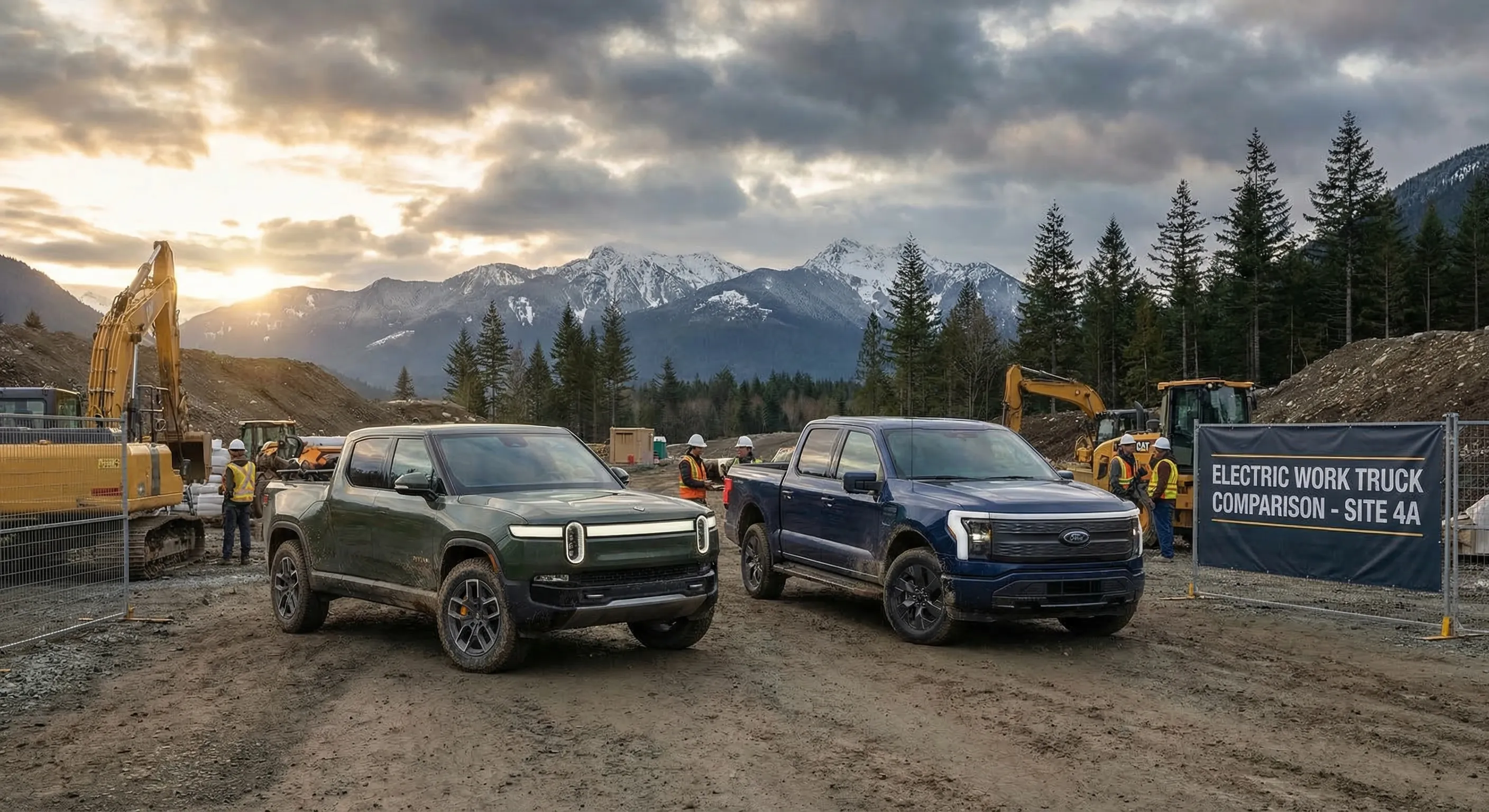
The F-150 Lightning is the first electric truck most Canadian tradespeople seriously price out. A trip to the Ford dealer in February, the kind of February where your eyelashes freeze between the parking lot and the front door, a test drive, and a quote somewhere north of $85,000 loaded. That's a Lariat trim with the Pro Power Onboard package. The payment math is ugly but not impossible for a tradesperson running a small crew.
Then there's the Rivian R1T.
After twenty minutes on the Rivian website, the question becomes what $130,000 could buy: two years of mortgage payments, a kid's university fund, a very nice cottage. The R1T is an astonishing machine. It's also a machine that costs twice what most Canadian tradespeople spend on a truck.
That tension, between the R1T's undeniable capability and its astronomical price, is the real story of this comparison. Because when you strip away the design language and the spec sheets and the YouTube review videos with suspiciously good lighting, you're left with a practical question: which of these two electric trucks actually makes sense for a Canadian who needs a truck to do truck things?
Data from tradespeople running these trucks on job sites in Fort McMurray and contractors using them as daily drivers in the Lower Mainland, charging in Edmonton parking structures in January and driving both on gravel roads north of Kamloops, tells a clear story. What follows is the answer, not the spec-sheet answer.
The Price Gap Is Real and It Matters
Let's get this out of the way immediately, because pretending the price difference is a minor footnote does everyone a disservice.
The F-150 Lightning Pro, Ford's base work-truck trim, starts at approximately $59,999 CAD before any applicable rebates. The Lightning Lariat, which is the trim most buyers actually consider, sits around $85,000. The top-spec Platinum is over $100,000.
The Rivian R1T Adventure, the standard configuration you can actually order today in Canada, starts at approximately $90,000 CAD. The Dual-Motor Standard Pack version lands closer to $75,000. But most R1T buyers are not getting the Standard Pack, they're getting the Quad-Motor with the Large or Max battery, which puts you between $110,000 and $135,000.
Neither truck qualifies for the federal EVAP rebate. Both exceed the $50,000 transaction value cap by a wide margin. You are paying full sticker on either of these, and that is not going to change.
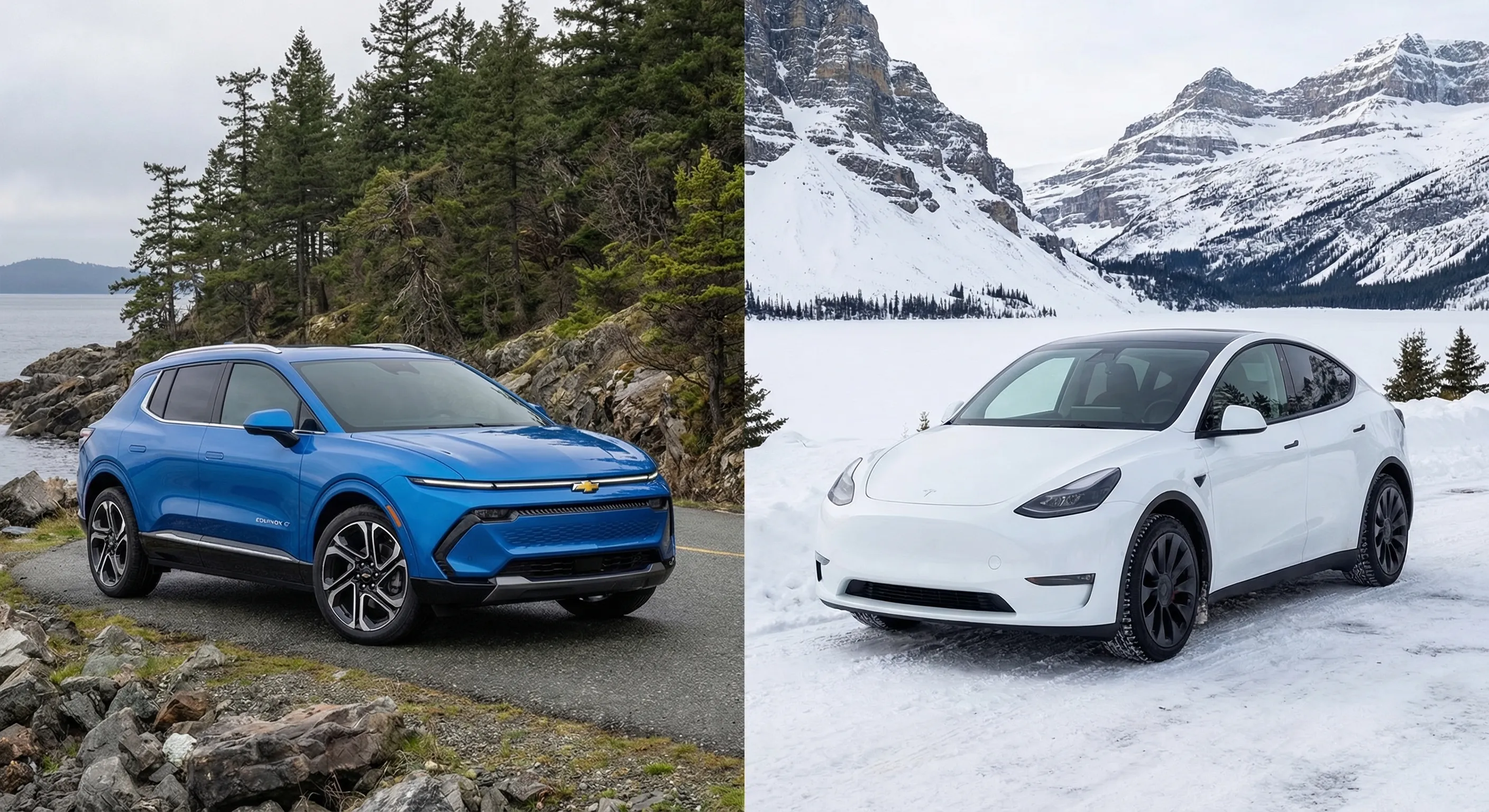
So the comparison most people are actually making is: Lightning Lariat ($85K) versus R1T Quad-Motor Large Pack ($115K). That is a $30,000 gap. That is not nothing. That is a Chevy Equinox EV sitting between them.
The Lightning's price advantage is not subtle. For a self-employed contractor, $30,000 is the difference between buying outright and financing for seven years. It's the difference between the truck fitting the business plan and requiring a business plan restructure.
This comparison does not pretend those two trucks are equally accessible. They're not. But they are both trying to do the same job, and understanding where each earns its price is worth doing carefully.
What Each Truck Was Built to Be
The F-150 Lightning was built to answer one question: can Ford make a truck that existing F-150 buyers will actually buy?
That sounds simple, but it's the hardest possible brief. F-150 buyers are the most brand-loyal, spec-specific, utility-focused buyers in the automotive market. They know exactly what they need. They know their towing weight, their payload requirements, their bed length preference, their hitch class. When they walked into a Ford dealer for thirty years and pointed at an F-150, Ford was selling them a tool.
The Lightning had to be that tool, just electric. Which means Ford spent its engineering budget making sure the Lightning could do real truck work: the Pro Power Onboard system, the large frunk where the engine used to be, the retained F-150 bed dimensions, the conventional hitch receiver, the familiar cab layout. Everything about it says: "You already know how to use this truck."
The Rivian R1T was built to answer a different question: what would a truck look like if you started from scratch and had no legacy customers to keep happy?
The answer is extraordinary. The R1T's gear tunnel running the full width under the bed. The camp kitchen that slides out from under the bed on the passenger side. The quad-motor architecture with independent torque control per wheel. The adjustable air suspension with 369 mm of ground clearance at maximum height. The distinctive headlight design. The completely reimagined interior. None of this is possible when you're constrained by thirty years of tooling and customer expectations.
The R1T is what happens when an automotive startup gets a billion dollars in venture capital, hires the best engineers in the industry, and builds the truck they actually want to build. That is impressive. It is also a statement of priorities, specifically, that the target buyer is someone who cares deeply about adventure capability and is willing to pay the premium for it.
Neither philosophy is wrong. But understanding them is essential to making the right call for your life.
The Specs That Actually Matter for Canadian Truck Work
Let me go through what I consider the seven numbers that decide this comparison for working Canadians, because the full spec sheets run to pages and most of it is noise.
Towing capacity. The R1T Quad-Motor is rated at 4,990 kg (11,000 lbs). The Lightning Platinum AWD is rated at 4,536 kg (10,000 lbs). In practical Canadian truck use, pulling a 16-foot enclosed trailer, a fifth-wheel camper, heavy construction equipment, this difference is small. Both trucks can handle a livestock trailer, a car hauler, most boats. Neither can touch a properly-specced diesel Ram 3500 pulling 20,000+ lbs. For the majority of Canadian towing applications: equivalent.
Payload. The Lightning actually has a higher payload rating than most R1T configurations, up to 907 kg (2,000 lbs) on the Lariat, versus 816 kg (1,800 lbs) for the R1T. That matters for tradespeople piling lumber or aggregate into the bed. In practice, the difference is 91 kg, about two bags of concrete. Not decisive, but worth knowing.
Range with a load. Both trucks lose significant range when towing. Real-world towing range estimates for the Lightning ER AWD at highway speed run around 300 km. The R1T Large Pack towing estimate is similar. If you're planning a trip from Calgary to Banff with a trailer, you will need to stop and charge. Plan for it with either truck.
Bed dimensions. The Lightning uses standard F-150 bed dimensions: approximately 163 cm long in the 5.5-foot bed, with a 142 cm width between wheel wells. The R1T's bed is shorter: 133 cm long, with 107 cm between wheel wells. If you regularly throw full sheets of plywood in the bed, the Lightning is more practical. If you're carrying shorter, irregular loads and relying on the gear tunnel for gear storage, the R1T works. But tradespeople who care about bed space should default to the Lightning.
Onboard power export. The Lightning's Pro Power Onboard tops out at 9.6 kW through multiple 120V and 240V outlets in the bed. The R1T can export up to 11 kW. In practice, both are more than enough to run power tools on a site without a generator. The R1T's outlets are located in the gear tunnel and frunk as well as the bed, which is actually more practical in some scenarios.
Fast charging speed. The R1T charges at up to 220 kW DC. The Lightning charges at up to 150 kW DC. At a Petro-Canada DCFC, the R1T gains roughly 160 km of range in 15 minutes; the Lightning gains roughly 130 km. Both trucks now use NACS connectors, giving access to the Tesla Supercharger network (though with an adapter for earlier model years). The R1T's faster charging ceiling matters on long road trips but makes minimal difference for daily use.
V2H (Vehicle-to-Home). The Lightning offers Ford's Intelligent Backup Power system, genuine bidirectional charging that can power a home through an outage. This is a complete, shipping system available today. The R1T's V2H capability is still in development; Rivian has indicated OTA delivery but has not shipped it. If home backup power is a priority, the Lightning wins this category by default.
Off-Road: Where the R1T Actually Justifies Part of Its Price Premium
I want to be careful here, because "off-road capability" in truck marketing has become almost meaningless. Every truck has a name for its terrain modes. Every truck claims impressive ground clearance. Very few trucks are genuinely good at technical four-wheeling.
The R1T is genuinely good at technical four-wheeling. Not because of marketing, because of how it was actually engineered.
The quad-motor setup gives the R1T something no traditional truck has: true torque vectoring at each individual wheel. The system can apply full torque to one wheel, zero to another, and any gradient in between, with millisecond precision. On a trail with a lifted wheel, the R1T simply transfers torque to whichever wheels still have traction, without wheel spin, without drama, without driver input. Tank turn, spinning in place by counter-rotating front and rear axles, is possible and actually useful in tight trail reversals.
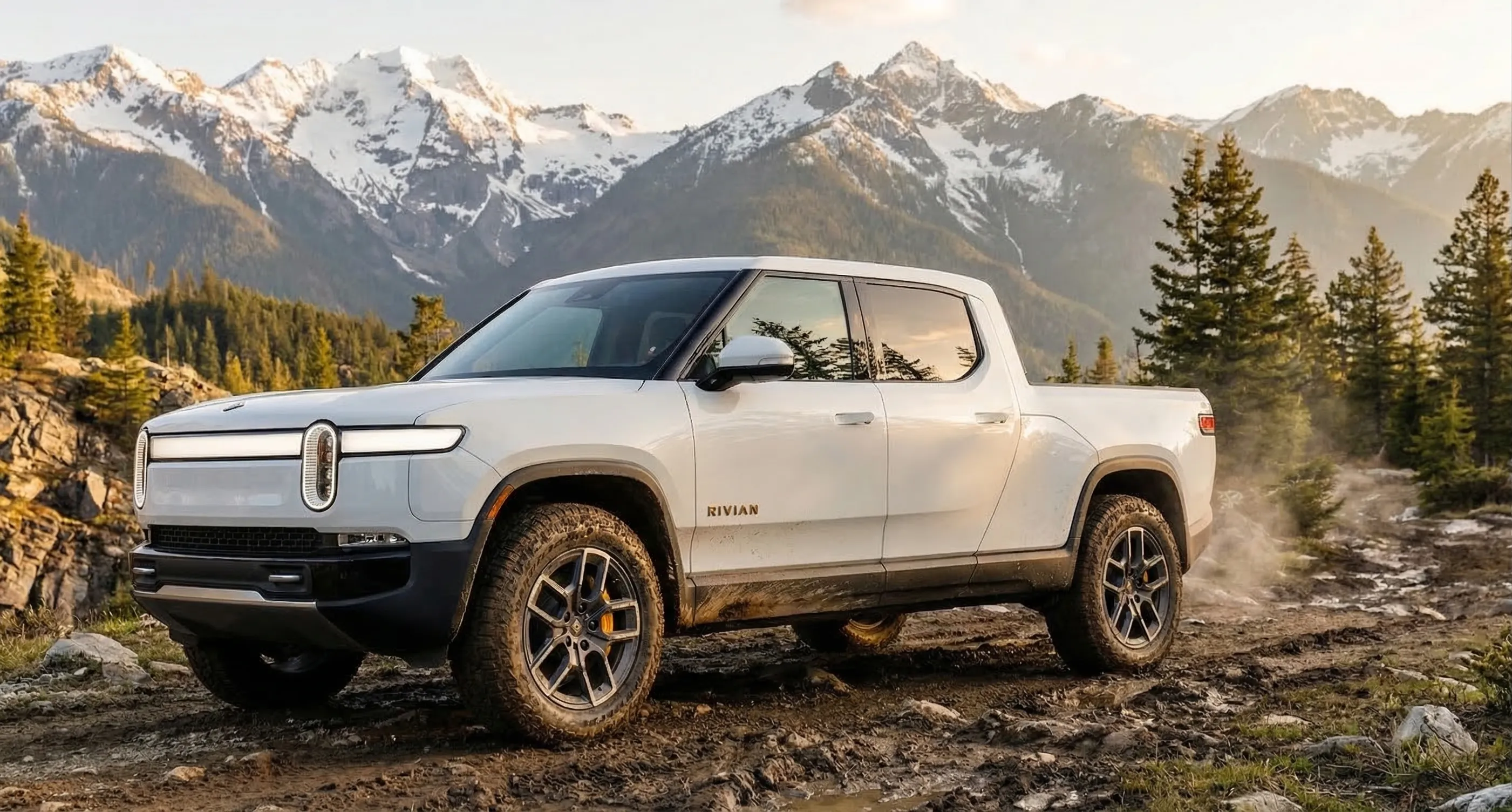
The air suspension is equally serious. At maximum off-road height, the R1T has 369 mm of ground clearance, meaningfully more than most factory 4x4 trucks. Approach angle is 34 degrees, departure angle is 30 degrees, breakover angle is 26 degrees. These are numbers that matter when you're picking a line over a ledge or through a rocky creek bed. They're competitive with modified trucks that cost $20,000 in lift kits to achieve similar specs.
Add the 1-metre water fording depth, the all-terrain tyres as standard fitment, and the fact that all of this comes from the factory in a single-purchase package, and you have a truck that is serious off-road hardware for someone who spends time on actual trails.
The F-150 Lightning's off-road story is honest and much less dramatic. The base suspension is conventional. Ground clearance is 213 mm, good for a truck, but not exceptional. The standard 4x4 system works well on unpaved roads, light off-road, and the kind of job sites that turn into mud pits in spring. It's a capable truck on everything up to moderate trail conditions. Beyond that, you'd want to add aftermarket suspension and tyres the way you would with any stock F-150, which some Canadian buyers absolutely do.
The Lightning's off-road limitation isn't a flaw; it's a deliberate design choice. Ford was solving for the most common Canadian truck use case: unpaved roads, winter conditions, gravel driveways, muddy job sites. Most Lightning buyers will never encounter conditions that stress its traction system. For those buyers, paying the R1T premium for off-road capability they won't use is poor budgeting.
For hunters, overlanders, backcountry recreationists, and anyone who spends real time on technical Canadian trails, the R1T is meaningfully better and that difference is worth real money. The question is whether it's worth the specific amount of money currently being asked.
Work: The Lightning's Domain
This is where I think the Lightning earns its reputation and the comparison shifts.
The Lightning was designed with the understanding that truck buyers are often at work when they're in their truck. The design reflects it in ways that go beyond the spec sheet.
The frunk is 400 litres, about the size of a small car's boot, with a 400W outlet built in. You can lock it. You can put a day's worth of tools in it and have them locked and secure when you're on a job site. This sounds minor until you've been that contractor who parks a truck at a site and comes back to find the bed has been rummaged through. The frunk offers an additional layer of storage security that a conventional truck simply can't match.
The Pro Power Onboard system is exceptional for site work. The standard package provides 2.4 kW of 120V power. The extended package bumps this to 7.2 kW, and the Platinum's full package delivers 9.6 kW through a 240V outlet in the bed, enough to run a table saw, a circular saw, a compressor, and still have capacity left. Framing crews in the Interior of BC have replaced their portable generators entirely with the Lightning. At approximately $800 for a quality 2,000W portable generator, the math on the Pro Power package justifies itself after a few months of site work just in fuel savings and maintenance headaches eliminated.
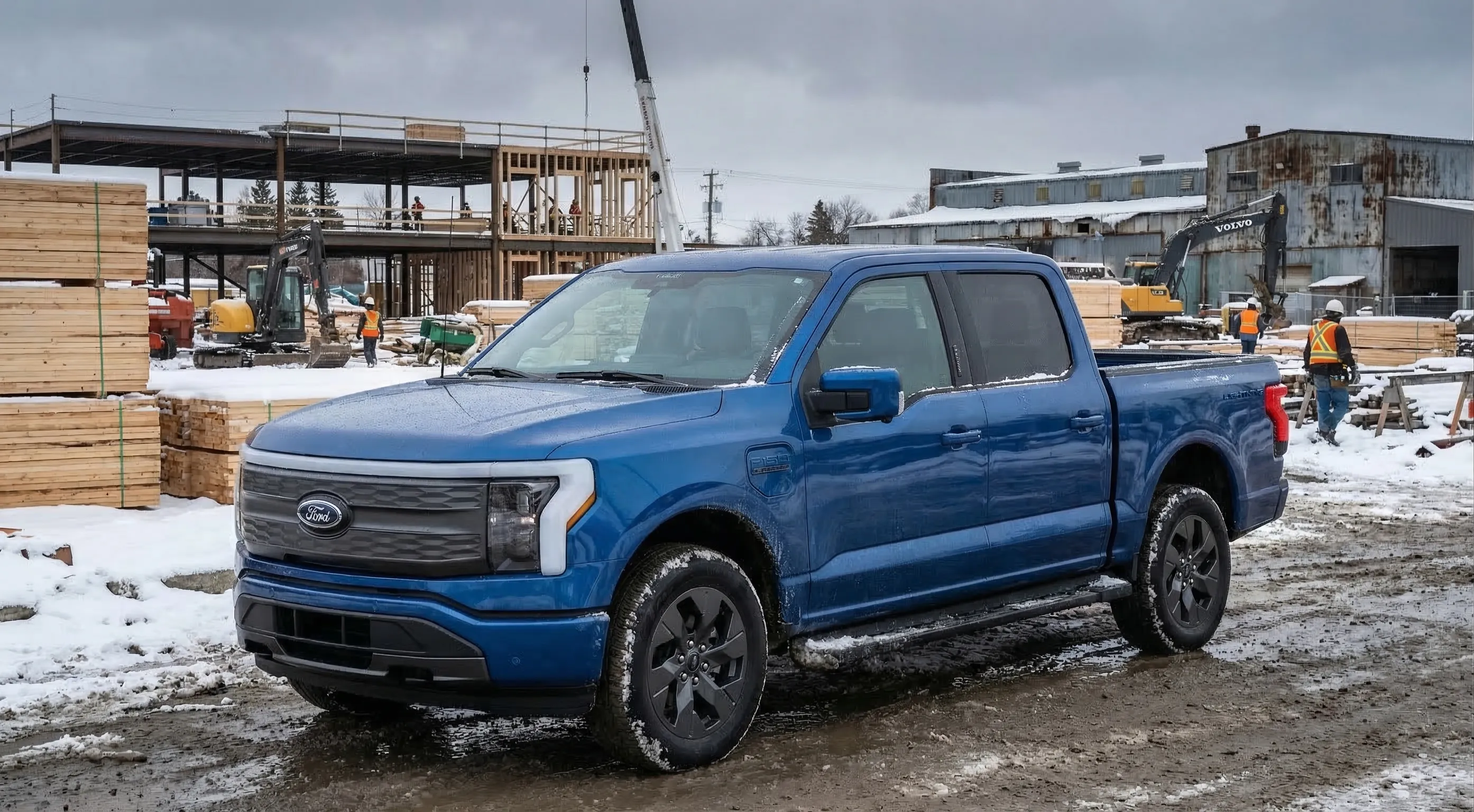
The bed itself is worth discussing. Ford kept the Lightning's bed consistent with the F-150 lineup, 5.5-foot or 6.5-foot options, with the same tie-down points, the same accessory mounting system, the same dimensions that thirty years of truck accessories have been designed around. Every bed cover, every tonneau cover, every bed liner, every rack system made for an F-150 works on the Lightning. For tradespeople with invested toolboxes or racks, this backward compatibility is a real advantage.
The R1T's bed is 56 cm shorter than the Lightning's standard bed. That matters when you're carrying 8-foot lumber and need it inside the bed, not hanging out the back. The gear tunnel is clever, 330 litres of waterproof, lockable storage that doesn't eat into bed space, but it doesn't replace bed length for longer materials. The gear tunnel is an adventure feature that has some work applications, but it's not a substitute for bed length if your primary use is construction materials.
Where the R1T does compete on the work side is power export. Eleven kilowatts is more than the Lightning's 9.6, and the distribution across frunk, gear tunnel, and bed outlets means you can run equipment in multiple locations simultaneously without running extension cords across the length of the truck. For a small crew working a job site, this is actually useful. It is not, however, a $30,000-useful advantage over the Lightning.
Charging: Both Trucks Use NACS Now, Here's What That Actually Means
The charging situation for both trucks shifted when Ford announced NACS adoption, and understanding the current situation is worth getting right.
Both 2024+ model year Lightning trucks come with NACS connectors natively. Both 2024+ R1T trucks also come with NACS natively. This means both trucks can use the Tesla Supercharger network without an adapter, which is the most consistent, most reliable DC fast charging network in Canada.
The practical charging difference comes down to charging speed, not connector compatibility.
The R1T charges at up to 220 kW. At a Supercharger V3 station (which runs up to 250 kW for compatible vehicles), the R1T can pull close to its 220 kW maximum, gaining roughly 160 km in 15 minutes. At a typical Electrify Canada 150 kW station, the R1T charges at that station's maximum speed, fast charging is always constrained by whichever is slower, the car or the charger.
The Lightning charges at up to 150 kW. At the same Supercharger V3, the Lightning pulls 150 kW and gains roughly 130 km in 15 minutes. At a 150 kW Electrify Canada station, performance is essentially identical.
The real-world impact for most Canadian Lightning or R1T owners: minimal. The charging speed difference matters most on fast-paced road trips where you're doing multiple long legs in a day. For daily driving, home charging overnight, occasional DCFC stops, the speed difference between 150 kW and 220 kW adds maybe 10-15 minutes to a typical road trip stop. Not nothing, but also not a dealbreaker.
What matters more for Canadian drivers is charging network density. Both trucks can now use Superchargers, Electrify Canada, Petro-Canada, FLO, and ChargePoint stations. The Supercharger network's recent NACS openness to non-Tesla vehicles has changed the game. The Trans-Canada corridor is reasonably well served. The Coquihalla, the Trans-Canada through the Rockies, the Trans-Canada across the Prairies, all have adequate DCFC coverage for a planned trip with either truck.
Where coverage gets sparse: northern routes, smaller highways off major corridors, remote job sites. The Lightning's V2H capability is an advantage in remote contexts, if you're staying somewhere with grid power, you can charge the truck and use it to power equipment or emergency loads. This isn't a charging infrastructure point per se, but it does factor into range anxiety on remote routes.
One honest point for Lightning buyers considering long road trips with a trailer: both trucks lose significant range when towing at highway speed. With a trailer, budget for charging stops every 250-300 km. This is the current reality of towing EVs and will remain true for several more years as battery density improves. Plan your trip around DCFC locations and the trip is completely manageable. Fail to plan and you will have a stressful afternoon.
V2H and Home Energy: The Lightning's Underappreciated Advantage
Let me spend more time on V2H than most comparison reviews do, because I think this is actually a meaningful differentiator for the Canadian context.
Canada has power outages. We just do. Ice storms in Ontario, wind events in the Maritimes, grid stress during winter peaks in Alberta, wildfire-related shutoffs in BC. The average Canadian household experiences roughly one outage per year lasting more than one hour. In some regions, that number is much higher.
The F-150 Lightning with Ford's Intelligent Backup Power system and a compatible home charging setup can power an average Canadian home for up to three days on a full charge, and up to ten days when running essential loads only. This is a complete, shipping system. Ford has worked out the installation requirements, the compatible hardware list, the inverter specs. You buy the truck, you get the compatible home charger installed (around $1,500-2,500 installed for the Sunrun Ford Charge Station Pro or equivalent), you're done. The truck becomes your backup generator.
The approximate cost of a whole-home standby generator in Canada, propane or natural gas powered, runs from $8,000 to $20,000 installed. A portable generator capable of running essential loads costs $1,000-3,000. If you were planning to buy either of those and the Lightning can replace it, that cost should reduce your effective Lightning price comparison.
For a homeowner in rural Ontario who was going to spend $12,000 on a standby generator anyway, the Lightning's V2H capability is worth $12,000 of the price premium over a truck that doesn't offer it. That changes the comparison significantly.
The R1T does not currently offer V2H. Rivian has been clear that the capability is intended, the hardware architecture supports it, but it has not been delivered via OTA update as of 2026. If you're buying an R1T today specifically for V2H backup power, you're buying a promise, not a delivered feature. For the Lightning, it's operational day one.
Gear worth having
As an Amazon Associate, ThinkEV earns a small commission from qualifying purchases — at no extra cost to you.

Grizzl-E Classic Level 2 EV Charger (40A)
Canadian-made and rated for minus 40C winters. 40A / 9.6 kW, NEMA 14-50, indoor/outdoor, 24-ft cable. The charger built for Canadian weather.
As an Amazon Associate, ThinkEV earns from qualifying purchases — at no extra cost to you.
Canadian Winter: Both Trucks Are Capable, With Important Differences
Both the R1T and Lightning use NMC battery chemistry. NMC handles cold weather better than LFP, which is relevant because some other EVs (many BYD models, some Teslas) use LFP and lose more range in extreme cold. With NMC, both trucks will lose approximately 25-35% of their rated range at sustained temperatures below -20°C. In real Winnipeg winter terms: an R1T rated for 580 km will deliver maybe 380-430 km in January. A Lightning ER rated for 515 km will deliver roughly 340-390 km. These aren't catastrophic numbers, enough for multiple days of typical driving before charging, but they need to be part of your mental model.
Both trucks have heat pumps, which are significantly more efficient for cabin heating than resistive electric heaters. Both support battery preconditioning, warming the pack before departure, either on a schedule or while plugged in, which is the single most impactful action you can take for winter range and charging speed. Use the apps. Set a departure time. Precondition before you unplug. This alone can recover 15-20% of winter range loss.
The R1T has a meaningful winter advantage in traction: quad-motor torque vectoring on each wheel. In snow and ice, this translates to exceptional stability and confidence that a traditional two-motor AWD system, like the Lightning, can't fully replicate. The R1T doesn't just have traction control; it has the ability to put precisely the right amount of torque on precisely the wheel that needs it, in real time. For a buyer who regularly deals with unplowed back roads, steep snowy driveways, or remote winter access, this is a genuine capability difference.
The Lightning's traction system is a capable conventional AWD, good in snow with proper winter tires, better than most traditional 4x4 trucks in traction management. But it's not the R1T on a slippery logging road in January. If that scenario describes your regular winter driving, note the difference. If you're mostly on plowed roads and maintained job sites, the Lightning's AWD is entirely adequate.
Both trucks support winter tires. Both are dramatically better with winter tires than all-seasons in Canadian conditions. This is not EV-specific advice; it applies to every vehicle in Canada. Budget $1,500-2,500 for a winter tire set and rims when you buy either of these trucks, it's not optional, it's part of the ownership cost.
Technology and Software: Two Very Different Philosophies
The R1T's technology story is impressive for an automotive startup with fewer than ten years of production history.
The infotainment system runs on a large 15.6-inch portrait-orientation touchscreen with fast response times and clean UI design. The climate controls are digital rather than physical knobs, which I find less intuitive for cold gloved hands, but the overall quality of interaction is much closer to Tesla than to traditional automotive software. Over-the-air updates have meaningfully improved the R1T since launch, adding features, improving charging speed, refining the air suspension logic. Rivian's software team has a culture of actually using software updates to make the vehicle better, not just fix bugs.
Gear worth having
As an Amazon Associate, ThinkEV earns a small commission from qualifying purchases — at no extra cost to you.

Coiled Lightning Car Cable for iPhone (2-Pack)
Retractable Lightning cables built for the car: fast, tidy, and long enough to reach the back seat.
As an Amazon Associate, ThinkEV earns from qualifying purchases — at no extra cost to you.
The R1T's off-road modes are sophisticated: Conserve, Sport, All-Purpose, Tow/Haul, Off-Road Auto, Rock Crawl, Sand, and Drift (a somewhat indulgent feature that's more entertaining than practical). Each mode meaningfully adjusts suspension height, throttle mapping, traction control aggressiveness, and torque distribution. On a trail, the difference between All-Purpose and Rock Crawl is palpable, the truck becomes more careful, more deliberate, more controlled in its power delivery.
The R1T's Camp Mode is worth mentioning for adventure-oriented buyers. You can run the climate system for extended periods with the truck stopped, monitor air quality, run the camp kitchen, and manage power export, all from a mode specifically designed for extended stationary use. It's the kind of detail that shows up in product design when the people building the vehicle are the same people who want to use it.
The F-150 Lightning's technology story is different: Ford spent its effort on integration rather than innovation.
The SYNC 4A system with the massive 15.5-inch widescreen touchscreen is fast, responsive, and supports wireless Apple CarPlay and Android Auto. This is the correct call for most truck buyers. Most truck buyers do not want to learn a new interface. They want to plug their iPhone in, get their Google Maps or Waze, and drive. The Lightning delivers this smoothly. Wireless CarPlay means your phone's familiar interface takes over within seconds of getting in the truck.
FordPass, the Lightning's companion app, handles remote start, charging management, and trip planning. It works reliably. It's not flashy, but it's competent in the ways that matter: you can check your charge level from the kitchen, you can start charging remotely, you can set a departure time. OTA updates come on a regular cadence and have improved the system over time.
The Lightning's frunk is powered, it opens with a button rather than requiring manual lifting. This is a small thing that matters when your hands are full of materials. The R1T's frunk is manual. I'm listing this as a work-practicality point, not a technology point, but it's the kind of detail that adds up.
The Gear Tunnel: Adventure Feature or Useful Differentiator?
The R1T's gear tunnel deserves its own section because it comes up constantly in reviews and I want to give it an assessment for Canadian buyers across different use cases.
The gear tunnel runs the full width of the truck under the bed. It's 330 litres of waterproof, lockable storage accessed from either side via roll-up doors. The floor is load-rated and flat when the doors are rolled up. There's a 120V outlet inside.
For adventure and recreation buyers, this is transformational. Muddy hiking boots, wet camping gear, tools, recovery boards, all of it goes in the gear tunnel and stays out of the cab and bed. You can carry wet or dirty equipment without contaminating the rest of your load. You can lock small valuables in a secure compartment while the bed is accessible. The waterproofing means you can fill it with ice and use it as a cooler on a long trail day. It's a clever, well-considered piece of design for the target buyer.
For the typical trade buyer, it's a nice-to-have, not a must-have. If you're carrying lumber and tools, your day ends when the lumber is unloaded and the tools go back in the gear tunnel until tomorrow. It's useful storage but not functionally different from a well-organized toolbox in a conventional truck.
What the gear tunnel is not, for anyone: a replacement for bed length. If you need to put 10-foot lumber in the bed, the R1T's shorter bed is still shorter. The gear tunnel doesn't extend your load capacity for long materials. This is the comparison point that matters most for construction tradespeople: the Lightning has more bed, and that's real.
The V2G Future: Thinking Ahead on Both Platforms
The broader context worth understanding: the F-150 Lightning and R1T are both positioned to participate in vehicle-to-grid (V2G) programs as Canadian utilities roll them out. V2G allows your truck to sell electricity back to the grid during peak demand periods, potentially generating revenue to offset your charging costs.
BC Hydro, Hydro One, and several other Canadian utilities are actively piloting V2G programs. The Lightning's bidirectional charging architecture makes it natively compatible with these programs. Rivian's intended V2H/V2G capability (once delivered) would make the R1T similarly capable.
If V2G becomes mainstream in Canada, and the trajectory suggests it will over the next five years, owning a large-battery truck becomes a potential revenue source rather than just a cost centre. Estimated revenue in early BC Hydro V2G pilots: $500-1,500 per year per vehicle depending on participation level. Small in the context of a $85,000-115,000 purchase, but a genuine offset worth factoring into long-term ownership math.
Total Cost of Ownership: Running the Real Numbers
I'm going to run the five-year ownership numbers as honestly as I can, because the purchase price comparison is only part of the financial picture.
Starting with the Lightning Lariat AWD ER at approximately $85,000 versus the R1T Quad-Motor Large Pack at approximately $115,000. That's a $30,000 purchase price gap. No EVAP rebate on either truck.
Electricity cost: both trucks have roughly similar efficiency, about 2.8-3.2 km per kWh in real-world mixed driving, somewhat worse when towing or in winter. At the Canadian average residential electricity rate of approximately $0.14/kWh, figure $3,500-4,500 over five years for either truck at typical annual mileage. Negligible difference.
Insurance: the R1T will typically cost $400-600 more per year to insure in Canada due to higher replacement cost and more complex repair requirements. Over five years: $2,000-3,000 more for the R1T.
Maintenance: electric trucks are simpler than gas trucks, no oil changes, no transmission fluid, fewer wear items. Both trucks should be cheap to maintain. Estimate $1,500-2,500 over five years for routine maintenance on either vehicle.
Tyres: both trucks need commercial-grade winter tyres. The R1T's 20-inch or 21-inch standard fitment tends to cost more to replace than the Lightning's 18-inch options. Budget $200-400 more over five years for R1T tyre costs.
Resale value: this is where the numbers get uncertain but important. The F-150 Lightning holds value well, it benefits from the F-150 brand equity and a large, established used market. Expect 50-55% residual value after five years based on current observed depreciation. The R1T has held value better than many expected, but it's a smaller market with more uncertainty. Call it 45-52% residual. On a $115,000 truck, a 5% residual value difference is $5,750. On an $85,000 truck, the same difference is $4,250.
The five-year total cost of ownership summary:
Lightning Lariat ($85K): purchase $85K, electricity $4K, insurance $8K typical, maintenance $2K, tyre cost ~$3K, depreciation ~$38K (55% residual at $47K). Five-year TCO approximately $100,000.
R1T Quad ($115K): purchase $115K, electricity $4K, insurance $12K typical, maintenance $2.5K, tyre cost ~$3.5K, depreciation ~$58K (50% residual at $57K). Five-year TCO approximately $135,000.
That is a $35,000 five-year TCO difference. The R1T needs to provide $35,000 of value over the Lightning to justify its premium, in adventure capability, in off-road competence, in the gear tunnel, in the quad-motor traction system, in the design satisfaction, in whatever matters to you personally.
For some buyers, it absolutely does. For the majority of Canadian truck buyers evaluating these two vehicles practically, it doesn't.
Who Buys Which Truck: An Honest Profile
After all the spec analysis, the real differentiation comes down to buyer profiles. Let me describe the two buyers I actually see making these purchases.
The Lightning buyer is a tradesperson, a contractor, a business owner, someone who uses their truck as a tool. They care about payload, bed space, onboard power, and reliability. They want a truck that their existing F-150 accessories will fit. They like the idea of not buying gasoline. They value the home backup power capability, especially if they work from home or live somewhere with frequent outages. They are practical, budget-conscious, and they will be proud of the Lightning, but they're not buying it as a statement. They're buying it as the right tool for their job at a price that makes financial sense.
The R1T buyer is someone who values the truck experience as much as the truck utility. They camp, they trail run, they spend weekends in the backcountry. They appreciate the gear tunnel and the camp kitchen not as gimmicks but as actually enabling their lifestyle. They're often tech-oriented, attracted to Rivian's software culture and OTA update trajectory. They may own a business where the truck's image communicates something, innovation, environmental commitment, premium positioning. The $115,000 price is within their means and the premium feels justified by a combination of capability and experience. They're not being irrational; they're prioritizing differently.
Both buyers can be right. There is no universal correct answer here. There is only: which of these two profiles is closer to you?
If you're unsure, here's the question I'd ask: imagine you've bought the Lightning. On a Saturday morning in June, you're driving it to pick up materials for a weekend project. Does that feel like the right truck in the right moment, or are you wishing you had something else? If the answer is "that feels right," buy the Lightning. If the answer is "I wish I were heading to a trail instead of a hardware store," buy the R1T, and reassess the priorities that led you to consider the Lightning in the first place.
Service, Warranty, and What Happens When Things Go Wrong
This category matters more than most truck comparisons acknowledge. When something breaks at -35°C on a job site two hours from the nearest city, what matters is not what the spec sheet promised, it's how fast someone competent shows up and fixes the problem.
Ford has the most extensive dealer and service network in Canada. There are Ford dealers in Estevan, Saskatchewan and Whitehorse, Yukon and Yarmouth, Nova Scotia. There are Ford dealers in communities that don't have a single traffic light. When your F-150 Lightning needs service, you're unlikely to be more than an hour's drive from someone who can work on it. That is genuinely valuable for buyers outside major urban centres.
More importantly: Ford dealers have been working on F-150 trucks for decades. The Lightning shares its cab, frame, and suspension geometry with the gas F-150. The drive units and battery are new, but the service infrastructure understands this platform. Parts availability is good. Warranty claims are processed through an established network. If you have a problem, you have options.
Rivian's service infrastructure is a different story, not bad, but limited by its newness. Rivian operates service centres in major Canadian cities: Toronto, Vancouver, Calgary are covered. Mobile service vans handle many repairs remotely. Rivian's app-based service request system is well-designed, you describe the problem, they often diagnose it remotely, and many issues are resolved via OTA update or a mobile service tech visit without you ever taking the truck anywhere.
But if you're in Kelowna or Saskatoon or Moncton, you're potentially looking at a significant service trip for anything the mobile van can't handle. Rivian is expanding its network, and the mobile service model addresses many common needs. The honest reality: if you live in a major Canadian city, Rivian's service experience is competitive. If you live in rural or smaller-urban Canada, Ford's network density is a meaningful advantage.
Both trucks come with comprehensive warranties. The Lightning: 3 years/60,000 km bumper-to-bumper, 8 years/160,000 km battery and electric components. The R1T: 5 years/100,000 km bumper-to-bumper, 8 years/175,000 km battery warranty. The R1T's longer bumper-to-bumper warranty reflects Rivian's confidence in their platform and helps address the service accessibility concern, more issues are covered at no cost for a longer period.
One practical ownership consideration for the R1T: Rivian parts sourcing can take longer than F-150 parts. The F-150 parts ecosystem is massive, aftermarket suppliers, independent shops with inventory, salvage yards. If your Lightning needs a minor body part or a non-EV component replaced, Ford's supply chain delivers quickly. For R1T owners, patience is occasionally required. This isn't a dealbreaker, but it's a real-world ownership texture worth knowing.
Both trucks offer roadside assistance programs during the warranty period. If you're doing long-distance towing or backcountry driving, supplementing either truck's roadside program with a CAA membership makes practical sense, CAA has agreements with towing companies across Canada that go places manufacturer roadside assistance can't efficiently reach.
The Camping and Overlanding Case for the R1T
I haven't spent enough time on the R1T's adventure-specific features, and that's because I've been looking at this comparison primarily through a utility lens. Let me give the R1T its due on the adventure side.
As covered in the Gear Tunnel section above, the camp kitchen and gear tunnel work as an integrated system, the kitchen slides out one side, gear comes out the other, and the whole setup is purpose-built in a way that aftermarket accessories can't replicate.
For overlanders who spend multiple nights in remote locations, the R1T's battery capacity doubles as a serious power bank. The 11 kW export capacity means you can run a rooftop tent heater, charge communication devices, run a portable fridge, and still have range to drive the next day. The capacity management system in the Rivian app lets you set minimum battery reserve, so you don't accidentally drain the truck below drive-home range while running camp power.
This is the version of the R1T comparison that makes the premium feel most justified: if you're the person who buys $10,000 in camping and overlanding equipment to do the same things the R1T makes easier, the truck's premium becomes a consolidation play. You're not paying more for a truck; you're paying for a truck that replaces a truck plus equipment.
The F-150 Lightning can absolutely be set up for camping and overlanding. The frunk makes a clean storage compartment. The bed with a quality tent or canopy setup works well. The Pro Power Onboard handles camp power needs. But you're assembling the system yourself from aftermarket parts rather than getting it from the factory as an integrated design. For someone who prioritises the adventure use case, the R1T's factory integration is worth something real.
What the Canadian Charging Network Looks Like in Practice in 2026
I want to give a current picture of where Canadian EV truck charging infrastructure actually stands in 2026, because the situation has changed significantly and the changes favour both trucks.
The Tesla Supercharger network is the most relevant development for both truck owners. Tesla opened the network to non-Tesla vehicles in 2023, and the combination of NACS connectors becoming standard (both trucks get them in 2024+ model years) and Tesla's aggressive Canadian Supercharger expansion means the coverage picture is better than it was two years ago. There are currently over 150 Supercharger stations in Canada, concentrated along major corridors and in urban centres. The Trans-Canada from Vancouver to Halifax, the highway 97 corridor through BC, the Trans-Canada across the Prairies, and Highway 401 through Ontario all have reasonable Supercharger coverage.
Electrify Canada has expanded to over 300 DCFC stations with ongoing growth. The Petro-Canada Electric Highway covers the Trans-Canada corridor from coast to coast with stations at regular intervals. FLO, ChargePoint, and various regional networks fill in secondary routes.
The assessment for rural Canada: if your regular driving takes you off the main corridors, you need to plan charging stops carefully. Northern Ontario, northern Quebec, the Maritime interior, and most of Northern Canada remain underserved by fast charging infrastructure. If your job takes you to remote sites on a regular basis, the Lightning's V2H capability and Pro Power Onboard make it more self-sufficient at remote locations, you can arrive at a remote camp, use the truck for power during the stay, and depart knowing the charge state at all times.
The R1T's larger battery capacity (up to 180 kWh on the Max Pack) gives it a theoretical advantage on extremely long remote drives where charging stops are sparse. More range means you can space your stops further apart and deal with charging deserts more comfortably. But this advantage assumes you're getting the Max Pack, which is the most expensive R1T configuration.
For urban and corridor driving, the majority of Canadian EV truck use, both trucks are well-served by current infrastructure. The days of range anxiety as a daily concern are largely behind us for people driving on or near major Canadian corridors. The concern now is specific to remote use cases, and both trucks have strategies to address it.
The Verdict: Which One You Should Actually Buy
For most Canadian truck buyers, including most people reading this review: buy the F-150 Lightning.
That's not a knock on the R1T. The R1T is an extraordinary machine that represents the most sophisticated electric truck currently available. But "most sophisticated" and "best value for your life" are different things, and for the majority of Canadian buyers, the Lightning's combination of price, utility, bed space, V2H capability, and industry compatibility lands in a better place.
The Lightning earns its recommendation because: it costs $30,000 less at comparable configurations. It has a longer bed for trade work. It has V2H backup power that works today. It has better payload rating. Its accessories ecosystem is huge. Ford's dealer network covers virtually every Canadian city and town. And it's an excellent truck, not a compromise, not a "good enough for the money" truck, but a good electric truck that does truck things well.
Buy the R1T if: you regularly do serious off-road work, actual trails, not just gravel driveways. If the quad-motor traction system and 369 mm air suspension address real conditions you encounter. If the gear tunnel and camp kitchen align with how you actually spend your weekends. If the price fits your situation without requiring financial gymnastics. And especially if you've driven one and felt something that you didn't feel in the Lightning, because that feeling is real and it matters.
The summary: both trucks are proof that electric powertrains have reached the point where no truck buyer needs to compromise on capability to go electric. You're choosing between two excellent tools. The Lightning is the smarter financial decision for most buyers. The R1T is the more extraordinary object. Canada needs both of them in the market.
Gear worth having
As an Amazon Associate, ThinkEV earns a small commission from qualifying purchases — at no extra cost to you.

PULIDIKI Car Cleaning Gel (Detailing Putty)
Press it into vents, buttons, and seams and it lifts out dust you did not know was there. Weirdly satisfying, genuinely useful.
As an Amazon Associate, ThinkEV earns from qualifying purchases — at no extra cost to you.
Related Reading
- Ford F-150 Lightning Canada Review 2026, A full breakdown of the Lightning as a standalone truck.
- Rivian R1S vs Tesla Model X Canada 2026, The Rivian SUV against Tesla's flagship.
- Best Level 2 EV Chargers Canada 2026, Home charging solutions for truck owners.
- Canada EV Rebates and EVAP Guide 2026, Full breakdown of federal and provincial EV incentives.
Gear worth having
As an Amazon Associate, ThinkEV earns a small commission from qualifying purchases — at no extra cost to you.

WixGear Magnetic Air Vent Phone Mount (2-Pack)
A magnet strong enough that your phone never flinches over potholes or rail crossings. Two in the box, one for each car.
As an Amazon Associate, ThinkEV earns from qualifying purchases — at no extra cost to you.

Founder & Chief Editor
Vlad Pereira is the founder and chief editor of ThinkEV.ca, the Canadian electric-vehicle publication he writes and edits from Courtenay, British Columbia. He covers EV pricing, federal and provincial rebates, charging costs, and the Chinese manufacturers now entering Canada, from the buyer's side rather than the press-fleet side. ThinkEV is a venture of Vlad Pereira Online; his writing on health, income and the long game lives at vladpereira.com.
Frequently asked questions
Does either the Rivian R1T or F-150 Lightning qualify for the federal EVAP rebate in Canada?
Can either truck actually power my home during a power outage?
How do these trucks perform in real Canadian winters, Alberta cold, BC snow?
Which truck is better for tradespeople and contractors in Canada?
What charging networks can both trucks use in Canada?
Is the Rivian R1T worth the premium over the F-150 Lightning for a Canadian buyer?
What is the F-150 Lightning's towing range in Canada, will it handle the Trans-Canada with a trailer?
More EV & road-trip finds
Affordable upgrades worth a look — tap any to check the price on Amazon.
 ★ 68
★ 68WeatherTech FloorLiner for Tesla Model 3
View on Amazon ★ 4,050
Touchscreen Mist Screen Cleaner Kit
View on Amazon ★ 164
★ 164Solar-Powered LED Ambient Light
View on Amazon ★ 900
★ 900Personalized Photo Car Air Freshener
View on Amazon ★ 865
★ 865Collapsible Trunk Organizer
View on Amazon ★ 1,866
70mai A810 4K Dual Dash Cam
View on Amazon ★ 87
★ 87Car Window Sun Shades for Kids (4-Pack)
View on Amazon ★ 268
★ 268Anti-Slip Leather Steering Wheel Cover
View on AmazonRead, Plan, Then Stay Current
Explore our expert articles to understand incentives and ownership costs, use the map to pressure-test charging reality, then subscribe so new EV coverage comes straight to you.
Continue Reading
EV vs Gas: 5-Year Cost of Ownership in Canada
BMW i4 vs Tesla Model 3: Is the $11K Premium Worth It?
BYD Atto 3 vs Hyundai Kona EV: The $35K Comparison
BYD Dolphin vs Chevy Bolt 2027: Cheapest EVs
BYD Seagull vs Nissan Leaf: Canada's Cheapest EVs