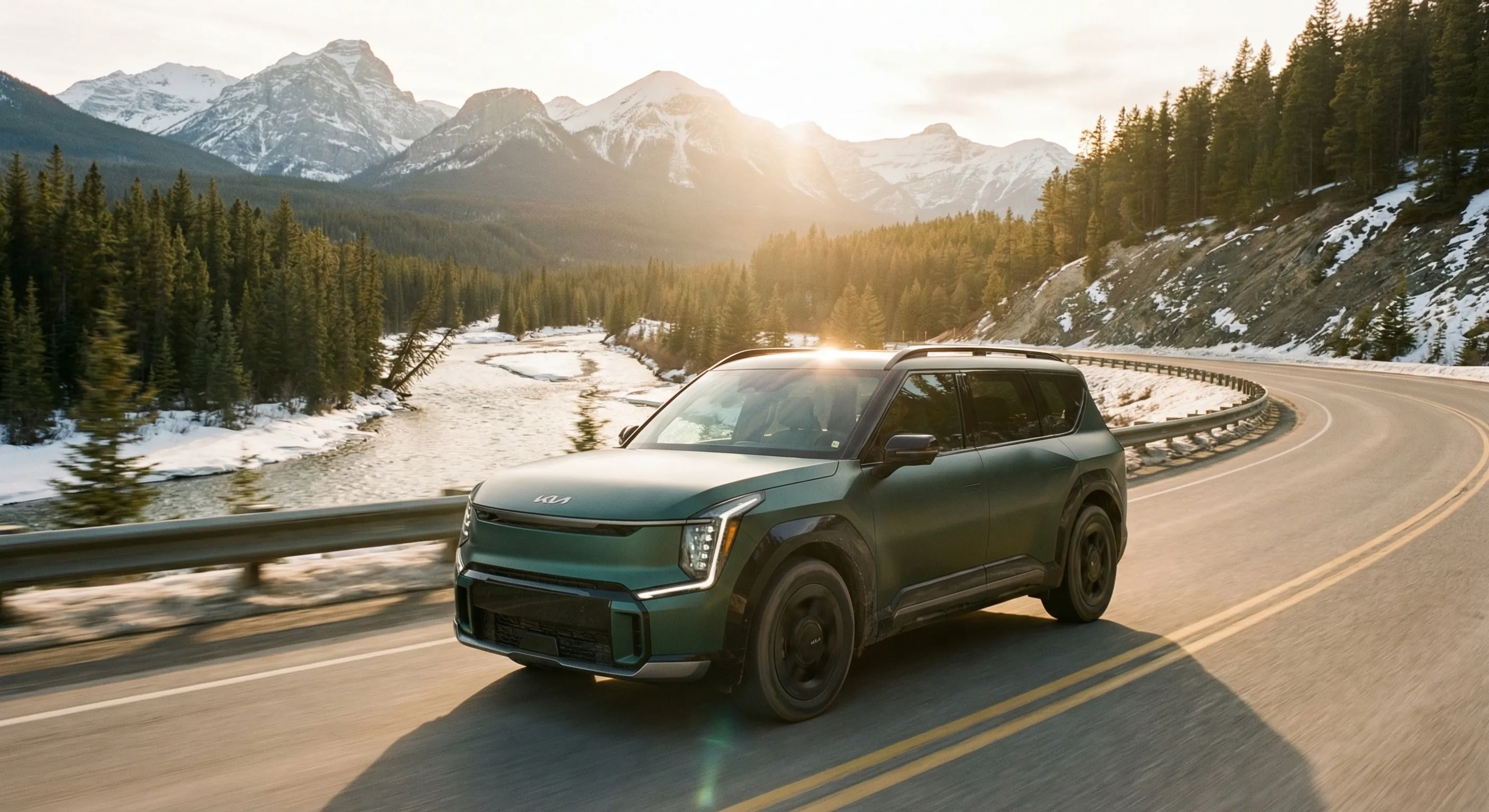
Key takeaways
- The Kia EV9 starts at $64,995 CAD in Light RWD trim, rising to $79,995 for the GT-Line AWD, and none of its three trims qualify for the $5,000 EVAP rebate because all exceed the $50,000 cap.
- The 99.8 kWh battery gives the Light RWD an estimated 490 km of range and the AWD models about 445 km.
- On a 350 kW Electrify Canada charger the EV9 goes 10–80% in roughly 24 minutes, enabled by its 800V E-GMP architecture.
- The GT-Line's second-row captain's chairs swivel 180 degrees to face the third row, creating conference-style seating when parked.
- The EV9 tows up to 2,500 kg when properly equipped, though towing cuts range by an estimated 40–50%.
It's a Saturday morning in early March. You've got two kids in hockey gear, a cooler of snacks, your partner managing the playlist, and your parents riding in the back because they wanted to tag along for the tournament in Kingston. Six people, a weekend's worth of luggage, and a three-hour highway run across Ontario. In a gas-powered Highlander, that's a $90 fuel bill and a cabin that smells like exhaust by the time you hit the 401.
In the Kia EV9, you plug in at home the night before, depart with 445 km of range showing on the dash, cruise in near-silence while the kids fall asleep to the hum of 283 horsepower distributed across two electric motors, and arrive without stopping for fuel. That's the pitch. And after spending serious time with this vehicle, I can tell you: the EV9 delivers on it.
The Kia EV9 is the first three-row electric SUV that doesn't require you to choose between practicality and electrification. The Tesla Model X has three rows but costs $120,000+. The Rivian R1S has three rows but costs $100,000+. The EV9 starts at $64,995 CAD, has genuine third-row space for adults, a 99.8 kWh battery delivering 490 km of range, and 800V ultra-fast charging that goes from 10% to 80% in 24 minutes. For Canadian families who need to move six or seven people electrically, the EV9 is in a class of one at its price point.
Let's be clear about the competitive picture. In 2026, if you want a three-row electric SUV in Canada, your options are the EV9, the Tesla Model X (starting around $120,000), and the Rivian R1S (around $100,000 if you can even get one delivered). The Hyundai Ioniq 9 is arriving later this year on the same E-GMP platform, but it's not on dealer lots yet. The Mercedes EQS SUV technically has three rows but starts well above $150,000. The EV9 occupies a price bracket, $65K to $80K, that no other three-row EV touches. It's not cheap in absolute terms, but it's roughly half the price of its nearest electric competitors while delivering 90% of the capability. That's a significant market position, and Kia knows it.
The EV9 comes in three main configurations: the Light RWD ($64,995), the Wind AWD ($74,995), and the GT-Line AWD ($79,995). None of these qualify for the $5,000 federal EVAP rebate, all exceed the $50,000 final transaction value cap. This is a premium family vehicle, and it's priced accordingly. But before that price tag scares you off, keep reading, the total cost of ownership story gets more interesting than the sticker price suggests.
What makes the EV9's market position so interesting is the vacuum it fills. For years, the electric vehicle market offered two types of three-row options: ultra-premium vehicles for six-figure budgets, or adapted two-row platforms with a third row bolted on as an afterthought. The EV9 is purpose-designed to be a three-row family vehicle first and an electric vehicle second. That might sound like a subtle distinction, but it produces a vehicle that feels fundamentally different from an electric crossover with extra seats stapled into the cargo area. Every design decision, the wheelbase length, the floor height, the cargo architecture, the seating configurations, starts from the premise that this vehicle needs to serve a family of five, six, or seven every single day.
Design
The EV9 is one of the most distinctive vehicles on Canadian roads. The design is angular, boxy, and bold, flat surfaces, sharp edges, vertical rear end, and a front face dominated by a sequential LED light bar. It looks like nothing else in the segment. Some will call it beautiful, others will call it aggressive, but nobody will call it boring.
The proportions work. At 5,010 mm long and 1,980 mm wide, the EV9 is a full-size SUV, roughly the same footprint as a Chevy Tahoe or Ford Expedition. But the flat floor, short overhangs, and upright greenhouse create interior space that's disproportionately large relative to the exterior footprint. Kia's designers used the skateboard platform to maximum effect here. The 3,100 mm wheelbase, one of the longest in the three-row SUV segment, is almost entirely usable cabin space because there's no transmission tunnel, no driveshaft hump, no exhaust routing stealing floor space. Every millimetre of that wheelbase goes to passengers and cargo.
The height of 1,755 mm keeps the EV9 manageable in parkades and underground garages, which is a real consideration for families in Toronto, Vancouver, or Montreal condos. You won't scrape your roof rack on the ceiling at Costco. The ground clearance is adequate for Canadian conditions, not Jeep-level, but sufficient for gravel cottage roads, snow-covered driveways, and the occasional pothole minefield that passes for municipal infrastructure in spring.
Standing next to the EV9 in a parking lot, you notice the design details that photographs don't capture. The "Digital Tiger Face" front end creates a recognizable identity without the traditional grille, because, of course, there's nothing to cool behind it. The flush door handles reduce drag and clean up the side profile. The vertical taillights extend up the D-pillar, making the rear end look wider and more planted. Kia offers the EV9 in nine colours for the Canadian market, including a striking Glacier White, a deep Aurora Black Pearl, and a distinctive Yacht Blue that turns heads in grocery store parking lots. The two-tone roof option on the GT-Line adds a premium touch that distinguishes it from the lower trims.
The E-GMP (Electric Global Modular Platform) underneath is shared with the Hyundai Ioniq 5, Ioniq 6, and EV6, but the EV9 represents its most ambitious application. This is a purpose-built electric platform, not a converted internal combustion chassis, and it shows. The battery sits flat between the axles, lowering the centre of gravity and creating that perfectly flat floor that transforms the interior packaging. There's no compromise in the architecture, the EV9 was designed from scratch to be an electric three-row SUV, and every proportion reflects that intention.
In daily life, the EV9 commands attention without trying too hard. It's a vehicle that other parents ask about in the school drop-off line, that neighbours pause to examine when you park in your driveway. The design manages to look modern and distinctive without veering into the "concept car that escaped the auto show" territory that some EVs inhabit. It reads as a premium, full-size SUV, which is exactly what it is, and the lack of a traditional grille doesn't make it look incomplete the way some early EV conversions did. Kia's design team earned their paycheques on this one. Five years from now, the EV9 will still look contemporary, which matters for a family vehicle you plan to own for the better part of a decade.
The Third Row
The third row is what separates the EV9 from every other EV crossover with a token extra row of seats. Adults up to about 175 cm (5'9") can sit back there comfortably. Taller adults can manage for shorter trips. This is a genuine three-row SUV, not a crossover with vestigial jump seats.
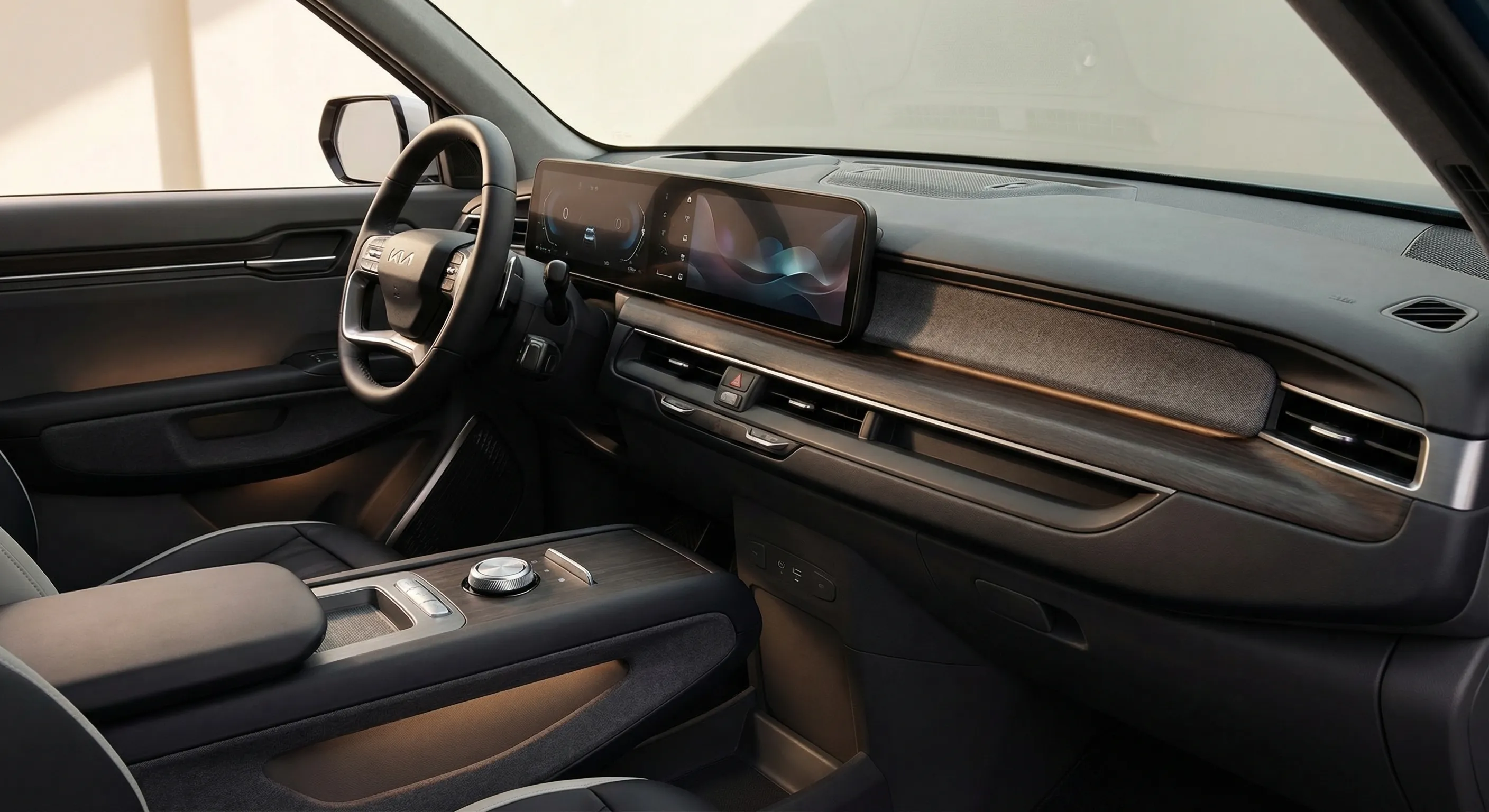
The second row comes in two configurations: a three-person bench (seven total seats) or captain's chairs (six total seats). On the GT-Line, the captain's chairs swivel 180 degrees to face the third row, creating a conference-style seating arrangement when the car is parked. It's great for camping, tailgating, or waiting in a parking lot while kids are at practice. The flat floor between the rows makes the cabin feel open and spacious.
Let's talk about those swivel seats in practical terms, because they're the kind of feature that sounds gimmicky until you actually use them. When you're parked at a campground on a rainy afternoon in Tofino, you can rotate those second-row chairs to face the third row, creating a four-person seating arrangement where everyone faces each other. Set up a board game on a lap tray. Hand out snacks. Put a tablet on the centre console for a family movie. With 99.8 kWh of battery powering the climate control, you can sit comfortably for hours without worrying about running out of energy. Try doing that in a gas SUV, you'd be idling the engine, burning fuel, filling the campground with exhaust fumes, and still not matching the quiet comfort of the EV9's cabin.
For families with younger children, the third row is genuinely practical for daily use. Kids in car seats and booster seats fit easily. The flat floor means there's no awkward step-over to access the third row, children can walk through the cabin to their seats rather than climbing over folded second-row chairs. The recline adjustment on the third row lets passengers find a comfortable angle for longer drives, and the headroom is sufficient for children up to their early teen years without any discomfort. USB-C charging ports in all three rows keep devices charged, which is the real key to peaceful family road trips.
Compared to a traditional gas-powered minivan like the Honda Odyssey or Toyota Sienna, the EV9's third row offers comparable legroom but less overall headroom. The minivans still have the edge for pure passenger space, their taller rooflines create an airier feel in the rear rows. But the EV9 offers something no minivan can: a flat floor throughout, SUV ride height and presence, and the complete absence of a transmission tunnel or drivetrain components eating into cabin space. Versus gas three-row SUVs like the Highlander or Traverse, the EV9's third row is meaningfully more usable because the flat floor creates additional legroom where those gas vehicles lose space to the exhaust and driveshaft tunnels.
Cargo space is approximately 828 litres behind the third row, enough for a family's weekly groceries and bags. Fold the third row and you get approximately 1,830 litres. Fold both rows and you have over 2,300 litres of flat cargo space, which approaches van territory. For families, this flexibility is the EV9's killer feature. The 828 litres with all seats up is enough for a family of six heading to a weekend hockey tournament, gear bags, a cooler, and duffel bags fit with room to spare. The power-folding third row drops flat with the press of a button, creating a massive cargo area for IKEA runs, Costco hauls, or moving a university student in or out of residence.
One practical note: there's a small sub-trunk storage area accessible from the cargo bay, handy for charging cables, emergency supplies, or items you want to keep out of sight. The EV9 also has a small frunk (front trunk) on some trims, though it's not as capacious as a Tesla's, think of it as a place for your charging adapter collection and a first-aid kit, not a secondary cargo hold.
Interior and Technology
The interior of the EV9 sets a standard for electric family SUVs that nothing else in this price range can match. The dashboard is dominated by a panoramic display spanning dual 12.3-inch screens, one for the digital instrument cluster and one for the infotainment system. Below that sits a dedicated 5-inch touchscreen panel for climate control, which is a welcome separation of functions that too many modern vehicles get wrong. You shouldn't need to dig through infotainment menus to change the temperature while driving, and Kia understands this.
The infotainment system runs Kia's latest ccNC (connected car Navigation Cockpit) software, and it's responsive. Wireless Apple CarPlay and Android Auto connect quickly and display crisply on the 12.3-inch screen. Navigation routes can be optimized for charging stops with real-time station availability, critical for a three-row family hauler that's going to be used for road trips. The system also integrates Kia Connect services, offering remote climate preconditioning, charge scheduling, and vehicle status monitoring through the Kia app on your phone.
The GT-Line trim adds an augmented reality heads-up display (HUD) that projects navigation arrows, speed limits, and driver-assist status information directly onto the windshield. It's one of those features you think is unnecessary until you use it on an unfamiliar highway, having turn-by-turn directions floating above the road surface means your eyes never leave the road. For families working through to unfamiliar hockey arenas, cottage rentals, or campgrounds, the HUD reduces distraction meaningfully.
Highway Driving Assist 2 (HDA2) is Kia's advanced driver-assistance system, and it's among the best Level 2 systems available in this price range. It combines lane centring, adaptive cruise control with stop-and-go functionality, and automatic lane changes on the highway. Activate it on the Trans-Canada, set your speed, and the EV9 will maintain your lane, keep distance from the vehicle ahead, and even execute lane changes when you signal. It's not autonomous driving, you need to keep your hands on the wheel and stay alert, but it significantly reduces fatigue on the long highway stretches that define Canadian road travel. A four-hour drive from Ottawa to Toronto becomes meaningfully less tiring with HDA2 managing the tedious parts of highway cruising.
Materials quality throughout the cabin is a step above what you'd expect at this price. The dashboard, door panels, and centre console use soft-touch materials with clean stitching. There's no cheap, hard plastic where your hands naturally rest. The seats are upholstered in a sustainable vegan leather that wears well and cleans easily, important when kids are involved. The ambient lighting on the GT-Line creates a calming atmosphere for evening drives, with customizable colours that extend across the dashboard and door panels.
The driver's seat position is excellent, you sit high with good forward visibility and a commanding view of the road, which is exactly what family drivers want. The wide A-pillars create minor blind spots, but the surround-view camera system compensates when manoeuvring. The steering wheel is chunky and well-padded, with logical button placement for audio, phone, cruise control, and driver-assist functions. Physical buttons and paddles handle the functions you use most frequently, which avoids the frustration of burying critical controls in touchscreen menus.
The Meridian sound system on the GT-Line is a standout. It delivers clear, detailed audio across all three rows, which matters when you're trying to keep a road trip soundtrack audible for passengers in the back without blowing out the eardrums of those in front. The sound staging is impressive for a vehicle cabin, and the bass response is surprisingly strong given the absence of a traditional engine compartment to mount a subwoofer in. Lower trims get a standard 6-speaker setup that's adequate but unremarkable.
Practical interior touches abound. The centre console has a large storage bin that swallows a full-size handbag or a lunch kit. The wireless charging pad up front accommodates larger phones without sliding around. Cup holders are appropriately sized for Canadian coffee cups (Tim Hortons large fits, which is really all you need to know). Second-row passengers get fold-down armrests with built-in cup holders, and the third row has its own dedicated cup holders and storage pockets. Kia designed the EV9's interior for daily family life, not for showroom glamour, and that practical focus pays dividends in daily use.
Range and Charging
The 99.8 kWh battery is one of the largest available in any production EV. The Light RWD is rated at approximately 490 km, while the AWD models are rated at approximately 445 km. In real-world Canadian summer driving, expect roughly 400-430 km from the RWD and 360-400 km from the AWD. These are strong numbers for a vehicle that weighs over 2,400 kg.
Gear worth having
As an Amazon Associate, ThinkEV earns a small commission from qualifying purchases — at no extra cost to you.
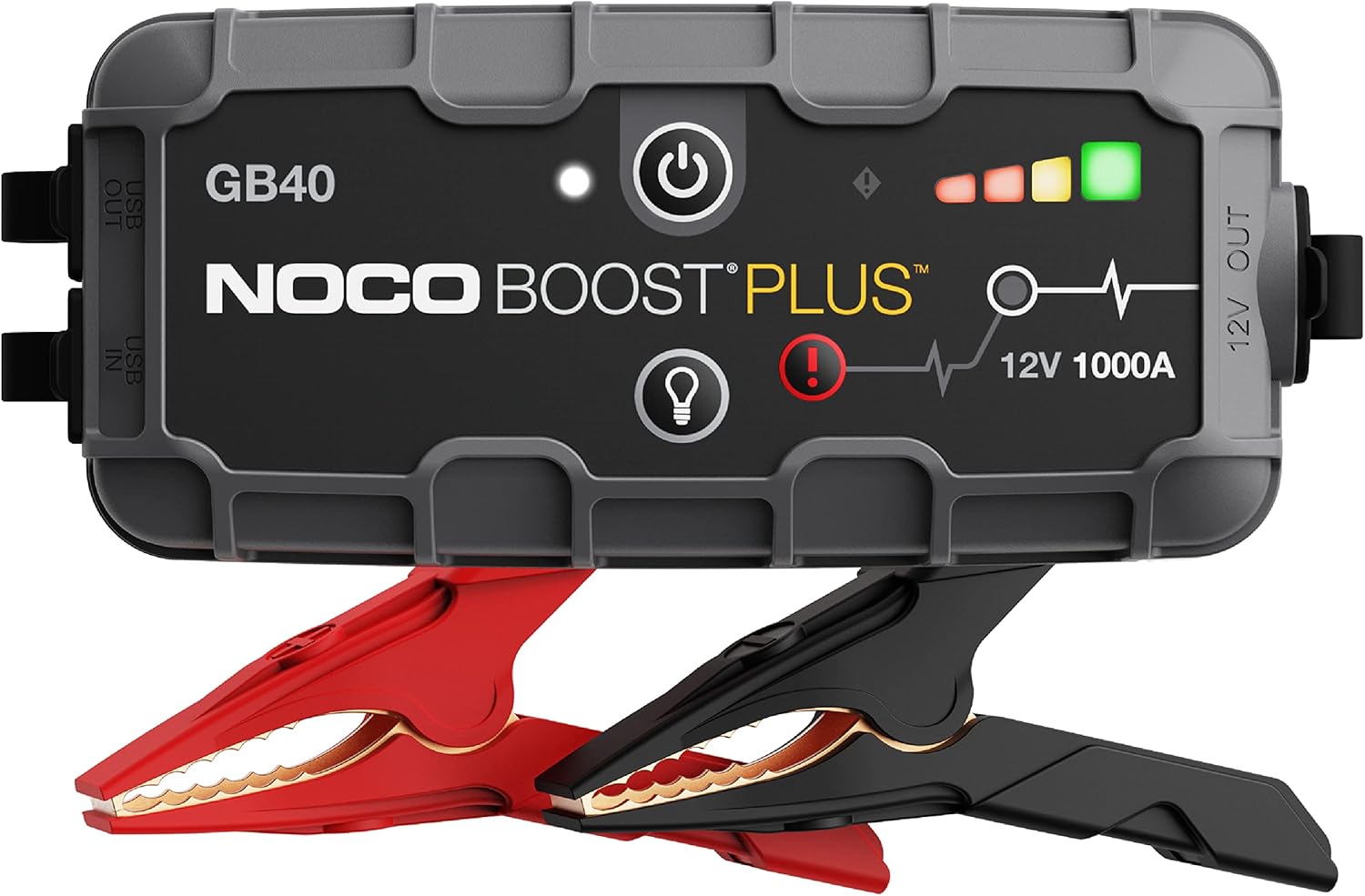
NOCO Boost Plus GB40 Jump Starter
A 1000A lithium jump starter that fits in your glovebox and works on any 12V battery. Your insurance against a dead 12V in a parking lot.
As an Amazon Associate, ThinkEV earns from qualifying purchases — at no extra cost to you.
Winter range drops to approximately 310-360 km for the RWD and 280-330 km for the AWD. For a family vehicle that's primarily used for school runs, errands, and weekend activities, that's easily a full week of driving between charges. For longer highway trips in winter, you'll want to plan one charging stop for drives over 250 km.
The 800V E-GMP architecture is the EV9's charging trump card. On a 350 kW Electrify Canada station, the car charges from 10% to 80% in approximately 24 minutes. That's a coffee and bathroom stop, not a lunch break. Even on a more common 150 kW station, 10% to 80% takes about 40 minutes. For a family road trip, the charging speed means the car keeps up with the pace of travel.
Let's put those charging numbers in road-trip context. Say you're driving from Toronto to Montreal, roughly 540 km on the 401 and the Trans-Canada. In the AWD EV9, you'd leave Toronto with a full charge, drive about 300 km to the Kingston/Brockville area, pull into an Electrify Canada station at about 15-20% battery, charge for 25 minutes while the kids use the washroom and everyone grabs a snack, then continue with enough charge to reach Montreal comfortably. Total charging time added to the trip: half an hour. In a gas Highlander, you'd stop for fuel too, probably 10-15 minutes. The difference in a real-world road trip is negligible. And on the way back, you know exactly where the stations are.
The cost of charging deserves attention. At home, where most Canadian families do 90% of their charging, electricity costs vary by province. In Ontario, off-peak rates run about $0.082/kWh, a full charge from empty on the 99.8 kWh battery costs roughly $8.18. That gives you 400+ km of real-world range for about eight dollars. Compare that to filling a Highlander's 65-litre tank at $1.50/litre, $97.50 for roughly 550 km of highway range. The math is stark: the EV9 costs about $0.02/km to fuel at home, while the Highlander costs about $0.18/km. In Quebec, where electricity is even cheaper, the advantage is even more dramatic. In BC, Alberta, or Saskatchewan, electricity costs are higher but still dramatically less than gasoline.
DC fast charging is more expensive, Electrify Canada charges around $0.40-0.55/kWh depending on membership and location. A 10-80% fast charge session costs roughly $25-35. That's comparable to a gas fill-up on a per-session basis, but you're doing it much less frequently if you charge at home overnight for daily driving.
Home charging on Level 2 (240V, 48A) takes approximately 11-12 hours from empty to full. Since you'll typically charge from 20-30% rather than empty, most nights require 6-8 hours. Plug in after the kids go to bed, full by morning. If you're considering a Level 2 home charger, the EV9's onboard 11 kW charger will max out a 48A circuit, any quality Level 2 home charger rated at 48A or higher will get you the fastest possible home charging speed.
For families planning longer road trips, Toronto to Tremblant, Calgary to Kelowna, Vancouver to Jasper, the charging planning guide is essential reading. The EV9's built-in route planner handles most of the work, but understanding the Canadian charging infrastructure picture helps you pick routes with reliable, fast stations. The 800V architecture is a genuine advantage here: while many EVs slow dramatically above 50% state of charge, the EV9 maintains strong charging speeds through most of the curve, meaning a 20-minute stop adds meaningful range even when you arrive at the charger with 30-40% remaining.
One more charging consideration: the EV9's battery management system allows charging to 100% without the degradation concerns that plague some competitors. Kia recommends an 80% daily charge limit for longevity, but for road trip days when you need maximum range, topping up to 100% is perfectly safe. The last 20% charges slower, as it does on every lithium battery, but you can fill the tank completely when the situation demands it.
Driving
The EV9 drives surprisingly well for its size. The Light RWD model makes approximately 215 hp from a single rear motor, which is adequate for daily driving but not thrilling. The AWD models add a front motor for approximately 283 hp combined, which provides a more satisfying driving experience and genuine all-wheel-drive traction for winter.
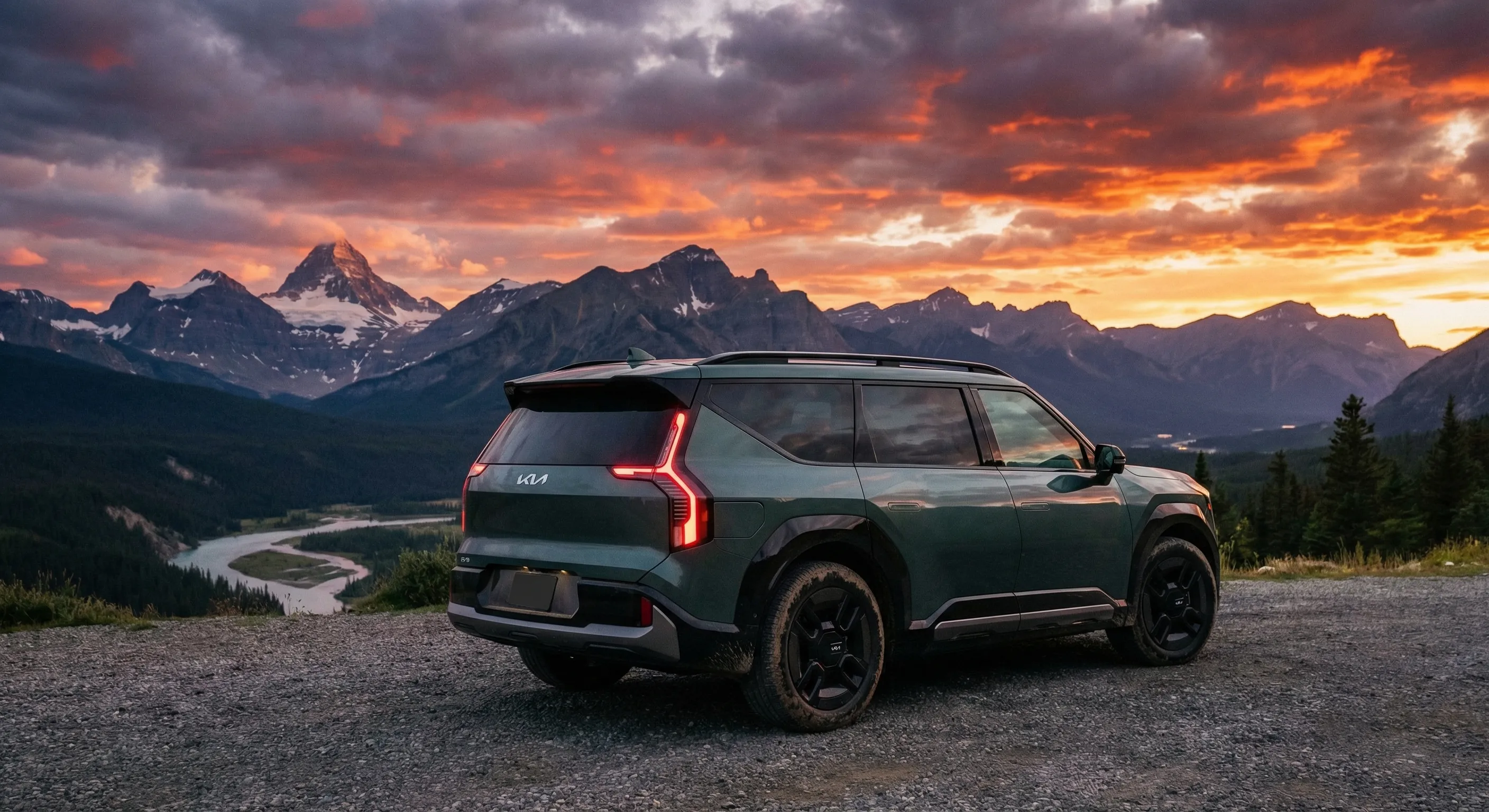
The ride quality is excellent, the long wheelbase and heavy battery pack create a stable, composed ride that absorbs bumps and rough roads well. Highway cruising is quiet and relaxed, with minimal wind and road noise for a vehicle this size. The EV9 feels like a luxury vehicle, which it should at this price.
The steering is light and manageable for parking and city driving, though it lacks the feedback of a smaller car. At highway speeds, the car tracks straight and stable. It's not a vehicle you drive for thrills, it's one you drive for comfort and capability.
Gear worth having
As an Amazon Associate, ThinkEV earns a small commission from qualifying purchases — at no extra cost to you.

VIOFO A229 Pro 4K Dash Cam
4K front plus 2K rear with parking mode and GPS. Your silent witness for insurance claims, with always-on sentry recording while parked.
As an Amazon Associate, ThinkEV earns from qualifying purchases — at no extra cost to you.
One aspect that surprises drivers coming from gas SUVs is the instant torque delivery. Even in the base RWD model with 215 hp, the EV9 feels quicker off the line than the numbers suggest because electric motors deliver maximum torque from zero RPM. Merging onto the 401 at rush hour, you have immediate response when you press the accelerator, no waiting for a transmission to downshift, no turbo lag, no hesitation. The AWD model is genuinely quick, dispatching 0-100 km/h in roughly 6 seconds, which is faster than any gas three-row SUV in this price bracket. It won't pin you to the seat like a Model X Plaid, but it's more than sufficient for safe, confident highway merging and passing.
The regenerative braking system offers multiple levels of intensity, including an i-Pedal mode that lets you drive with one pedal in most situations. In city driving, one-pedal mode is significant, you lift off the accelerator and the car decelerates smoothly, capturing energy back into the battery. After a few days, you'll rarely touch the brake pedal in traffic. The paddle shifters on the steering wheel let you adjust regen intensity on the fly without entering any menus, which is the kind of thoughtful implementation that makes daily driving more pleasant.
Parking and manoeuvring the EV9 requires some adjustment if you're coming from a smaller vehicle. At just over five metres long and nearly two metres wide, it's a large vehicle. But the surround-view camera system, front and rear parking sensors, and tight turning circle (11.6 metres) make it more manageable than you'd expect. The boxy shape helps with spatial awareness, you can see the corners of the vehicle through the greenhouse. Most families won't find parking challenging once they've spent a week calibrating their sense of the vehicle's dimensions.
Gear worth having
As an Amazon Associate, ThinkEV earns a small commission from qualifying purchases — at no extra cost to you.

Grizzl-E Classic Level 2 EV Charger (40A)
Canadian-made and rated for minus 40C winters. 40A / 9.6 kW, NEMA 14-50, indoor/outdoor, 24-ft cable. The charger built for Canadian weather.
As an Amazon Associate, ThinkEV earns from qualifying purchases — at no extra cost to you.
The EV9 can tow up to 2,500 kg (braked) when properly equipped, which opens up possibilities for small boat trailers, utility trailers, and pop-up campers. Towing significantly impacts range, expect 40-50% reduction depending on trailer weight and speed, but for short towing runs to the cottage or the boat launch, the EV9 is more than capable. This is a meaningful advantage over many EVs that either can't tow at all or are limited to 750 kg.
Noise, or more precisely, the lack of it, deserves specific mention. The EV9 is remarkably quiet at every speed. At city speeds, it's nearly silent, with only a faint electric hum audible. At highway speeds (100-110 km/h), wind and tire noise are present but well-managed for a vehicle this size. Kia used acoustic laminated glass on the windshield and front windows, and the door seals are thicker than typical for the segment. For families, cabin quietness translates directly to reduced fatigue on long drives and the ability to carry a conversation across all three rows without shouting. Backseat passengers can watch a tablet with the volume at a normal level, which is a luxury that gas-powered SUVs with their engine drone simply cannot match.
The EV9 also offers selectable drive modes, Eco, Normal, Sport, and Snow, that adjust throttle response, steering weight, regenerative braking intensity, and climate control aggressiveness. Sport mode sharpens everything and provides the most engaging drive, while Eco mode maximizes range by softening acceleration and limiting climate output. Snow mode, predictably, is the one you'll use most in a Canadian winter, it reduces initial torque delivery to prevent wheel spin and adjusts the traction control for slippery surfaces.
Winter Performance
Canadian winters are the ultimate proving ground for any vehicle, and for EVs in particular, winter separates the well-engineered from the merely electrified. The EV9, especially in AWD configuration, handles winter with a confidence that should reassure any family considering the switch from a gas SUV.
The dual-motor AWD system distributes torque between front and rear axles electronically, reacting to traction loss faster than any mechanical differential could. On snow-covered side streets, icy parking lots, and slush-covered highways, the AWD EV9 feels planted and predictable. Pair it with a quality set of winter tires, mandatory in Quebec, strongly recommended everywhere else, and the EV9 inspires genuine confidence in conditions that would have lesser vehicles scrambling for grip. The low centre of gravity from the floor-mounted battery pack keeps the vehicle stable through corners and lane changes on slippery surfaces, reducing the top-heavy feeling common in tall gas SUVs.
Winter range loss is the elephant in every Canadian EV conversation, and the EV9 handles it better than most. Expect 280-330 km from the AWD and 310-360 km from the RWD in typical Canadian winter conditions (-10 to -20 degrees Celsius). That 30-35% reduction from rated range is consistent with what we see across the EV segment, it's not unique to the EV9, and the large 99.8 kWh battery means that even with winter losses, you're getting range that exceeds most EVs' summer numbers. A 280 km worst-case winter range still covers a full week of daily driving for most families, school drop-offs, grocery runs, hockey practice, and weekend errands without needing to plug in more than once or twice a week.
The heat pump is standard across all EV9 trims, and it makes a measurable difference in winter efficiency. Traditional resistive heaters draw heavily from the battery to warm the cabin, a heat pump moves heat rather than generating it, using roughly 50-60% less energy to maintain cabin temperature. On a -15 degree morning in Ottawa or Winnipeg, the heat pump helps preserve range that would otherwise go straight to heating.
Heated seats are available across all three rows, heated front and second-row seats are standard, and the third row gets heated outboard seats on higher trims. The heated steering wheel is standard on all trims. Using seat heaters and a heated steering wheel instead of cranking the cabin heater can extend winter range by 10-15% because they warm passengers directly rather than heating the entire cabin volume. It's a strategy that EV owners learn quickly and appreciate daily.
Preconditioning is the winter EV secret weapon, and the EV9 does it well. Using the Kia Connect app, you can schedule the cabin to warm up while the vehicle is still plugged in at home, drawing power from the wall outlet rather than the battery. This means you step into a warm cabin, sit on heated seats, and depart with a full battery and a preconditioned battery pack that charges and discharges more efficiently in cold weather. The 800V architecture benefits from preconditioning as well, a warm battery accepts fast charging more readily than a cold one. If you're planning a winter road trip and know you'll need to DC fast charge, departing with a preconditioned battery means you'll hit those advertised 24-minute charge times even in January.
Cold-weather DC fast charging deserves specific mention. Many EVs see dramatically reduced charging speeds in winter because their battery management systems limit charge rates to protect cold cells. The EV9's battery preconditioning system activates automatically when you set a fast charger as your navigation destination, warming the battery to optimal temperature during the drive so that when you arrive at the station, you get full charging speed. This is the kind of engineering sophistication that separates a winter-capable EV from one that technically works in winter but makes you wait 90 minutes at a charging station in -20 degree weather.
If you want to see how winter range loss compares across the full EV market, our cold-weather testing covers 20+ models in real Canadian conditions. The short version: the EV9's winter performance is above average for its class, and the large battery provides a substantial cushion that smaller-battery EVs simply cannot match. A 30% winter loss on a 100 kWh battery still leaves you with more usable range than a 20% loss on a 60 kWh battery. Size matters in winter, and the EV9 has it in abundance.
V2L and Practical Features
Vehicle-to-Load (V2L) is one of those features that sounds like a marketing bullet point until you actually need it, and then it becomes the reason you're grateful you chose the EV9 over a competing vehicle. The EV9 delivers 3.6 kW of power through both an interior outlet (under the second-row seats) and an exterior outlet (accessed through the charging port with an adapter). That's 3,600 watts, enough to power a full-size refrigerator, a microwave, power tools, camping equipment, or even another electric vehicle in an emergency.
The camping use case is the most compelling for Canadian families. Park at a campground, plug in a portable induction cooktop, a small heater, string lights, a phone charger, and a Bluetooth speaker, all running simultaneously from the EV9's battery without any generator noise or fumes. With 99.8 kWh of stored energy and 3.6 kW of output, you could theoretically run this setup for over 24 hours on a single charge. In practice, accounting for climate control and efficiency losses, you'd get a comfortable weekend of power camping from a full battery. No hauling a generator, no buying fuel for it, no listening to it drone all night.
The emergency backup power capability is increasingly relevant for Canadian homeowners. During ice storms, windstorms, or grid outages, events that are becoming more frequent across the country, the EV9 can power essential home circuits. At 3.6 kW continuous output, you can keep your refrigerator, sump pump, a few lights, phone chargers, and a Wi-Fi router running for approximately two days on a full battery. That's not whole-home power, but it's enough to keep food from spoiling, prevent basement flooding, and maintain communication until the grid comes back. In rural areas where outages can last 24-48 hours, this is a genuine safety feature.
Beyond V2L, the EV9 is loaded with practical features that serve family life. Roof rails are standard, supporting aftermarket roof boxes and bicycle carriers for camping and cottage trips. The power liftgate opens with a foot gesture, wave your foot under the rear bumper and the hatch rises, which is invaluable when your hands are full of groceries or hockey equipment. The second-row seats slide fore and aft to balance legroom between second and third-row passengers, and the third-row seats fold flat electrically to expand cargo space without wrestling with heavy seatbacks.
The frunk (front trunk) provides a small but useful sealed storage compartment, ideal for charging cables, winter emergency kits, or items you want to keep separate from the main cargo area. It's not the gaping front trunk of a Ford Lightning or a Rivian R1S, but it's a practical addition that eliminates the need to clutter your cargo area with cables and accessories.
The tailgate party and camping scenarios are worth dwelling on because they represent a genuinely new category of vehicle capability. Traditional camping with a gas vehicle means bringing a generator for power, dealing with the noise and exhaust, and storing fuel canisters. With the EV9, the vehicle itself is your silent, zero-emission generator. Plug in a portable heater for a chilly October evening at a Muskoka campsite.
Run a projector off the exterior V2L outlet for an outdoor movie night. Charge your e-bikes after a day on the trails. Power a CPAP machine for overnight use without worrying about a battery dying. These aren't theoretical use cases, they're the kinds of things that EV9 owners discover and then wonder how they ever managed without. The 99.8 kWh battery is massive enough that running accessories for a full weekend barely dents the state of charge.
The EV9 also features a digital key system that lets you use your smartphone as the vehicle key. You can share digital keys with family members, set driving limitations for teen drivers, and lock or unlock the vehicle remotely. For a family vehicle that might be shared between parents and an older teen, this flexibility is genuinely useful.
Ownership and Value
The EV9's sticker price is the number that gives Canadian families pause. Let's break it down trim by trim and then look at the total ownership picture.
The Light RWD at $64,995 is the value entry point. You get the full 99.8 kWh battery, 490 km of rated range, a single 215 hp rear motor, dual 12.3-inch screens, wireless CarPlay/Android Auto, heated front and second-row seats, heated steering wheel, V2L, surround-view cameras, HDA2, and a seven-seat configuration with a second-row bench. It's a genuinely well-equipped vehicle at its base price. What you give up versus the higher trims: AWD traction, the additional power of the front motor, and some premium interior features.
The Wind AWD at $74,995 adds the front motor for 283 hp combined and AWD traction, essential for most Canadian families who face winter driving. It also adds features like a power-adjustable passenger seat, blind-spot monitor cameras on the instrument cluster, and second-row captain's chairs as an option. The $10,000 premium over the Light RWD buys you meaningful capability for Canadian conditions.
The GT-Line AWD at $79,995 is the fully loaded model. It adds the augmented reality HUD, 180-degree swivel second-row captain's chairs, the Meridian premium sound system, upgraded ambient lighting, 21-inch wheels (20-inch on other trims), and premium interior materials. The $5,000 premium over the Wind AWD buys luxury features that enhance the ownership experience but aren't strictly necessary.
None of these trims qualify for the $5,000 federal EVAP rebate, all exceed the $50,000 final transaction value cap. Some provinces offer their own incentives: Quebec's Roulez Vert program may offer up to $7,000 depending on current terms, and BC has offered rebates for higher-priced vehicles in the past. Check current provincial rebates for the latest availability, as programs change frequently.
Now, the total cost of ownership comparison, this is where the EV9's value proposition gets compelling. Compare the EV9 Wind AWD ($74,995) to a comparably equipped Toyota Highlander Limited AWD (approximately $55,000) or a Chevrolet Traverse RS AWD (approximately $52,000) over a five-year ownership period.
Fuel costs at 25,000 km per year (typical for a family with kids in activities):
- EV9 at home charging: approximately $500-700/year (depending on provincial electricity rates)
- Highlander: approximately $3,200-3,800/year (at $1.40-1.60/litre, 9.0 L/100 km combined)
- Traverse: approximately $3,000-3,600/year (at $1.40-1.60/litre, 8.5 L/100 km combined)
That's a fuel savings of $2,500-3,500 per year, or $12,500-17,500 over five years. The fuel savings alone close most of the purchase price gap between the EV9 and its gas competitors.
Maintenance costs reinforce the advantage. The EV9 has no oil changes, no transmission fluid, no timing belt, no spark plugs, no exhaust system to rust out. Annual maintenance runs approximately $500-800 per year, tire rotations, cabin air filter, brake fluid, and washer fluid. A gas SUV runs $1,200-1,800 per year in maintenance. Over five years, the EV9 saves another $3,000-5,000 in maintenance costs.
Add it up: over five years, the total cost of ownership gap between an EV9 Wind AWD and a Highlander Limited narrows to roughly $2,000-5,000, a fraction of the $20,000 purchase price difference. Factor in provincial rebates where available, and the gap shrinks further or disappears entirely.
Kia's warranty is among the best in the industry: 5 years/100,000 km comprehensive warranty, plus an 8-year/160,000 km warranty on the battery and electric drivetrain. That battery warranty guarantees at least 70% capacity retention over the warranty period. For a family that plans to keep the vehicle for 8-10 years, the battery warranty provides genuine peace of mind that the most expensive component is protected.
Kia's dealer network in Canada is extensive, far more so than Rivian's service centre model or Tesla's often-overloaded service infrastructure. With over 190 Kia dealers across the country, you can get warranty service, routine maintenance, and repairs without driving to a distant city. For a family vehicle, accessible service infrastructure matters.
Insurance costs for the EV9 run approximately 10-15% higher than comparable gas SUVs, reflecting the higher purchase price and repair costs associated with EV-specific components. Shop around, rates vary significantly between insurers for EVs, and some companies (Aviva, Intact, TD Insurance) have developed more competitive EV pricing than others.
Depreciation is the wild card in the ownership equation. EVs have historically depreciated faster than gas vehicles, partly due to rapid technology improvements and partly due to range anxiety concerns in the used market. The EV9 may buck this trend somewhat, its unique position as an affordable three-row EV, combined with the 800V architecture that will remain competitive for years, could support stronger residual values. Kia's growing brand perception in the premium space also helps. That said, no honest review can predict future depreciation with certainty, so factor in the possibility of 40-50% value loss over five years when running your ownership calculations.
Maintenance costs in detail break down further if you want the full picture.
The Verdict
The EV9 is the electric minivan replacement that Canadian families have been waiting for. It has the space, the range, the charging speed, and the practical features to handle everything from daily school runs to cross-province road trips. The third row is genuinely usable, the cargo space is enormous, and the 800V charging means you spend less time plugged in and more time driving.
The price is the only real barrier. At $64,995-$79,995 with no EVAP rebate, the EV9 is a premium purchase. It costs more than a base Toyota Highlander or Chevy Traverse. But when you factor in fuel savings ($2,500-$3,500 per year at average family driving distances), lower maintenance costs, and the 8-year/160,000 km battery warranty, the total ownership cost starts to look competitive. For families ready to go electric, the EV9 makes the strongest case.
Is the EV9 perfect? No. The lack of EVAP eligibility hurts in a market where $5,000 off the purchase price matters to budget-conscious families. The RWD model's lack of all-wheel drive limits its appeal in most Canadian provinces. The infotainment system, while functional, doesn't match the responsiveness of Tesla's interface. And the third row, while genuine, still can't match a dedicated minivan for rear-passenger comfort on long drives. These are real limitations, and they'll matter to some buyers.
But what Kia has accomplished with the EV9 is something that the entire EV industry has struggled with: building an electric vehicle that serves the most demanding use case in the passenger vehicle market, the active, multi-child family, without requiring compromises that send buyers back to the gas pump. The EV9 doesn't ask you to give up your third row. It doesn't ask you to spend $120,000. It doesn't ask you to wait 90 minutes at a charger while your kids lose their patience. It delivers a three-row family SUV that happens to be electric, rather than an electric vehicle that happens to have three rows. That distinction matters, and it's the reason the EV9 is the most important family vehicle on sale in Canada right now.
If you're cross-shopping the Kia EV6, note that it shares the same E-GMP platform and 800V architecture but is a two-row crossover, it's the right choice for couples or small families who don't need the third row and prefer a sportier driving experience at a lower price point.
The Hyundai Ioniq 9 is coming soon on the same platform, and it will be the EV9's most direct competitor. If you can wait, the EV9 vs Ioniq 9 comparison will be worth reading. If you need a three-row EV today, the EV9 stands alone, and it stands tall.
For a broader look at which EV fits your family, read our best EVs for families guide. And if the total cost numbers interest you, the full EV vs gas TCO breakdown covers every vehicle class with five-year Canadian ownership projections.
Gear worth having
As an Amazon Associate, ThinkEV earns a small commission from qualifying purchases — at no extra cost to you.

PULIDIKI Car Cleaning Gel (Detailing Putty)
Press it into vents, buttons, and seams and it lifts out dust you did not know was there. Weirdly satisfying, genuinely useful.
As an Amazon Associate, ThinkEV earns from qualifying purchases — at no extra cost to you.
Related Reading
- Kia EV9 vs Hyundai Ioniq 9 Canada 2026, Head-to-head with its closest competitor.
- EV Rebates by Province Canada 2026, Every provincial and federal rebate compared.
- Best EVs for Families Canada 2026, Our complete family EV buyers guide.
- EV vs Gas: Total Cost of Ownership Canada 2026, Five-year cost breakdown for every segment.
- EV Winter Range Test Canada 2026, Real-world cold weather range data across 20+ models.
- EV Road Trip Charging and Planning Guide Canada 2026, How to plan charging stops for cross-country drives.
Gear worth having
As an Amazon Associate, ThinkEV earns a small commission from qualifying purchases — at no extra cost to you.

WixGear Magnetic Air Vent Phone Mount (2-Pack)
A magnet strong enough that your phone never flinches over potholes or rail crossings. Two in the box, one for each car.
As an Amazon Associate, ThinkEV earns from qualifying purchases — at no extra cost to you.

Founder & Chief Editor
Vlad Pereira is the founder and chief editor of ThinkEV.ca, the Canadian electric-vehicle publication he writes and edits from Courtenay, British Columbia. He covers EV pricing, federal and provincial rebates, charging costs, and the Chinese manufacturers now entering Canada, from the buyer's side rather than the press-fleet side. ThinkEV is a venture of Vlad Pereira Online; his writing on health, income and the long game lives at vladpereira.com.
Frequently asked questions
Does the EV9 qualify for the EVAP rebate?
Can adults fit in the third row?
How does the EV9 handle Canadian winters?
How does the EV9 compare to the Tesla Model X?
What does V2L mean and how is it useful?
How much does it cost to charge the EV9 at home?
Can the EV9 tow a trailer?
How does the EV9 compare to gas three-row SUVs like the Highlander?
Which EV9 trim should I buy?
More EV & road-trip finds
Affordable upgrades worth a look — tap any to check the price on Amazon.
 ★ 55
★ 55LED Car Door Logo Projector Light
View on Amazon ★ 1,349
Cool Swinging Duck Dashboard Ornament
View on Amazon ★ 21,304
Car Headrest Hooks (4-Pack)
View on Amazon ★ 12,834
P3 Kill A Watt Electricity Usage Monitor
View on Amazon ★ 121
★ 121Foldable Windshield Sun Umbrella
View on Amazon ★ 268
★ 268Anti-Slip Leather Steering Wheel Cover
View on Amazon ★ 2,941
Microfiber Cleaning Cloths (Multi-Pack)
View on Amazon ★ 164
★ 164Solar-Powered LED Ambient Light
View on AmazonRead, Plan, Then Stay Current
Explore our expert articles to understand incentives and ownership costs, use the map to pressure-test charging reality, then subscribe so new EV coverage comes straight to you.
Continue Reading
Kia EV3 Canada Price 2026: The $38K Electric SUV
Kia EV5 Canada Review 2026: The $48K Electric SUV
Kia EV6 Canada Review: The Most Overlooked EV
Kia EV4 Canada: Cheapest Long-Range EV at $38,995
Volvo EX30 Canada Review: The Small One to Want