Key takeaways
- The federal government has committed to a zero-emission vehicle sales mandate: by 2035, 100% of new passenger cars and light trucks sold in Canada must be zero-emission.
- The interim milestones are equally ambitious: 20% of new sales must be ZEVs by 2026, 40% by 2028, 60% by 2030, and 100% by 2035.
- Canada pledged to reduce its total greenhouse gas emissions by 40-45% below 2005 levels by 2030, and to achieve net-zero emissions by 2050.
- Transportation accounts for roughly 25% of Canada's total greenhouse gas emissions, making it the second-largest emitting sector after oil and gas.
As of 2026, 20% of every new passenger car and light truck sold in Canada must be zero-emission, by law. That is not a target automakers are being nudged toward; it is a regulatory floor backed by financial penalties, and 100% is required by 2035. Transportation makes up roughly 25% of Canada's total greenhouse gas output, which means there is no credible path to Canada's emissions commitments without fundamentally changing what rolls off dealership lots. The emissions standards are what make that happen, and most Canadians have never heard of them.
The federal government has committed to a zero-emission vehicle sales mandate: by 2035, 100% of new passenger cars and light trucks sold in Canada must be zero-emission. That is not a suggestion or an aspirational target, it is a regulatory requirement backed by law. The interim milestones are equally ambitious: 20% of new sales must be ZEVs by 2026, 40% by 2028, 60% by 2030, and 100% by 2035. Automakers who fail to meet these targets face compliance deficits that must be made up in subsequent years or through credit purchases from manufacturers who exceed the targets.
This is the invisible engine behind Canada's EV transition. When you see more EV models appearing at your local dealership, or when a manufacturer announces a new Canadian EV production line, the emissions standards are almost always the underlying reason. But to really understand what is happening, you need to know where these rules came from, how the credit system actually works, and what the interplay between federal policy, provincial mandates, and international agreements means for the price and availability of your next vehicle.
THE HISTORICAL CONTEXT: HOW WE GOT HERE
Canada's current emissions framework did not appear out of thin air. It is the product of two decades of international climate commitments and domestic policy evolution that accelerated dramatically after 2015.
The story starts with the Paris Agreement. In December 2015, Canada joined 195 other nations in committing to limit global warming to well below 2 degrees Celsius, with efforts to cap it at 1.5 degrees. Under that agreement, each country sets its own nationally determined contributions, essentially, voluntary but politically binding emissions reduction targets. Canada pledged to reduce its total greenhouse gas emissions by 40-45% below 2005 levels by 2030, and to achieve net-zero emissions by 2050.
Transportation accounts for roughly 25% of Canada's total greenhouse gas emissions, making it the second-largest emitting sector after oil and gas. Within transportation, passenger vehicles and light trucks are the single biggest contributor. You cannot hit a 40-45% emissions reduction target without fundamentally changing what comes out of tailpipes. The math simply does not work otherwise.
The federal government's first major step was the Pan-Canadian Framework on Clean Growth and Climate Change in 2016, which laid the groundwork for carbon pricing and clean fuel standards. But the real turning point for vehicles came with the Canadian Net-Zero Emissions Accountability Act in 2021, which enshrined the 2050 net-zero target in law. That legislation gave the government the legal authority, and the political obligation, to set binding vehicle emissions standards that would make the net-zero target achievable.
In December 2023, Environment and Climate Change Canada published the final regulations for the Electric Vehicle Availability Standard, which formalized the ZEV sales mandate with specific interim targets. This was not the government asking nicely. This was the government telling automakers: hit these numbers or pay up. The regulation took effect in 2026, making Canada one of a small number of countries with a legally binding pathway to 100% zero-emission vehicle sales.
Canada did not arrive at this position in isolation. The European Union has its own 2035 ban on new ICE vehicle sales. The United Kingdom, Norway, and several other countries have similar timelines. California, the single largest auto market in North America, has had a ZEV mandate since the 1990s, and its Advanced Clean Cars II regulation mirrors Canada's 2035 target. Canada's policy sits within a global trend, which gives it additional durability. Even if domestic politics shift, the direction of travel in every major auto market is the same: toward electrification, with regulatory mandates as the primary accelerant.
The practical implication for Canadian buyers is that the vehicles arriving at your local dealership are being designed, engineered, and priced for a world that has collectively decided to phase out internal combustion. The emissions standards are not an isolated Canadian experiment, they are Canada's implementation of a global industrial transformation that is already well underway.
HOW THE ZEV MANDATE ACTUALLY WORKS
The ZEV mandate is structured as a ratcheting requirement that tightens every two years. The milestones are:
- 2026: 20% of new light-duty vehicle sales must be ZEVs
- 2028: 40% of new light-duty vehicle sales must be ZEVs
- 2030: 60% of new light-duty vehicle sales must be ZEVs
- 2032: 80% of new light-duty vehicle sales must be ZEVs (interpolated)
- 2035: 100% of new light-duty vehicle sales must be ZEVs
These percentages apply to each manufacturer individually, not to the market as a whole. Toyota cannot point to Tesla's sales and claim collective compliance. Every automaker that sells vehicles in Canada must meet the target based on their own sales volume, or face the consequences.
The system operates on fleet averages and ZEV credits. Every automaker that sells vehicles in Canada receives a score based on the emissions profile of their total sales. Sell a gas-powered SUV that produces 250 g/km of CO2, and it counts against your average. Sell a battery-electric vehicle that produces zero tailpipe emissions, and it brings the average down. The ZEV credit system is the enforcement mechanism that keeps the whole thing honest.
ZEV CREDIT MECHANICS: TRADING, BANKING, AND COMPLIANCE
The ZEV credit system is more nuanced than most people realize, and understanding it explains a lot of the manufacturer behaviour you see in the market.
Each ZEV sold generates credits based on its type and range. A battery-electric vehicle with 400 km or more of range earns the maximum credit value. A plug-in hybrid with 80 km of electric range earns a fraction of that. A hydrogen fuel cell vehicle also earns full credits but accounts for a negligible share of the Canadian market. The credit formula is designed to reward longer-range, fully electric vehicles over partial solutions.
Here is where it gets interesting. Credits are tradeable. A manufacturer that exceeds its ZEV obligation in a given model year accumulates surplus credits that it can sell to a manufacturer that falls short. Tesla is the most famous example of this globally, for years, Tesla generated more revenue from selling ZEV credits to other automakers than from selling actual cars. In Canada, any manufacturer that over-delivers on ZEV sales can monetize that performance by selling credits to competitors who are behind.
Credits can also be banked. If a manufacturer earns surplus credits in 2026, it can carry those credits forward to apply against its 2027 or 2028 obligations. This gives manufacturers some flexibility to manage the transition, a strong ZEV sales year can cushion a weaker one. However, banking is not unlimited. There are caps on how many banked credits can be applied in any given compliance year, which prevents manufacturers from front-loading credits and then coasting.
Conversely, manufacturers can carry a deficit forward for up to three years, but they must eventually make it up. A persistent deficit triggers administrative monetary penalties. The exact penalty amounts are set by Environment and Climate Change Canada and escalate over time. By the 2028-2030 compliance window, the penalties per credit shortfall will be significant enough that selling EVs at thin margins, or even at a loss, is more economical than paying fines for non-compliance.
This credit trading system creates a secondary market that has real financial implications. Manufacturers like Hyundai and Kia, which have strong EV lineups in Canada, are in a position to generate surplus credits. Legacy automakers that are slower to electrify, think Stellantis brands like Dodge, Ram, and Jeep, may need to buy credits to stay compliant. The cost of those credits effectively becomes a hidden subsidy from ICE-heavy manufacturers to EV-focused ones, which further tilts the competitive field toward electrification.
Gear worth having
As an Amazon Associate, ThinkEV earns a small commission from qualifying purchases — at no extra cost to you.

NOCO Boost Plus GB40 Jump Starter
A 1000A lithium jump starter that fits in your glovebox and works on any 12V battery. Your insurance against a dead 12V in a parking lot.
As an Amazon Associate, ThinkEV earns from qualifying purchases — at no extra cost to you.
MANUFACTURER COMPLIANCE: WHO IS AHEAD AND WHO IS BEHIND
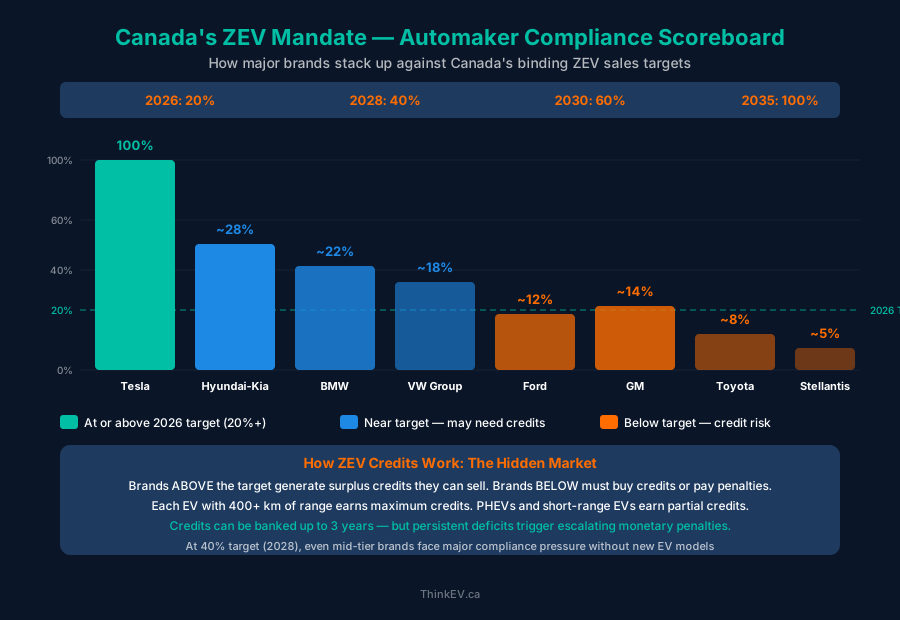
Not all automakers are created equal when it comes to ZEV compliance, and the current standings tell you a lot about which brands are positioned for the next decade and which ones are scrambling.
The leaders: Tesla obviously leads the pack since 100% of its sales are ZEVs. But among traditional automakers, Hyundai-Kia is the standout in the Canadian market. Between the Hyundai Ioniq 5, Ioniq 6, Kona Electric, and the Kia EV6, EV9, and Niro EV, the group has a broad ZEV lineup that covers multiple price points and segments. BMW has also been surprisingly aggressive, with the iX, i4, i5, and iX1 giving it a competitive ZEV share. Volkswagen Group, through the ID.4 and upcoming ID. Buzz, is making a credible push.
The middle of the pack: Ford has the Mustang Mach-E and F-150 Lightning, which sell reasonably well in Canada, but its overall ZEV percentage is dragged down by massive volumes of F-150s, Rangers, and Broncos. GM has the Equinox EV and Blazer EV ramping up to complement the discontinued Bolt, but it is in a transition year. Toyota is finally bringing the bZ4X and bZ3X to market in meaningful volumes after years of dragging its feet, but its ZEV share remains below the industry average.
The laggards: Stellantis is in the toughest position. Its Canadian sales are dominated by Ram trucks, Jeep Wranglers and Grand Cherokees, and Dodge muscle cars, none of which have zero-emission alternatives in significant production. The Jeep Avenger and upcoming Ram REV will help, but Stellantis may need to purchase substantial credits in the near term. Honda has the Prologue but is also playing catch-up after years of prioritizing hybrids over full electrification.
The compliance framework creates real market consequences. Manufacturers that are behind on ZEV targets have a financial incentive to push their EV inventory harder in Canada, offering dealer incentives, marketing spend, and competitive pricing to move units. For consumers, that translates to better deals on EVs from brands that need the compliance credits. If you see aggressive lease offers on a particular EV model, the compliance math is often the reason.
There is also the question of how the compliance picture changes as the targets ramp up. At 20% in 2026, most manufacturers with any EV lineup can scrape by. But at 40% in 2028, the math gets brutally hard for truck-heavy brands. Consider a manufacturer that sells 100,000 vehicles in Canada, of which 70,000 are trucks and large SUVs. To hit 40%, they need to sell 40,000 ZEVs. If their EV lineup only includes two models, say a compact crossover and a pickup, they need enormous volume from those two vehicles to hit the number. That is why you are seeing manufacturers announce five, six, seven new EV models for the 2027-2028 timeframe. They do not have a choice. The alternative is writing very large cheques to competitors or to the government, neither of which shareholders appreciate.
The credit market also introduces an interesting dynamic for smaller manufacturers and new entrants. A company like Rivian or Polestar, which sells 100% EVs in modest volumes, generates surplus credits that can be sold to larger competitors. This creates a revenue stream that helps smaller EV-focused companies survive while they scale production, effectively a market-based subsidy funded by the compliance obligations of legacy automakers. It is one of the reasons the ZEV mandate is considered a more market-friendly approach than a straight ban, it creates economic incentives rather than just prohibitions.
THE STANDARD VS THE US
Canada's standards are more aggressive than the US EPA's in several respects, and the divergence between the two countries has widened significantly since 2024.
The 2035 100% ZEV mandate has no direct equivalent in US federal law. The Biden administration set a target aiming for 50% of new vehicle sales to be electric by 2030, and the EPA finalized tailpipe emissions rules in March 2024 that were projected to result in approximately 56% EV sales by 2032. But these were never a hard mandate, they set emissions limits and let manufacturers decide how to comply, which could include hybrids, plug-in hybrids, or efficiency improvements to gas engines. The Trump administration, upon returning to office, moved to weaken or rescind several of these EPA rules, creating significant regulatory uncertainty in the US market.
Canada's approach is more definitive. The Electric Vehicle Availability Standard is not an emissions averaging scheme, it is a sales percentage mandate. You must sell X% ZEVs or face penalties. This clarity benefits automakers in some ways because it removes ambiguity about the direction of the market. Manufacturers can plan their product pipelines with certainty about what Canada will require.
The scope is also broader. Canada's regulations cover passenger vehicles and light trucks under a single framework, with separate but related rules for medium- and heavy-duty vehicles. Transport Canada has been tightening standards for commercial trucks and buses, which account for roughly a third of Canada's transportation emissions. Long-haul freight is the next frontier, electrifying highway trucks requires different technology (larger batteries, hydrogen fuel cells, or catenary systems), but the regulatory direction is clear.
One area where the two countries align is in harmonizing vehicle safety and technical standards, which helps automakers sell the same EV models in both markets without costly modifications. This is why most EVs available in the US are also available in Canada, with minor differences in pricing and incentive eligibility. The harmonization of standards like SAE J1772 (now NACS) charging connectors and crash safety ratings means manufacturers can develop a single North American platform rather than separate US and Canadian versions.
However, the regulatory divergence creates a risk. If US standards remain significantly weaker than Canada's, automakers may prioritize US-market vehicles (where compliance pressure is lower) over Canadian allocations. Canada's smaller market, roughly one-tenth the size of the US, means manufacturers can absorb Canadian penalties more easily if their global strategy is optimized for larger markets. The federal government has acknowledged this risk and included provisions in the ZEV standard to prevent manufacturers from underserving the Canadian market.
CARBON TAX AND HOW IT INTERSECTS WITH EMISSIONS STANDARDS
The ZEV mandate does not exist in isolation. It works alongside Canada's federal carbon pricing system to create a comprehensive economic framework that favours electrification from multiple angles.
As of 2026, the federal carbon price sits at $80 per tonne of CO2 equivalent, and it increases by $15 per year until it reaches $170 per tonne in 2030. This carbon price is embedded in the cost of gasoline and diesel fuel through the federal fuel charge. At $80 per tonne, the carbon price adds approximately 17.6 cents per litre to the price of gasoline. By 2030, at $170 per tonne, the carbon charge on gasoline will be approximately 37.6 cents per litre.
Here is the key point for EV owners: electricity is not subject to the federal fuel charge in the same way. If you charge your EV at home, you are not paying a per-kilowatt-hour carbon surcharge. The carbon costs embedded in electricity generation vary by province, Alberta's grid has higher carbon intensity than Quebec's hydro-dominated grid, but in every province, the per-kilometre carbon cost of driving an EV is dramatically lower than driving a gas car.
This creates a compounding advantage over time. As the carbon price escalates from $80 to $170 per tonne over the next four years, the fuel cost advantage of EVs grows automatically. A household that drives 20,000 km per year in a gas car consuming 10 L/100 km is burning 2,000 litres of fuel annually. At the current carbon price, that is roughly $352 in carbon charges alone, on top of the base cost of fuel. By 2030, the same driving pattern would incur approximately $752 in carbon charges. An EV driver paying for electricity instead avoids essentially all of that.
The carbon tax and the ZEV mandate are designed to work in tandem. The mandate pushes EVs into the market from the supply side. The carbon tax makes EVs more attractive from the demand side by widening the operating cost gap between electric and gas vehicles. Together, they create a pincer movement that makes the transition to EVs economically rational for both manufacturers and consumers, regardless of ideology or environmental concern.
There is political controversy around the carbon tax, and it has become a wedge issue in federal politics. The Climate Action Incentive Payment, the quarterly rebate that returns carbon tax revenue to households, means most Canadian families receive more back than they pay in direct carbon charges. But the indirect costs embedded in goods and services make the true impact harder to calculate, and the perception of being taxed more is politically potent regardless of the rebate math.
For EV owners specifically, the carbon tax creates a tangible, growing financial advantage that compounds over the life of the vehicle. A buyer who switches from a gas SUV to an EV in 2026 and keeps the vehicle for eight years will avoid an estimated $4,000-$6,000 in carbon charges over that period, on top of the $8,000-$12,000 in base fuel cost savings from electricity being cheaper than gasoline per kilometre. The carbon tax is not the only reason to buy an EV, but it is an increasingly significant one, and it gets more significant every April when the rate steps up by another $15 per tonne.
THE IMPACT ON VEHICLE AVAILABILITY AND PRICING
For consumers, the most visible effect of these standards is model availability. Automakers are allocating more EV inventory to Canada because they need to meet ZEV credit obligations. In 2020, finding an EV at a Canadian dealership often meant joining a waitlist. By 2026, most major manufacturers have multiple EV models on the lot and are actively marketing them.
The model year 2026-2027 lineup for the Canadian market is the most diverse it has ever been. Buyers can choose from sub-compact EVs like the Chevrolet Equinox EV starting around $45,000, mid-range options like the Hyundai Ioniq 5 and Tesla Model 3 in the $45,000-$55,000 range, and premium entries from BMW, Mercedes-Benz, and Audi for those with larger budgets. The full list of new EVs arriving in Canada is genuinely extensive.
The standards also create downward pressure on EV pricing. When manufacturers must sell a certain volume of EVs to meet their targets, they are incentivized to price those vehicles competitively. This is one reason why sub-$40,000 EVs have become more common in the Canadian market, the combination of EVAP rebates and manufacturer pricing strategies driven by regulatory compliance has brought entry-level EVs within reach of more buyers.
The pricing dynamic works like this: a manufacturer that needs to sell another 5,000 ZEVs to meet its compliance target will accept thinner margins, or even short-term losses, on those units rather than face credit shortfalls and penalties. The manufacturer spreads the compliance cost across its entire fleet, effectively using profits from high-margin trucks and SUVs to subsidize EV pricing. This is exactly what is happening at Ford, GM, and Stellantis, where their profitable ICE trucks finance their EV transition.
The flip side is that gas-powered vehicles may gradually become more expensive. As manufacturers face higher compliance costs for their ICE vehicle sales, some of those costs get passed through to consumers. This is a subtle but real shift, the price gap between EVs and gas cars narrows from both directions. Analysts at the Canadian Automobile Dealers Association have estimated that compliance costs could add $1,500-$3,000 to the effective cost of a new ICE vehicle by 2030, even though that cost may not appear as a line item on the invoice.
For budget-conscious buyers, the message is clear: the economics of buying an EV get better every year as compliance pressure increases manufacturer incentives, carbon tax widens operating cost advantages, and battery costs continue their long-term decline. The trajectory of EV vs gas sales in Canada makes the trend impossible to ignore.
PROVINCIAL POLICIES: BC AND QUEBEC LEAD THE WAY
The federal ZEV mandate sets the floor, but two provinces have gone further with their own zero-emission vehicle regulations, and the interplay between federal and provincial policy creates a complex compliance picture for automakers.
British Columbia was the first jurisdiction in Canada to enact a ZEV mandate, passing its Zero-Emission Vehicles Act in 2019. BC's original targets were 10% by 2025, 30% by 2030, and 100% by 2040. When the federal mandate was finalized with more aggressive timelines, BC updated its regulation to align with or exceed the federal targets. BC has consistently led the country in ZEV market share, hitting approximately 26% of new vehicle sales in 2025, well ahead of the 2026 federal target of 20%. The province's combination of ZEV mandate, provincial rebate (the CleanBC Go Electric program), and carbon tax (which BC pioneered in 2008, years before the federal system) has created the strongest pro-EV policy environment in the country.
Quebec followed BC with its own ZEV standard, and the province has been the volume leader for EV sales due to its large population and generous stacking of provincial rebates with the federal EVAP. Quebec's Roulez Vert program offers up to $7,000 in provincial rebates on top of the $5,000 federal EVAP, making a new EV potentially $12,000 cheaper at the point of purchase. That stacking has been enormously effective, Quebec consistently accounts for more than 50% of Canada's total EV registrations despite having about 23% of the country's population.
Ontario, by contrast, has no provincial EV rebate and no provincial ZEV mandate. The Doug Ford government cancelled the province's EV incentive program in 2018 and has shown little appetite for reinstating it. Ontario relies entirely on the federal EVAP rebate and the federal ZEV mandate to drive EV adoption. Despite this, Ontario is the second-largest market for EVs in Canada by volume, partly because of its large population and partly because the federal compliance framework ensures automakers still push EV inventory into the province.
Gear worth having
As an Amazon Associate, ThinkEV earns a small commission from qualifying purchases — at no extra cost to you.

Grizzl-E Classic Level 2 EV Charger (40A)
Canadian-made and rated for minus 40C winters. 40A / 9.6 kW, NEMA 14-50, indoor/outdoor, 24-ft cable. The charger built for Canadian weather.
As an Amazon Associate, ThinkEV earns from qualifying purchases — at no extra cost to you.
Alberta has neither a provincial rebate nor a provincial ZEV mandate, and its political leadership has been vocally skeptical of both carbon pricing and EV mandates. Alberta's EV market share is the lowest among major provinces, but it is growing, driven entirely by federal policy and the economic realities of falling EV prices and rising fuel costs. Interestingly, Alberta's cheap electricity (averaging 10-12 cents per kWh) makes EVs particularly economical to operate there, even without provincial incentives.
The Prairies and Atlantic provinces have varying levels of support. Nova Scotia offers a modest point-of-sale rebate. New Brunswick has pilot programs for charging infrastructure. Manitoba briefly offered EV rebates that have since expired. None of these provinces have their own ZEV mandates, relying entirely on the federal framework.
The provincial patchwork matters because it creates uneven market conditions. A buyer in Quebec can access $12,000 in combined rebates. A buyer in Alberta gets $5,000 from the federal EVAP and nothing else. This means the effective price of the same EV varies significantly by province, which affects adoption rates, resale values, and the pace of the transition. The federal ZEV mandate acts as an equalizer, ensuring that automakers send EV inventory to every province, not just the ones with the richest incentives.
Gear worth having
As an Amazon Associate, ThinkEV earns a small commission from qualifying purchases — at no extra cost to you.

PULIDIKI Car Cleaning Gel (Detailing Putty)
Press it into vents, buttons, and seams and it lifts out dust you did not know was there. Weirdly satisfying, genuinely useful.
As an Amazon Associate, ThinkEV earns from qualifying purchases — at no extra cost to you.
THE USED CAR MARKET IMPACT
The emissions standards are already reshaping the used car market in ways that most buyers do not yet appreciate.
As the ZEV mandate pushes more new EVs into the market, the supply of used EVs grows proportionally. Lease returns, fleet disposals, and early-adopter trade-ins are flooding the secondary market with three-to-five-year-old EVs at increasingly accessible price points. The used EV market in Canada has exploded, with prices dropping 15-20% year over year as supply outpaces demand.
But the less obvious impact is on used gas cars. As new ICE vehicles become relatively more expensive due to compliance costs, and as the ZEV mandate reduces the share of new gas cars available for purchase, used gas cars become the default option for buyers who are not ready to go electric. This increases demand for used ICE vehicles in the short term, which could prop up their resale values even as used EV values decline.
The long-term trajectory, however, points in one direction. A gas car purchased new in 2026 will be competing against a much larger fleet of affordable used EVs when its owner tries to sell it in 2030 or 2031. By then, charging infrastructure will be more widespread, consumer comfort with EVs will be higher, and the carbon tax will have escalated to $155-$170 per tonne, adding roughly 34-38 cents per litre to gas prices. The resale value proposition for ICE vehicles gets worse with each passing year.
For buyers thinking long-term, this has practical implications for purchase decisions today. A new gas car purchased in 2026 will face steeper depreciation than historical norms would suggest, because the regulatory and economic environment for ICE vehicles is deteriorating year over year. An EV purchased today, while subject to technology-driven depreciation (newer models will have better range and features), at least benefits from a regulatory tailwind that keeps demand for used EVs growing.
There is also a financing angle that is starting to matter. Some lenders are beginning to factor regulatory risk into their residual value calculations for ICE vehicles. If a bank expects a gas-powered truck to be worth less in three years because of tightening emissions standards and rising carbon costs, it may set a lower residual value on the lease, which means higher monthly payments for the lessee. Conversely, EVs with strong projected residual values (driven by growing demand in the used market) can qualify for more favourable lease terms. This is still an emerging trend, but it is another way that the emissions standards ripple through the entire automotive ecosystem, not just the new car lot.
The trade-in dynamics are particularly interesting for the 2026-2028 window. Buyers who trade in an ICE vehicle now are likely getting close to peak trade-in value for that vehicle category. Waiting another two to three years to trade means facing a market where used gas cars compete against a much larger pool of affordable used EVs, and where the carbon tax has added another $100-$200 per year to the operating cost disadvantage. The sweet spot for making the switch, from a purely financial perspective, is narrowing.
CANADA'S GRID AND THE EMISSIONS MATH
Critics of EV mandates often raise the question: if the electricity comes from fossil fuels, are EVs actually cleaner? In Canada's case, the answer is unambiguously yes, and it is not even close.
Canada's electricity grid is approximately 82% non-emitting. Hydro power dominates in Quebec, British Columbia, Manitoba, and Newfoundland. Ontario gets roughly 60% of its electricity from nuclear and another 25% from hydro. Even Alberta, which has the most carbon-intensive grid in the country due to its historical reliance on coal and natural gas, has been rapidly adding wind and solar capacity, coal generation has been almost entirely phased out.
The result is that an EV driven in Canada produces 70-78% fewer lifetime greenhouse gas emissions than an equivalent gas-powered vehicle, even when you account for battery manufacturing, electricity generation, and end-of-life recycling. In Quebec, where the grid is 99% hydro, the lifetime emissions reduction approaches 90%. In Alberta, with its heavier grid, the reduction is closer to 55-60%, still a massive improvement over a gas car.
This is important context for the emissions standards because it means the ZEV mandate is not just shifting emissions from tailpipes to power plants. It is genuinely reducing total transportation emissions, and the reductions get larger as the grid continues to decarbonize. Natural Resources Canada projects that Canada's grid will be 90%+ non-emitting by 2035, which means EVs will get cleaner over their lifetime even without any improvements to the vehicles themselves.
The per-kilometre emissions comparison makes the case even starker. A typical gas car emits approximately 200-250 g of CO2 per kilometre. An EV charged on the Canadian average grid emits approximately 20-40 g of CO2 per kilometre when you include upstream electricity generation emissions. In hydro-dominant provinces, it drops to under 5 g/km. No amount of efficiency improvement to internal combustion engines can close that gap.
What about the battery manufacturing argument? Critics often point out that EV batteries are energy-intensive to produce, and that the mining of lithium, cobalt, and nickel has environmental consequences. This is true. Battery production adds roughly 8-12 tonnes of CO2 to an EV's lifetime footprint before it drives a single kilometre. But here is the context that gets left out of that talking point: a gas car that drives 200,000 km over its lifetime will emit approximately 40-50 tonnes of CO2 from its tailpipe alone.
Even after accounting for the battery manufacturing burden, the EV comes out dramatically ahead on lifetime emissions in Canada, and the advantage grows as battery manufacturing becomes cleaner (which it is, as factories increasingly run on renewable energy) and as the Canadian grid continues to decarbonize.
The battery recycling picture is also improving rapidly. Companies like Li-Cycle, which is headquartered in Toronto, are developing hydrometallurgical recycling processes that can recover 95%+ of the critical minerals from spent EV batteries. This means the environmental cost of battery production is a one-time burden that diminishes with each generation of recycled materials. By the time today's EV batteries reach end-of-life in 2035-2040, the recycling infrastructure to handle them will be mature and commercially viable.
POLITICAL RISK: CAN THE MANDATE BE REVERSED?
The elephant in the room is political uncertainty. The federal carbon tax has become a polarizing issue, and the Conservative Party of Canada has pledged to "axe the tax" and roll back various climate regulations. What happens to the ZEV mandate if there is a change in government?
The short answer is that rolling back the ZEV mandate would be legally complex, economically disruptive, and practically difficult, but not impossible.
The Canadian Net-Zero Emissions Accountability Act enshrines the 2050 net-zero target in law. Repealing or amending that act requires parliamentary action, which a majority government could accomplish. However, the ZEV mandate itself is a regulation under the Canadian Environmental Protection Act (CEPA), which means it can be modified or revoked through a regulatory process without new legislation, though that process includes mandatory public consultation periods and regulatory impact analysis that typically take 12-18 months.
From an economic perspective, the auto industry has already invested billions of dollars in electrification based on the current regulatory trajectory. GM is retooling its Oshawa and CAMI plants. Stellantis is building a battery plant in Windsor with substantial government subsidies. Ford is investing in Oakville for EV production. These investments were made with regulatory certainty as a key assumption. Rolling back the mandate would strand those investments and create chaos in manufacturer planning, which is why even some industry groups that initially opposed the mandate now quietly prefer regulatory stability to uncertainty.
There is also the provincial dimension. Even if the federal mandate were weakened, BC and Quebec have their own ZEV mandates that would remain in force. Since those two provinces account for roughly 40% of Canada's new vehicle market, automakers would still need to sell significant volumes of EVs in Canada regardless of federal policy.
The most likely political risk is not outright repeal but delay, extending the timelines or softening the interim targets while keeping the 2035 endpoint intact. This would give manufacturers more breathing room but would not fundamentally alter the direction of the market. The current trajectory of EV sales in Canada suggests the market may actually outpace even the current mandate in some provinces.
For consumers, the political risk is largely academic. Regardless of which party forms government, the combination of falling EV prices, rising fuel costs, expanding charging infrastructure, and global manufacturer commitments to electrification means more EVs are coming to Canadian dealerships. The mandate accelerates that process, but it is not the only force driving it.
There is also a practical consideration that gets overlooked in the political debate: international trade agreements and harmonization commitments. Canada's auto industry is deeply integrated with the US market through the USMCA (formerly NAFTA). Vehicles manufactured in Ontario are sold across North America. If Canadian manufacturers are building EVs to meet domestic mandates and global market demand, those production decisions cannot be easily reversed by a change in federal policy.
The factory retooling is already happening. The supply chains are already shifting. The workforce is already being retrained. Policy can accelerate or decelerate these trends, but the notion that a single election can reverse a multi-decade industrial transformation overstates the power of any individual government.
THE CHINESE EV FACTOR
One complication in Canada's ZEV transition is the tariff situation with Chinese-manufactured EVs. In October 2024, Canada imposed a 100% tariff on Chinese-made EVs, aligning with similar US tariffs, which effectively blocked affordable Chinese models from entering the Canadian market. That tariff was subsequently reduced to 6.1% in January 2026, with a quota system allowing approximately 49,000 Chinese-made vehicles per year.
This matters for the emissions standards because Chinese manufacturers, particularly BYD, NIO, and Xpeng, produce some of the most affordable EVs in the world. A BYD Seal, which competes directly with the Tesla Model 3, sells for significantly less in markets without tariff barriers. The entry of Chinese EVs into Canada could dramatically accelerate compliance with the ZEV mandate by making sub-$35,000 EVs widely available.
However, Chinese-made EVs are excluded from the federal EVAP rebate, which reduces their effective price advantage. A buyer choosing between a $42,000 Hyundai Ioniq 5 with a $5,000 EVAP rebate (net $37,000) and a $38,000 BYD Seal with no rebate faces a much closer decision than the sticker prices suggest.
The tariff situation adds another layer of uncertainty to the ZEV mandate compliance picture. If tariffs are tightened, automakers must rely on North American and European EV production to meet compliance targets, which constrains supply and potentially raises prices. If tariffs are relaxed further, Chinese competition could accelerate the transition but at the cost of North American auto manufacturing jobs. The federal government is trying to thread the needle between climate policy objectives and industrial policy objectives, and the balance is inherently unstable.
There is a credible argument that Canadian consumers are paying a premium for the ZEV transition because of the tariff wall. In markets like Australia, Thailand, and much of Southeast Asia, Chinese EVs are available at prices that significantly undercut Korean, Japanese, and North American alternatives. A BYD Atto 3 sells for the equivalent of $28,000-$32,000 CAD in many markets. In Canada, with the tariff and without the EVAP rebate, that same vehicle would cost noticeably more, and still face consumer skepticism about Chinese build quality, warranty service, and resale value.
The tension between tariff policy and climate policy is one of the most interesting contradictions in Canadian industrial strategy. The government simultaneously wants to maximize EV adoption (which argues for more competition and lower prices, including from Chinese manufacturers) and protect domestic auto manufacturing jobs in Ontario (which argues for tariff barriers that keep Chinese competitors out). The current quota system is a compromise, but compromises in trade policy tend to satisfy nobody completely. How this plays out over the next three to five years will have a material impact on the pace and cost of Canada's ZEV transition.
WHAT COMES NEXT: THE 2026-2030 ACCELERATION
The 2026-2030 period is the critical acceleration phase. The 20% ZEV target for 2026 is achievable based on current market trends, Canada was already approaching 12-14% ZEV sales by the end of 2025, and the February 2026 market data shows strong momentum. But the jump to 40% by 2028 and 60% by 2030 requires a dramatic increase in both production and consumer adoption.
That means several things need to happen simultaneously:
-
More affordable models must enter the market. The sub-$35,000 EV segment is still thin in Canada. The Chevrolet Equinox EV is pushing in that direction, and Chinese models could fill the gap if tariff policy allows, but buyers need more options at price points that compete with a new Civic or Corolla.
-
Charging infrastructure must scale faster. The federal government is backing the mandate with infrastructure investment through programs like the Zero Emission Vehicle Infrastructure Program (ZEVIP), which funds public charging station installations. But the gap between urban and rural charging availability remains significant, and apartment dwellers face particular challenges. Roughly 30% of Canadians live in multi-unit residential buildings without access to home charging.
-
Cold-weather performance must continue improving. Canadian winters remain a legitimate concern for EV owners, particularly in the Prairies and Northern Ontario. Battery technology is advancing, heat pumps, battery pre-conditioning, and improved energy density are reducing winter range loss, but the perception gap between what modern EVs can actually do in -30C and what the average Canadian believes they can do remains wide.
-
Consumer education needs to catch up. Surveys consistently show that many Canadians overestimate the cost of EVs, underestimate their range, and are unaware of available incentives. The brand-by-brand market share data shows that the brands investing most heavily in marketing and dealer education are capturing disproportionate ZEV market share.
Provincial programs complement the federal investment, though with significant variation. Quebec and British Columbia offer substantial provincial rebates that stack with the federal EVAP, while Ontario and Alberta provide no provincial purchase incentives. The provinces that have invested most aggressively in both incentives and infrastructure are the ones seeing the fastest adoption, which reinforces the case for comprehensive policy rather than mandates alone.
There is one more factor that does not get enough attention: the insurance and maintenance cost trajectory. As the EV fleet grows in Canada, insurance companies are accumulating more data on EV collision repair costs, theft rates, and total loss frequencies. Early data suggests that EVs have slightly higher average repair costs (due to expensive battery packs and specialized body structures) but significantly lower maintenance costs (no oil changes, fewer brake replacements due to regenerative braking, simpler drivetrains). The net effect on total cost of ownership is favourable for EVs, and as insurance actuarial data matures, premiums should better reflect the lower overall risk profile of EV drivers, who tend to drive fewer kilometres and have fewer at-fault claims.
The emissions standards accelerate all of these secondary effects by increasing the size of the EV fleet faster than market forces alone would achieve. More EVs on the road means more repair shops trained in EV service, more competitive insurance products, more strong resale markets, and better charging coverage. The mandate is not just about selling new cars, it is about building the entire ecosystem that makes EV ownership practical and affordable for ordinary Canadians.
Canada's GHG emissions standards are the regulatory foundation that makes the EV transition inevitable rather than optional. Rebates can be cut, gas prices can drop, and consumer preferences can shift, but the legal requirement for automakers to sell an increasing percentage of zero-emission vehicles ensures that EVs will keep coming to Canadian dealerships in greater numbers and at more competitive prices. Whether you are buying your next car in 2026 or 2030, these rules are shaping what is available, what it costs, and how the market evolves.
Gear worth having
As an Amazon Associate, ThinkEV earns a small commission from qualifying purchases — at no extra cost to you.

WixGear Magnetic Air Vent Phone Mount (2-Pack)
A magnet strong enough that your phone never flinches over potholes or rail crossings. Two in the box, one for each car.
As an Amazon Associate, ThinkEV earns from qualifying purchases — at no extra cost to you.
FAQ
Related Reading
- EV vs Gas Sales Trajectory in Canada, How the market is shifting and what the trendlines show.
- Canada EV Sales: February 2026 Market Report, Latest monthly data on the Canadian EV market.
- EV Market Share by Brand in Canada, Which automakers are winning the Canadian EV race.
- Canada EVAP Rebate Guide 2026, How to claim your $5,000 federal EV incentive.
- Chinese EVs Entering Canada in 2026, The tariff situation and what models are coming.
- Every New EV Coming to Canada in 2026-2027, The complete list of electric vehicles arriving.
Gear worth having
As an Amazon Associate, ThinkEV earns a small commission from qualifying purchases — at no extra cost to you.

Car Cup Holder Coasters (4-Pack)
Drop-in coasters that catch spills and crumbs so your cup holders stay clean. Rinse and reuse forever.
As an Amazon Associate, ThinkEV earns from qualifying purchases — at no extra cost to you.

Founder & Chief Editor
Vlad Pereira is the founder and chief editor of ThinkEV.ca, the Canadian electric-vehicle publication he writes and edits from Courtenay, British Columbia. He covers EV pricing, federal and provincial rebates, charging costs, and the Chinese manufacturers now entering Canada, from the buyer's side rather than the press-fleet side. ThinkEV is a venture of Vlad Pereira Online; his writing on health, income and the long game lives at vladpereira.com.
Frequently asked questions
What are Canada's federal GHG emission standards for vehicles?
How do ZEV credits work in Canada?
How do these standards affect car buyers?
What happens if a manufacturer does not meet the ZEV targets?
Are Canada's standards stricter than the US?
How does the carbon tax affect EV ownership costs?
Can a new government reverse the ZEV mandate?
Are EVs actually cleaner than gas cars on Canada's grid?
Which provinces have their own ZEV mandates?
More EV & road-trip finds
Affordable upgrades worth a look — tap any to check the price on Amazon.
 ★ 4,626
HoogaLife Hanging Car Diffuser (2-Pack)
View on Amazon ★ 4,424
Sun Visor Card and Document Organizer
View on Amazon ★ 12,834
P3 Kill A Watt Electricity Usage Monitor
View on Amazon ★ 87
★ 87Car Window Sun Shades for Kids (4-Pack)
View on Amazon ★ 68
★ 68WeatherTech FloorLiner for Tesla Model 3
View on Amazon ★ 4,050
Touchscreen Mist Screen Cleaner Kit
View on Amazon ★ 164
★ 164Solar-Powered LED Ambient Light
View on Amazon ★ 1,349
Cool Swinging Duck Dashboard Ornament
View on AmazonRead, Plan, Then Stay Current
Explore our expert articles to understand incentives and ownership costs, use the map to pressure-test charging reality, then subscribe so new EV coverage comes straight to you.
Continue Reading

Electric School Buses Are Changing Canadian Streets

Norway's -27C Winter EV Test: Chinese Cars Beat Tesla
BYD 1.5MW Charging Canada: 400 km in Five Minutes
BYD Seagull Canada Price: The $15K-$20K EV in 2026
Canada EV Sales February 2026: The Growth Streak