Key takeaways
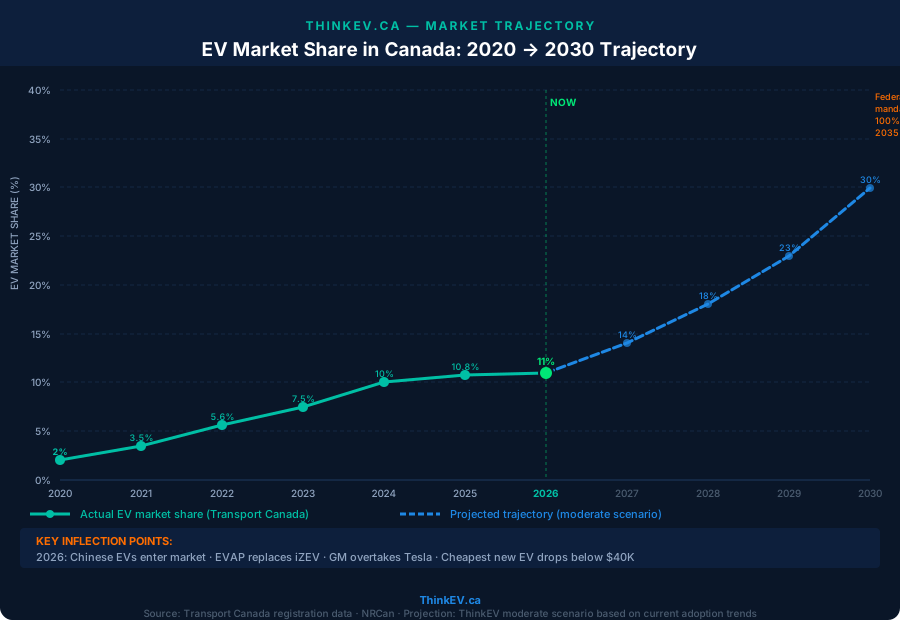
- Meanwhile, EV registrations have grown from 2% of new car sales in 2020 to about 10% in 2024, and are at approximately 11% as of early 2026.
- That's a 10% decline from peak in just two years.
- In 2020, Canadians bought about 54,000 new EVs.
- In 2024, approximately 170,000, about 10% of all new car sales.
Canadian gas car registrations peaked at 1.2 million units in 2023 and have fallen every quarter since, down to roughly 1.08 million by 2025, a 10% decline in two years. Over the same period, EVs went from 2% of new car sales to 11%. The lines are crossing, and structural shifts of this kind don't reverse.
The question isn't whether EVs will replace gas cars in Canada, it's how fast. And based on the data we have right now, the answer is: faster than most people expect.
This is not a story about environmentalism. It's not a story about government mandates, though those exist and they matter. It's a story about economics, technology, and consumer behaviour converging in a direction that makes one type of vehicle increasingly obsolete. If you're buying a car in 2026, this is the most important article you'll read, because what's happening right now will determine whether the vehicle you buy today holds its value in five years or becomes a liability.
The Peak That Already Happened
Let's start with the number that matters most: gas car sales in Canada peaked in 2023. That year, Canadians registered approximately 1.2 million new internal combustion engine vehicles. It was the post-pandemic recovery peak, pent-up demand, supply chains finally unclogging, dealer lots restocked. And it was the last time the number went up.
In 2024, gas car registrations dropped to approximately 1.15 million. In 2025, they fell again to roughly 1.08 million. That's a 10% decline from peak in just two years. And the decline is accelerating, the drop from 2024 to 2025 was steeper than from 2023 to 2024.
This pattern is not unique to Canada. Global gas car sales peaked in 2017. The United States peaked in 2023. Europe peaked even earlier. What's happening in Canada is part of a worldwide structural shift, and structural shifts don't reverse. Nobody went back to buying horses after the Model T.
The reasons for the decline are compounding. Gas prices remain volatile, the average price of regular gasoline in Canada hovered around $1.65-$1.85/L through 2025, with spikes above $2.00/L in some provinces. Insurance costs for gas vehicles continue to rise. Maintenance costs continue to rise. And every year, there are more and better EV alternatives at competitive prices. The value proposition of a new gas car erodes a little more with every passing quarter.
What makes this particularly significant is that the decline is happening despite the fact that gas cars still have some structural advantages. They're still cheaper at the entry level. They still have more widespread refuelling infrastructure. They still don't suffer range penalties in cold weather. The gas car is declining despite its remaining advantages, which tells you how powerful the forces pushing in the other direction really are.
The EV Growth Curve
While gas cars slide, EVs are climbing at a rate that catches even optimists off guard. The numbers tell the story clearly.
In 2020, Canadians bought about 54,000 new EVs. That was 2% of the total market. In 2021, it jumped to 86,000. In 2022, 108,000. In 2023, 145,000. In 2024, approximately 170,000, about 10% of all new car sales. In 2025, the market pulled back to approximately 143,000 amid incentive uncertainty and the transition from iZEV to EVAP. But the underlying trajectory didn't change, the 2025 dip was a policy hiccup, not a demand problem, and early 2026 numbers already show recovery with market share hitting approximately 11%.
The compound annual growth rate (CAGR) from 2020 to 2024 is roughly 33%. To put that in context, the smartphone market grew at about 40% CAGR during its equivalent adoption phase. Streaming video grew at about 25%. EVs in Canada are growing at a rate that's historically associated with technology transitions that become irreversible within a decade.
That 33% CAGR is the number that should keep gas car executives up at night. If it holds, and there are strong reasons to believe it will, EVs reach 25% market share by 2028, 40% by 2029, and 50% by 2030. Gas car sales would need to absorb the difference, falling from 1.08 million units to under 800,000 by 2030. That's not a gradual wind-down. That's a structural collapse of the traditional auto market.
The 2025 dip deserves more context because it's the one data point skeptics like to cite. When the federal iZEV rebate program ended on March 31, 2025, and its replacement EVAP didn't launch until February 16, 2026, there was a roughly 10-month gap where no federal point-of-sale rebate existed. Sales predictably softened. But they only dropped to 143,000, which is still higher than 2023's 145,000 when you account for seasonality. Remove the incentive entirely and EV sales still held above 2022 levels. That tells you the demand is structural, not subsidy-dependent.
Provincial Divergence: A Country Moving at Different Speeds
Canada's EV transition isn't happening uniformly across the country, and the provincial differences reveal a lot about what drives adoption, and what holds it back.
British Columbia is the clear national leader. Gas car registrations in BC dropped 12% between 2023 and 2025, the steepest decline of any province. EV market share in BC is approaching 20%, driven by a combination of high environmental awareness, mild coastal climate (which minimizes range concerns), strong charging infrastructure, and historically high gas prices. Vancouver alone accounts for nearly half of BC's EV registrations. The Lower Mainland is already past the tipping point, EVs are a normal, unremarkable sight on every block.
BC's provincial rebate program (CleanBC Go Electric) is currently paused for new applications, but the federal EVAP rebate applies. Even without provincial stacking, BC's adoption rate continues to climb. That's significant, it suggests that once a market reaches critical mass, incentives become less important than peer effects and infrastructure.
Quebec is the second stronghold. Gas sales dropped 7% over the same period. Quebec benefits from the lowest electricity rates in North America (thanks to Hydro-Quebec), a $2,000 provincial rebate via Roulez vert that stacks with the federal EVAP, and a mandatory ZEV standard that's been in place since 2018. EV market share in Quebec is around 16-17%, and the province accounts for roughly 30% of all EV sales in Canada despite having about 23% of the population.
Quebec's advantage is fundamentally economic. When your electricity costs $0.07/kWh and gasoline costs $1.80/L, the fuel cost comparison isn't even close. A Quebec EV driver spending $500-$600/year on electricity is saving $2,600+ compared to gasoline. Over a 10-year ownership period, that's $26,000 in fuel savings alone, more than the price difference between most EVs and their gas equivalents.
Ontario is the largest market by volume, it accounts for 40% of all new vehicle registrations in Canada. Gas car sales in Ontario dropped 9% from 2023 to 2025. EV market share is around 10-11%, roughly in line with the national average. Ontario has no provincial rebate, which limits adoption among price-sensitive buyers, but the sheer size of the market means Ontario still registers the most EVs by total count.
The Ontario story is about untapped potential. If Ontario matched BC's adoption rate, national EV sales would jump by tens of thousands of units annually. The absence of a provincial rebate is the single biggest drag on Ontario's EV adoption, and given that Ontario's electricity rates are moderate (around $0.10-$0.13/kWh for time-of-use off-peak), the economics still favour EVs, just not as dramatically as in Quebec.
Alberta recorded only a 5% decline in gas car sales, the smallest drop of any major province. EV market share in Alberta sits around 5-6%, well below the national average. Alberta's oil economy creates both economic and cultural headwinds for EV adoption. Gas prices in Alberta are typically among the lowest in Canada (no provincial gas tax), which weakens the fuel savings argument. And there's a real cultural resistance, in a province where oil and gas employs tens of thousands of people directly and many more indirectly, buying an EV can feel like betraying your neighbours.
But even Alberta's 5% gas sales decline is notable. It means the transition is happening everywhere, just at different speeds. And Alberta's lower EV adoption actually represents a massive growth opportunity, when affordable EVs and better charging infrastructure reach the prairies, the uptake could be rapid precisely because it's been suppressed.
Saskatchewan and Manitoba are the slowest adopters, with EV market share in the 3-4% range. Both provinces have harsh winters, long driving distances between cities, and limited charging infrastructure. Manitoba's $4,000 MPI rebate (ending March 31, 2026) has helped, but it hasn't been enough to overcome the structural challenges. These provinces will be the last to transition, but they will transition. The economics are too compelling to resist indefinitely.
Atlantic Canada (New Brunswick, Nova Scotia, PEI, Newfoundland) is a mixed picture. PEI offers a $5,000 provincial rebate and has surprisingly strong adoption for its size. Nova Scotia's EV uptake has grown, helped by the province's aggressive clean electricity targets. New Brunswick and Newfoundland remain below the national average.
The provincial picture matters because it tells us the national average understates what's happening in the leading markets. Canada's 11% national EV market share includes Alberta at 5% and Saskatchewan at 3%. If you live in Vancouver, Montreal, or Victoria, the EV transition is already well past the early-adopter phase. The market has bifurcated, and the leading provinces are pulling the national average up while the lagging provinces keep it from reflecting what's actually happening on the ground in the places where most Canadians live.
What's Driving the Shift
Three forces are converging to accelerate the transition. The first is economic. The average Canadian spent about $3,200 on gasoline in 2025, according to the Canadian Automobile Association. An equivalent EV driver spent roughly $800-$1,200 on electricity for the same distance. That's a $2,000 annual saving that compounds over the life of the vehicle. Add in lower maintenance costs, no oil changes, fewer brake replacements thanks to regenerative braking, no transmission service, and the total cost of ownership gap widens to $4,000-$6,000 per year. At that level, the higher purchase price of an EV pays for itself within 3-5 years for most drivers.
The maintenance savings alone are significant enough to change buying decisions. A gas car owner spending $1,500-$2,000/year on oil changes, brake pads, transmission fluid, spark plugs, timing belts, and other wear items is looking at $15,000-$20,000 in maintenance costs over a 10-year ownership period. An EV owner's maintenance costs over the same period, tire rotations, cabin air filters, brake fluid, and eventual brake pad replacement, typically total $5,000-$8,000. That's a $10,000+ gap that doesn't require any assumptions about gas prices or electricity rates.
The second force is policy. Canada's federal Zero-Emission Vehicle mandate requires that 100% of new passenger vehicles sold by 2035 must be zero-emission. The interim targets are 20% by 2026, 60% by 2030, and 100% by 2035. That mandate is cascading through the auto industry: manufacturers are allocating production capacity toward EVs, dealers are being incentivized to stock and sell electric models, and the $5,000 EVAP rebate continues to lower the barrier to entry.
Provincial policies vary, Quebec stacks a $2,000 provincial rebate, while Ontario, Alberta, and BC (whose provincial rebate is currently paused) offer nothing beyond the federal program. Manitoba's $4,000 MPI rebate ends March 31, 2026. PEI adds $5,000 on top of federal. But the overall policy direction is clear and irreversible. No serious political party in Canada is proposing to cancel the 2035 ZEV mandate. The question is implementation speed, not direction.
The third force is product quality. The EVs available in 2026 are genuinely better cars than the gas equivalents at the same price. The Chevy Equinox EV at $45,000 offers more interior tech, a smoother ride, and lower running costs than a similarly priced gas SUV. The Kia EV6 drives better than most $55,000 gas crossovers. Even the humble Hyundai Kona Electric, at $40,000 after rebates, is a more refined daily driver than a comparably priced gas Kona. The era of EVs being a compromise is over.
This last point deserves emphasis because it's the one that changes minds most effectively. Policy and economics are abstract. But when your neighbour buys a Chevy Equinox EV and you sit in it, feel how quiet it is, see the tech, and learn they're spending $100/month on fuel instead of $350, that changes behaviour in a way that no government mandate or cost-of-ownership spreadsheet ever could.
Gear worth having
As an Amazon Associate, ThinkEV earns a small commission from qualifying purchases — at no extra cost to you.

NOCO Boost Plus GB40 Jump Starter
A 1000A lithium jump starter that fits in your glovebox and works on any 12V battery. Your insurance against a dead 12V in a parking lot.
As an Amazon Associate, ThinkEV earns from qualifying purchases — at no extra cost to you.
The Tipping Point: Why 15-20% Changes Everything
EV market researchers have identified a pattern that plays out in every country: once EVs cross roughly 15-20% of new car sales, adoption accelerates dramatically. This isn't speculation, it's an observed phenomenon backed by data from over a dozen countries.
The mechanism is straightforward. At 5% market share, EVs are exotic. Most people have never ridden in one, let alone driven one. They're curious objects that other people buy. At 10%, EVs become visible, you see them in parking lots, at traffic lights, in your neighbourhood. But they're still the exception. At 15-20%, critical mass is reached. At that level, virtually everyone knows someone who owns an EV. Your coworker drives one. Your sister-in-law has one. Your neighbour charges theirs in the driveway every night. The social proof becomes overwhelming, and the fear of being an early adopter evaporates.
The international data is remarkably consistent. Norway hit 15% EV market share in 2018. By 2020, it was at 54%. By 2023, it crossed 80%. By 2025, Norway hit 90%+, new gas car sales have essentially ceased. That's a complete market transformation in seven years from the tipping point.
The Netherlands crossed 15% in 2020. By 2025, it's approaching 60%. Sweden crossed in 2021 and is at 55%. Denmark crossed in 2022 and is already above 45%. Iceland hit 15% in 2019 and is now above 70%. The pattern repeats with remarkable consistency: once you cross 15%, the market moves to 50%+ within five to seven years.
Canada is at approximately 11% nationally as of Q1 2026. BC and Quebec are already past 15%. Ontario, which matters most by volume, is at 10-11%. If Canada follows the international pattern, and there's no structural reason it wouldn't, the national market should cross the 15% threshold in late 2026 or early 2027. From that point, the historical pattern suggests 50% by 2031-2033.
But there's a case to be made that Canada could move faster than the Scandinavian countries did. The technology is more mature now. Battery costs are lower. Charging infrastructure is more developed. And critically, there are far more affordable EV models available in 2026 than existed when Norway crossed 15% in 2018. Norway's transition happened with a relatively limited model selection, it's going to happen in Canada with dozens of competitive options across every segment.
If the pattern holds, and there's no reason to think it won't, given the economic and policy tailwinds, EV market share could hit 30-35% by 2028 and 50%+ by 2030. Gas car sales would decline proportionally, with the steepest drops in provinces that already have strong EV adoption (BC, Quebec) and the most gradual declines in provinces with less charging infrastructure (Saskatchewan, Manitoba).
International Comparison: Lessons from Countries Ahead of Us
Canada's EV transition doesn't exist in a vacuum. Looking at countries further along the adoption curve tells us what to expect, and what to prepare for.
Norway is the global benchmark. With over 90% of new car sales being electric in 2025, Norway is essentially a post-gas-car country. New gas vehicle sales have collapsed to the point where dealers struggle to justify stocking them. Norway got here through a combination of aggressive tax incentives (no VAT on EVs, no import duties, no registration fees), high gas prices, excellent charging infrastructure, and cheap hydroelectric power. The lesson for Canada: once the transition crosses 50%, it accelerates to near-completion within just a few more years. The tail end of the transition is faster than the beginning.
The Netherlands is perhaps more relevant to Canada because it's a larger, more complex market. At roughly 60% EV market share in 2025, the Netherlands shows what happens when a country with diverse geography and economic conditions pushes past the tipping point. Dutch gas stations are already converting to EV charging hubs. Used gas car values have dropped measurably. And auto dealers have restructured their businesses around EV sales and service.
China is the most important comparison for Canada, not because of similarities in geography or climate, but because of market power. China's EV market share crossed 50% in 2025, and Chinese manufacturers, BYD, NIO, XPeng, Geely, are now producing EVs at price points that traditional manufacturers can't match. The BYD Seagull retails for under $15,000 CAD equivalent in China. Even with tariffs (reduced from 100% to 6.1% as of January 2026, with a 49,000-unit quota), Chinese EVs will put downward pressure on pricing across the Canadian market. The arrival of competitively priced Chinese EVs, when it happens at scale, could accelerate Canada's transition by 2-3 years by making sub-$30,000 EVs widely available.
The United States is Canada's closest comparison and the one that matters most for supply chain and manufacturer decisions. US EV market share is around 9-10% as of early 2026, slightly behind Canada. But American EV policy is far less stable, the Inflation Reduction Act incentives face political uncertainty, and there's no federal ZEV mandate equivalent to Canada's. This creates an interesting dynamic: Canadian policy stability may attract manufacturer allocation ahead of what our market size alone would justify. Automakers looking for reliable demand signals are finding them in Canada's clear regulatory trajectory.
The international pattern is consistent: once a country crosses 15%, it reaches 50% within five to seven years. Canada is on track to follow that pattern, with the 15% threshold likely crossed nationally in late 2026 or early 2027.
What Happens to Gas Car Dealers and Infrastructure
The transition from gas to electric isn't just a consumer story, it's an industry upheaval that will reshape every business connected to the internal combustion engine. And the impacts are already starting to show.
Dealerships are the most immediately affected. The traditional dealership model depends on two revenue streams: new car sales and service. Both are under pressure. On the sales side, as EV market share grows, dealers need to invest in EV-trained sales staff, charging infrastructure on their lots, and inventory of models they may not fully understand. Some are embracing the transition, GM dealers invested $200,000-$300,000 each to become EV-certified, and it's paying off with Equinox EV sales leading the market. Others are resisting, and those dealers are falling behind.
The service revenue problem is even more fundamental. EVs need less maintenance, no oil changes, no transmission service, no exhaust system work, fewer brake jobs. A typical gas car generates $2,000-$3,000/year in service revenue for a dealership. An EV generates perhaps $800-$1,200. As EVs become a larger share of the fleet, dealership service departments will see revenue decline. Some dealers will compensate by adding EV-specific services (battery health diagnostics, software updates, charger installation referrals), but the per-vehicle revenue will be permanently lower.
Gas stations face an existential timeline. Canada has approximately 12,000 gas stations, many of which are in rural areas where they serve as essential infrastructure. As gas car sales decline and the existing gas fleet ages out, fuel volumes will drop. Gas stations in urban areas, where EV adoption is highest, will feel the pressure first. Some are already adding EV chargers alongside fuel pumps, but the economics are different: a gas car refuels in five minutes and moves on; an EV charges for 20-45 minutes, which means lower throughput but potential for higher ancillary revenue (coffee, food, shopping).
The rural gas station question is genuinely challenging. In small towns where a single station serves a wide area, declining fuel volumes could lead to closures before EV charging infrastructure is adequate to replace them. This is a transition risk that policy needs to address, and it's one reason why rural EV adoption will lag urban adoption even after price parity is achieved.
Auto mechanics and independent shops are in a similar bind. The skills needed to service an internal combustion engine, diagnosing fuel injection problems, replacing timing chains, rebuilding transmissions, are becoming less valuable every year. EV service requires different expertise: high-voltage electrical systems, battery management, software diagnostics. Mechanics who retrain will thrive. Those who don't will find their customer base shrinking as the gas car fleet ages out.
Parts suppliers, the entire aftermarket chain from oil filter manufacturers to exhaust pipe makers, face declining demand over the next decade. This won't happen overnight (there are 25+ million gas cars on Canadian roads that will need parts for years), but the trend is unmistakable and new investment in gas car parts manufacturing has essentially stopped.
The Used Car Market Transition
The used car market is where the gas-to-electric transition gets personal for millions of Canadians, and the dynamics here are more nuanced than most analysis suggests.
Right now, in early 2026, used gas cars still hold value well. Supply remains constrained from the pandemic-era production shortfall, and the used market is large enough that no single trend has overwhelmed it yet. But there are early warning signs.
Resale values for gas vehicles are already softening in certain segments. Large gas SUVs and trucks, the $60,000-$80,000 vehicles that cost $5,000+/year to fuel, are seeing 3-5% steeper depreciation than historical norms. Mid-size gas sedans, squeezed from above by EV alternatives and from below by their own declining desirability, are depreciating faster too. The segments holding up best are affordable subcompacts (because no EV competitor exists under $30,000) and full-size pickup trucks (because EV alternatives remain limited and expensive).
The used EV market, meanwhile, is maturing rapidly. Used Chevy Bolts and Nissan Leafs are available for $20,000-$25,000, making EV ownership accessible to a wider income range. Used Tesla Model 3s from 2021-2023 are trading in the $30,000-$38,000 range. As more EVs come off lease and as new EV buyers trade in their first-generation electrics, the used EV market will deepen significantly through 2026-2028.
Here's the dynamic that matters: as new EV sales cross 30-40% of the market (projected for 2028-2029), the supply of used EVs entering the market will increase dramatically. At the same time, demand for used gas cars will begin to soften as more buyers, including budget-conscious used car shoppers, opt for used EVs instead. The result will be downward pressure on used gas car values that accelerates over time.
Gear worth having
As an Amazon Associate, ThinkEV earns a small commission from qualifying purchases — at no extra cost to you.

Grizzl-E Classic Level 2 EV Charger (40A)
Canadian-made and rated for minus 40C winters. 40A / 9.6 kW, NEMA 14-50, indoor/outdoor, 24-ft cable. The charger built for Canadian weather.
As an Amazon Associate, ThinkEV earns from qualifying purchases — at no extra cost to you.
For anyone buying a new gas car today, the math deserves attention. A $40,000 gas car purchased in 2026 might retain 50-55% of its value after five years under historical norms. But if EV adoption follows the tipping point pattern and hits 40-50% market share by 2030-2031, demand for used gas cars in 2031 will be measurably lower than historical trends would predict. That $40,000 gas car might retain only 40-45% of its value, a difference of $4,000-$6,000 in resale. Add that to the higher fuel and maintenance costs over five years, and the true cost of choosing gas over electric in 2026 could be $20,000-$30,000 over the ownership period.
The opposite is likely true for EVs, whose resale values are stabilizing as the technology matures and buyer confidence grows. Early EVs depreciated steeply because of battery degradation concerns and rapid technology improvement. But modern EVs with battery warranties of 8 years/160,000 km, combined with slower rates of technology improvement (we're past the revolutionary phase and into incremental refinement), are holding value much better. A 2026 EV purchased today is likely to retain value comparably to or better than an equivalent gas car.

Manufacturer Strategy Shifts
The world's automakers aren't waiting to see how this plays out. They're making massive, irreversible bets on electrification, and their production allocation decisions are telling us exactly where they think this is going.
General Motors has committed $35 billion to EV and autonomous vehicle development through 2025, with ongoing investment beyond that. GM's Ultium battery platform underpins everything from the Equinox EV to the Hummer EV, and the company has explicitly stated its goal of an all-electric lineup by 2035. In Canada, GM's strategy is already paying off, the Equinox EV's price point ($44,995 before rebates) and its EVAP eligibility have made it the best-selling EV brand in the country.
Hyundai-Kia is investing $18 billion in EVs through 2030 and plans to have 31 EV models globally by 2030. Their E-GMP platform (Ioniq 5, Ioniq 6, EV6, EV9) has been one of the most successful in the market, and both brands are strong in Canada. Hyundai and Kia together account for approximately 20% of Canadian EV sales.
Ford has separated its EV business (Model e) from its gas business (Ford Blue) precisely to allocate resources more aggressively to electrification. The F-150 Lightning, Mustang Mach-E, and upcoming models are designed to convert Ford's enormous existing customer base, the F-150 has been Canada's best-selling truck for decades, and electrifying it is a strategic masterstroke aimed at bringing EV-skeptical truck buyers into the fold.
Toyota, long resistant to full electrification, has shifted strategy significantly. After years of betting on hydrogen and hybrids, Toyota is now committing to 1.5 million EV sales globally by 2026 and 3.5 million by 2030. Their bZ4X was a stumbling first attempt, but the next generation of Toyota EVs, built on a dedicated EV platform, will matter enormously given Toyota's brand loyalty in Canada.
Volkswagen has invested over $100 billion globally in EV development and is ramping ID.4 production for North America. VW's strategy to become the volume EV leader in markets where Tesla has priced itself above rebate eligibility could find traction in Canada.
What these investment numbers tell us is that the major manufacturers have already made their decision. They're not hedging between gas and electric, they're winding down gas and ramping up electric. Production lines are being converted. Supply contracts for batteries and electric motors are being signed for the next decade. Engineering talent is being redeployed. The manufacturing base of the global auto industry is pivoting, and that pivot is irreversible regardless of what happens to any individual country's incentive program.
For Canadian buyers, this means the EV options available in 2027 and 2028 will be dramatically broader than what's available today. Every segment, subcompact, compact, mid-size, SUV, truck, will have multiple competitive EV options from established brands. The "there's no EV that fits my needs" objection is rapidly approaching its expiry date.
Gear worth having
As an Amazon Associate, ThinkEV earns a small commission from qualifying purchases — at no extra cost to you.

PULIDIKI Car Cleaning Gel (Detailing Putty)
Press it into vents, buttons, and seams and it lifts out dust you did not know was there. Weirdly satisfying, genuinely useful.
As an Amazon Associate, ThinkEV earns from qualifying purchases — at no extra cost to you.
Infrastructure Scaling to Match Growth
Charging infrastructure is the supply-side story that determines how fast the demand-side transition can proceed. And while Canada has made meaningful progress, there's still a gap between where infrastructure is and where it needs to be.
Canada added over 12,000 public charging stations in 2025, bringing the national total to roughly 28,000 public charging points. That's a 22% increase year-over-year, impressive, but not yet sufficient for the scale of adoption that's coming. The distribution is uneven: southern Ontario, BC's Lower Mainland, and the Montreal-Quebec City corridor have excellent coverage. Rural Canada, especially northern Ontario, the prairies, and Atlantic Canada, still has significant gaps.
The federal government's commitment of $680 million toward EV charging infrastructure is addressing part of the gap. The Canada Infrastructure Bank is funding large-scale projects. Provincial programs are adding more. And the private sector, Petro-Canada's HPC network, FLO, ChargePoint, Tesla's Supercharger network (now open to non-Tesla vehicles via NACS adapter), is investing heavily because the business case is becoming clear.
But here's the infrastructure reality that doesn't get enough attention: roughly 80% of EV charging happens at home, overnight. The public charging network matters enormously for road trips and for the 30% of Canadians who live in apartments or condos without dedicated parking. But for the 70% of Canadians who have a garage or driveway, a Level 2 home charger ($500-$1,500 installed) provides all the daily charging they need. The "where will I charge?" question is, for the majority of potential EV buyers, already answered, and the answer is "at home, while you sleep, for a fraction of what gas costs."
For the apartment and condo segment, the challenge is real and needs solutions. Some provinces (BC, Ontario, Quebec) have "right to charge" legislation that prevents condo boards from blocking charger installations. But the cost of retrofitting older buildings with electrical capacity for EV charging can be substantial. This is an area where targeted infrastructure investment, both public and private, will be critical for maintaining adoption momentum as EVs move beyond the early majority of single-family homeowners.
Highway corridor charging is scaling rapidly. The Trans-Canada Highway now has fast-charging stations at intervals of 50-100 km through most of southern Canada. The gaps are primarily in northern and remote areas, northern Ontario between Sudbury and Thunder Bay, northern BC, and parts of the Atlantic provinces. These gaps matter psychologically even more than practically (most people don't drive these routes regularly), but closing them is important for removing the last range-anxiety objections.
The target is roughly 60,000-80,000 public charging points by 2030, which would provide adequate coverage for a fleet that's 30-40% electric. Based on current investment trajectories, that target appears achievable, but it requires continued public and private sector commitment.
Price Parity Timeline
The single most important milestone in the gas-to-electric transition is price parity, the point at which an EV costs the same as an equivalent gas car at the point of purchase, before incentives. Once price parity is reached, the economic case for choosing gas over electric essentially disappears.
We're not there yet across all segments, but we're close, and in some segments, we've already crossed the line.
In the compact SUV segment, the most popular vehicle category in Canada, the Chevy Equinox EV at $44,995 is within striking distance of a comparably equipped gas SUV like the Toyota RAV4 ($37,000-$44,000) or Honda CR-V ($36,000-$44,000). After the $5,000 EVAP rebate, the Equinox EV is at $39,995, essentially at parity with the top-trim gas competitors. In Quebec with the additional $2,000 Roulez vert rebate, the Equinox EV is $37,995, cheaper than a loaded RAV4.
In the mid-size sedan segment, the Hyundai Ioniq 6 ($47,000-$54,000) competes against gas sedans in the $35,000-$45,000 range. There's still a gap here, though the total cost of ownership over five years already favours the EV.
The segment where price parity remains furthest away is the entry level, vehicles under $30,000 CAD. The cheapest new EV in Canada is the Nissan Leaf at approximately $39,560 before rebates ($34,560 after EVAP). The cheapest new gas car is under $20,000 (Nissan Versa, Mitsubishi Mirage). This gap matters enormously because a significant portion of new car buyers are budget-constrained. Until a reliable new EV is available under $30,000 before rebates, a segment of the market will remain locked out of new EV ownership.
This is where Chinese manufacturers could change everything. The BYD Seagull, which sells for under $15,000 CAD equivalent in China, would be a breakthrough if it enters the Canadian market at scale. A Canada-ready Seagull-class import would likely still land well above its domestic Chinese sticker once shipping, compliance, dealer margin, and tariff treatment are layered in, but it could still pull entry-level EV pricing materially lower than today's market. Whether and when this happens depends on the quota framework and BYD's strategic decisions. The important point is that the technology for a genuinely low-cost EV already exists; what remains unsettled is the Canadian retail path.
Battery cost trends suggest that organic price parity (without incentives) will arrive across most segments by 2027-2028. Lithium-ion battery pack costs have fallen from $1,200/kWh in 2010 to approximately $120/kWh in 2025, and industry projections suggest $80-$90/kWh by 2027-2028. At $80/kWh, a 60 kWh battery pack costs $4,800, low enough for manufacturers to price EVs at parity with gas cars in most segments while maintaining their margins.
When price parity arrives across the board, likely 2027-2028 for most segments, potentially earlier with Chinese competition, the last rational argument for choosing a gas car over an EV will be charging infrastructure access for apartment/condo dwellers and extreme-range use cases. Everything else, purchase price, fuel cost, maintenance cost, driving experience, will favour the EV.
Insurance Industry Response
One underreported aspect of the gas-to-electric transition is how it's affecting, and being affected by, the insurance industry. Insurance costs are a meaningful part of vehicle ownership, and they're evolving differently for gas and electric vehicles.
Currently, EV insurance premiums in Canada average 15-25% higher than equivalent gas vehicles. The primary reasons are higher repair costs (EVs use more expensive materials, and body shops with EV-certified technicians are still scarce), higher replacement costs (battery damage can total a vehicle), and limited claims data (insurers price uncertainty into premiums).
But the insurance picture is changing. As the EV fleet grows and insurers accumulate more claims data, premiums are beginning to normalize. Some insurers are offering EV-specific discounts, Intact Insurance, Aviva, and Desjardins all have EV programs that reduce the premium gap. As more body shops become EV-certified and repair costs decline with standardization, the premium differential should narrow to 5-10% by 2028 and potentially disappear by 2030.
There's also an underappreciated safety factor. EVs have a lower centre of gravity (heavy battery pack on the floor), which makes rollover accidents less common. Their crash structures, designed around the battery pack, tend to perform well in collision tests. And the absence of a flammable fuel tank reduces fire risk in certain crash scenarios (despite the media attention given to the rare EV battery fire). As this safety data accumulates, it should put downward pressure on EV insurance premiums.
For gas vehicles, the insurance trajectory is less favourable. As gas cars become a smaller share of new sales, the pool of insured gas vehicles will age. Older vehicles tend to have higher claims frequencies. And as parts become harder to source for older gas models (as manufacturing shifts toward EV components), repair costs for gas cars could actually increase, pushing their insurance premiums up even as EV premiums come down.
What Slows the Transition
The trajectory is clear, but it's not a straight line. Several factors could moderate the pace of adoption, and being honest about them is important for setting realistic expectations.
Charging infrastructure remains the biggest bottleneck. While Canada added over 12,000 public charging stations in 2025, the distribution is uneven. Southern Ontario, BC's Lower Mainland, and the Montreal-Quebec City corridor have excellent coverage. Rural Canada, especially northern Ontario, the prairies, and Atlantic Canada, still has significant gaps. Until you can drive from Winnipeg to Thunder Bay without planning your charging stops like a military operation, some Canadians will remain hesitant.
Affordability is the second constraint. While EVs are approaching price parity with gas cars in several segments, the cheapest new car in Canada is still a gas model. Until a reliable new EV is available near the low-$30,000 range before rebates ? whether that comes from a Chinese entry model, a next-generation Korean compact, or a future North American budget EV ? a segment of the market will remain locked out. The used EV market is helping here: used Chevy Bolts and Nissan Leafs are available for $20,000-$25,000, making EV ownership accessible to a wider income range.
Cold weather performance is a real concern in a country where winter lasts 4-6 months in most provinces. Modern EVs handle winter significantly better than the early models, heat pumps, battery preconditioning, and improved battery chemistry have reduced the cold-weather range penalty from 40%+ to 20-25% for most current models. But range anxiety in winter is still a psychological barrier, even when the actual range is sufficient for daily use.
Grid capacity is an emerging consideration. As millions of EVs are added to the Canadian fleet, the electrical grid needs to handle the additional load. The good news is that most EV charging happens overnight, during off-peak hours, which actually helps utilities balance their load. The challenge is in localized areas where transformer capacity may be insufficient for multiple EVs charging simultaneously. Provincial utilities are aware of this and are planning upgrades, but the investment required is substantial, particularly in older urban neighbourhoods where the electrical infrastructure was sized for 1960s demand.
Trade policy uncertainty adds a layer of unpredictability. The tariff on Chinese EVs (currently at 6.1% with a 49,000-unit quota, down from the punitive 100% imposed in October 2024) could change with political winds. If tariffs are reimposed or expanded, the affordable Chinese EVs that could accelerate the transition would be delayed. Conversely, if tariffs are further reduced, the price parity timeline moves forward.
Despite these constraints, the trajectory is unmistakable. Gas car sales are declining. EV sales are growing. The curves are crossing. The only uncertainty is speed, not direction.
2030 Projections: What the Math Says
Projecting forward from current trends requires some assumptions, but the range of plausible outcomes is narrower than most people think.
Conservative scenario (25% CAGR): If EV growth slows from its 33% CAGR to 25% due to infrastructure bottlenecks and affordability constraints, Canada reaches approximately 25% EV market share by 2028 and 35-40% by 2030. Gas car sales fall to approximately 900,000 units by 2030. This scenario assumes no major acceleration from Chinese EV imports and slower-than-expected infrastructure buildout.
Base scenario (30% CAGR): If EV growth moderates slightly but remains strong, Canada reaches 30% by 2028 and 45-50% by 2030. Gas car sales fall to approximately 750,000-800,000 units. This is the scenario most consistent with the international tipping point pattern and current policy trajectory.
Aggressive scenario (35%+ CAGR): If Chinese EVs enter the market at scale, battery costs drop faster than expected, and the tipping point effect kicks in as strongly as it did in Scandinavia, Canada could reach 35% by 2028 and 55-60% by 2030. Gas car sales could fall below 650,000 units. This scenario is less likely but not implausible, especially if BYD and other Chinese manufacturers gain meaningful Canadian market access.
In all three scenarios, the 2035 federal ZEV mandate target of 100% zero-emission new vehicle sales appears achievable, the question is whether we arrive early or need the mandate to push us across the finish line.
The broader picture is even more striking. By 2030, even in the conservative scenario, there will be 2-3 million EVs on Canadian roads (up from roughly 500,000 today). That's a fleet large enough to support a strong used EV market, justify continued infrastructure investment, and create the network effects that make EV ownership increasingly convenient and gas ownership increasingly inconvenient.
By 2035, under the base scenario, new gas car sales in Canada will be at or near zero. The gas car won't disappear from Canadian roads, there will be 15-20 million used gas cars still operating, but it will cease to be a product you can buy new. That's not a prediction; it's federal law. The only question is how smooth the transition is and whether the infrastructure and supply chains are ready.
For buyers making decisions today, the implications are clear. A gas car purchased in 2026 will likely be the last or second-to-last gas car you ever own. Its resale value in 2031-2033 will reflect a market where EVs are 40-50% of new sales and used EV alternatives are abundant and affordable. That doesn't mean it's a bad purchase, if a gas car meets your needs and budget today, it will continue to work for years. But go in with realistic expectations about what it'll be worth when you sell it.
What This Means for Canadian Buyers Right Now
If you're shopping for a new vehicle in 2026, here's the practical takeaway from everything above.
If you can buy an EV that fits your needs and budget, buy the EV. The economics are already in your favour on fuel and maintenance. The technology is mature. The charging infrastructure is adequate for the vast majority of daily use cases. And you'll be on the right side of the resale value curve for the next decade.
If an EV doesn't fit your situation yet, maybe you live in a condo without charging access, or you need a vehicle type that doesn't have a good EV option yet, or you're budget-constrained below $30,000, a gas car is still a reasonable choice. But be aware that its long-term value will be lower than historical norms suggest, and plan accordingly.
If you're considering a hybrid as a middle ground, that's a defensible strategy for the next 3-5 years. Hybrids offer lower fuel costs than pure gas without requiring charging infrastructure. But recognize that hybrids are a transitional technology, by 2030, the market will have moved past them as battery EVs achieve full price parity and infrastructure coverage.
The trajectory is set. The data is clear. Gas peaked. Electric is climbing. The only variable is speed, and every signal says it's faster than the forecasts predict.
Gear worth having
As an Amazon Associate, ThinkEV earns a small commission from qualifying purchases — at no extra cost to you.

WixGear Magnetic Air Vent Phone Mount (2-Pack)
A magnet strong enough that your phone never flinches over potholes or rail crossings. Two in the box, one for each car.
As an Amazon Associate, ThinkEV earns from qualifying purchases — at no extra cost to you.
Related Reading
- EV Market Share by Brand in Canada 2026, Which brands are winning the Canadian EV market
- Canada EV Sales February 2026: Market Report, The latest monthly numbers
- Federal GHG Emissions Standards Explained, How the ZEV mandate works and what it means for buyers
- EV Resale Values in Canada: 2026 Trends, How EVs and gas cars are holding value
- EV Adoption Rate by City in Canada 2026, Where EVs are selling fastest across the country
- EV vs Gas: Total Cost of Ownership in Canada, The real numbers on fuel, maintenance, and long-term savings
Gear worth having
As an Amazon Associate, ThinkEV earns a small commission from qualifying purchases — at no extra cost to you.

Car Cup Holder Coasters (4-Pack)
Drop-in coasters that catch spills and crumbs so your cup holders stay clean. Rinse and reuse forever.
As an Amazon Associate, ThinkEV earns from qualifying purchases — at no extra cost to you.

Founder & Chief Editor
Vlad Pereira is the founder and chief editor of ThinkEV.ca, the Canadian electric-vehicle publication he writes and edits from Courtenay, British Columbia. He covers EV pricing, federal and provincial rebates, charging costs, and the Chinese manufacturers now entering Canada, from the buyer's side rather than the press-fleet side. ThinkEV is a venture of Vlad Pereira Online; his writing on health, income and the long game lives at vladpereira.com.
Frequently asked questions
What percentage of new car sales in Canada are EVs in 2026?
When will EVs outsell gas cars in Canada?
Will gas cars lose resale value because of EVs?
How much cheaper is it to drive an EV vs a gas car in Canada?
When did gas car sales peak in Canada?
What is the EV adoption tipping point and has Canada reached it?
Which provinces are leading EV adoption in Canada?
Will Chinese EVs accelerate Canada's EV transition?
How fast is Canada's EV charging network growing?
More EV & road-trip finds
Affordable upgrades worth a look — tap any to check the price on Amazon.
 ★ 47,507
HOMEXCEL Microfiber Cloths (12-Pack)
View on Amazon ★ 55
★ 55LED Car Door Logo Projector Light
View on Amazon ★ 546
★ 546Funny Headrest Face Covers (2-Pack)
View on Amazon ★ 12,396
K KNODEL Car Trash Can with Lid
View on Amazon ★ 15,014
Spigen Tempered Glass for Tesla Model 3/Y
View on Amazon ★ 119
★ 119Foldable Waterproof Trunk Organizer
View on Amazon ★ 392
★ 392Large Cup Holder Adapter (32-40oz)
View on Amazon ★ 9,349
Auto Detailing Brush Set (10-Piece)
View on AmazonRead, Plan, Then Stay Current
Explore our expert articles to understand incentives and ownership costs, use the map to pressure-test charging reality, then subscribe so new EV coverage comes straight to you.
Continue Reading
Tesla Model Y vs Toyota RAV4: 5-Year Cost Canada
EV vs Gas: 5-Year Cost of Ownership in Canada

Electric School Buses Are Changing Canadian Streets

Norway's -27C Winter EV Test: Chinese Cars Beat Tesla
BYD 1.5MW Charging Canada: 400 km in Five Minutes